CUFinder vs VC-Backed Data Tools: Which Wins in 2026?
CUFinder is a lean, bootstrapped B2B data tool going up against deep-pocketed VC-backed giants like ZoomInfo and Apollo. Here's an honest look at price, accuracy, and which one actually fits your team.
The CUFinder vs VC-backed choice is the quiet tension nobody names out loud when you buy B2B data in 2026. Do you pick the scrappy, bootstrapped tool that undercuts everyone? Or the VC-backed platform with a huge database and a sales rep who calls three times a week? CUFinder sits on the bootstrapped side. Its rivals — ZoomInfo, Apollo, Clearbit, and Lusha — mostly sit on the venture-funded side.
This CUFinder vs VC-backed guide breaks down what that difference means for your pipeline, your budget, and your data quality.
TL;DR#
- CUFinder is a lean, self-funded B2B data and email-finder tool. It competes on price, transparent credits, and a generous free tier — not on the biggest database.
- VC-backed platforms (ZoomInfo, Apollo, Lusha, Clearbit) win on raw contact volume, intent data, and enterprise integrations. But you pay for it — often five figures a year, with annual lock-in.
- If you're a small-to-mid team that mostly needs verified emails and firmographics, CUFinder or a focused finder like Tomba usually delivers better ROI than a full VC-backed suite.
- If you need buyer-intent signals, org charts, and CRM-native enrichment at scale, a VC-backed platform is hard to avoid.
- Accuracy is the deciding factor, not funding. Test bounce rates on your own list before you sign anything.
What does "CUFinder vs VC-backed" actually mean?#
Short version: it's a business-model comparison disguised as a tool comparison.
Think of it like buying coffee. A VC-backed platform is the big chain on the corner — consistent, everywhere, expensive, and always trying to upsell you a loyalty program. CUFinder is the independent café two blocks down — cheaper, friendlier, smaller menu, and it lives or dies on whether the coffee is actually good.
CUFinder is a bootstrapped company, and that shapes everything. It prices in public. It offers pay-as-you-go credits. And it doesn't chase an aggressive growth target set by investors. "VC-backed" isn't one product. It's a category of well-funded data giants that raised money to build huge databases and sales teams. ZoomInfo, Apollo.io, Lusha, and Clearbit all fit that mold.
The practical question isn't "which brand is best." It's which model fits the way you actually buy and use data.

How do CUFinder and VC-backed tools compare on price?#
In a CUFinder vs VC-backed comparison, price is where the two models split hardest.
Bootstrapped tools like CUFinder almost always publish a clear, self-serve price and let you start free. VC-backed platforms often hide pricing behind a "book a demo" wall. They bundle features you don't need and push annual contracts. ZoomInfo is a good example. It's known for multi-thousand-dollar minimums and multi-year terms, and G2 reviews repeatedly flag the cost and contract rigidity.
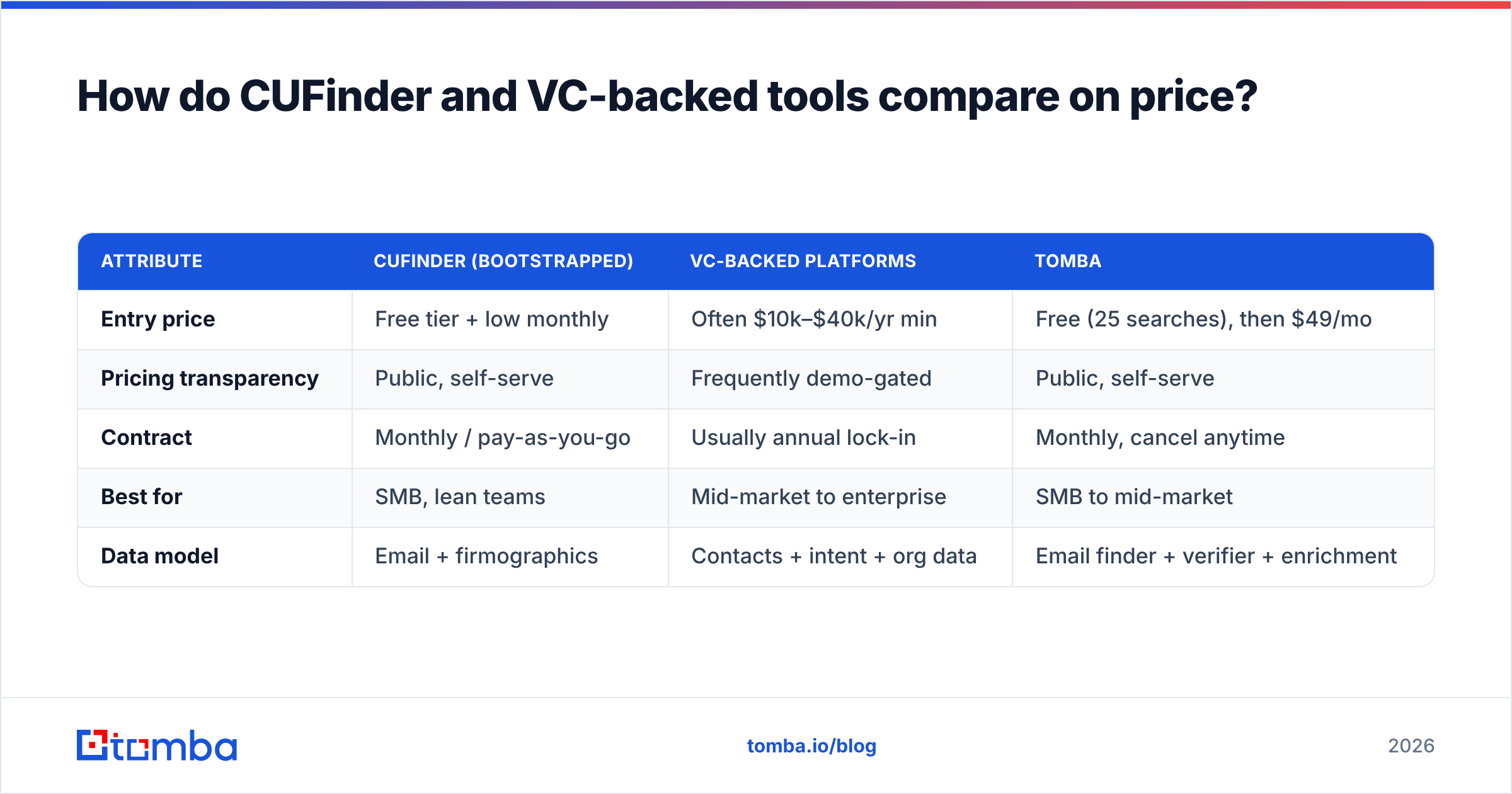
Here's a representative comparison. Exact numbers shift, so treat this as directional and always confirm on the vendor's own page:
| Attribute | CUFinder (bootstrapped) | VC-backed platforms | Tomba |
|---|---|---|---|
| Entry price | Free tier + low monthly | Often $10k–$40k/yr min | Free (25 searches), then $49/mo |
| Pricing transparency | Public, self-serve | Frequently demo-gated | Public, self-serve |
| Contract | Monthly / pay-as-you-go | Usually annual lock-in | Monthly, cancel anytime |
| Best for | SMB, lean teams | Mid-market to enterprise | SMB to mid-market |
| Data model | Email + firmographics | Contacts + intent + org data | Email finder + verifier + enrichment |
The takeaway is simple. If predictable, low-commitment spend matters to you, bootstrapped tools win by default. If you have budget for a strategic platform and need everything in one place, the VC-backed premium can be worth it. You can check a focused finder's pricing details in about ten seconds — no demo required. That's the whole point of the bootstrapped model.
Is a VC-backed platform more accurate than CUFinder?#
Not automatically. In the CUFinder vs VC-backed debate, this is the myth worth killing.
Bigger funding buys a bigger database, not a cleaner one. A VC-backed provider might list 200 million contacts. But if 15% of those emails bounce, that volume is a liability, not an asset. Accuracy comes from verification pipelines, refresh cadence, and honest catch-all handling. None of those correlate with how much money a company raised.

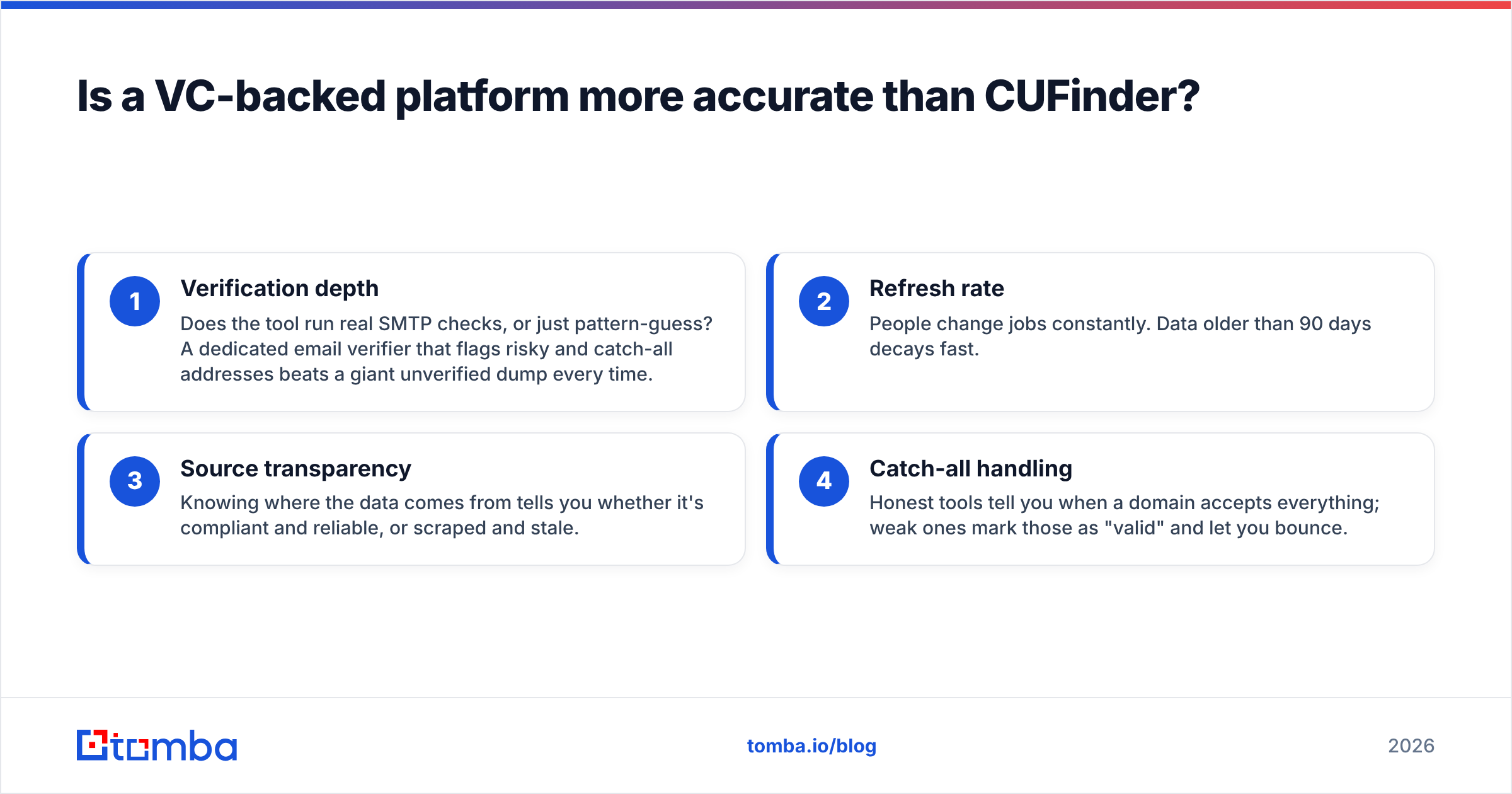
What actually drives accuracy:
- Verification depth — Does the tool run real SMTP checks, or just pattern-guess? A dedicated email verifier that flags risky and catch-all addresses beats a giant unverified dump every time.
- Refresh rate — People change jobs constantly. Data older than 90 days decays fast.
- Source transparency — Knowing where the data comes from tells you whether it's compliant and reliable, or scraped and stale.
- Catch-all handling — Honest tools tell you when a domain accepts everything; weak ones mark those as "valid" and let you bounce.
The only real test is empirical. Run the same 100 target contacts through each tool. Then measure bounce rate and match rate on your segment. A bootstrapped tool often ties or beats a VC-backed giant in a specific niche, because it isn't padding numbers to justify a valuation.
Which one fits your team? A decision guide#
In the CUFinder vs VC-backed decision, match the tool to your motion, not the marketing.
- Solo founder / small SMB team — You need verified emails and basic firmographics without a five-figure commitment. CUFinder or a focused email finder is the right call. Pay-as-you-go beats annual lock-in when your volume is unpredictable.
- Mid-market outbound team — You want good data plus workflow: bulk enrichment, CRM sync, maybe sequences. Look at Apollo (VC-backed, all-in-one) versus stacking a lean finder with your own sequencer. Often the stitched-together stack is cheaper and just as effective.
- Enterprise / RevOps at scale — You need intent data, org charts, and deep Salesforce/HubSpot integration. This is where VC-backed platforms genuinely earn their price. ZoomInfo and Apollo are built for this.
- Developer / automation-first team — You want an API to enrich records programmatically. A clean data enrichment endpoint or email finder API matters more than a slick dashboard.

CUFinder vs VC-backed: feature-by-feature#
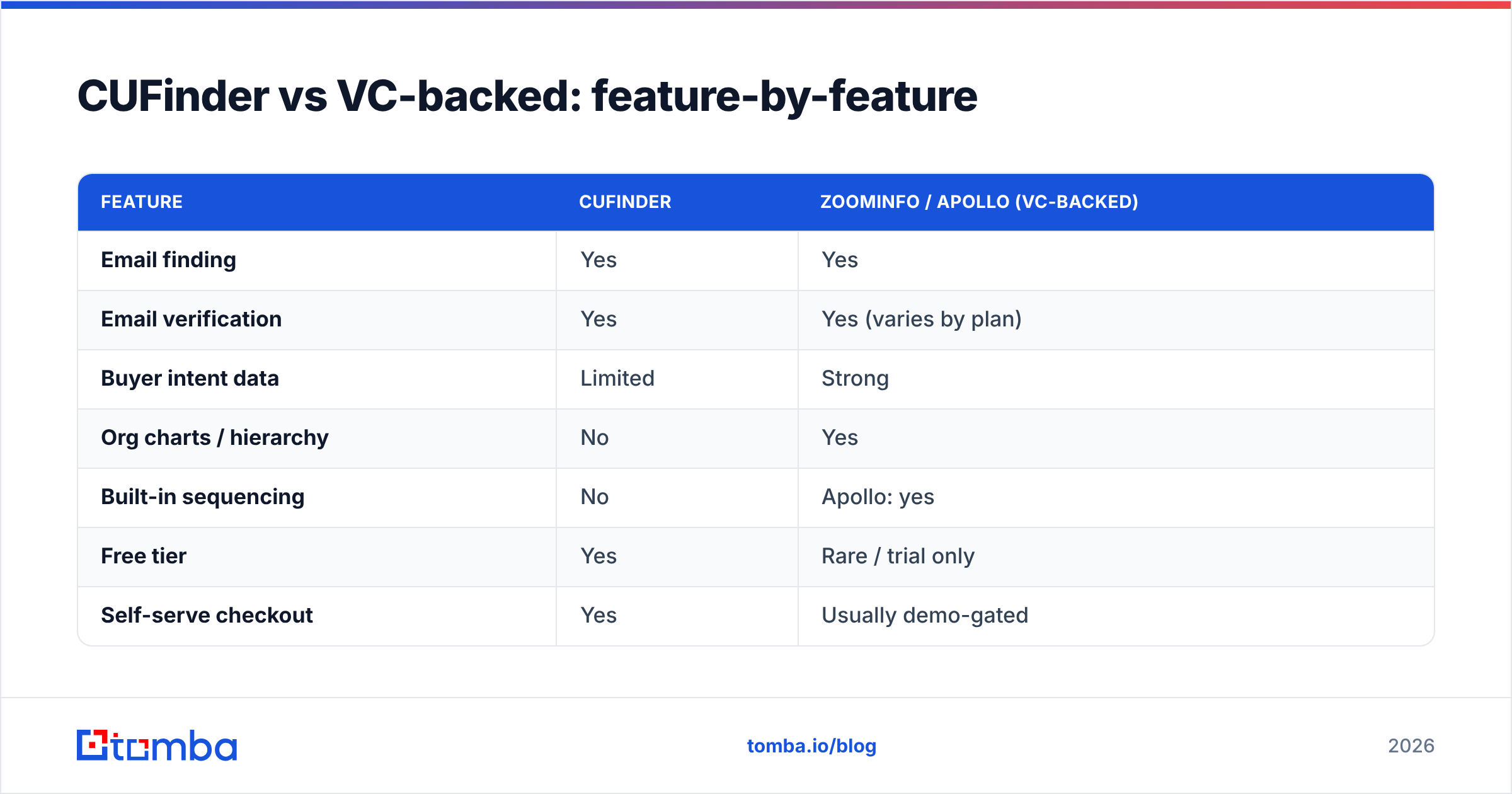
Zooming into the capabilities that usually decide the purchase:
| Feature | CUFinder | ZoomInfo / Apollo (VC-backed) |
|---|---|---|
| Email finding | Yes | Yes |
| Email verification | Yes | Yes (varies by plan) |
| Buyer intent data | Limited | Strong |
| Org charts / hierarchy | No | Yes |
| Built-in sequencing | No | Apollo: yes |
| Free tier | Yes | Rare / trial only |
| Self-serve checkout | Yes | Usually demo-gated |
| Annual lock-in | No | Common |
Read this table as a map of tradeoffs, not winners and losers. The VC-backed column has more checkmarks, and that's the point of raising capital. But every checkmark you don't use is money wasted. Most teams use three features and pay for thirty.
Where does Tomba fit in this comparison?#
Tomba sits on the same bootstrapped-friendly side as CUFinder, but with a sharper focus on email accuracy and verification.
Say your core problem is simple: "I need to reliably reach the right person by email." A specialized finder-plus-verifier stack tends to beat both a jack-of-all-trades bootstrapped suite and an over-featured VC-backed platform. Tomba's pricing is public and honest. You get a free tier with 25 searches per month, then Starter at $49/mo, Growth at $99/mo, and Pro at $249/mo. No demo wall, no annual handcuffs.
Where Tomba is especially strong versus the VC-backed crowd:
- Verification-first — Every found email can pass through the email verifier, with catch-all detection built in, so you protect sender reputation instead of gambling on unverified volume.
- Domain-level prospecting — Domain search pulls known emails and patterns for a company in one call.
- Fair, transparent cost — See the full Tomba pricing before you enter a card. That alone puts it ahead of most demo-gated giants for buyers who hate the sales dance.
Tomba won't give you org charts or a full intent-data cloud, and it doesn't pretend to. That honesty is the bootstrapped advantage. You pay for accurate contact data and nothing you'll never open.
When is a VC-backed platform genuinely worth it?#
There are real scenarios where writing the bigger check is the right business decision.
Buy VC-backed when several things are true. You run account-based marketing that depends on intent signals. You need org-chart mapping to navigate large enterprise deals. Your CRM is your single source of truth and needs native, automated enrichment. Or you have the team and budget to actually run a full platform. In those cases, a tool like ZoomInfo isn't overpriced. It's infrastructure.
Skip it when the opposite is true. Your outbound is email-first. Your volume is modest or spiky. You hate annual contracts. Or you're a startup where every dollar of CAC gets scrutinized. Paying enterprise rates for features you'll never touch is the most common data-budget mistake teams make.
The honest verdict#
In the CUFinder vs VC-backed debate, there's no universal winner. There's a winner for your situation.
Bootstrapped tools like CUFinder and Tomba win on price transparency, low commitment, and accuracy-per-dollar for focused use cases. VC-backed platforms win on breadth: intent, hierarchy, native CRM automation, and enterprise-grade scale. Funding buys features, not accuracy. So never let a big valuation stand in for a bounce-rate test on your own list.
Run the trial. Test 100 real contacts. Measure match rate and bounce rate. Let the data pick the data tool.
Get accurate B2B emails without the enterprise price tag#
Is your real need reaching the right people by email — verified, compliant, and without a five-figure annual contract? Start with the Tomba Email Finder. Find professional email addresses by domain, name, or company. Verify them in the same workflow, and keep your bounce rate low. The free tier gives you 25 searches a month, so you can test the accuracy on your own list before you spend a cent. That's the bootstrapped promise: prove the value first, then scale.
Related guides#
Ready to find emails that actually work?
Join 150,000+ professionals who stopped guessing and started sending. Free credits on signup — no credit card required.
Get the Tomba newsletter
Practical outbound tactics and product updates — once every two weeks.
About the author