Custom GPT for Sales in 2026: The Complete Build Guide
A custom GPT can draft outreach, qualify leads, and prep calls in seconds — but only if you feed it clean data and the right instructions. Here's how to build one that actually books meetings, and where it quietly fails.
Sales teams keep asking the same question: can a custom GPT actually sell, or is it another shiny tab you open twice and forget? The honest answer is that a well-built custom GPT for sales is one of the highest-leverage tools a rep can own in 2026 — but only when it's wired to real data and clear instructions. Built badly, it's a confident liar that emails the wrong person at the wrong company.
This guide shows you how to build one that earns its keep, where it breaks, and what to hand off to purpose-built tools instead.
TL;DR#
- A custom GPT for sales is a configured version of ChatGPT with your instructions, knowledge files, and (optionally) API actions baked in — think of it as a junior SDR who never forgets your playbook.
- The three jobs it does best: drafting personalized outreach, qualifying and researching accounts, and prepping reps for calls.
- Its biggest failure mode is bad or missing data — it will invent email addresses, job titles, and company facts without blinking.
- Pair the GPT with a verified data source (an email finder and email verifier) so it works from truth, not guesses.
- Custom GPTs are strong at language and reasoning, weak at live data, deliverability, and compliance — keep those in dedicated systems.
What is a custom GPT for sales?#
A custom GPT is a version of ChatGPT you configure once and reuse forever. Instead of re-pasting your ICP, tone, and objection-handling notes into every chat, you load them into the GPT's instructions and knowledge files. From then on, every conversation starts with that context already in place.
Analogy first: a raw ChatGPT is a brilliant new hire on day one who knows nothing about your company. A custom GPT is that same hire after a two-week onboarding — they've read the playbook, memorized your pricing, and know exactly how you talk to a VP of Engineering versus a founder.
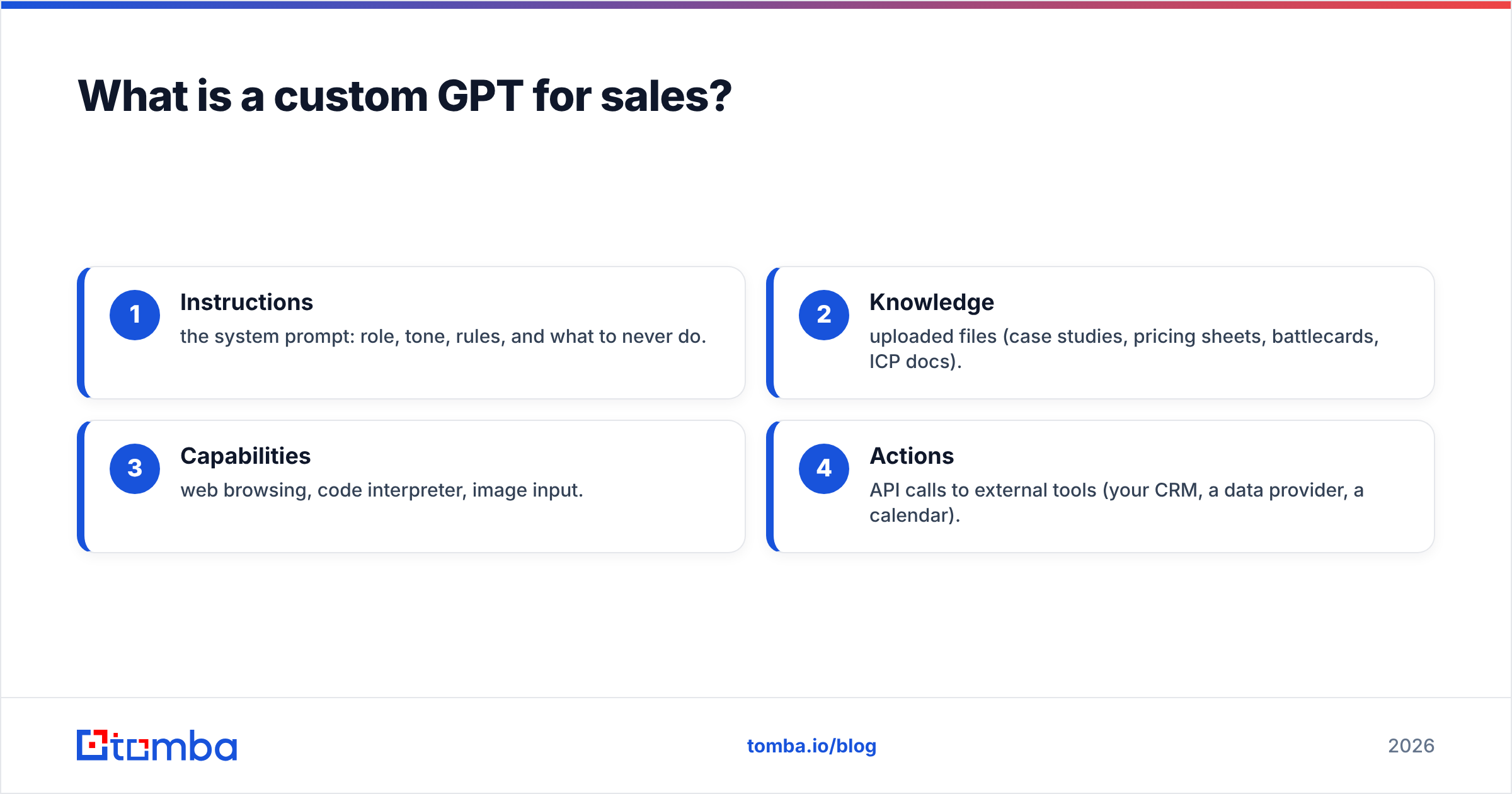
Technically, OpenAI's GPT Builder lets you define four things:
- Instructions — the system prompt: role, tone, rules, and what to never do.
- Knowledge — uploaded files (case studies, pricing sheets, battlecards, ICP docs).
- Capabilities — web browsing, code interpreter, image input.
- Actions — API calls to external tools (your CRM, a data provider, a calendar).
For sales, actions are where it gets powerful. A GPT that can call an email finder API mid-conversation stops guessing and starts retrieving.
Why do sales teams build custom GPTs instead of using plain ChatGPT?#
Because repetition is the enemy of consistency. A plain ChatGPT session forgets your context the moment you close it, so every rep prompts differently and gets different-quality output. A custom GPT enforces one standard.
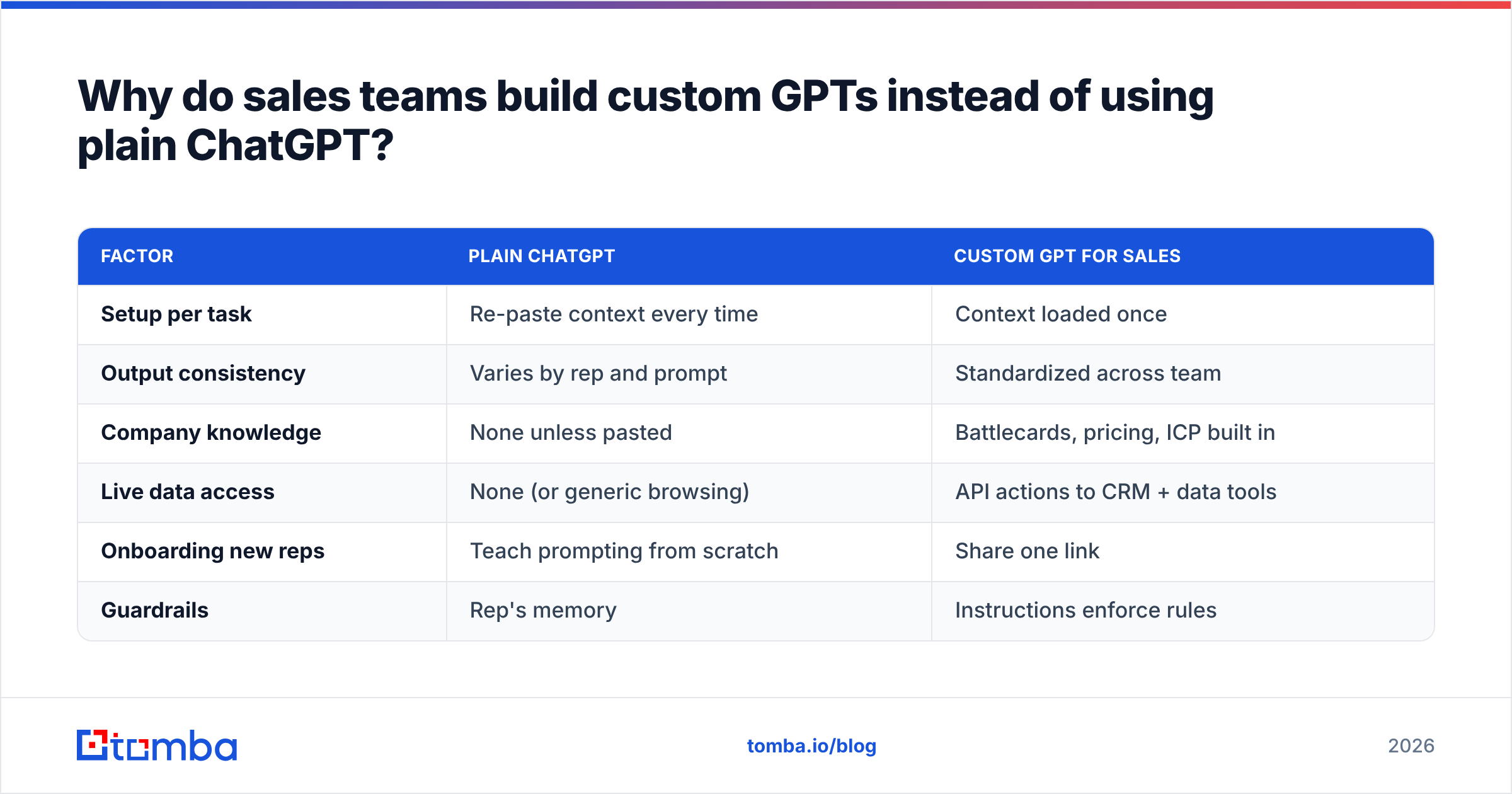
Here's the concrete difference:
| Factor | Plain ChatGPT | Custom GPT for sales |
|---|---|---|
| Setup per task | Re-paste context every time | Context loaded once |
| Output consistency | Varies by rep and prompt | Standardized across team |
| Company knowledge | None unless pasted | Battlecards, pricing, ICP built in |
| Live data access | None (or generic browsing) | API actions to CRM + data tools |
| Onboarding new reps | Teach prompting from scratch | Share one link |
| Guardrails | Rep's memory | Instructions enforce rules |
The payoff is speed with a floor on quality. Your best rep's outreach framework becomes the default everyone starts from, and your newest hire produces near-senior first drafts on week one.
What can a custom GPT for sales actually do well?#
Three things, reliably.
1. Draft personalized outreach at speed. Feed it a prospect's role, company, and a trigger event, and it writes a first-draft email or LinkedIn note in your voice. It won't replace a rep's judgment, but it kills the blank-page problem. For subject lines and structure, you can pair it with a free subject line generator to test variants fast.
2. Research and qualify accounts. Paste a company's about page or recent news and ask the GPT to score fit against your ICP, surface likely pain points, and suggest an angle. It's a research analyst that reads faster than you.
3. Prep reps for calls. Before a demo, ask it to summarize the account, predict objections, and draft discovery questions. It turns 30 minutes of scattered prep into a two-minute briefing.
What ties all three together is input quality. The GPT is only as good as the facts you give it — which is exactly where most teams cut the wrong corner.
Where do custom GPTs for sales fail?#
They fail at the boundary between language and truth. A custom GPT is a language model, not a database. Ask it for a prospect's email address and it will happily generate first.last@company.com — formatted perfectly, frequently wrong. Ask it for a company's current headcount and it may quote a number from its training data that's two years stale.
The failure modes worth naming:
- Hallucinated contact data. Emails, phone numbers, and titles invented on the spot.
- Stale facts. Funding rounds, headcounts, and tech stacks frozen at training time.
- No deliverability awareness. The GPT doesn't know or care whether your domain is warmed up or your list is full of spam traps.
- Compliance blind spots. It won't check GDPR/CAN-SPAM consent or suppression lists for you.
Sending AI-drafted cold email at scale on top of unverified data is the fastest way to torch a sending domain. Before any list touches a sequence, run it through real verification and understand email deliverability fundamentals — the GPT won't do this for you.
How do you build a custom GPT for sales? (Step by step)#
Here's a build order that produces something useful, not a toy.
- Define one job. Don't build an "everything" GPT. Build a "cold email first-draft" GPT or an "account research" GPT. Narrow scope, better output.
- Write tight instructions. Specify the role, your ICP, tone rules, hard constraints ("never invent an email address; if you don't have one, say so"), and output format.
- Upload real knowledge. Add 3–5 files: your ICP definition, two case studies, a pricing sheet, and a battlecard. Quality over volume.
- Wire an action to real data. Connect the Tomba API so the GPT can look up and verify contacts instead of guessing. This single step removes the biggest failure mode.
- Add guardrails. Instruct it to flag low-confidence claims, cite which knowledge file it used, and refuse to fabricate contact details.
- Test with real prospects. Run 20 real accounts through it. Score the output. Tighten instructions where it drifts.
The difference between a GPT reps ignore and one they open daily is almost always steps 3 and 4 — real knowledge and real data.
Custom GPT vs. dedicated sales tools: which does what?#
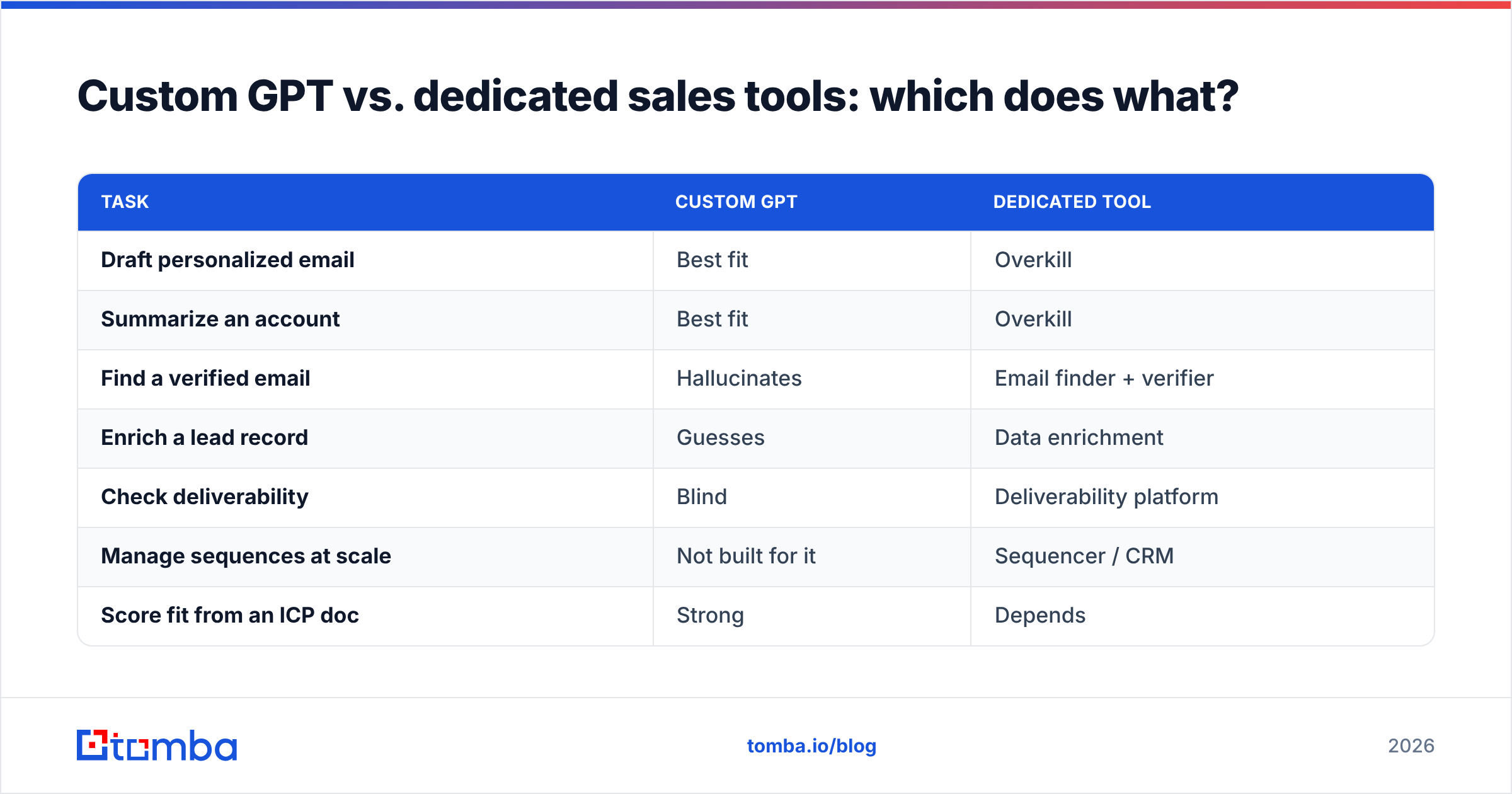
A custom GPT is a generalist. It's excellent at reasoning over text and terrible at the operational plumbing of outbound. The smart play is division of labor.
| Task | Custom GPT | Dedicated tool |
|---|---|---|
| Draft personalized email | Best fit | Overkill |
| Summarize an account | Best fit | Overkill |
| Find a verified email | Hallucinates | Email finder + verifier |
| Enrich a lead record | Guesses | Data enrichment |
| Check deliverability | Blind | Deliverability platform |
| Manage sequences at scale | Not built for it | Sequencer / CRM |
| Score fit from an ICP doc | Strong | Depends |
Read that table as a workflow, not a competition. The GPT reasons; the tools supply verified facts and handle sending. When you connect them, the GPT drafts an email to a real, verified person — which is the only version that books meetings.
What does a real custom-GPT sales workflow look like?#
Picture an SDR's morning with the two systems working together:
- Pull 50 target accounts from your CRM.
- Use a domain search to find the right contacts and their verified emails.
- Feed each contact into the custom GPT with a one-line trigger event.
- The GPT drafts a tailored first-touch email and two follow-ups.
- The rep edits for judgment, then loads the sequence into their sending tool.
The GPT never touches the data-truth layer, and the data tools never try to write prose. Each does what it's best at. That's the entire secret to making AI useful in outbound — let the model handle language and let verified data handle facts.
If you want proof that data quality is the bottleneck, compare reply rates from a GPT working off guessed emails versus verified ones. Teams routinely see bounce rates collapse and replies climb once the contact layer is real — a pattern echoed across sales-tech reviews on G2 and in HubSpot's own sales research.
How much does a custom GPT for sales cost to run?#
The GPT itself is cheap; the data behind it is where budgets go — and where ROI lives.
- ChatGPT Team / Enterprise covers GPT Builder access for your reps.
- A verified data source is the line item that determines whether the GPT works. This is not the place to run on free-tier guesses.
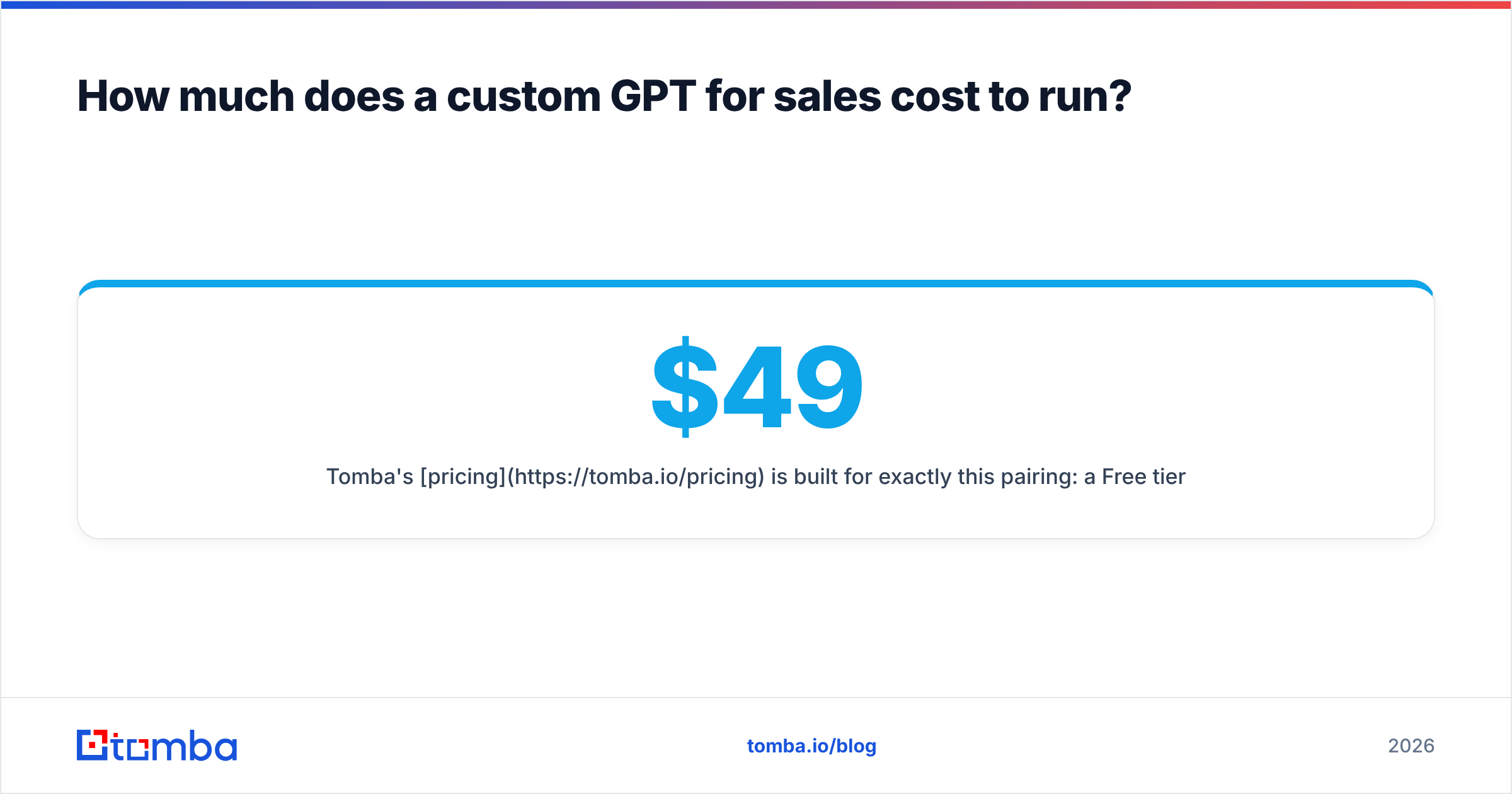
Tomba's pricing is built for exactly this pairing: a Free tier with 25 searches/month to prototype, Starter at $49/month, Growth at $99/month, and Pro at $249/month as your volume grows. You wire the API into your GPT once and every draft it writes is grounded in a real, verifiable contact.
Compared to hiring another SDR to do manual research, a custom GPT plus a data API is a rounding error — as long as you resist the temptation to cheap out on the data half.
Frequently asked questions#
Is a custom GPT for sales worth it in 2026? Yes, if you connect it to verified data. As a standalone text generator it's a nice-to-have; as a reasoning layer on top of clean contact data it's a genuine force multiplier.
Can a custom GPT find email addresses? Not reliably on its own — it guesses formats and hallucinates. Connect it to an email finder and verifier through an API action so it retrieves real addresses instead of inventing them.
Will AI-written cold emails hurt my deliverability? They can, if you send at scale on unverified lists. Verify every address, warm your domain, and respect sending limits. The GPT won't manage any of that for you.
Do I need to know how to code to build one? No for instructions and knowledge files. For API actions, you'll paste an OpenAPI schema — a technical rep or one short engineering task handles it.
The bottom line#
A custom GPT for sales is worth building — but it's a language engine, not a source of truth. Give it clean instructions, real knowledge, and above all verified contact data, and it will draft outreach and prep calls faster than any human could. Give it guesses, and it will scale those guesses straight into your spam folder.
Start with the data layer. Wire the Tomba Email Finder into your GPT so every email it writes goes to a real, verified person — then let the model do what it does best. Spin up a free account, connect the API, and turn your custom GPT from a clever demo into a pipeline machine.
Related guides#
Ready to find emails that actually work?
Join 150,000+ professionals who stopped guessing and started sending. Free credits on signup — no credit card required.
Get the Tomba newsletter
Practical outbound tactics and product updates — once every two weeks.
About the author