Customer Acquisition and Retention Strategy: A 2026 Playbook
Acquisition wins headlines, but retention builds the bank. Here is a practical 2026 framework for balancing both—the metrics, channels, and tactics that actually compound revenue.
Most teams treat growth as a single number: more logos, more MRR, more pipeline. But revenue is a bucket with two problems—how fast you pour in and how fast it leaks out. A serious customer acquisition and retention strategy manages both at once, because winning a customer you cannot keep is just an expensive way to lose money.
This guide gives you a concrete 2026 framework: the metrics that matter, how acquisition and retention differ, a channel comparison, and the tactics that compound instead of just spiking a dashboard.
TL;DR#
- Acquisition and retention are two sides of one equation. Optimize either in isolation and unit economics break—chase logos with high churn, or protect margins so hard you stop growing.
- Retention is usually the cheaper lever. Keeping a customer costs a fraction of winning a new one, and small churn reductions compound into large LTV gains.
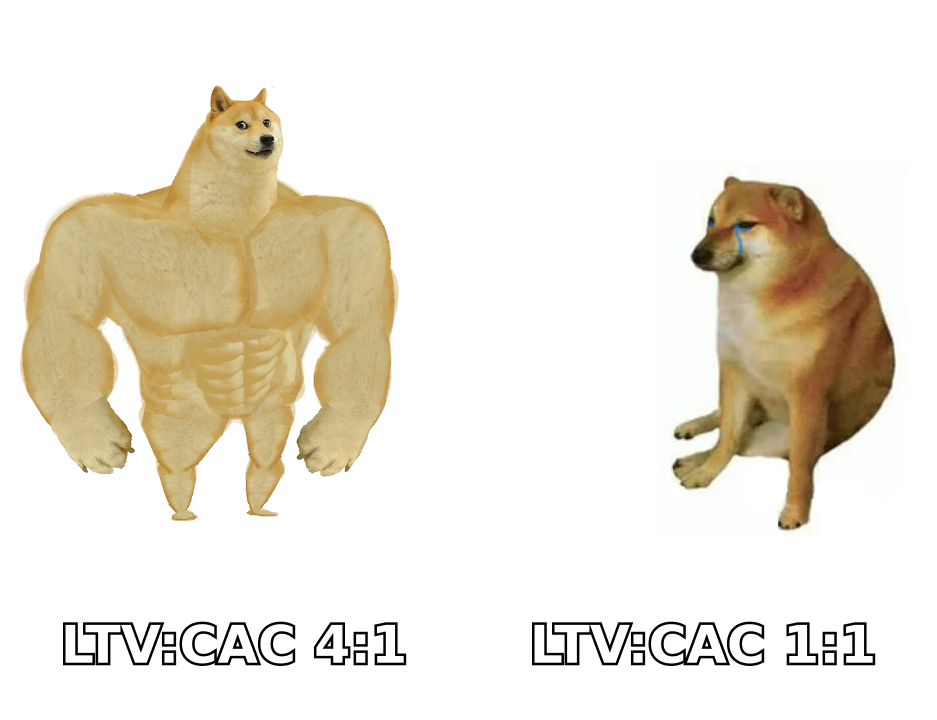
- Your north-star ratio is LTV:CAC. Aim for roughly 3:1 or better; below that, fix retention before you spend more on ads.
- Data quality decides both. Bad contact data inflates acquisition cost and poisons onboarding. Clean, enriched records feed better targeting and better lifecycle marketing.
- Instrument the whole lifecycle—acquisition source, activation, expansion, and churn reason—so you know which lever to pull next quarter.
What is a customer acquisition and retention strategy?#
A customer acquisition and retention strategy is your coordinated plan for two jobs: turning strangers into paying customers, and turning paying customers into loyal, expanding ones. Acquisition covers everything up to the first purchase—awareness, lead generation, and conversion. Retention covers everything after—onboarding, adoption, support, renewal, and expansion.
Think of it like a leaky bucket. Acquisition is the tap filling the bucket; retention is how well the bucket holds water. Pour faster into a bucket full of holes and you burn cash without ever filling it. The best operators tighten the holes first, then open the tap.
Here is how the two functions actually differ in practice:
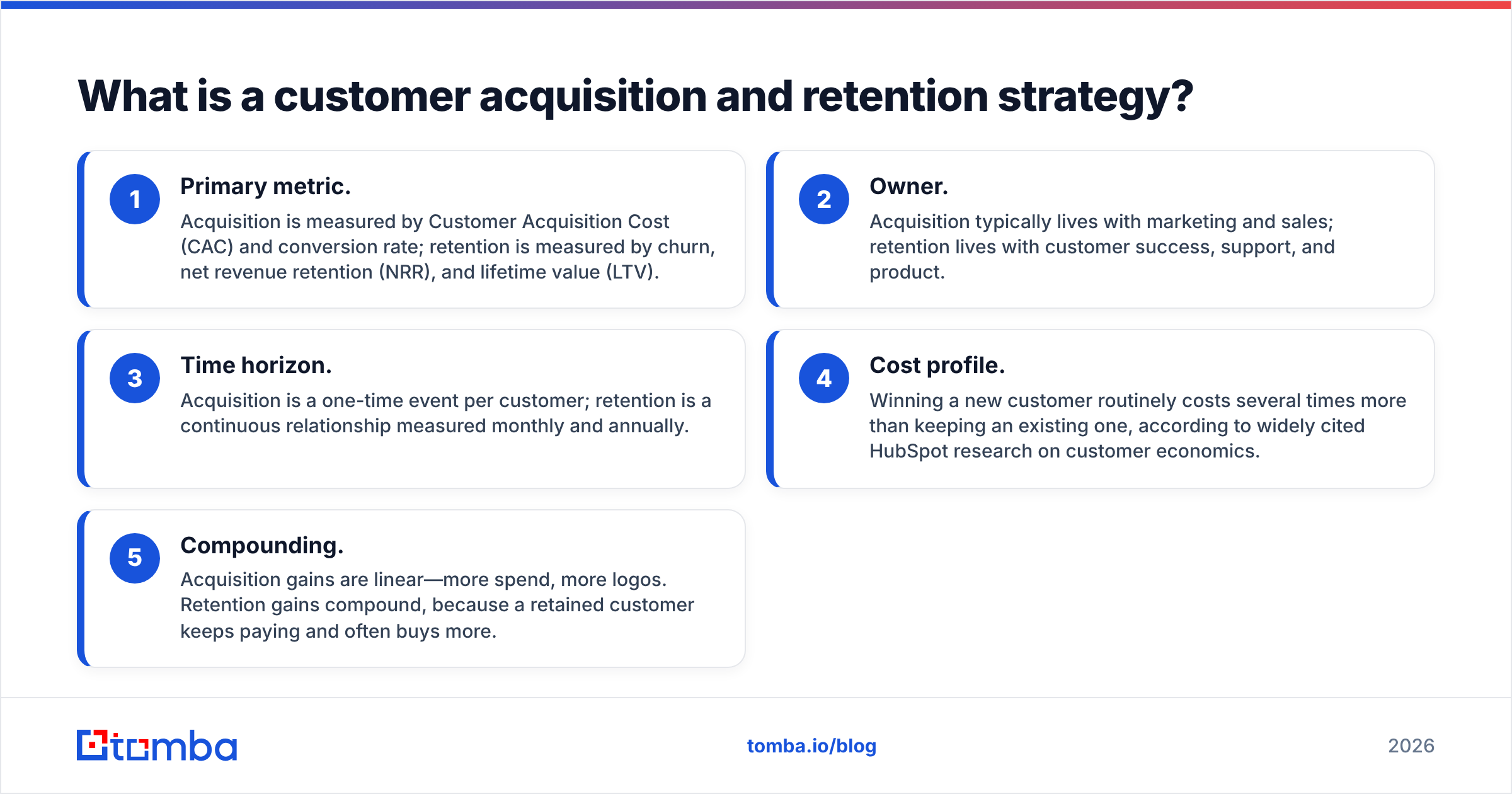
- Primary metric. Acquisition is measured by Customer Acquisition Cost (CAC) and conversion rate; retention is measured by churn, net revenue retention (NRR), and lifetime value (LTV).
- Owner. Acquisition typically lives with marketing and sales; retention lives with customer success, support, and product.
- Time horizon. Acquisition is a one-time event per customer; retention is a continuous relationship measured monthly and annually.
- Cost profile. Winning a new customer routinely costs several times more than keeping an existing one, according to widely cited HubSpot research on customer economics.
- Compounding. Acquisition gains are linear—more spend, more logos. Retention gains compound, because a retained customer keeps paying and often buys more.
Why does retention matter more than most teams admit?#
Retention matters more because it is where the margin lives. When you acquire a customer, you pay CAC upfront and only recover it over months of retained revenue. If a customer churns before you recoup CAC, that account was never profitable—no matter how good the acquisition campaign looked.
A useful mental model comes from analyst firms like Gartner, which have long argued that a large share of future revenue comes from existing customers. Small improvements stack fast: cutting monthly churn from 5% to 3% can extend average customer lifetime and lift LTV dramatically, without spending a dollar more on ads.
Retention also improves acquisition. Happy, long-tenured customers generate referrals, case studies, and reviews on sites like G2, which lower CAC for the next cohort. That feedback loop is the closest thing to free growth you will find.
How do acquisition and retention compare head to head?#
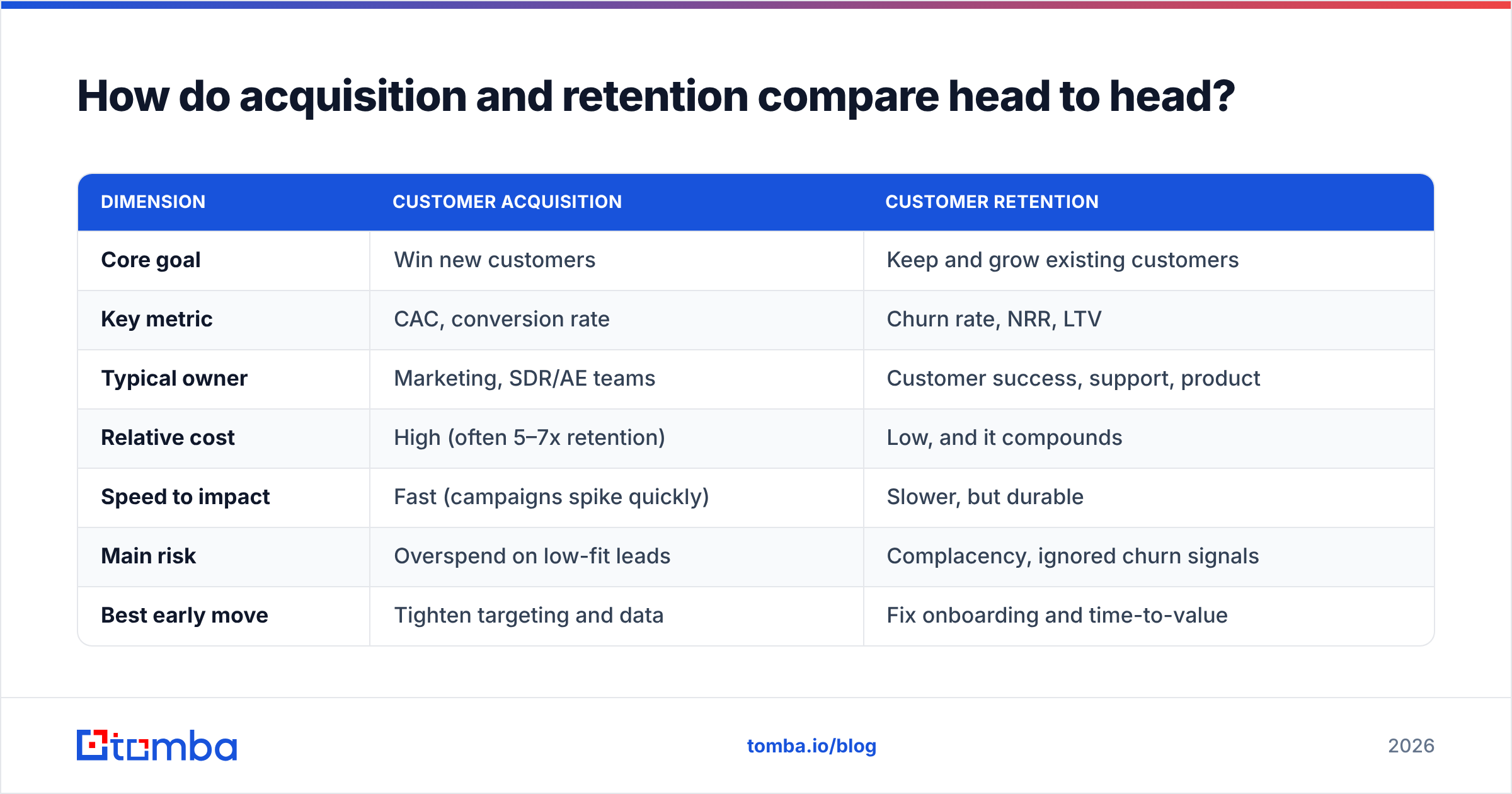
Neither function is "better"—they solve different problems at different stages. But laying them side by side clarifies where to invest when budget is tight.
| Dimension | Customer Acquisition | Customer Retention |
|---|---|---|
| Core goal | Win new customers | Keep and grow existing customers |
| Key metric | CAC, conversion rate | Churn rate, NRR, LTV |
| Typical owner | Marketing, SDR/AE teams | Customer success, support, product |
| Relative cost | High (often 5–7x retention) | Low, and it compounds |
| Speed to impact | Fast (campaigns spike quickly) | Slower, but durable |
| Main risk | Overspend on low-fit leads | Complacency, ignored churn signals |
| Best early move | Tighten targeting and data | Fix onboarding and time-to-value |
The takeaway: if your LTV:CAC ratio is under 3:1, retention is almost always the higher-ROI place to start. If retention is already strong and growth has stalled, pour fuel into acquisition.
Which metrics should you actually track?#
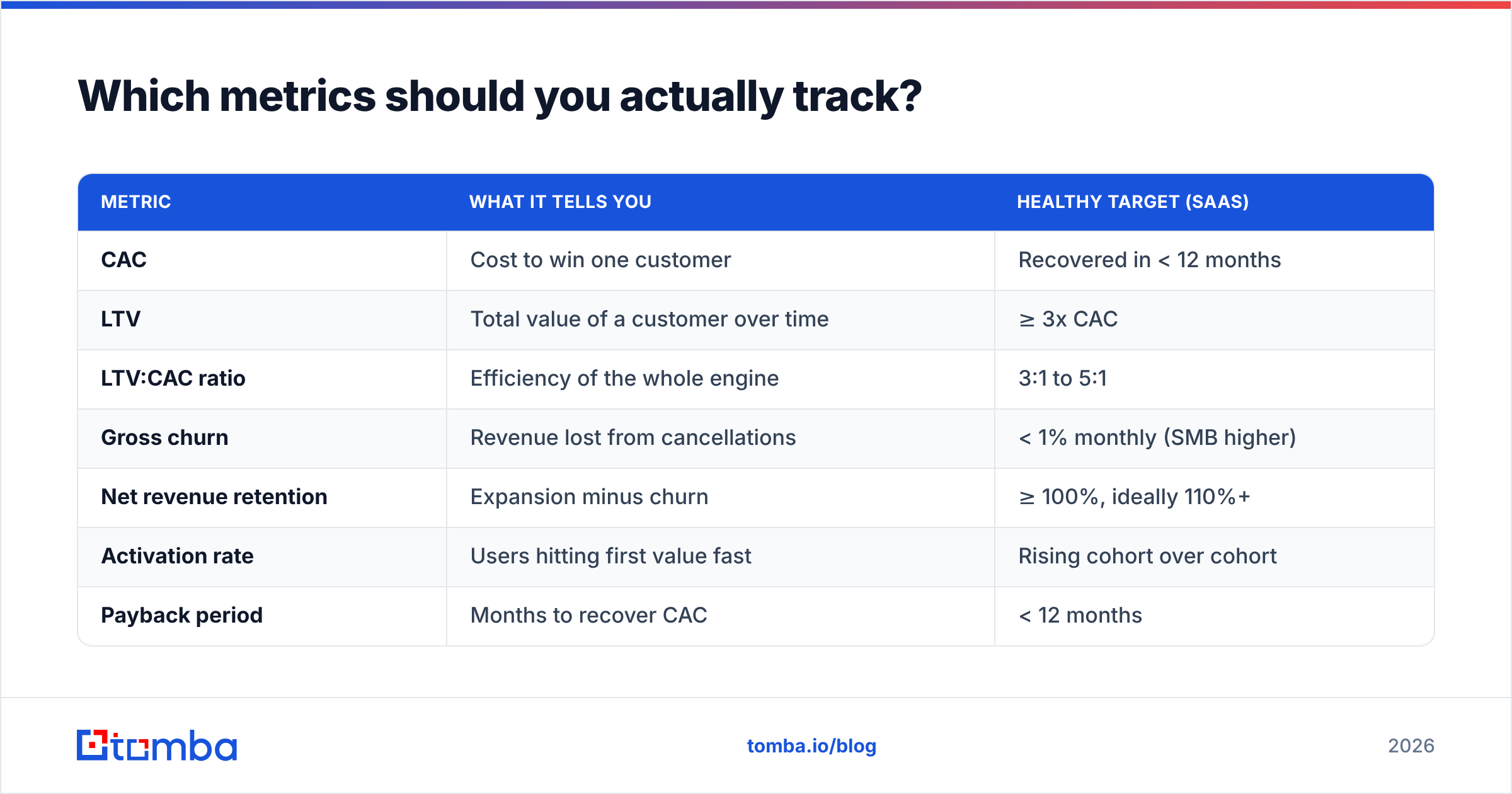
You cannot manage a customer acquisition and retention strategy you do not measure. Track a small set of numbers that connect spend to durable revenue, and review them monthly.
| Metric | What it tells you | Healthy target (SaaS) |
|---|---|---|
| CAC | Cost to win one customer | Recovered in < 12 months |
| LTV | Total value of a customer over time | ≥ 3x CAC |
| LTV:CAC ratio | Efficiency of the whole engine | 3:1 to 5:1 |
| Gross churn | Revenue lost from cancellations | < 1% monthly (SMB higher) |
| Net revenue retention | Expansion minus churn | ≥ 100%, ideally 110%+ |
| Activation rate | Users hitting first value fast | Rising cohort over cohort |
| Payback period | Months to recover CAC | < 12 months |
If you only watch one number, watch LTV:CAC. It forces acquisition and retention into the same conversation—because you cannot improve the ratio by chasing cheap-but-churny customers.
What acquisition tactics work in 2026?#
Acquisition in 2026 rewards precision over volume. Rising ad costs and buyer skepticism punish spray-and-pray outreach. The teams that win narrow their targeting and personalize at the contact level.
- Define an ICP with real firmographic and technographic signals, then build target lists that match it instead of buying generic databases.
- Enrich every inbound lead so your reps open with context, not a blank form. Feeding your CRM with accurate roles, company size, and contact details raises conversion and shortens cycles—clean data enrichment is the quiet multiplier here.
- Reach the right person, not just the right company. A verified work email or direct dial beats a shared info@ inbox every time; tools like a dedicated email finder close that gap.
- Protect deliverability. Verify addresses before you send so bounces do not wreck your sender reputation and your domain stays out of spam folders.
- Match channel to buyer. Outbound email, LinkedIn, and cold calling each fit different segments; test, measure reply rates, and double down on what your ICP answers.
The common thread is data quality. A campaign built on stale or guessed contacts inflates CAC before a single reply lands. Verify first, then scale.
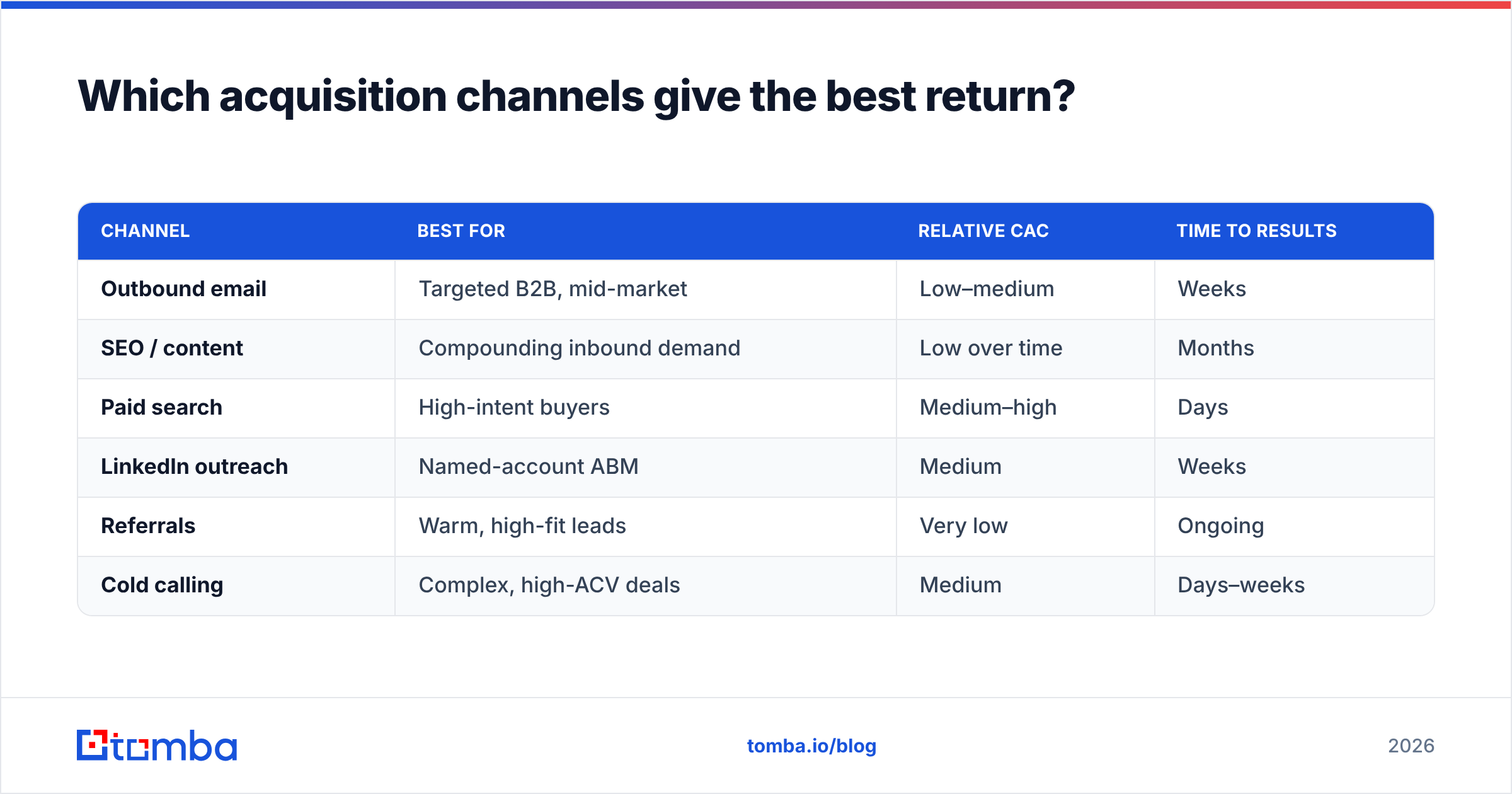
Which acquisition channels give the best return?#
Channel ROI depends on your motion, but this rough comparison helps you prioritize where to test first.
| Channel | Best for | Relative CAC | Time to results |
|---|---|---|---|
| Outbound email | Targeted B2B, mid-market | Low–medium | Weeks |
| SEO / content | Compounding inbound demand | Low over time | Months |
| Paid search | High-intent buyers | Medium–high | Days |
| LinkedIn outreach | Named-account ABM | Medium | Weeks |
| Referrals | Warm, high-fit leads | Very low | Ongoing |
| Cold calling | Complex, high-ACV deals | Medium | Days–weeks |
Outbound email and referrals tend to deliver the strongest early efficiency for B2B teams, provided your contact data is accurate. That is why so many acquisition programs start with a reliable way to find and verify decision-maker emails before any sequence goes out.
How do you build retention that compounds?#
Retention is earned in the first 90 days and defended every quarter after. The goal is fast time-to-value followed by steady expansion. If a customer reaches their "aha" moment quickly, churn risk drops sharply.
- Onboard toward first value, not feature tours. Define the one action that predicts retention and drive every new account to it fast.
- Instrument health scores. Combine usage, support tickets, and NPS into a signal that flags at-risk accounts before renewal, not after.
- Make expansion a plan, not an accident. Map upsell and cross-sell triggers to usage milestones so growth inside accounts is deliberate.
- Close the churn-reason loop. Tag every cancellation with a reason and feed it back to product and marketing—churn data is your cheapest roadmap.
- Keep contact records current. Champions change jobs; when your buyer leaves, a stale record means a silent churn. Re-enrich accounts and track response rate so relationships survive turnover.
Retention is not a customer-success problem alone. Product fixes the value gap, support fixes the friction, and RevOps fixes the data. Treat it as a cross-functional system—see how it connects to your broader revenue operations motion.
How do acquisition and retention reinforce each other?#
They compound when you connect the data. The same clean, enriched contact record that helped you win a deal should follow that customer through onboarding, expansion, and renewal. Break that thread—let data go stale between marketing and success—and you re-pay to relearn who your customer is.
Here is the loop that ties both together:
- Acquisition feeds retention by targeting high-fit customers who are likely to stay, not just anyone who converts.
- Retention feeds acquisition through referrals, reviews, and expansion revenue that lower blended CAC.
- Shared data is the connective tissue. One source of truth for contacts and accounts keeps handoffs clean and lifecycle marketing accurate.
Teams that centralize this—often on a well-maintained B2B database synced into their CRM—stop treating acquisition and retention as separate budgets and start treating them as one revenue engine.
What mistakes quietly kill both?#
Watch for these failure modes, which drain acquisition and retention at the same time:
- Buying dirty data. High bounce rates burn sender reputation and start every customer relationship on a wrong number or dead inbox.
- Optimizing for logos over fit. Cheap acquisition of low-fit accounts spikes churn three months later.
- No churn diagnosis. If you cannot say why customers leave, you cannot fix it—and you will keep acquiring into the same leak.
- Ignoring expansion. Flat NRR means you rely entirely on new logos to grow, the most expensive path there is.
- Siloed tools. When marketing, sales, and success each keep their own contact list, nobody trusts the data and everyone re-does the work.
Putting it together: a 90-day plan#
Start where the ROI is highest for your stage. If churn is high, spend the first month fixing onboarding and health scoring before touching ad spend. If retention is healthy and growth is flat, invest in tighter acquisition targeting and better contact data. In both cases, pick your metrics, clean your data, and instrument the full lifecycle so next quarter's decision is evidence-based, not a guess.
The through-line across every tactic here is data you can trust. Accurate, verified contact information is what makes acquisition efficient and retention durable—it is the input both engines share.
Ready to make your acquisition and retention engine run on clean data? Start with the Tomba Email Finder to reach the right decision-makers with verified, up-to-date contact details, then keep those records fresh as accounts grow. Check the Tomba pricing plans—including a free tier with 25 searches a month—and build both sides of your revenue bucket on data that actually holds water.
Related guides#
Ready to find emails that actually work?
Join 150,000+ professionals who stopped guessing and started sending. Free credits on signup — no credit card required.
Get the Tomba newsletter
Practical outbound tactics and product updates — once every two weeks.
About the author