Customer Acquisition Cost: How to Calculate and Reduce CAC
Customer acquisition cost decides whether your growth is profitable or a slow leak. Here's how to calculate CAC correctly, benchmark it, and cut it without starving your pipeline.
Customer acquisition cost is the single number that tells you whether growth is making you money or quietly bleeding it. Spend goes up, logos go up, the board is happy — and then someone finally divides total spend by new customers and the room goes quiet. This guide walks through how to calculate CAC correctly, what a healthy ratio looks like in 2026, and the concrete levers that pull it down.
TL;DR#
- Customer acquisition cost (CAC) = total sales and marketing spend divided by the number of new customers won in the same period.
- Track blended CAC for a board-level view and fully-loaded CAC by channel for real decisions.
- A healthy LTV:CAC ratio is roughly 3:1; a CAC payback period under 12 months keeps cash flow sane.
- The fastest way to cut CAC is not spending less — it's wasting less, and most waste hides in bad contact data and untargeted outreach.
- Clean, verified data and tight ICP targeting routinely trim 20–40% off effective CAC before you touch ad budgets.
What is customer acquisition cost?#
Customer acquisition cost is the total amount you spend to turn a stranger into a paying customer. Think of it like the cost of fishing: it's not just the bait (ad spend), it's the boat, the fuel, the guide's salary, and the hours you spent casting into empty water. Add all of it up, divide by the fish you actually caught, and that's your real cost per customer.
Formally:
CAC = (Total sales spend + Total marketing spend) ÷ Number of new customers acquired
The number looks simple, which is exactly why so many teams get it wrong. They count ad spend but forget salaries. They count this month's new customers against last quarter's campaign spend. They blend a $200 self-serve signup with a $40,000 enterprise deal into one meaningless average. CAC is only useful when the inputs are honest and the time windows line up.
CAC sits at the center of modern revenue operations because almost every other efficiency metric leans on it — payback period, magic number, LTV:CAC, and burn multiple all start here.
How do you calculate CAC correctly?#
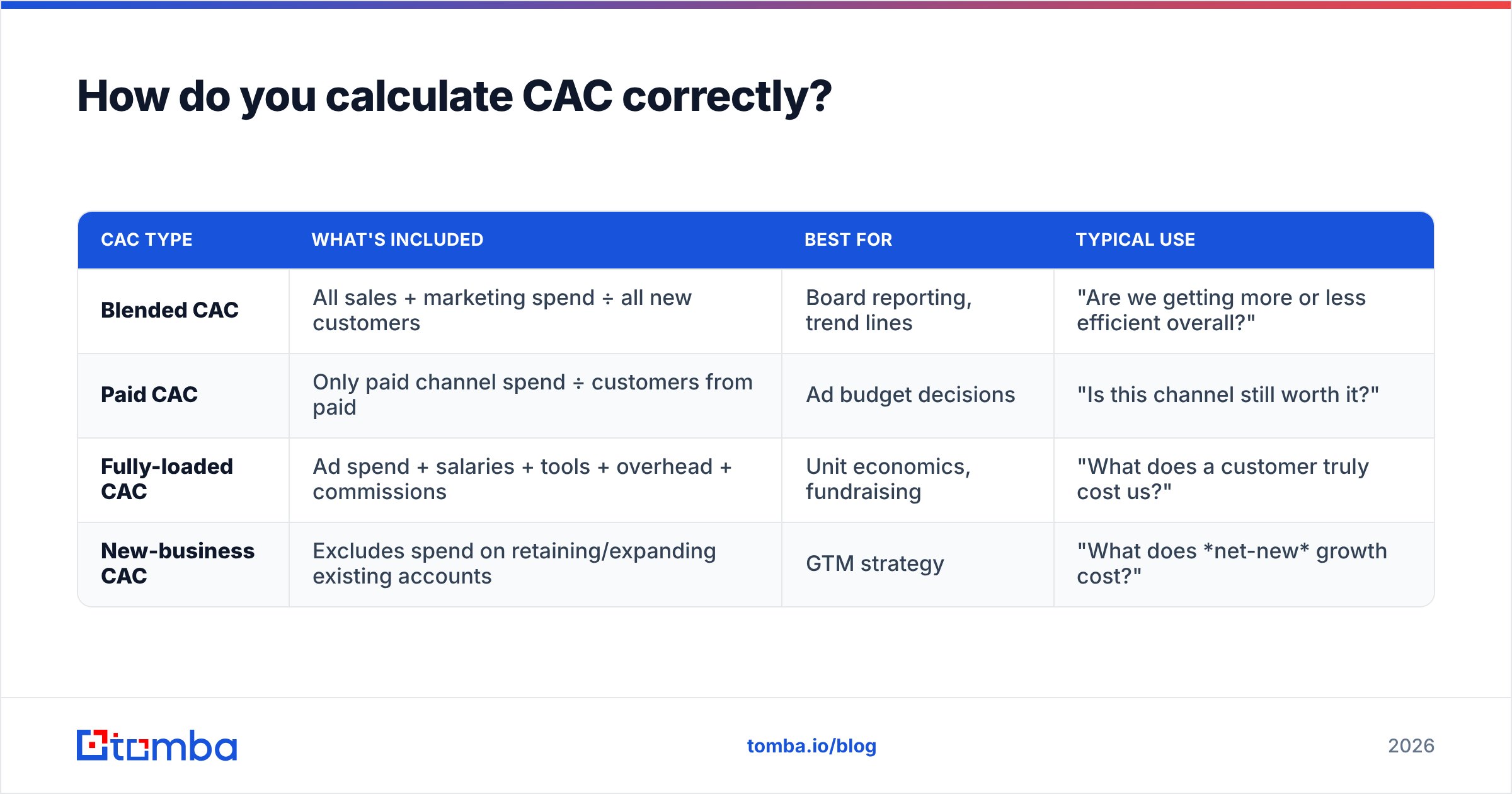
Start by deciding which version of CAC you actually need. There are three common ways to draw the line, and they answer different questions.
| CAC type | What's included | Best for | Typical use |
|---|---|---|---|
| Blended CAC | All sales + marketing spend ÷ all new customers | Board reporting, trend lines | "Are we getting more or less efficient overall?" |
| Paid CAC | Only paid channel spend ÷ customers from paid | Ad budget decisions | "Is this channel still worth it?" |
| Fully-loaded CAC | Ad spend + salaries + tools + overhead + commissions | Unit economics, fundraising | "What does a customer truly cost us?" |
| New-business CAC | Excludes spend on retaining/expanding existing accounts | GTM strategy | "What does net-new growth cost?" |
For a defensible number, fully-loaded CAC is the one that matters. Here's what belongs in the numerator:
- Paid media — ads, sponsorships, paid placements, retargeting.
- Team salaries — the loaded cost of SDRs, AEs, marketers, and their managers, prorated to acquisition work.
- Tools and software — your CRM, email finder, sequencing platform, enrichment, and analytics stack.
- Content and creative — agency fees, freelancers, design, and production.
- Commissions and overhead — deal payouts plus a fair slice of shared costs.
Then divide by new customers in the same window, and mind the lag: if your sales cycle is 90 days, this quarter's customers were largely paid for by last quarter's spend. Serious teams cohort by acquisition date rather than smashing everything into a calendar month.

What is a good CAC and LTV:CAC ratio in 2026?#
There's no universal "good" CAC — a $50 number is disastrous for a $30 product and a bargain for a $50,000 contract. That's why CAC is almost always read against lifetime value.
The benchmark most operators anchor to comes from SaaS economics popularized across the industry and echoed by analysts like Gartner:
- LTV:CAC of 3:1 — healthy. You're recovering roughly three dollars of lifetime value for every dollar spent acquiring.
- Below 1:1 — you lose money on every customer. Growth makes the hole deeper.
- Above 5:1 — often a sign you're underinvesting and leaving growth on the table, not a trophy.
The second guardrail is CAC payback period — how many months of gross margin it takes to earn back the cost of a customer:
CAC payback = CAC ÷ (Monthly revenue per customer × Gross margin %)
For most B2B software, under 12 months is comfortable, 12–18 months is workable with strong retention, and beyond 24 months is a cash-flow trap unless you have very cheap capital. HubSpot's research on sales and marketing benchmarks is a useful sanity check when you're comparing against your segment.
Why is your CAC higher than it should be?#
Most bloated CAC traces back to one root cause: you're paying full price to reach people who were never going to buy. The spend is real; the targeting is not.
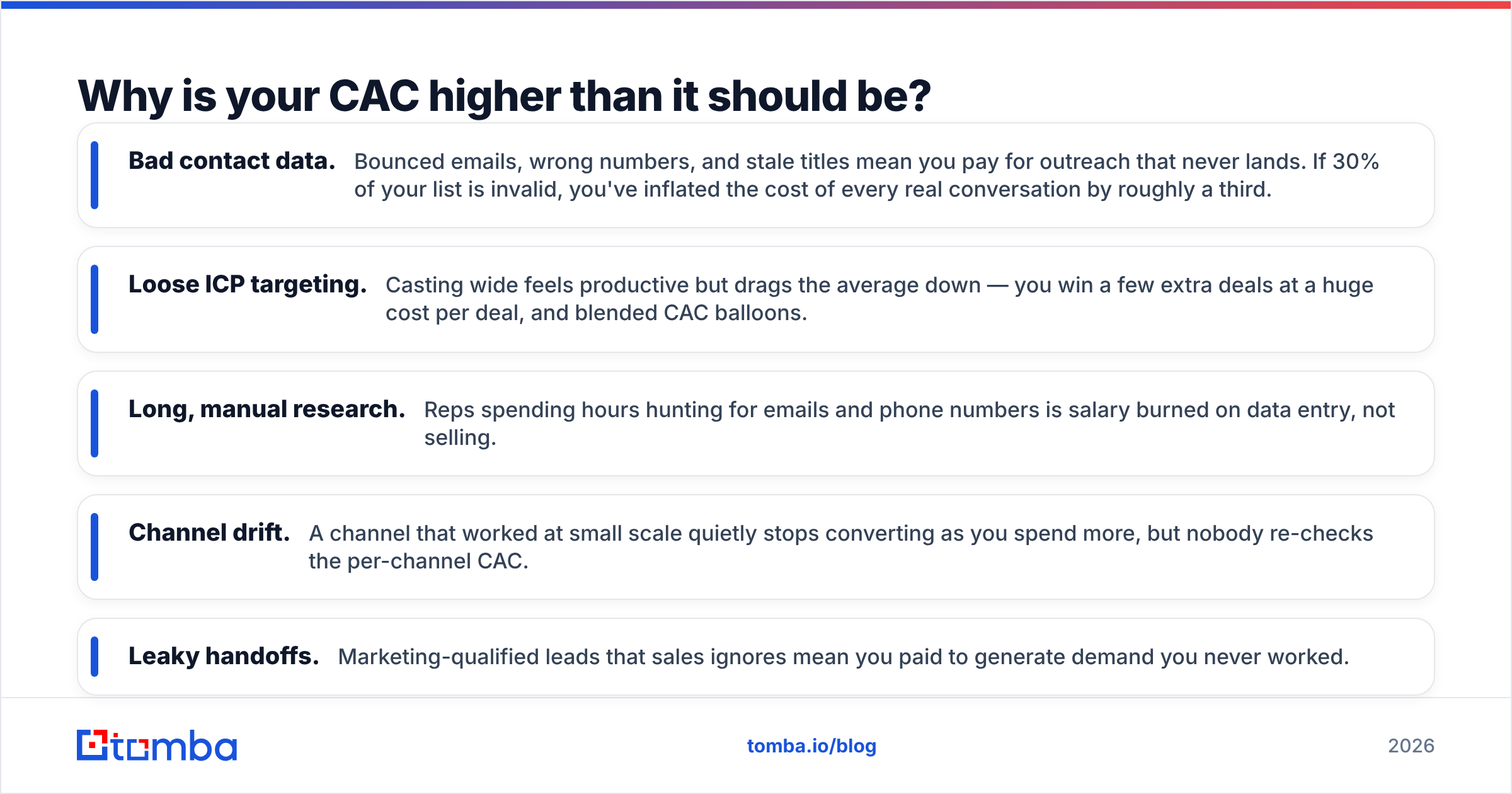
Here's where the money leaks, in rough order of impact:
- Bad contact data. Bounced emails, wrong numbers, and stale titles mean you pay for outreach that never lands. If 30% of your list is invalid, you've inflated the cost of every real conversation by roughly a third.
- Loose ICP targeting. Casting wide feels productive but drags the average down — you win a few extra deals at a huge cost per deal, and blended CAC balloons.
- Long, manual research. Reps spending hours hunting for emails and phone numbers is salary burned on data entry, not selling.
- Channel drift. A channel that worked at small scale quietly stops converting as you spend more, but nobody re-checks the per-channel CAC.
- Leaky handoffs. Marketing-qualified leads that sales ignores mean you paid to generate demand you never worked.

That first bullet is the quiet killer. When your list is full of dead addresses, every downstream cost — sending, sequencing, rep time — gets spread across fewer real prospects. Running lists through an email verifier before a campaign is one of the cheapest CAC reductions available, because it removes cost you're currently paying for zero return.
How do you reduce customer acquisition cost?#
Cutting CAC is not the same as cutting budget. The goal is to remove waste so that every dollar reaches someone who might actually convert. Five levers do most of the work.
1. Fix your data before you spend#
Verified, enriched contact data is the highest-ROI CAC fix because it compounds across every channel. When your outreach reaches real, correctly-titled decision-makers, response rates climb and cost-per-reply falls without adding a cent to media spend. Pairing accurate targeting with data enrichment also lets you personalize at scale, which lifts conversion further.
2. Tighten your ICP#
Narrow beats wide. A smaller, sharper target list of accounts that genuinely fit will out-convert a bloated one, and it shrinks the denominator problem where you chase marginal deals at absurd cost. Score leads ruthlessly and let your best-fit segment absorb most of the spend.
3. Automate the grunt work#
Every hour a rep spends manually finding contacts is CAC you don't need to pay. Feeding prospecting through an API, a browser extension, or a bulk workflow turns hours of research into seconds, freeing sellers to do the one thing that closes deals — talk to people.
4. Reallocate by channel CAC, not gut feel#
Calculate fully-loaded CAC per channel monthly. Kill or shrink the channels drifting past your payback threshold and pour the savings into the ones still under it. This single discipline often beats any clever new tactic.
5. Lift retention and expansion#
CAC and LTV are two ends of the same lever. Improving onboarding, reducing churn, and expanding existing accounts raises LTV, which makes your existing CAC look far healthier without changing acquisition at all. Cross-referenced against G2's software benchmarks, retention-led efficiency is what separates durable growth from paid-growth hamster wheels.
How does data quality change the CAC math?#
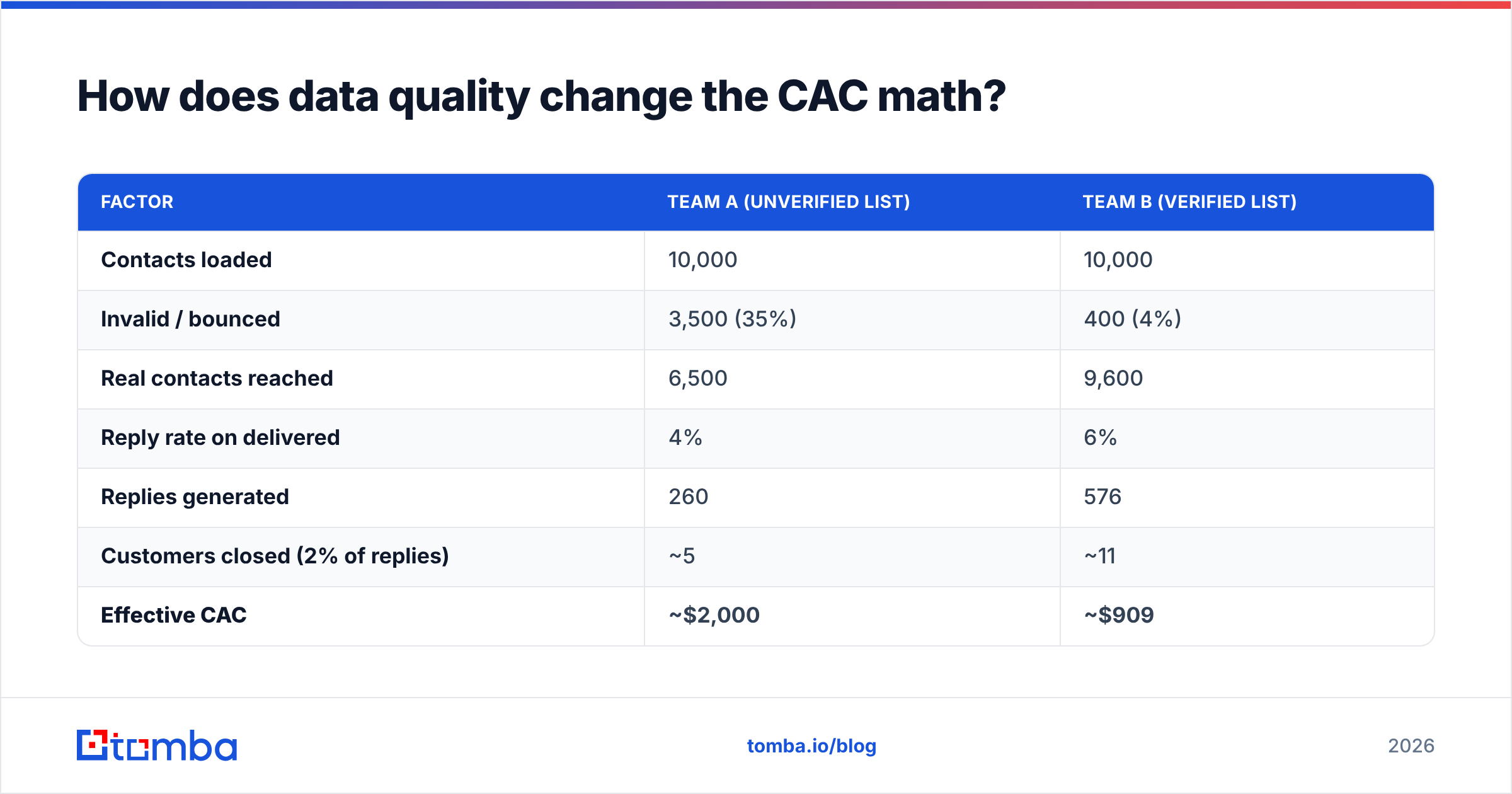
Let's make the leak concrete. Imagine two teams running identical $10,000 outbound campaigns to 10,000 contacts.
| Factor | Team A (unverified list) | Team B (verified list) |
|---|---|---|
| Contacts loaded | 10,000 | 10,000 |
| Invalid / bounced | 3,500 (35%) | 400 (4%) |
| Real contacts reached | 6,500 | 9,600 |
| Reply rate on delivered | 4% | 6% |
| Replies generated | 260 | 576 |
| Customers closed (2% of replies) | ~5 | ~11 |
| Effective CAC | ~$2,000 | ~$909 |
Same spend, same offer, more than double the efficiency — driven entirely by data quality. Team A also risks damaging its sender reputation with a high bounce rate, which raises the cost of every future campaign. This is why deliverability-minded teams treat verification as non-negotiable, and why cleaning the list is usually the first move, not the last.
The math scales in both directions: the bigger your spend, the more a dirty list costs you in absolute dollars. At enterprise volume, a 30% invalid rate can hide six figures of wasted acquisition spend a year.
Blended CAC vs paid CAC: which should you report?#
Report both, but act on the granular one. Blended CAC is your trend line — it tells leadership whether the whole GTM engine is getting more or less efficient over time. Paid and channel-level CAC are your steering wheel — they tell you where to add or pull budget this week.
The mistake is optimizing to blended CAC alone. A great organic quarter can mask a paid channel that's quietly gone underwater, because the organic wins drag the average back down. You only see the problem when you separate the channels, and by then you may have burned a quarter of budget on a channel below 1:1.
A practical cadence:
- Weekly: paid and channel CAC, so you can reallocate fast.
- Monthly: fully-loaded CAC by segment, tied to payback period.
- Quarterly: blended CAC and LTV:CAC, cohorted by acquisition date, for the board.
Frequently asked questions#
What's the difference between CAC and CPA? Cost per acquisition (CPA) usually measures the cost of a specific action — a lead, a trial, a signup. CAC measures the cost of a paying customer. CPA is a step in the funnel; CAC is the whole journey.
Should CAC include salaries? For any serious decision, yes. Fully-loaded CAC that includes team salaries, tools, and overhead is the only version that reflects what a customer truly costs. Ad-only CAC flatters your numbers and misleads planning.
How often should I recalculate CAC? Blended CAC quarterly, channel-level CAC monthly or even weekly for fast-moving paid channels. The faster the channel, the faster you need to see its CAC drift.
Can CAC be too low? Yes. A very low CAC with a very high LTV:CAC ratio often means you're underinvesting and could profitably spend more to grow faster. Efficiency without growth is its own trap.
The bottom line#
Customer acquisition cost is a mirror: it reflects the quality of your targeting and data far more than the size of your budget. Teams that obsess over cutting spend usually plateau; teams that obsess over cutting waste keep CAC flat while volume climbs. The starting point is almost always the list — verified contacts, accurate titles, and tight ICP fit.
If your effective CAC is being dragged down by bounced emails and stale data, the cheapest fix is better data at the top of the funnel. Tomba's Email Finder finds professional email addresses by name, domain, or company and verifies them before they ever hit a sequence — so you stop paying to reach people who don't exist. Start free with 25 searches a month, and check the full Tomba pricing when you're ready to scale it across the team. Lower CAC starts with better data, not a smaller budget.
Related guides#
Ready to find emails that actually work?
Join 150,000+ professionals who stopped guessing and started sending. Free credits on signup — no credit card required.
Get the Tomba newsletter
Practical outbound tactics and product updates — once every two weeks.
About the author