Customer Acquisition Cost by Industry: 2026 Benchmark Guide
What counts as a healthy CAC in your vertical? Compare customer acquisition cost by industry with 2026 benchmarks, the math behind them, and how to bring yours down.
Customer acquisition cost (CAC) is the single number that decides whether growth makes you money or quietly bankrupts you. But a "good" CAC in ecommerce would be a catastrophe in enterprise SaaS, and a SaaS number would look reckless in insurance. Averages without context are noise. This guide breaks down customer acquisition cost by industry for 2026, shows the math, and gives you a plan to pull yours down.
TL;DR#
- CAC is not universal. Healthy benchmarks range from under $50 in some B2C verticals to well over $1,000 in B2B SaaS, fintech, and enterprise software.
- The metric that matters is the ratio, not the raw dollar. A $1,200 CAC is excellent at a 4:1 LTV:CAC ratio and a disaster at 1.2:1.
- Sales-led motions cost more than product-led ones — expect higher CAC where a human closes the deal.
- Bad data inflates CAC quietly. Bounced sends, wrong contacts, and duplicate records burn budget before a rep ever talks to a buyer.
- You can move CAC fast by fixing targeting and contact data before you touch ad spend.
What is customer acquisition cost, exactly?#
CAC is the total cost of sales and marketing divided by the number of new customers won in the same period. Think of it like the price tag on a customer before they've paid you a cent — everything you spent to convince them, spread across everyone who said yes.
The formula is deliberately simple:
CAC = (Total sales + marketing spend) / (New customers acquired)
If you spent $200,000 on sales and marketing last quarter and closed 160 customers, your CAC is $1,250. The trap is what you leave out. A defensible CAC includes ad spend, salaries and commissions, tooling, agency fees, and content production — not just the media bill. Leaving out salaries is the most common way teams fool themselves into thinking acquisition is cheaper than it is.
CAC only means something next to two other numbers: lifetime value (LTV) and payback period. That relationship is the heart of revenue operations, because it ties marketing spend directly to unit economics.
Customer acquisition cost by industry: 2026 benchmarks#
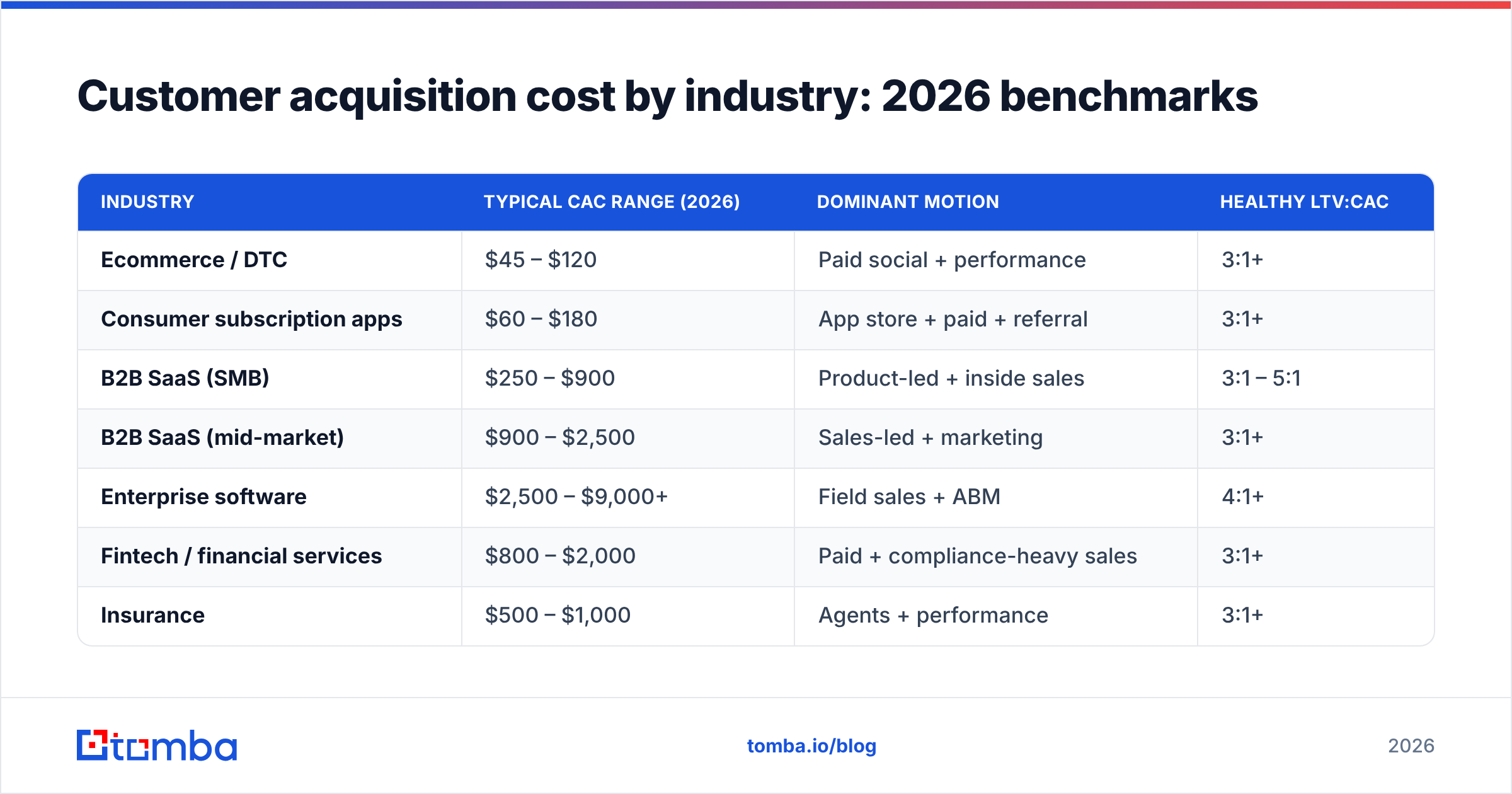
Here's the part you came for. The table below shows representative 2026 CAC ranges by industry, along with the dominant go-to-market motion that explains each range. Treat these as directional benchmarks, not guarantees — your business model, price point, and channel mix will move you within (or beyond) each band.
| Industry | Typical CAC range (2026) | Dominant motion | Healthy LTV:CAC |
|---|---|---|---|
| Ecommerce / DTC | $45 – $120 | Paid social + performance | 3:1+ |
| Consumer subscription apps | $60 – $180 | App store + paid + referral | 3:1+ |
| B2B SaaS (SMB) | $250 – $900 | Product-led + inside sales | 3:1 – 5:1 |
| B2B SaaS (mid-market) | $900 – $2,500 | Sales-led + marketing | 3:1+ |
| Enterprise software | $2,500 – $9,000+ | Field sales + ABM | 4:1+ |
| Fintech / financial services | $800 – $2,000 | Paid + compliance-heavy sales | 3:1+ |
| Insurance | $500 – $1,000 | Agents + performance | 3:1+ |
| Healthcare / healthtech | $600 – $1,800 | Sales-led + long cycles | 3:1+ |
| Professional services / agencies | $400 – $1,500 | Referral + outbound | 4:1+ |
| Real estate (B2B/proptech) | $700 – $2,000 | Outbound + events | 3:1+ |
A few patterns jump out. First, anything with a human closing the deal costs more — enterprise software sits at the top because field sales, long cycles, and multi-stakeholder buying commit expensive people for months. Second, B2C verticals cluster low because performance channels are measurable and self-serve checkout removes the sales cost entirely. Third, regulated industries (fintech, insurance, healthcare) carry a compliance tax that inflates CAC through longer approvals and heavier documentation.
For a broader view of how these benchmarks are assembled, industry analysts like Gartner and demand-gen benchmarks published by HubSpot track CAC alongside conversion and pipeline metrics year over year.
Why does CAC vary so much between industries?#
Four structural forces explain almost all of the variance. Understanding them tells you which levers you can actually pull.
- Sales motion. Product-led growth (self-serve signup, freemium) pushes cost onto the product and away from a rep, so CAC stays low. Sales-led growth adds salaries, commissions, and time — every one of which compounds the cost per closed deal.
- Deal size and cycle length. A 9-month enterprise cycle ties up an account executive, a sales engineer, and marketing air cover the entire time. Longer cycles mean more touches, more content, and more people paid to wait.
- Buyer complexity. More stakeholders equals more meetings, more security reviews, and more chances to stall. B2B deals with 6–10 decision-makers structurally cost more to win than a single-buyer B2C purchase.
- Data and targeting quality. This is the lever most teams ignore. If half your outbound list is stale or mis-targeted, you pay full price to reach people who will never buy. Clean, well-matched contact data enrichment is the cheapest CAC reduction available, because it removes waste before spend even happens.
The first three are mostly fixed by your business model. The fourth is entirely within your control — which is why it's where smart teams start.
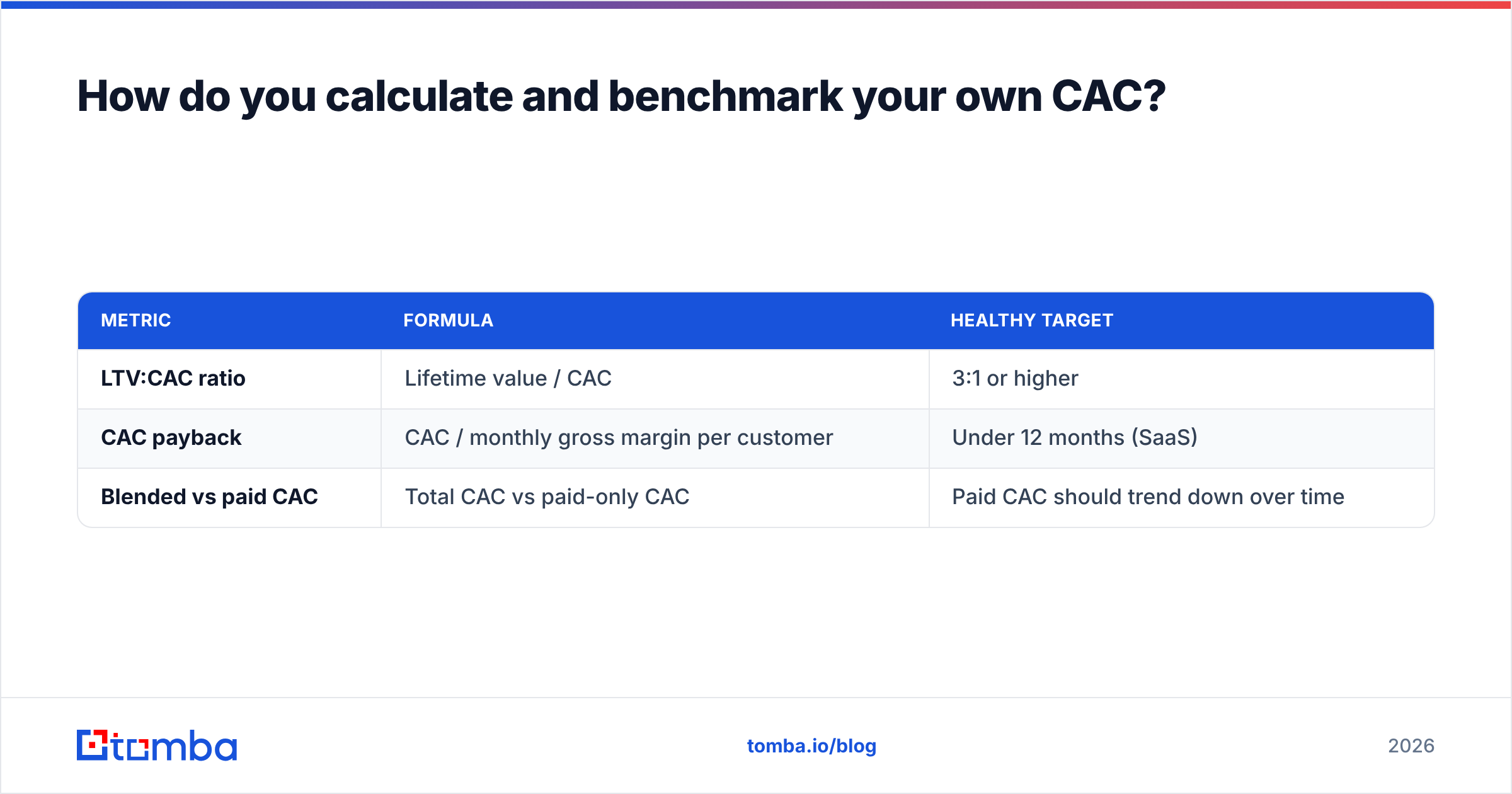
How do you calculate and benchmark your own CAC?#
Run the calculation in four steps, then compare against the table above.
- Step 1 — Pick a clean time window. Use a full quarter to smooth out spiky months. Match the spend period to the acquisition period.
- Step 2 — Add every acquisition cost. Media spend, salaries and commissions for sales and marketing, software and tooling, agency and freelancer fees, and content costs. If a dollar went toward winning customers, it counts.
- Step 3 — Count only new customers. Exclude renewals, expansions, and reactivations. Blending those in artificially lowers CAC and hides the real cost of net-new growth.
- Step 4 — Segment. Calculate CAC by channel, by segment, and by product. A healthy blended CAC often hides one channel bleeding money and another subsidizing it.
Once you have the number, judge it against LTV:CAC and payback period, not against the raw benchmark alone.
| Metric | Formula | Healthy target |
|---|---|---|
| LTV:CAC ratio | Lifetime value / CAC | 3:1 or higher |
| CAC payback | CAC / monthly gross margin per customer | Under 12 months (SaaS) |
| Blended vs paid CAC | Total CAC vs paid-only CAC | Paid CAC should trend down over time |
If your ratio is above 5:1, you're probably under-investing in growth and leaving pipeline on the table. If it's below 3:1, acquisition is too expensive to scale profitably. The sweet spot balances efficiency with ambition.

Which industries have the highest and lowest CAC?#
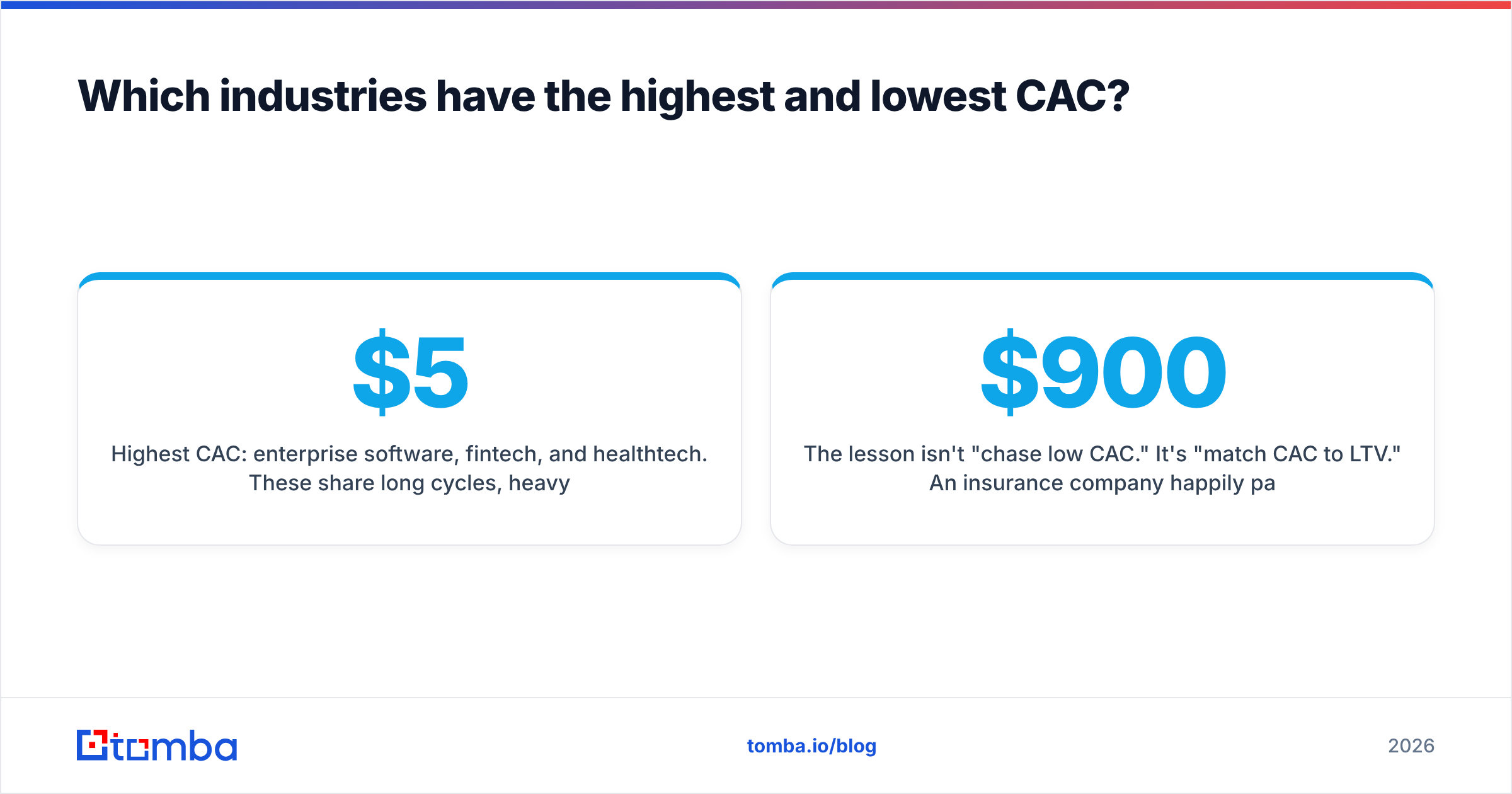
Highest CAC: enterprise software, fintech, and healthtech. These share long cycles, heavy compliance, and multi-stakeholder buying committees. A single enterprise logo can cost $5,000–$9,000+ to acquire, but the contract values and retention rates justify it — a five-figure or six-figure annual deal easily supports a four-figure CAC.
Lowest CAC: DTC ecommerce and consumer subscription apps. Self-serve checkout, measurable performance channels, and impulse-friendly price points keep costs down. The catch is thinner margins and lower switching costs, so these businesses live or die on retention and repeat purchase rate.
The lesson isn't "chase low CAC." It's "match CAC to LTV." An insurance company happily paying $900 per policyholder and a DTC brand paying $60 per buyer can both be world-class — because both respect their own unit economics.
How do you lower customer acquisition cost?#
CAC reduction almost never starts with spending less. It starts with wasting less. Here's the order of operations that moves the number fastest.
- Fix targeting before budget. The fastest CAC win is not reaching more people — it's reaching the right people. Precise firmographic and role-based targeting cuts wasted impressions and wasted rep hours.
- Verify your contact data. Every bounced email and wrong-number dial is CAC spent on nobody. Running lists through an email verifier before a campaign protects sender reputation and stops you paying to reach dead addresses.
- Shorten the cycle with better first contact. Reaching a decision-maker directly — instead of a gatekeeper — compresses the cycle and lowers the labor cost baked into CAC. A reliable email finder gets reps to the right inbox on the first try.
- Lean into referral and product-led loops. Referred customers convert faster and cost less. Where your product allows self-serve, a freemium or trial motion offloads acquisition cost onto the product itself.
- Kill your worst channel. Segment CAC by channel and cut the one with the worst payback. Reallocating that budget to your best channel often drops blended CAC more than any optimization.
- Enrich before you route. Feeding reps enriched, complete records means fewer dead-end conversations. Pairing enrichment with a solid B2B database keeps pipeline full of contacts who actually match your ICP.
Notice that most of these levers are about data quality and targeting, not media buying. According to peer-reviewed marketing research summarized on Wikipedia's CAC overview, acquisition efficiency correlates far more strongly with targeting precision than with raw spend volume — which is exactly why fixing the top of your funnel beats squeezing the bottom.
How does contact data quality affect CAC?#
Bad data is a CAC tax you pay silently. Picture two outbound teams with identical budgets. Team A works a list where 30% of emails bounce and 20% of contacts are mis-titled. Team B works a verified, enriched list. Team A pays the same salaries and tooling costs but converts a fraction of the meetings — so their real CAC is dramatically higher, even though their spend looks identical on paper.
This is why the cheapest CAC improvement is usually upstream of marketing entirely. When you find and verify the right decision-maker before outreach, you stop paying to talk to the wrong people. Multiply that across thousands of monthly touches and the compounding is enormous. Clean data doesn't just improve conversion — it changes the denominator of your CAC formula by turning wasted attempts into won customers.
That's the connective tissue between this whole guide and daily execution: benchmarks tell you where you stand, but data quality determines whether you can actually beat them.
Frequently asked questions#
What is a good customer acquisition cost? There's no universal number. A good CAC is one that produces an LTV:CAC ratio of 3:1 or higher with a payback period under 12 months for SaaS. Judge CAC against value, never in isolation.
Why is B2B CAC higher than B2C? B2B deals involve more stakeholders, longer cycles, and human sellers whose salaries and time are baked into the cost. B2C often uses self-serve checkout, which removes the sales cost entirely.
Does CAC include salaries? Yes. A defensible CAC includes sales and marketing salaries, commissions, tooling, and content — not just ad spend. Excluding salaries is the most common way teams understate CAC.
How often should I recalculate CAC? Quarterly for a stable view, plus monthly channel-level tracking to catch a bleeding channel early. Always segment by channel, product, and customer type.
Bring your CAC down at the source#
Your CAC benchmark tells you the target. Your data quality decides whether you hit it. The fastest, cheapest reduction in customer acquisition cost by industry isn't a smarter ad — it's reaching the right decision-maker on the first attempt instead of burning spend on bounces and wrong contacts.
That's exactly what Tomba's Email Finder is built for: find verified, ICP-matched professional emails by name, company, or domain so your reps and campaigns spend budget on real buyers, not dead ends. Start free with 25 searches a month, and when you're ready to scale, Tomba pricing begins at $49/mo — a rounding error against the CAC you'll save by cutting the waste out of your funnel.
Related guides#
// get started
Find, verify and enrich your first contacts today
Start on the free plan with 25 searches a month, then scale when your team is ready.
Free plan · No credit card required · GDPR & CCPA
// about the author