Customer Acquisition Cost (CAC): How to Calculate and Lower It
Customer acquisition cost (CAC) decides whether growth is profitable or a slow bleed. Here's how to calculate CAC correctly, benchmark it by channel, and cut it in 2026.
Every growth deck eventually runs into one number that quietly decides the whole story: what it actually costs to win a customer. Spend too much to acquire each account and even a great product turns into a cash furnace. Spend efficiently and modest revenue compounds into real margin. That number is your customer acquisition cost (CAC), and most teams either miscalculate it or track a version so watered down it hides the truth.
This guide breaks CAC down the way an operator actually needs it: the correct formula, what to include (and what people wrongly leave out), realistic 2026 benchmarks, and the concrete levers that move it.
TL;DR#
- CAC = total sales and marketing spend ÷ new customers acquired in the same period. Include salaries, tools, and ad spend, not just media.
- CAC only means something next to LTV. A healthy B2B SaaS target is an LTV:CAC ratio of 3:1 or higher with a payback period under 12 months.
- Blended CAC hides your best and worst channels. Always track paid CAC and organic CAC separately.
- The fastest way to lower CAC is better targeting, not cheaper ads. Clean data and precise lists cut wasted outreach at the top of the funnel.
- Payback period matters as much as the ratio when cash is tight in 2026 — it tells you how long each customer ties up capital.
What is customer acquisition cost (CAC)?#
Customer acquisition cost is the total amount you spend on sales and marketing to acquire one new paying customer over a defined period. Think of it like the cost of catching a single fish: it is not just the bait (ad spend), it is also the boat, the fuel, and the hours you paid the crew (salaries and tools). Count only the bait and you will badly underestimate what each fish really costs.
Formally:
CAC = (Total sales spend + Total marketing spend) ÷ Number of new customers acquired
Say you spent $50,000 on marketing and $30,000 on sales in Q1 — including salaries, software, and ad budget — and closed 200 new customers. Your CAC is $80,000 ÷ 200 = $400 per customer. Simple arithmetic; the hard part is being honest about the numerator.
What should you include in the CAC calculation?#
Most inflated or deflated CAC numbers come from disagreement about the numerator. Here is the line most disciplined RevOps teams draw.
- Paid media — Google, LinkedIn, Meta, retargeting, sponsorships, all ad spend.
- Salaries and commissions — the fully loaded cost of everyone in sales and marketing, including SDRs, AEs, and demand-gen staff.
- Software and tools — CRM, sales engagement, data providers, email finder tools, and analytics licenses tied to acquisition.
- Agencies and contractors — freelancers, creative shops, and outsourced SDR firms.
- Content and creative production — the cost of producing the assets that drive pipeline.
What you generally exclude: customer success, onboarding, and support costs (those belong to retention), plus overhead like rent and finance salaries that are not acquisition-specific. If you are unsure whether a cost belongs in CAC, ask a simple question — would you stop paying it if you stopped acquiring new customers? If yes, it counts.
How do you calculate CAC step by step?#
Keep it repeatable so the number is comparable quarter over quarter.
- Pick a time window. Monthly is noisy; a quarter smooths out lumpy ad spend and long sales cycles.
- Total your sales and marketing spend for that window using the five buckets above.
- Count new customers acquired in the same window — new logos, not renewals or expansions.
- Divide spend by new customers. That is blended CAC.
- Segment. Recalculate for paid vs. organic, by channel, and by customer tier.
The segmentation in step 5 is where the insight lives. A single blended number tells you almost nothing about where to put the next dollar.
What is a good CAC — and how does LTV factor in?#
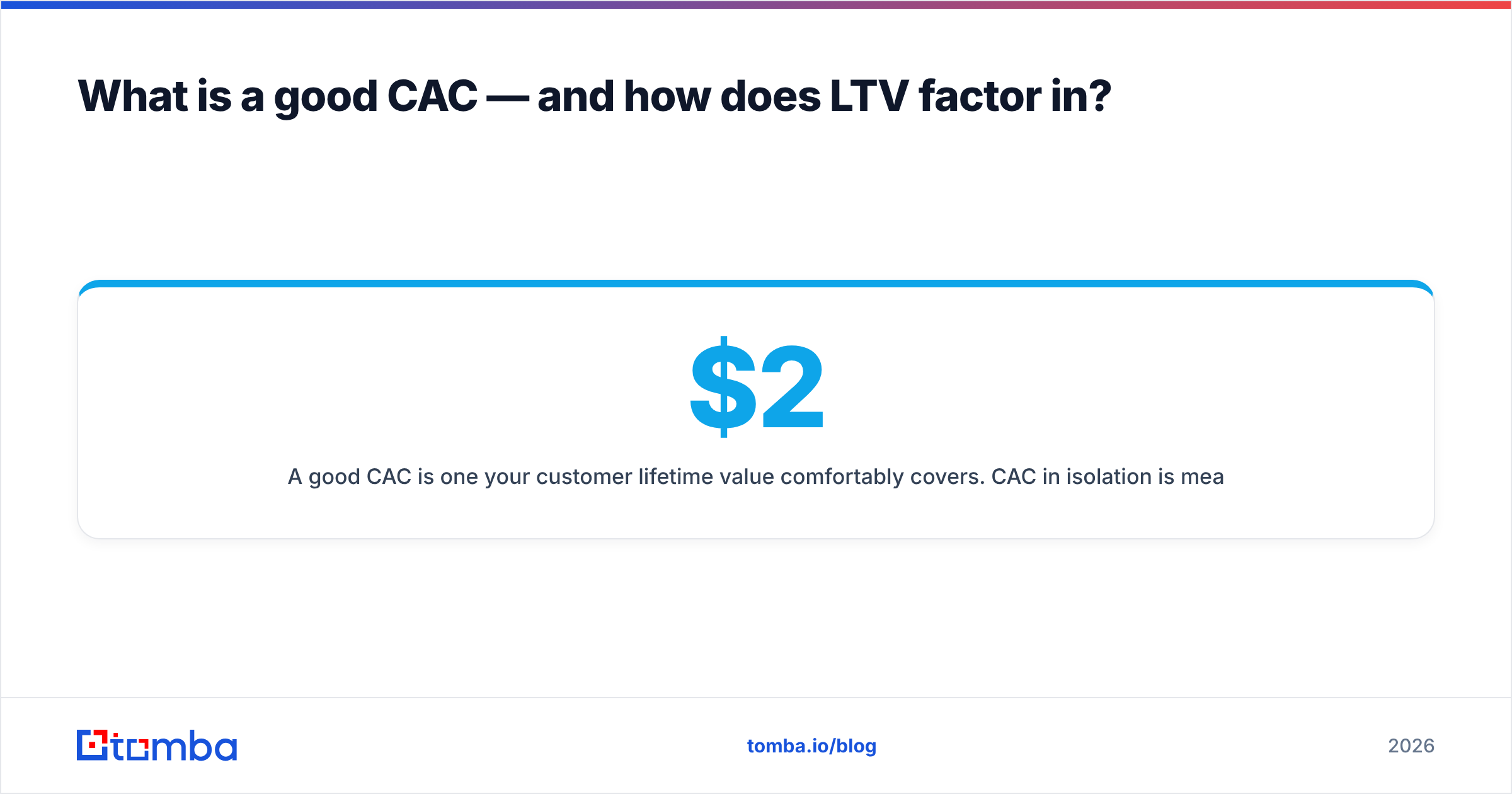
A good CAC is one your customer lifetime value comfortably covers. CAC in isolation is meaningless: $2,000 to acquire a customer is a disaster if they pay you $1,500 total, and a bargain if they pay you $40,000 over five years.
The two guardrail metrics:
- LTV:CAC ratio — lifetime value divided by CAC. The widely cited healthy benchmark for B2B SaaS is 3:1. Below 1:1 you lose money on every customer. Far above 5:1 often means you are underinvesting in growth and leaving market share on the table.
- CAC payback period — how many months of gross margin it takes to earn back the CAC. Under 12 months is strong; 12–18 is workable; beyond 24 is dangerous when capital is expensive.
HubSpot and other operators publish updated benchmarks worth checking against your own numbers — see HubSpot's marketing statistics for current ranges. For a deeper grounding on the underlying unit economics, the Wikipedia entry on customer acquisition cost is a clean primer.
How does CAC vary by channel?#
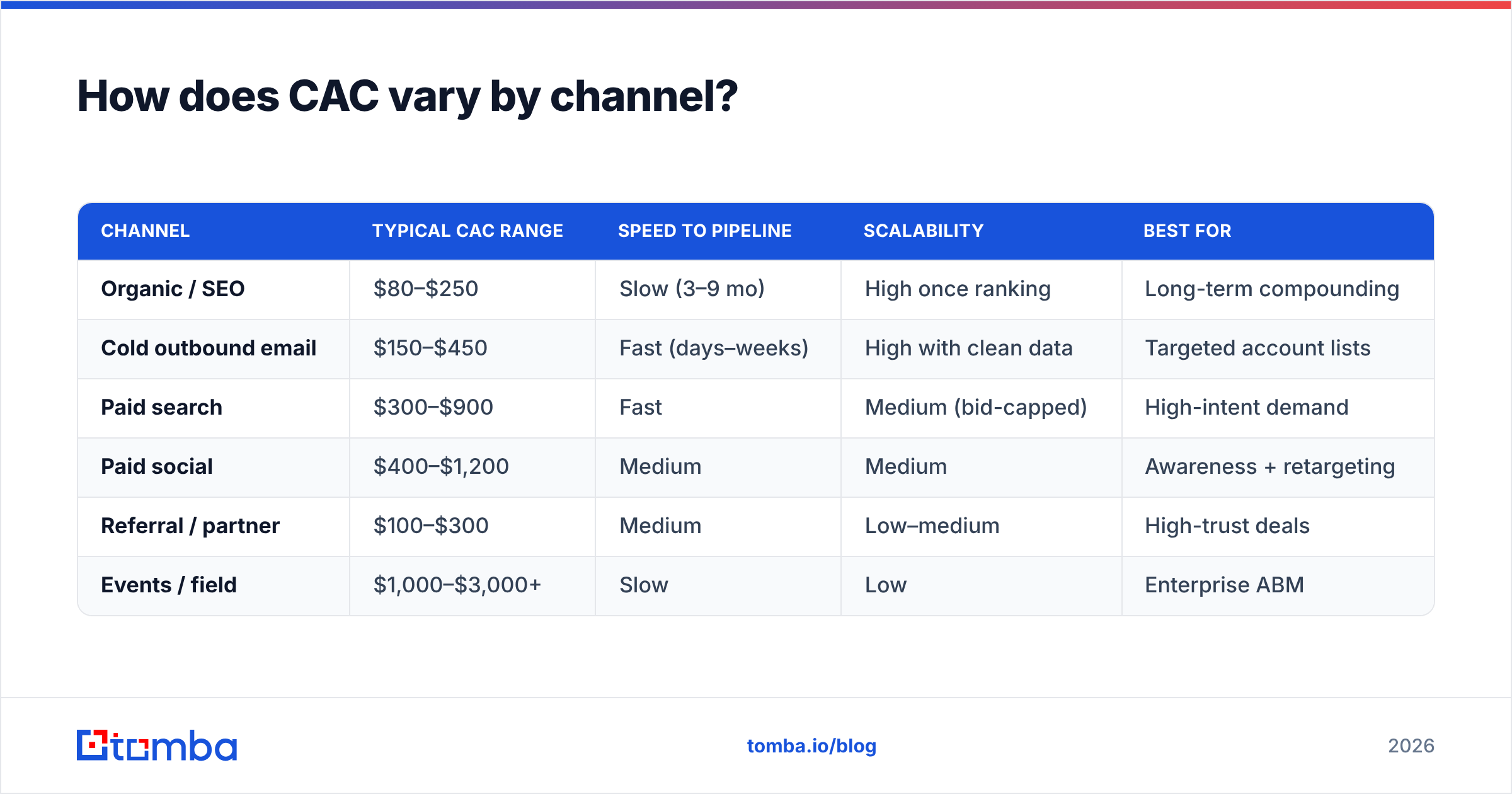
Blended CAC averages your cheapest and most expensive channels into one misleading figure. The table below shows illustrative 2026 ranges for B2B — treat them as directional, since your motion and price point shift everything.
| Channel | Typical CAC range | Speed to pipeline | Scalability | Best for |
|---|---|---|---|---|
| Organic / SEO | $80–$250 | Slow (3–9 mo) | High once ranking | Long-term compounding |
| Cold outbound email | $150–$450 | Fast (days–weeks) | High with clean data | Targeted account lists |
| Paid search | $300–$900 | Fast | Medium (bid-capped) | High-intent demand |
| Paid social | $400–$1,200 | Medium | Medium | Awareness + retargeting |
| Referral / partner | $100–$300 | Medium | Low–medium | High-trust deals |
| Events / field | $1,000–$3,000+ | Slow | Low | Enterprise ABM |
Two patterns show up almost everywhere. Organic and referral are the cheapest per customer but slowest and hardest to scale on demand. Paid and events buy speed at a premium. The right mix depends on how fast you need pipeline and how much runway you have.
Why is my CAC rising — and what drives it up?#
If your customer acquisition cost is creeping up, it is usually one of these five causes. Diagnose before you cut.
- Audience saturation — you have already reached the easy-to-convert segment, so each new customer costs more.
- Rising ad costs — auction competition on Google and LinkedIn pushes CPCs up every year.
- Poor targeting — spraying outreach at unqualified contacts burns SDR hours and inflates the numerator with nothing to show.
- Longer sales cycles — more touches and more people involved mean more cost per closed deal.
- Weak conversion — a leaky funnel means you pay to generate demand that never closes.
The third cause is the one teams underrate most. When your B2B database is stale or your lists are full of guesses, reps spend their day chasing bounced emails and wrong numbers instead of live conversations. That waste lands squarely in your CAC.
How do you lower customer acquisition cost?#
You lower CAC by improving one of two things: the efficiency of your spend, or the conversion rate of what that spend generates. Here are the highest-leverage moves.
1. Sharpen targeting before you spend. The single biggest CAC lever is not paying less per lead — it is stopping payment for the wrong leads. Precise, verified contact data means every outreach dollar hits a real, reachable, in-market buyer. Using data enrichment to fill in firmographics and validate contacts before a rep ever reaches out removes a huge chunk of wasted effort.
2. Verify contacts to protect deliverability. Bounced emails hurt sender reputation, which quietly raises the cost of every future campaign. Running lists through an email verifier keeps bounce rates low and inboxes reachable.
3. Shorten the sales cycle. Faster deals mean fewer touches per customer. Tighten qualification, arm reps with better context, and remove friction from demos and trials.
4. Lean into compounding channels. Shift budget toward SEO, referral, and content that keeps producing after the spend stops. These lower blended CAC over time even though they are slow to start.
5. Improve conversion at every funnel stage. A 20% lift in landing-page or reply rates lowers CAC just as much as a 20% cut in spend — often more cheaply.
6. Automate the manual middle. Bulk-sourcing and enriching contacts through a bulk email finder frees expensive rep hours for actual selling instead of list-building.
For a broader view of efficiency tactics across the funnel, G2's sales software category is a useful place to compare tooling that affects CAC.
How does data quality directly affect CAC?#
Data quality is the quiet multiplier on your entire acquisition budget. Every wrong email, dead number, or mistargeted account is spend that produced nothing — yet it still sits in your CAC numerator.
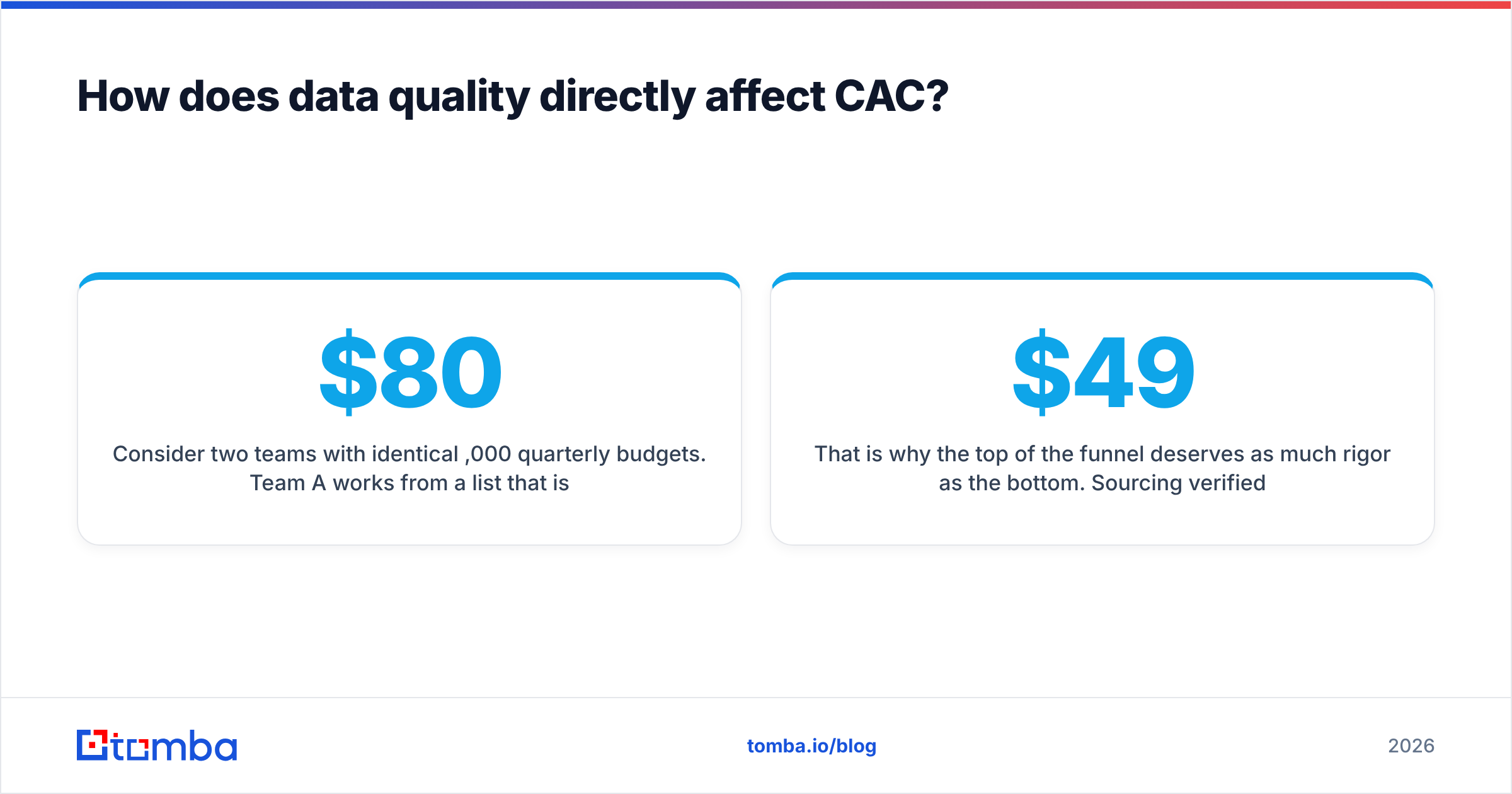
Consider two teams with identical $80,000 quarterly budgets. Team A works from a list that is 60% accurate; Team B works from one that is 95% accurate. Team B's reps spend their time on real conversations, close more, and drive the denominator up. Same spend, dramatically different CAC — purely from data quality.
That is why the top of the funnel deserves as much rigor as the bottom. Sourcing verified emails with an email finder, confirming them, and enriching them with real firmographics is not a nice-to-have. It is CAC control at the source. Tools like Tomba exist precisely to keep that top-of-funnel data clean and reachable, and pricing starts with a free tier of 25 searches per month, then $49/mo on the Starter plan — see full Tomba pricing for the tiers.
CAC vs. CPA vs. CPL: what's the difference?#
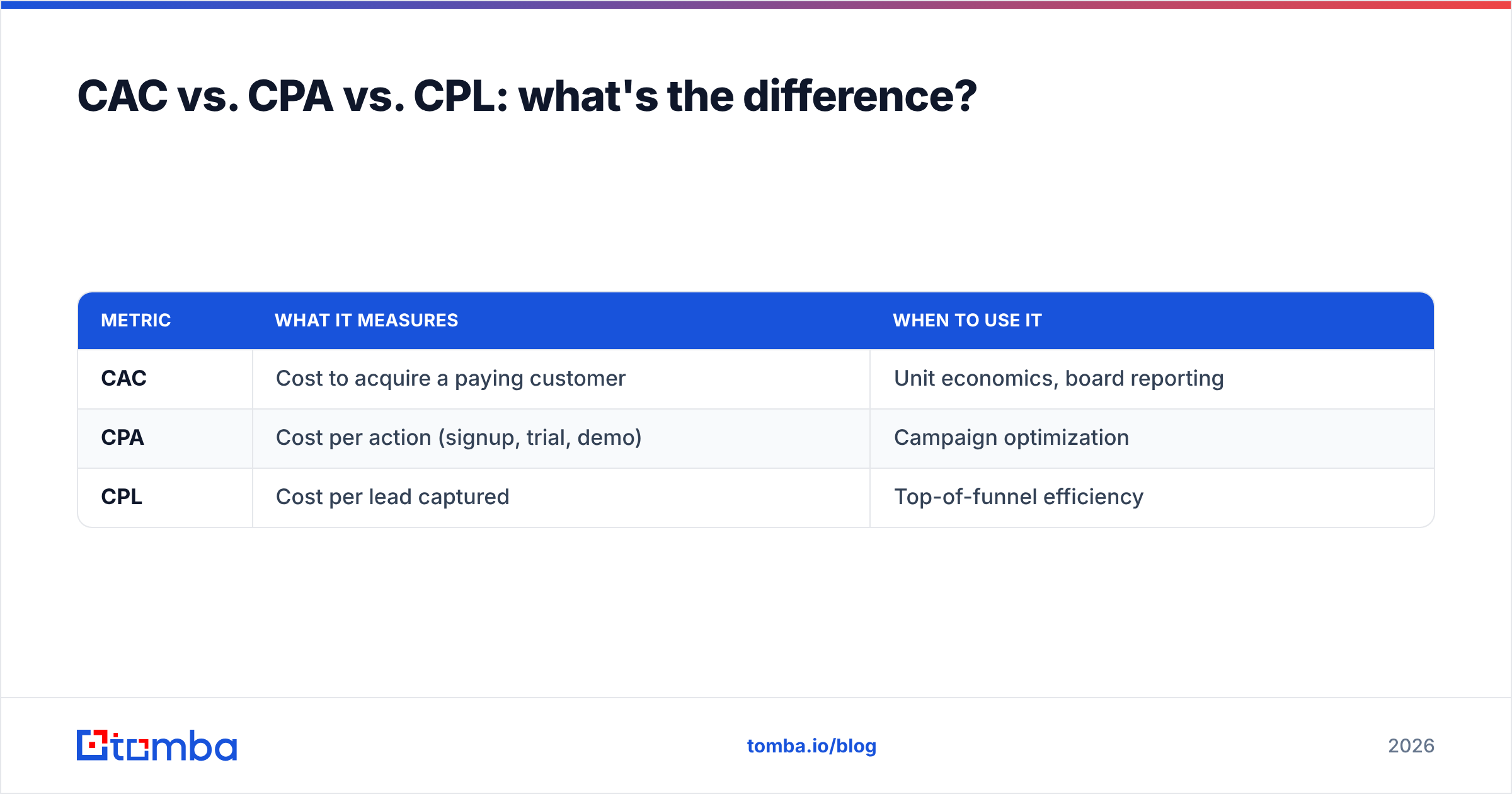
These three get used interchangeably and they should not be.
| Metric | What it measures | When to use it |
|---|---|---|
| CAC | Cost to acquire a paying customer | Unit economics, board reporting |
| CPA | Cost per action (signup, trial, demo) | Campaign optimization |
| CPL | Cost per lead captured | Top-of-funnel efficiency |
CPL and CPA are upstream signals; CAC is the outcome that pays your bills. A cheap CPL that never converts to a customer produces an expensive CAC. Optimize the upstream metrics, but always tie them back to the customer that actually closed.
How often should you review CAC?#
Review blended CAC monthly for trend-spotting and channel-level CAC quarterly for decisions. Monthly numbers are too noisy to reallocate budget on, but they surface direction early. Quarterly segmentation is where you decide which channels to scale, fix, or kill. Pair every CAC review with LTV and payback so you never optimize one at the expense of the other — cutting CAC by starving your best channel is an own goal.
Closing: control CAC at the source#
CAC is not a vanity metric you report and forget. It is the pulse of whether your growth is building a business or draining one. The teams that win in 2026 are not the ones spending the most — they are the ones wasting the least, because every dollar lands on a real, reachable, qualified buyer.
That starts with your data. If your reps are chasing bounced emails and wrong contacts, no amount of clever campaign optimization will fix your CAC. Start the Tomba Email Finder free tier, verify and enrich your lists before you spend, and watch the wasted acquisition spend disappear from your numerator. Lower CAC is mostly a data problem — solve it there first.
Related guides#
Ready to find emails that actually work?
Join 150,000+ professionals who stopped guessing and started sending. Free credits on signup — no credit card required.
Get the Tomba newsletter
Practical outbound tactics and product updates — once every two weeks.
About the author