The Customer Acquisition Cost Formula, Explained for 2026
The customer acquisition cost formula looks simple until hidden costs, blended channels, and payback windows enter the picture. Here is how to calculate CAC correctly, with worked examples and the mistakes that quietly break the math.
You can recite the customer acquisition cost formula in one breath: total sales and marketing spend divided by new customers. The trouble starts the moment you try to plug in real numbers. Which costs count? Over what window? Do you blend paid and organic? Get those calls wrong and your CAC looks great on a slide while your bank balance says otherwise.
This guide walks through the formula, the variables people forget, worked examples, and the payback and LTV:CAC ratios that turn a raw number into a decision.
TL;DR#
- The core customer acquisition cost formula is: CAC = (total sales + marketing spend in a period) ÷ (new customers acquired in that period).
- Most CAC numbers are wrong because teams exclude salaries, tools, and overhead — or mismatch the spend window with the customer window.
- Blended CAC hides your best and worst channels. Segment by channel and by paid vs. organic to see what actually scales.
- CAC means nothing alone. Pair it with LTV:CAC ratio (aim for 3:1+) and CAC payback period (aim under 12 months for SMB SaaS).
- Cheaper, more accurate lead data lowers CAC at the top of the funnel — fewer wasted touches on bad contacts.
What is the customer acquisition cost formula?#
Customer acquisition cost (CAC) is what you spend, on average, to turn a stranger into a paying customer. The formula is deliberately blunt:
CAC = Total Sales & Marketing Costs ÷ Number of New Customers Acquired
Pick a period — a month, quarter, or year — add up everything you spent to win business, and divide by the customers you actually closed in that same period. If you spent $50,000 last quarter and signed 100 new customers, your CAC is $500.
That is the whole formula. The skill is not the arithmetic; it is deciding what belongs in the numerator and how you count the denominator. This is where finance, marketing, and revenue operations often quietly disagree — and where a "healthy" CAC turns out to be fiction.

Wait, it's all customer acquisition cost? Always has been — once you count the true inputs.
What costs go into the CAC formula?#
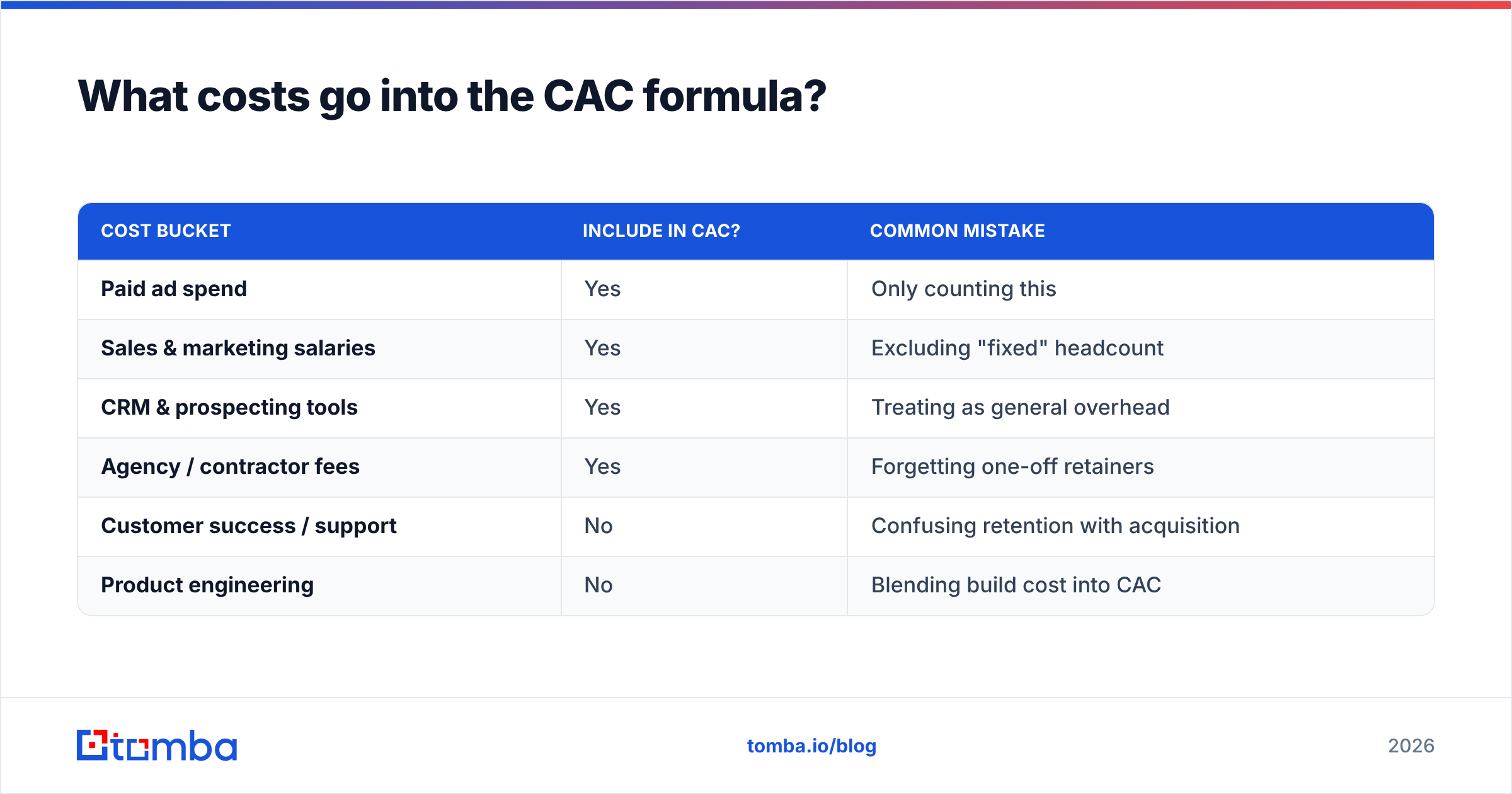
Here is the part spreadsheets get wrong. Your numerator is not just ad spend. A defensible CAC includes every cost tied to winning customers:
- Paid media — Google, Meta, LinkedIn, retargeting, sponsorships.
- Salaries and commissions — the loaded cost of your marketing and sales teams, including SDRs, AEs, and their bonuses.
- Software and tools — CRM, sales engagement, data enrichment, analytics, and your ad platforms' fees.
- Agencies and contractors — freelancers, creative shops, consultants.
- Content and creative production — the cost to make what you distribute.
- Overhead allocation — the slice of rent, equipment, and admin that supports the go-to-market team.
Leave out salaries and tools and you will understate CAC by 40–60% in most SaaS teams. That is not a rounding error; it is the difference between a channel that prints money and one that burns it.
A quick reference table#
| Cost bucket | Include in CAC? | Common mistake |
|---|---|---|
| Paid ad spend | Yes | Only counting this |
| Sales & marketing salaries | Yes | Excluding "fixed" headcount |
| CRM & prospecting tools | Yes | Treating as general overhead |
| Agency / contractor fees | Yes | Forgetting one-off retainers |
| Customer success / support | No | Confusing retention with acquisition |
| Product engineering | No | Blending build cost into CAC |
The line to hold: if the cost exists to acquire customers, it counts. If it exists to serve or retain them, it belongs in your cost to serve, not your CAC.
How do you calculate CAC? A worked example#
Say you run a B2B SaaS team and you want Q1 CAC.
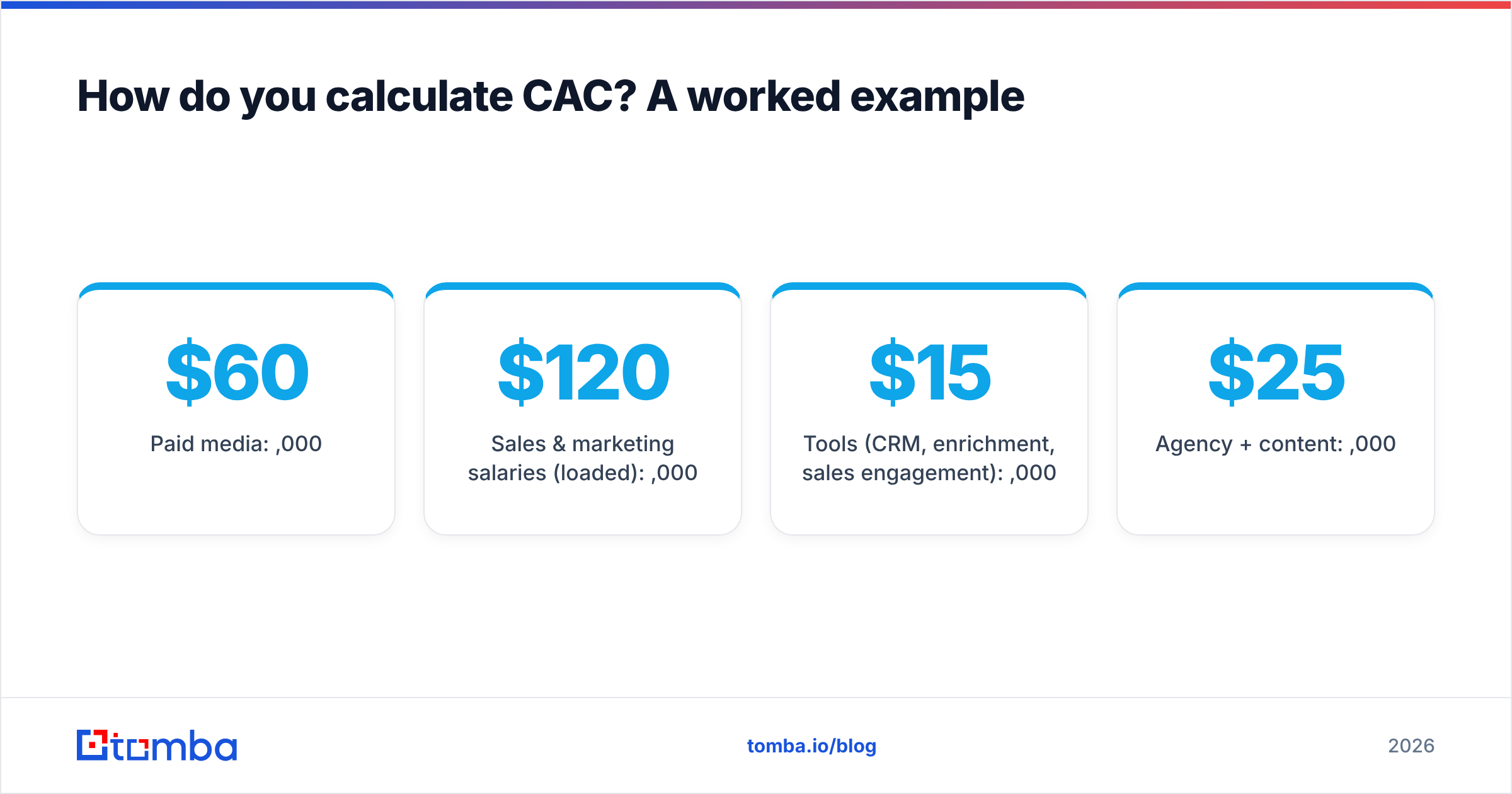
- Paid media: $60,000
- Sales & marketing salaries (loaded): $120,000
- Tools (CRM, enrichment, sales engagement): $15,000
- Agency + content: $25,000
- Total acquisition cost: $220,000
- New customers closed in Q1: 110
CAC = $220,000 ÷ 110 = $2,000 per customer.
Now watch what happens if you only counted paid media, the way many dashboards default to: $60,000 ÷ 110 = $545. Same quarter, same customers, a number that is 3.7x too optimistic. Budget decisions made on the $545 figure will overspend on channels that are actually underwater.
One more wrinkle: timing. If your sales cycle is 90 days, the customers you close in Q1 were largely generated by Q4 spend. For long-cycle B2B, align the spend window with the period that actually produced the deals, or use a trailing average so you are not dividing this quarter's cost by last quarter's wins.
Blended CAC vs. paid CAC: which should you use?#
Use both, because they answer different questions.
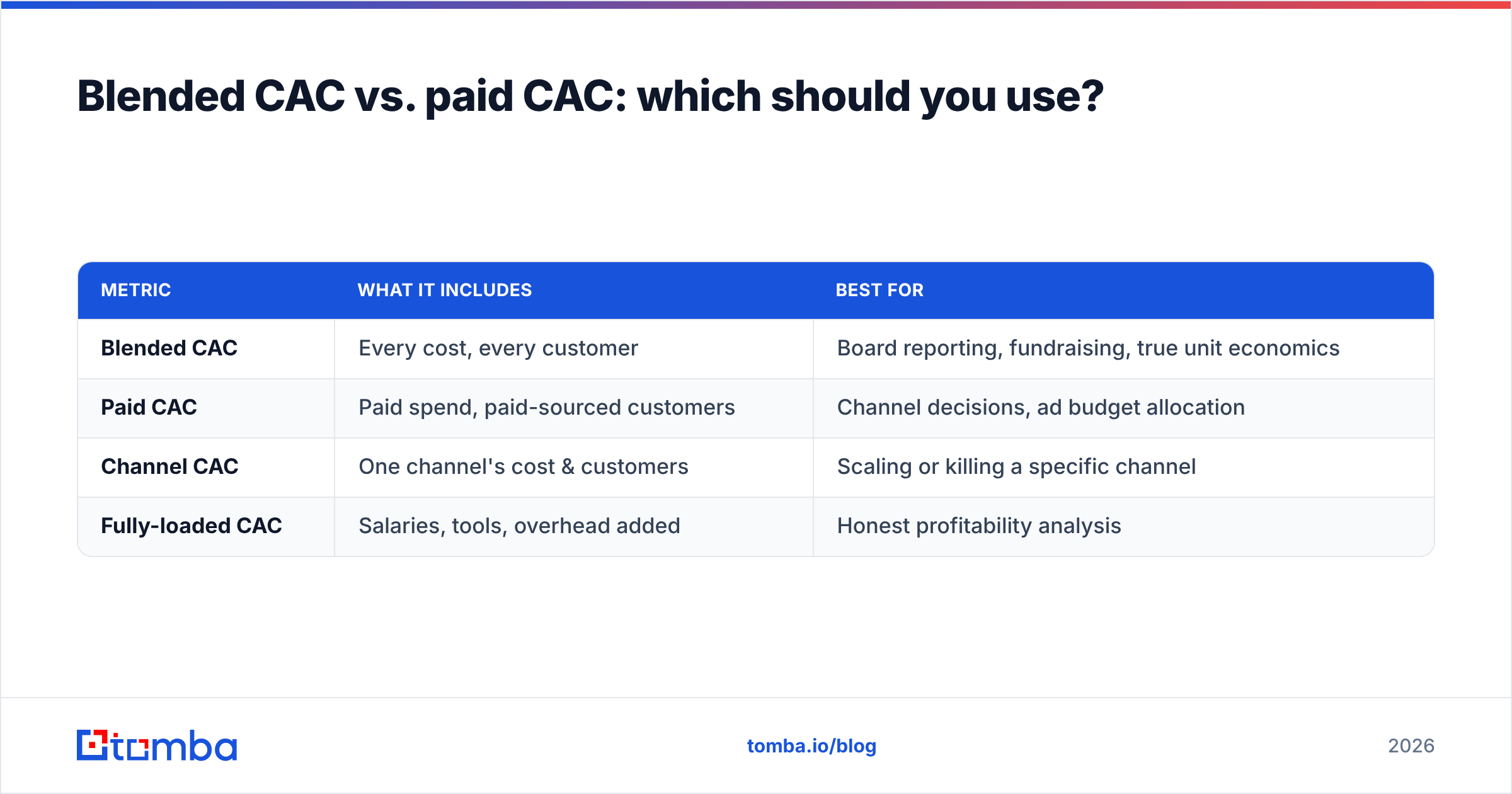
- Blended CAC divides all acquisition cost by all new customers, including the ones who arrived through organic search, referrals, and word of mouth. It tells you the true, all-in economics of the business.
- Paid CAC divides only paid spend by only the customers paid channels produced. It tells you whether your ad engine works.
| Metric | What it includes | Best for |
|---|---|---|
| Blended CAC | Every cost, every customer | Board reporting, fundraising, true unit economics |
| Paid CAC | Paid spend, paid-sourced customers | Channel decisions, ad budget allocation |
| Channel CAC | One channel's cost & customers | Scaling or killing a specific channel |
| Fully-loaded CAC | Salaries, tools, overhead added | Honest profitability analysis |
The failure mode is reporting a low blended CAC (propped up by free organic traffic) while your paid channels quietly run at a loss. Segment it, or you will scale the wrong thing.
What is a good CAC — and how do you know?#
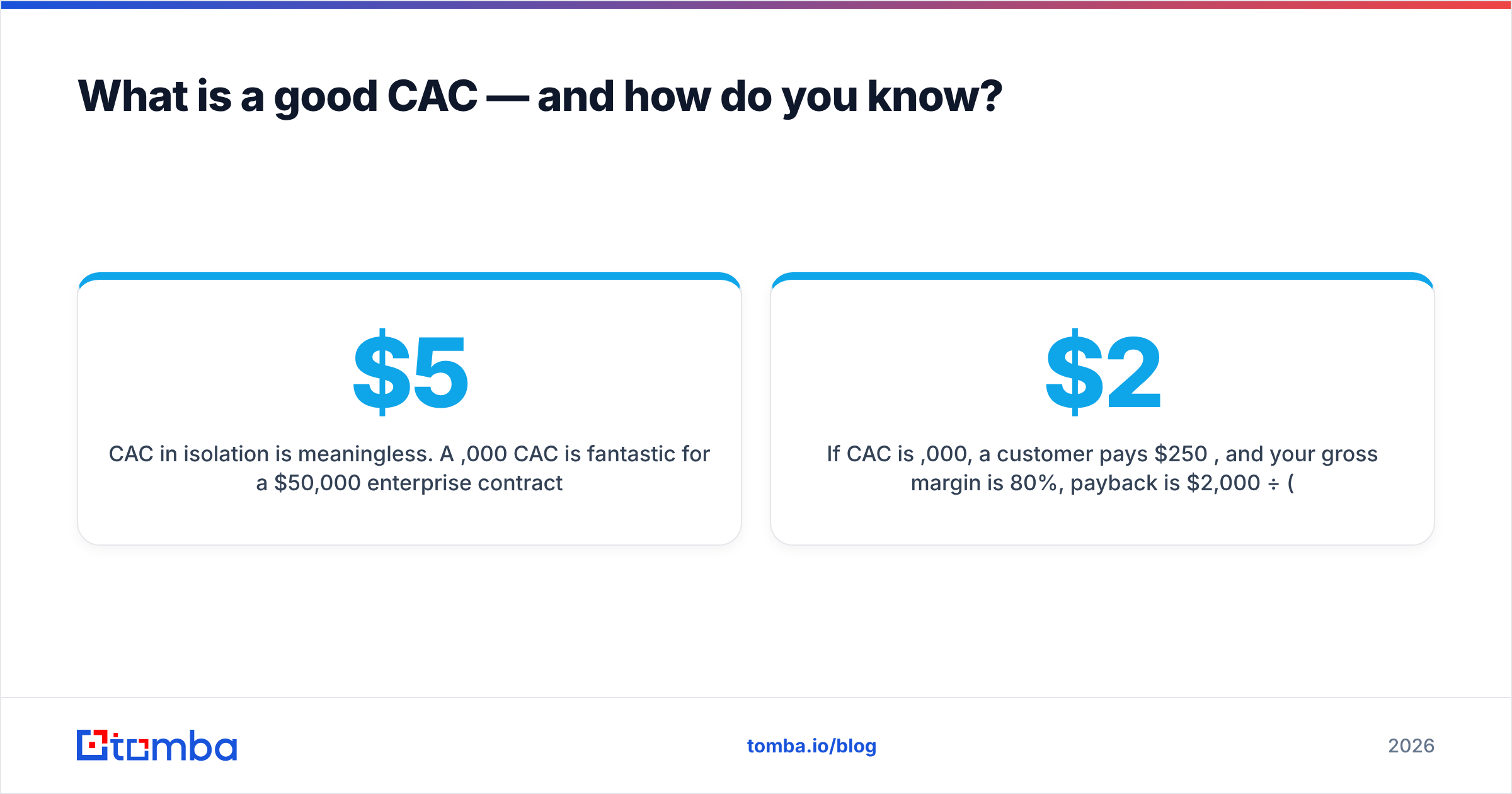
CAC in isolation is meaningless. A $5,000 CAC is fantastic for a $50,000 enterprise contract and catastrophic for a $30/month tool. Two ratios give it context.
LTV:CAC ratio#
Lifetime value divided by CAC tells you whether each customer is worth what you paid.
LTV:CAC = Customer Lifetime Value ÷ Customer Acquisition Cost
The rough industry benchmark, popularized across SaaS investing, is 3:1 — you should earn about three dollars of lifetime gross profit for every dollar of acquisition cost. Below 1:1, you lose money on every customer. Above 5:1, you are probably under-investing in growth and leaving the market to competitors.
CAC payback period#
This is how many months of gross margin it takes to earn CAC back.
CAC Payback = CAC ÷ (Monthly Recurring Revenue per customer × Gross Margin %)
If CAC is $2,000, a customer pays $250/month, and your gross margin is 80%, payback is $2,000 ÷ ($250 × 0.80) = 10 months. For SMB SaaS, under 12 months is healthy; for enterprise, 18–24 can still work because contracts are longer and stickier. The shorter the payback, the faster you can recycle cash into the next cohort.

Strong pipeline runs on clean, verified data. Weak pipeline runs on lists that never should have passed a bounce check.
How do you lower customer acquisition cost?#
You can attack CAC from two directions: spend less to acquire, or convert more of what you acquire. The highest-leverage moves usually sit at the very top of the funnel, before a rep ever touches a lead.
- Stop paying to chase bad contacts. Every bounced email, wrong number, and dead lead is acquisition cost with zero chance of return. Cleaning your inputs with an email verifier before outreach cuts wasted sends and protects your sender reputation.
- Improve targeting, not just volume. A smaller list of well-fit accounts beats a huge list of maybes. Precise B2B database filtering means fewer touches per closed deal.
- Shorten the sales cycle. Faster cycles mean the same salary spend produces more customers in the period — mechanically lowering CAC.
- Raise conversion at each stage. Better response rate, tighter qualification, and cleaner handoffs all shrink the denominator's cost.
- Lean on lower-CAC channels. Referrals and organic almost always beat paid on a per-customer basis; fund them deliberately instead of treating them as free luck.
The unglamorous truth: a large share of "acquisition cost" in outbound teams is spent contacting people who were never reachable. Accurate contact data is one of the few levers that lowers CAC and raises conversion at the same time. Tools like an email finder exist to remove that waste — and industry directories like G2 and Capterra are useful for comparing vendors on verified accuracy rather than marketing claims.
Common mistakes that break your CAC math#
Even careful teams trip on the same handful of errors:
- Excluding fully-loaded costs. Salaries, tools, and overhead left out inflate how efficient you look. HubSpot's own marketing metrics guidance stresses including these for a true figure.
- Mismatched time windows. Dividing this month's spend by this month's customers in a long-cycle business double-counts nothing and attributes wrongly. Use trailing averages.
- Reporting only blended CAC. It masks channel-level losses.
- Ignoring the discount and free-trial tail. Customers acquired via heavy discounting often have lower LTV, quietly worsening your real LTV:CAC.
- Treating CAC as static. It drifts as channels saturate, competition bids up ad costs, and your data decays. Recalculate quarterly.
Frequently asked questions#
What is the simplest customer acquisition cost formula? CAC equals total sales and marketing spend for a period divided by the number of new customers acquired in that period. If you spent $50,000 and gained 100 customers, CAC is $500.
Does CAC include salaries? Yes. A fully-loaded CAC includes the loaded salaries and commissions of everyone on the sales and marketing team, plus tools and overhead. Excluding them is the most common reason CAC looks artificially low.
What is a good LTV:CAC ratio? Around 3:1 is the widely cited healthy benchmark for SaaS. Below 1:1 you lose money per customer; well above 5:1 may signal you are under-investing in growth.
What is a good CAC payback period? Under 12 months is strong for SMB SaaS. Enterprise businesses can tolerate 18–24 months because contracts are larger and retention is higher.
How is CAC different from CPA? Cost per acquisition (CPA) usually measures the cost of a mid-funnel action like a lead or signup. CAC measures the cost of an actual paying customer. CAC is always the stricter, more meaningful number.
Turn accurate data into a lower CAC#
The fastest way to move CAC is to stop spending on contacts that were never going to convert. Feed your funnel with verified, well-targeted contact data and every downstream dollar works harder — fewer bounces, fewer dead dials, more closed deals per unit of spend.
Tomba's Email Finder gives you accurate, source-backed professional emails so your sales and marketing budget lands on real, reachable buyers instead of guesses. Start on the free tier (25 searches a month), then scale to a plan that fits — see current Tomba pricing from $49/month. Clean inputs are the cheapest CAC reduction you will ever buy.
Related guides#
Ready to find emails that actually work?
Join 150,000+ professionals who stopped guessing and started sending. Free credits on signup — no credit card required.
Get the Tomba newsletter
Practical outbound tactics and product updates — once every two weeks.
About the author