Customer Acquisition Cost Marketing: The 2026 Playbook
Customer acquisition cost quietly decides whether your growth is profitable or a slow leak. Here's how to measure CAC correctly, benchmark it, and cut it without starving your pipeline.
TL;DR
- Customer acquisition cost (CAC) is the fully loaded cost of turning a stranger into a paying customer — ad spend, salaries, tools, and overhead divided by new customers won.
- A "good" CAC only makes sense next to lifetime value: aim for an LTV:CAC ratio of 3:1 or better and a payback period under 12 months.
- Most teams underprice CAC because they forget salaries, software, and content costs. The real number is usually 2–3x the "media-only" figure.
- The fastest CAC wins come from higher conversion and better targeting, not just cheaper clicks — and from cutting waste in how you source contact data.
- Owned, first-party prospecting (finding and enriching your own leads) is one of the cheapest acquisition channels you can build.
Customer acquisition cost marketing is the discipline of measuring, benchmarking, and lowering what it costs to win each new customer — and then reinvesting the savings into channels that scale. Get it right and every dollar of growth compounds. Get it wrong and you can hit your revenue target while quietly going broke.
This guide walks through how to calculate CAC properly, what healthy benchmarks look like in 2026, why paid channels inflate it, and the specific levers that bring it down without shrinking your pipeline.
What is customer acquisition cost in marketing?#
Customer acquisition cost is the total sales and marketing spend required to acquire one new customer over a given period. The formula is deliberately simple:
CAC = (Total Sales + Marketing Spend) ÷ New Customers Acquired
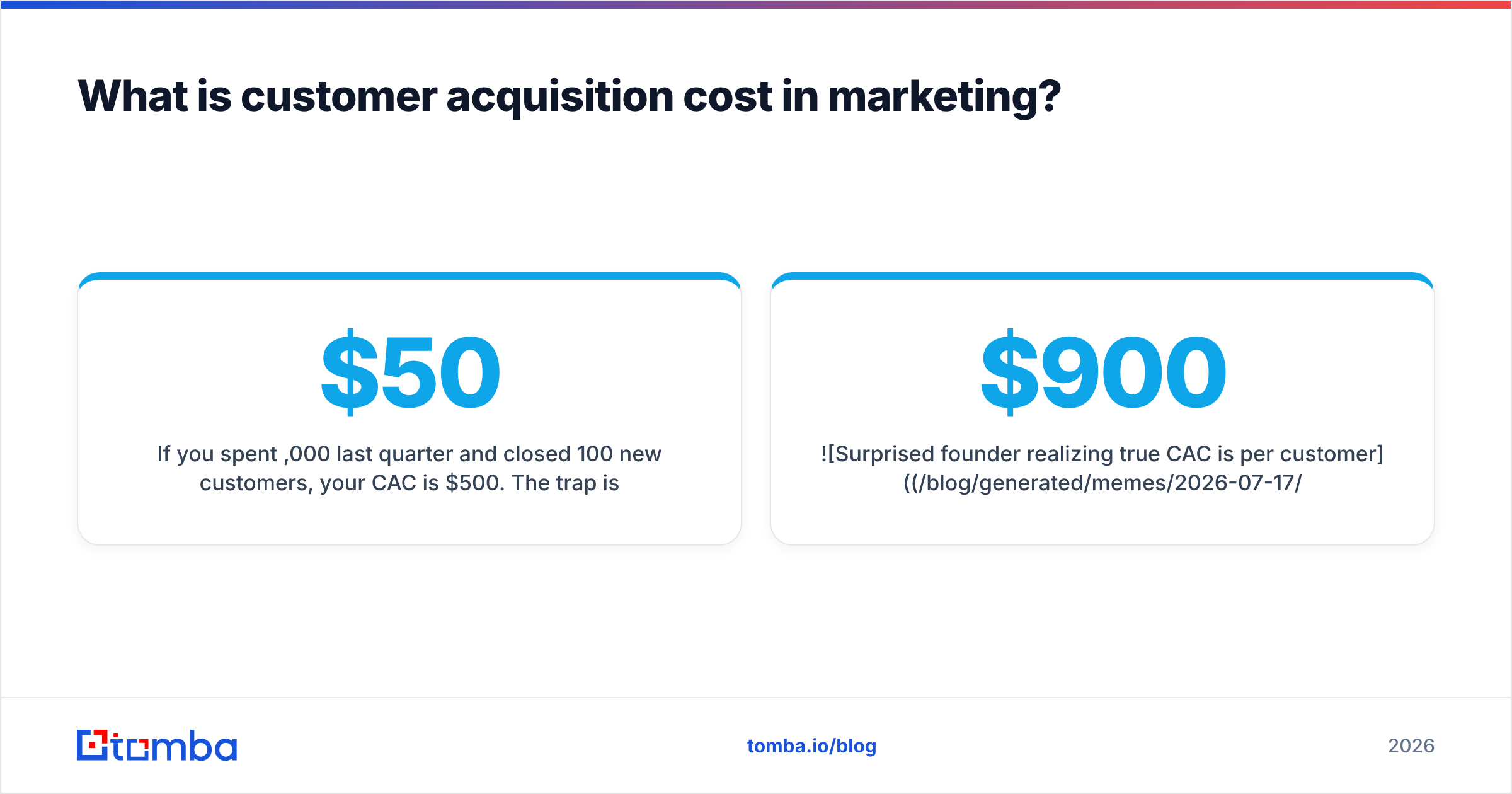
If you spent $50,000 last quarter and closed 100 new customers, your CAC is $500. The trap is in the numerator. "Total spend" is not just your ad budget — it's the fully loaded cost of acquisition:
- Media spend — paid search, paid social, display, sponsorships.
- Salaries and commissions — the SDRs, AEs, marketers, and designers who touch acquisition.
- Software and tools — your CRM, outreach platform, data enrichment, and analytics stack.
- Content and creative — production costs for the assets that drive demand.
- Overhead allocation — the slice of rent, management, and admin that supports the team.
Skip any of these and your CAC looks artificially healthy. That's the single most common reason a "profitable" campaign turns out to lose money once you load in the real costs. For a formal definition and its role in unit economics, see the overview on Wikipedia's customer acquisition cost entry.
Blended CAC vs. paid CAC#
Two numbers matter, and mixing them up causes bad decisions:
- Blended CAC divides all spend by all new customers, including the ones who arrived organically. It flatters you because free traffic hides in the denominator.
- Paid CAC isolates the customers won through paid channels only. This is the honest cost of buying growth and the number your CFO should watch.
Track both. Blended CAC tells you overall efficiency; paid CAC tells you whether your acquisition engine scales when you pour money into it.
Why does customer acquisition cost keep rising?#
CAC has climbed steadily for most B2B companies, and the drivers are structural, not temporary. Ad auctions are more crowded, buying committees are larger, and privacy changes have made paid targeting blunter and more expensive. According to HubSpot's research on sales and marketing benchmarks, longer sales cycles and more decision-makers per deal both push the cost of each closed customer upward.
There are three forces at work:
- Auction inflation. More advertisers bidding on the same keywords and audiences means you pay more for the same click.
- Signal loss. Cookie deprecation and opt-out defaults reduce the targeting precision that once made paid channels efficient.
- Committee buying. In B2B, a single deal now involves 6–10 stakeholders on average, so you're effectively acquiring a group, not a person.
The takeaway: if your entire acquisition strategy rents attention from ad platforms, your CAC is exposed to forces you don't control. The companies keeping CAC flat are the ones building owned channels — SEO, community, referral, and first-party outbound — alongside paid.
How do you calculate a healthy LTV:CAC ratio?#
CAC in isolation is meaningless. A $2,000 CAC is a disaster for a $50/month product and a bargain for a $100,000 enterprise contract. The metric that gives CAC context is customer lifetime value (LTV) — the total gross profit you earn from a customer before they churn.
LTV:CAC ratio = Lifetime Value ÷ Customer Acquisition Cost
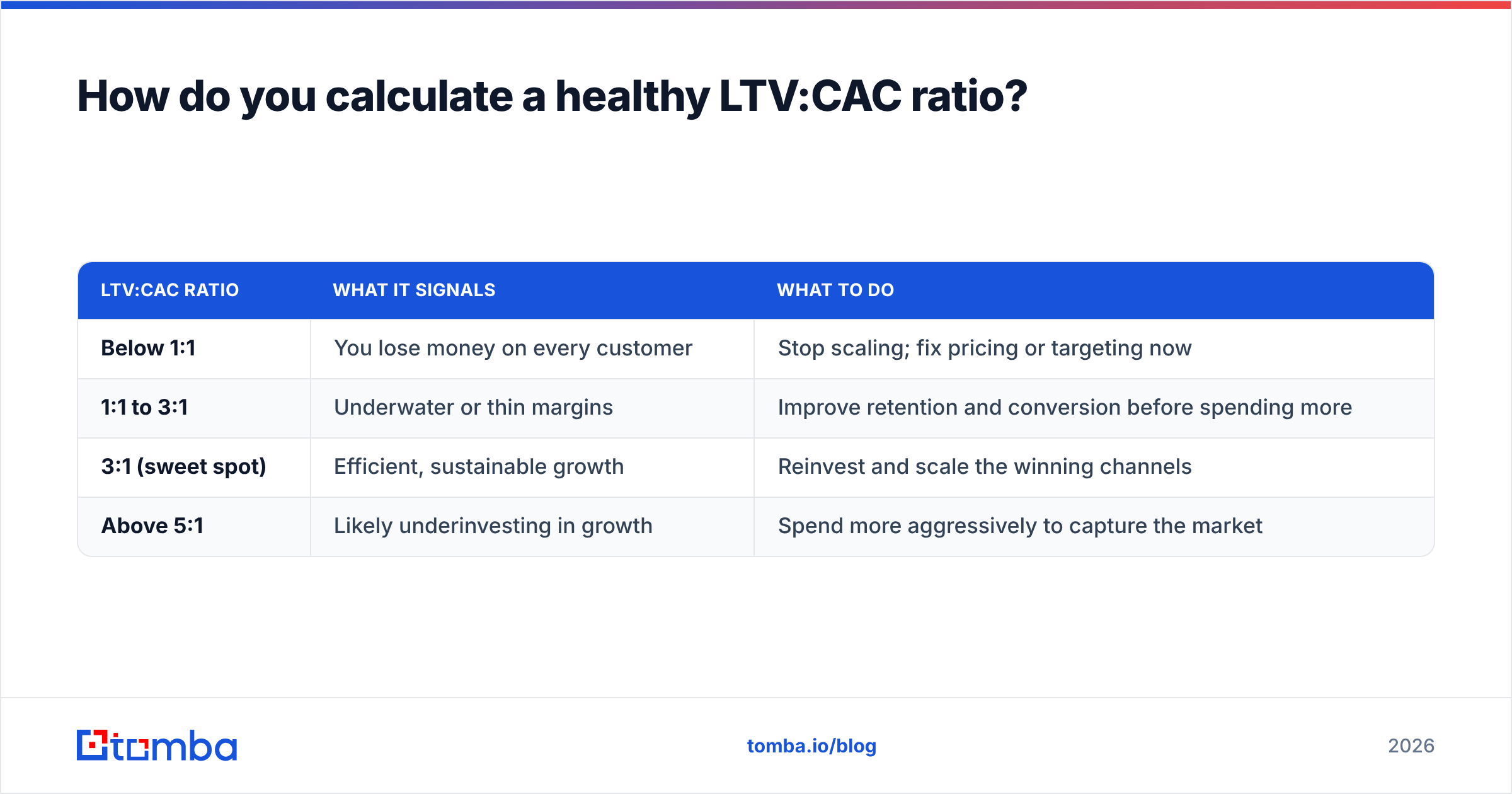
The widely used benchmark is 3:1 — for every dollar you spend acquiring a customer, you want three dollars of lifetime value back. Here's how to read the ranges:
| LTV:CAC ratio | What it signals | What to do |
|---|---|---|
| Below 1:1 | You lose money on every customer | Stop scaling; fix pricing or targeting now |
| 1:1 to 3:1 | Underwater or thin margins | Improve retention and conversion before spending more |
| 3:1 (sweet spot) | Efficient, sustainable growth | Reinvest and scale the winning channels |
| Above 5:1 | Likely underinvesting in growth | Spend more aggressively to capture the market |
A ratio that's too high isn't a trophy — it usually means you're leaving growth on the table by being overly cautious with spend. The other half of the equation is payback period: how many months of revenue it takes to recoup CAC. Under 12 months is healthy for most B2B SaaS; under 6 is excellent.
What is a good CAC benchmark by channel?#
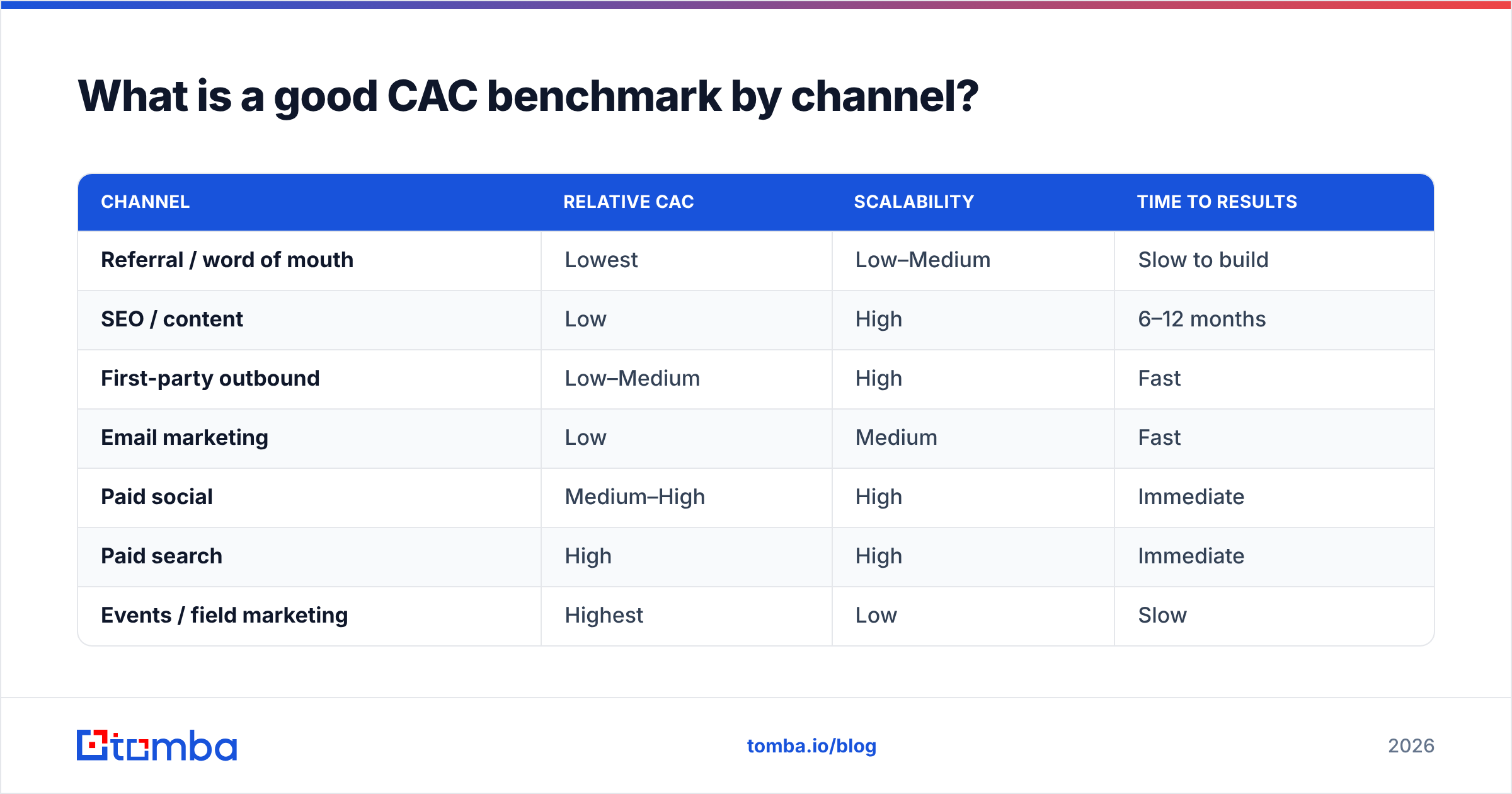
CAC varies enormously by channel, and the differences drive where you should invest. The table below shows representative directional ranges — treat them as a framework, not gospel, since your industry and ACV shift the absolute numbers.
| Channel | Relative CAC | Scalability | Time to results |
|---|---|---|---|
| Referral / word of mouth | Lowest | Low–Medium | Slow to build |
| SEO / content | Low | High | 6–12 months |
| First-party outbound | Low–Medium | High | Fast |
| Email marketing | Low | Medium | Fast |
| Paid social | Medium–High | High | Immediate |
| Paid search | High | High | Immediate |
| Events / field marketing | Highest | Low | Slow |
Notice the pattern: the cheapest channels (referral, SEO, owned outbound) take longer to build but compound over time, while the most expensive (paid search, events) deliver instantly but never get cheaper. A durable low-CAC strategy front-loads investment into owned channels so you're not permanently renting demand.
This is exactly where a disciplined prospecting motion earns its keep. When your team sources accurate contact data in-house instead of buying inflated leads or paying per-click, the marginal cost of each new conversation drops sharply.

How can you lower customer acquisition cost without shrinking pipeline?#
Cutting CAC by cutting spend is easy and usually wrong — you just shrink the pipeline. The goal is to lower cost per acquired customer while holding or growing volume. Five levers do most of the work:
- Improve conversion rate. Doubling landing-page or demo-to-close conversion halves CAC with zero extra spend. Audit every step of the funnel and fix the biggest leak first.
- Tighten targeting. Spending on the wrong accounts is the quietest CAC killer. Build a sharp ICP and only pursue accounts that match it — precision beats volume.
- Shift budget to owned channels. Move marginal dollars from paid ads into SEO, referral, and first-party outbound that compound instead of resetting to zero each month.
- Cut data waste. Bounced emails, wrong numbers, and duplicate records burn rep time and inflate cost per meeting. Clean, verified data means fewer wasted touches.
- Automate the repetitive work. Every hour a rep spends manually hunting for contact details is CAC with no upside. Tooling that finds and verifies contacts in bulk frees that time for selling.
Levers 4 and 5 are where most teams overlook easy savings. If half your outbound emails bounce, you're paying full salary cost for half the reach. Using a reliable email verifier before you send protects sender reputation and keeps your cost-per-reply low. And building lists with a bulk lead generation workflow — rather than paying premium per-lead prices — turns prospecting into one of your cheapest channels.
The hidden CAC tax of bad data#
Bad contact data is a CAC multiplier that rarely shows up in a dashboard. Consider a team running outbound to 10,000 prospects:
- At a 30% bounce rate, 3,000 emails never land — but you paid to research and load every one.
- Bounces damage domain reputation, which lowers deliverability on the good addresses too, compounding the loss.
- Reps chase dead records, so cost-per-meeting climbs even though "activity" looks healthy.
Fixing data quality is one of the few CAC levers that improves results and reduces cost at the same time. Sourcing accurate emails at the top of the funnel with a purpose-built email finder, then verifying before send, removes the tax entirely.
How does first-party prospecting reduce CAC?#
First-party prospecting means finding and reaching your ideal customers directly, using data you source and own, rather than buying leads or renting audiences. It's structurally cheaper for three reasons:
- No per-lead premium. Marketplaces and lead vendors charge a markup on every contact. Sourcing your own contacts with a domain search removes that middleman margin.
- No auction inflation. You're not bidding against competitors for the same click, so costs don't rise as the market gets crowded.
- Compounding assets. The lists, playbooks, and verified data you build stay yours and keep paying off, unlike a paid campaign that stops the moment you stop funding it.
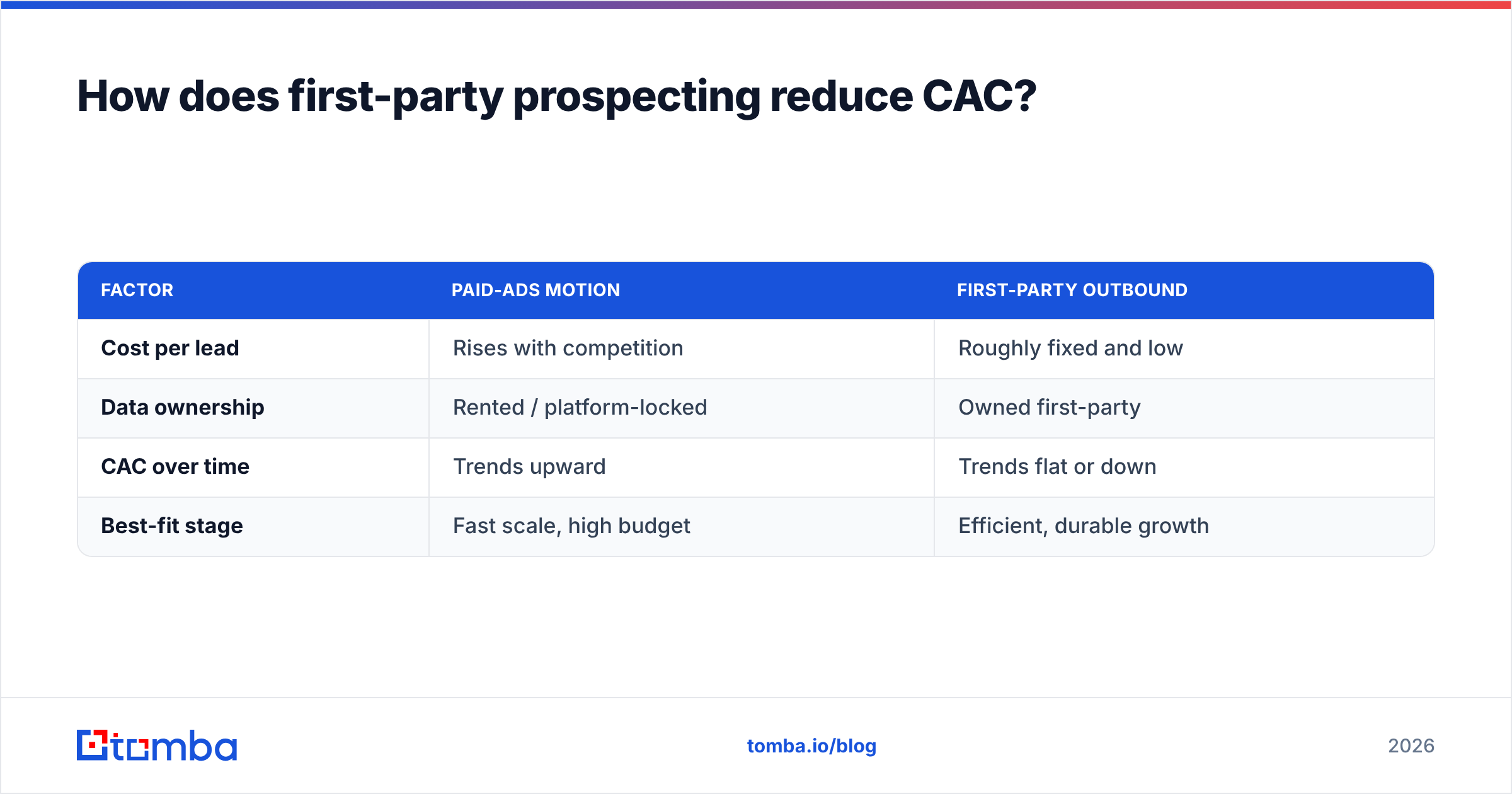
The economics get clearer when you compare a paid-heavy motion against an owned-outbound motion at the same pipeline target:
| Factor | Paid-ads motion | First-party outbound |
|---|---|---|
| Cost per lead | Rises with competition | Roughly fixed and low |
| Data ownership | Rented / platform-locked | Owned first-party |
| CAC over time | Trends upward | Trends flat or down |
| Best-fit stage | Fast scale, high budget | Efficient, durable growth |
None of this means abandoning paid channels — they're essential for speed and scale. It means balancing them with owned motions so your blended CAC stays defensible when ad costs spike. If you want to sanity-check where your budget goes, review transparent tools with public Tomba pricing against the per-lead cost of your current data vendors; the math often favors owning the workflow. Independent reviews on platforms like G2 can help you compare providers on accuracy and price before you commit.
What CAC mistakes should you avoid?#
A few recurring errors quietly wreck CAC math:
- Ignoring salaries. Media-only CAC is a fantasy number. Load in fully burdened team costs or you'll scale a channel that's actually unprofitable.
- Optimizing for leads, not customers. Cheap leads that never convert raise CAC even as your "cost per lead" falls. Always measure to the closed customer.
- Judging channels too early. SEO and referral look expensive in month one and cheap in month twelve. Give compounding channels time before you cut them.
- Chasing CAC without LTV. Slashing CAC by targeting bargain-hunter customers who churn fast destroys LTV and worsens your ratio. Optimize the ratio, not the raw number.
- Letting data rot. Contact data decays roughly 2–3% per month. Stale records inflate CAC every quarter you ignore them.
Fix these and your CAC numbers become trustworthy enough to actually steer the business.
Frequently asked questions#
What is a good customer acquisition cost? There's no universal figure — a good CAC is one that produces an LTV:CAC ratio of at least 3:1 with a payback period under 12 months. The absolute dollar amount depends entirely on your average contract value and margins.
How is CAC different from cost per lead? Cost per lead measures spend per lead generated; CAC measures spend per customer acquired. Because most leads never buy, CAC is always higher — and it's the number that determines profitability.
How often should I recalculate CAC? Monthly for fast-moving paid channels and quarterly for a fuller blended view. Recalculate whenever you change pricing, launch a new channel, or shift budget significantly.
Can better data really lower CAC? Yes. Verified, accurate contact data reduces bounces, protects deliverability, and cuts the wasted rep hours that inflate cost per meeting — all of which lower CAC directly.
Put your CAC on a diet#
The cheapest customer is the one you reach directly, with accurate data, before your competitors are bidding against you in an ad auction. That's the core of lowering customer acquisition cost: shift weight from rented demand to owned prospecting, kill the data waste that silently doubles your costs, and measure everything to the closed customer, not the click.
If your acquisition math is being dragged down by bounced emails and expensive per-lead vendors, start at the top of the funnel. The Tomba Email Finder lets you source accurate professional emails by name, company, or domain and verify them before you send — turning first-party prospecting into one of the lowest-CAC channels you can build. Start on the free tier, prove the unit economics, and scale the channel that actually gets cheaper over time.
Related guides#
// get started
Find, verify and enrich your first contacts today
Start on the free plan with 25 searches a month, then scale when your team is ready.
Free plan · No credit card required · GDPR & CCPA
// about the author