Customer Centric Selling: A Practical 2026 Sales Playbook
Customer-centric selling flips the script: the buyer's problem leads, your product follows. Here's a concrete 2026 framework, a product-vs-customer-centric comparison, real examples, and the data workflow that makes it repeatable.

Customer centric selling is not a slogan for a sales-kickoff banner. It is a repeatable way to run deals. The buyer's situation drives every message, meeting, and next step. Your product enters the conversation only after it maps to a problem the buyer already cares about.
If your reps still open with a feature tour, you are leaving money on the table. Below is a no-fluff 2026 playbook. You will learn what customer centric selling means, how it differs from the product-led pitch most teams still run, and the workflow that makes it stick.
TL;DR#
- Customer centric selling organizes the whole sale around the buyer's problem, timing, and decision process — not your feature list.
- It beats product-centric selling on win rate, deal size, and retention. It lowers buyer risk instead of amplifying seller hype.
- The mechanics are learnable. Research first. Diagnose before you prescribe. Quantify the problem. Then co-build the business case.
- It falls apart without clean prospect data. You cannot personalize outreach to 500 accounts if half your contacts bounce.
- Pair the method with accurate contact data — verified emails, enrichment, and direct dials — so reps sell instead of scrubbing lists.
What is customer centric selling?#
Customer centric selling is a sales approach that anchors every stage of the deal to the buyer. Their goals, constraints, and buying process lead. The seller's product and quota clock do not. The term was popularized by the 2003 book CustomerCentric Selling (Michael Bosworth, John Holland, and colleagues). The underlying idea is older than any framework: people buy to solve problems, and they trust sellers who understand the problem better than they do.
In practice it means three shifts:
- From pitching to diagnosing. You ask before you tell. Discovery is the product, not a warm-up.
- From features to outcomes. You translate "we have X" into "here is the specific result X produces in your situation."
- From closing to enabling. You help the buyer build an internal case and navigate their own committee, instead of pressuring them toward your close date.
None of this means being passive or "nice." Customer-centric reps are often more direct. They will tell a prospect the timing is wrong or the fit is poor. Their credibility comes from honesty about the buyer's problem, not from happy-ears optimism.

How is it different from product-centric selling?#
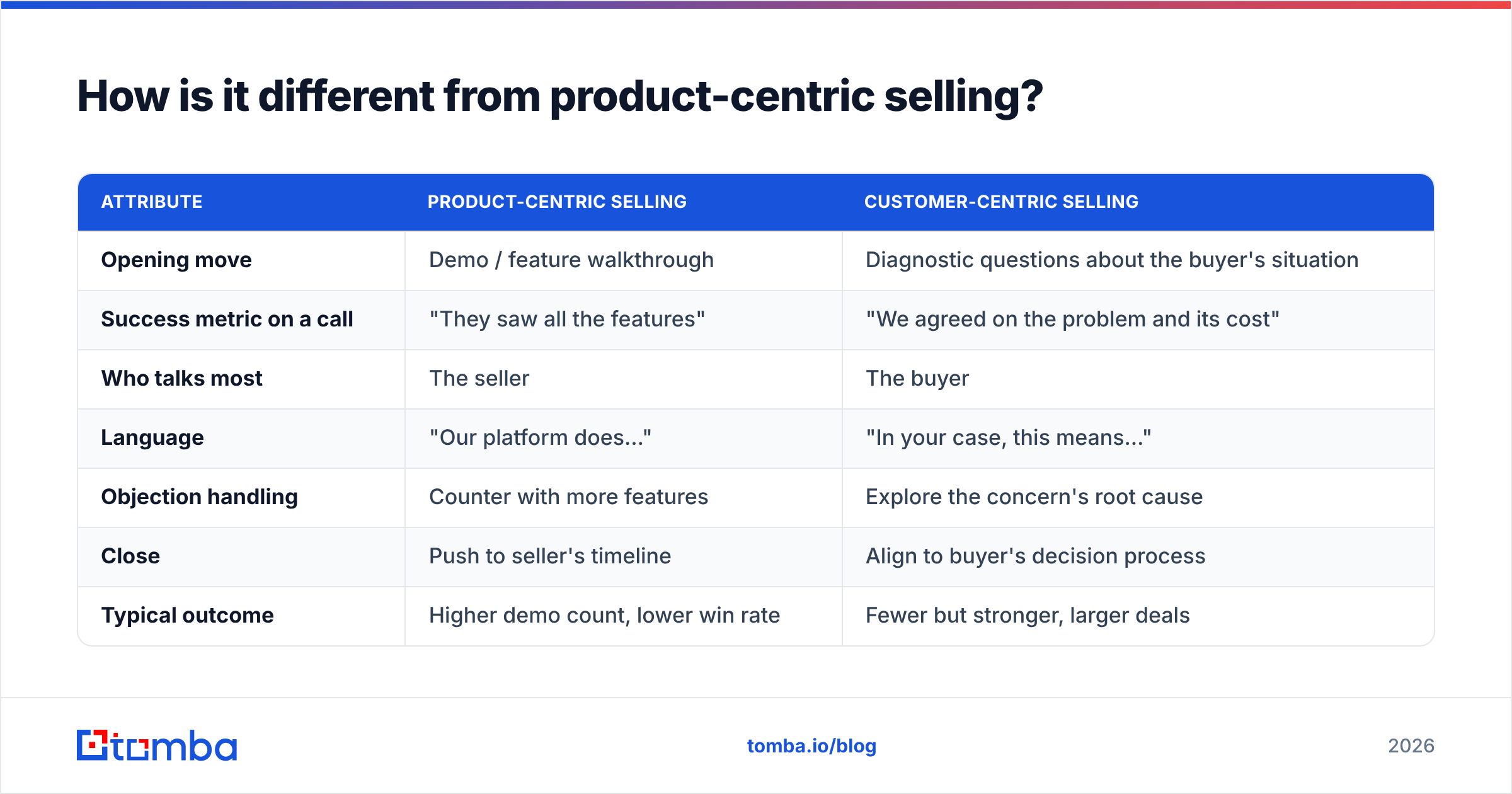
The fastest way to feel the difference is to watch two reps handle the same call. The product-centric rep talks 80% of the time. The customer centric rep makes the buyer talk 80% of the time. Then the rep reflects the problem back with more precision than the buyer used.
Here is the contrast laid out attribute by attribute.
| Attribute | Product-Centric Selling | Customer-Centric Selling |
|---|---|---|
| Opening move | Demo / feature walkthrough | Diagnostic questions about the buyer's situation |
| Success metric on a call | "They saw all the features" | "We agreed on the problem and its cost" |
| Who talks most | The seller | The buyer |
| Language | "Our platform does…" | "In your case, this means…" |
| Objection handling | Counter with more features | Explore the concern's root cause |
| Close | Push to seller's timeline | Align to buyer's decision process |
| Typical outcome | Higher demo count, lower win rate | Fewer but stronger, larger deals |
The point is not that features are irrelevant. Features just have no meaning until they attach to a problem the buyer already wants to solve. Product-centric selling asks the buyer to do that translation work. Most won't. They will say "send me some info" and then ghost.
Why does customer-centric selling win more deals?#
Because it lowers buyer risk. Modern B2B purchases are governed by risk aversion, not enthusiasm.
Gartner's research on B2B buying keeps finding the same thing. Today's decisions involve large buying groups and long stretches of independent research. Buyers spend only a small part of the journey talking to any one vendor. So when you get time, a generic pitch wastes it. The buyer already found your feature list online. What they cannot get there is a sharp, situation-specific read on whether the problem is worth the money, disruption, and political capital.
Customer-centric selling wins because it:
- Builds trust through diagnosis. A rep who understands the problem is assumed to understand the solution.
- Quantifies the cost of inaction. Deals die in "no decision," not to rivals. Making the status quo expensive is how you beat inertia.
- Reduces post-sale churn. Sell to a real, agreed problem and the customer actually adopts the product. That protects renewal revenue.
- Scales personalization. Relevance beats volume. One researched message beats fifty templated blasts.
That last point is where method meets machinery, which we'll get to.
What does the customer-centric selling process look like?#
Think of it like a good doctor's visit. A doctor who prescribes before an exam commits malpractice. A rep who quotes before diagnosing does the same thing. The exam comes first, every time.
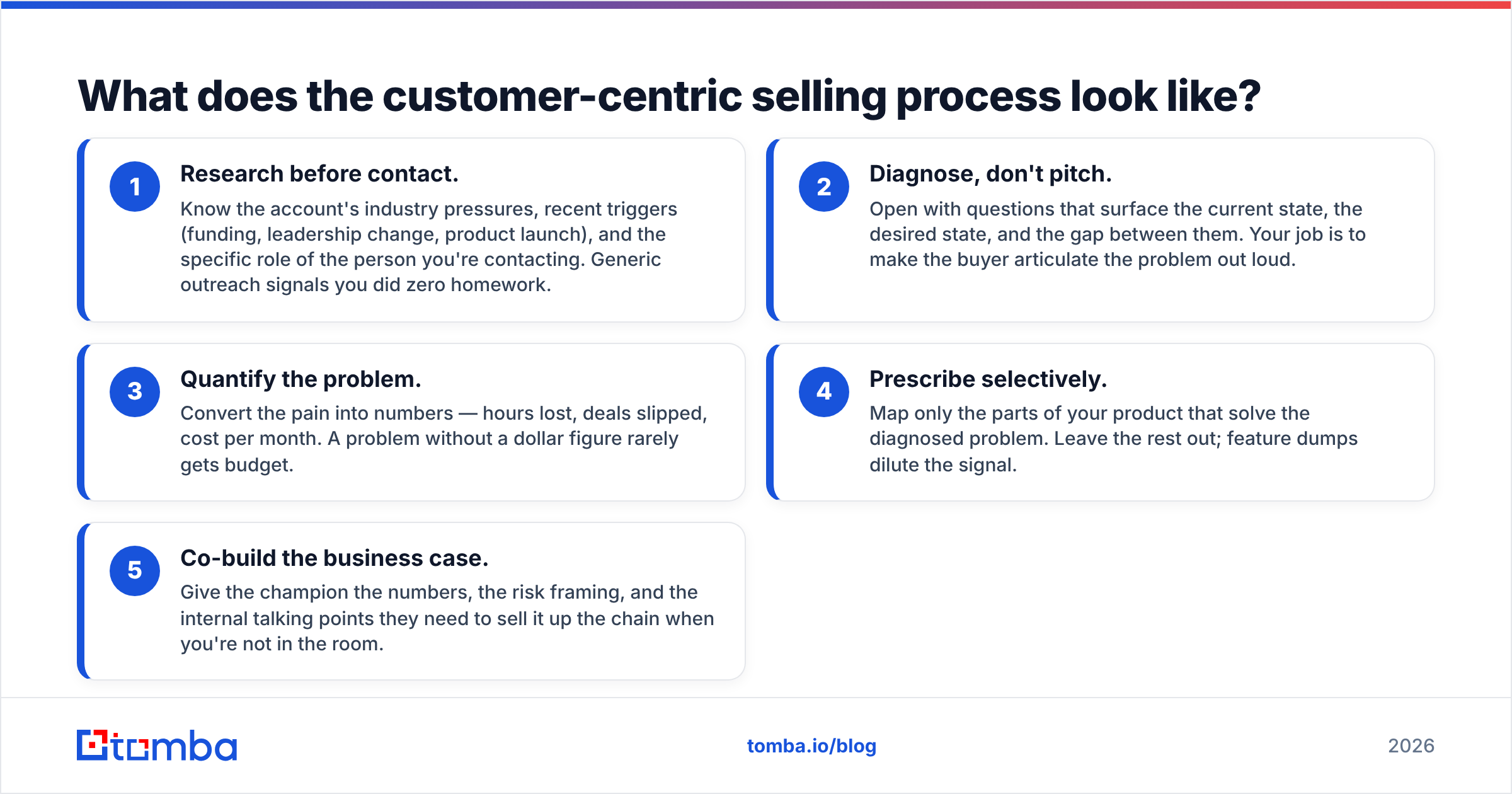
Here is a five-stage process you can install this quarter.
- Research before contact. Know the account's industry pressures, recent triggers (funding, leadership change, product launch), and the role of the person you contact. Generic outreach signals you did zero homework.
- Diagnose, don't pitch. Open with questions. Surface the current state, the desired state, and the gap. Your job is to make the buyer say the problem out loud.
- Quantify the problem. Turn the pain into numbers — hours lost, deals slipped, cost per month. A problem without a dollar figure rarely gets budget.
- Prescribe selectively. Map only the parts of your product that solve the diagnosed problem. Leave the rest out. Feature dumps dilute the signal.
- Co-build the business case. Give the champion the numbers, the risk framing, and the talking points. They need them to sell it up the chain when you are not in the room.
Notice how little of this is about your product. Four of the five stages are about the buyer. That ratio is the whole game.
Which sales methodologies support a customer-centric approach?#
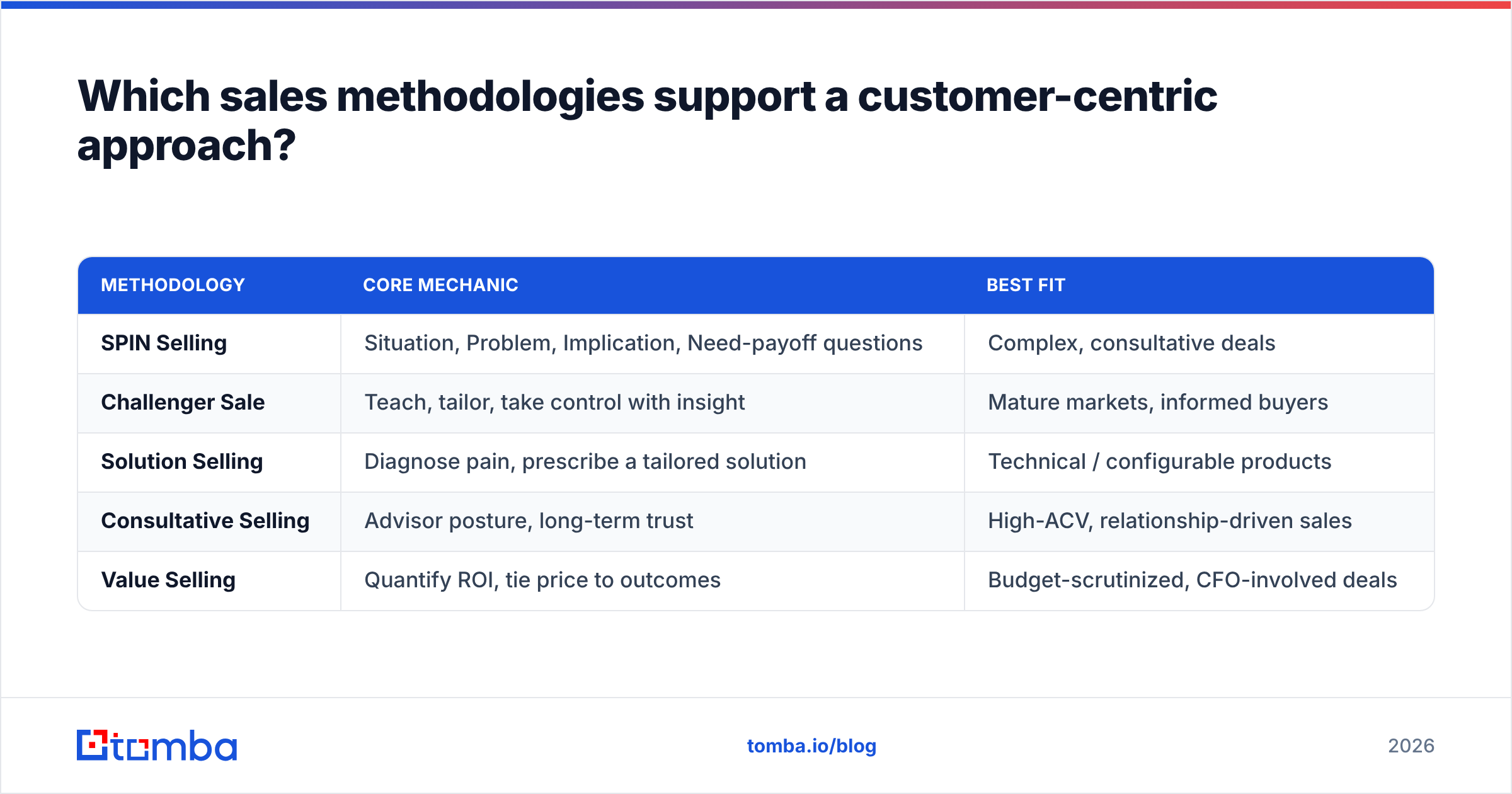
Customer centric selling is a philosophy. Several named methodologies put it into practice. None is "the" answer, and most strong teams blend them.
| Methodology | Core mechanic | Best fit |
|---|---|---|
| SPIN Selling | Situation, Problem, Implication, Need-payoff questions | Complex, consultative deals |
| Challenger Sale | Teach, tailor, take control with insight | Mature markets, informed buyers |
| Solution Selling | Diagnose pain, prescribe a tailored solution | Technical / configurable products |
| Consultative Selling | Advisor posture, long-term trust | High-ACV, relationship-driven sales |
| Value Selling | Quantify ROI, tie price to outcomes | Budget-scrutinized, CFO-involved deals |
The common thread across every row is diagnosis before prescription. If a "methodology" jumps straight to the pitch, it isn't customer-centric, whatever the deck calls it. For a deeper vocabulary of these terms, the B2B glossary helps when you standardize language across a team.

Where does prospect data fit into customer-centric selling?#
Here is the uncomfortable truth. Customer centric selling needs good data more than the spray-and-pray approach it replaces, not less.
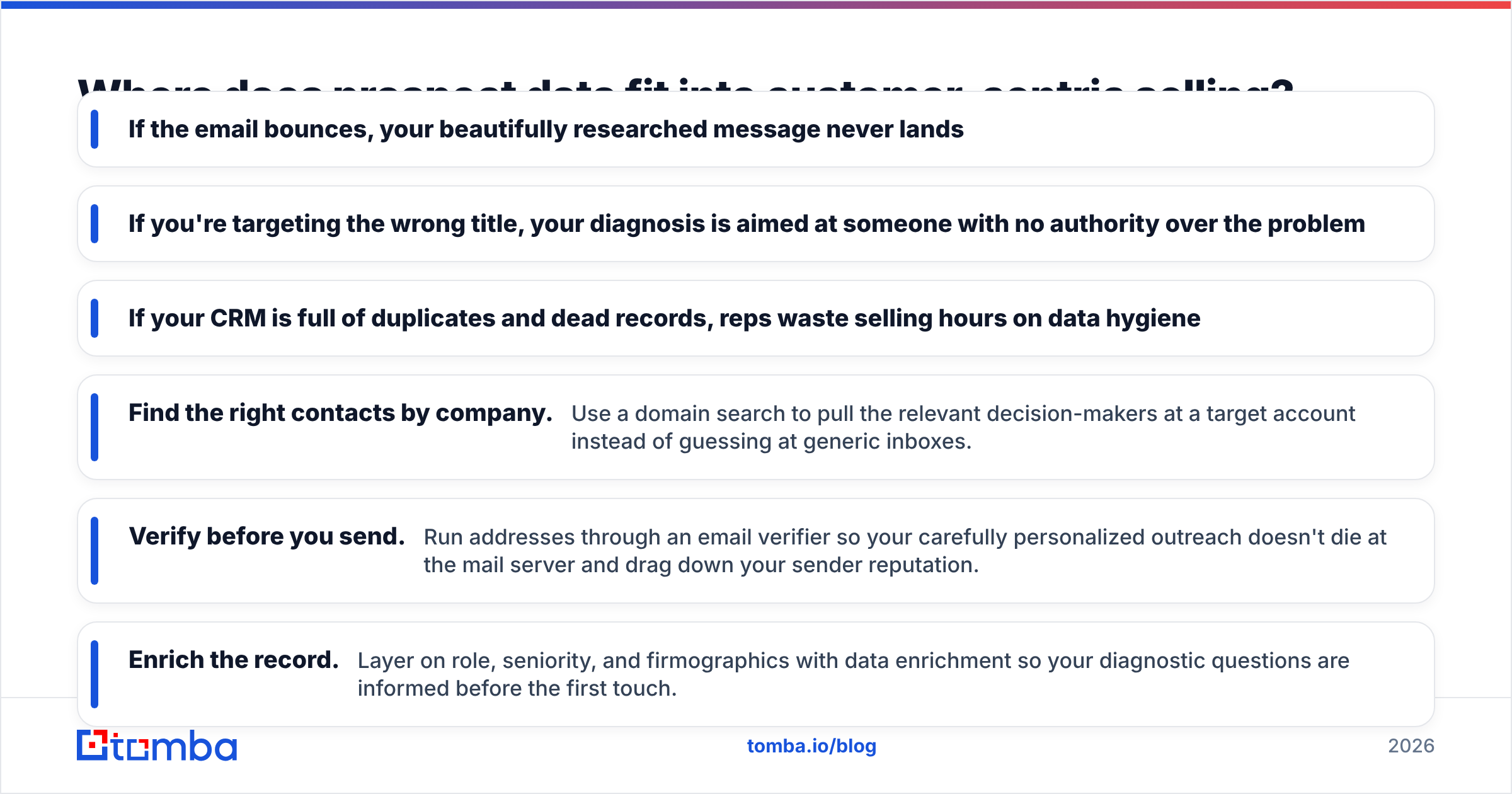
The whole model rests on relevance. To open with a diagnostic built for one account, you must reach the right person, at the right company, with a message shaped by real context. That falls apart the moment your contact data is stale:
- If the email bounces, your beautifully researched message never lands.
- If you're targeting the wrong title, your diagnosis is aimed at someone with no authority over the problem.
- If your CRM is full of duplicates and dead records, reps waste selling hours on data hygiene.
This is why the best customer-centric teams treat data as sales infrastructure. A clean workflow looks like this:
- Find the right contacts by company. Use a domain search to pull the relevant decision-makers at a target account instead of guessing at generic inboxes.
- Verify before you send. Run addresses through an email verifier so your carefully personalized outreach doesn't die at the mail server and drag down your sender reputation.
- Enrich the record. Layer on role, seniority, and firmographics with data enrichment so your diagnostic questions are informed before the first touch.
- Find the actual buyer's email. When you know the person but not the address, an email finder closes the gap in seconds.
The method tells you what to say. The data determines whether it reaches the person who needs to hear it. Ignore either half and the system breaks.
What are common customer-centric selling mistakes?#
Even teams that buy into the philosophy trip over the execution. Watch for these:
- Fake discovery. Asking scripted questions while you rehearse your pitch. Buyers can tell. Real diagnosis means the answers might change your recommendation.
- Skipping quantification. "That sounds painful" is not enough. If you can't put a number on the problem, you can't justify a price.
- Over-personalizing or over-scaling. The goal is relevant at scale — not one artisanal email a week, and not five hundred identical ones. Fix it with better data and tooling, not by picking an extreme.
- Confusing customer-centric with customer-servile. Being buyer-focused doesn't mean you never challenge the buyer. Sometimes the most helpful move is a hard truth about their assumptions.
- Selling to a problem the buyer won't fund. Not every real pain has budget. Qualify the problem's priority, not just its existence.
How do you measure customer-centric selling?#
You measure it by the quality of deals, not the volume of activity. Track:
- Win rate on qualified opportunities — the clearest signal that diagnosis is landing.
- Average deal size — customer-centric selling tends to expand deals because you uncover more of the problem.
- "No decision" loss rate — it should fall as your cost-of-inaction framing improves.
- Sales cycle for closed-won — often longer per deal but with far higher conversion, which nets out positive.
- Net revenue retention — the downstream proof that you sold to real problems, since well-fit customers renew and expand.
If activity is up but these outcome metrics are flat, your team is running product-centric selling with customer centric words. For an outside benchmark, review categories on G2 and study what customers praise. It is almost always understanding, not feature breadth. HubSpot's sales research is another honest source on where buyers get stuck.
Is customer-centric selling worth it in 2026?#
Yes. And it is now table stakes more than an edge. Buyers are better informed. Buying groups are larger. Tolerance for a generic pitch is near zero. The vendors who win show up already understanding the problem. They also make the buyer's job — selling the decision internally — easier.
The catch is simple. Customer centric selling only scales on accurate, current contact data. A brilliant diagnostic sent to a bounced email or the wrong title is wasted work.
That's the practical starting point. Before your reps write one personalized opener, make sure they can reach the right decision-makers. Tomba's Email Finder pulls verified, professional email addresses by name, company, or domain. So the buyer-first message you worked so hard to craft lands in the right inbox, not a spam folder. Start on the free tier (25 searches a month). Scale into the $49/mo Starter plan as your pipeline grows. Check Tomba pricing for the tier that matches your volume. Get the data right, and the method finally has something to stand on.
Related guides#
Ready to find emails that actually work?
Join 150,000+ professionals who stopped guessing and started sending. Free credits on signup — no credit card required.
Get the Tomba newsletter
Practical outbound tactics and product updates — once every two weeks.
About the author