Customer Data Orchestration: The 2026 Guide for RevOps Teams
Your customer data lives in a dozen tools that don't talk to each other. Customer data orchestration fixes that — here's how it works, what to buy, and where to start.
TL;DR
- Customer data orchestration is the layer that collects, cleans, matches, and routes customer data across your stack in real time — so every tool acts on the same profile instead of its own stale copy.
- It is not a CDP, a data warehouse, or a reverse-ETL tool. It's the connective tissue that makes those pieces cooperate.
- The payoff is concrete: fewer duplicate records, faster lead routing, cleaner segmentation, and outreach that fires on accurate contact data.
- The hard part isn't moving data — it's identity resolution (deciding two records are the same person) and keeping enrichment fresh.
- Start small: pick one high-value flow (lead capture → enrichment → CRM → sequence), orchestrate that end to end, then expand.
What is customer data orchestration?#
Customer data orchestration is the practice of coordinating how customer data moves, merges, and updates across every system you run — in real time, against a single set of rules.
Think of it like an air-traffic control tower. Planes (data from your website, product, CRM, ads, and enrichment vendors) all want to land at the same airport (your customer profile). Without a tower, they collide: duplicate records, conflicting fields, a sales rep emailing a churned account. The orchestration layer is the tower — it sequences arrivals, resolves conflicts, and makes sure each plane lands on the right runway.
Technically, orchestration sits above your storage and below your activation tools. It ingests events and records, resolves identity, applies transformation and enrichment, then pushes the clean result to wherever it's needed. It is the difference between having customer data and using it.
The reason this became its own category is simple: the average B2B go-to-market team now runs dozens of tools, and each one keeps its own copy of the truth. When those copies drift, every downstream decision degrades — scoring, routing, personalization, forecasting. Orchestration exists to stop the drift.

Why does customer data orchestration matter in 2026?#
Because the cost of bad data compounds, and it compounds fastest at the point of action. A wrong email address doesn't just fail once — it drags down sender reputation, inflates bounce rates, and poisons the deliverability of every campaign that follows.
Here's what orchestration prevents in practice:
- Duplicate records — The same account entered three ways (Acme, Acme Inc., Acme Corporation) splits your history and breaks reporting.
- Stale enrichment — A contact changed jobs six months ago; without a refresh loop, you're still emailing their old inbox.
- Routing lag — A high-intent lead sits unassigned for hours because enrichment and scoring happen in separate, unsynced jobs.
- Conflicting fields — Marketing says the lead is an MQL, sales says it's disqualified, and nobody knows which system won.
- Wasted spend — You pay for the same contact enrichment repeatedly because no system remembers it was already resolved.
Gartner has long estimated that poor data quality costs organizations millions per year in wasted effort and bad decisions (see Gartner's data quality research). Orchestration is how you stop paying that tax at every handoff instead of just at the warehouse.
How does customer data orchestration work?#
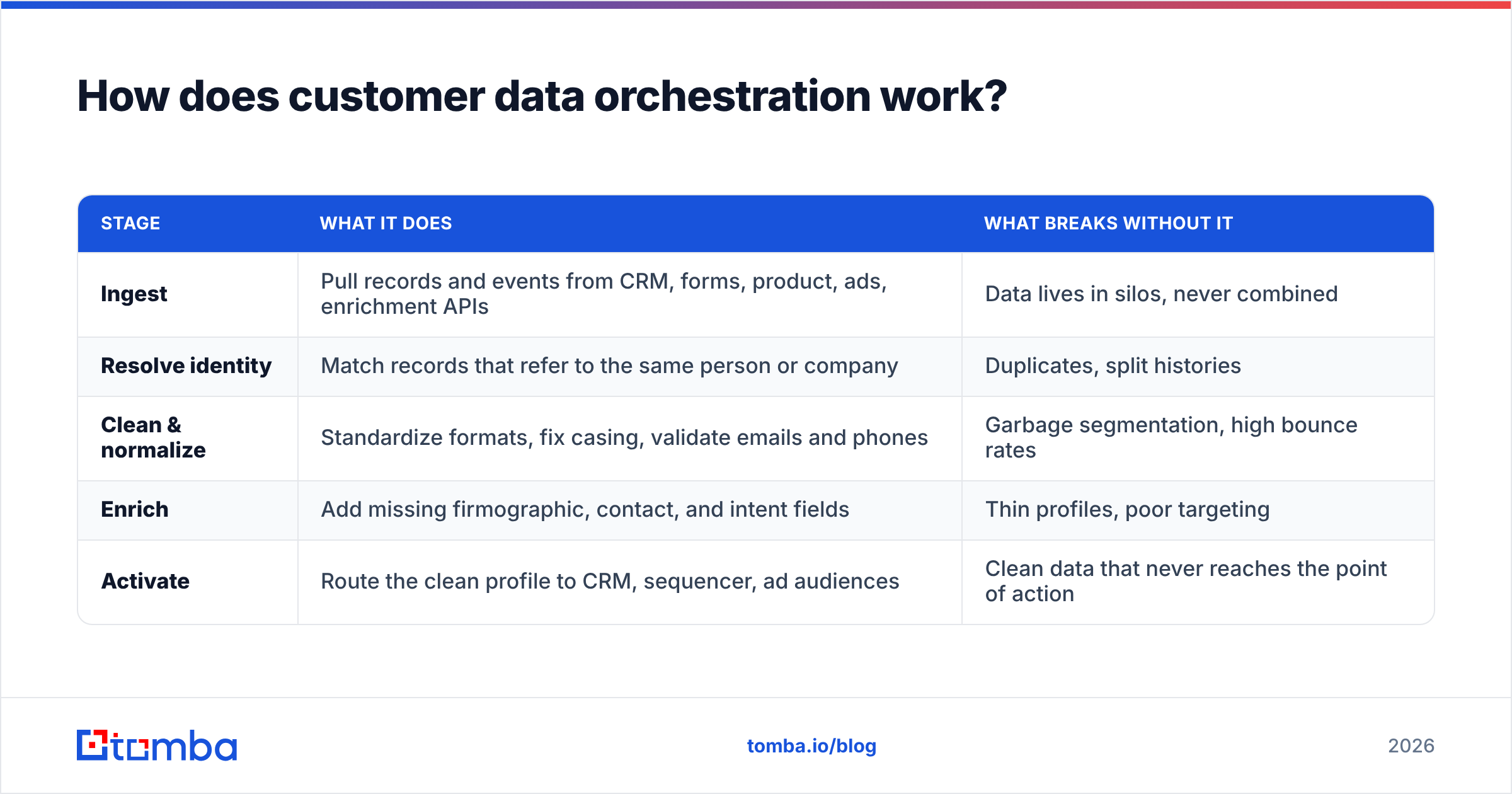
It runs as a pipeline with five stages. Each stage has a distinct job, and the value comes from doing all five continuously rather than in nightly batches.
| Stage | What it does | What breaks without it |
|---|---|---|
| Ingest | Pull records and events from CRM, forms, product, ads, enrichment APIs | Data lives in silos, never combined |
| Resolve identity | Match records that refer to the same person or company | Duplicates, split histories |
| Clean & normalize | Standardize formats, fix casing, validate emails and phones | Garbage segmentation, high bounce rates |
| Enrich | Add missing firmographic, contact, and intent fields | Thin profiles, poor targeting |
| Activate | Route the clean profile to CRM, sequencer, ad audiences | Clean data that never reaches the point of action |
The two stages teams underestimate are identity resolution and enrichment freshness. Identity resolution is a matching problem: given two rows, are they the same entity? Get it too loose and you merge two different people; too strict and you keep duplicates. Enrichment freshness is a decay problem: contact data goes stale at roughly 2–3% per month as people change jobs, so a one-time enrichment is worthless within a year.
This is where a reliable data source matters more than the orchestration plumbing. Your pipeline can be flawless, but if the email it enriches with is a guess, every downstream step inherits the error. Using an accurate email finder and a real-time email verifier at the enrichment stage is what keeps the whole pipeline honest. For company-wide coverage, a domain search pulls every known address at an account in one call, which feeds identity resolution far better than scraping one contact at a time.
Customer data orchestration vs CDP vs reverse ETL: what's the difference?#
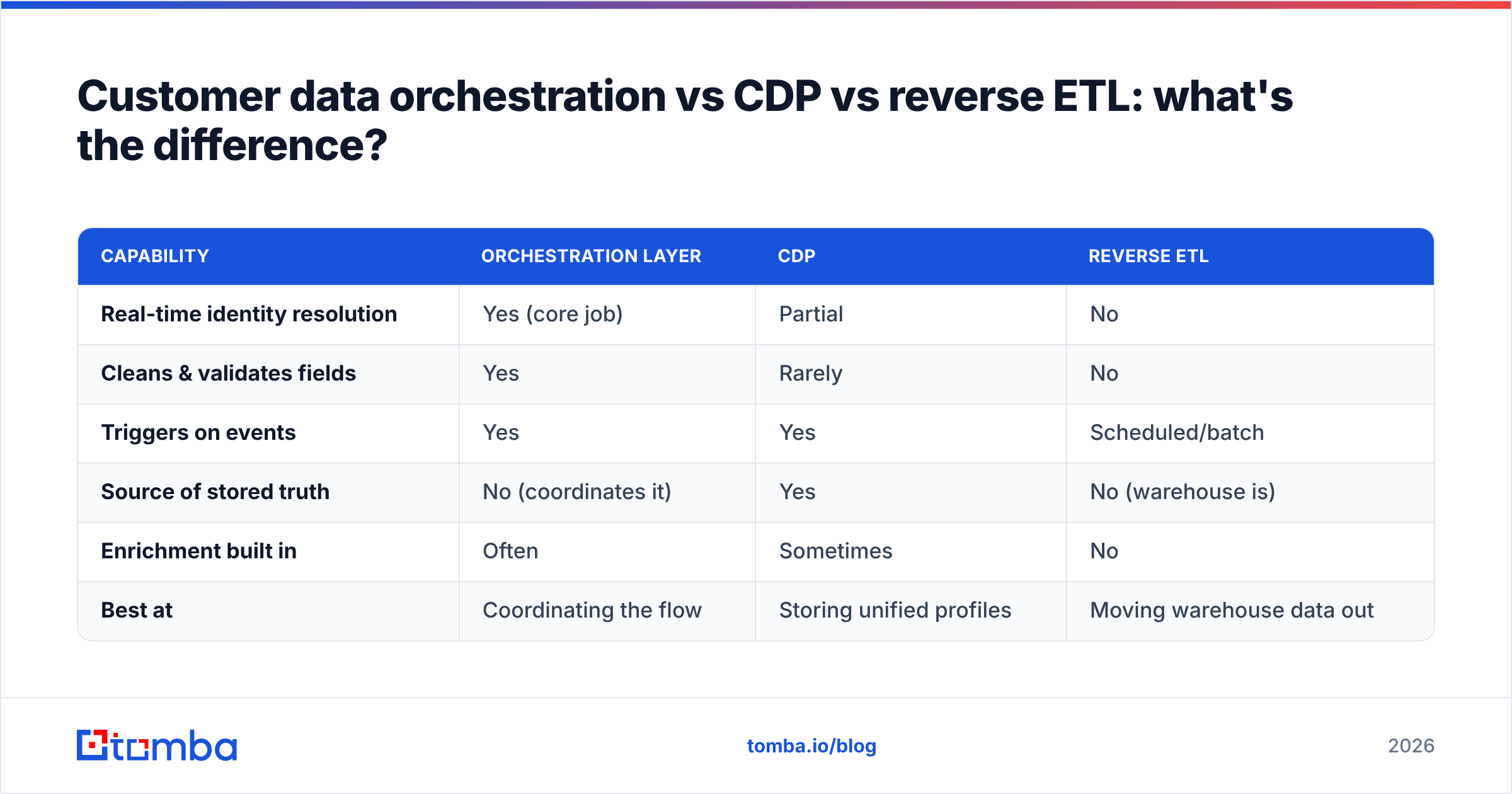
These get conflated constantly. They are related but not interchangeable — you often run all three.
| Capability | Orchestration layer | CDP | Reverse ETL |
|---|---|---|---|
| Real-time identity resolution | Yes (core job) | Partial | No |
| Cleans & validates fields | Yes | Rarely | No |
| Triggers on events | Yes | Yes | Scheduled/batch |
| Source of stored truth | No (coordinates it) | Yes | No (warehouse is) |
| Enrichment built in | Often | Sometimes | No |
| Best at | Coordinating the flow | Storing unified profiles | Moving warehouse data out |
The short version: a CDP is a database of unified profiles. Reverse ETL copies warehouse data into SaaS tools on a schedule. Orchestration is the logic that decides what to match, clean, enrich, and route — and when. If the CDP is the warehouse and reverse ETL is the delivery truck, orchestration is the dispatcher deciding what ships where and catching the broken packages before they leave the dock.
You can do lightweight orchestration without a full CDP. Many teams start with their CRM as the system of record, a Zapier or Make automation to move records, and an enrichment API in the middle. That's real orchestration, just without the enterprise price tag. G2's category listings (see G2's data platform categories) show how blurry these lines have become in practice.
What does a practical customer data orchestration stack look like?#
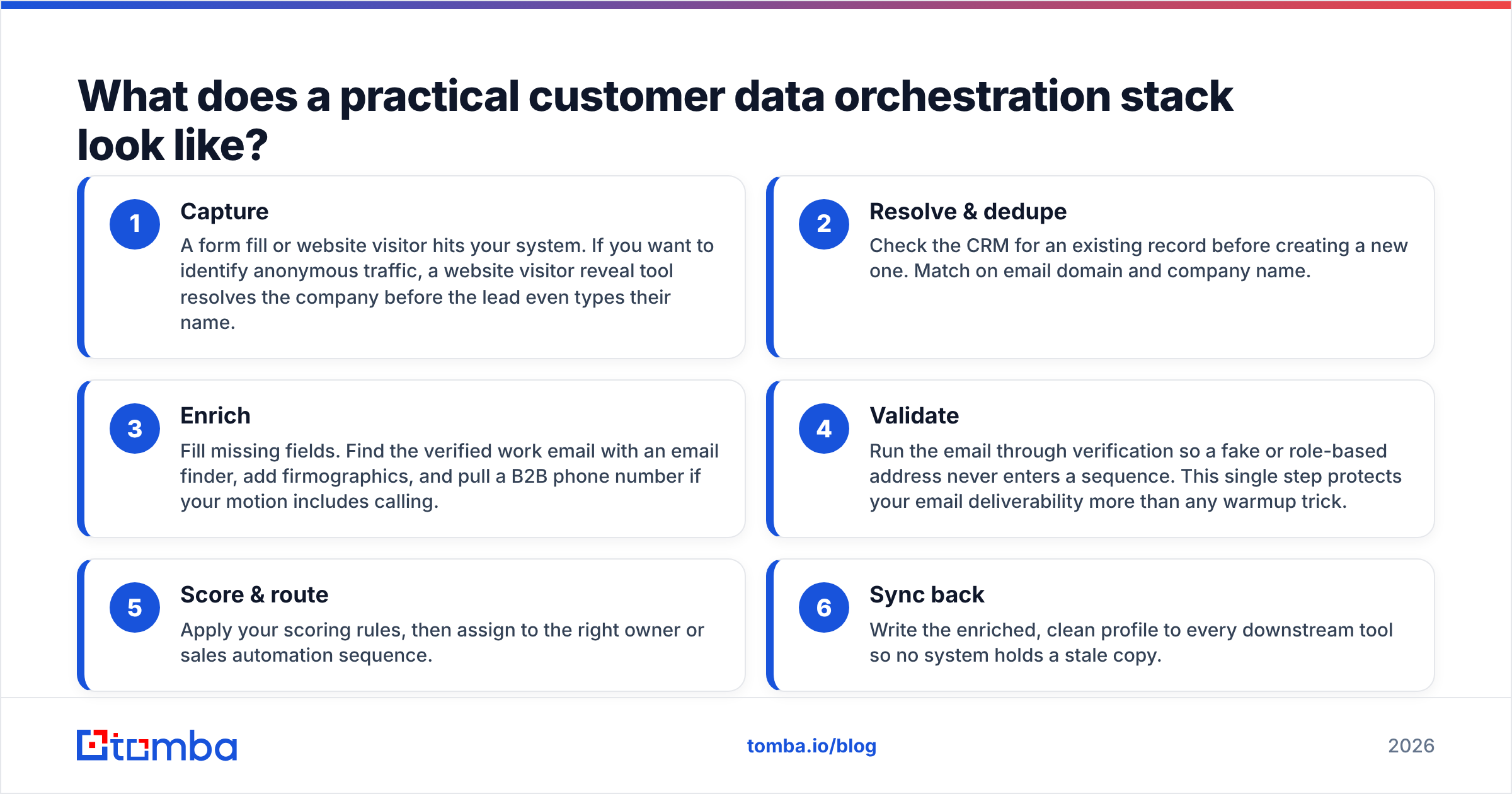
Start with the flow that touches revenue most directly: a new lead arriving. Here's a concrete, buildable version.
- Capture — A form fill or website visitor hits your system. If you want to identify anonymous traffic, a website visitor reveal tool resolves the company before the lead even types their name.
- Resolve & dedupe — Check the CRM for an existing record before creating a new one. Match on email domain and company name.
- Enrich — Fill missing fields. Find the verified work email with an email finder, add firmographics, and pull a B2B phone number if your motion includes calling.
- Validate — Run the email through verification so a fake or role-based address never enters a sequence. This single step protects your email deliverability more than any warmup trick.
- Score & route — Apply your scoring rules, then assign to the right owner or sales automation sequence.
- Sync back — Write the enriched, clean profile to every downstream tool so no system holds a stale copy.
For teams doing this at volume, batch operations matter. A bulk email finder lets you enrich and verify thousands of records in one pass rather than one API call at a time, and the Tomba API drops the whole flow into your own orchestration code. If your team lives in spreadsheets, the Google Sheets add-on or HubSpot integration puts enrichment where the work already happens.
Build vs buy: a quick honest take#
- Build (automation + APIs) — Cheapest to start, full control, but you own every edge case. Best for teams under ~5 core tools.
- Buy (CDP + orchestration platform) — Faster to enterprise scale, handles identity resolution well, but expensive and slower to change. Best when data volume and team size justify it.
Most mid-market teams live in a hybrid: a light orchestration layer wired from a workflow tool, a strong enrichment vendor, and the CRM as the source of truth. You do not need a six-figure platform to get 80% of the benefit.
What are the biggest customer data orchestration mistakes?#
- Orchestrating dirty data faster. Speed multiplies whatever you feed it. Clean and verify at ingest, not after.
- Treating enrichment as one-time. Set a refresh cadence. Re-verify contacts before major campaigns.
- Over-merging identities. Loose matching rules quietly combine two real people into one broken record. Tune conservatively and log every merge.
- Ignoring the point of activation. A perfect warehouse profile that reaches your sequencer as a stale copy helped no one. Sync back matters as much as ingest.
- No source-of-truth rule. When two systems disagree, one must win by policy, not by whichever job ran last.
The throughline: orchestration is only as good as the data quality and the data source underneath it. Fast plumbing on bad data just delivers bad decisions sooner. Anchoring the enrichment stage on accurate, well-sourced data is what turns orchestration from a liability into an advantage.
How do you measure if it's working?#
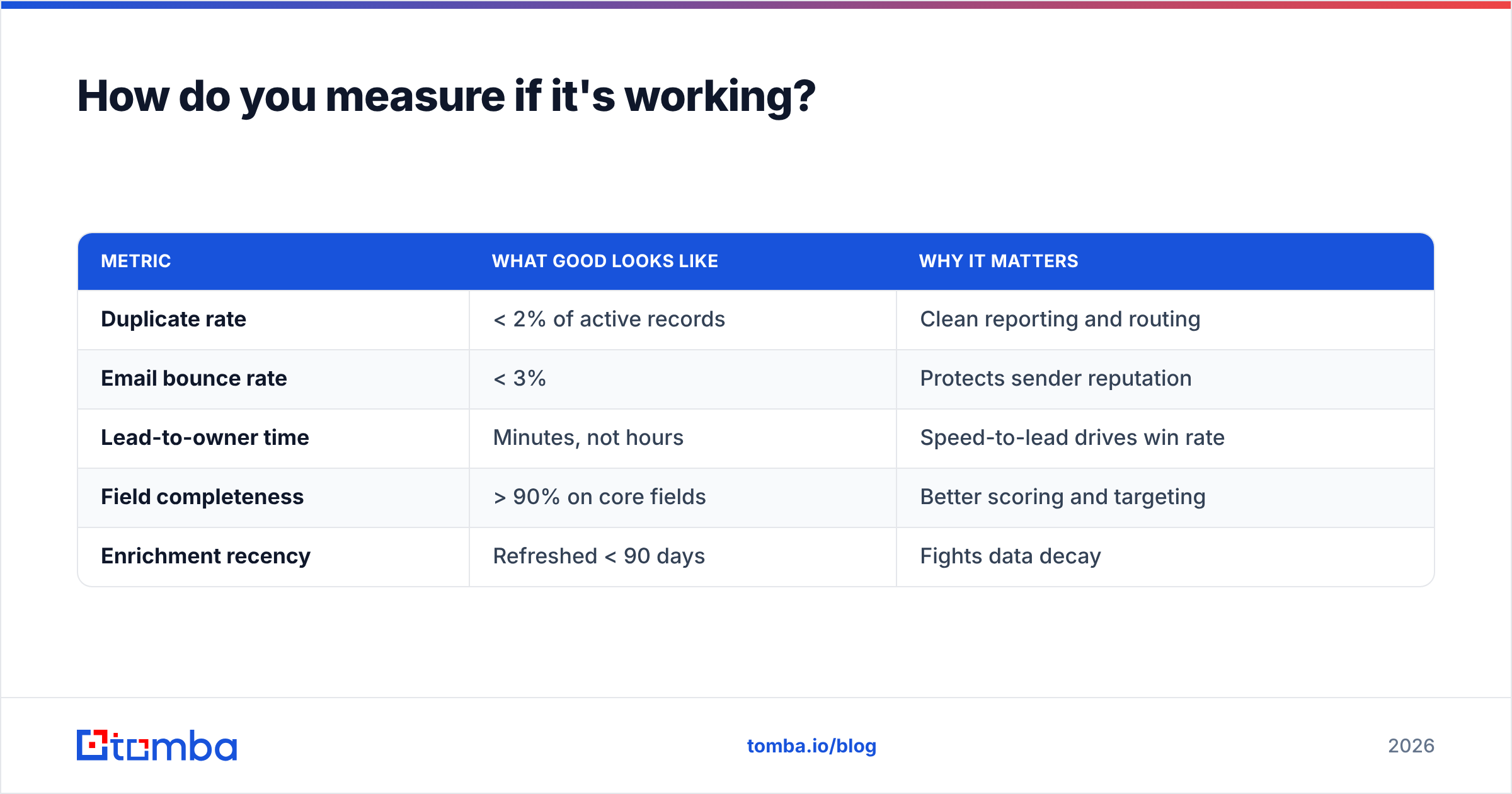
Track these before and after you orchestrate a flow:
| Metric | What good looks like | Why it matters |
|---|---|---|
| Duplicate rate | < 2% of active records | Clean reporting and routing |
| Email bounce rate | < 3% | Protects sender reputation |
| Lead-to-owner time | Minutes, not hours | Speed-to-lead drives win rate |
| Field completeness | > 90% on core fields | Better scoring and targeting |
| Enrichment recency | Refreshed < 90 days | Fights data decay |
If these move in the right direction, the orchestration is doing its job. If bounce rate stays high, the problem is upstream — your data source, not your pipeline.
Getting started#
Pick one flow. Make it the lead-capture-to-sequence path, because that's where clean data converts to pipeline. Wire ingest, resolve, enrich, verify, and route for that single flow, measure the five metrics above, then repeat the pattern for the next flow. Don't boil the ocean with a full CDP migration on day one.
The enrichment and verification stage is where most pipelines quietly fail, and it's the cheapest place to get a big lift. Start there: use Tomba's Email Finder to source verified professional emails by name, company, or domain, then feed those clean, confirmed contacts straight into your orchestration flow. You can test it on the free tier (25 searches/month) before committing — plans scale from Starter at $49/mo up to Pro at $249/mo as your volume grows. Good orchestration starts with data you can trust, and that's exactly the part Tomba is built to get right.
Related guides#
Ready to find emails that actually work?
Join 150,000+ professionals who stopped guessing and started sending. Free credits on signup — no credit card required.
Get the Tomba newsletter
Practical outbound tactics and product updates — once every two weeks.
About the author