7 Best Customer Dynamics Alternatives in 2026 for B2B Data
Customer Dynamics is a solid B2B data provider, but it isn't the only option. Here are 7 alternatives compared on accuracy, pricing, and real-time coverage so you can pick the right fit for your team in 2026.
Customer Dynamics has earned its place in the B2B data conversation, but if you're reading this, you already suspect it isn't a perfect match for how your team prospects. Maybe the pricing model doesn't fit your volume, maybe you need fresher records, or maybe you just want to benchmark it against the field before you sign another annual contract.
This guide compares the seven strongest Customer Dynamics alternatives for 2026, judged on the things that actually move pipeline: data accuracy, coverage, pricing transparency, and how quickly you can go from a name to a verified, deliverable contact.
TL;DR — The Short Version#
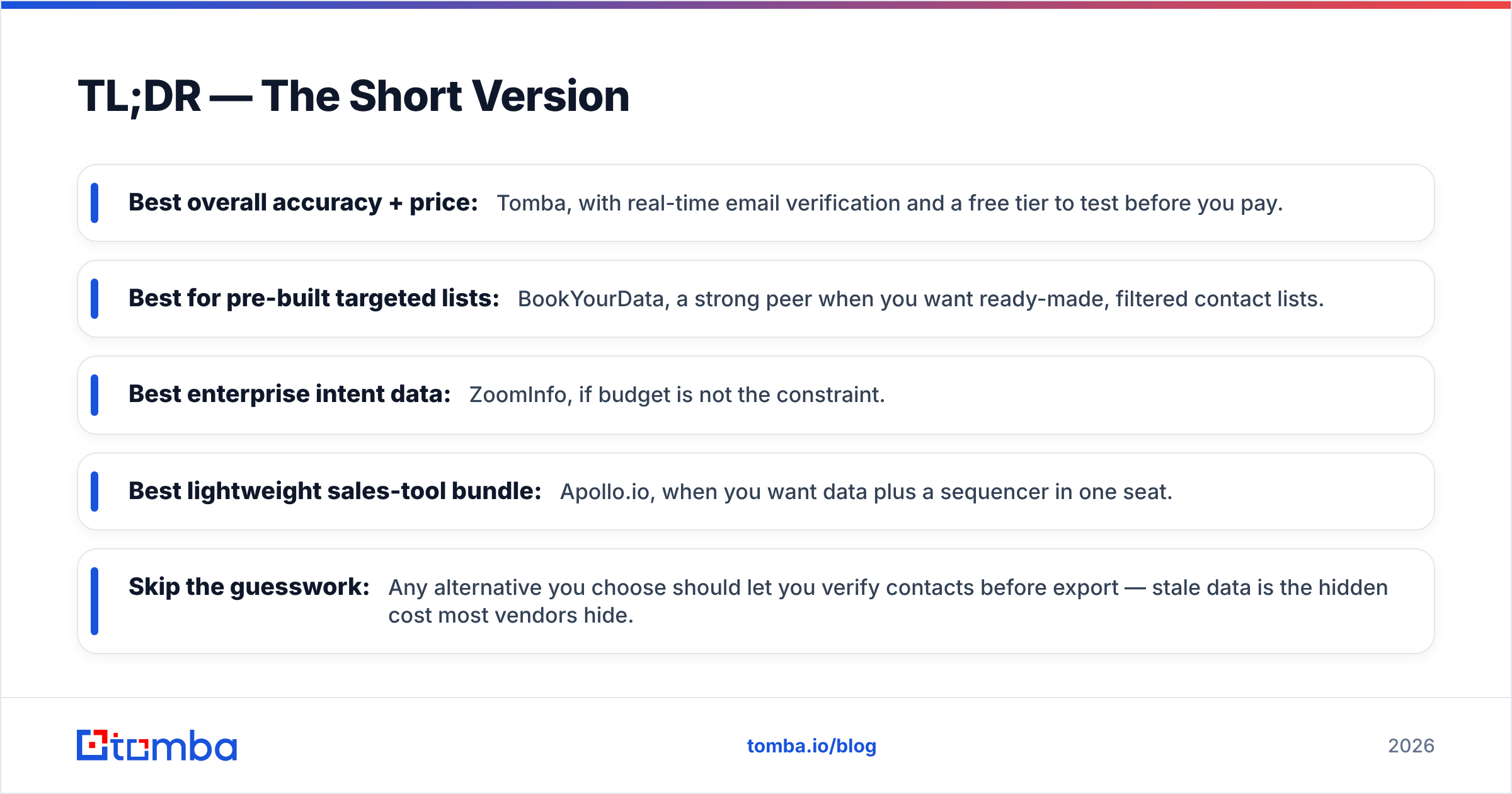
- Best overall accuracy + price: Tomba, with real-time email verification and a free tier to test before you pay.
- Best for pre-built targeted lists: BookYourData, a strong peer when you want ready-made, filtered contact lists.
- Best enterprise intent data: ZoomInfo, if budget is not the constraint.
- Best lightweight sales-tool bundle: Apollo.io, when you want data plus a sequencer in one seat.
- Skip the guesswork: Any alternative you choose should let you verify contacts before export — stale data is the hidden cost most vendors hide.
What Is Customer Dynamics and Why Look for Alternatives?#
Customer Dynamics is a B2B marketing-data and demand-generation provider. It supplies contact lists, data append/enrichment, and campaign services aimed at mid-market and enterprise marketing teams. Think of it less like a self-serve email finder and more like a managed data partner: you tell them the audience, they help build and clean the list.
That model works well for some teams and poorly for others. The common reasons people search for a switch:
- Pricing opacity — Managed-data providers rarely publish rates, so you can't compare cost-per-contact without a sales call.
- Speed — Self-serve prospecting teams want to pull a verified email in seconds, not wait on a list build.
- Freshness — People change jobs roughly every 2–3 years, so any static list decays fast. You want data verified at the moment of export.
- Tool sprawl — Modern SDR stacks want data that plugs directly into a CRM, a spreadsheet, or an API — not a one-off CSV.
If any of those hit home, the alternatives below are worth a look.

How We Compared the Customer Dynamics Alternatives#
Every tool on this list was scored on four criteria that predict real prospecting results:
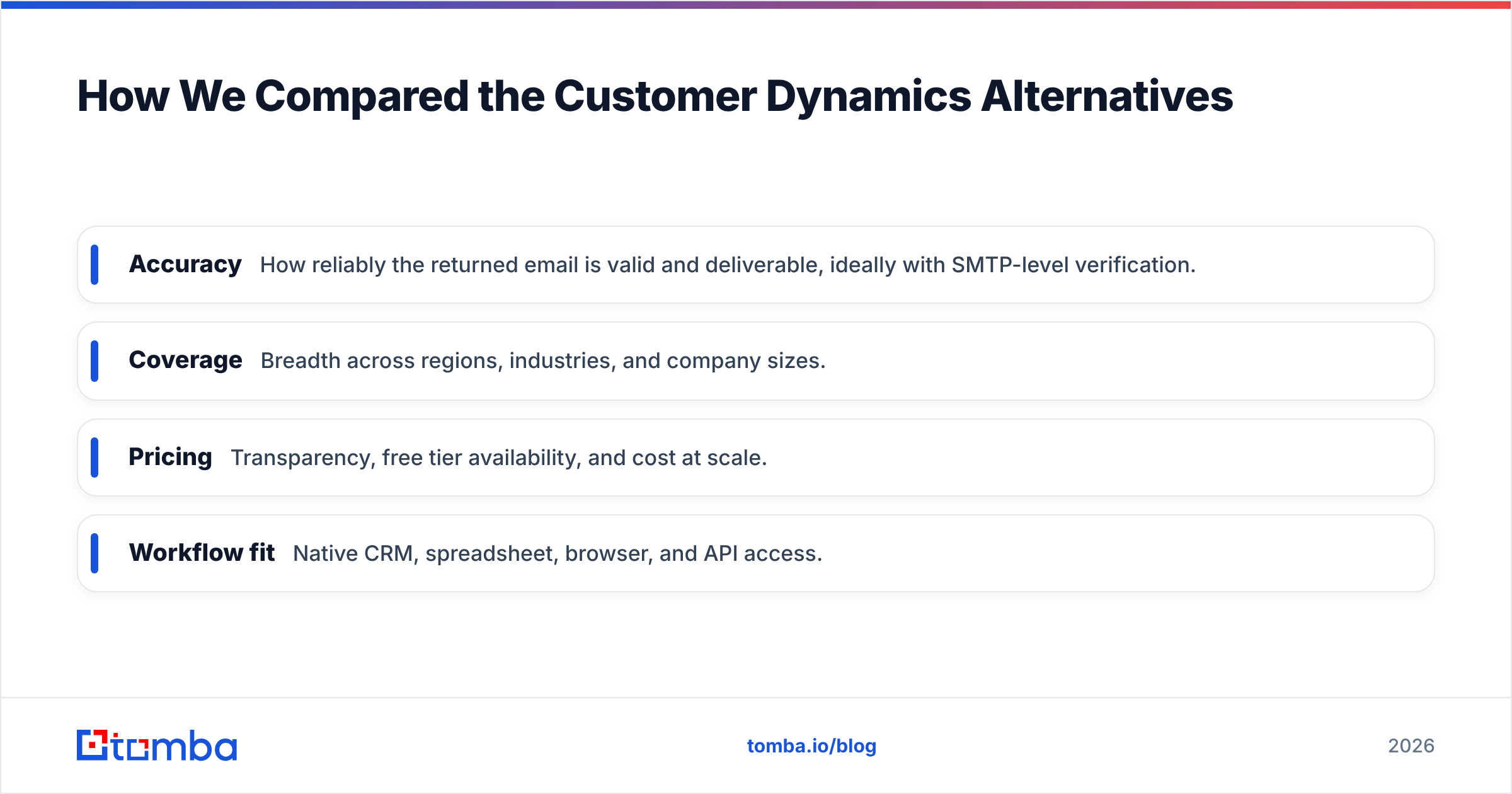
- Accuracy — How reliably the returned email is valid and deliverable, ideally with SMTP-level verification.
- Coverage — Breadth across regions, industries, and company sizes.
- Pricing — Transparency, free tier availability, and cost at scale.
- Workflow fit — Native CRM, spreadsheet, browser, and API access.
A tool that nails accuracy but hides its price loses points, because you can't plan a budget around a black box. Likewise, cheap data that bounces is not cheap — it burns your sender reputation and your domain.

Which Customer Dynamics Alternatives Are Best in 2026?#
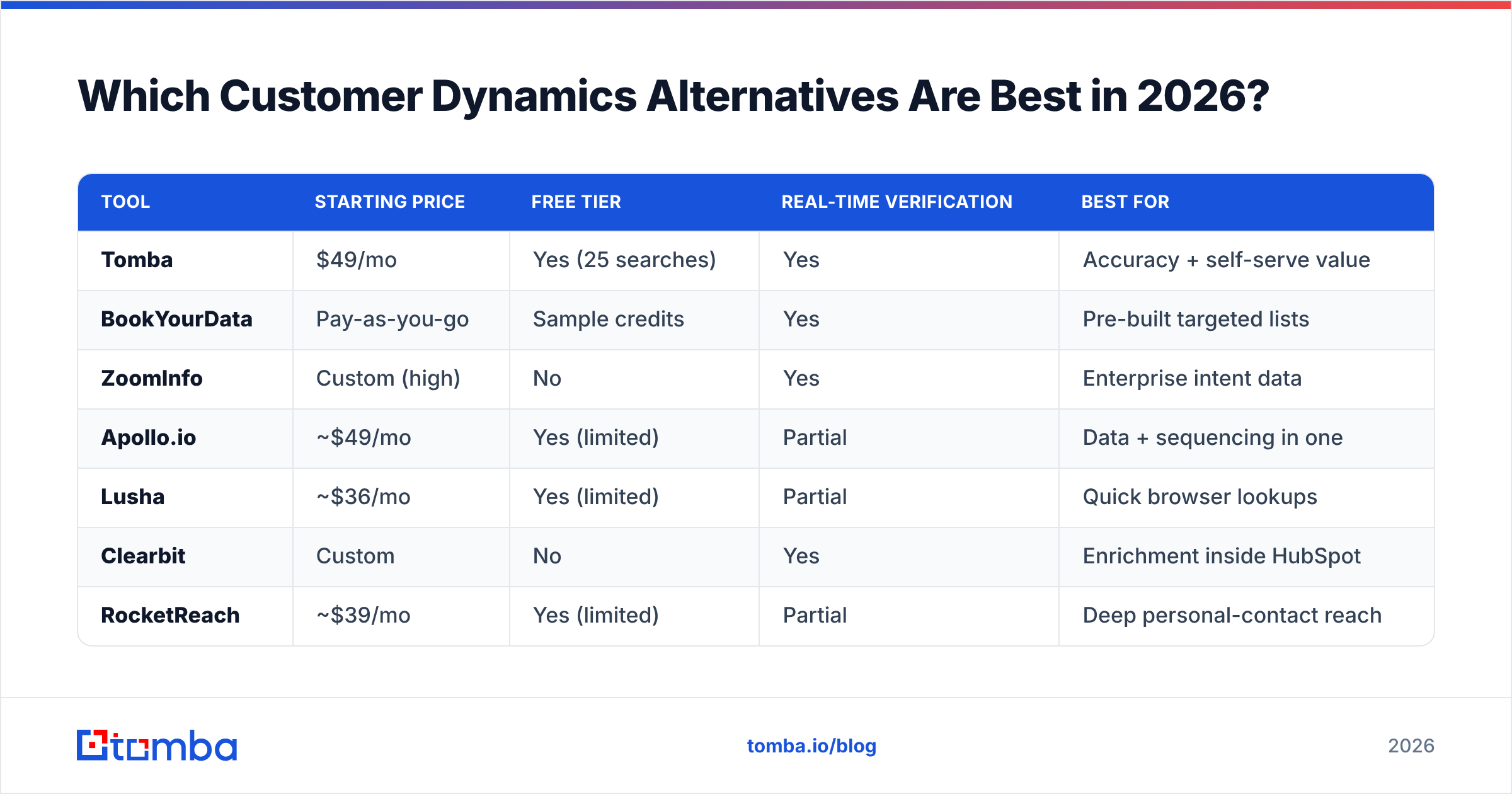
Here's the head-to-head. Prices reflect published self-serve rates as of 2026; enterprise and managed-service quotes vary.
| Tool | Starting price | Free tier | Real-time verification | Best for |
|---|---|---|---|---|
| Tomba | $49/mo | Yes (25 searches) | Yes | Accuracy + self-serve value |
| BookYourData | Pay-as-you-go | Sample credits | Yes | Pre-built targeted lists |
| ZoomInfo | Custom (high) | No | Yes | Enterprise intent data |
| Apollo.io | ~$49/mo | Yes (limited) | Partial | Data + sequencing in one |
| Lusha | ~$36/mo | Yes (limited) | Partial | Quick browser lookups |
| Clearbit | Custom | No | Yes | Enrichment inside HubSpot |
| RocketReach | ~$39/mo | Yes (limited) | Partial | Deep personal-contact reach |
1. Tomba — Best Overall Alternative#
Tomba is a self-serve B2B email-finding and enrichment platform built around one promise: the contact you export should actually be deliverable. Its email finder works by domain, name, or company, and every result can be run through the built-in email verifier before it ever hits your outreach tool.
Where Customer Dynamics sells a managed list, Tomba hands you the controls. You can pull single contacts, run a bulk email finder against a target account list, or wire it straight into your workflow with the Tomba API. Pricing is public and predictable: a Free tier with 25 searches per month, then Starter at $49/mo, Growth at $99/mo, and Pro at $249/mo. You can see the full Tomba pricing breakdown without a demo call.
Pros: Transparent pricing, real-time verification, generous free test, strong API and spreadsheet integrations. Cons: Self-serve model means you build the list yourself — no done-for-you campaign services.
2. BookYourData — Best for Ready-Made Targeted Lists#
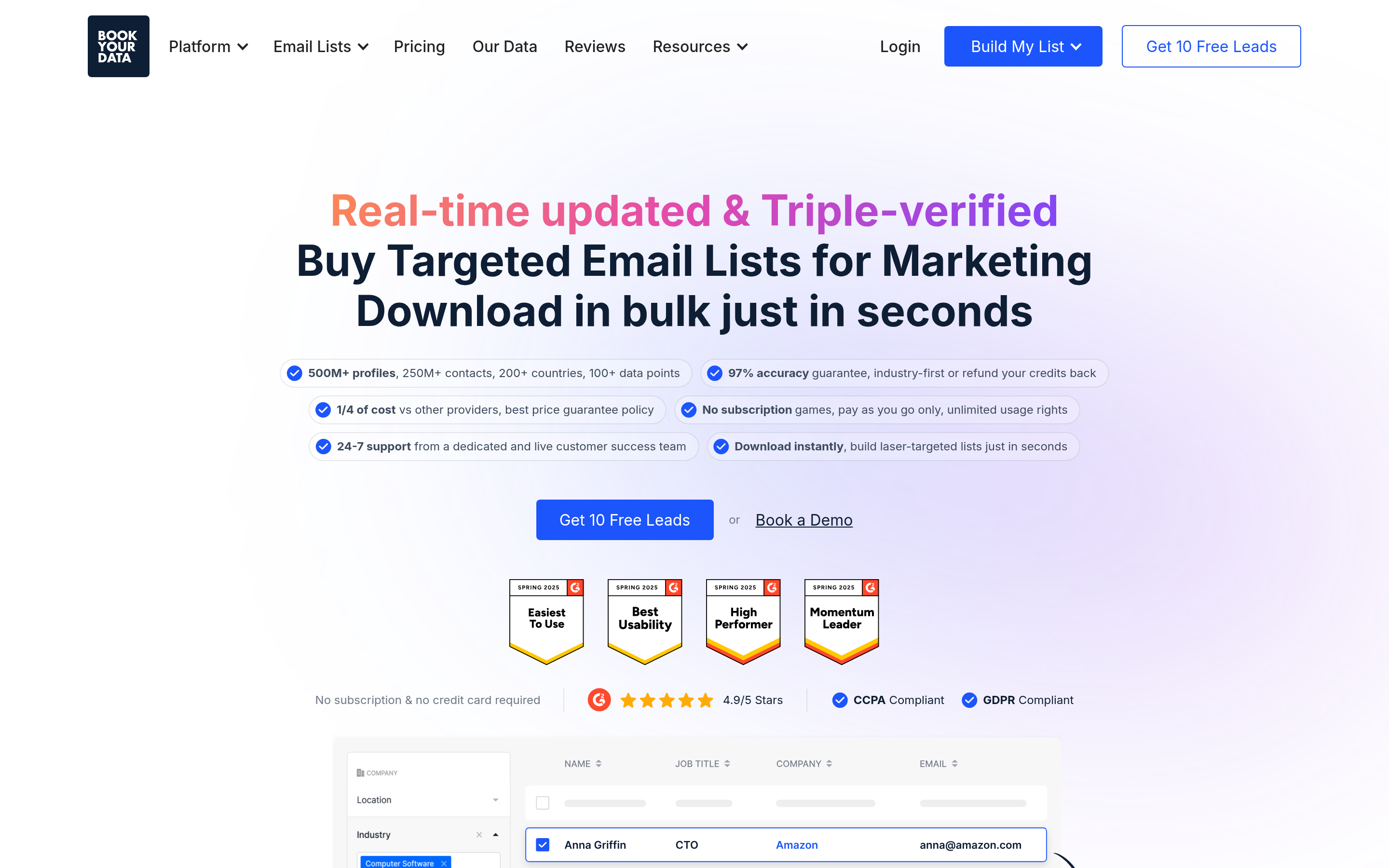
BookYourData is a respected peer in the targeted-list space and a strong match if you like Customer Dynamics' "give me a filtered list" approach but want more control over the filters. You build a segment by industry, title, geography, and company size, then buy exactly those verified contacts — often on a pay-as-you-go basis rather than a locked annual seat.
It's a good fit for marketers who think in audiences rather than individual lookups, and its accuracy guarantee gives buyers a safety net. If your workflow is list-first, put it high on your shortlist alongside Tomba.
3. ZoomInfo — Best for Enterprise Intent#

ZoomInfo is the heavyweight. Beyond contact data it layers on intent signals, org charts, and workflow automation. If you're a large revenue team with budget to match, it's hard to beat on depth. The catch is cost and contract length — this is an enterprise commitment, not a quick swap. Check current buyer reviews on G2 before committing.
4. Apollo.io — Best All-in-One#
Apollo bundles a contact database with sequencing and a dialer, so a small team can prospect and send from one seat. Data depth is solid, though verification is less rigorous than a dedicated finder. If you'd rather consolidate tools than chase the highest accuracy, it's a sensible pick. Teams comparing the two often read our Apollo alternative breakdown first.
5. Lusha — Best for Fast Browser Lookups#
Lusha lives in your browser and shines when you're prospecting one profile at a time on LinkedIn or a company site. It's quick and friendly, but coverage thins out at scale and outside North America. Good for AEs doing manual research, less ideal for large automated pulls.
6. Clearbit — Best for HubSpot-Native Enrichment#
Now part of HubSpot, Clearbit is the natural choice if your CRM is already HubSpot and you want enrichment to happen automatically on form fill. It's less a standalone prospecting tool and more an enrichment layer. If you need a portable data source, our Clearbit alternative comparison covers the trade-offs.
7. RocketReach — Best for Personal Contact Reach#
RocketReach is known for surfacing personal emails and phone numbers where other tools return only corporate addresses. That's powerful for recruiters and hard-to-reach executive outreach, though it raises the usual compliance considerations you'll want to review for your region.

Is a Self-Serve Tool Better Than a Managed Data Provider?#
It depends on how your team actually works — but for most modern SDR and growth teams, self-serve wins.
Think of it like cooking. A managed provider like Customer Dynamics is a meal-kit delivery service: convenient, but you eat what they send and pay their markup. A self-serve tool like Tomba is a well-stocked kitchen — more control, better cost-per-meal, and you can cook exactly what you need the moment you need it.
Here's the decision framework:
- Choose a managed provider if: your marketing team runs a few large campaigns a year, has no in-house data ops, and prefers to outsource list building entirely.
- Choose a self-serve alternative if: your reps prospect continuously, you need contacts verified at export time, and you want the data flowing into your data enrichment and CRM stack automatically.
The freshness argument is the tiebreaker. A list built and cleaned once decays every month afterward. A self-serve finder verifies at the moment you pull the record, which is why deliverability-focused teams lean that way. If you want to understand the mechanics, the fundamentals of email deliverability explain why verification timing matters more than raw list size.

How Much Should You Pay for B2B Contact Data?#
The honest answer: pay for accuracy, not volume. A database of 500 million contacts is worthless if 30% of the emails bounce. Two numbers matter more than the headline count:
- Verified deliverability rate — What percentage of exported emails actually land? Aim for 95%+.
- Effective cost per usable contact — Total spend divided by deliverable contacts, not total contacts.
When you re-run the math on that second metric, a "cheap" list with a high bounce rate often costs more per usable lead than a mid-priced tool with rigorous verification. Vendor pricing pages rarely show this, which is why free tiers are so useful — you can measure real deliverability on your own audience before committing. Compare published rates side by side on Capterra or a vendor's own site rather than trusting a headline count.
What About Compliance and Data Sourcing?#
Any Customer Dynamics alternative you adopt should be transparent about where its data comes from and how it handles GDPR, CCPA, and opt-out requests. Ask every vendor two questions before you buy:
- Where is the data sourced, and how often is it refreshed?
- How do you handle deletion and suppression requests?
Tomba publishes its approach openly on its data sources page, and reputable providers like BookYourData and ZoomInfo document their compliance posture as well. If a vendor won't answer these questions clearly, treat that as your answer.
Frequently Asked Questions#
Is there a free Customer Dynamics alternative? Yes. Tomba offers a free tier with 25 searches per month, and Apollo, Lusha, and RocketReach all have limited free plans. These let you test real accuracy on your own target list before paying.
What is the most accurate alternative to Customer Dynamics? For self-serve prospecting, tools with real-time SMTP verification — like Tomba — tend to deliver the highest deliverable-email rates, because they verify at the moment of export rather than relying on a periodically cleaned list.
Can I migrate my existing lists? Most alternatives let you upload a CSV to enrich or verify existing records. Tomba's bulk tools and HubSpot integration make it straightforward to clean an inherited list and keep it fresh going forward.
The Bottom Line#
Customer Dynamics is a legitimate managed-data partner, but it's built for a specific buyer: marketing teams that want to outsource list building. If you're a sales or growth team that prospects continuously and cares about deliverability, a self-serve, verification-first tool will almost always give you better cost-per-usable-contact and far more control.
Start with the free tier before you commit a budget. Run 25 searches against your real target accounts with the Tomba Email Finder, verify the results, and measure the deliverability rate yourself — then let the numbers, not a sales deck, decide your next data provider.
Related guides#
Ready to find emails that actually work?
Join 150,000+ professionals who stopped guessing and started sending. Free credits on signup — no credit card required.
Get the Tomba newsletter
Practical outbound tactics and product updates — once every two weeks.
About the author