Customer Focused Selling: The Complete 2026 Playbook
Customer-focused selling shifts the conversation from your product to the buyer's outcome. Here's the framework, a head-to-head vs product-led pitching, and how to run it in 2026.
Most reps lose the deal in the first five minutes. The reason is rarely a weak product. It's that they start talking about the product at all. Customer focused selling flips that instinct. You lead with the buyer's problem, not your features. You quantify what solving it is worth. Only then do you position your offer as the shortest path there.
This guide breaks down what this method really is in 2026. You'll see how it stacks up against product-led pitching. And you'll get the exact moves that make it repeatable for a whole team — not just your one charismatic closer.
TL;DR#
- Customer focused selling means you structure every conversation around the buyer's desired outcome, not your feature list. The rep's job is diagnosis first, prescription second.
- It beats product-led pitching on win rate and deal size. Buyers pay more for a quantified outcome than for a spec sheet.
- The method rests on four repeatable moves: research, situational questions, outcome framing, and mutual next steps. All are coachable. None depend on personality.
- It only works when your data is clean. You can't personalize outreach to the wrong person at the wrong company. Accurate contact and account data is the input, not an afterthought.
- Tools like a reliable email finder and data enrichment feed the top of this motion. Reps spend time selling, not scrubbing lists.
What is customer focused selling?#
It is a sales method where the buyer's situation, goals, and constraints drive the whole conversation. Your product only enters as a means to their end. Think of it like a good doctor. A bad doctor pitches the most expensive procedure before asking where it hurts. A good one runs a diagnosis, tells you what's wrong, and then recommends a treatment you trust — because they clearly understood the problem first.
The approach traces back to the "Customer Centric Selling" framework from the 2000s. But the core idea is older than any book: people don't buy products. They buy better versions of their own situation. In practice, that means you can describe a prospect's problem better than they can — before you ever mention your solution.
The distinction matters because the default sales reflex is the opposite. Reps get trained on the product, so they talk about the product. Buyers, meanwhile, have done their homework. Gartner research shows B2B buyers spend only a fraction of their journey with any vendor. They arrive already informed. A feature dump adds nothing. A sharp diagnosis does.

Why does customer focused selling beat product-led pitching?#
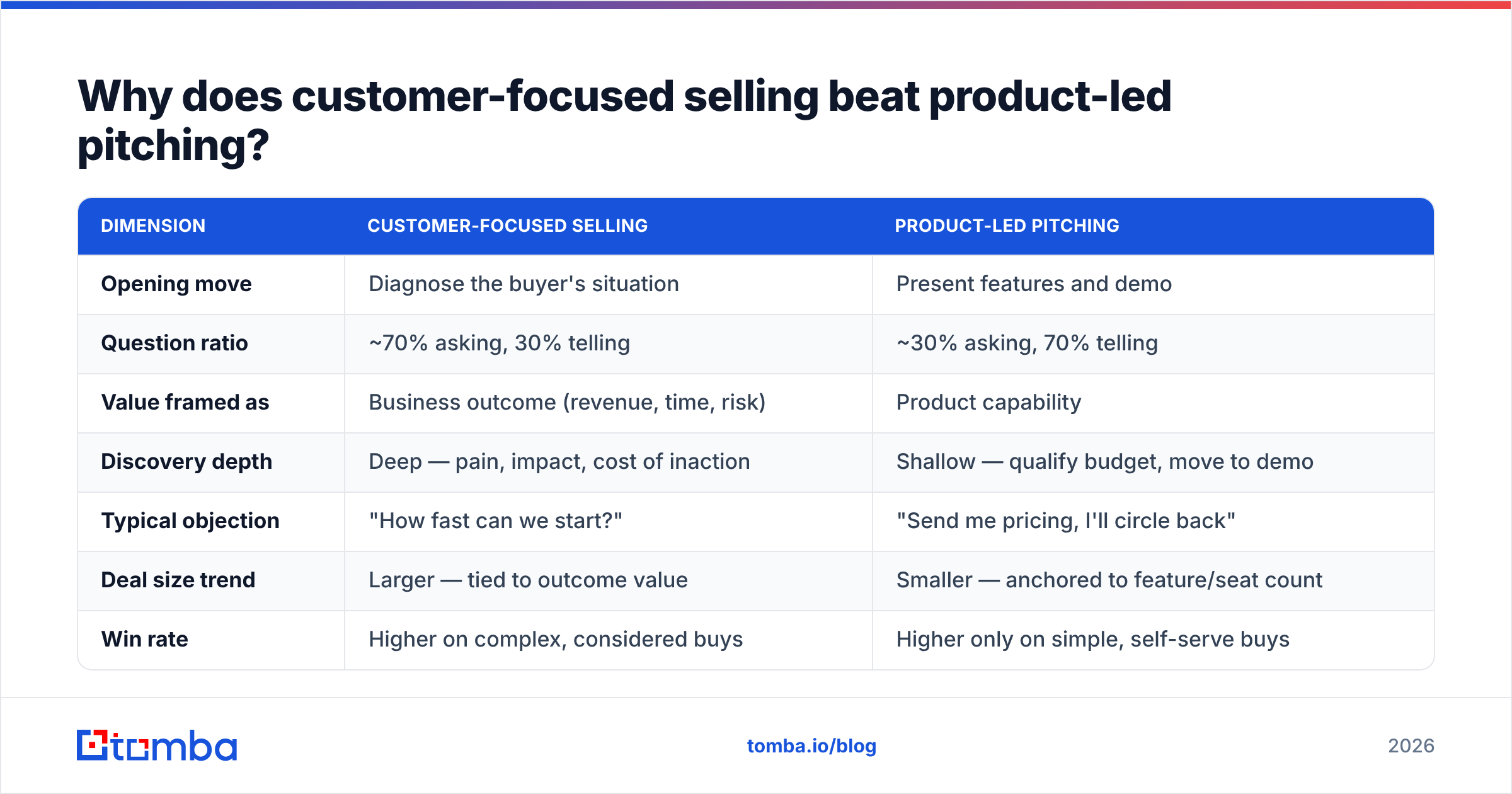
Because it changes what you're actually selling. A product-led pitch sells capability: "here's what it does." The outcome-led version sells a quantified result: "here's what changes for you, and what that's worth." Buyers approve budget for the second one far more often.
Here's the head-to-head:
| Dimension | Customer Focused Selling | Product-Led Pitching |
|---|---|---|
| Opening move | Diagnose the buyer's situation | Present features and demo |
| Question ratio | ~70% asking, 30% telling | ~30% asking, 70% telling |
| Value framed as | Business outcome (revenue, time, risk) | Product capability |
| Discovery depth | Deep — pain, impact, cost of inaction | Shallow — qualify budget, move to demo |
| Typical objection | "How fast can we start?" | "Send me pricing, I'll circle back" |
| Deal size trend | Larger — tied to outcome value | Smaller — anchored to feature/seat count |
| Win rate | Higher on complex, considered buys | Higher only on simple, self-serve buys |
The pattern is consistent. The more considered the purchase, the more this method wins. For a $20/month self-serve tool, a product page and a free trial beat a rep. For a $50k platform decision with five stakeholders, the vendor who best understands the buyer's world almost always closes.
There's also a compounding effect. When you sell the outcome, your renewal and expansion talks write themselves. You already agreed on what success looks like, so you can point to it. Reps who pitch features have to re-sell the product every single quarter.
What are the core steps of customer focused selling?#
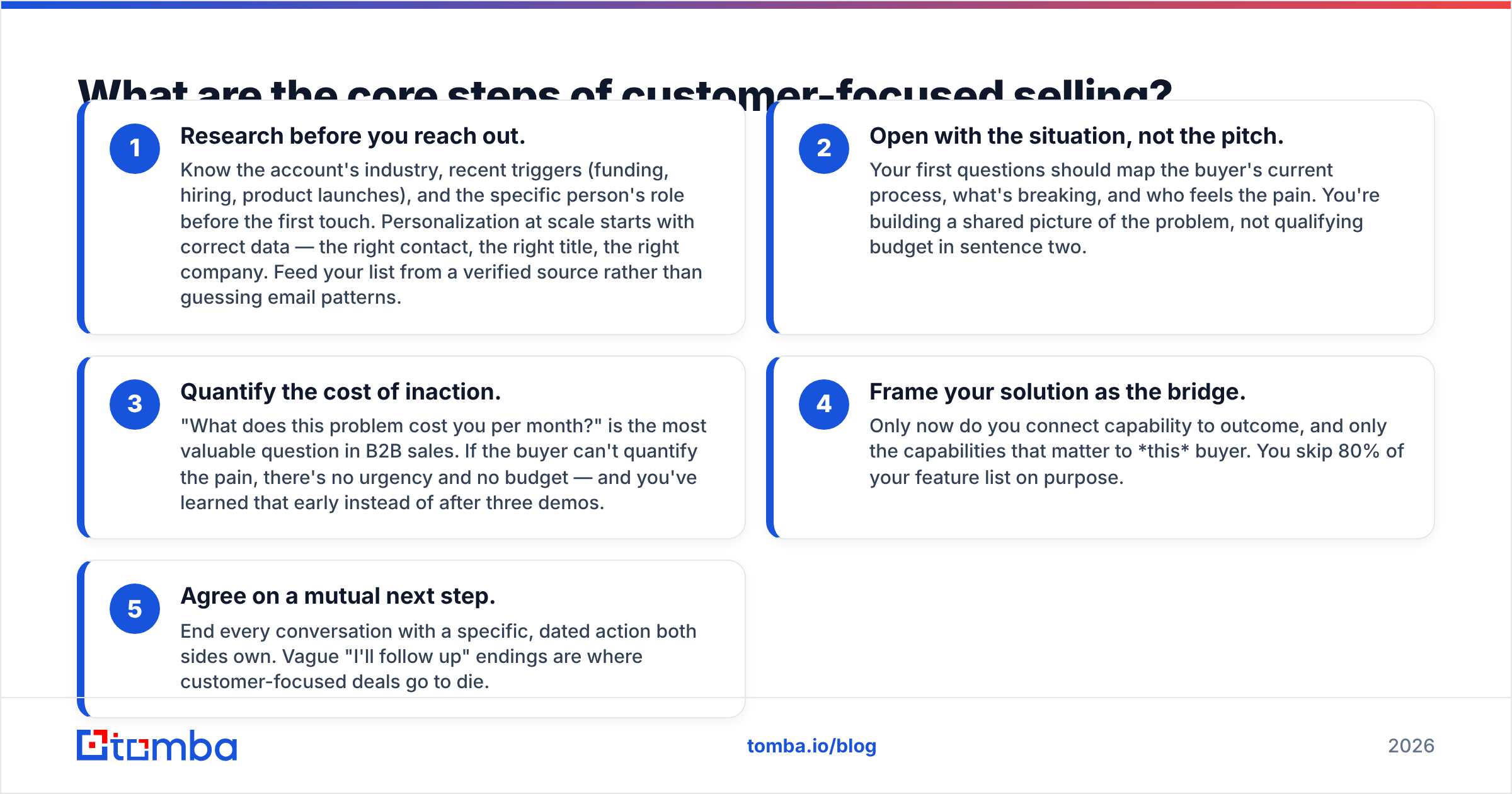
The method is only useful if it's repeatable. These are the moves you can put in a playbook and coach against. No "born closer" required.
- Research before you reach out. Know the account's industry, recent triggers (funding, hiring, product launches), and the person's role before the first touch. Personalization at scale starts with correct data — the right contact, the right title, the right company. Feed your list from a verified source rather than guessing email patterns.
- Open with the situation, not the pitch. Your first questions should map the buyer's current process, what's breaking, and who feels the pain. You're building a shared picture of the problem, not qualifying budget in sentence two.
- Quantify the cost of inaction. "What does this problem cost you per month?" is the most valuable question in B2B sales. If the buyer can't quantify the pain, there's no urgency and no budget. And you've learned that early, not after three demos.
- Frame your solution as the bridge. Only now do you connect capability to outcome — and only the capabilities that matter to this buyer. You skip 80% of your feature list on purpose.
- Agree on a mutual next step. End every conversation with a specific, dated action both sides own. Vague "I'll follow up" endings are where good deals go to die.
Notice what's missing: a monologue. The method is closer to an interview than a presentation. The reps who internalize that shift see the biggest jump in results.
How do you research a prospect for customer focused selling?#
Good research is specific, recent, and role-aware. It's also where most of the actual work lives. You need three layers of context before a meaningful conversation is even possible:
- Account context: What does the company do, how big is it, and what changed recently? A company email search across a domain shows you the org and the people who matter inside it.
- Person context: Who exactly are you talking to, what do they own, and what does success look like in their role? Titles, seniority, and department drive the entire framing of your questions.
- Reachability: You can have the sharpest insight in the world and still lose if you email the wrong address or dial a dead number. Verified contact data — accurate emails and B2B phone numbers — is the difference between a conversation and a bounce.
This is the unglamorous part nobody puts in the LinkedIn post, but it's decisive. HubSpot's sales research shows that non-selling admin eats most of a rep's time — much of it list-building and data cleanup. Automating the data layer is how customer focused reps buy back the hours to actually do discovery.
It also protects deliverability. Blasting unverified addresses tanks your sender reputation. Then even your best-researched emails stop landing. Clean data is both a targeting tool and a deliverability safeguard.
Where do teams get customer focused selling wrong?#
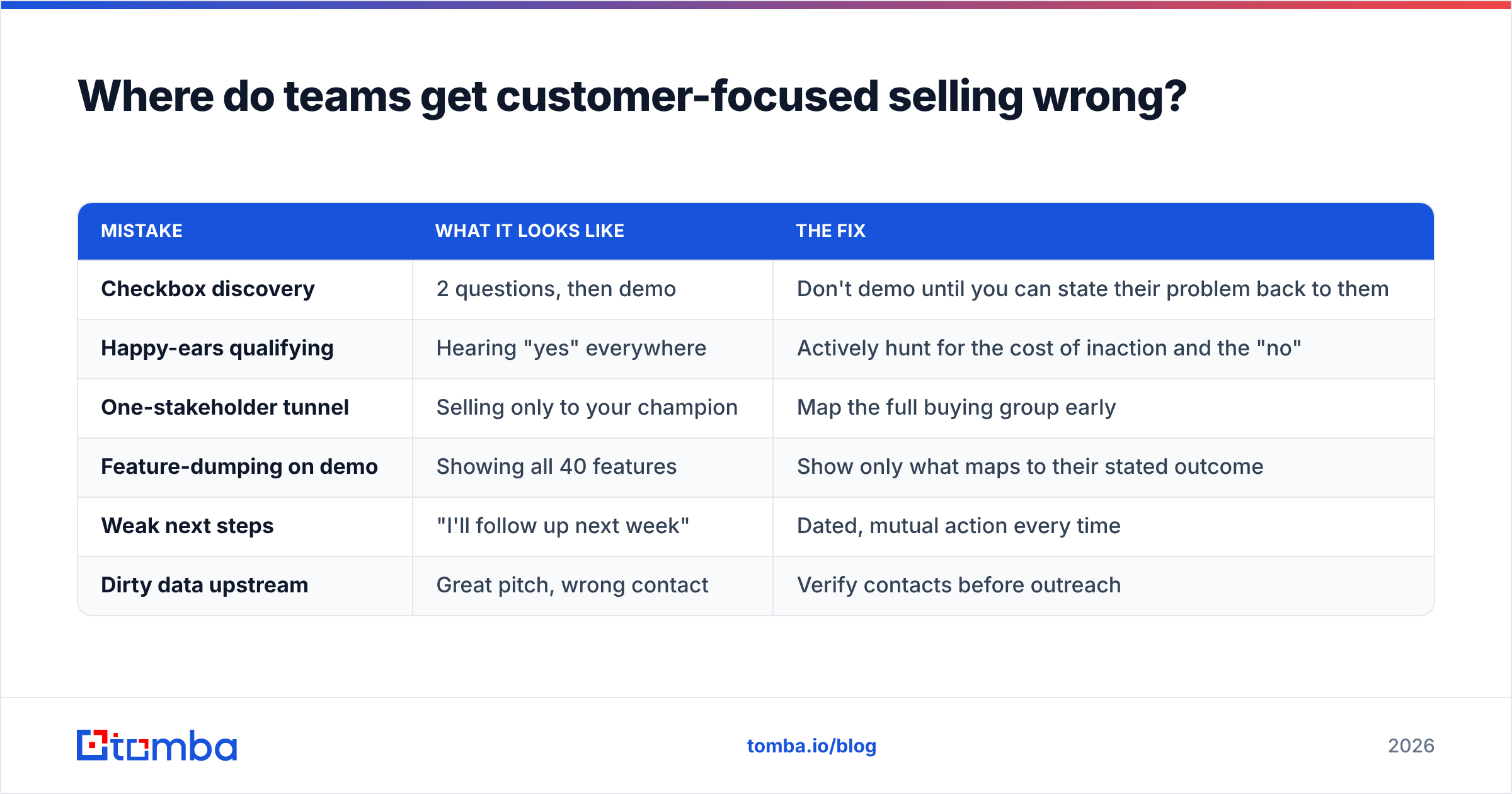
The most common failure isn't skipping discovery. It's fake discovery. Reps ask two throwaway questions, mentally check the "did discovery" box, and jump straight into the demo they always wanted to give. The buyer feels the switch, and the conversation reverts to a pitch.
Here are the traps that quietly kill the method:
| Mistake | What it looks like | The fix |
|---|---|---|
| Checkbox discovery | 2 questions, then demo | Don't demo until you can state their problem back to them |
| Happy-ears qualifying | Hearing "yes" everywhere | Actively hunt for the cost of inaction and the "no" |
| One-stakeholder tunnel | Selling only to your champion | Map the full buying group early |
| Feature-dumping on demo | Showing all 40 features | Show only what maps to their stated outcome |
| Weak next steps | "I'll follow up next week" | Dated, mutual action every time |
| Dirty data upstream | Great pitch, wrong contact | Verify contacts before outreach |
The last row is the silent killer. You can execute steps one through five flawlessly and still watch the quarter slip. The reason is a list built on guessed emails and stale titles. Customer focused selling assumes you're talking to the right human. That assumption has to be earned with data, not hope.

How does customer focused selling change your metrics?#
It shifts your attention from activity metrics to progression metrics. Product-led teams obsess over demos booked. Outcome-led teams watch whether deals are advancing on the buyer's terms. That shows up differently in the pipeline.
Watch these instead of raw dial counts:
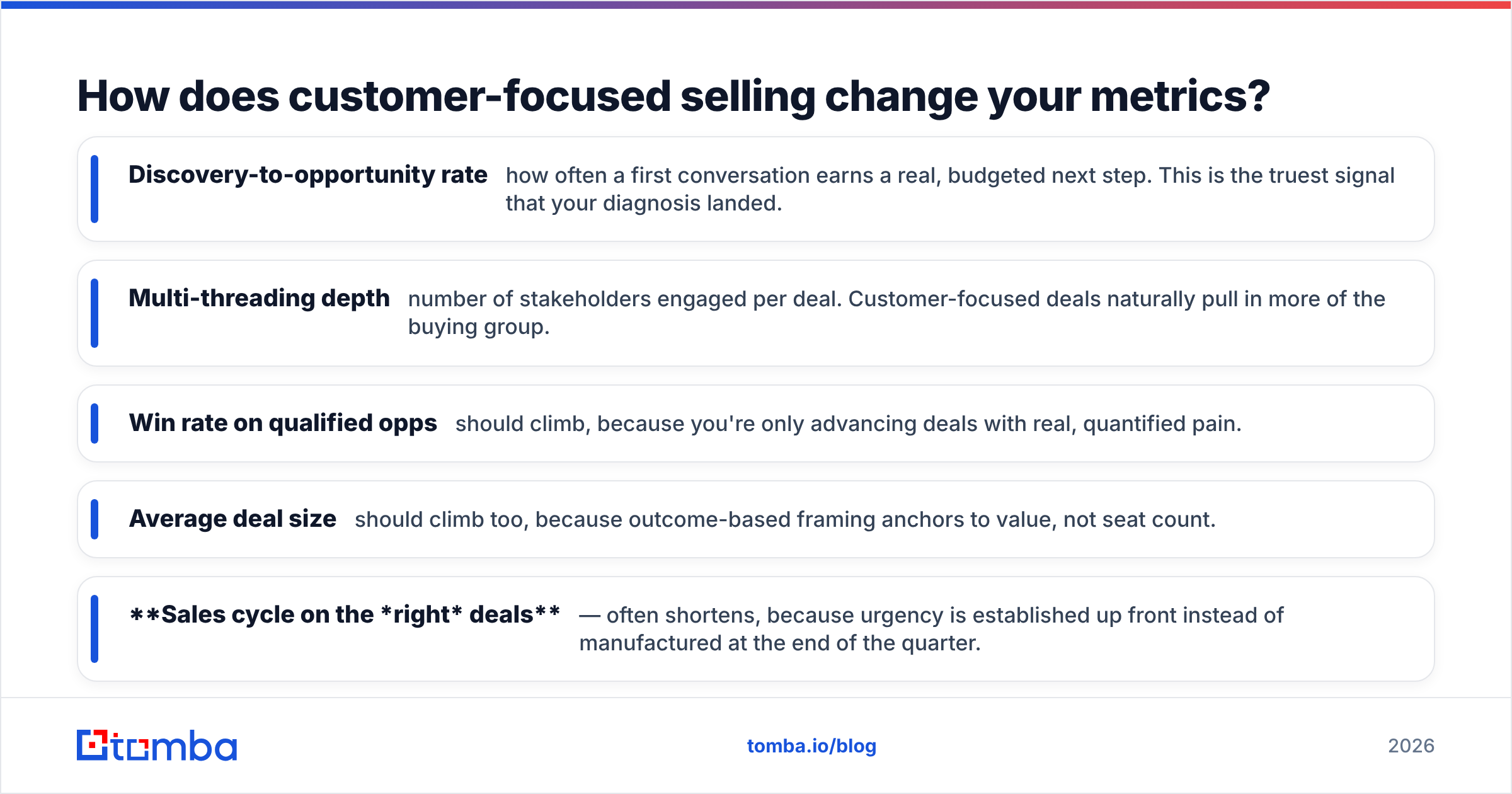
- Discovery-to-opportunity rate — how often a first conversation earns a real, budgeted next step. This is the truest signal that your diagnosis landed.
- Multi-threading depth — number of stakeholders engaged per deal. These deals naturally pull in more of the buying group.
- Win rate on qualified opps — should climb, because you're only advancing deals with real, quantified pain.
- Average deal size — should climb too, because outcome-based framing anchors to value, not seat count.
- Sales cycle on the right deals — often shortens, because urgency is established up front instead of manufactured at the end of the quarter.
Push these into your CRM as required fields — cost of inaction, stakeholders mapped, agreed next step. That turns a philosophy into a forecastable process. It's the part leadership actually cares about: not that reps are "being consultative," but that the method produces predictable, inspectable pipeline. Independent reviews on G2 show the highest-rated sales teams pair a clear methodology with clean data infrastructure. Neither works alone.
Is customer focused selling worth it for smaller teams?#
Yes — and arguably more so. A small team can't afford wasted swings. When you have three reps instead of thirty, every conversation with a wrong-fit buyer is a real chunk of your capacity gone. The method acts as a filter. It surfaces "no budget, no pain" deals early, so your limited hours go to accounts that can actually close.
The one prerequisite is data discipline. A large org can brute-force a bad list with volume. A small team can't. That's why lean teams get the most leverage from automating the top of the funnel. They use a bulk lead generation workflow to build verified lists. Then they spend their scarce human hours on the diagnosis that no tool can do for them.
The math is simple. Say the approach lifts your win rate on qualified opportunities by even a few points, and your deal size with it. A three-person team then performs like a five-person one — without new headcount.
The bottom line#
Customer focused selling isn't a personality trait or a scripting trick. It's a repeatable sequence — research, diagnose, quantify, frame, commit. It consistently produces bigger deals and higher win rates on considered purchases. The reps who win with it aren't smoother talkers. They're better prepared, and they talk about the buyer's outcome instead of their own product.
That preparation starts with data. You can't run outcome-based discovery with the wrong contact at the wrong company. And you can't personalize at scale off guessed email patterns. So start every motion on a verified foundation. Use the Tomba Email Finder to build accurate, deliverable contact lists by domain, name, or company. Your reps then spend their hours on the conversation that closes the deal — not on cleaning the list that gets them there. Check the Tomba pricing to match a plan to your team's volume, starting free with 25 searches a month.
Related guides#
Ready to find emails that actually work?
Join 150,000+ professionals who stopped guessing and started sending. Free credits on signup — no credit card required.
Get the Tomba newsletter
Practical outbound tactics and product updates — once every two weeks.
About the author