What Is a Customer Intelligence Platform? A 2026 Buyer's Guide
A customer intelligence platform unifies scattered data into one profile you can act on. Here's how CIPs work, what they cost, and how to avoid overbuying in 2026.
TL;DR
- A customer intelligence platform (CIP) collects, unifies, and analyzes data from every customer touchpoint so your teams work from one accurate profile instead of five conflicting ones.
- A CIP is not the same as a CRM or a CDP: the CRM stores relationships, the CDP unifies identities, and the CIP adds the analysis and enrichment layer on top.
- Real budgets run from a few hundred dollars a month for lightweight enrichment to $50K+/year for enterprise suites — most teams overbuy.
- The value collapses if the underlying data is stale or unverified, so accurate contact data is the foundation, not an afterthought.
- If your core problem is "we can't find or trust our contact data," a focused enrichment and email finder stack often beats a heavyweight platform.
What is a customer intelligence platform?#
A customer intelligence platform is software that gathers data about your prospects and customers from many sources, stitches it into a single profile per person or company, and turns that profile into something your sales, marketing, and success teams can act on.
Think of it like an air-traffic control tower. Individual planes (your CRM, your product analytics, your billing system, your support desk) each see one slice of the sky. The tower pulls every radar feed into one screen so controllers make decisions with the full picture instead of guessing. A CIP is that tower for customer data.
Technically, most platforms combine four jobs: ingestion (pull data in via integrations and APIs), identity resolution (decide that jane@acme.com and J. Doe in Salesforce are the same person), enrichment (append firmographic, technographic, and contact details), and activation (push scores, segments, and alerts back out to the tools reps live in).
That third job — enrichment — is where data quality makes or breaks the whole system. A beautifully unified profile with a bounced email address still can't be contacted.

How is a CIP different from a CRM or a CDP?#
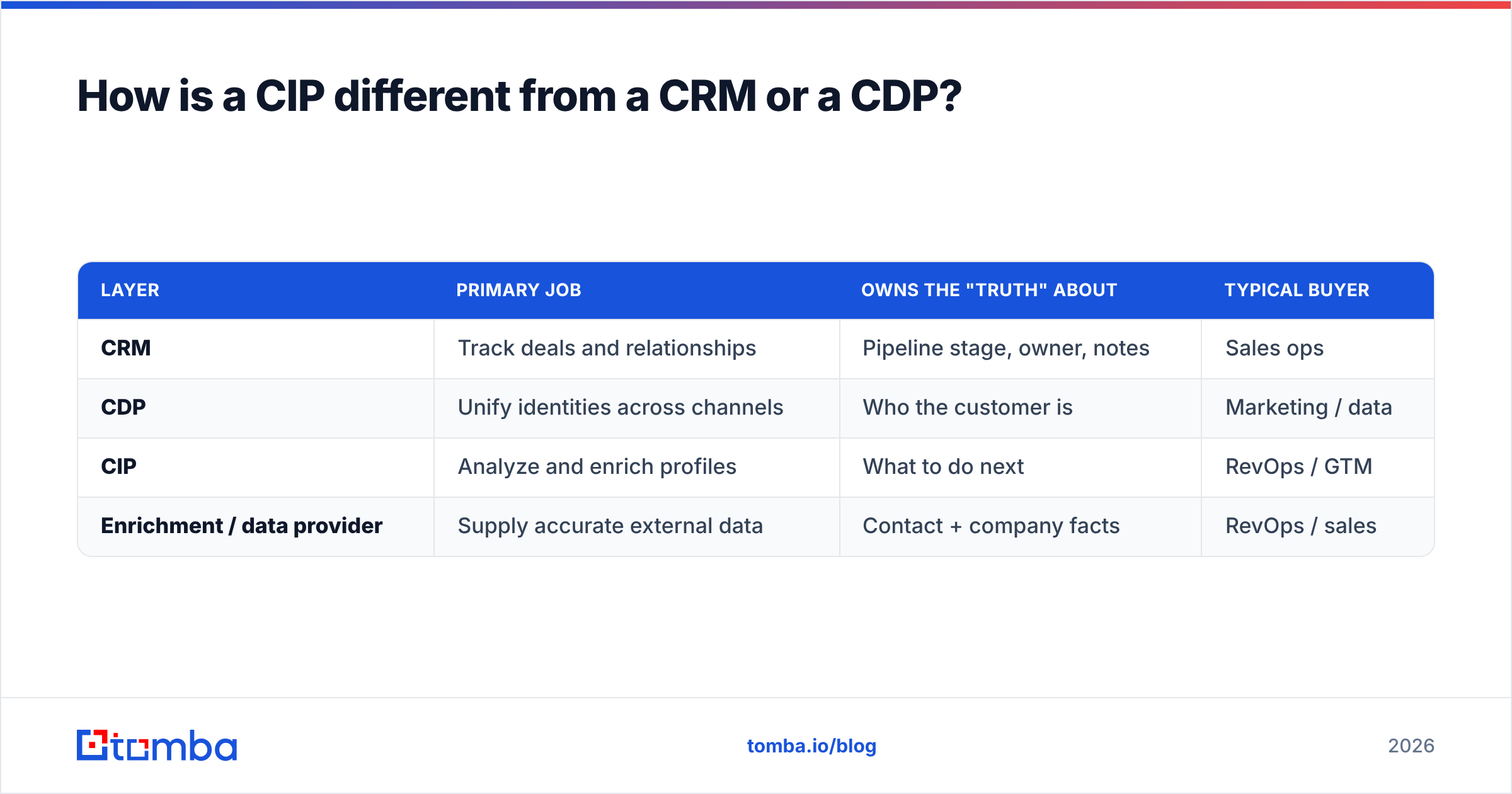
This is the question that derails most buying committees, because the categories genuinely overlap. Here's the cleanest way to separate them.
| Layer | Primary job | Owns the "truth" about | Typical buyer |
|---|---|---|---|
| CRM | Track deals and relationships | Pipeline stage, owner, notes | Sales ops |
| CDP | Unify identities across channels | Who the customer is | Marketing / data |
| CIP | Analyze and enrich profiles | What to do next | RevOps / GTM |
| Enrichment / data provider | Supply accurate external data | Contact + company facts | RevOps / sales |
The lines blur because vendors keep absorbing each other's features. Many CDPs now advertise "intelligence," and many CIPs bundle a lightweight CDP. What matters is not the label on the box but which job is your actual bottleneck.
If reps waste time hunting for correct email addresses and phone numbers, no amount of "intelligence" fixes that — you need better source data. That's why teams increasingly pair a lean data enrichment layer with the tools they already own instead of ripping everything out for a monolith. For the terminology itself, the revenue operations discipline is the one that usually owns the CIP decision.
What are the core features of a customer intelligence platform?#
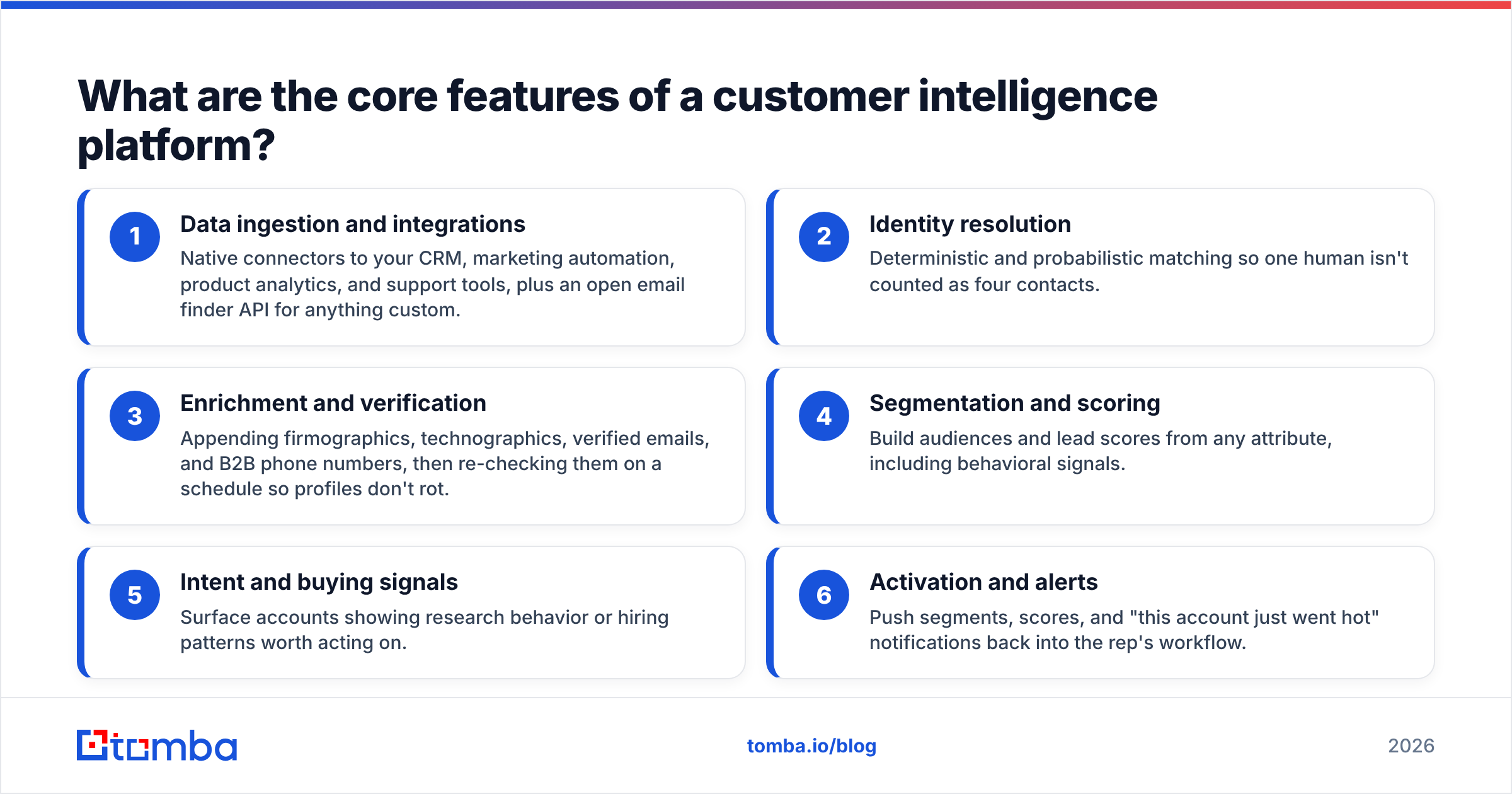
Not every platform includes every capability, but a serious CIP in 2026 should cover these six areas. Use this as a shortlist when you compare vendors.
- Data ingestion and integrations — Native connectors to your CRM, marketing automation, product analytics, and support tools, plus an open email finder API for anything custom.
- Identity resolution — Deterministic and probabilistic matching so one human isn't counted as four contacts.
- Enrichment and verification — Appending firmographics, technographics, verified emails, and B2B phone numbers, then re-checking them on a schedule so profiles don't rot.
- Segmentation and scoring — Build audiences and lead scores from any attribute, including behavioral signals.
- Intent and buying signals — Surface accounts showing research behavior or hiring patterns worth acting on.
- Activation and alerts — Push segments, scores, and "this account just went hot" notifications back into the rep's workflow.
The middle item — enrichment and verification — is the one buyers most often underestimate. Gartner has long noted that B2B data decays fast as people change jobs, so a platform that enriches once and never re-verifies is selling you a snapshot that's wrong within a year. Continuously verified data through an email verifier is what keeps the rest of the stack honest.
Is a customer intelligence platform worth the cost?#
Short answer: only if you'll actually operationalize the output. A CIP that produces gorgeous dashboards nobody acts on is the most expensive wallpaper you'll ever buy.
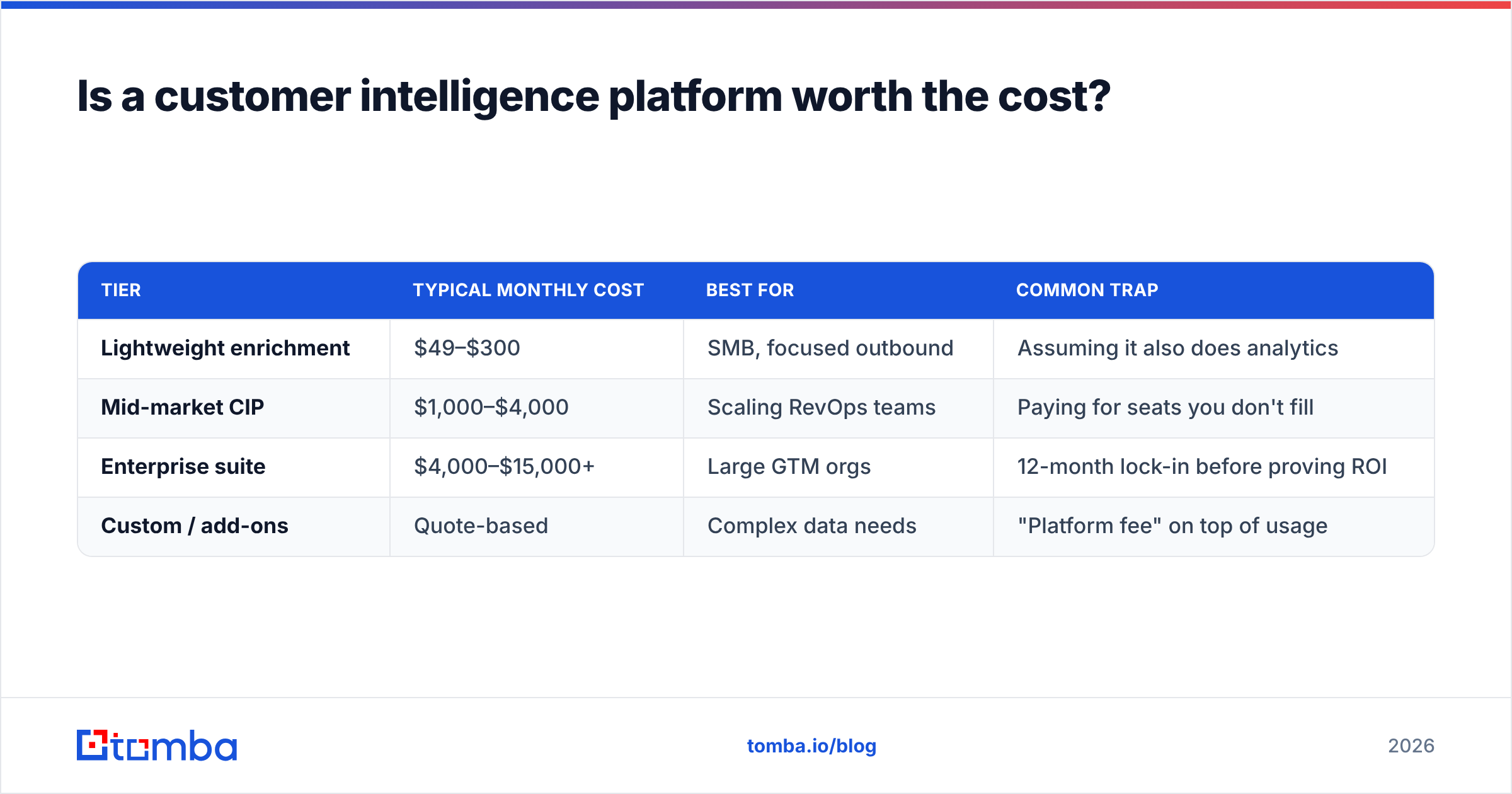
Pricing spans a huge range. Here's a realistic 2026 picture across tiers, using representative numbers rather than any single vendor's sticker.
| Tier | Typical monthly cost | Best for | Common trap |
|---|---|---|---|
| Lightweight enrichment | $49–$300 | SMB, focused outbound | Assuming it also does analytics |
| Mid-market CIP | $1,000–$4,000 | Scaling RevOps teams | Paying for seats you don't fill |
| Enterprise suite | $4,000–$15,000+ | Large GTM orgs | 12-month lock-in before proving ROI |
| Custom / add-ons | Quote-based | Complex data needs | "Platform fee" on top of usage |
The mistake I see most often: a 20-person team signs a $50K enterprise contract to solve a problem that was really just dirty contact data. They needed accurate emails and a way to enrich records in bulk — not a six-figure intelligence suite. Compare that to transparent Tomba pricing, where a Free tier gives you 25 searches a month, Starter is $49/mo, and Growth is $99/mo, and the overbuy becomes obvious.
Before you sign anything, run the math on cost per actioned insight, not cost per feature. A cheaper tool your team actually uses beats an expensive one they log into twice.

How do you choose the right customer intelligence platform?#
Work through these questions in order. Each one narrows the field faster than a feature checklist.
1. What's the actual bottleneck? If it's "we can't find or trust contact data," start with enrichment and verification, not analytics. If it's "we have data but no idea who's in-market," you need signals and scoring. Name the bottleneck before you demo anything.
2. Where does the data come from? Ask every vendor to explain sourcing and refresh cadence in plain language. A platform that won't describe its data sources is asking for blind trust. Reputable review sites like G2 and Capterra are useful for cross-checking accuracy claims against real user reports.
3. Does it fit your existing stack? Check native integrations first — a HubSpot integration or Salesforce integration that works out of the box saves months. HubSpot's own research on data quality is a good reality check on how much bad data quietly costs.
4. How is it priced — and when do you break even? Prefer transparent, usage-aligned pricing over quote-locked annual deals until you've proven value. Negotiate a pilot.
5. Can you export your data? If leaving the platform means losing your enriched records, you don't own your data — you're renting it. Confirm export terms before signing.
CIP vs. a focused data stack: which do you actually need?#
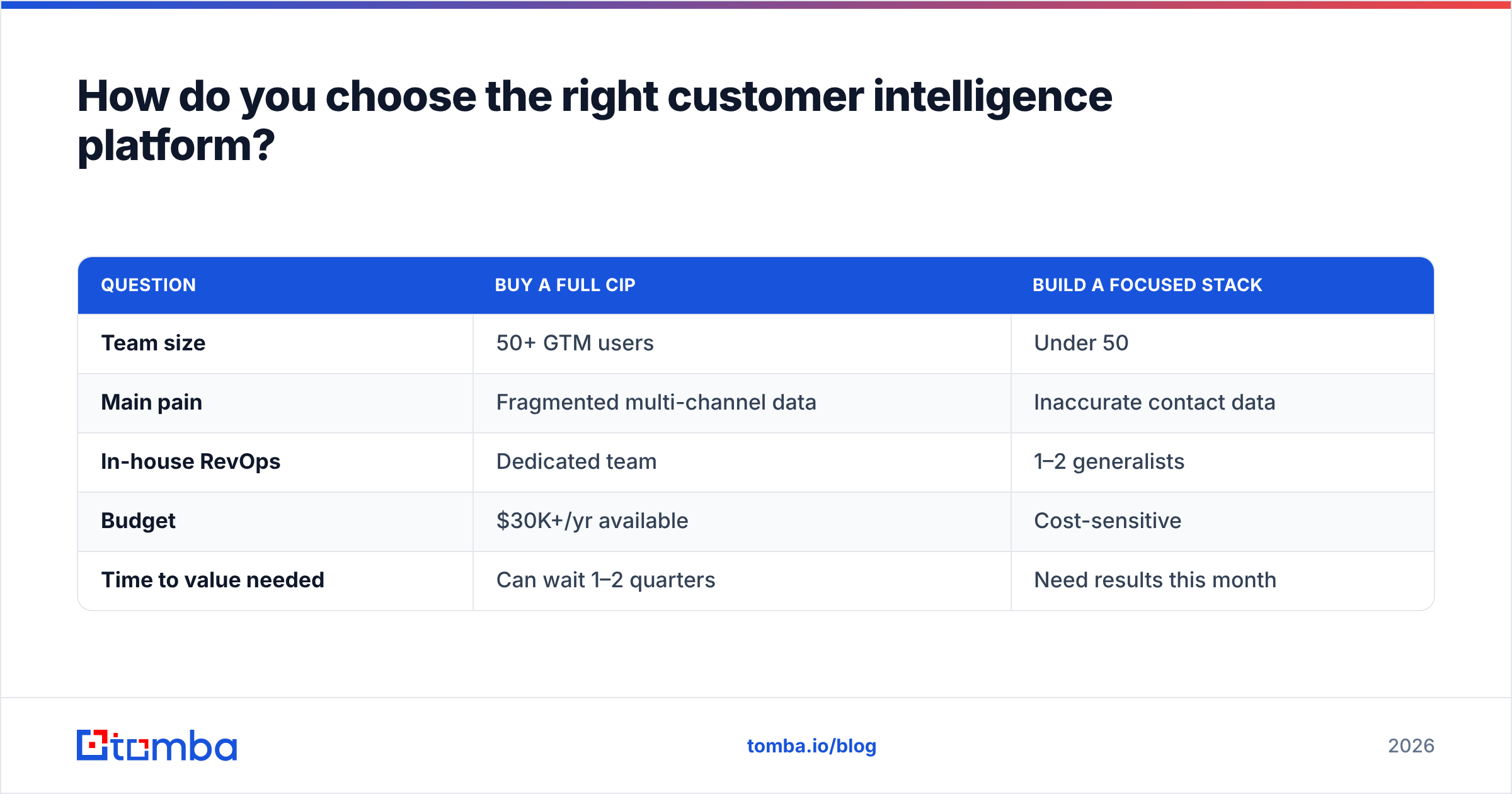
| Question | Buy a full CIP | Build a focused stack |
|---|---|---|
| Team size | 50+ GTM users | Under 50 |
| Main pain | Fragmented multi-channel data | Inaccurate contact data |
| In-house RevOps | Dedicated team | 1–2 generalists |
| Budget | $30K+/yr available | Cost-sensitive |
| Time to value needed | Can wait 1–2 quarters | Need results this month |
If most of your answers land in the right column, you probably don't need a monolithic platform yet. A combination of accurate find email addresses capability, bulk lead generation for list building, and your existing CRM covers the 80% that matters — at a fraction of the cost and complexity.
What does a customer intelligence workflow look like in practice?#
Here's a concrete, unglamorous example of a CIP doing its job well for a mid-market SaaS team.
A target account visits the pricing page three times in a week. The platform recognizes the anonymous visitor, resolves them to a known company, and enriches the record with the right decision-maker's title, verified email, and direct phone. It scores the account "hot" based on the behavior, then alerts the account owner in Slack with everything they need to reach out in one message.
Every step depends on data being correct. If the enriched email bounces, the rep looks foolish and the "intelligence" was worthless. This is why teams often anchor the workflow on a reliable company email search and verification layer first, then add scoring and signals once the foundation is trustworthy.
The sequence matters: accurate data → unified profile → scoring → activation. Skip the first step and you've automated the delivery of wrong answers.
Common mistakes when buying a customer intelligence platform#
- Buying analytics to fix a data-quality problem. Dashboards don't clean bounced emails. Fix the source first.
- Ignoring refresh cadence. A one-time enrichment is stale within months. Insist on ongoing verification.
- Overbuying seats and tiers. Match the plan to the users who will log in weekly, not your headcount.
- Skipping the pilot. Never sign an annual enterprise deal before a 30-day proof on your real data.
- No exit plan. If you can't export enriched records, switching later means starting over.
Avoiding these five keeps you from the classic outcome: a six-figure contract, a beautiful platform, and a sales team still copy-pasting emails from LinkedIn because the "intelligence" data was wrong.
Frequently asked questions#
Is a customer intelligence platform the same as a CDP? No. A CDP focuses on unifying customer identities across channels. A customer intelligence platform adds enrichment, scoring, and analysis on top so teams know what to do with those unified profiles. Many CIPs include CDP-like features, but the emphasis differs.
Do small teams need a CIP? Usually not at first. Small teams get more value from accurate enrichment and a solid email finder plugged into their existing CRM. Add a full platform once data volume and channel complexity outgrow that setup.
What's the single biggest factor in CIP success? Data accuracy. Every downstream feature — scoring, segmentation, alerts — inherits the quality of the underlying contact and company data. Verified data makes the platform trustworthy; stale data makes it a liability.
How much should I budget? Anywhere from $49/month for focused enrichment to $15K+/month for enterprise suites. Start small, prove ROI on actioned insights, then scale. Don't let a vendor size you before you've validated the use case.
The bottom line#
A customer intelligence platform is powerful when it sits on a foundation of accurate, continuously verified data — and a costly distraction when it doesn't. Diagnose your real bottleneck before you shop. If it's fragmented data across many channels and a large GTM team, a full platform may earn its price. If it's "we can't find or trust our contact data," you can solve that today for a fraction of the cost.
Start where the value actually comes from: correct, verified contact data. Tomba's Email Finder lets you find and verify professional email addresses by name, domain, or company — the accurate foundation any customer intelligence workflow needs. Try it free with 25 searches a month, then scale on transparent Tomba pricing as your program grows.
Related guides#
Ready to find emails that actually work?
Join 150,000+ professionals who stopped guessing and started sending. Free credits on signup — no credit card required.
Get the Tomba newsletter
Practical outbound tactics and product updates — once every two weeks.
About the author