The B2B Customer Journey: Stages, Maps, and Metrics (2026)
The B2B customer journey is longer, multi-threaded, and messier than any funnel diagram admits. Here is how to map it stage by stage in 2026 — with the touchpoints, metrics, and tools that actually move buyers.
The B2B customer journey is not a funnel. It is a group of six to ten skeptical people, each with their own agenda, wandering in and out of your website, your competitors' G2 pages, a Slack channel you will never see, and three vendor demos — over an average of four to twelve months. If your marketing and sales teams still treat it as a tidy top-to-bottom slide, you are optimizing for a map that does not match the terrain.
This guide breaks the customer journey B2B buyers actually take: the real stages, how to map them without a 40-hour workshop, the metrics that tell you whether a stage is working, and the stack that keeps a buyer moving instead of stalling.
TL;DR#
- The B2B journey is non-linear and multi-threaded. A single deal involves 6–10 stakeholders (Gartner), each entering at a different stage — so "one funnel, one lead" thinking loses deals.
- There are five core stages: Awareness, Consideration, Decision, Onboarding, and Advocacy. Most teams over-invest in the first two and neglect the last two, where revenue actually compounds.
- You cannot map what you cannot see. Accurate contact data — knowing who is in the buying group and how to reach them — is the connective tissue between stages.
- Metrics change per stage. Awareness cares about reach; Decision cares about win rate and cycle length; Advocacy cares about NRR and referrals.
- The tooling is modular, not monolithic. Pair a CRM, an enrichment layer, and outreach automation instead of forcing one platform to do everything.
What is the B2B customer journey?#
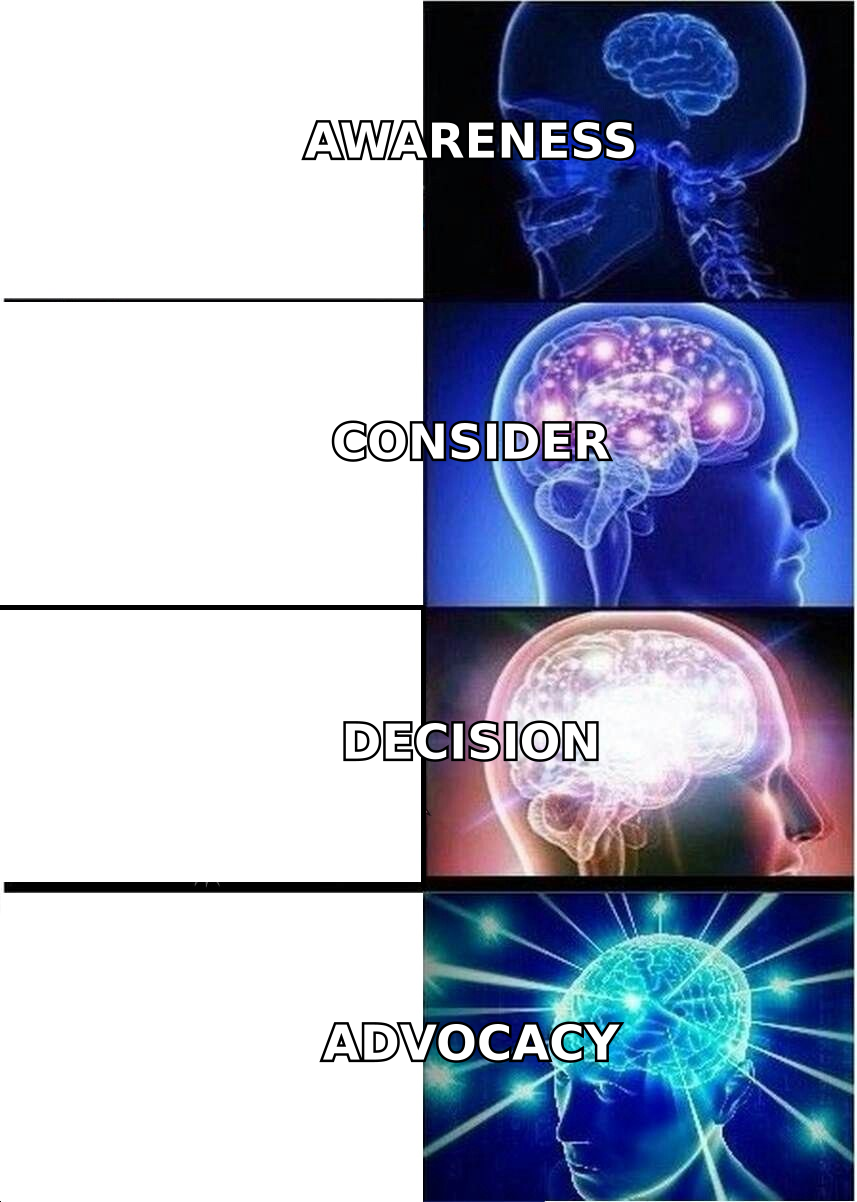
The B2B customer journey is the full sequence of experiences a business buyer — and their entire buying committee — has with your company, from the first unbranded problem search to renewal and referral. Think of it less like a slide and more like a subway map: multiple lines, shared stations, and passengers boarding at different points.
Unlike a marketing funnel (which describes your process), the customer journey describes the buyer's process. The distinction matters. A funnel says "MQL → SQL → Opportunity → Closed Won." A journey says "a VP felt a pain, googled it at 11 p.m., forgot about it, saw a LinkedIn post six weeks later, forwarded it to an analyst, and the analyst built a shortlist you weren't on." Your job is to be present, useful, and easy to reach at every one of those unglamorous moments.
Why does the B2B customer journey look different from B2C?#
Because in B2B, nobody buys alone and nobody buys fast. Three structural differences reshape everything:
- The buying committee. According to Gartner, a typical B2B purchase involves six to ten decision-makers, each armed with four or five pieces of independently gathered information. You are not persuading a person; you are equipping an internal coalition.
- The length. Considered purchases stretch across months and multiple budget cycles. A lead who "went quiet" is often just waiting for the next fiscal quarter.
- The stakes. A wrong SaaS decision gets someone blamed in a QBR. That risk-aversion means buyers do most of their research anonymously, long before they ever fill out a form.
The practical takeaway: the majority of the journey happens where you have zero visibility. You compensate by being findable, by publishing genuinely useful content, and by having the data enrichment needed to identify and reach the committee once any single member raises a hand.
What are the stages of the B2B customer journey?#
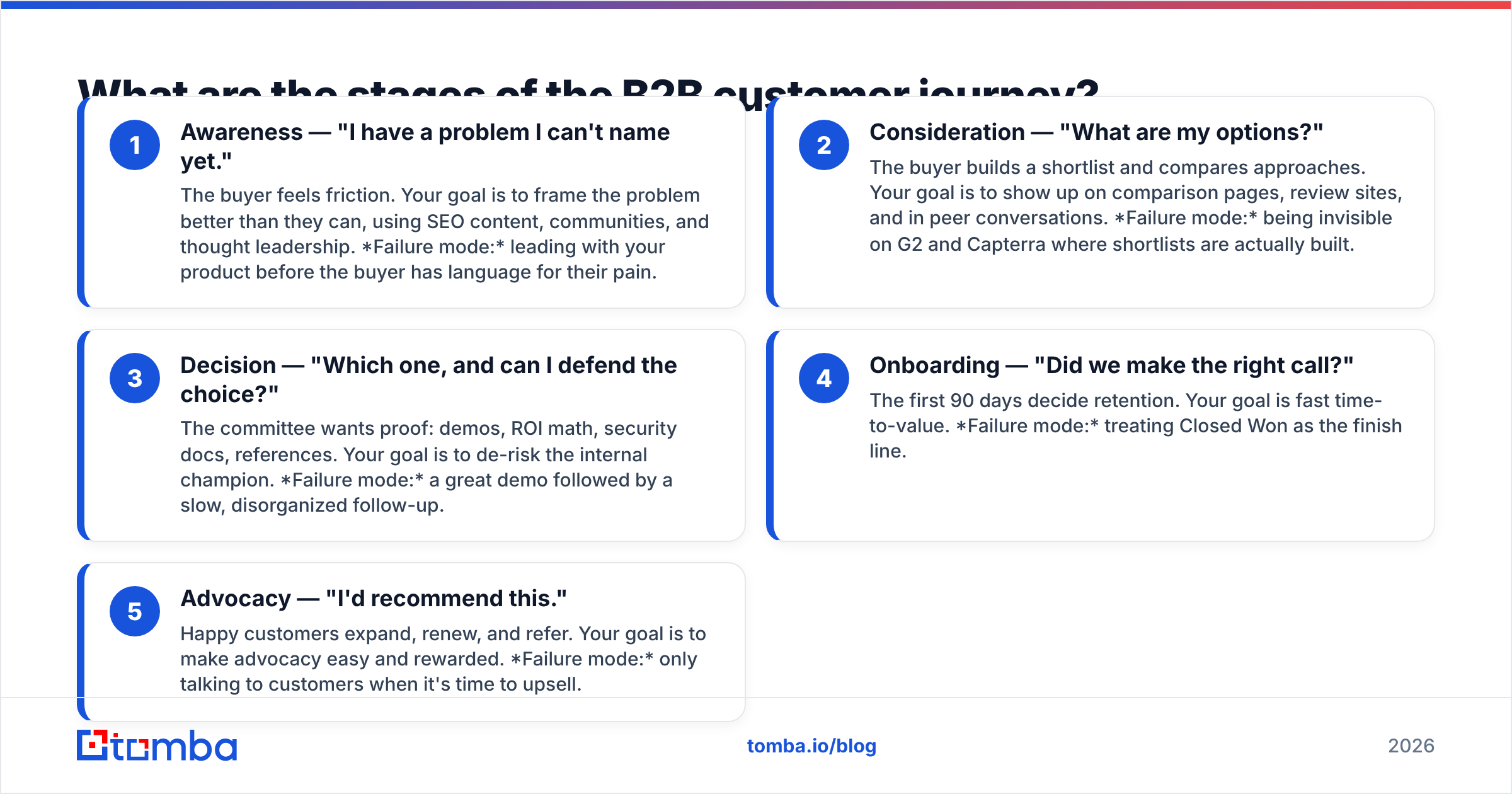
Here is the core map. Five stages, each with a buyer goal, a company goal, and the failure mode that kills momentum. Treat this as the backbone you customize — not a rigid script.
- Awareness — "I have a problem I can't name yet." The buyer feels friction. Your goal is to frame the problem better than they can, using SEO content, communities, and thought leadership. Failure mode: leading with your product before the buyer has language for their pain.
- Consideration — "What are my options?" The buyer builds a shortlist and compares approaches. Your goal is to show up on comparison pages, review sites, and in peer conversations. Failure mode: being invisible on G2 and Capterra where shortlists are actually built.
- Decision — "Which one, and can I defend the choice?" The committee wants proof: demos, ROI math, security docs, references. Your goal is to de-risk the internal champion. Failure mode: a great demo followed by a slow, disorganized follow-up.
- Onboarding — "Did we make the right call?" The first 90 days decide retention. Your goal is fast time-to-value. Failure mode: treating Closed Won as the finish line.
- Advocacy — "I'd recommend this." Happy customers expand, renew, and refer. Your goal is to make advocacy easy and rewarded. Failure mode: only talking to customers when it's time to upsell.
Most teams pour 80% of their budget into stages one and two. But net revenue retention and word-of-mouth — the two cheapest growth levers in B2B — live in stages four and five.
How do you map the B2B customer journey?#
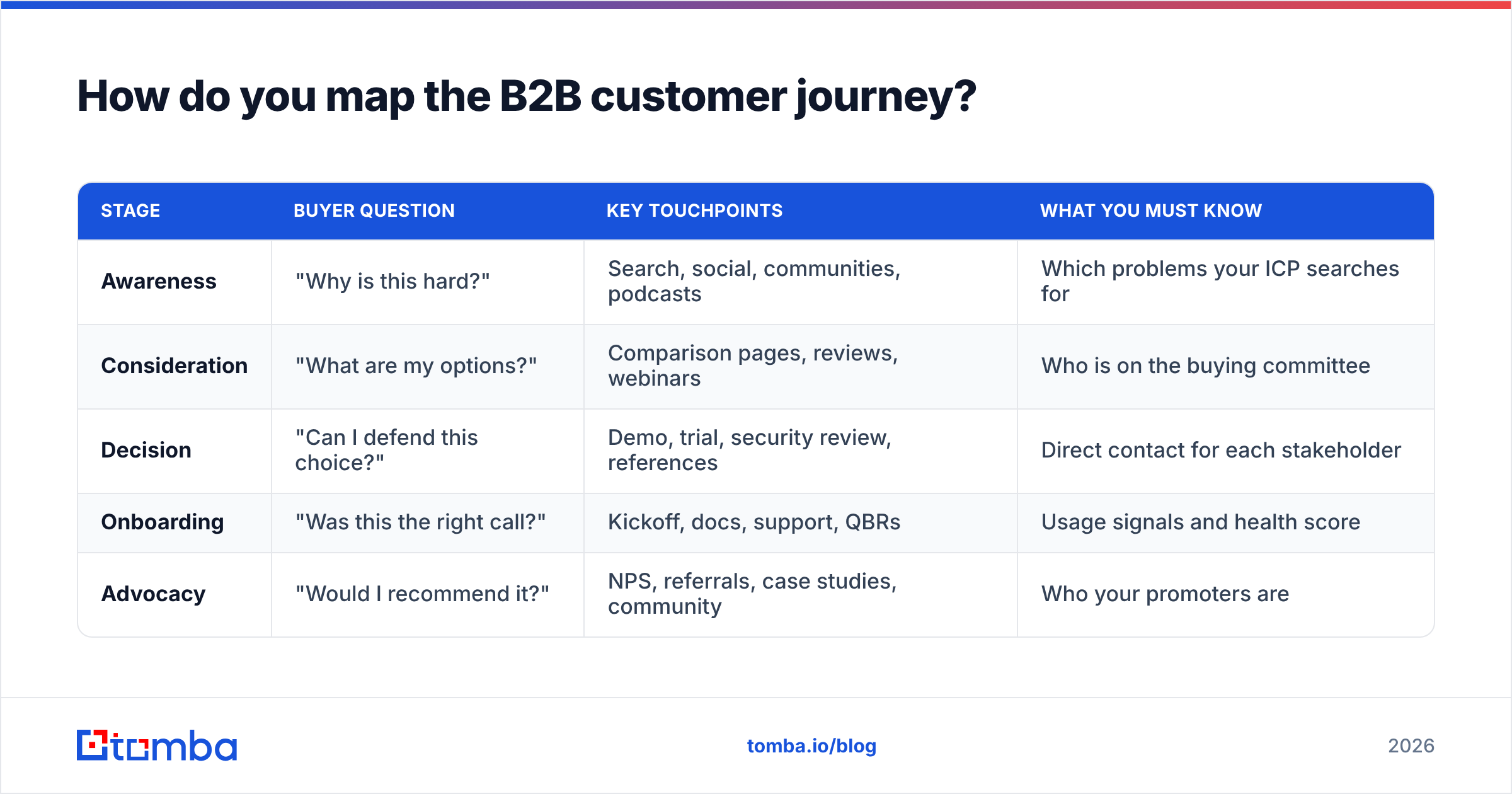
Mapping does not require a two-day offsite. It requires answering four columns for each stage. Build this table in a spreadsheet with your actual data and you will have a working map by end of day.
| Stage | Buyer question | Key touchpoints | What you must know |
|---|---|---|---|
| Awareness | "Why is this hard?" | Search, social, communities, podcasts | Which problems your ICP searches for |
| Consideration | "What are my options?" | Comparison pages, reviews, webinars | Who is on the buying committee |
| Decision | "Can I defend this choice?" | Demo, trial, security review, references | Direct contact for each stakeholder |
| Onboarding | "Was this the right call?" | Kickoff, docs, support, QBRs | Usage signals and health score |
| Advocacy | "Would I recommend it?" | NPS, referrals, case studies, community | Who your promoters are |
Notice the "What you must know" column. Every row depends on data — and in the Consideration and Decision stages, that data is who the humans are and how to reach them. This is where a lot of otherwise-good journey maps collapse: the marketing team knows an account is engaged, but sales can't reach the four other people quietly influencing the decision. Closing that gap with reliable data enrichment and verified contacts is what turns a pretty diagram into pipeline.
Which metrics matter at each stage?#
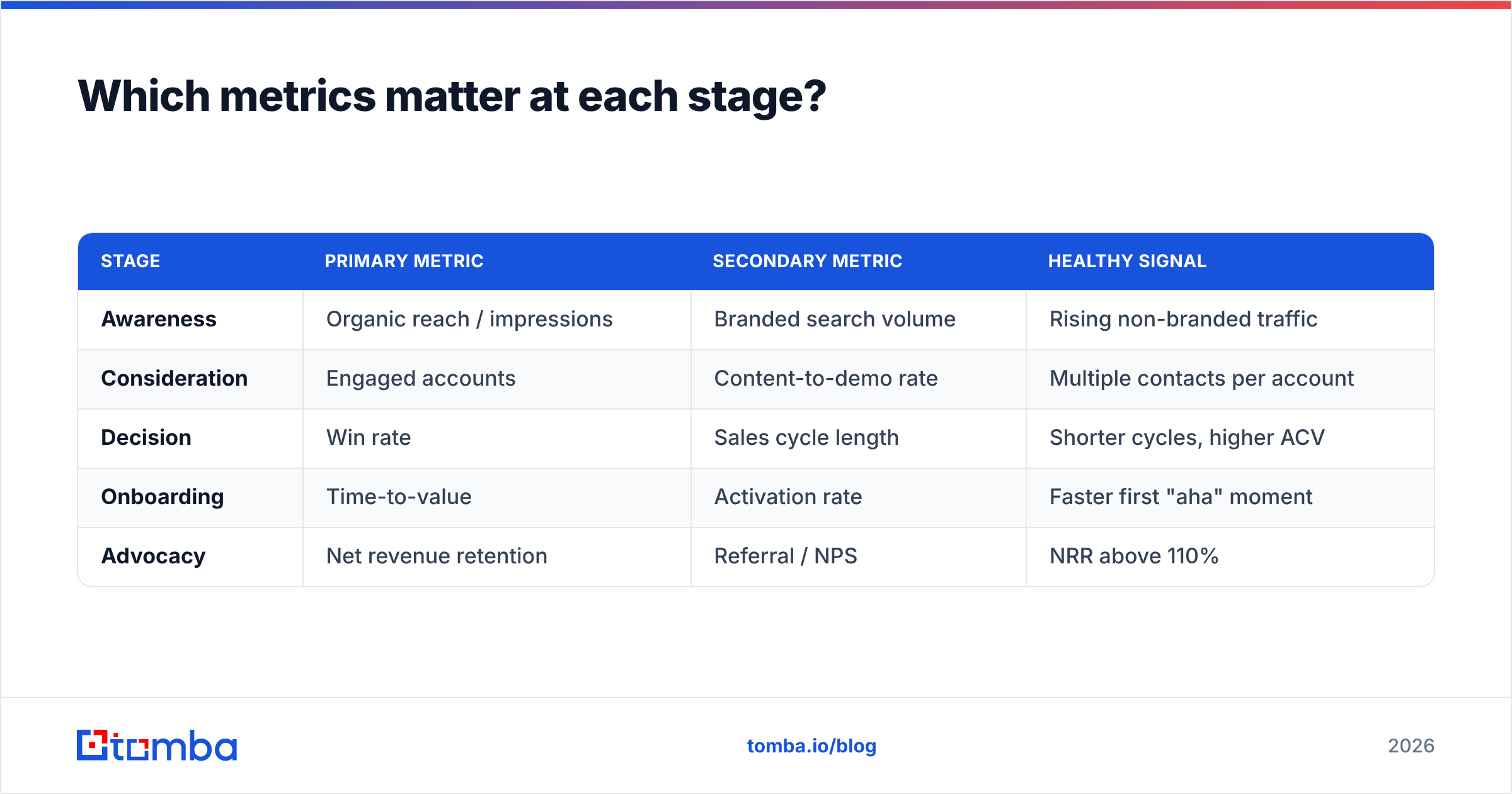
A journey map without metrics is a poster. Assign each stage one or two numbers that actually change behavior, and review them where the stage lives — not in a single blended "conversion rate."
| Stage | Primary metric | Secondary metric | Healthy signal |
|---|---|---|---|
| Awareness | Organic reach / impressions | Branded search volume | Rising non-branded traffic |
| Consideration | Engaged accounts | Content-to-demo rate | Multiple contacts per account |
| Decision | Win rate | Sales cycle length | Shorter cycles, higher ACV |
| Onboarding | Time-to-value | Activation rate | Faster first "aha" moment |
| Advocacy | Net revenue retention | Referral / NPS | NRR above 110% |
The Decision-stage pair — win rate and cycle length — is the most diagnostic in the whole table. If win rate is fine but cycles are ballooning, your problem is usually follow-up speed and multi-threading, not lead quality. Aligning these numbers across marketing, sales, and success is the entire point of revenue operations; when each team optimizes its own stage in isolation, the buyer feels the seams.
What tools power each stage of the B2B customer journey?#
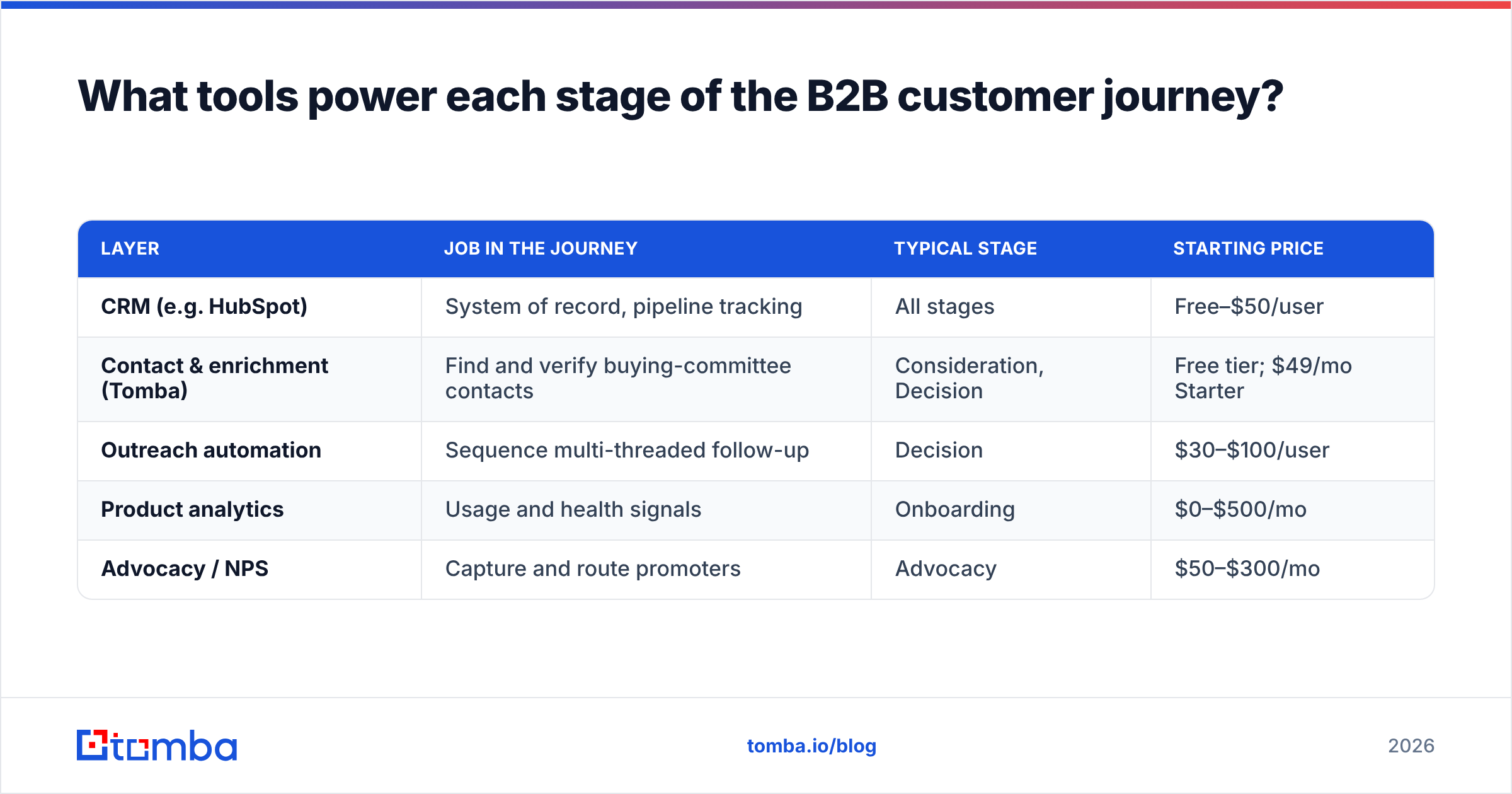
You do not need a single "journey platform." You need a small, well-connected stack where data flows cleanly between stages. Here is a practical, vendor-neutral breakdown of what each layer does and roughly what it costs.
| Layer | Job in the journey | Typical stage | Starting price |
|---|---|---|---|
| CRM (e.g. HubSpot) | System of record, pipeline tracking | All stages | Free–$50/user |
| Contact & enrichment (Tomba) | Find and verify buying-committee contacts | Consideration, Decision | Free tier; $49/mo Starter |
| Outreach automation | Sequence multi-threaded follow-up | Decision | $30–$100/user |
| Product analytics | Usage and health signals | Onboarding | $0–$500/mo |
| Advocacy / NPS | Capture and route promoters | Advocacy | $50–$300/mo |
The layer teams most often under-build is the second one: contact and enrichment. You can have a beautiful CRM and a slick outreach tool, but if the records are half-empty or the emails bounce, the journey breaks exactly where it matters — between an engaged account and a real conversation. Tomba's email finder and domain search fill that gap by turning a company name into the verified contacts for the whole buying group, so your Decision-stage sequences reach humans instead of catch-all inboxes.
A quick note on pricing sanity: this is not the stage to over-buy. Tomba's plans start at a Free tier (25 searches/month) and a $49/mo Starter, scaling to Growth ($99/mo) and Pro ($249/mo) as your volume grows. You can see the full Tomba pricing breakdown, but the point is to match the tool to your actual monthly contact volume rather than buying an enterprise seat you'll use at 5% capacity.
What are the most common B2B customer journey mistakes?#
Five patterns quietly wreck otherwise-solid journeys:
- Single-threading. Selling to one champion who then leaves, gets overruled, or goes quiet. Always map and reach at least three stakeholders per open opportunity.
- Treating the sale as the finish line. The journey's most profitable stretch (Onboarding → Advocacy) starts after Closed Won. A fast, well-instrumented onboarding is worth more than another awareness campaign.
- Blended metrics. Reporting one funnel conversion rate hides which stage is actually leaking. Measure per stage.
- Dirty data between stages. Marketing hands off an "engaged account," sales can't find the right contacts, momentum dies. Verify and enrich at the handoff.
- Ignoring the anonymous majority. Most research happens before any form fill. Publish content and maintain review-site presence so you're on shortlists you'll never watch being built.
Fixing even two of these — multi-threading and clean handoff data — typically compresses cycle length and lifts win rate faster than any new lead source.
How do you keep buyers moving between stages?#
Momentum is a design choice, not luck. Three habits keep a buyer advancing:
- Reduce the next step's friction. Every touchpoint should make the following one obvious and easy — a clear CTA, a pre-filled form, a calendar link, a relevant case study. Ambiguity is where journeys stall.
- Follow up faster than your competitor. In the Decision stage, speed-to-follow-up correlates with win rate more than almost anything else. Have verified contact data ready before the demo, not after.
- Multi-thread deliberately. When one stakeholder engages, use enrichment to identify the other four and bring them into the conversation early, so a single reorg or vacation can't reset the whole deal.
None of this works without knowing who the buyers are. That's the unglamorous foundation the pretty journey map sits on.
Frequently asked questions#
How long is a typical B2B customer journey? Anywhere from a few weeks for low-cost tools to 12+ months for enterprise platforms. Longer cycles usually reflect larger buying committees and higher perceived risk, not disinterest.
Is the B2B customer journey linear? No. Buyers loop backward, pause across budget cycles, and enter at different stages. Map it as a network of touchpoints, not a straight line.
Who owns the customer journey? Ideally a shared RevOps function, because no single team touches all five stages. When marketing, sales, and success each own their stage in isolation, buyers feel the gaps.
What's the fastest way to improve journey performance? Clean up the data at your marketing-to-sales handoff and start multi-threading every open deal. Both lift win rate without spending a dollar more on lead generation.
Turn your journey map into reachable contacts#
A journey map is only as good as your ability to act on it — and acting means reaching the right people at the right stage. That's where most B2B teams stall: the account is engaged, but the contacts are missing, stale, or bouncing.
Start free with the Tomba Email Finder. Turn any company or domain into the verified, deliverable contacts for the entire buying committee, so your Consideration and Decision stages run on real conversations instead of guesswork. Map the journey, then actually walk it — with contact data you can trust at every step.
Related guides#
Ready to find emails that actually work?
Join 150,000+ professionals who stopped guessing and started sending. Free credits on signup — no credit card required.
Get the Tomba newsletter
Practical outbound tactics and product updates — once every two weeks.
About the author