Customer Journey Funnel: Stages, Metrics, and How to Map It
The customer journey funnel is where marketing and sales either align or leak revenue. Here's how the stages actually work in 2026, the metrics that matter, and a repeatable way to map your own.
The customer journey funnel is the model that connects a stranger's first click to a signed contract and a renewal. Get it right and every team knows what to do at each stage. Get it wrong and leads leak out of gaps nobody is measuring.
This guide breaks down the stages, the metrics that actually predict revenue, and a repeatable process to map the journey for your own business — without the buzzwords.
TL;DR#
- The customer journey funnel maps how a buyer moves from unaware stranger to paying, renewing customer across awareness, consideration, decision, and retention stages.
- The classic funnel is not dead — but in 2026 it's a loop, not a straight drop. Buyers self-educate, loop back, and involve buying committees before they ever talk to sales.
- Measure the transitions, not the stages. Conversion rate between steps, velocity, and drop-off tell you where revenue leaks.
- Marketing and sales share one funnel. The handoff at the MQL-to-SQL line is where most deals die.
- Clean contact data is the fuel. A well-mapped funnel still stalls if your outreach hits bounced or wrong emails — accurate contact data keeps every stage moving.
What is a customer journey funnel?#
A customer journey funnel is a visual model of the path a person takes from first hearing about you to becoming a loyal customer. Picture a kitchen funnel: a wide mouth catches a lot of liquid at the top, and a narrow spout lets a smaller, focused stream out the bottom. Many people enter at awareness; fewer make it to purchase.
Technically, it's a staged framework that assigns each prospect a position based on their intent and readiness to buy. It merges two older ideas: the marketing funnel (awareness to lead) and the sales funnel (lead to close). Modern teams treat them as one continuous system so nobody drops the baton at the handoff.
The difference between a "funnel" and a "customer journey" is subtle but important. The funnel is your internal, business-facing view of stages and conversion math. The journey is the buyer's actual lived experience — the emails, the demo, the pricing page they visited three times at 11pm. The best operators overlay both so the internal model matches how people really buy. HubSpot's own flywheel research argues the funnel should feed itself, with happy customers driving new awareness.
What are the stages of the customer journey funnel?#
Most funnels use four to six stages. Here's the practical version that maps cleanly to both marketing and sales activity.
- Awareness — The prospect realizes they have a problem and discovers you exist. Blog posts, ads, social, and word of mouth live here. Success = qualified traffic and reach.
- Interest / Consideration — They actively research solutions and compare options. Lead magnets, webinars, and comparison content pull them in. Success = leads captured and content engagement.
- Evaluation / Decision — They shortlist vendors and involve a buying committee. Demos, trials, case studies, and pricing conversations dominate. Success = opportunities created and demos booked.
- Purchase / Conversion — They buy. Proposal, negotiation, and signature. Success = win rate and deal velocity.
- Retention — Onboarding, adoption, and support keep them paying. Success = churn rate and net revenue retention.
- Advocacy — Happy customers refer others and leave reviews, feeding the top of the funnel again. Success = referrals and review volume.
Not every business needs all six. A self-serve SaaS tool might collapse evaluation and purchase into a free trial. An enterprise deal might stretch evaluation across six months and eleven stakeholders. The stages are a scaffold — adapt the labels to how your buyers actually move.
Is the marketing funnel different from the sales funnel?#
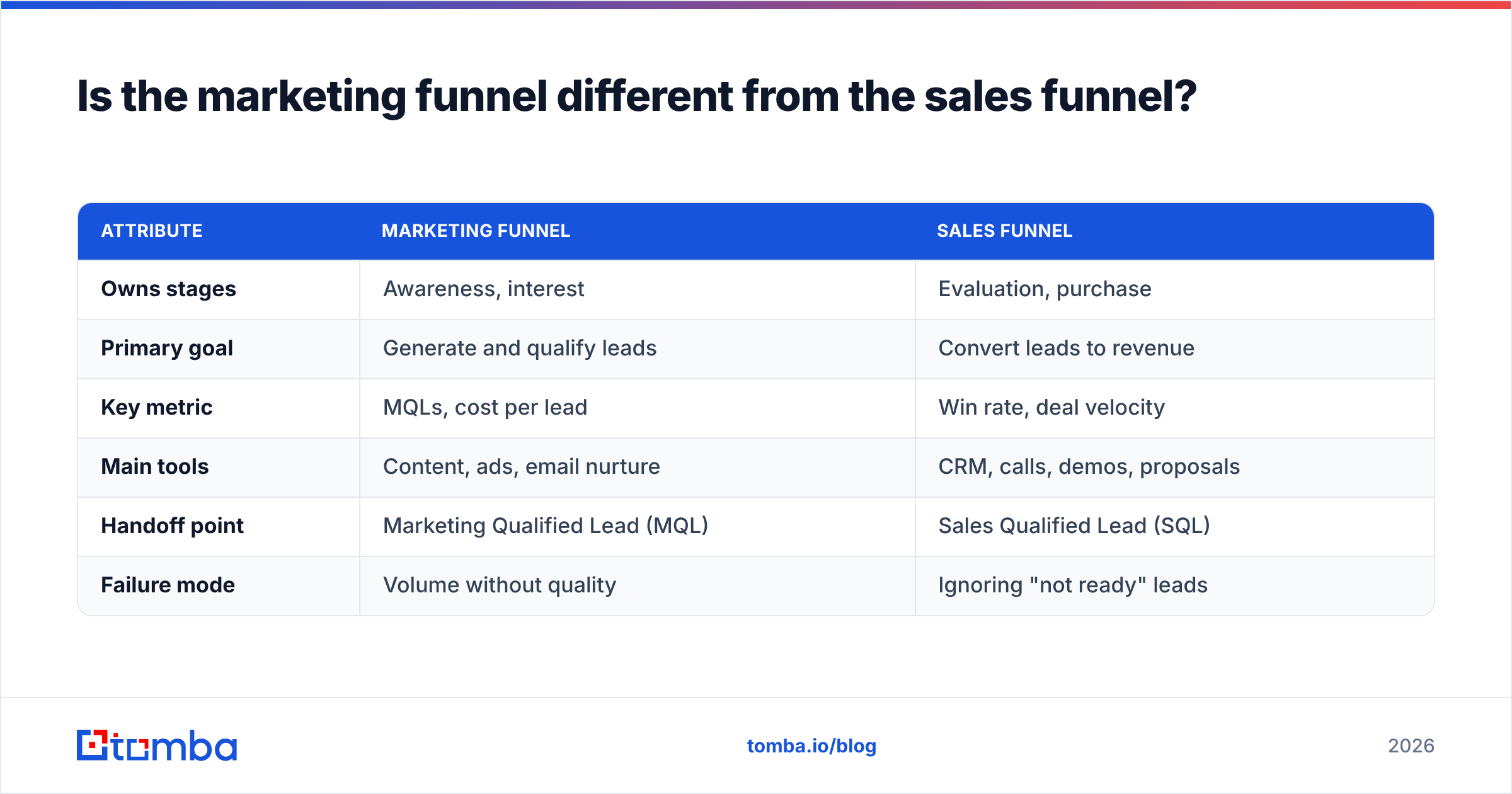
Yes, but they're two halves of the same pipe. The trouble starts when each team optimizes its own half and ignores the seam between them.
| Attribute | Marketing funnel | Sales funnel |
|---|---|---|
| Owns stages | Awareness, interest | Evaluation, purchase |
| Primary goal | Generate and qualify leads | Convert leads to revenue |
| Key metric | MQLs, cost per lead | Win rate, deal velocity |
| Main tools | Content, ads, email nurture | CRM, calls, demos, proposals |
| Handoff point | Marketing Qualified Lead (MQL) | Sales Qualified Lead (SQL) |
| Failure mode | Volume without quality | Ignoring "not ready" leads |
The marketing qualified lead to SQL line is the single most expensive gap in most funnels. Marketing celebrates lead volume; sales complains the leads are junk; leads that were merely "not ready yet" get dumped instead of nurtured. Fixing this seam — with a shared definition of a qualified lead and a closed-loop feedback process — often recovers more revenue than any top-of-funnel campaign.
Why does the classic funnel model break in 2026?#
Because buyers no longer move in a straight line. The tidy top-to-bottom drop assumes a controlled, linear path. Real buyers loop.
Gartner's research on B2B buying found that buyers spend only a fraction of the journey talking to any single vendor's sales team — most of it is spent independently researching and building consensus inside a buying group. By the time someone requests a demo, they may already be 70% decided. Gartner's B2B buying journey work documents how nonlinear and committee-driven this has become.
Three shifts break the classic model:
- Self-education. Prospects consume your content, reviews on G2, and competitor pages long before they raise their hand. Much of the "consideration" stage happens invisibly.
- Buying committees. Six to ten stakeholders now weigh in on a typical B2B deal. A "lead" is rarely one person — it's a group, each at a different stage.
- Loops, not drops. A prospect can be in "decision" for pricing but bounce back to "awareness" when a new stakeholder joins. The journey zigzags.
The fix isn't to abandon the funnel — it's to treat it as a flexible map with entry and exit points at every stage, plus a retention loop that feeds advocacy back to the top.
How do you measure a customer journey funnel?#
Measure the transitions between stages, not just the headcount inside them. A stage full of leads that never advance is a warehouse, not a funnel.
Track these core metrics:
- Stage conversion rate — the percentage that moves from one stage to the next. This is where leaks show up. If 1,000 leads become 40 opportunities, your interest-to-evaluation conversion is 4%.
- Velocity — how long a prospect spends in each stage. Slow stages signal friction: unclear pricing, a clunky demo, or a stalled buying committee.
- Drop-off rate — the inverse of conversion. Rank your biggest drop-offs and fix the worst one first.
- Cost per stage — what you spend to move a prospect one step. Ties spend to outcomes instead of vanity reach.
- Win rate and response rate — the bottom-of-funnel reality check on whether qualified leads actually convert.
- Net revenue retention — post-sale, whether customers expand or churn. A leaky retention stage quietly erases top-of-funnel wins.
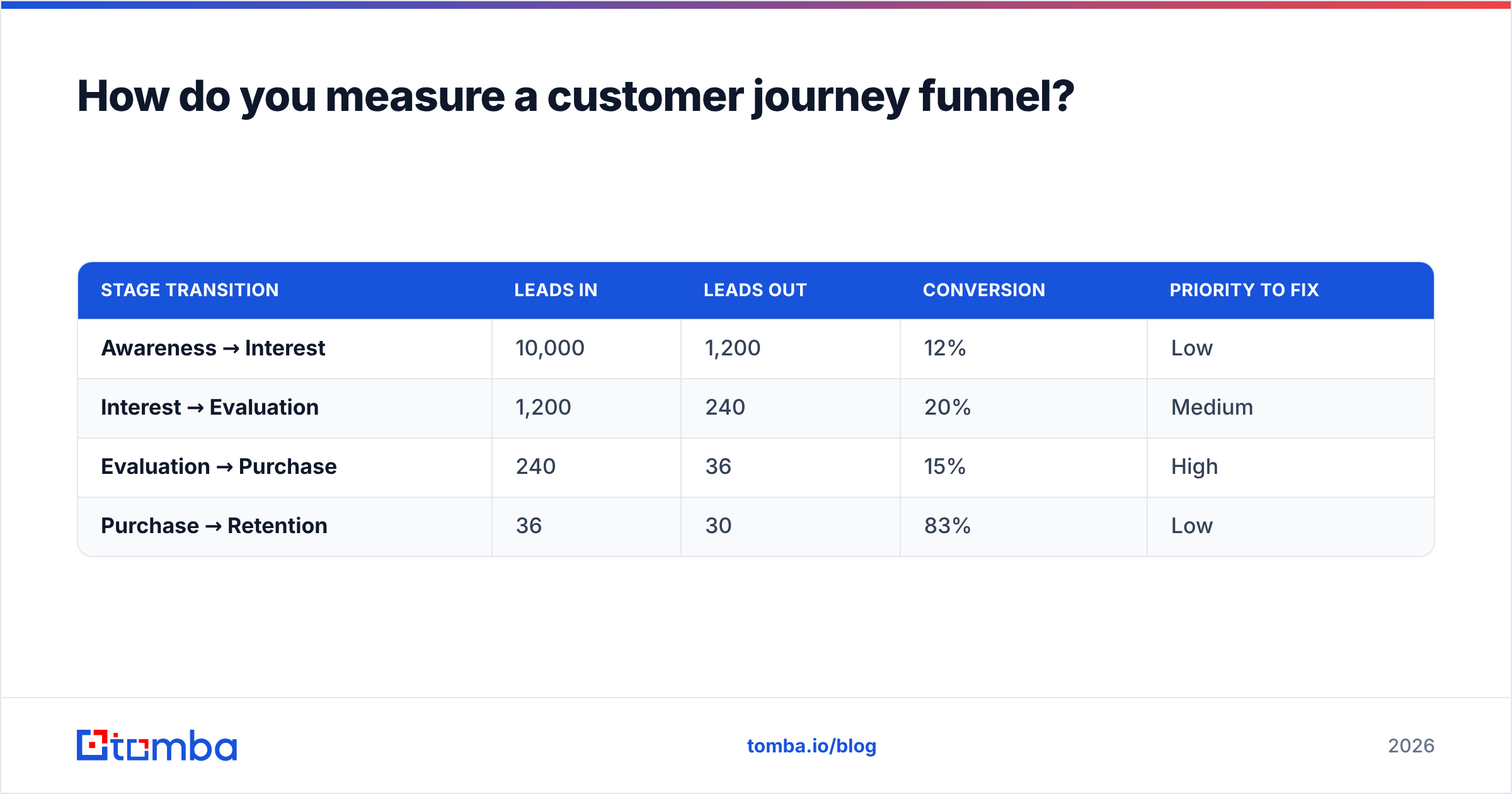
A simple diagnostic: put your last 90 days of data into the table below and find your worst-performing transition.
| Stage transition | Leads in | Leads out | Conversion | Priority to fix |
|---|---|---|---|---|
| Awareness → Interest | 10,000 | 1,200 | 12% | Low |
| Interest → Evaluation | 1,200 | 240 | 20% | Medium |
| Evaluation → Purchase | 240 | 36 | 15% | High |
| Purchase → Retention | 36 | 30 | 83% | Low |
In this example, the evaluation-to-purchase step leaks the most absolute revenue relative to effort spent getting there — so that's where you invest, not in pouring more cold traffic into an already-wide top.
How do you map your own customer journey funnel?#
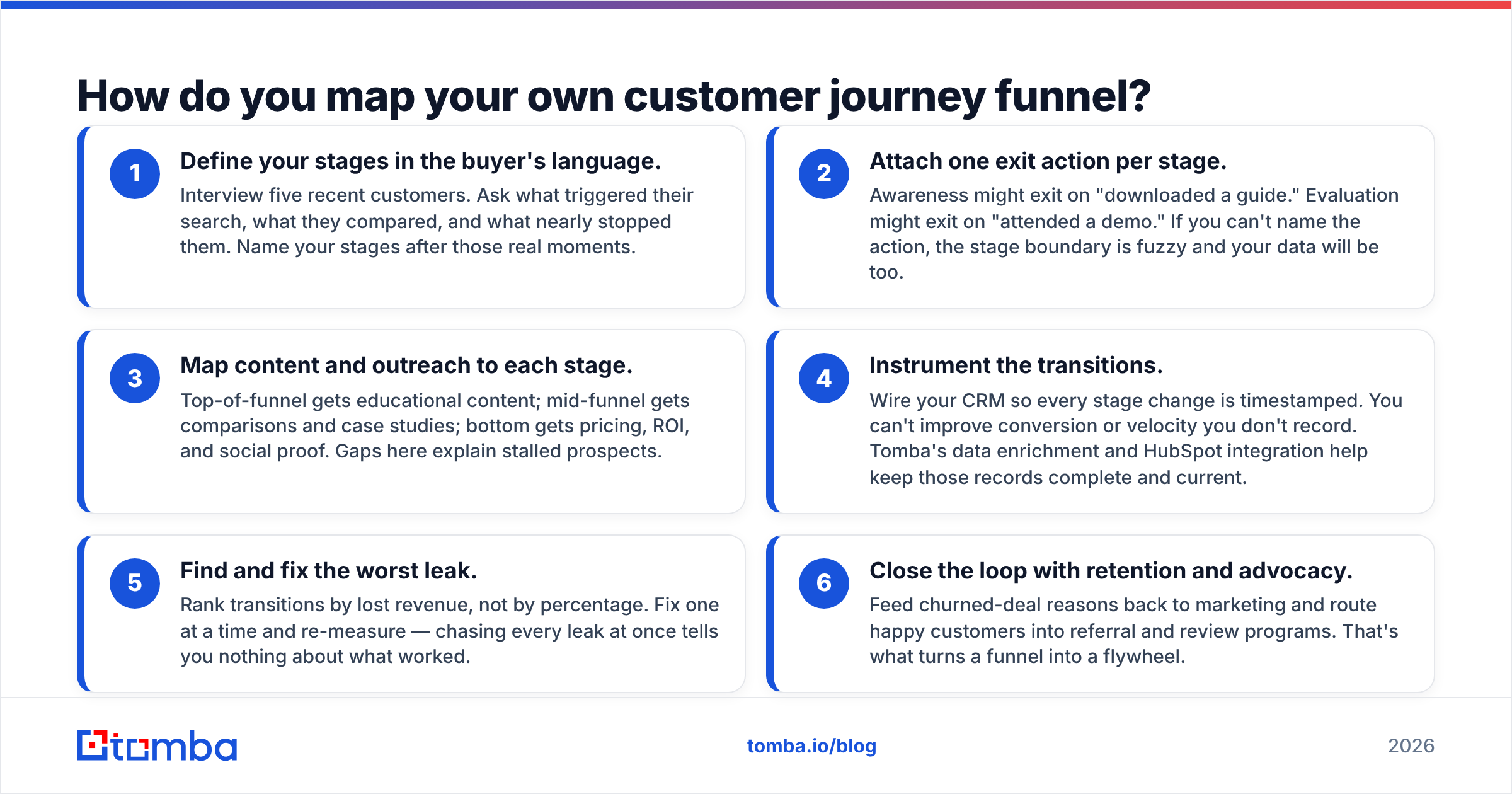
Follow these six steps to build a map that reflects reality, not a whiteboard fantasy.
- Define your stages in the buyer's language. Interview five recent customers. Ask what triggered their search, what they compared, and what nearly stopped them. Name your stages after those real moments.
- Attach one exit action per stage. Awareness might exit on "downloaded a guide." Evaluation might exit on "attended a demo." If you can't name the action, the stage boundary is fuzzy and your data will be too.
- Map content and outreach to each stage. Top-of-funnel gets educational content; mid-funnel gets comparisons and case studies; bottom gets pricing, ROI, and social proof. Gaps here explain stalled prospects.
- Instrument the transitions. Wire your CRM so every stage change is timestamped. You can't improve conversion or velocity you don't record. Tomba's data enrichment and HubSpot integration help keep those records complete and current.
- Find and fix the worst leak. Rank transitions by lost revenue, not by percentage. Fix one at a time and re-measure — chasing every leak at once tells you nothing about what worked.
- Close the loop with retention and advocacy. Feed churned-deal reasons back to marketing and route happy customers into referral and review programs. That's what turns a funnel into a flywheel.
The step most teams skip is #4. Without clean, timestamped data at each transition, the whole map becomes guesswork. And the fuel for every outbound stage is accurate contact data — a perfectly mapped funnel still stalls if your sequences bounce because the email was wrong.
Where does contact data fit into the funnel?#
Contact data is the fuel that moves prospects between stages. You can map a beautiful journey, but if your outreach lands in the void, nothing advances.
Two failure points are common. First, top-of-funnel enrichment: when a visitor converts on a form, enriching that record with verified company, role, and email data lets you route and score them correctly instead of chasing a half-empty row. Second, outbound to target accounts: for accounts that never fill out a form, you need to find the right decision-maker's verified email to start the journey at all. That's where an email finder and an email verifier earn their keep — they keep bounce rates low so your email deliverability and sender reputation stay healthy across every campaign.
Bounced sends don't just waste a message. They damage your domain reputation, which quietly throttles deliverability for every stage that relies on email — nurture, demo reminders, onboarding, renewal. Clean data protects the whole funnel, not just the first touch.
For teams building the funnel on a budget, transparent Tomba pricing starts with a free tier of 25 searches per month and scales to a $49/mo Starter plan, so you can validate a segment before committing budget.
What tools support each funnel stage?#
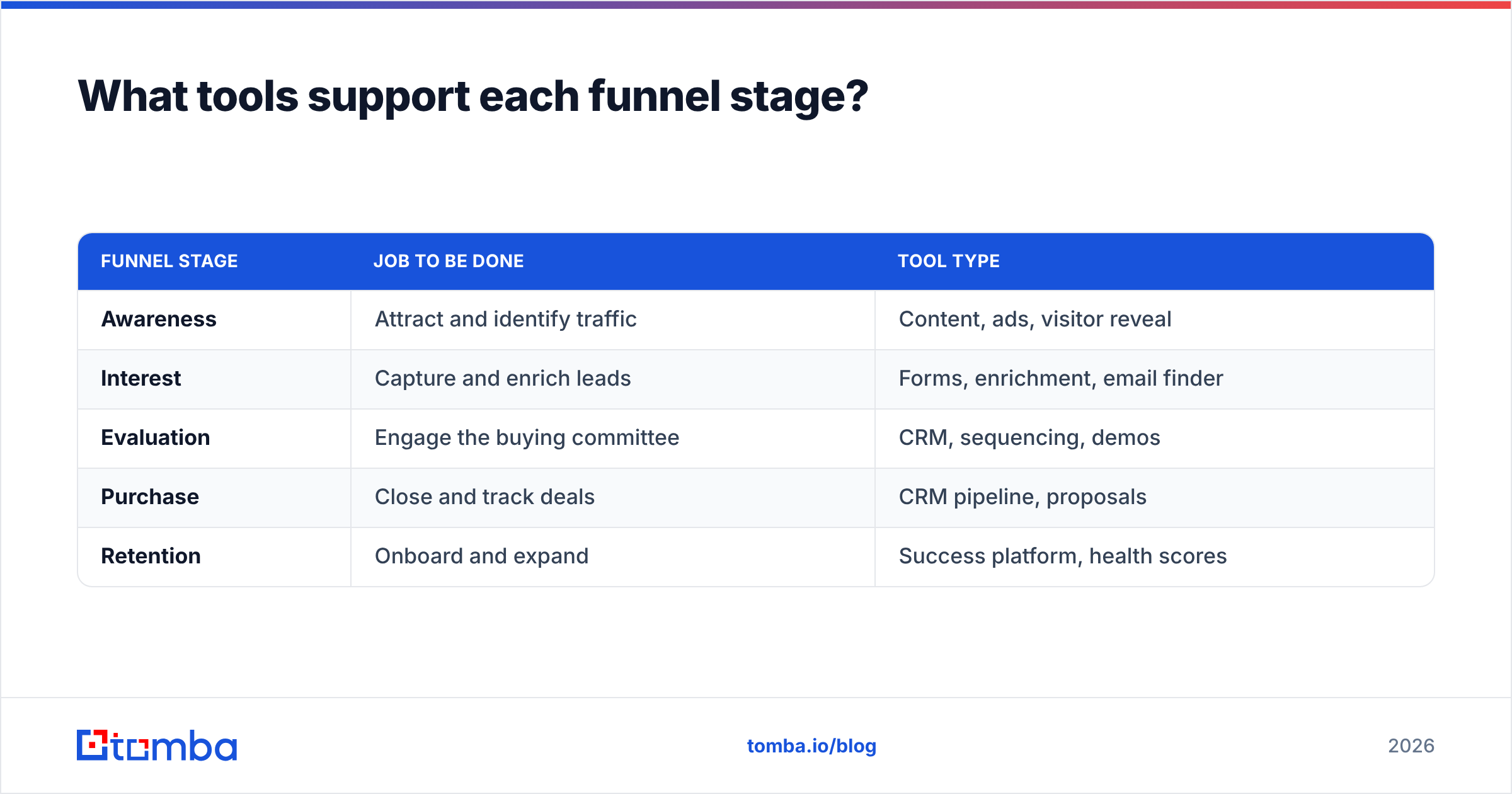
You don't need a 30-app stack. You need one reliable tool per job and clean data flowing between them.
| Funnel stage | Job to be done | Tool type |
|---|---|---|
| Awareness | Attract and identify traffic | Content, ads, visitor reveal |
| Interest | Capture and enrich leads | Forms, enrichment, email finder |
| Evaluation | Engage the buying committee | CRM, sequencing, demos |
| Purchase | Close and track deals | CRM pipeline, proposals |
| Retention | Onboard and expand | Success platform, health scores |
Whatever you assemble, the connective tissue is data quality. Salesforce's own research on the state of sales repeatedly ties rep productivity to trustworthy CRM data — reps waste hours when records are stale or wrong. Enrich once, verify at the point of capture, and keep the pipeline honest.
Common mistakes that break the funnel#
- Optimizing volume over fit. A wider top-of-funnel just pushes more unqualified leads into a leaky middle. Fix conversion before you scale traffic.
- No shared MQL/SQL definition. If marketing and sales disagree on what "qualified" means, the handoff will always feel broken.
- Ignoring retention. Treating the funnel as "closed = done" ignores that expansion and referrals are the cheapest revenue you'll ever get.
- Dirty data. Bounced emails, duplicate records, and missing roles corrupt every metric downstream. Verify at capture and enrich continuously.
- Measuring stages, not transitions. A full stage looks healthy until you notice nobody is leaving it.
Final takeaway and next step#
The customer journey funnel is not a poster on the wall — it's an operating system for how strangers become revenue. Map it in the buyer's language, measure the transitions instead of the stages, fix the worst leak first, and close the loop with retention and advocacy so the funnel feeds itself.
None of it works without accurate contact data moving prospects from one stage to the next. If your outbound stages stall on bounced sends and half-empty records, start there: use the Tomba Email Finder to find and verify decision-maker emails by name, company, or domain, so every stage of your funnel runs on data you can trust. Spin up the free tier, enrich one target segment, and watch how much faster leads move when the fuel is clean.
Related guides#
Ready to find emails that actually work?
Join 150,000+ professionals who stopped guessing and started sending. Free credits on signup — no credit card required.
Get the Tomba newsletter
Practical outbound tactics and product updates — once every two weeks.
About the author