Customer Objection Handling: The Complete 2026 Playbook
Objections aren't rejection — they're buying signals in disguise. Here's a no-fluff framework, ready-to-steal scripts, and a rebuttal cheat sheet for turning pushback into closed deals in 2026.
Objections are not the sound of a deal dying. They are the sound of a prospect thinking out loud about how to buy. Handle them well and your win rate climbs; handle them badly and you train buyers to ghost you.
This guide gives you a repeatable system for customer objection handling — the psychology, a five-step framework, word-for-word scripts, and a cheat sheet you can paste into your CRM today.
TL;DR#
- An objection is a request for more information, not a "no." Treat it as a buying signal and slow down instead of speeding up.
- Use a five-step loop: pause, acknowledge, ask, respond, confirm. Skipping the middle steps is why most rebuttals fail.
- The four objection families are price, need, trust, and timing. Each needs a different move.
- Prevention beats rebuttal. Most objections trace back to a bad-fit lead or a missing discovery question — fix your targeting and half of them disappear.
- Prep is a system, not a talent. A living objection library plus verified contact data lets you handle pushback calmly and follow up on the right person.
What is customer objection handling?#
Customer objection handling is the process of responding to a prospect's stated concerns — about price, fit, timing, or trust — in a way that resolves the concern and moves the deal forward. It is the bridge between "interesting" and "signed."
Think of an objection like a locked door with the key already in it. The buyer isn't refusing to let you in; they're telling you exactly which lock to open. "It's too expensive" is a key labeled value. "We're happy with our current vendor" is a key labeled status quo. Your job is to hear which key they handed you and turn it — not to shove harder on the handle.
The mistake most reps make is treating an objection as a personal rejection and reacting emotionally: defending, discounting, or talking over the prospect. According to HubSpot's sales research, the reps who close most consistently are the ones who ask more questions after an objection, not fewer. Objection handling is a listening skill first and a talking skill second.
Why do prospects raise objections in the first place?#
Prospects object for four core reasons, and naming the reason tells you which play to run.
- Price — They don't yet see enough value to justify the number. This is rarely about the literal dollar figure; it's about the ratio of perceived value to cost.
- Need — They're not convinced the problem is worth solving right now, or that your solution actually solves it.
- Trust — They doubt your company, your proof, or their own ability to succeed with your product.
- Timing — The problem is real and you're a fit, but budget cycles, competing priorities, or internal politics say "not now."
Here is a fast diagnostic you can keep on a sticky note:
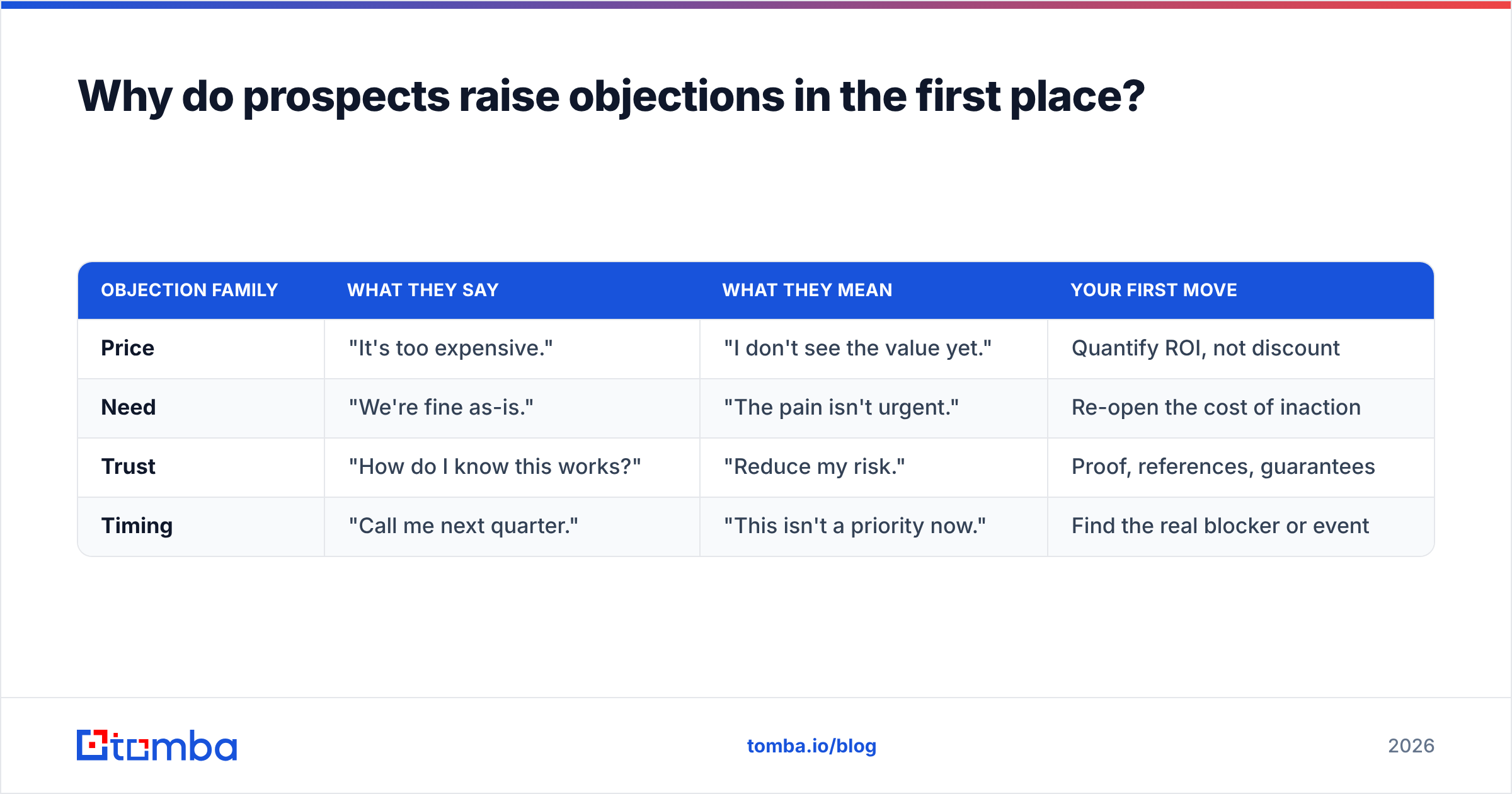
| Objection family | What they say | What they mean | Your first move |
|---|---|---|---|
| Price | "It's too expensive." | "I don't see the value yet." | Quantify ROI, not discount |
| Need | "We're fine as-is." | "The pain isn't urgent." | Re-open the cost of inaction |
| Trust | "How do I know this works?" | "Reduce my risk." | Proof, references, guarantees |
| Timing | "Call me next quarter." | "This isn't a priority now." | Find the real blocker or event |
The families overlap — a "timing" objection is often a "need" objection wearing a nicer suit — but starting from the right family keeps you from answering a value problem with a price cut. Discounting a prospect who actually has a trust concern just makes you look desperate and cheap at the same time.
What is the best framework for handling objections?#
The best framework is a five-step loop that forces you to understand before you persuade. Reps who rush from objection straight to rebuttal skip the two steps that actually change minds.
- 1. Pause. Let the objection land. A two-second silence signals you're taking it seriously and stops you from getting defensive.
- 2. Acknowledge. Validate the concern out loud: "That's a fair question." This lowers the buyer's guard without agreeing that you're overpriced.
- 3. Ask. Dig into the real driver: "When you say it's expensive, is it the total, the payment terms, or the ROI you're unsure about?" This is the step 80% of reps skip.
- 4. Respond. Answer the specific concern you just uncovered — not the generic version you assumed.
- 5. Confirm. Check that the concern is resolved: "Does that address the pricing piece?" Then advance to the next step.
This loop maps cleanly to how modern revenue teams coach calls. Conversation-intelligence platforms like Gong consistently find that top performers talk less and ask more clarifying questions right after an objection surfaces. The pause-and-ask discipline is what separates a consultative rep from a pitch machine.
How do you respond to the most common sales objections?#
Below are word-for-word responses for the objections you'll hear every week. Adapt the language to your voice — robotic scripts are worse than no script.
"It's too expensive."#
"I appreciate you being direct. So I answer the right way — is it that the number is above budget, or that the value isn't clear yet? If we could show this pays for itself in the first quarter, would the price still be a blocker?" Then quantify: tie the cost to a measurable outcome like hours saved, deals recovered, or churn avoided.
"We're already using [competitor]."#
"That makes sense — most of our best customers came from [competitor]. Out of curiosity, if there were one thing you could change about it, what would it be?" You're not trashing the incumbent; you're finding the gap. Then position your differentiator against that specific gap.
"Send me some information."#
"Happy to. To make sure I send the right thing and not a 40-page PDF you'll never open — what's the one question you most want answered?" This converts a brush-off into a discovery question.
"I need to talk to my team."#
"Totally reasonable — this usually involves a few people. Who else should be in the room, and what will they want to know that I haven't covered? I'd rather arm you than make you present this cold." Now you've identified the real decision-makers and can get their B2B phone numbers or emails to loop them in directly.
"Now's not a good time."#
"No problem. Just so I understand — is it that the priority is lower right now, or that there's a specific event, like budget renewal, we should plan around?" A real timing objection has a date attached. A fake one is a polite exit; keep probing gently.
Can you prevent objections before they happen?#
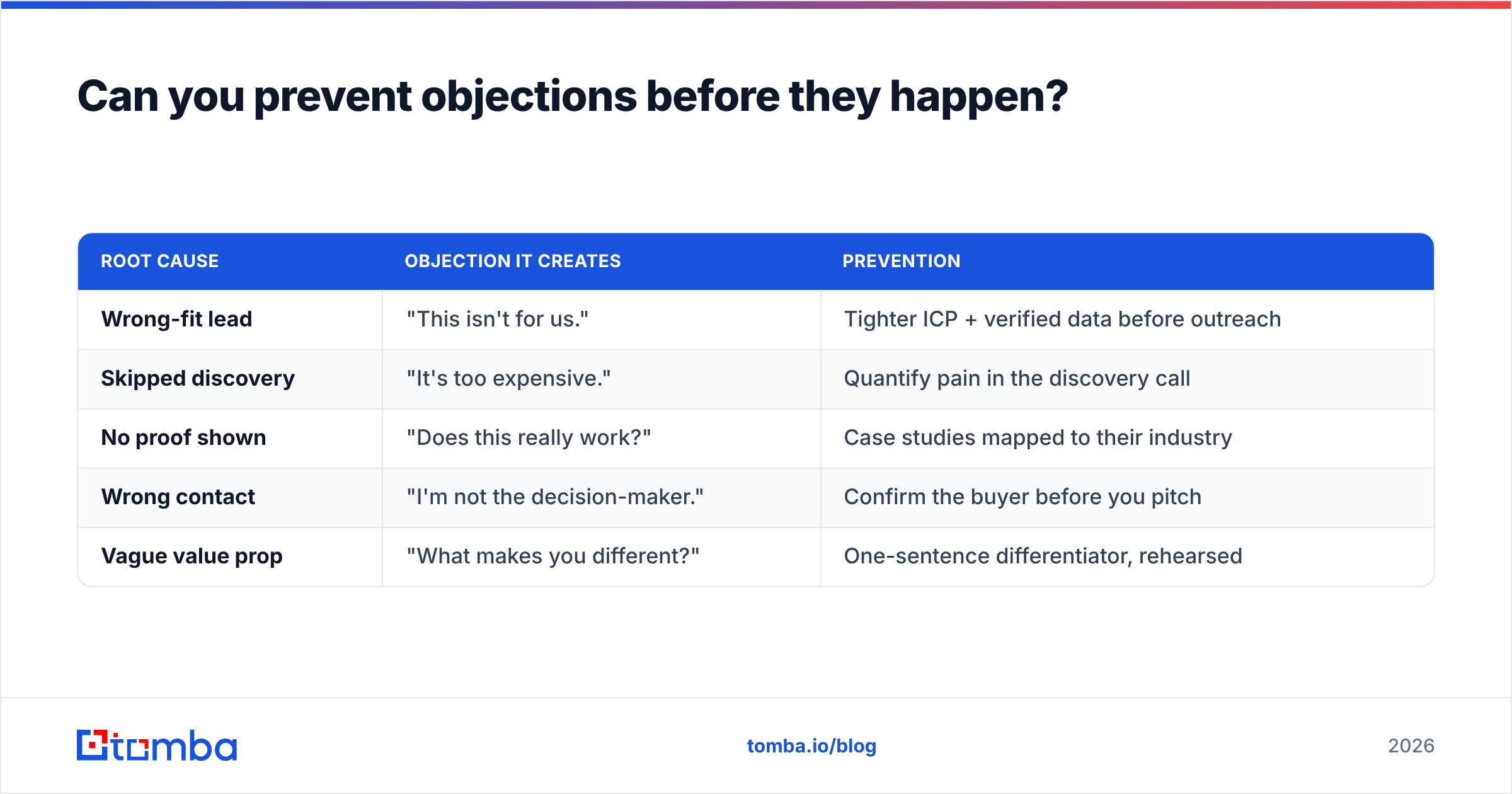
Yes — and prevention is cheaper than rebuttal. Most objections are self-inflicted, created earlier in the process by weak targeting or shallow discovery.
Here is where objections actually come from and how to head them off:
| Root cause | Objection it creates | Prevention |
|---|---|---|
| Wrong-fit lead | "This isn't for us." | Tighter ICP + verified data before outreach |
| Skipped discovery | "It's too expensive." | Quantify pain in the discovery call |
| No proof shown | "Does this really work?" | Case studies mapped to their industry |
| Wrong contact | "I'm not the decision-maker." | Confirm the buyer before you pitch |
| Vague value prop | "What makes you different?" | One-sentence differentiator, rehearsed |
Two of those root causes — wrong-fit leads and wrong contacts — are pure data problems. If you're pitching someone who was never going to buy, or who can't sign, no script saves you. That's why strong objection handling starts upstream, with clean prospecting. When you reach the right person with an accurate email finder and a validated title, the "I'm not the right person" objection largely evaporates before the first call.
Good discovery also pre-empts price objections. If you've already established that the prospect loses 15 hours a week to a manual process, "it's expensive" becomes a math problem you've already solved together. Prevention isn't about avoiding hard conversations — it's about not creating easy objections through carelessness.
How should you handle objections over email vs. on a call?#
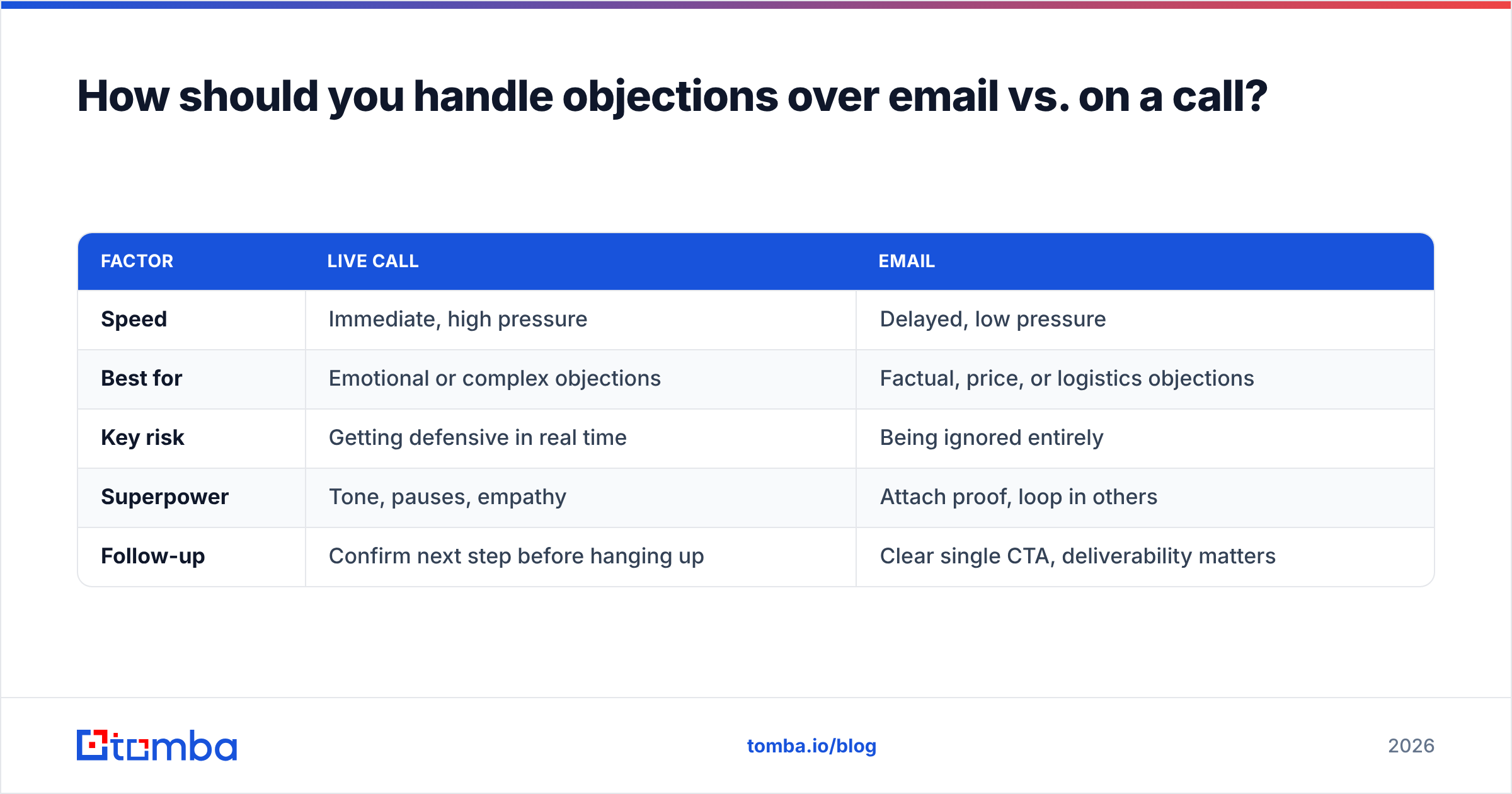
The channel changes the tempo, not the framework. On a call you handle objections live; over email you handle them asynchronously and with more precision.
| Factor | Live call | |
|---|---|---|
| Speed | Immediate, high pressure | Delayed, low pressure |
| Best for | Emotional or complex objections | Factual, price, or logistics objections |
| Key risk | Getting defensive in real time | Being ignored entirely |
| Superpower | Tone, pauses, empathy | Attach proof, loop in others |
| Follow-up | Confirm next step before hanging up | Clear single CTA, deliverability matters |
On a call, your advantage is tone — a warm pause does work that no sentence can. Over email, your advantage is preparation: you can attach the exact case study, cc the CFO, and craft a response with no "um." The catch is that email objection handling only works if your message lands in the inbox. If your follow-ups hit spam, the buyer never even sees your perfectly crafted rebuttal. Protecting email deliverability — verified addresses, warmed domains, no spam triggers — is a prerequisite, not an afterthought.
Across both channels, one rule holds: never end an objection exchange without a confirmed next step. "I'll follow up next week" is where deals go to die. "Let's book 20 minutes Thursday to review the ROI model with your CFO" is momentum.
How do you build an objection-handling system for your team?#
Turn objection handling from a solo talent into a team asset by building three things.
- A living objection library. A shared doc or CRM field listing every objection your team hears, the best-performing response, and the win rate after it. Update it monthly. New reps ramp in days instead of months.
- Call reviews with tags. Tag recorded calls by objection type so you can see which ones stall deals. If "timing" kills 40% of your late-stage opportunities, that's a process problem, not a scripting one — track it against your win rate.
- Clean data feeding the top. Every objection is easier to handle when the contact is real, the title is right, and enrichment tells you who else is involved. Keeping your CRM accurate and enriched means reps spend their energy on persuasion, not on chasing bounced emails and wrong numbers.
The teams that win aren't the ones with the smoothest talkers. They're the ones who treat objections as data — logged, analyzed, and prevented — the way Salesforce and other mature revenue orgs treat every other stage of the funnel. Objection handling is a system you build, not a gift you're born with.
Put it into practice#
Great objection handling starts long before the objection — with reaching the right person, at the right company, through an address that actually works. If half your "objections" are really just bad-fit leads and dead contacts, no script will save the quarter.
That's where the Tomba Email Finder earns its place in your stack. Find verified, decision-maker emails by name, domain, or company, enrich them with the context you need to pre-empt the "I'm not the right person" objection, and start every conversation with someone who can actually say yes. You can test it free (25 searches a month), and paid plans start at $49/mo — see full Tomba pricing to match a plan to your outbound volume.
Handle the data upstream, and the objections downstream get a whole lot easier to answer.
Related guides#
Ready to find emails that actually work?
Join 150,000+ professionals who stopped guessing and started sending. Free credits on signup — no credit card required.
Get the Tomba newsletter
Practical outbound tactics and product updates — once every two weeks.
About the author