Customer Outreach in 2026: The Complete, No-Fluff Guide
Customer outreach is the discipline of starting the right conversation with the right person at the right time. Here is the 2026 playbook: channels, timing, templates, tooling, and the metrics that separate pipeline from noise.
Customer outreach is not "sending more emails." It is the disciplined practice of starting a relevant conversation with a specific person, on a channel they actually check, at a moment the timing makes sense. Do that well and outreach becomes your most predictable pipeline source. Do it badly and you burn your domain, your list, and your team's morale.
This guide is the no-fluff version: what customer outreach is in 2026, which channels earn replies, how to sequence them, and the tooling and metrics that keep the whole thing honest.
TL;DR#
- Customer outreach = relevance × reachability × timing. Weak on any one factor and the whole message fails.
- Multichannel beats single-channel. Email plus LinkedIn plus phone consistently outperforms email-only sequences.
- Data quality is the hidden lever. Bad contact data quietly caps your reply rate no matter how good the copy is.
- Personalization at the segment level scales; per-contact hand-crafting does not. Build tiers.
- Measure replies and meetings booked, not opens. Apple Mail Privacy Protection made open rates close to useless.
What is customer outreach?#
Customer outreach is any proactive, targeted contact you initiate to start or advance a relationship with a prospective or existing customer. Think of it like knocking on the right door in a large apartment building. Blasting every buzzer annoys the whole block and gets you ignored. Knowing which unit, who lives there, and when they are home is the entire game.
Technically, outreach spans cold email, LinkedIn messaging, cold calling, SMS, direct mail, and warm reactivation of existing accounts. What unites them is intent: you reach out first, with a reason, to a defined person — not a "spray and pray" list.
There are two broad modes:
- Cold outreach — contacting people who do not yet know you, based on a fit hypothesis (industry, role, trigger event).
- Warm outreach — contacting people who have some prior signal: a demo request, a churned account, a webinar sign-up, or a website visit.
Warm converts far better, which is why smart teams engineer more warm signals rather than simply buying bigger cold lists.

Why does most customer outreach fail?#
Most outreach fails for boring, fixable reasons — not because "cold is dead." The usual suspects:
- Bad data. The email bounces, the number is disconnected, or the person changed jobs eight months ago. Every bounce also chips at your sender reputation.
- No relevance. The message could have been sent to 10,000 people, and the reader can tell.
- Wrong channel. You emailed a VP who lives in LinkedIn DMs, or you called a developer who never answers unknown numbers.
- Bad timing. Right message, but you reached them the week their quarter closed and nothing else existed.
- Volume over craft. Sending 2,000 mediocre emails a day feels productive and destroys deliverability.
The uncomfortable truth: you can fix copy in an afternoon, but you cannot out-write a dirty list. That is why the outreach stack starts with data, not templates.
Which channels work best in 2026?#
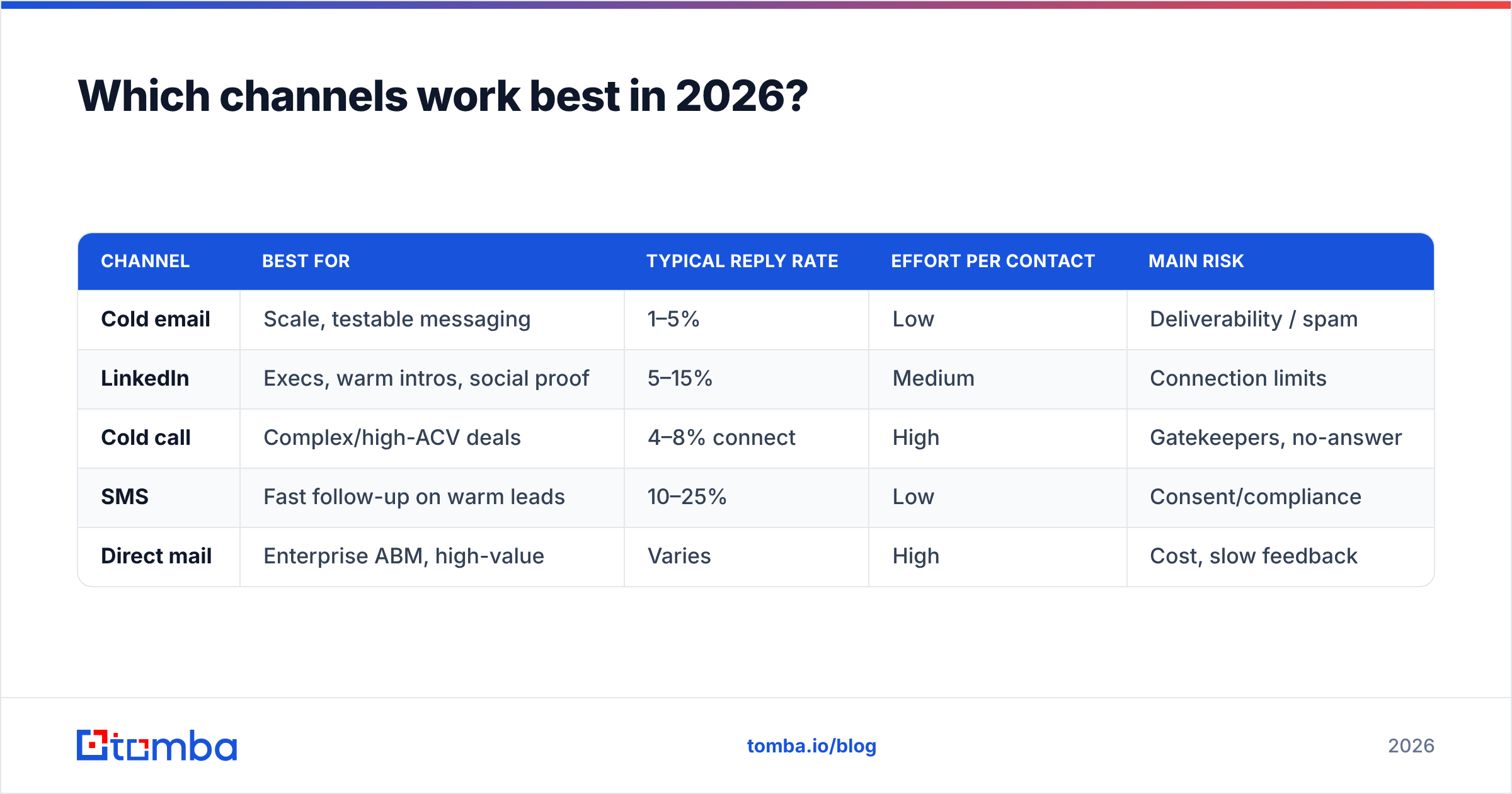
There is no single best channel — there is a best sequence for your buyer. Here is how the main channels compare on the attributes that actually matter.
| Channel | Best for | Typical reply rate | Effort per contact | Main risk |
|---|---|---|---|---|
| Cold email | Scale, testable messaging | 1–5% | Low | Deliverability / spam |
| Execs, warm intros, social proof | 5–15% | Medium | Connection limits | |
| Cold call | Complex/high-ACV deals | 4–8% connect | High | Gatekeepers, no-answer |
| SMS | Fast follow-up on warm leads | 10–25% | Low | Consent/compliance |
| Direct mail | Enterprise ABM, high-value | Varies | High | Cost, slow feedback |
Notice the pattern: higher reply rates track with higher effort and lower scale. The winning play is to stack channels — use email for scale, LinkedIn for credibility, and the phone to break through on your best-fit accounts. A LinkedIn view before a cold call makes the call feel less cold; an email after a call gives the prospect something to act on.
For most B2B teams in 2026, a three-touch multichannel motion (email → LinkedIn → call) outperforms any single channel run in isolation. If you only have bandwidth for two, pair email with the phone using a reliable phone finder so your reps are dialing numbers that actually connect.
How do you build an outreach sequence that converts?#
A sequence is just a planned series of touches across time and channels. The goal is to be persistent without being annoying — present enough to earn a reply, spaced enough to avoid the block button.
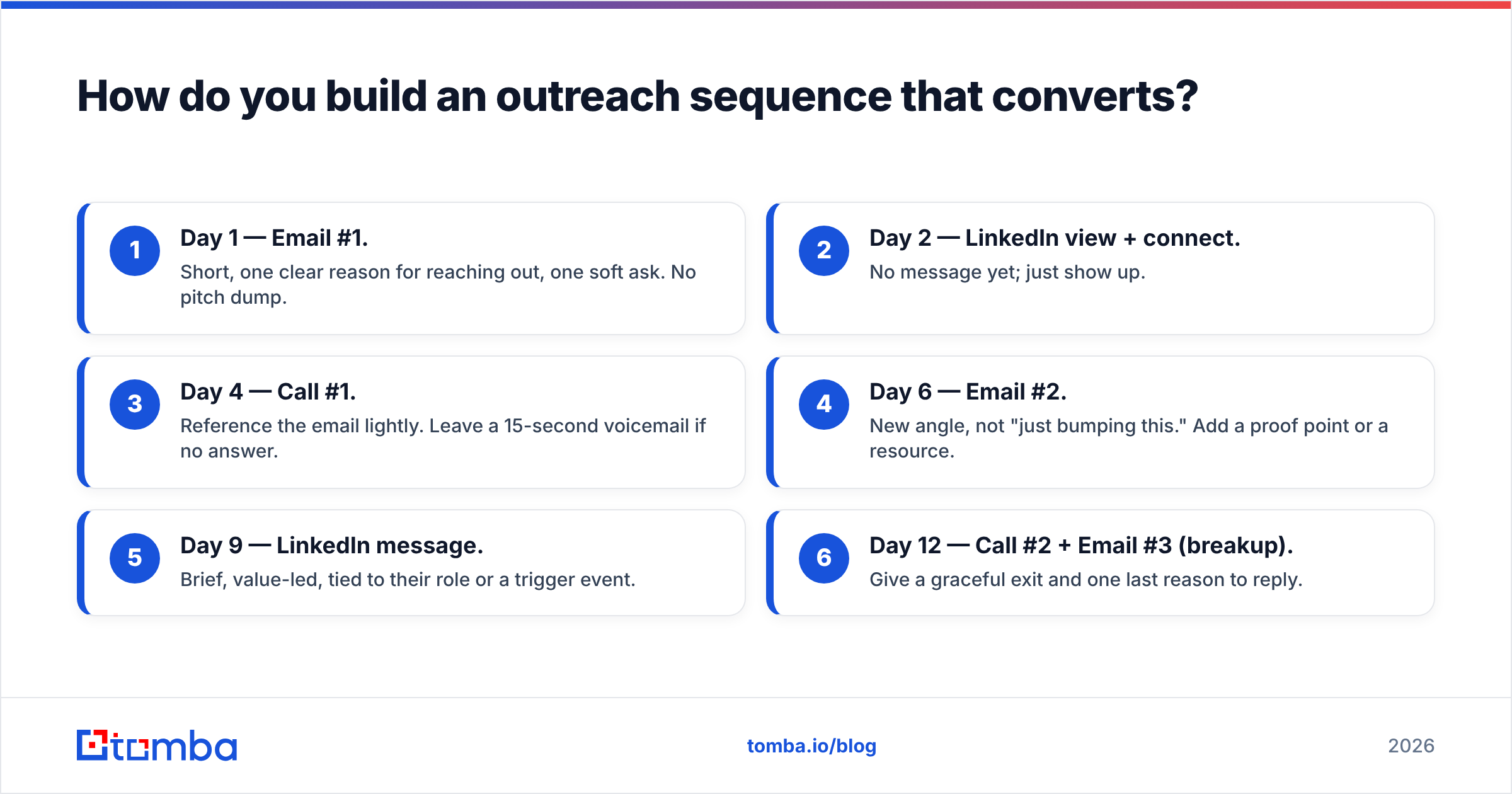
A dependable 12–14 day multichannel structure looks like this:
- Day 1 — Email #1. Short, one clear reason for reaching out, one soft ask. No pitch dump.
- Day 2 — LinkedIn view + connect. No message yet; just show up.
- Day 4 — Call #1. Reference the email lightly. Leave a 15-second voicemail if no answer.
- Day 6 — Email #2. New angle, not "just bumping this." Add a proof point or a resource.
- Day 9 — LinkedIn message. Brief, value-led, tied to their role or a trigger event.
- Day 12 — Call #2 + Email #3 (breakup). Give a graceful exit and one last reason to reply.
Two rules keep sequences healthy. First, every touch should add something — a new angle, a relevant insight, a specific question. Repeating "circling back" trains people to ignore you. Second, cap the touches. After ~6–8 attempts across channels with zero engagement, move the contact to a long-term nurture list instead of grinding.
How much personalization do you actually need?#
Personalize at the level you can sustain, not the level that looks impressive in a LinkedIn screenshot. The practical model is three tiers:
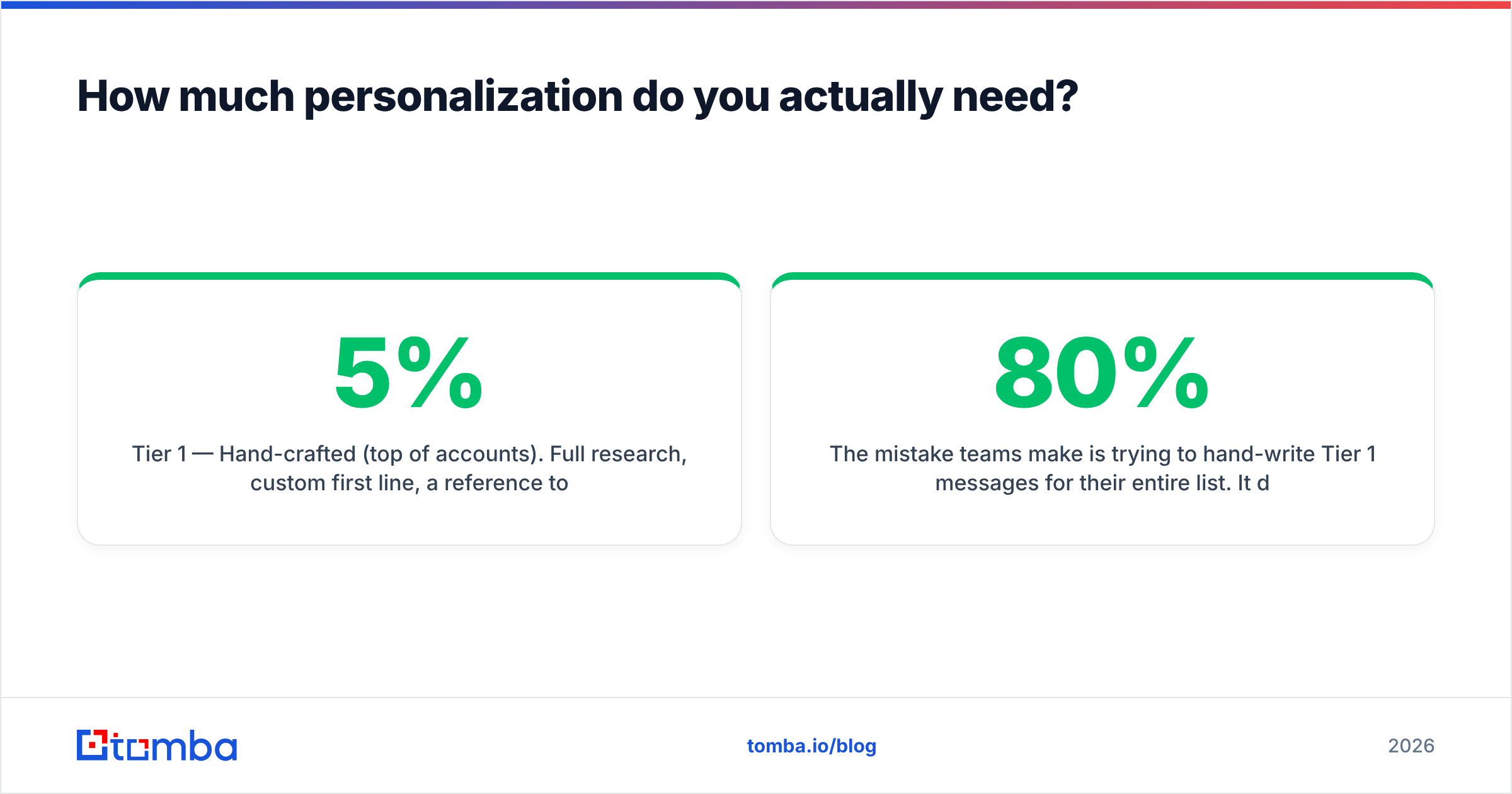
- Tier 1 — Hand-crafted (top 5% of accounts). Full research, custom first line, a reference to something specific and recent. Reserved for dream logos.
- Tier 2 — Segment-personalized (the bulk). Templates with dynamic variables by industry, role, and trigger. One insight tailored to the segment, not the individual.
- Tier 3 — Lightly templated (broad top-of-funnel). Clean data, relevant offer, minimal customization. Volume plays where fit is the personalization.
The mistake teams make is trying to hand-write Tier 1 messages for their entire list. It does not scale, and reps quietly stop doing the research — so you get the cost of "personalization" with none of the benefit. Segment-level personalization, powered by good data enrichment, gives you 80% of the lift at 20% of the effort.
Everyday analogy: personalization is like seasoning. A pinch on every dish (segment-level) is doable every night. Plating each individual meal like a Michelin course (per-contact) is a special occasion, not a daily operation.
What tools power a modern outreach stack?#
Your stack has four jobs: find the person, verify you can reach them, send across channels, and measure what happens. Skipping the first two is where most teams quietly fail.
- Contact data & finding. You cannot reach someone you cannot locate. An accurate email finder and domain search turn a company and a name into a real, reachable inbox.
- Verification. Run every address through an email verifier before you send. Cutting bounces protects deliverability and keeps your sequences alive.
- Sending & sequencing. A cold-email platform or sales-engagement tool (many exist — compare options on a neutral marketplace like G2) handles cadence, throttling, and multichannel steps.
- CRM & tracking. Everything flows back to your CRM so you see what converted and can double down.
Tomba sits at the front of this stack — the finding and verification layer that feeds clean, reachable contacts into whatever sending tool you already use. If the top of your funnel is dirty, no downstream tool can save it.
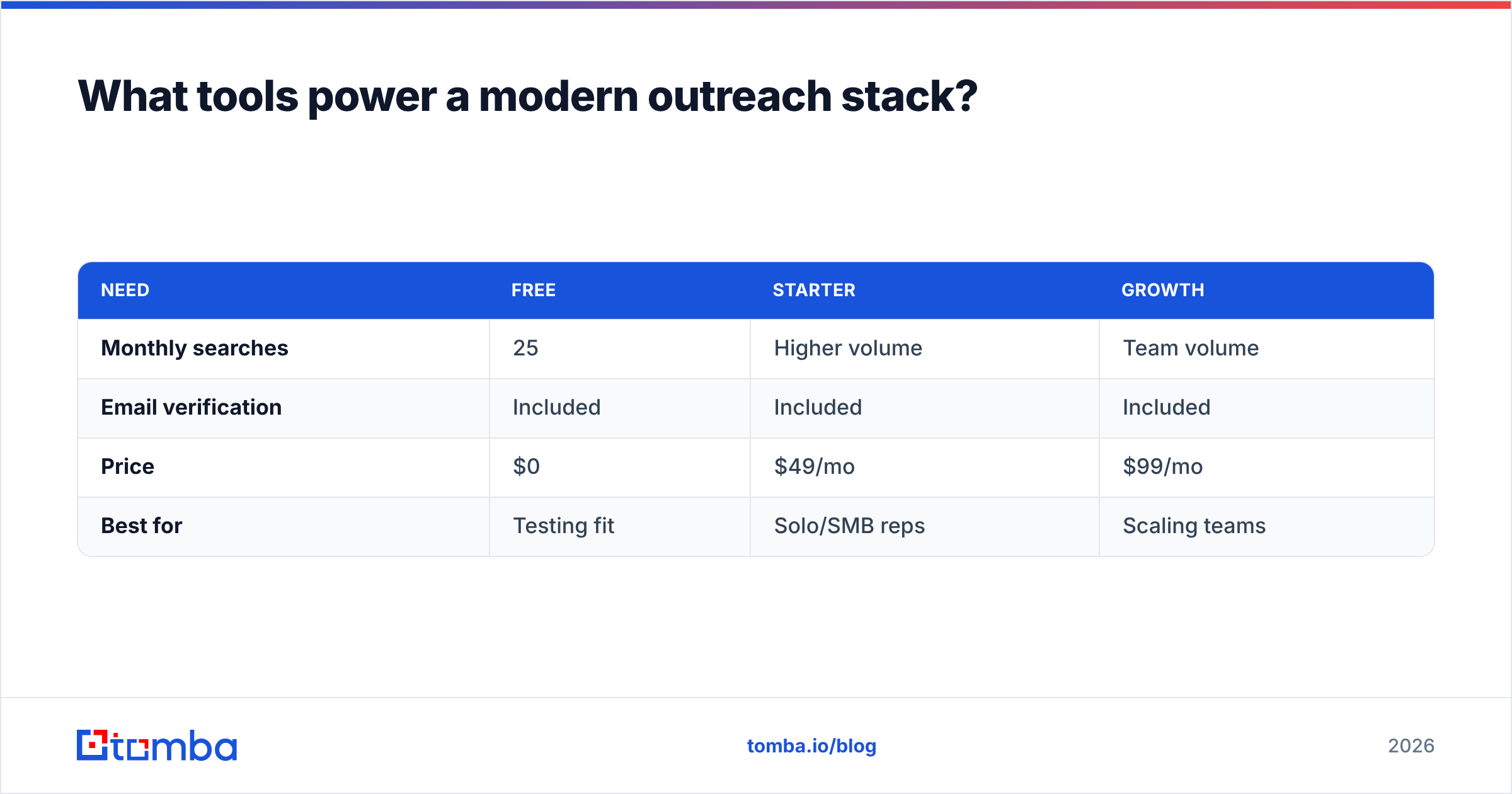
Here is how those data-layer needs map to plans, so you can size the spend to your volume:
| Need | Free | Starter | Growth |
|---|---|---|---|
| Monthly searches | 25 | Higher volume | Team volume |
| Email verification | Included | Included | Included |
| Price | $0 | $49/mo | $99/mo |
| Best for | Testing fit | Solo/SMB reps | Scaling teams |
You can see full Tomba pricing for exact limits, but the important point is that you can validate the workflow on the free tier before committing budget.
How do you keep outreach out of the spam folder?#
Deliverability is the plumbing behind email outreach, and it fails silently. You do not get an error — your messages just quietly land in spam while your dashboard still shows "sent." Protect it deliberately:
- Warm up new domains and inboxes before sending volume. Ramp gradually over 2–4 weeks.
- Authenticate everything — SPF, DKIM, and DMARC. Missing records are an instant credibility hit with mailbox providers.
- Verify before you send. Bounces above ~3% are a red flag to providers like Google and Microsoft.
- Keep volume human. A single inbox blasting hundreds of cold emails an hour looks like exactly what it is.
- Watch engagement. Replies and positive interactions build email deliverability; spam complaints destroy it.
For the authoritative technical side, Google's own Email sender guidelines are worth reading directly — they define the bulk-sender rules that now gate the inbox.
What metrics actually matter for customer outreach?#
Track outcomes, not vanity. With Apple's Mail Privacy Protection inflating opens, open rate is close to noise. Focus on the metrics that predict revenue:
- Reply rate — the honest signal of relevance and targeting. Benchmark and improve this first. (See how it is defined in this response rate breakdown.)
- Positive reply rate — replies that are interested, not "unsubscribe."
- Meetings booked — the real conversion event for most outbound teams.
- Bounce rate — a data-quality and deliverability canary; keep it under ~3%.
- Opportunities and pipeline created — the number leadership actually cares about.
A useful rule of thumb: if your reply rate is low, fix targeting and data before you touch copy. If your positive reply rate is low but total replies are fine, fix the offer. If meetings are low but positive replies are healthy, fix your booking flow. Diagnose in that order and you stop guessing. For broader benchmarks and process frameworks, HubSpot's sales statistics library is a solid neutral reference.
A simple 30-day plan to start#
If you are building outreach from scratch, do not boil the ocean. Run this instead:
- Week 1 — Define one ICP segment. One industry, one role, one trigger. Write the fit hypothesis down.
- Week 2 — Build a clean list of 100–200 contacts. Find and verify every one; discard anything that bounces.
- Week 3 — Launch one multichannel sequence. Email + LinkedIn + one call step. Small volume, tight tracking.
- Week 4 — Read the metrics and iterate. Adjust targeting first, offer second, copy third.
Small, clean, and measured beats big, dirty, and blind every time. Once one segment works, clone the motion for the next.
Start with data you can trust#
Customer outreach lives or dies on the quality of the contacts you reach. The best sequence in the world is wasted on an email that bounces or a number that rings into a void. Start where the leverage is: get accurate, verified contact data into your funnel, then layer channels, sequencing, and personalization on top.
Try the Tomba Email Finder to turn your target account list into real, reachable inboxes — and pair it with the built-in email verifier so every message you send has a fighting chance of landing, getting read, and earning a reply. Clean data first; everything else in your outreach compounds from there.
Related guides#
Ready to find emails that actually work?
Join 150,000+ professionals who stopped guessing and started sending. Free credits on signup — no credit card required.
Get the Tomba newsletter
Practical outbound tactics and product updates — once every two weeks.
About the author