Customer Persona Guide 2026: How to Build One That Works
A customer persona is only useful if it changes who you target and what you say. Here's a practical 2026 framework to build one from real data — not guesswork.
Customer Persona Guide 2026: How to Build One That Works
Most customer personas are fiction. Someone invents "Marketing Mary," gives her a stock photo and a coffee habit, pins it to a wall, and it never touches a single targeting or messaging decision again. That's not a persona — that's a poster.
A real customer persona is a decision tool. It tells you who to prospect, what to say first, and which deals to walk away from. This guide shows you how to build one from evidence in 2026, keep it tied to your actual pipeline, and turn it into a repeatable list of accounts you can contact.
TL;DR#
- A customer persona is a research-based profile of a specific buyer type — their role, goals, triggers, and objections — used to guide targeting and messaging.
- Personas built from interviews and real account data outperform imaginary "archetypes" that were guessed in a meeting.
- Separate the buyer persona (the human) from the Ideal Customer Profile (the company). You need both.
- A persona is worthless until it becomes a contact list. Turn attributes into filters, then find real people who match.
- Refresh personas every 6–12 months; markets, titles, and buying committees shift fast.
What is a customer persona?#
A customer persona is a semi-fictional profile of a specific type of buyer, built from real research, that represents a segment of your market. Think of it like a casting brief for a film: you're not describing one real person, you're describing the kind of person who fits the role — precisely enough that anyone on your team could recognize them in a crowd.
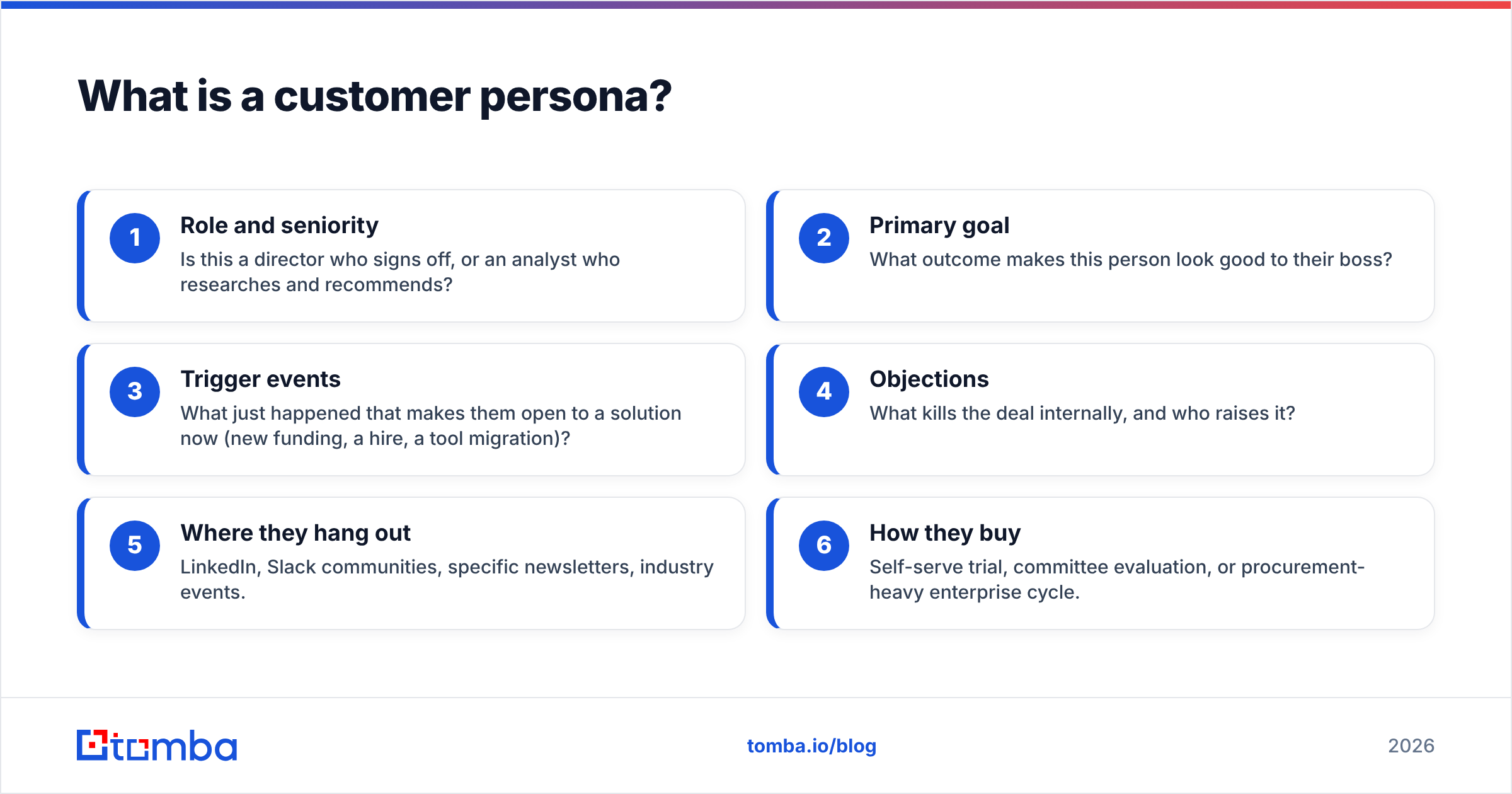
A useful persona answers questions your team argues about:
- Role and seniority — Is this a director who signs off, or an analyst who researches and recommends?
- Primary goal — What outcome makes this person look good to their boss?
- Trigger events — What just happened that makes them open to a solution now (new funding, a hire, a tool migration)?
- Objections — What kills the deal internally, and who raises it?
- Where they hang out — LinkedIn, Slack communities, specific newsletters, industry events.
- How they buy — Self-serve trial, committee evaluation, or procurement-heavy enterprise cycle.
If a "persona" doesn't answer those six, it's a mood board. The marketing qualified lead that matches all six is worth ten that match none.
Customer persona vs. buyer persona vs. ICP: what's the difference?#
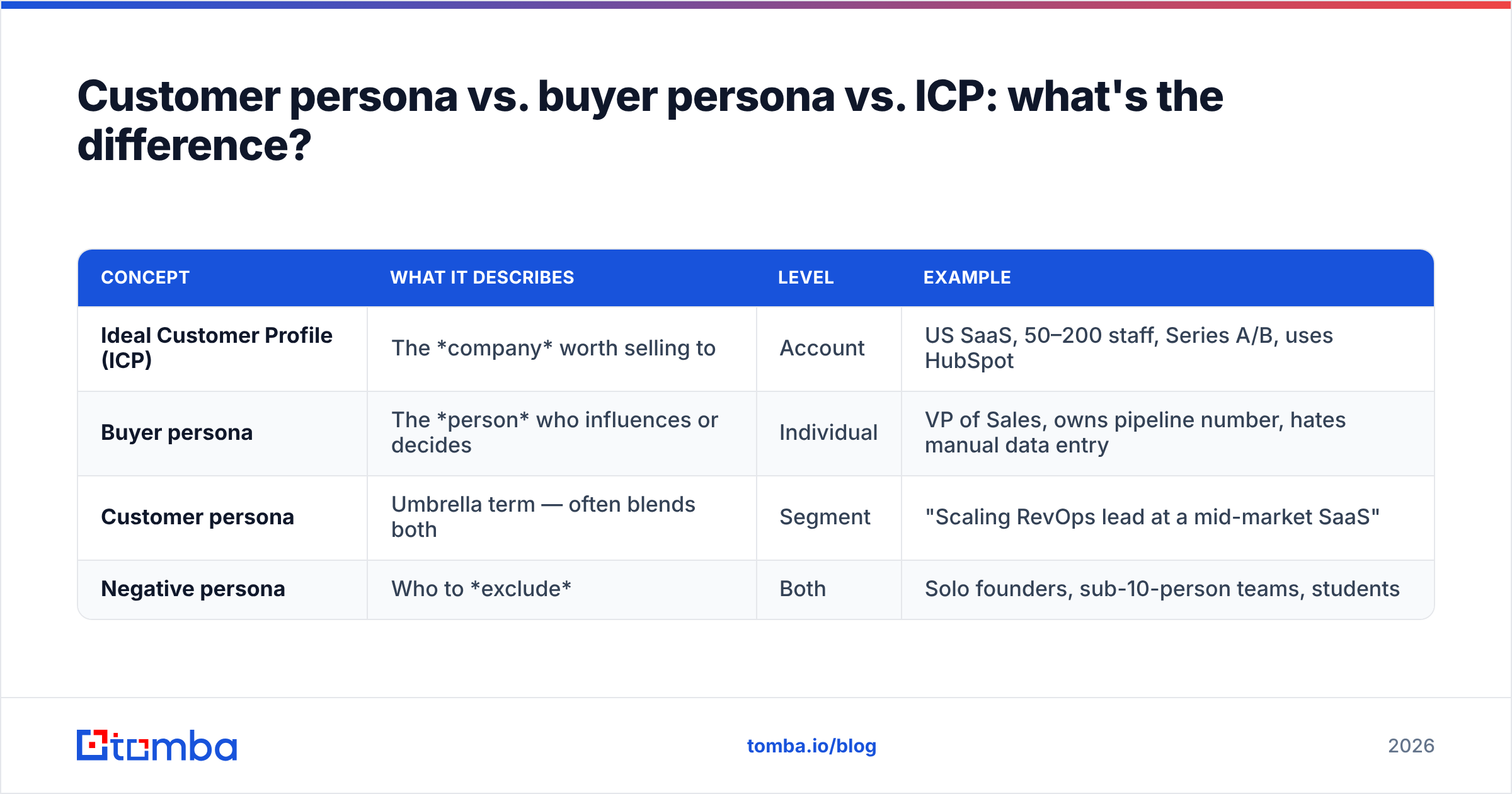
These three terms get used interchangeably, and that sloppiness costs deals. They operate at different levels.
| Concept | What it describes | Level | Example |
|---|---|---|---|
| Ideal Customer Profile (ICP) | The company worth selling to | Account | US SaaS, 50–200 staff, Series A/B, uses HubSpot |
| Buyer persona | The person who influences or decides | Individual | VP of Sales, owns pipeline number, hates manual data entry |
| Customer persona | Umbrella term — often blends both | Segment | "Scaling RevOps lead at a mid-market SaaS" |
| Negative persona | Who to exclude | Both | Solo founders, sub-10-person teams, students |
The practical takeaway: your ICP filters accounts, your buyer persona filters people inside those accounts. You prospect the company because it fits the ICP, then you find the specific human who matches the buyer persona. Skip either layer and you either email the right company's wrong person, or a perfect-fit person at a company that will never buy.
Gartner's research on B2B buying shows a typical purchase now involves six to ten decision-makers, each with their own information. That's why one persona is never enough — you likely need a champion persona, an economic-buyer persona, and a blocker persona for the same deal.
How do you build a customer persona in 2026?#
Build it in five steps, in this order. Skipping the research steps is how you end up with "Marketing Mary."
1. Mine your existing customers. Pull your closed-won deals from the last 12 months. Look for patterns in company size, industry, tech stack, and the job titles of the people who actually signed. Your best future customers usually rhyme with your best current ones.
2. Interview real buyers. Talk to 5–10 recent customers. Ask what triggered the search, what they tried first, what almost stopped them from buying, and how they described the problem internally. Their words become your messaging.
3. Layer in firmographic and behavioral data. Enrich what you learned with hard attributes — headcount, funding, location, technologies used. This is where a data enrichment step turns a fuzzy sketch into filterable fields.
4. Write the persona as a one-pager. Role, goals, triggers, objections, channels, buying process. Keep it to a single page. If it needs a deck, nobody will use it.
5. Convert it to targeting criteria. Translate every soft trait into a hard filter you can search on. "Cares about deliverability" becomes "job title contains Email/Growth/RevOps at a company sending cold outbound." Now it's actionable.
A minimal persona template#
Copy this and fill it with evidence, not vibes:
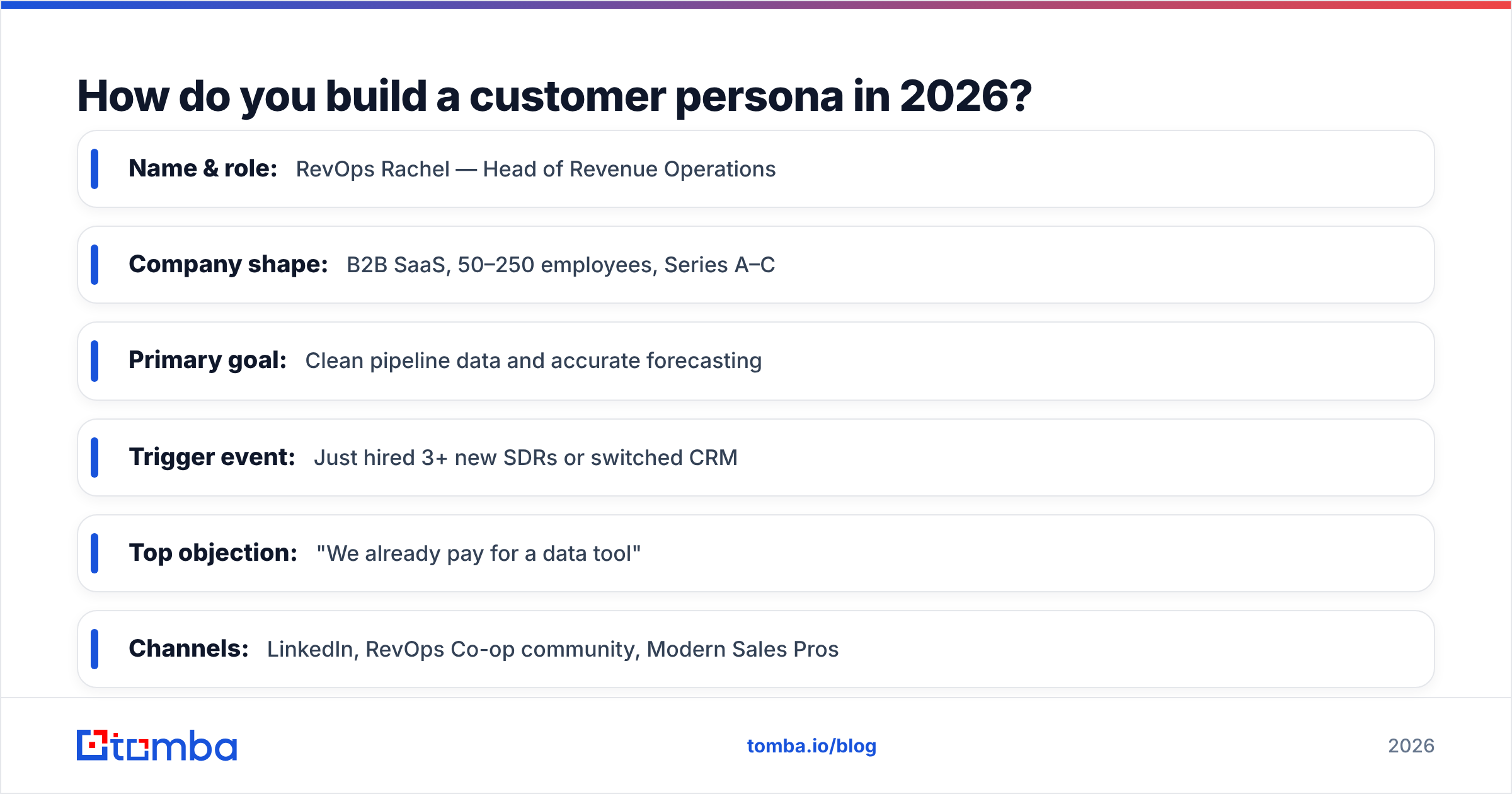
- Name & role: RevOps Rachel — Head of Revenue Operations
- Company shape: B2B SaaS, 50–250 employees, Series A–C
- Primary goal: Clean pipeline data and accurate forecasting
- Trigger event: Just hired 3+ new SDRs or switched CRM
- Top objection: "We already pay for a data tool"
- Channels: LinkedIn, RevOps Co-op community, Modern Sales Pros
- Buying process: Evaluates 2–3 tools, runs a data-accuracy bake-off, needs security sign-off
That last line — the bake-off — tells you exactly how to win: lead with data accuracy, not features.
Where does the data come from?#
Here's where most persona projects quietly die: you define a beautiful buyer, then have no way to find 500 of them to contact. A persona that can't be turned into a list is a diary entry.
You're choosing between two approaches, and only one scales.
The manual route — scrolling LinkedIn and copying names into a spreadsheet — works for your first ten accounts and collapses at scale. The data route turns persona attributes directly into a queryable search. HubSpot's own buyer persona research makes the same point: personas only create ROI when they feed segmentation and outreach systems, not slide decks.
Concretely, once you know your persona works at, say, mid-market SaaS companies, you can run a domain search across a target account to surface every relevant contact and their role, then filter to the titles your buyer persona specifies. From a list of company domains, a bulk email finder converts your ICP account list into named, contactable people in one pass.
How do you turn a persona into a contact list?#
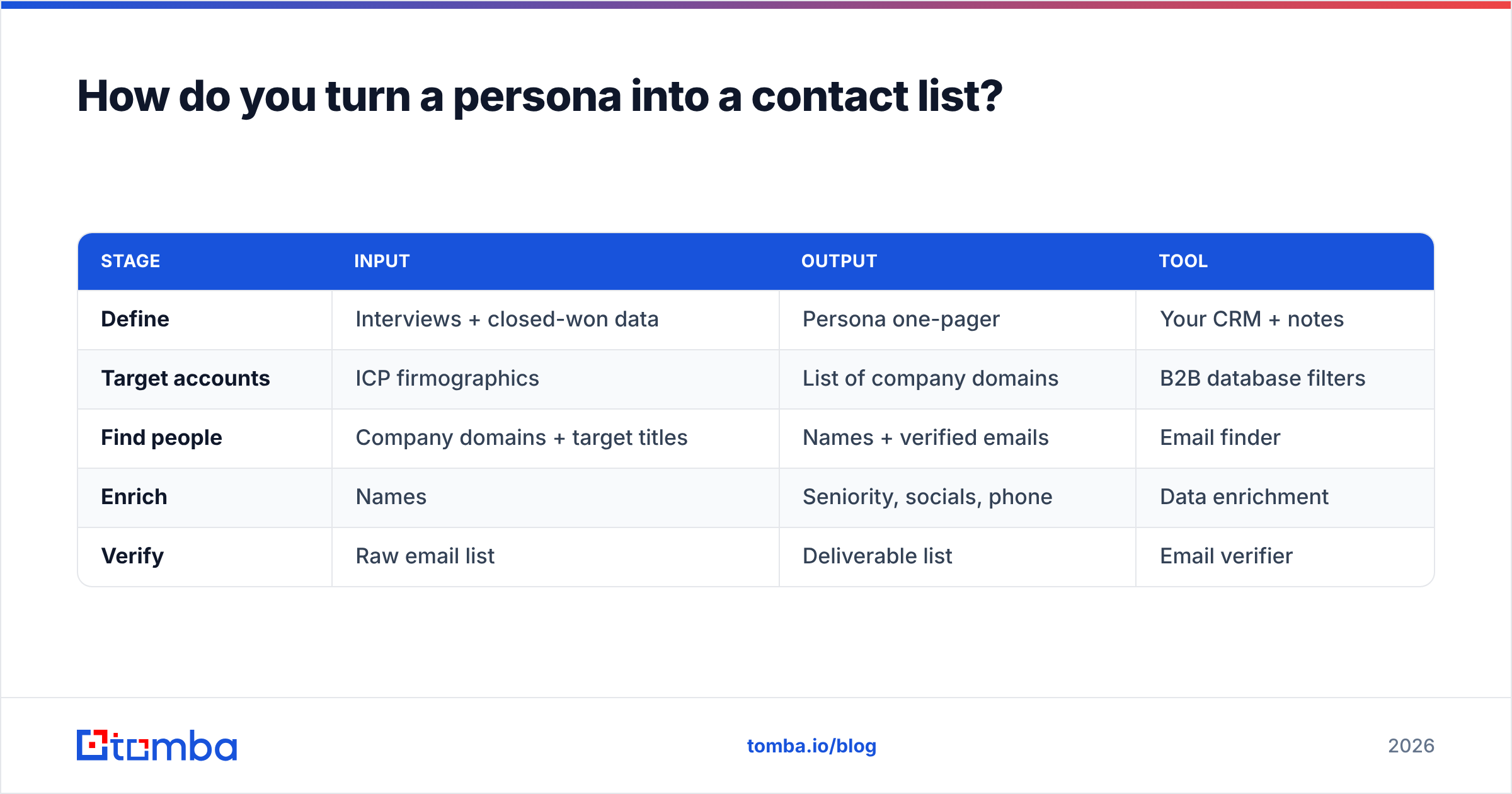
Follow the funnel from abstract to concrete:
| Stage | Input | Output | Tool |
|---|---|---|---|
| Define | Interviews + closed-won data | Persona one-pager | Your CRM + notes |
| Target accounts | ICP firmographics | List of company domains | B2B database filters |
| Find people | Company domains + target titles | Names + verified emails | Email finder |
| Enrich | Names | Seniority, socials, phone | Data enrichment |
| Verify | Raw email list | Deliverable list | Email verifier |
The verification step matters more than people expect. Even a perfect persona and a perfect account list produce bounces if the emails are stale — and bounces wreck sender reputation. Verifying before you send keeps your bounce rate low and your domain out of the spam folder.
What are the most common customer persona mistakes?#
- Fiction over research. Inventing traits in a meeting instead of interviewing real buyers. If you can't cite where a trait came from, cut it.
- One persona for a committee. Modern B2B deals have multiple stakeholders. Build a champion, a decision-maker, and a blocker.
- No negative persona. Not defining who to exclude means reps waste weeks on deals that were never going to close.
- Demographics theater. Age, favorite coffee, and a stock photo don't change any decision. Goals, triggers, and objections do.
- Set-and-forget. A 2023 persona describing pre-AI buying behavior is actively misleading in 2026. Refresh it.
- No path to a list. The persona lives in a Google Doc and never becomes a filter, a search, or a contactable list.
How often should you update a customer persona?#
Review personas every 6–12 months, and immediately after any major market shift — a new competitor, a pricing-model change in your category, or a wave of layoffs that reshuffles titles. Buying committees in 2026 look different than they did even two years ago: more technical stakeholders, tighter budget scrutiny, and AI-assisted vendor research that shortens the top of the funnel.
A fast sanity check: pull your last 20 closed-won deals and see whether the buyers still match your written persona. If a third of them don't, your persona has drifted and your targeting is quietly wasting spend.
Customer persona FAQ#
How many personas do I need? Start with one primary buyer persona and one negative persona. Add a second buyer persona only when you have data showing a distinct, sizable segment — not because it feels thorough.
What's the difference between a customer persona and a customer profile? A profile is usually the raw attribute record (firmographics, tech stack). A persona adds the human layer — goals, objections, and the story behind why they buy.
Can I build personas without interviews? You can start from CRM and enrichment data, but skipping interviews means you'll miss the language buyers use. That language is what makes cold outreach convert. Do at least three interviews before you finalize.
Do personas matter for outbound specifically? More than anywhere else. In outbound you have one line to prove relevance. A sharp persona tells you the exact trigger and pain to lead with, which is the difference between a reply and the trash folder.
Turn your persona into pipeline#
A customer persona earns its keep the moment it stops being a document and becomes a list of real people you can email today. That's the whole game: define the buyer from evidence, translate every trait into a filter, then find and verify the humans who match.
That last mile is where Tomba Email Finder fits. Feed it your ICP's company domains and target titles, and it returns verified, contactable emails for the exact people your persona describes — so your research turns into outreach instead of a poster on the wall. You can start free with 25 searches a month, and scale up on the Starter plan at $49/mo when your list outgrows the free tier. Build the persona once; contact the right people every day after.
Related guides#
Ready to find emails that actually work?
Join 150,000+ professionals who stopped guessing and started sending. Free credits on signup — no credit card required.
Get the Tomba newsletter
Practical outbound tactics and product updates — once every two weeks.
About the author