Customer Profile Example: How to Build an ICP That Converts in 2026
A vague "anyone with a budget" customer profile is why your outbound flops. Here's a real customer profile example, copy-paste templates, and the exact data fields that turn a fuzzy ICP into a targetable list.
Most "customer profiles" are useless because they describe a fantasy: decision-makers at fast-growing companies who value quality. That sentence targets everyone, which means it targets no one. A real customer profile is specific enough that a junior rep could build a prospect list from it in an afternoon without asking you a single question.
This guide gives you a concrete customer profile example you can copy, the exact fields that make it operational, and the difference between the three documents people confuse constantly: ICP, buyer persona, and customer profile.
TL;DR#
- A customer profile describes the company you sell to; a buyer persona describes the person who signs. You need both, and they are not interchangeable.
- A profile is only useful if every attribute is filterable in a database — industry, headcount, tech stack, funding stage, geography. "Ambitious" is not filterable; "hired 3+ SDRs in the last 90 days" is.
- Start from your best 10–20 closed-won accounts, find what they share, and write that down. Do not start from a whiteboard brainstorm.
- The example below is a full B2B SaaS customer profile you can adapt in ten minutes.
- Once the profile is written, the bottleneck becomes finding matching contacts — that's where enrichment and an email finder turn the profile into a live pipeline.
What is a customer profile (and how is it different from an ICP)?#
A customer profile is a documented description of the type of company that gets the most value from your product and returns the most value to you — high contract value, fast close, low churn.
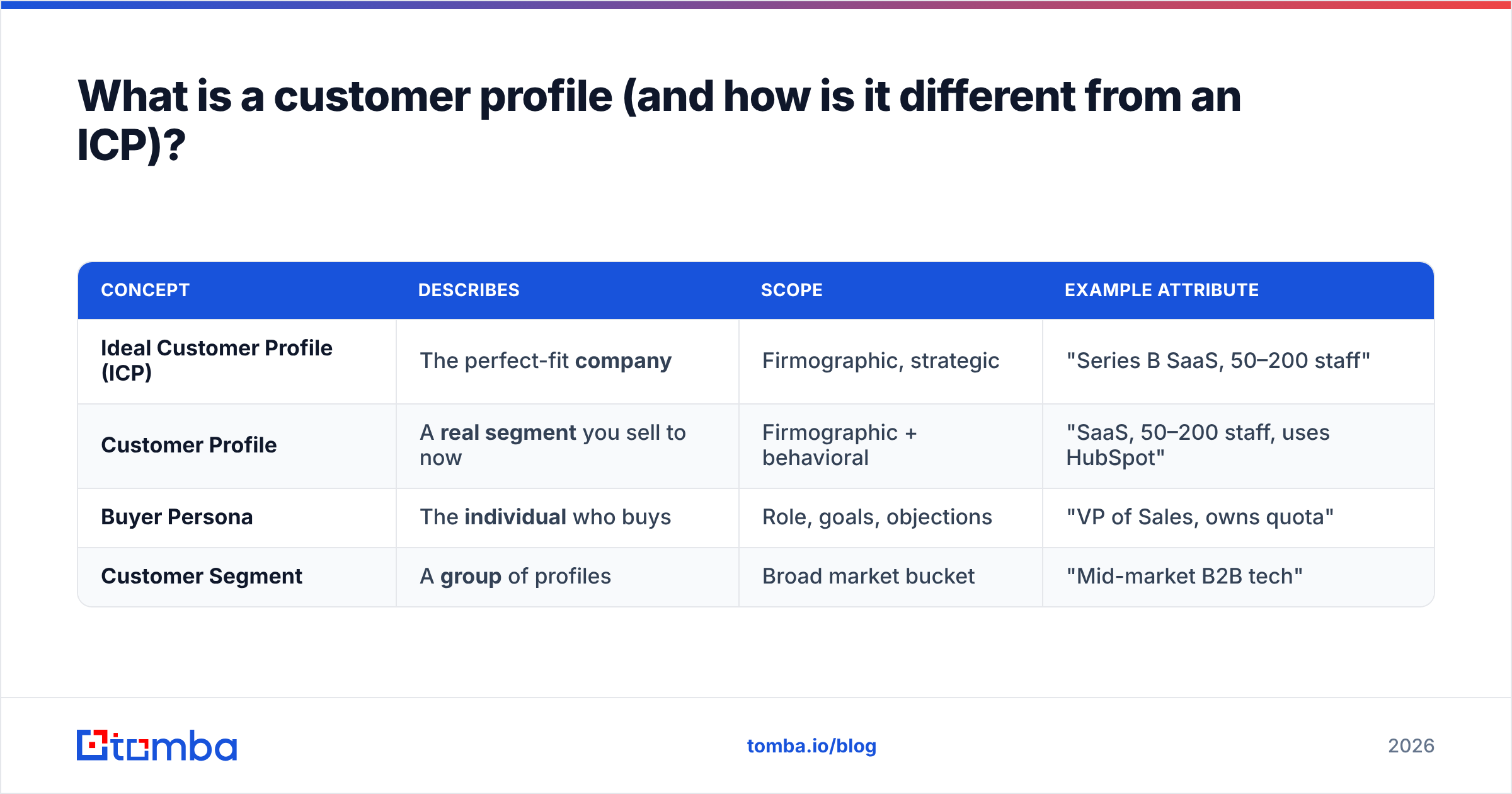
People use three terms almost interchangeably, so here's the clean split:
| Concept | Describes | Scope | Example attribute |
|---|---|---|---|
| Ideal Customer Profile (ICP) | The perfect-fit company | Firmographic, strategic | "Series B SaaS, 50–200 staff" |
| Customer Profile | A real segment you sell to now | Firmographic + behavioral | "SaaS, 50–200 staff, uses HubSpot" |
| Buyer Persona | The individual who buys | Role, goals, objections | "VP of Sales, owns quota" |
| Customer Segment | A group of profiles | Broad market bucket | "Mid-market B2B tech" |
The practical takeaway: your ICP is the aspiration, the customer profile is the operational version with enough detail to build a list, and the buyer persona lives inside that profile. Gartner's research on buyer enablement makes the same point from the buyer's side — modern B2B deals involve 6–10 stakeholders, so one persona is never enough.

What does a good customer profile example look like?#
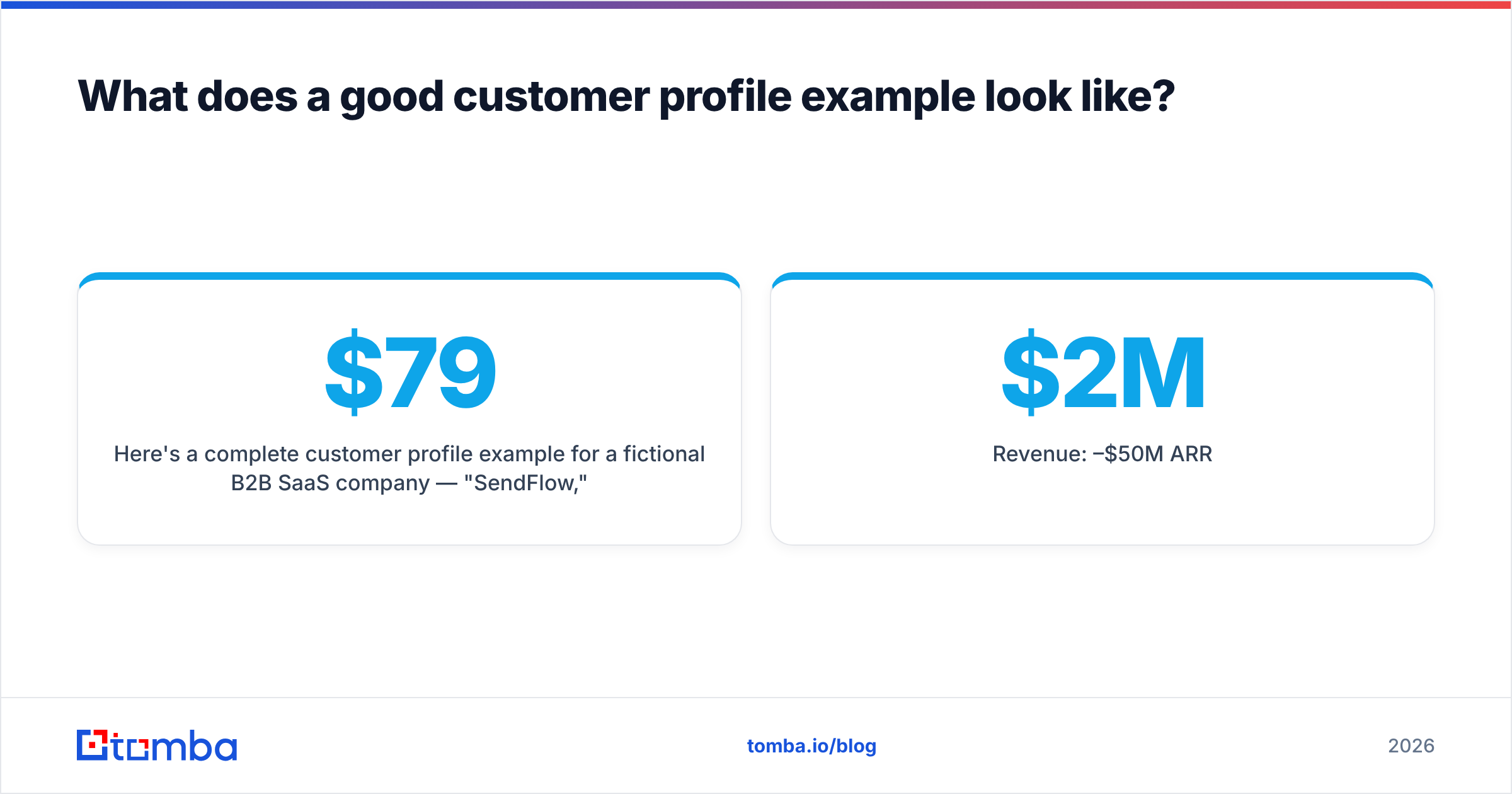
Here's a complete customer profile example for a fictional B2B SaaS company — "SendFlow," a $79/mo cold-email platform. Notice that every line is something you could actually filter on.
Company snapshot
- Industry: B2B software, marketing agencies, recruiting firms
- Headcount: 20–200 employees
- Revenue: $2M–$50M ARR
- Funding stage: Bootstrapped to Series B
- Geography: US, UK, Canada, Australia (English-first outbound)
- Tech stack signals: Uses a CRM (HubSpot, Pipedrive, or Salesforce) and at least one email tool
- Trigger events: Recently hired an SDR/BDR, posted a "Growth" or "Demand Gen" role, raised a funding round in the last 6 months
Buyer persona inside this profile
- Primary buyer: Head of Sales / Head of Growth (owns the number, feels the pipeline pain)
- Champion: SDR team lead (uses the tool daily)
- Blocker: RevOps or IT (cares about deliverability and data compliance)
- Top goal: Book more qualified meetings without hiring more reps
- Top objection: "We already have a tool" or "Will this hurt our domain reputation?"
Fit and disqualifiers
- Green flags: Sending 500+ cold emails/month, an active outbound motion, a defined territory
- Red flags: Pre-revenue, no CRM, purely inbound-led, enterprise procurement cycles over 6 months
That is a customer profile you can act on. Compare it to "growth-minded companies that want more leads" — the difference is that a stranger could take the example above and build a list; they could not do anything with the fluffy version.
Which data fields turn a customer profile into a targetable list?#
The fastest test of a profile: can each attribute be found in a B2B database or enrichment tool? If not, rewrite it. Here are the field types that matter, ranked by how targetable they are.
- Firmographics — industry (NAICS/SIC or plain category), employee count, revenue, HQ country. The backbone of every filter.
- Technographics — the software a company runs. Selling a Salesforce app? Filter for Salesforce users only. This alone can double reply rates.
- Trigger/intent signals — recent funding, new hires, leadership changes, job postings. Timing beats fit; a mediocre-fit account hiring 5 SDRs today outperforms a perfect-fit account that's dormant.
- Contact-level data — the role, seniority, and above all a valid work email and direct line for the persona you defined.
- Exclusions — competitors, existing customers, and known bad-fit segments. A profile without disqualifiers is only half done.
Fields 1–3 tell you which companies to chase. Field 4 is what actually lets you contact them — and it's where most teams stall, because a list of 500 target companies with no verified emails is just homework. Running those domains through a domain search and enriching each account with contact enrichment is what closes the gap between "profile" and "pipeline."
How do you actually build your customer profile in 5 steps?#
You don't invent a profile — you reverse-engineer it from accounts that already worked.
- Pull your best 10–20 closed-won accounts. Filter for high value, fast close, and low churn. Ignore the logos you're proud of but that barely pay.
- Find the shared attributes. Line them up in a spreadsheet: industry, size, stack, how they found you, who signed. Patterns jump out fast — often it's an industry + size + one tech signal.
- Interview 3–5 of them. Ask why they bought, what almost stopped them, and what they'd Google to find you. This is where the persona's objections come from.
- Write the disqualifiers. Look at your worst churned accounts and your longest never-closed deals. Those attributes become your red flags.
- Make it filterable. Rewrite every soft attribute ("ambitious," "quality-focused") into a hard one ("hired a demand-gen lead in the last quarter"). If you can't filter it, cut it.
HubSpot's team frames this well in their buyer persona guide — the goal is a research-backed document, not a creative-writing exercise. And peer-review sites like G2 are a goldmine for step 2, since real reviews tell you exactly which company types praise a product like yours.
Customer profile vs buyer persona: which do you need first?#
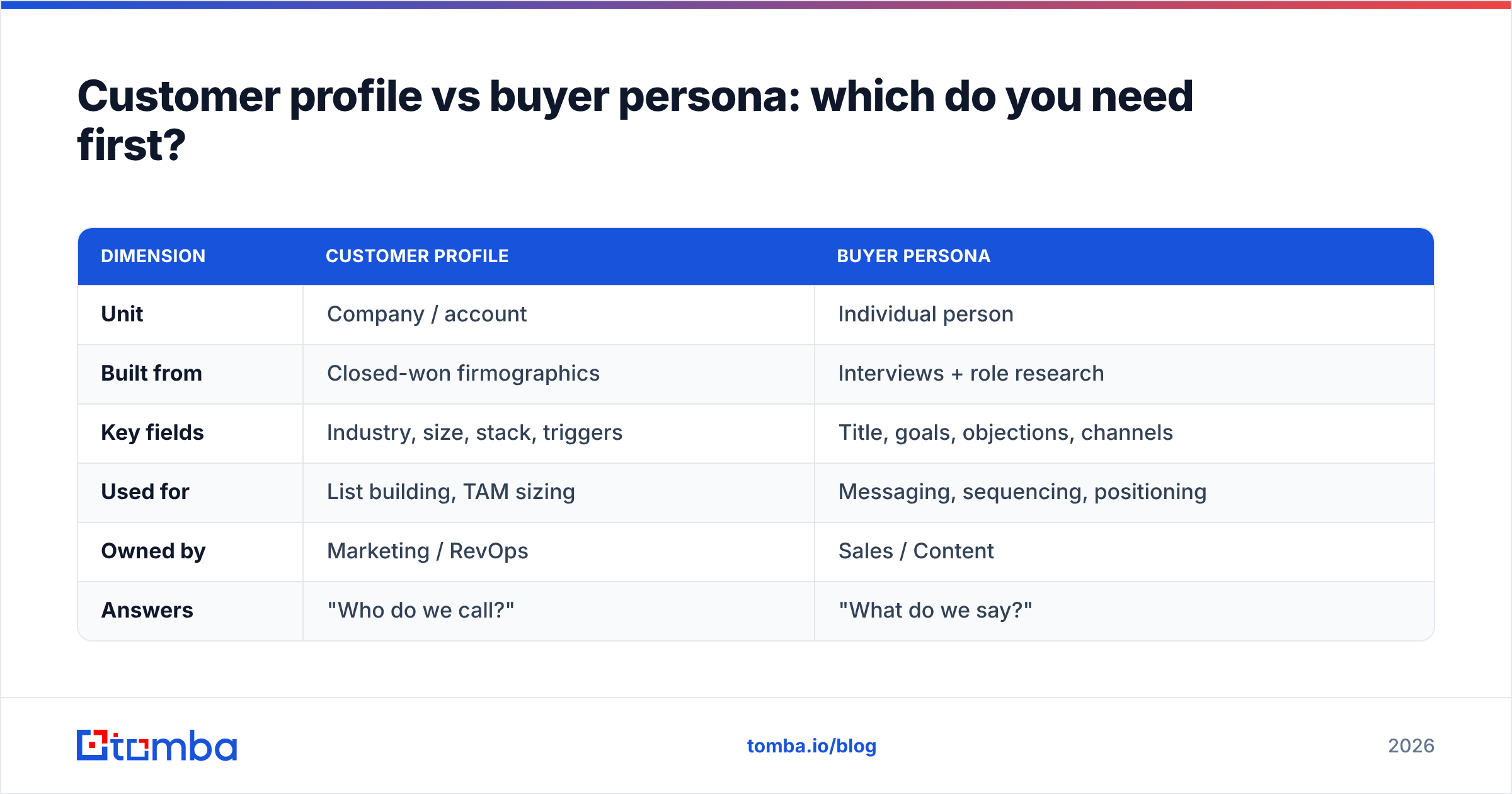
Build the company profile first, then the persona inside it. You can't define the right buyer until you know the right company — a "VP of Sales" at a 10-person agency and a 5,000-person enterprise are completely different buyers with different budgets, urgency, and objections.
| Dimension | Customer Profile | Buyer Persona |
|---|---|---|
| Unit | Company / account | Individual person |
| Built from | Closed-won firmographics | Interviews + role research |
| Key fields | Industry, size, stack, triggers | Title, goals, objections, channels |
| Used for | List building, TAM sizing | Messaging, sequencing, positioning |
| Owned by | Marketing / RevOps | Sales / Content |
| Answers | "Who do we call?" | "What do we say?" |
Think of it like fishing. The customer profile picks the lake — the one actually stocked with the fish you want. The buyer persona picks the bait — the message that gets a specific fish to bite. Great bait in an empty lake still catches nothing, which is why account targeting comes before copywriting every single time.
What tools help you operationalize a customer profile?#
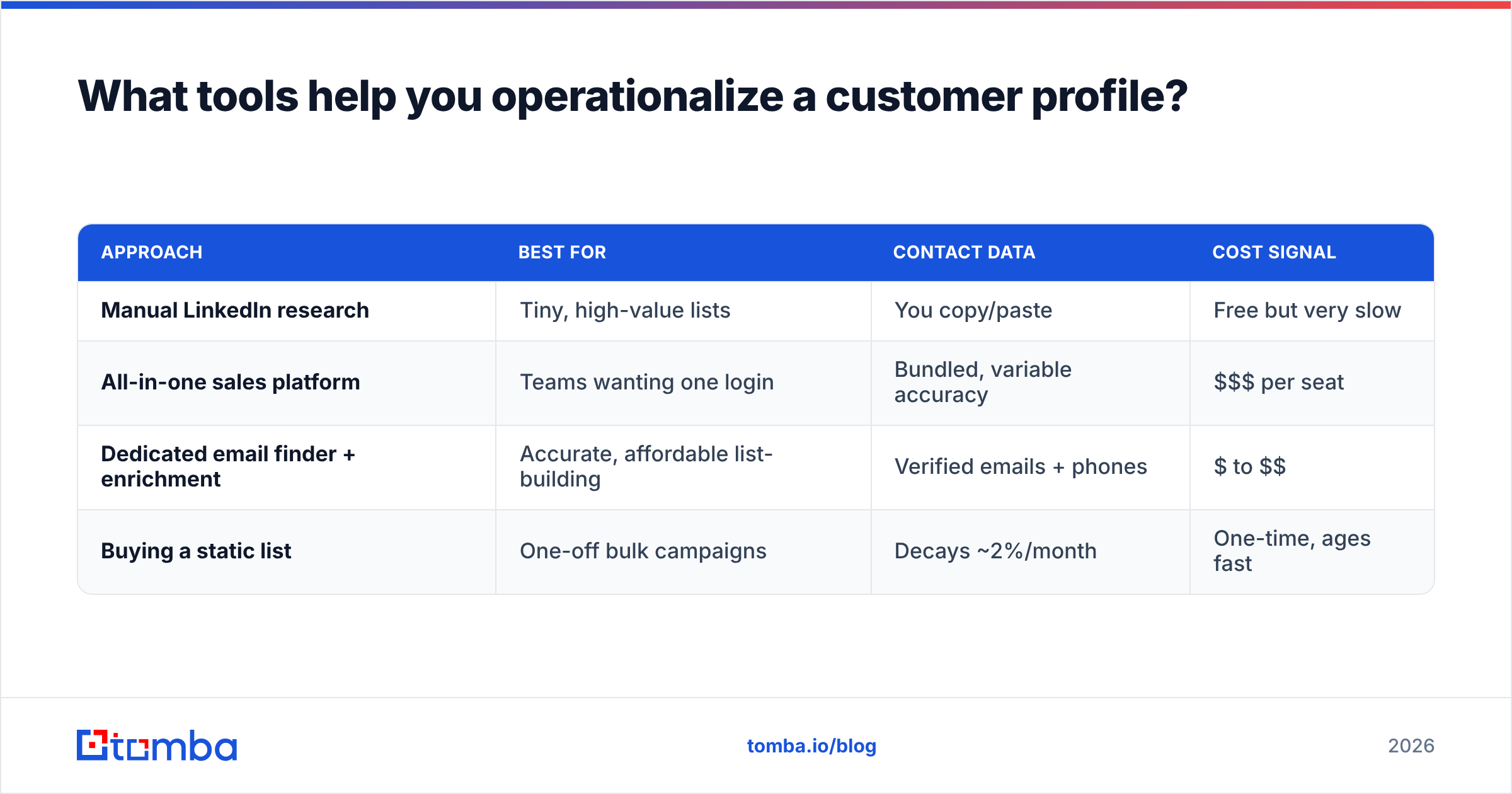
Once the profile is written, you need three capabilities: a source of companies that match, a way to find the right people inside them, and verified contact details so your outreach lands. Here's how the common approaches compare.
| Approach | Best for | Contact data | Cost signal |
|---|---|---|---|
| Manual LinkedIn research | Tiny, high-value lists | You copy/paste | Free but very slow |
| All-in-one sales platform | Teams wanting one login | Bundled, variable accuracy | $$$ per seat |
| Dedicated email finder + enrichment | Accurate, affordable list-building | Verified emails + phones | $ to $$ |
| Buying a static list | One-off bulk campaigns | Decays ~2%/month | One-time, ages fast |
For most SMB and mid-market teams, a dedicated finder is the sweet spot: you feed it the firmographic profile you built, and it returns verified contacts for the exact personas you defined. Tomba covers this end to end — find email addresses by domain and role, verify them, and enrich each record with company and social data. If you need volume, reputable list providers like BookYourData can seed the top of the funnel, and you verify before you send. You can compare approaches and tiers on the Tomba pricing page; the free tier (25 searches/month) is enough to test your profile against real data before committing.
How do you know your customer profile is actually working?#
A customer profile is a hypothesis, and every campaign is an experiment. Track these four signals and revise quarterly:
- Reply and positive-reply rate by segment — if one industry replies 3x more, tighten the profile toward it.
- Close rate and sales cycle — profiles that close fast and cheap should get more of your targeting, not less.
- Churn by segment — a segment that buys fast but churns in 90 days is a trap; add it to your red flags.
- CAC payback — the whole point of a tight profile is efficiency. If payback shrinks after you narrow, the profile is working.
The mistake is treating the profile as a one-time document. Markets shift, your product matures, and your best-fit customer in 2026 won't be identical to your best-fit customer next year. Revisit it every quarter against real closed-won data.
Frequently asked questions#
How many customer profiles should I have? Start with one primary profile. Add a second only when your data clearly shows a distinct, high-performing segment with different firmographics or buying behavior. Most sub-$10M companies overreach with four profiles when one sharp one would outperform.
What's the difference between a customer profile and a customer segment? A segment is a broad market bucket ("mid-market B2B tech"); a customer profile is the specific, filterable definition inside it that you actually target. Segments are for strategy decks; profiles are for building lists.
Can I build a customer profile without historical data? Yes, but treat it as a guess until data arrives. Use competitor reviews on G2, your founder's network, and the first 10 deals you close to validate or rewrite it fast.
Turn your profile into pipeline#
A customer profile is only worth the effort if it ends in conversations with real people. Once you've defined the industries, sizes, and roles that fit, the Tomba Email Finder turns that definition into verified, ready-to-contact leads — search by domain, filter by role, and export emails you can trust. Write the profile this week, then spend your free 25 searches finding the first accounts that match. That's the shortest path from a document on a whiteboard to replies in your inbox.
Related guides#
Ready to find emails that actually work?
Join 150,000+ professionals who stopped guessing and started sending. Free credits on signup — no credit card required.
Get the Tomba newsletter
Practical outbound tactics and product updates — once every two weeks.
About the author