Customer Profile vs Buyer Persona: Differences That Matter
An ICP tells you which companies to chase; a buyer persona tells you who to talk to inside them. Here's how customer profiles and buyer personas differ—and how to use both together.
Most teams use "customer profile" and "buyer persona" as if they were the same document. They are not, and treating them as interchangeable is why so much outbound lands in the wrong inbox at the right company — or the right inbox at a company that will never buy.
Here's the short version: a customer profile (usually an Ideal Customer Profile, or ICP) describes the company worth selling to. A buyer persona describes the person inside that company you actually talk to. You need both, and they do different jobs at different stages of the funnel.
TL;DR#
- Customer profile (ICP) = the account. Firmographics like industry, company size, revenue, tech stack, and region. It answers "which companies should we go after?"
- Buyer persona = the human. Role, goals, pains, objections, and buying triggers. It answers "who do we talk to, and what do we say?"
- ICP filters your list; personas shape your message. Use the ICP to build the target account list, then use personas to tailor outreach to each stakeholder.
- B2B deals have 6–10 people in the buying group (per Gartner), so one account almost always maps to several personas.
- The workflow: define ICP → build account list → identify personas in each account → find verified contact details → personalize by persona.
What is a customer profile (ICP)?#
A customer profile is a description of the organization that gets the most value from your product and gives you the most value back. In B2B, this is almost always your Ideal Customer Profile.
It is built from firmographic and technographic attributes — the traits of the company, not any one employee:
- Industry / vertical — e.g., B2B SaaS, logistics, fintech.
- Company size — headcount and/or revenue band.
- Geography — regions or countries you can legally and practically serve.
- Tech stack — tools they already run that signal a fit (a CRM, a specific cloud, a competing product).
- Maturity / triggers — recent funding, hiring sprees, expansion, or compliance deadlines.
- Economic fit — budget authority and willingness to pay at your price point.
A good ICP is exclusionary on purpose. Its value is in the companies it tells you to ignore. If your ICP doesn't disqualify anyone, it isn't doing its job.
You typically assemble an ICP by analyzing your best existing customers — the ones with the highest retention, fastest sales cycles, and lowest support cost — and reverse-engineering what they have in common. Enriching your closed-won accounts with firmographic data makes those patterns obvious; Tomba's data enrichment and B2B database are built for exactly that kind of backfill.
What is a buyer persona?#
A buyer persona is a semi-fictional profile of a specific person involved in the purchase. Where the ICP is firmographic, the persona is psychographic and role-based.
A useful persona captures:
- Job title and seniority — VP of Sales, RevOps Manager, IT Director.
- Responsibilities and KPIs — what they're measured on.
- Goals — what a win looks like for them personally.
- Pain points — the friction your product removes.
- Objections — why they'd say no or stall.
- Buying role — champion, decision-maker, economic buyer, blocker, or end user.
- Where they hang out — LinkedIn, Slack communities, industry newsletters.
HubSpot popularized the modern persona template, and its buyer persona guide is still a solid starting point if you're building your first one. The key discipline is to base personas on real interviews and CRM data, not on a whiteboard guess about who you wish was buying.
Customer profile vs buyer persona: what's the actual difference?#
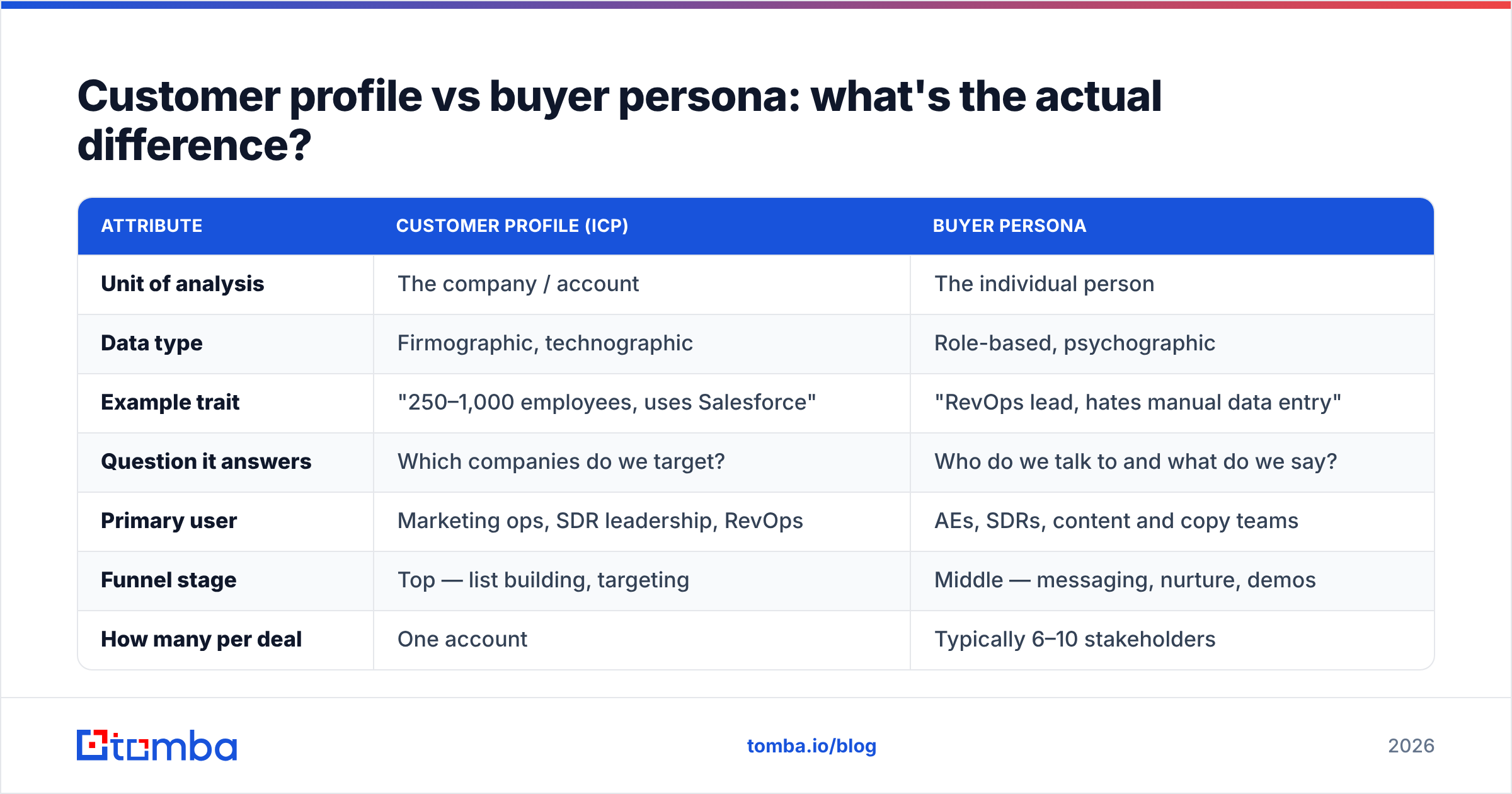
The cleanest way to see it: the ICP scopes the market, the persona scopes the conversation. One account that matches your ICP will contain several personas, because B2B purchases are made by committees, not individuals.
| Attribute | Customer Profile (ICP) | Buyer Persona |
|---|---|---|
| Unit of analysis | The company / account | The individual person |
| Data type | Firmographic, technographic | Role-based, psychographic |
| Example trait | "250–1,000 employees, uses Salesforce" | "RevOps lead, hates manual data entry" |
| Question it answers | Which companies do we target? | Who do we talk to and what do we say? |
| Primary user | Marketing ops, SDR leadership, RevOps | AEs, SDRs, content and copy teams |
| Funnel stage | Top — list building, targeting | Middle — messaging, nurture, demos |
| How many per deal | One account | Typically 6–10 stakeholders |
| Changes when | You enter a new market or tier | A new role joins the buying committee |
Notice the "how many per deal" row. Gartner's research on the B2B buying journey found that a typical purchase involves six to ten decision-makers. That single fact is why you can't collapse the two concepts: one ICP-fit account forces you to run several persona-specific plays in parallel.
When should you use each one?#
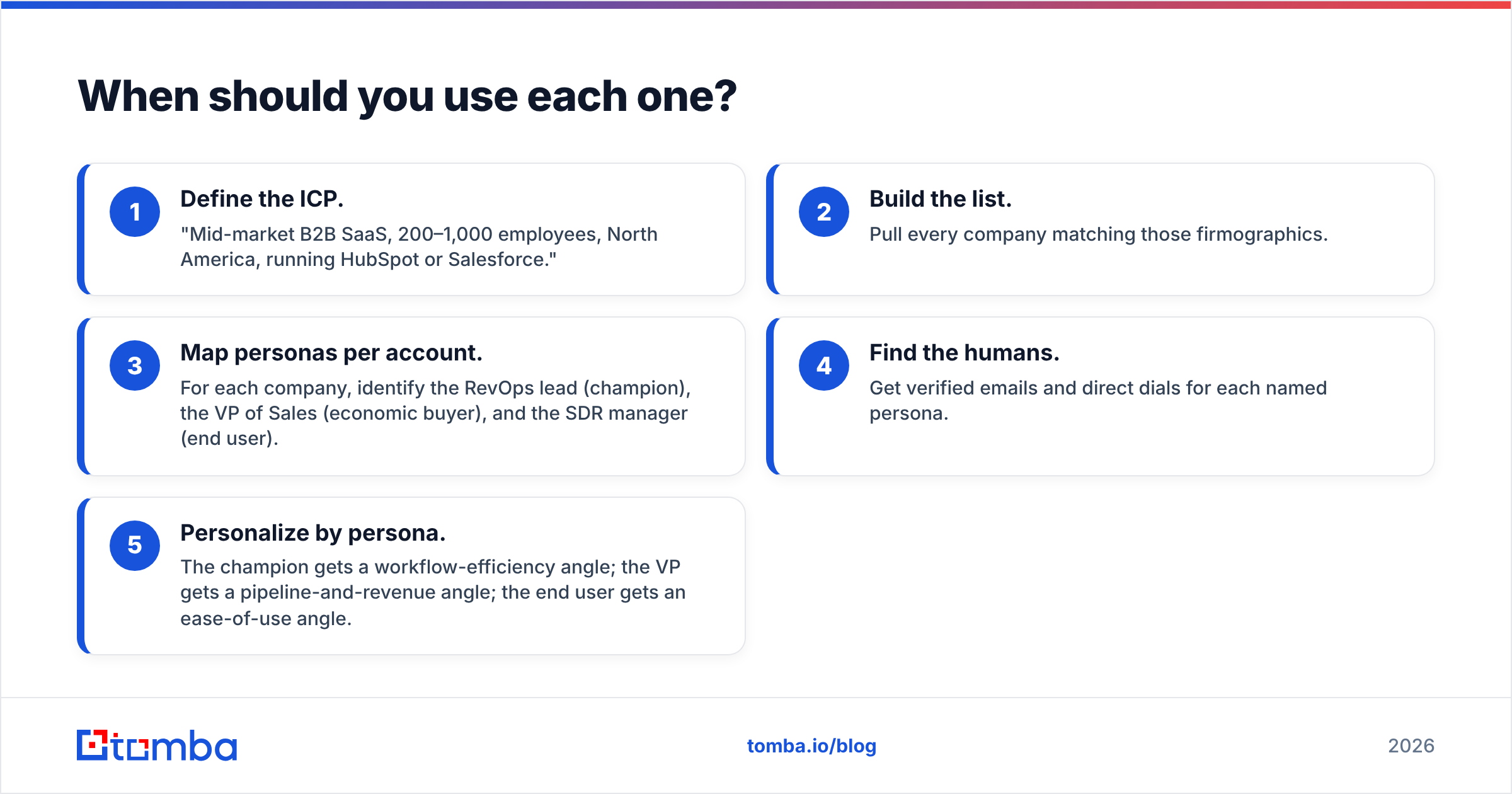
They're sequential, not competing. Use the ICP first to decide where to spend effort, then use personas to decide how to spend it.
- Use your ICP when you're building target account lists, setting territory boundaries, scoring inbound leads, choosing ad audiences, or deciding which deals to disqualify. This is where a tight marketing qualified lead definition pays off.
- Use your personas when you're writing cold email copy, tailoring a demo, building a nurture sequence, prepping for a discovery call, or deciding which stakeholder to multithread into next.
A concrete flow:
- Define the ICP. "Mid-market B2B SaaS, 200–1,000 employees, North America, running HubSpot or Salesforce."
- Build the list. Pull every company matching those firmographics.
- Map personas per account. For each company, identify the RevOps lead (champion), the VP of Sales (economic buyer), and the SDR manager (end user).
- Find the humans. Get verified emails and direct dials for each named persona.
- Personalize by persona. The champion gets a workflow-efficiency angle; the VP gets a pipeline-and-revenue angle; the end user gets an ease-of-use angle.
Skip step 1 and you'll personalize beautifully to people who will never buy. Skip steps 3–4 and you'll target the right companies but pitch the wrong person — or blast a generic message to everyone and convert no one.
How do ICP and personas work together in practice?#
Think of the ICP as the guest list for a party and personas as knowing what to say to each guest once they arrive. The list gets the right people in the room; the personas make the conversation land.
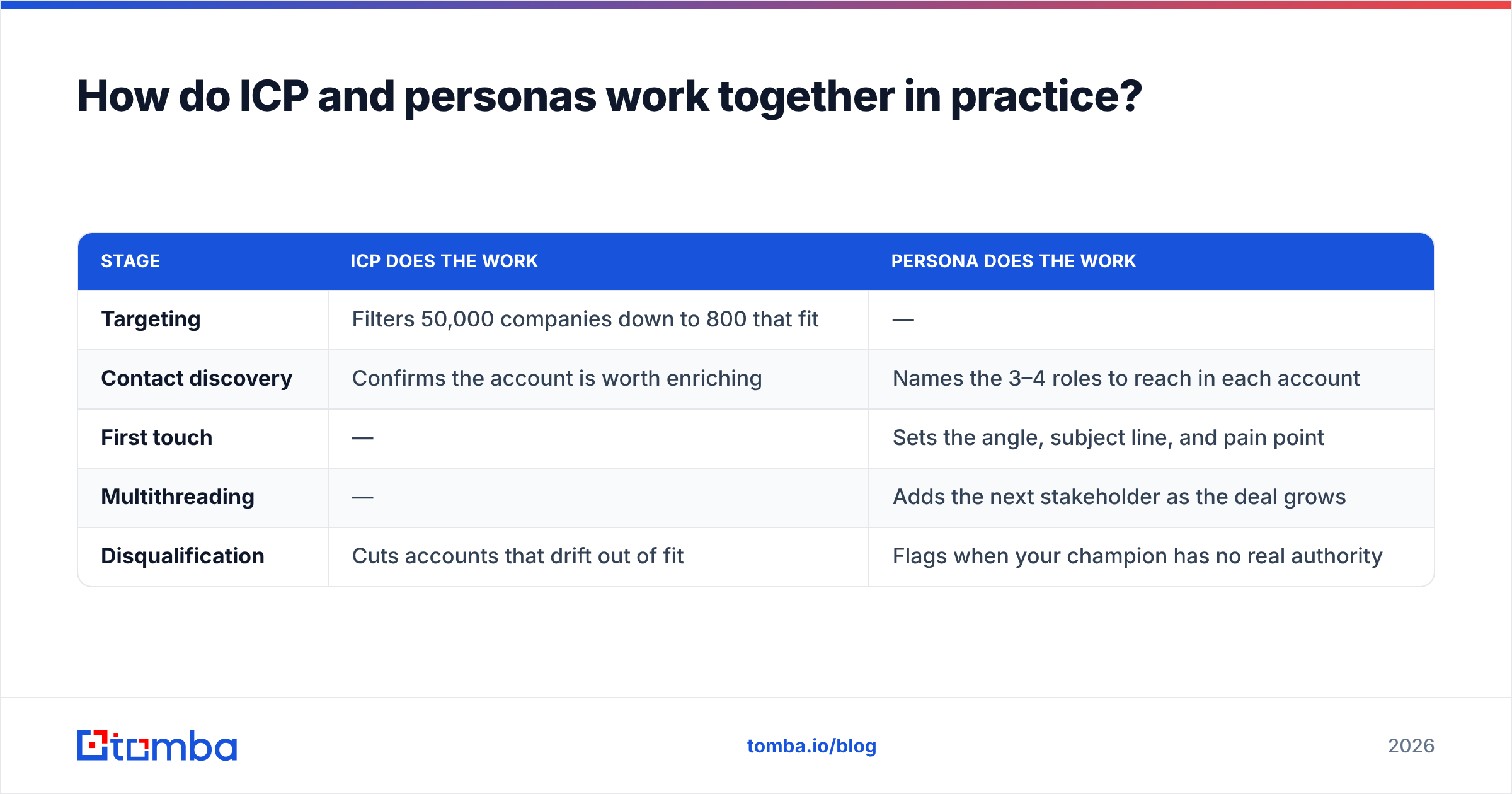
Here's how the two layers stack across a real outbound motion:
| Stage | ICP does the work | Persona does the work |
|---|---|---|
| Targeting | Filters 50,000 companies down to 800 that fit | — |
| Contact discovery | Confirms the account is worth enriching | Names the 3–4 roles to reach in each account |
| First touch | — | Sets the angle, subject line, and pain point |
| Multithreading | — | Adds the next stakeholder as the deal grows |
| Disqualification | Cuts accounts that drift out of fit | Flags when your champion has no real authority |
The operational bottleneck between "we know who to target" and "we're actually in their inbox" is contact data. You've matched the account (ICP) and named the role (persona) — now you need a real, deliverable email for that specific person. That's where an accurate email finder closes the gap, turning a persona like "RevOps lead at Acme" into first.last@acme.com that you can verify before you send.
Common mistakes teams make#
- Building personas without an ICP. You end up with vivid profiles of people at companies that can't afford you. Persona detail is wasted without account fit.
- Building an ICP without personas. You get clean target lists and generic, ignorable outreach. Firmographics don't write email copy.
- Confusing a persona with a job title. "CFO" is a title. "Cost-conscious CFO at a Series B startup worried about burn rate" is a persona. The extra context is the whole point.
- Never updating either one. ICPs drift as you move upmarket; personas change as new roles join the buying committee. Revisit both quarterly against closed-won data.
- Ignoring the buying committee. Optimizing for a single "primary" persona ignores the 5–9 other people who can kill the deal. Map the blockers too.
- Chasing volume over fit. A giant list of non-ICP contacts feels productive and performs terribly. Salesforce's own sales resources hammer this point: fit beats volume every time.
How do you build both without guessing?#
Start with data you already own, then enrich outward.
For the ICP, export your best accounts and look for shared firmographics. If your CRM records are thin, run them through contact enrichment to append company size, industry, and tech stack, then cluster the winners. The pattern that emerges is your ICP — grounded in revenue, not opinion.
For personas, interview the humans who actually bought. Pull the job titles from your closed-won deals, note who championed and who signed, and document the pains they described in discovery calls. Three to five personas per product is plenty; more than that and you're slicing too thin.
For execution, once ICP and personas are defined, the daily job is finding and verifying the specific people who match. Search a target company's domain to surface everyone in the relevant roles, then confirm each address so your carefully targeted message actually gets delivered.
Which one matters more?#
Neither wins in isolation — but if you're forced to sequence them, define the customer profile first. Targeting the wrong companies with perfect persona messaging is more expensive than targeting the right companies with average messaging, because the ICP failure wastes every downstream dollar.
The teams that consistently hit pipeline treat it as a pipeline, not a debate: ICP scopes the market, personas shape the message, and verified contact data connects the two so nothing leaks between "we know who to reach" and "we reached them."
Put your ICP and personas to work#
Once your customer profile and buyer personas are defined, the last mile is contact data — real, deliverable emails for the exact people your personas describe at the exact companies your ICP filtered. That's what Tomba's Email Finder does: give it a name and a domain, and it returns a verified professional email you can trust before you hit send. Start free with 25 searches a month, and scale up on the Starter plan at $49/mo when your list outgrows the free tier. Get the targeting and the message right, and let Tomba handle getting you in the door.
Related guides#
Ready to find emails that actually work?
Join 150,000+ professionals who stopped guessing and started sending. Free credits on signup — no credit card required.
Get the Tomba newsletter
Practical outbound tactics and product updates — once every two weeks.
About the author