Customer Profiles in 2026: How to Build Them (With Examples)
Most teams confuse a customer profile with a buyer persona and target the wrong accounts. Here's how to build customer profiles that actually improve win rates.
Most B2B teams think they have a customer profile. What they actually have is a vague gut feeling — "mid-market SaaS, maybe 50 to 500 people, probably a VP of Sales" — dressed up in a slide deck. That fuzziness is why so much outbound misses, why reps chase accounts that never close, and why marketing spend leaks.
A real customer profile is a specific, data-backed description of the accounts and people most likely to buy, stay, and expand. Build it right and every downstream decision — targeting, messaging, scoring, routing — gets sharper. This guide shows you how.
TL;DR#
- A customer profile is a data-backed definition of who your best-fit buyers are — by firmographics, technographics, behavior, and pain — not a demographic sketch.
- It is not the same as a buyer persona: the profile describes the account, the persona describes the person inside it.
- Build it from your won and retained customers, not aspirations. Mine the CRM for patterns, then validate with interviews.
- Enrich thin profiles with firmographic and contact data so segments are actually actionable, not just theoretical.
- Refresh profiles at least twice a year — markets, products, and your own win data all drift.
What is a customer profile?#
A customer profile is a structured description of the type of company (and the people within it) that gets the most value from your product and returns the most value to your business. Think of it like a casting brief for a film: you are not describing one actor, you are describing the exact character traits anyone must have to land the role.
In B2B, the strongest version of this is the Ideal Customer Profile (ICP) — the account-level definition of your best-fit market. A complete customer profile usually captures four layers:
- Firmographics — industry, company size, revenue, geography, funding stage, growth rate.
- Technographics — the tools and platforms they already run (a CRM, a data warehouse, a specific cloud), which signal readiness and integration fit.
- Behavioral and intent signals — hiring patterns, product usage, content consumed, expansion moves, or trigger events like a new funding round.
- Pain and priorities — the specific problem your product removes and the business outcome the buyer is accountable for.
The reason to separate these layers is practical: each one maps to a different data source and a different filter you can apply when prospecting. A profile that lives only in prose can't be turned into a target list. A profile broken into fields can.
Is a customer profile the same as a buyer persona?#
No — and conflating them is the single most common mistake teams make. The customer profile answers which companies should we sell to. The buyer persona answers which humans inside those companies do we talk to, and what do they care about.
You need both, and they stack. The customer profile filters your total addressable market down to accounts worth pursuing. The persona then tells each rep how to speak to the economic buyer versus the champion versus the end user inside a qualifying account. HubSpot's own buyer persona research frames personas as semi-fictional representations of ideal customers — useful for messaging, but they are not a targeting filter on their own.
Here is the distinction laid out:
| Dimension | Customer profile (ICP) | Buyer persona |
|---|---|---|
| Unit of analysis | The account / company | The individual person |
| Core attributes | Industry, size, revenue, tech stack | Role, goals, objections, channels |
| Primary use | Targeting and account selection | Messaging and outreach |
| Data source | CRM wins, firmographic data | Interviews, surveys, call notes |
| Changes when | Your market or product shifts | The buying committee shifts |
| Owned by | RevOps / marketing leadership | Marketing / sales enablement |
A clean rule: build the customer profile first, because it defines the set of people your personas will ever describe. Personas built without a profile tend to drift into generic "Marketing Mary" caricatures that no rep actually uses.
Why do customer profiles matter for B2B revenue?#
Because targeting error compounds. If your customer profile is 20% wrong, that error flows into your ad audiences, your outbound lists, your lead scoring model, and your sales forecast. Every team downstream inherits the mistake.
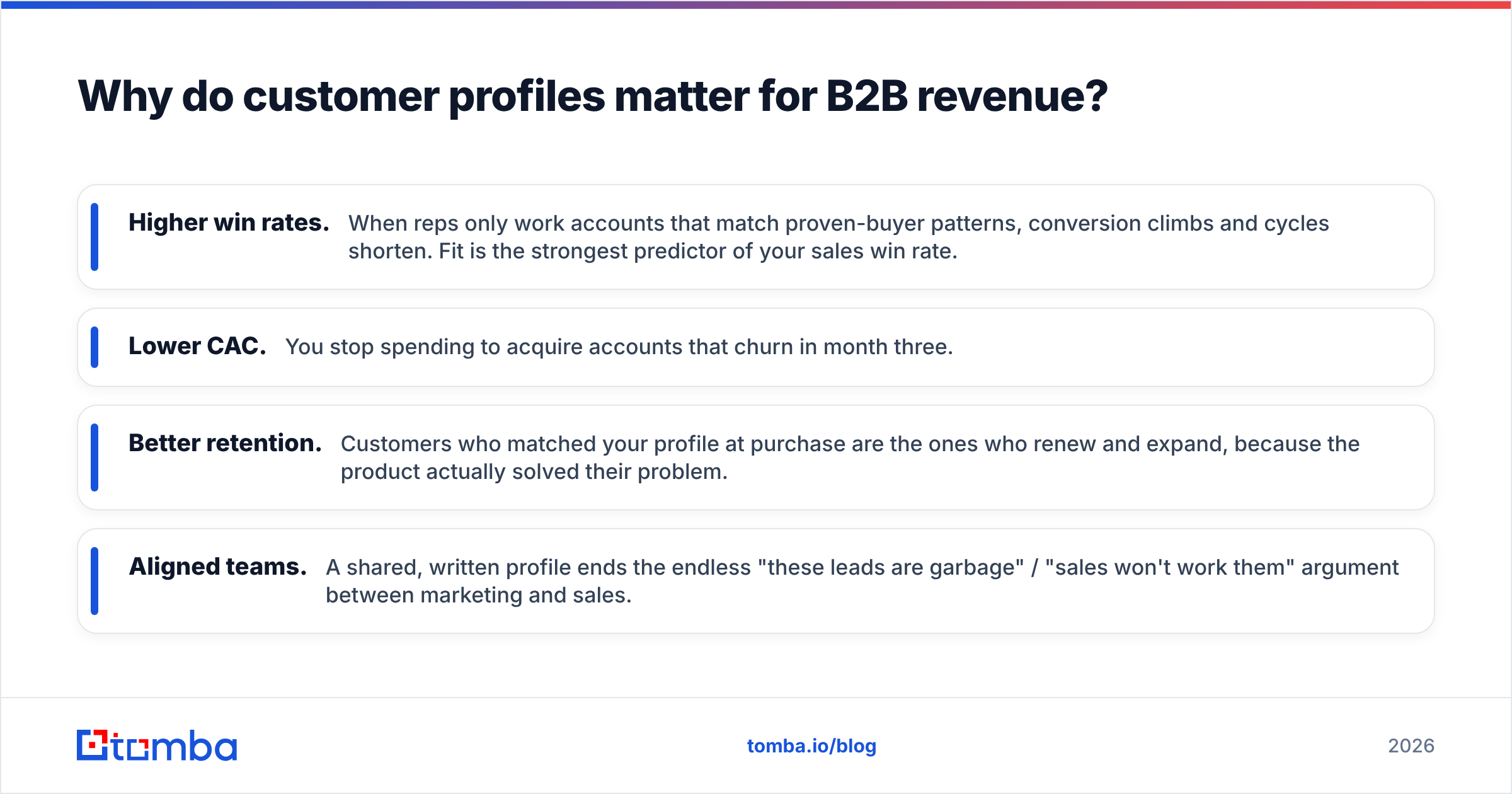
Sharp profiles pay off in four measurable ways:
- Higher win rates. When reps only work accounts that match proven-buyer patterns, conversion climbs and cycles shorten. Fit is the strongest predictor of your sales win rate.
- Lower CAC. You stop spending to acquire accounts that churn in month three.
- Better retention. Customers who matched your profile at purchase are the ones who renew and expand, because the product actually solved their problem.
- Aligned teams. A shared, written profile ends the endless "these leads are garbage" / "sales won't work them" argument between marketing and sales.
Analyst firms have pushed this account-centric view for years — Gartner's B2B buying research shows buying happens across a committee inside a target account, not with a single lead, which is exactly why the account-level profile has to come first.
How do you build a customer profile step by step?#
Start with evidence, not imagination. Your best customers have already told you who your best customers are — you just have to read the data.
Step 1 — Pull your won and retained accounts. Export closed-won deals from the last 12–24 months, then filter to the ones that stayed and expanded. Losers and churners are noise here; you want the pattern of success.
Step 2 — Find the shared attributes. For that winning cohort, tabulate industry, employee count, revenue band, region, tech stack, and how they first engaged. Look for concentrations. If 60% of your best accounts are 200–1,000-person B2B software companies running a specific CRM, that's a signal, not a coincidence.
Step 3 — Layer in the human context. Interview five to ten of those customers. Ask what triggered the purchase, who was in the room, what almost killed the deal, and what outcome they were measured on. This turns firmographic correlation into causal understanding.
Step 4 — Write the profile as filters. Convert every insight into a field with a threshold: Industry = SaaS, Employees = 200–1,000, Uses = Salesforce, Trigger = raised Series B in last 6 months. If you can't filter a list by it, it's not in the profile yet.
Step 5 — Enrich and operationalize. Most CRMs have gaps — missing revenue, missing tech stack, missing contacts. Fill them with data enrichment so your segments are complete enough to act on, then push the profile into your scoring model and prospecting workflow.
Step 6 — Test against a holdout. Score a batch of open pipeline against the new profile and see whether high-fit accounts really do close at a higher rate. If they don't, your attributes are wrong — go back to step two.

What data do you need, and where does it come from?#
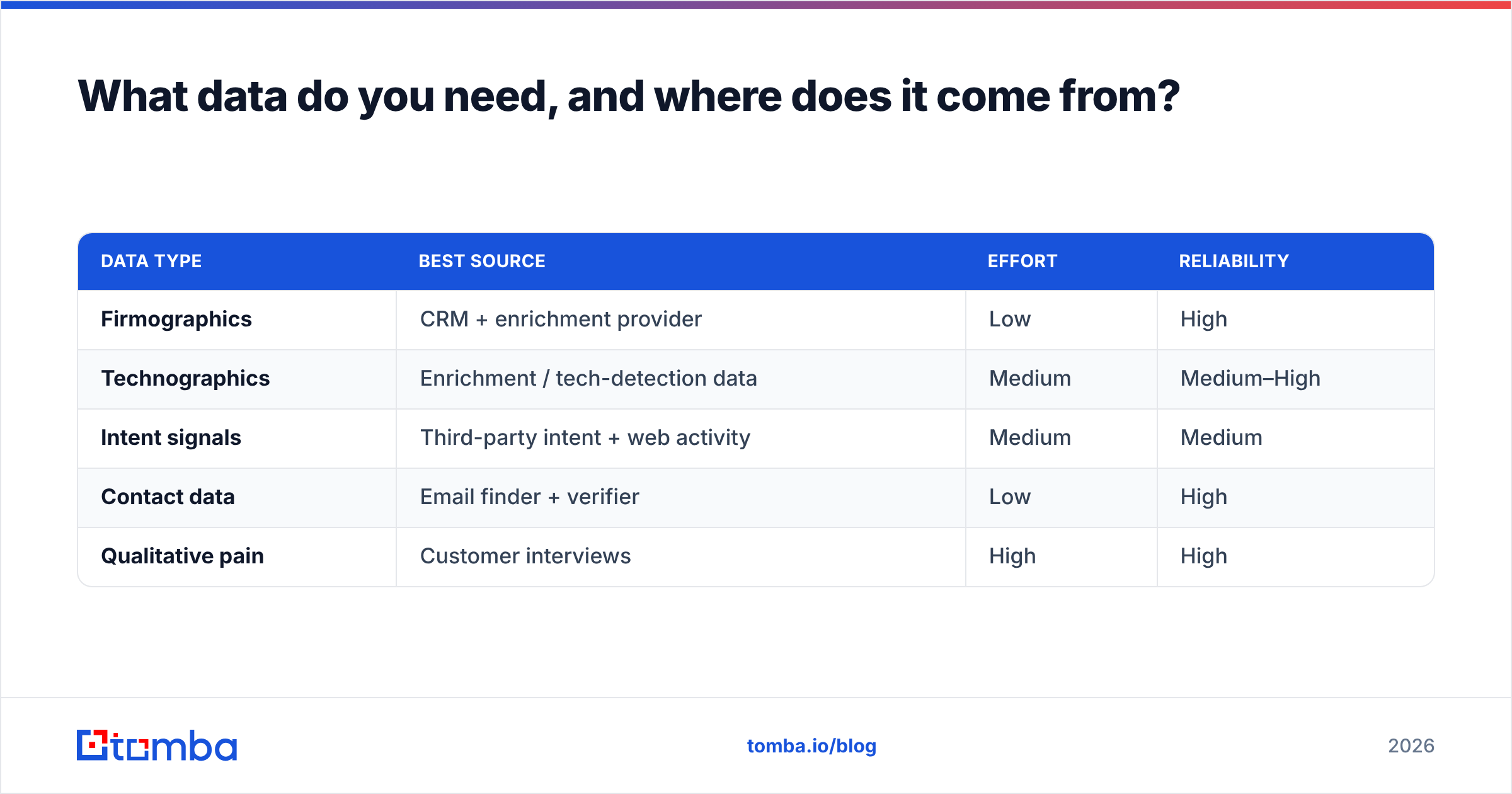
A profile is only as good as the data behind it. Thin, stale, or guessed data produces confident-sounding segments that don't survive contact with the market. Here's how the main inputs compare on effort and reliability:
| Data type | Best source | Effort | Reliability |
|---|---|---|---|
| Firmographics | CRM + enrichment provider | Low | High |
| Technographics | Enrichment / tech-detection data | Medium | Medium–High |
| Intent signals | Third-party intent + web activity | Medium | Medium |
| Contact data | Email finder + verifier | Low | High |
| Qualitative pain | Customer interviews | High | High |
The two ends of that table matter most. Qualitative interviews give you the why that no dataset contains. And clean contact data is what makes the profile executable — a perfectly defined ICP is useless if you can't reach the right person at each account. Pulling verified emails by company through domain search turns a target list into an outreach list.
For firmographic and tech-stack fields at scale, a maintained B2B database beats manual research every time, because you're pattern-matching across thousands of accounts and manual entry can't keep up. When you're evaluating providers, cross-check coverage and freshness claims against independent reviews on G2 rather than taking any vendor's word for it.
How often should you update your customer profile?#
Treat the profile as a living document, not a founding artifact. Three things push it out of date: your product evolves and unlocks new segments, your market shifts (new regulation, new competitor, new buying behavior), and your own win data accumulates and reveals patterns you couldn't see at launch.
A workable cadence:
- Quarterly: a light review — re-score recent wins and losses, check whether any attribute is drifting.
- Twice a year: a full rebuild from fresh closed-won data.
- Immediately: whenever you launch a major new product line, enter a new region, or change pricing tier, because each of those can create or invalidate a whole segment.
The trap to avoid is aspiration creep — quietly editing the profile toward the logos you wish you sold to instead of the ones you actually win. Anchor every change to a number from your CRM. If the data doesn't support the attribute, it doesn't go in the profile.
What does a finished customer profile look like?#
Concrete beats abstract, so here's a realistic example for a fictional mid-market sales-analytics tool:
- Industry: B2B SaaS and digital services
- Company size: 200–1,500 employees
- Revenue: $20M–$200M ARR
- Geography: North America and Western Europe
- Tech stack: Salesforce or HubSpot CRM, plus a data warehouse
- Trigger events: hired a RevOps leader in the last 6 months, or raised a growth round
- Primary pain: no single source of truth for pipeline, forecasting done in spreadsheets
- Buying committee: VP RevOps (champion), CRO (economic buyer), Sales Ops manager (user)
Notice that every line is either a filter you can apply to a list or a message hook a rep can use on a call. That's the test of a good profile: it's immediately operational. Vague adjectives — "innovative," "growth-minded," "forward-thinking" — never make the cut, because you can't segment a database by them.
Common mistakes that quietly wreck customer profiles#
- Building from wins only, ignoring retention. An account that closed fast and churned in 90 days is not a model customer. Filter for accounts that stayed.
- One profile for a multi-product company. Different products often serve different ICPs. Force them into one profile and both get blurry.
- Confusing "who buys" with "who we wish bought." Enterprise logos look great in a deck and destroy your close rate when your product and motion are built for mid-market.
- Letting the profile rot. A profile last touched 18 months ago is targeting a market that no longer exists.
- Skipping verification. Even a perfect profile fails if the contact data behind it bounces. Run lists through an email verifier before your reps ever hit send.
Build customer profiles you can actually act on#
A customer profile is only worth building if it changes what your team does on Monday morning — which accounts they open, which they skip, and what they say when they get someone on the phone. That requires two things working together: a profile grounded in your real win data, and contact data clean enough to execute against it.
Tomba handles the second half. Once you know which companies fit your profile, use the Tomba Email Finder to pull verified, professional email addresses for the exact roles in your buying committee — by name, company, or domain — so your sharply defined ICP turns into a working outreach list instead of a slide. Start on the free tier (25 searches a month) to test it against your profile, and scale up on the Growth plan at $99/mo when it's proving out. A profile is a hypothesis; verified contact data is how you finally test it against the market.
Related guides#
Ready to find emails that actually work?
Join 150,000+ professionals who stopped guessing and started sending. Free credits on signup — no credit card required.
Get the Tomba newsletter
Practical outbound tactics and product updates — once every two weeks.
About the author