Customer Profiling in 2026: A Complete B2B Playbook
Customer profiling is how you stop guessing who to sell to. Here's the 2026 playbook: the data points that matter, the frameworks, and a build-it-yourself template.
Customer profiling is the difference between a rep who "just knows" who to call and a team that can hand a data query to a machine and get 500 qualified accounts back. If your pipeline is full but your win rate is thin, the problem usually isn't your pitch. It's that you never defined who you sell to with enough precision to act on it.
This guide walks through what customer profiling actually is in 2026, how it differs from personas and ICPs, what data belongs in a profile, and how to build one you can operationalize, not just laminate and forget.
TL;DR#
- Customer profiling is the structured process of describing your best-fit customers using firmographic, technographic, behavioral, and intent data so you can find more of them on demand.
- It is not the same as a buyer persona (a person) or an ICP (a company-level filter). You need all three, layered.
- A usable profile is query-able: every attribute maps to a field you can filter a database or enrichment tool on.
- The biggest failure mode is profiling from opinion instead of your closed-won data. Start with who already pays you.
- Once the profile exists, tools like data enrichment and a B2B contact database turn it into a live prospecting list.
What is customer profiling?#
Customer profiling is the practice of building a detailed, data-backed description of the customers who get the most value from your product and return the most value to you. Think of it like a restaurant learning that its most profitable regulars all come for lunch, sit at the bar, and order the same three dishes. Once you know that, you stop marketing dinner specials to the wrong crowd and start doubling down on what works.
In B2B, a customer profile aggregates traits across your existing accounts and finds the patterns: company size, industry, tech stack, growth stage, and the behaviors that preceded a purchase. The output isn't a story. It's a filter set you can apply to the entire market.
Done well, profiling feeds every downstream motion: territory planning, lead scoring, ad targeting, outbound list-building, and even product roadmap decisions. Done poorly, it becomes a slide nobody opens.
Customer profiling vs buyer persona vs ICP: what's the difference?#
These three terms get used interchangeably, and that's exactly why so many go-to-market plans are muddled. They operate at different levels. You want all of them, stacked.
| Concept | Level | Answers | Example |
|---|---|---|---|
| Ideal Customer Profile (ICP) | Account | Which companies should we sell to? | US SaaS firms, 50–500 employees, using HubSpot |
| Customer profile | Account + segment | What do our best customers actually look like across data? | ICP + $5M–$50M revenue, Series B, hiring SDRs |
| Buyer persona | Individual | Who inside the account do we talk to? | "RevOps Rita," Director of RevOps, owns tooling budget |
| Buyer journey stage | Behavior | Where are they in the process right now? | Comparing vendors, downloaded a pricing guide |
The ICP sets the boundary. The customer profile enriches that boundary with the granular attributes that separate a good account from a great one. The persona tells you who to email once you're inside. Skip any layer and you get waste: great accounts with the wrong contact, or the right contact at an account that will never buy.
For a deeper primer on the account-level filter specifically, HubSpot's ICP guide is a solid, vendor-neutral reference.
What data goes into a customer profile?#
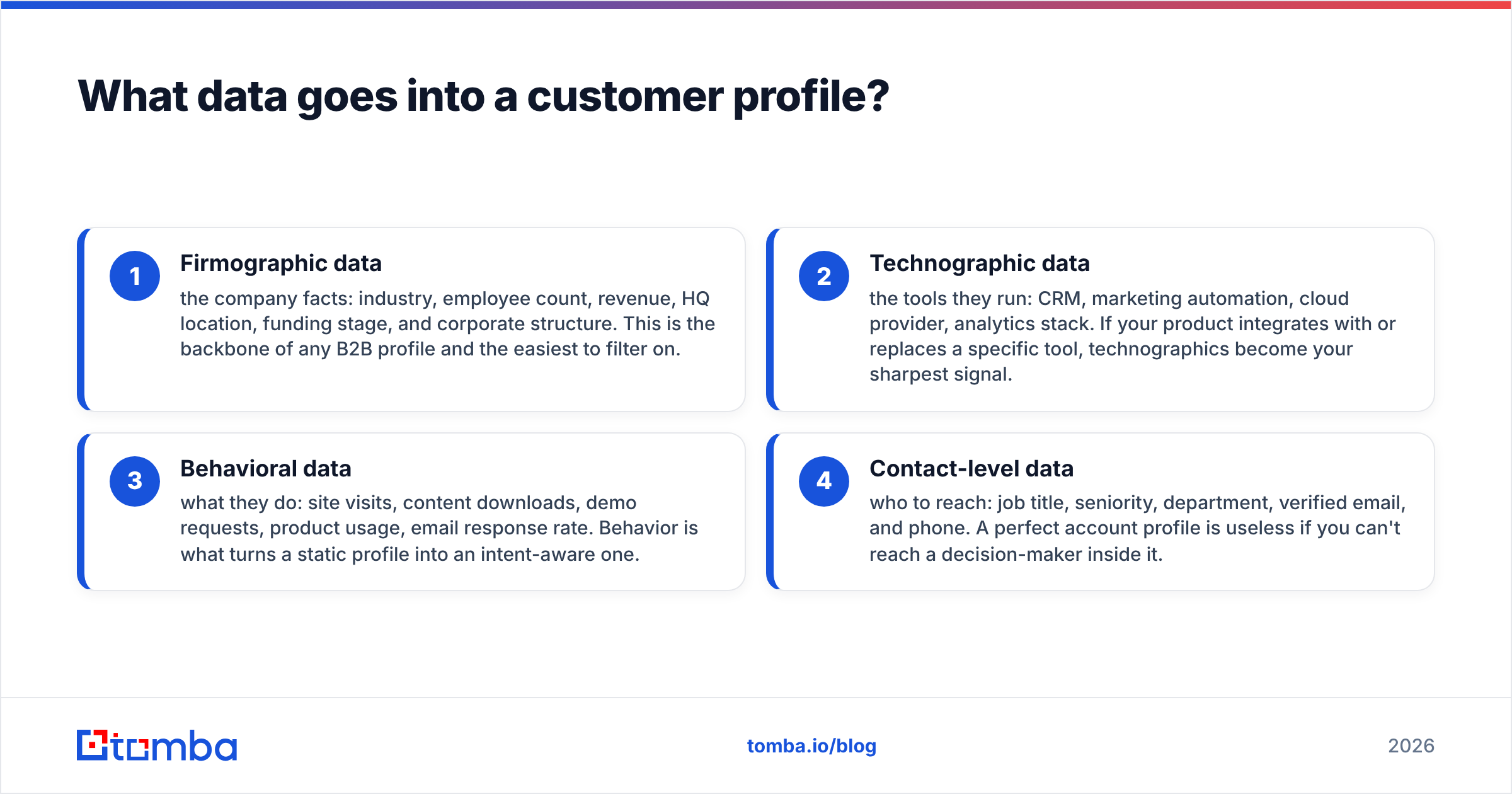
A profile is only as actionable as the data behind it. Vague attributes ("innovative companies," "growth-minded teams") can't be queried. Concrete, sourceable attributes can. Group your data into four buckets:
- Firmographic data — the company facts: industry, employee count, revenue, HQ location, funding stage, and corporate structure. This is the backbone of any B2B profile and the easiest to filter on.
- Technographic data — the tools they run: CRM, marketing automation, cloud provider, analytics stack. If your product integrates with or replaces a specific tool, technographics become your sharpest signal.
- Behavioral data — what they do: site visits, content downloads, demo requests, product usage, email response rate. Behavior is what turns a static profile into an intent-aware one.
- Contact-level data — who to reach: job title, seniority, department, verified email, and phone. A perfect account profile is useless if you can't reach a decision-maker inside it.
The trap is treating these as one-time entries. Firmographics drift, tech stacks change, and people switch jobs roughly every two to three years. That's why enrichment matters more than the initial capture. Analysts at Gartner have long flagged data decay as the silent killer of B2B targeting accuracy.
How do you build a customer profile step by step?#
Here's the build sequence that survives contact with a real pipeline. Follow it in order; each step feeds the next.
- Start from closed-won, not opinion. Pull your last 20–50 winning deals. This is your ground truth. What you believe your ICP is and what actually converts are rarely identical.
- Layer in retention and margin. Filter those wins by which accounts renewed, expanded, and were cheap to serve. A "customer" who churns in four months is a false positive. Profile the ones who stay and grow.
- Extract the shared attributes. Line up the survivors and look for firmographic and technographic overlap. You're hunting for the three to five traits that consistently repeat.
- Enrich to fill the gaps. Your CRM won't have every field. Use data enrichment to append revenue, headcount, tech stack, and funding to each account so the pattern becomes obvious.
- Validate contact reachability. For each profiled account type, confirm you can actually find and verify a decision-maker's email. A profile you can't act on is a wish. An email verifier keeps that step honest.
- Write it as a query, not a paragraph. Translate every trait into a concrete filter:
industry = SaaS AND employees BETWEEN 50 AND 500 AND uses = Salesforce. If a trait can't become a filter, it can't scale.
That last step is the one most teams skip, and it's the whole point. A profile is finished when a person who has never met your customers could paste it into a database and rebuild your target list.
Which tools support customer profiling in 2026?#
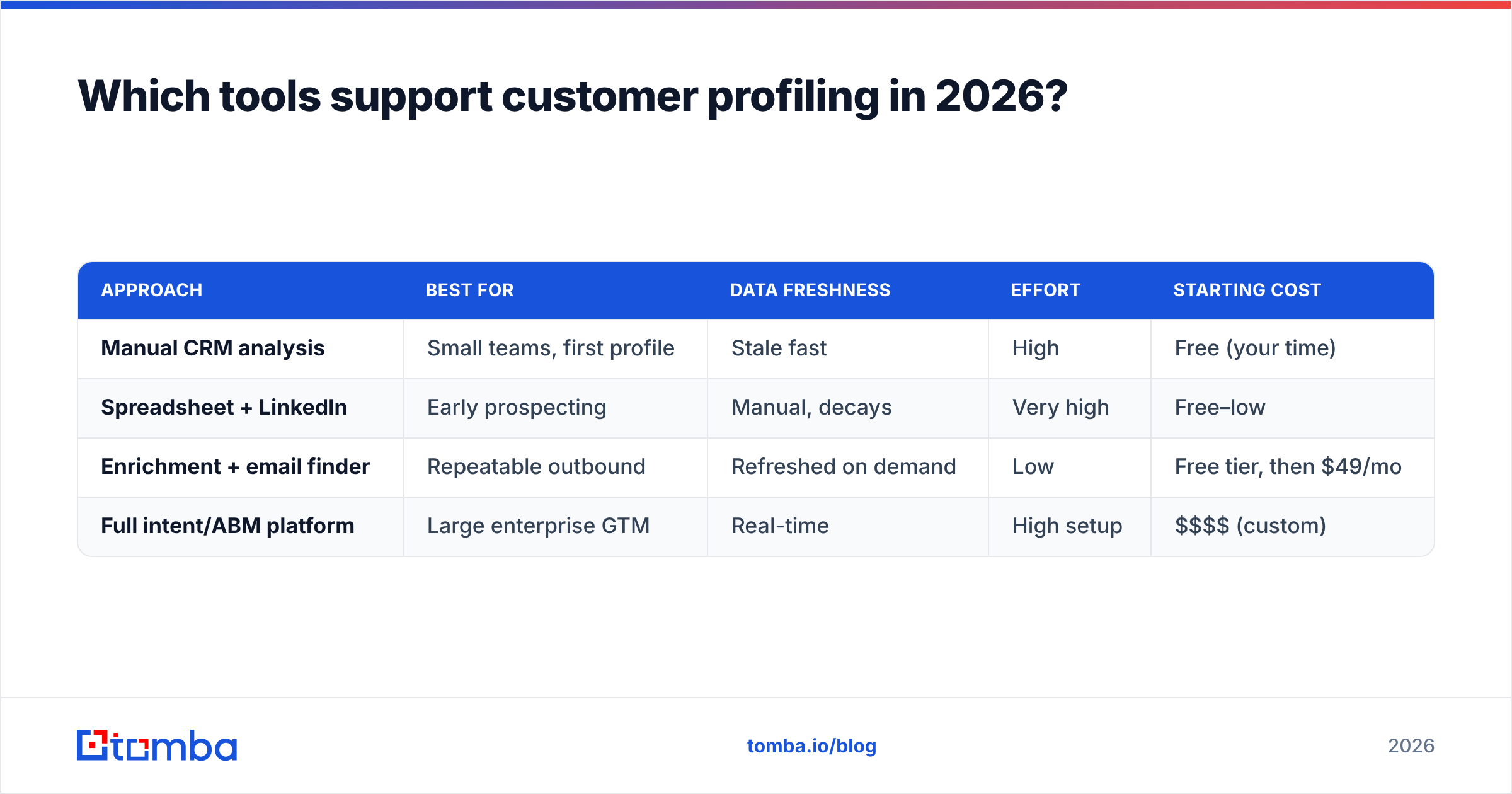
You don't need a 12-tool stack. You need reliable data at three moments: defining the profile, finding matching accounts, and reaching the people inside them. Here's how common approaches compare.
| Approach | Best for | Data freshness | Effort | Starting cost |
|---|---|---|---|---|
| Manual CRM analysis | Small teams, first profile | Stale fast | High | Free (your time) |
| Spreadsheet + LinkedIn | Early prospecting | Manual, decays | Very high | Free–low |
| Enrichment + email finder | Repeatable outbound | Refreshed on demand | Low | Free tier, then $49/mo |
| Full intent/ABM platform | Large enterprise GTM | Real-time | High setup | $$$$ (custom) |
For most B2B teams building their first serious profile, the middle-right column wins: an enrichment layer plus an email finder gives you refreshable firmographics and reachable contacts without an enterprise contract. Tomba's Free tier covers 25 searches a month to test the workflow; the Starter plan at $49/mo and Growth at $99/mo scale it up as your list grows. Peers in the space such as BookYourData offer prebuilt lists that can complement a profile-driven build when you need volume quickly.
Whatever you choose, the buying criterion is the same: can it turn your written profile back into a fresh, verified list of accounts and contacts? If it can't, it's a reporting tool, not a profiling tool.
What are the most common customer profiling mistakes?#
Even teams with good data get profiling wrong in predictable ways. Watch for these:
- Profiling your loudest customers, not your best. The account that emails support daily is memorable, not necessarily profitable. Weight by retention and margin, not recall.
- Building it once and freezing it. Markets move. Revisit the profile quarterly against fresh closed-won data, or it silently drifts out of date.
- Confusing "who buys" with "who benefits." Sometimes the champion isn't the economic buyer. Map both, or you'll write perfect emails to people with no budget.
- Over-narrowing on day one. A profile so tight it yields 40 accounts starves your pipeline. Start slightly broad, then tighten as data accumulates.
- Ignoring contact-level reachability. You can define a flawless account profile and still stall if you can't get past a generic info@ address. Validate that decision-makers are findable before you commit the whole team to a segment.
The through-line: a customer profile is a living system, not a document. It earns its keep only when it's connected to fresh data and revisited on a schedule.
How often should you update a customer profile?#
Review the account-level profile quarterly and the contact-level data continuously. Firmographics like funding stage and headcount shift over months; contact accuracy degrades weekly as people change roles. A practical cadence: re-pull closed-won every quarter to confirm the pattern still holds, and run email verification on any list before a campaign so you're not burning sender reputation on dead addresses.
If you sell into fast-moving segments like startups, tighten the account review to every six to eight weeks. The cost of a stale profile isn't just wasted outreach; it's a whole quarter of reps chasing accounts that no longer fit.
Put your customer profile to work#
A customer profile is only valuable when it produces a list you can call today. Once you've defined the firmographic and technographic traits of your best accounts, the Tomba Email Finder turns that definition into verified, reachable contacts, matching your profile to real decision-makers by domain, name, or company. Start on the free tier, confirm the workflow fits your motion, and scale into a repeatable outbound engine built on data instead of guesswork.
Stop describing your ideal customer. Start finding them.
Related guides#
Ready to find emails that actually work?
Join 150,000+ professionals who stopped guessing and started sending. Free credits on signup — no credit card required.
Get the Tomba newsletter
Practical outbound tactics and product updates — once every two weeks.
About the author