Customer Profiling for B2B Sales: The Complete 2026 Playbook
Guessing who to sell to burns pipeline. This 2026 playbook shows how customer profiling for B2B sales turns firmographic, technographic, and intent data into an ICP your reps can actually act on.
Most B2B sales teams do not have a targeting problem. They have a profiling problem. Reps chase anyone with a pulse and a job title, close a handful of misfit deals that churn in six months, and then blame the pipeline. Customer profiling for B2B sales fixes that by replacing "who might buy" with "who consistently buys, expands, and stays."
This playbook walks through what a real profile looks like in 2026, the data layers you need, how to score fit, and how to keep the profile from rotting after quarter one.
TL;DR#
- Customer profiling for B2B sales is the practice of defining, with data, the accounts and buyers most likely to become high-value, low-churn customers — then routing effort toward them.
- A usable profile has four layers: firmographic (company shape), technographic (tools), behavioral/intent (signals), and contact-level (the actual humans and their verified emails).
- Build it from your own closed-won and closed-lost data first, not from a whiteboard fantasy of the "perfect" buyer.
- Score every account against the profile so reps spend time on A-fit and B-fit accounts, not the long tail.
- Profiles decay. Re-validate quarterly with fresh enrichment and win/loss data or your ICP quietly drifts out of date.
What is customer profiling for B2B sales?#
Customer profiling for B2B sales is the process of describing your best-fit customers precisely enough that a rep, a marketer, or a routing rule can recognize one on sight. Think of it like a bouncer's guest list versus a vague dress code. "Business casual" gets argued at the door; a name on the list does not. A sharp profile is the guest list — it removes judgment calls about who deserves your team's limited hours.
Two terms sit under this umbrella and often get muddled:
- Ideal Customer Profile (ICP): the company-level description — industry, size, region, tech stack, growth stage.
- Buyer persona: the person-level description — role, goals, objections, buying triggers, where they hang out.
You need both. The ICP tells you which doors to knock on; the persona tells you what to say when someone answers. HubSpot's research on buyer personas is a solid primer on the persona half, but personas without a data-backed ICP are just creative writing.
Why does customer profiling matter more in 2026?#
Because outreach volume stopped working. Inbox providers now filter aggressively on engagement, buying committees have grown to an average of 6–10 stakeholders, and buyers ignore anything that is not obviously relevant. Spraying a generic pitch across a bad list does not just waste time — it damages your sender reputation and gets your domain throttled.
Gartner's B2B buying research has repeatedly found that buyers spend only a small fraction of the purchase journey with any single sales rep, which means the few minutes you get must land. Precise profiling is what makes those minutes relevant. When you know an account matches your ICP on five dimensions, your first line writes itself and your reply rates climb.
The efficiency math is blunt: if 20% of your addressable market drives 80% of good revenue, every hour spent outside that 20% is an hour stolen from quota.
What data goes into a B2B customer profile?#
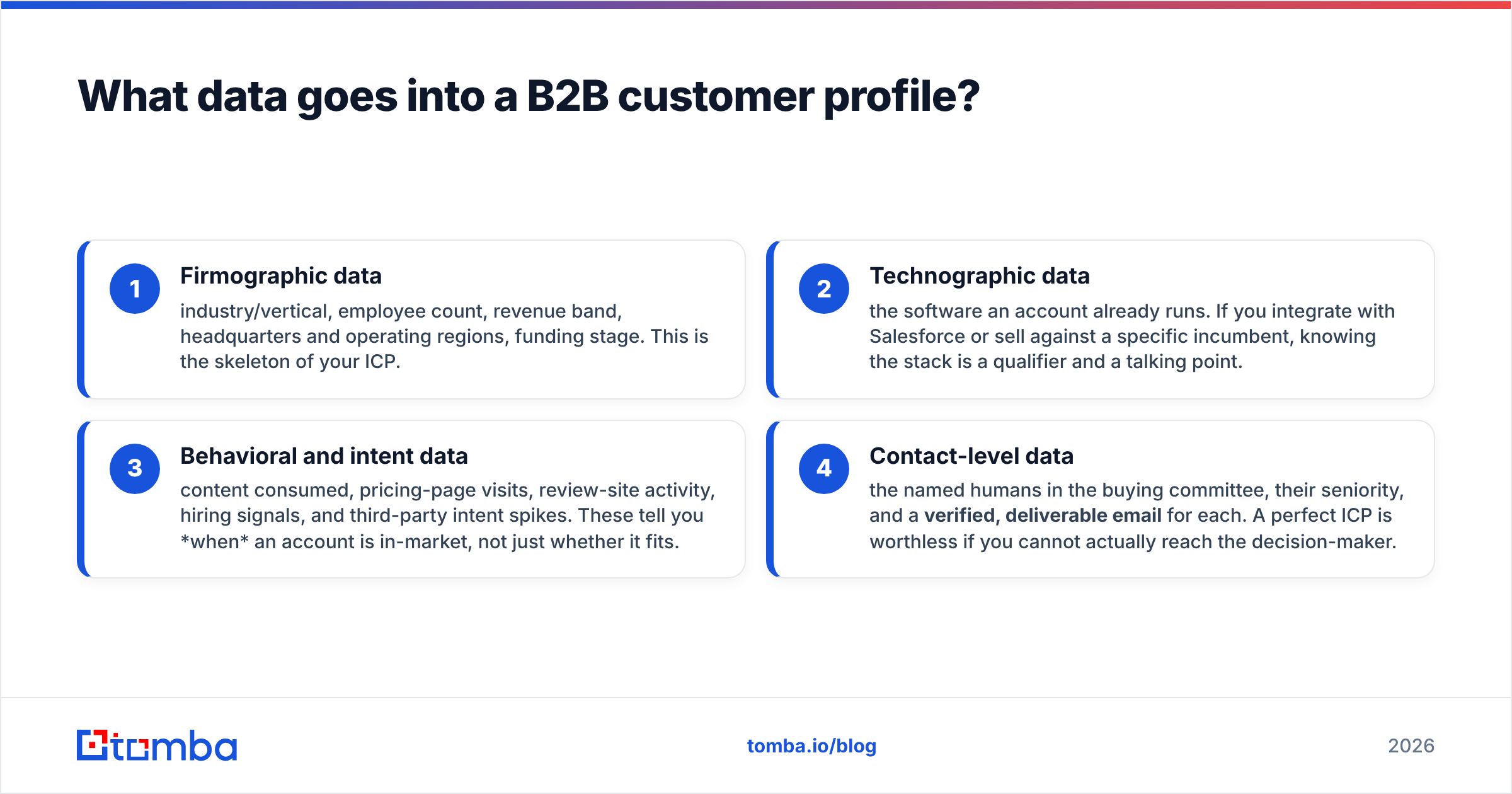
A profile is only as good as the layers feeding it. Here are the four that matter, from broadest to most specific.
- Firmographic data — industry/vertical, employee count, revenue band, headquarters and operating regions, funding stage. This is the skeleton of your ICP.
- Technographic data — the software an account already runs. If you integrate with Salesforce or sell against a specific incumbent, knowing the stack is a qualifier and a talking point.
- Behavioral and intent data — content consumed, pricing-page visits, review-site activity, hiring signals, and third-party intent spikes. These tell you when an account is in-market, not just whether it fits.
- Contact-level data — the named humans in the buying committee, their seniority, and a verified, deliverable email for each. A perfect ICP is worthless if you cannot actually reach the decision-maker.
That last layer is where most profiling projects quietly fail. Teams define a beautiful ICP and then hand reps a spreadsheet of guessed addresses. Pairing your profile with an accurate email finder and running the list through an email verifier before outreach is what turns a profile into pipeline.
How do you build a customer profile step by step?#
Skip the brainstorm-in-a-conference-room approach. Build from evidence.
- Mine closed-won accounts. Export your last 12–24 months of won deals. Look for clusters in industry, size, region, deal velocity, and retention. These clusters are your real ICP, not the one you wish you had.
- Study closed-lost and churned accounts. Negative signals are as valuable as positive ones. If deals in a certain segment always stall in procurement or churn at renewal, that segment belongs in an exclusion rule.
- Enrich the raw list. Layer firmographic and technographic attributes onto every account with data enrichment so you are comparing complete records, not half-empty rows.
- Interview your best customers. Five to eight conversations surface the trigger events and language your data cannot. Ask what changed the week they decided to buy.
- Draft the profile and the anti-profile. Write both the "green light" attributes and the disqualifiers. A profile without disqualifiers accepts everyone.
- Attach a persona to each ICP tier. Map the roles on the buying committee, then find and verify their contact details so the profile is immediately actionable.
What does a good B2B customer profile look like?#
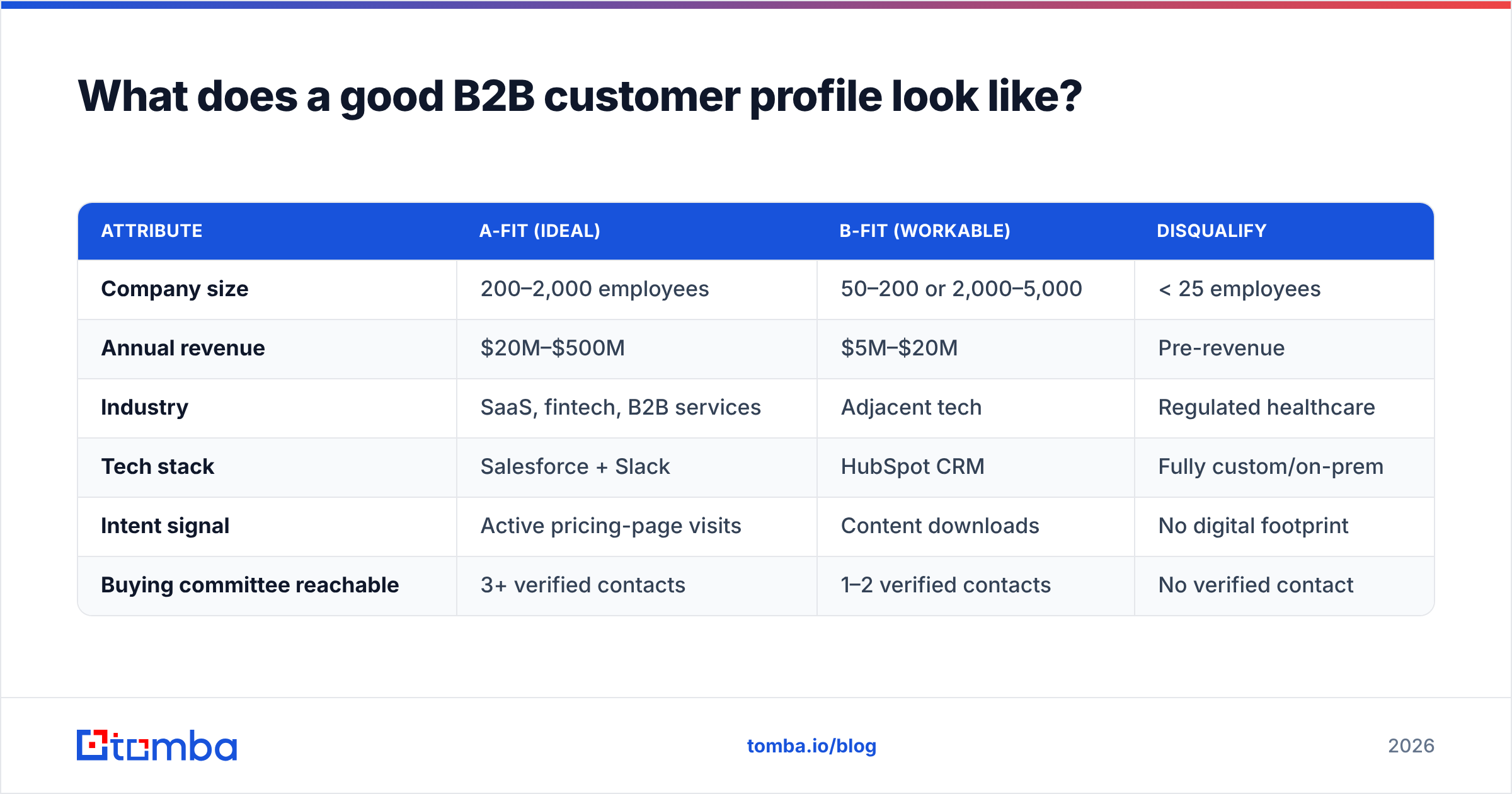
Concrete beats abstract. Below is a simplified, anonymized example for a mid-market SaaS seller, showing how the profile scores across account tiers.
| Attribute | A-Fit (ideal) | B-Fit (workable) | Disqualify |
|---|---|---|---|
| Company size | 200–2,000 employees | 50–200 or 2,000–5,000 | < 25 employees |
| Annual revenue | $20M–$500M | $5M–$20M | Pre-revenue |
| Industry | SaaS, fintech, B2B services | Adjacent tech | Regulated healthcare |
| Tech stack | Salesforce + Slack | HubSpot CRM | Fully custom/on-prem |
| Intent signal | Active pricing-page visits | Content downloads | No digital footprint |
| Buying committee reachable | 3+ verified contacts | 1–2 verified contacts | No verified contact |
Notice the last row. Reachability is a scoring criterion, not an afterthought. An account can be a perfect firmographic match and still be a C-fit if you cannot get a deliverable email for a single decision-maker. That is why the profiling step and the contact-sourcing step belong in the same workflow — pull matching companies with domain search, then confirm you have real people you can reach.
ICP vs buyer persona vs lead scoring: what's the difference?#
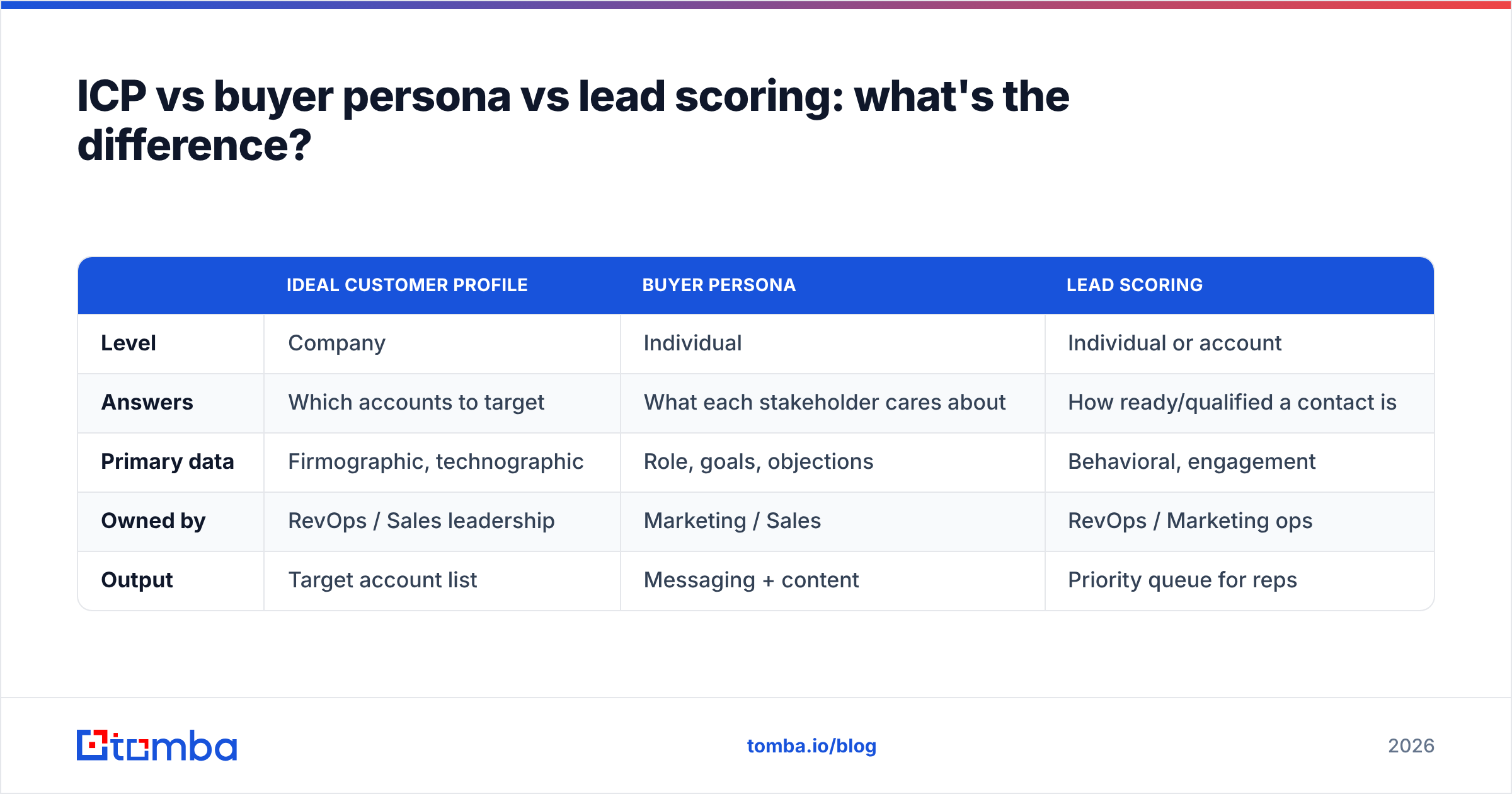
These three get used interchangeably and they should not be. Here is how they divide the work.
| Ideal Customer Profile | Buyer Persona | Lead Scoring | |
|---|---|---|---|
| Level | Company | Individual | Individual or account |
| Answers | Which accounts to target | What each stakeholder cares about | How ready/qualified a contact is |
| Primary data | Firmographic, technographic | Role, goals, objections | Behavioral, engagement |
| Owned by | RevOps / Sales leadership | Marketing / Sales | RevOps / Marketing ops |
| Output | Target account list | Messaging + content | Priority queue for reps |
The clean mental model: your ICP filters the universe down to the right accounts, personas shape the message, and scoring ranks the timing. Skip any one and the other two get weaker. G2's buyer behavior research is a good outside reference for how buying committees actually evaluate vendors across these dimensions.

How do you operationalize a profile so reps actually use it?#
A profile that lives in a slide deck is decoration. Make it operational:
- Turn attributes into routing rules. Encode A/B/C tiers directly in your CRM or B2B database so accounts self-sort as they enter.
- Gate outreach on reachability. Before a rep touches an account, ensure at least one verified contact exists. Run new lists through bulk verification so bounces never leave the building.
- Feed the profile into cadences. Different tiers get different effort. A-fit accounts earn multi-threaded, researched sequences; C-fit accounts get low-touch nurture or nothing.
- Make disqualification a celebrated action. Reward reps for correctly killing bad-fit deals early. Time saved is quota protected.
The failure mode here is treating profiling as a one-time marketing project. It is a shared, living asset that RevOps, marketing, and every rep reference daily.
How often should you update your customer profile?#
Quarterly at minimum, plus any time the business shifts — new product, new market, new pricing. Markets move, competitors reposition, and your own product's sweet spot drifts as it matures.
Two triggers should force an immediate review:
- Win-rate divergence. If a segment you flagged as A-fit starts losing, the profile is wrong or stale.
- Data decay. Roughly 25–30% of B2B contact data goes stale each year as people change jobs. Re-enrich and re-verify your target lists on a schedule, or your beautiful ICP will point reps at people who left 14 months ago. Keeping Tomba pricing tiers in mind, most teams fold this re-verification into an existing plan rather than buying a separate tool.
Think of a customer profile like a garden, not a statue. It needs seasonal maintenance, or it overgrows into something that no longer reflects reality.
What are the most common customer profiling mistakes?#
- Profiling from ambition, not data. Targeting the logos you want instead of the ones that actually close and stay.
- No anti-profile. Without explicit disqualifiers, reps rationalize every bad-fit deal.
- Ignoring reachability. A profile with no verified contacts is a wish list.
- One profile for everything. Different products or motions often need different ICPs; forcing one profile flattens the nuance.
- Set-and-forget. Never revisiting the profile guarantees drift.
- Over-segmentation. Fifteen micro-personas nobody remembers is as useless as none. Start with two or three.
Avoid these and you are ahead of most teams, who never write the profile down at all.
Put your profile to work#
A customer profile is only revenue once a rep sends the right message to a real, reachable person at a right-fit account. That final mile — turning "this company matches our ICP" into a verified inbox you can actually land in — is exactly what the Tomba Email Finder is built for. Define your ICP with the framework above, pull the matching companies, then use Tomba to find and verify the decision-makers' emails so your outreach hits deliverable inboxes instead of bouncing.
Start on the free tier (25 searches a month), and when profiling becomes a weekly habit, the Starter plan at $49/mo scales the contact-sourcing side without adding another tool to your stack. Build the profile once, keep it fresh, and let precise targeting do the heavy lifting your outreach volume used to.
Related guides#
Ready to find emails that actually work?
Join 150,000+ professionals who stopped guessing and started sending. Free credits on signup — no credit card required.
Get the Tomba newsletter
Practical outbound tactics and product updates — once every two weeks.
About the author