Customer Profiling Methods: A 2026 Guide to Sharper Targeting
Seven customer profiling methods compared for 2026 — firmographic, behavioral, technographic, and more — so you can pick the one that sharpens your B2B targeting fastest.
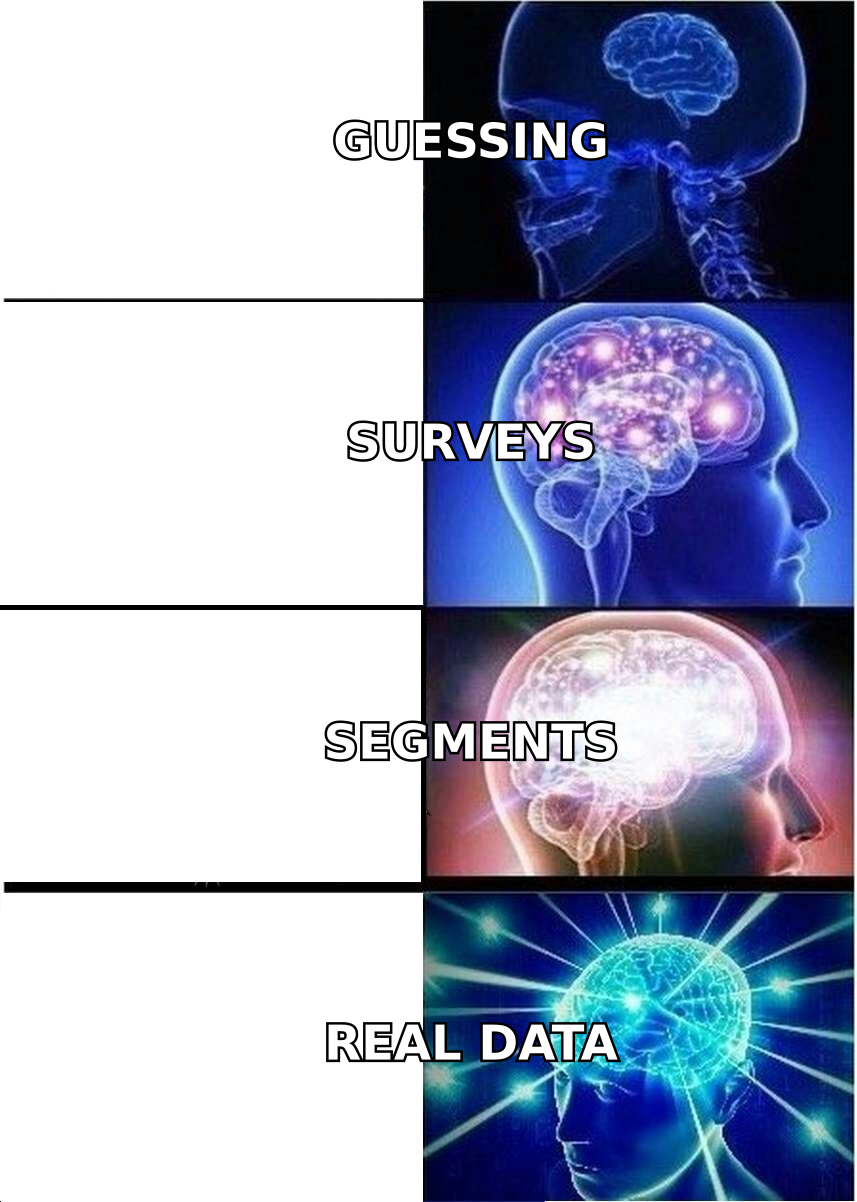
Most teams think they have a customer profile. What they actually have is a vague memory of the three deals that closed easily last quarter. That is not a profile — it is anecdote wearing a suit.
Customer profiling is the discipline of turning scattered signals about who buys from you into a repeatable, testable definition you can act on. Done well, it tells your reps who to call, your marketers who to target, and your product team what to build next. Done badly, it becomes a slide nobody opens.
This guide walks through seven customer profiling methods, when each one earns its keep, and how to combine them without drowning in data.
TL;DR#
- Customer profiling methods fall into two buckets: descriptive (who the customer is) and behavioral (what the customer does). You need both.
- Firmographic and demographic profiling are the fastest to start and the easiest to get wrong if your data is stale.
- Behavioral and psychographic methods predict intent better but need more signal and tooling.
- The winning approach in 2026 is layered — start with a firmographic ICP, enrich it with technographic and behavioral data, then validate against closed-won reality.
- Accurate contact and company data is the fuel for every method here; garbage in, garbage profile out.
What is customer profiling, and why do methods matter?#
Customer profiling is like assembling a police sketch, except the goal is to find more of the same person, not fewer. You gather features — company size, industry, buying triggers, tech stack, behavior — until the picture is sharp enough that someone new can look at a lead and say "yes, that's one of ours" or "no, skip it."
The reason methods matter is that each one captures a different feature. Firmographics tell you the shape of the company. Behavioral data tells you whether they are actually in-market. Psychographics tell you why they buy. Pick only one method and you get a flat, one-dimensional profile that misfires the moment reality gets complicated.
A quick vocabulary note before we go further: your Ideal Customer Profile (ICP) describes the company you want to sell to, while a buyer persona describes the person inside that company who signs off. Good profiling produces both. If you want the formal definitions, HubSpot's buyer persona guide is a solid neutral reference.
What are the main customer profiling methods?#
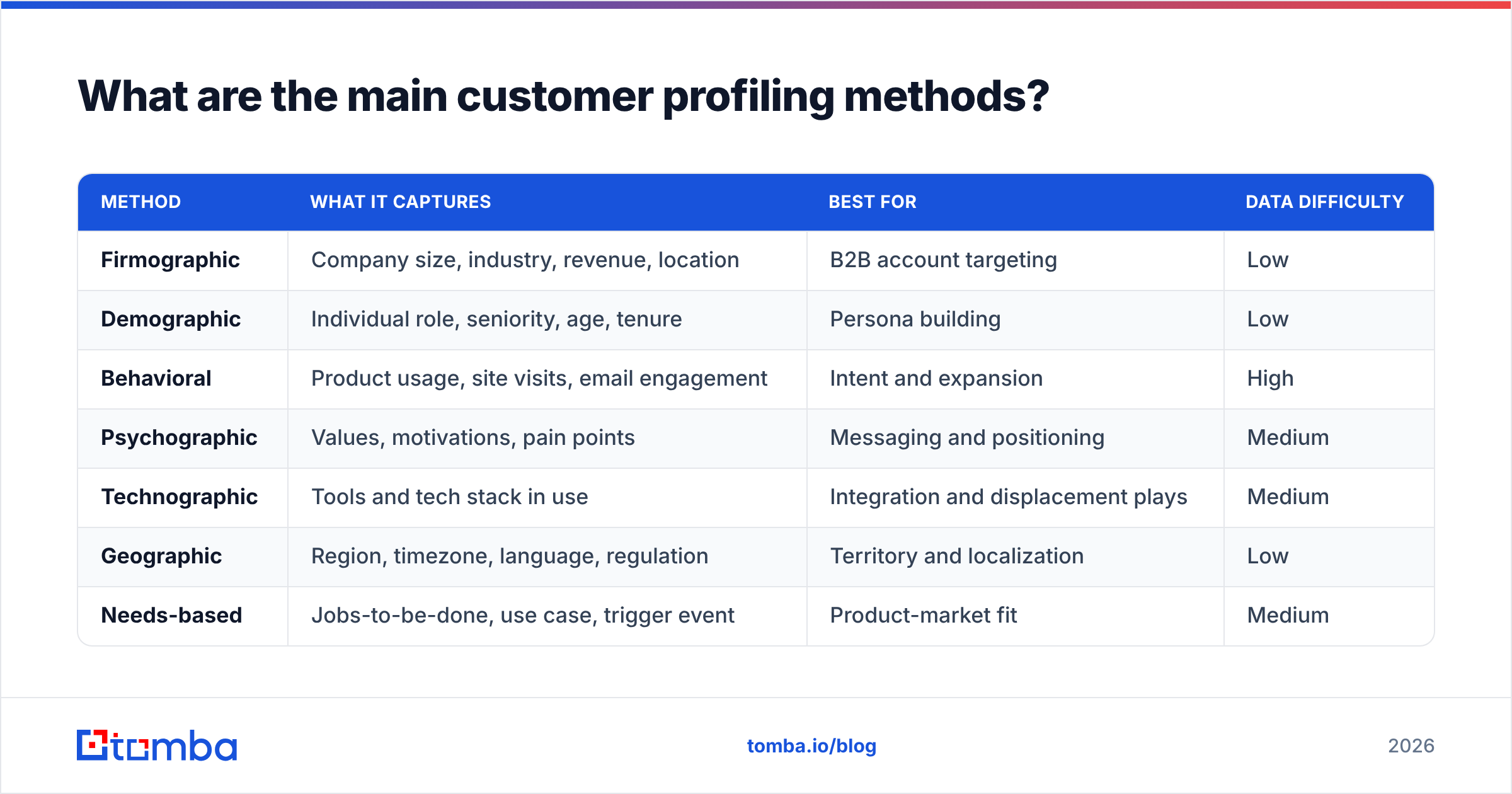
Here is the full landscape at a glance. Each method answers a different question, carries different data costs, and shines in a different scenario.
| Method | What it captures | Best for | Data difficulty |
|---|---|---|---|
| Firmographic | Company size, industry, revenue, location | B2B account targeting | Low |
| Demographic | Individual role, seniority, age, tenure | Persona building | Low |
| Behavioral | Product usage, site visits, email engagement | Intent and expansion | High |
| Psychographic | Values, motivations, pain points | Messaging and positioning | Medium |
| Technographic | Tools and tech stack in use | Integration and displacement plays | Medium |
| Geographic | Region, timezone, language, regulation | Territory and localization | Low |
| Needs-based | Jobs-to-be-done, use case, trigger event | Product-market fit | Medium |
Notice that no single row is "the best." The difficulty column is where teams get stuck — the highest-value methods (behavioral, needs-based) are also the hardest to fuel with clean data. That tension is the whole game.
How does firmographic profiling work?#
Firmographic profiling is the B2B equivalent of demographics. Instead of age and income, you segment companies by attributes like:
- Industry / vertical — SaaS, manufacturing, healthcare, fintech.
- Company size — headcount bands or revenue tiers.
- Growth stage — seed, growth, enterprise, public.
- Location — HQ region, operating markets.
- Business model — B2B, B2C, marketplace, agency.
It is the fastest method to deploy because the data is relatively public and stable. You can pull firmographics from a B2B database, enrich existing CRM records, or infer them from a company's domain. The classic mistake is treating firmographics as the whole profile. Two 200-person SaaS companies can behave nothing alike — one is a self-serve rocket ship, the other a sales-led enterprise grinder. Firmographics gets you to the right neighborhood, not the right door.
Firmographics also decay. Companies raise rounds, get acquired, and double headcount in a year. If your profile runs on data captured 18 months ago, you are targeting a company that no longer exists. This is why data enrichment is not a one-time task but a maintenance habit.
When should you use behavioral profiling?#
Use behavioral profiling when you need to know not just who someone is but whether they are ready. Firmographics describe a static company; behavior describes a moving one.
Behavioral signals include:
- Website activity — pricing-page visits, repeat sessions, demo requests.
- Product usage — feature adoption, login frequency, seat expansion.
- Email engagement — opens, clicks, replies over a sequence.
- Content consumption — which guides, webinars, or comparison pages they read.
The payoff is intent. A mid-market company that visited your pricing page three times this week is a hotter lead than a "perfect fit" account that has never heard of you. Gartner's research on B2B buying behavior has repeatedly shown that buyers are deep into their own research before they ever talk to sales — behavioral profiling is how you catch them mid-journey instead of after.
The cost is tooling and volume. Behavioral profiling needs event tracking, a CDP or analytics layer, and enough traffic for patterns to be statistically real. For a young company with 40 leads a month, behavior is noise. For one with 40,000, it is the single best predictor you have.
Descriptive vs. behavioral: which profiling approach wins?#
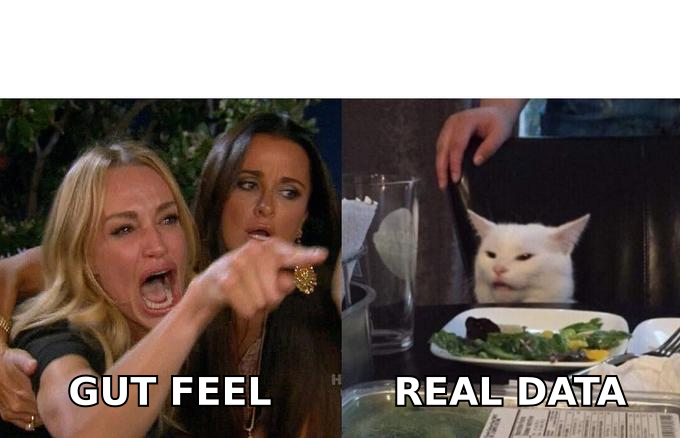
This is the argument that never dies in GTM meetings — the "just target the right firmographics" camp versus the "only behavior matters" camp. Both are half right, which is why they keep yelling past each other.
Here is the honest scorecard.
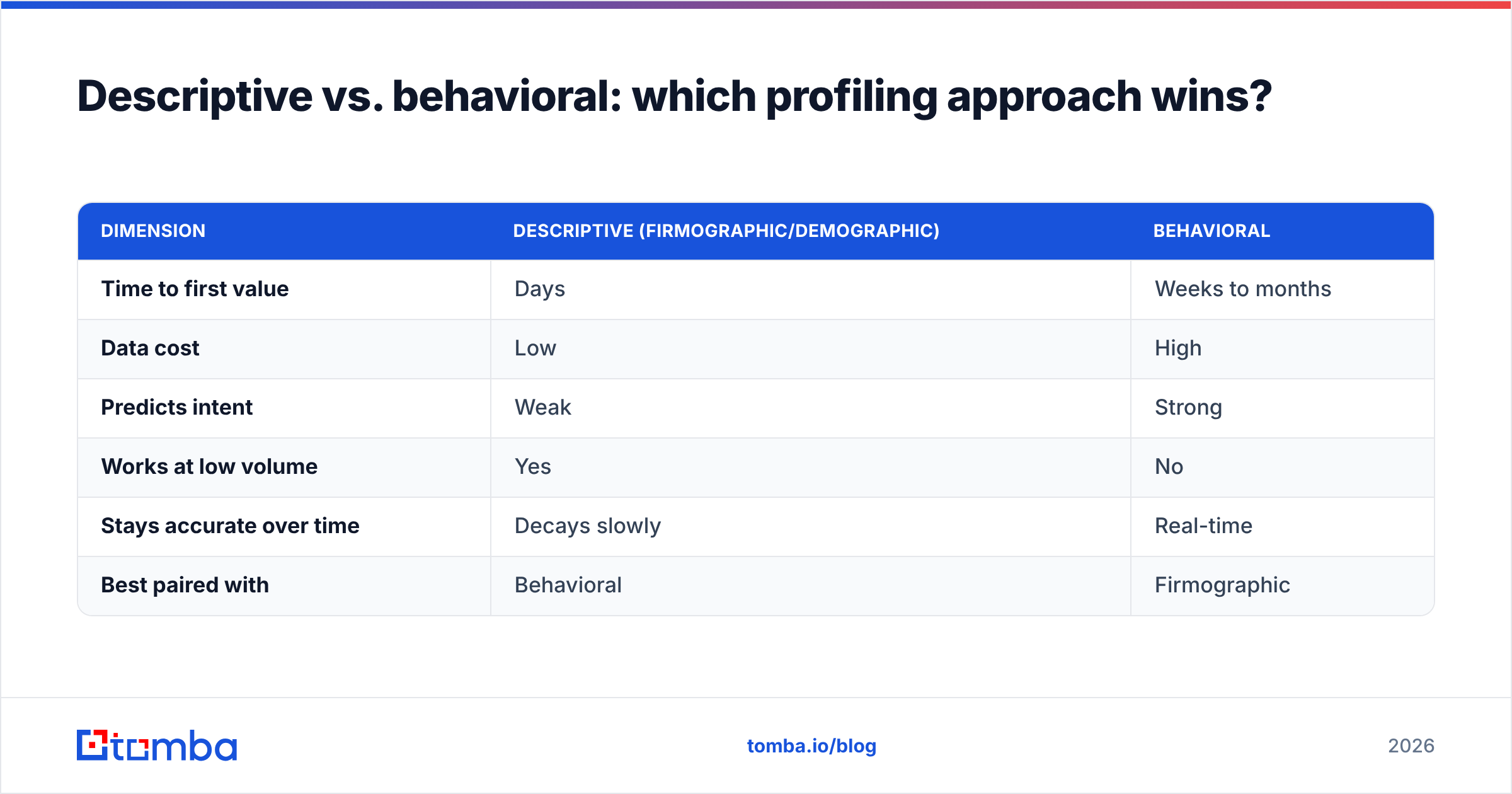
| Dimension | Descriptive (firmographic/demographic) | Behavioral |
|---|---|---|
| Time to first value | Days | Weeks to months |
| Data cost | Low | High |
| Predicts intent | Weak | Strong |
| Works at low volume | Yes | No |
| Stays accurate over time | Decays slowly | Real-time |
| Best paired with | Behavioral | Firmographic |
The verdict is not "pick one." Descriptive methods tell you which accounts deserve attention; behavioral methods tell you when. Run descriptive profiling to build your target list, then layer behavioral scoring on top to prioritize within it. A team that does only the first sprays and prays. A team that does only the second reacts to whoever happens to show up, fit or not.
What about psychographic and technographic profiling?#
These two methods are the depth layer — less about whether to target and more about how to win.
Psychographic profiling captures the human motivations behind the purchase: the pain the buyer feels, the internal risk they are managing, the outcome they will be promoted (or fired) for. You gather it from win/loss interviews, sales-call transcripts, support tickets, and community threads. Psychographics is what turns a generic pitch ("we save you time") into one that lands ("we get your quarterly board deck out without your analysts pulling an all-nighter"). It is medium-difficulty because it resists automation — the best insights still come from talking to actual humans.
Technographic profiling maps the tools a company already runs. If you integrate deeply with Salesforce, knowing an account is a Salesforce shop is gold. If you displace a competitor, knowing who uses that competitor is a target list handed to you on a plate. You can detect technographics from job postings, website tags, and enrichment providers. Peer-review sites like G2 are also a useful open source for seeing which tools cluster together in a given segment.
Both methods depend on reaching the right person with the right context — which is a data problem before it is a messaging problem. You cannot run a technographic displacement play if you cannot find the buyer's email in the first place.
How do you build a customer profile step by step?#
You do not need all seven methods on day one. Here is a sequence that compounds.
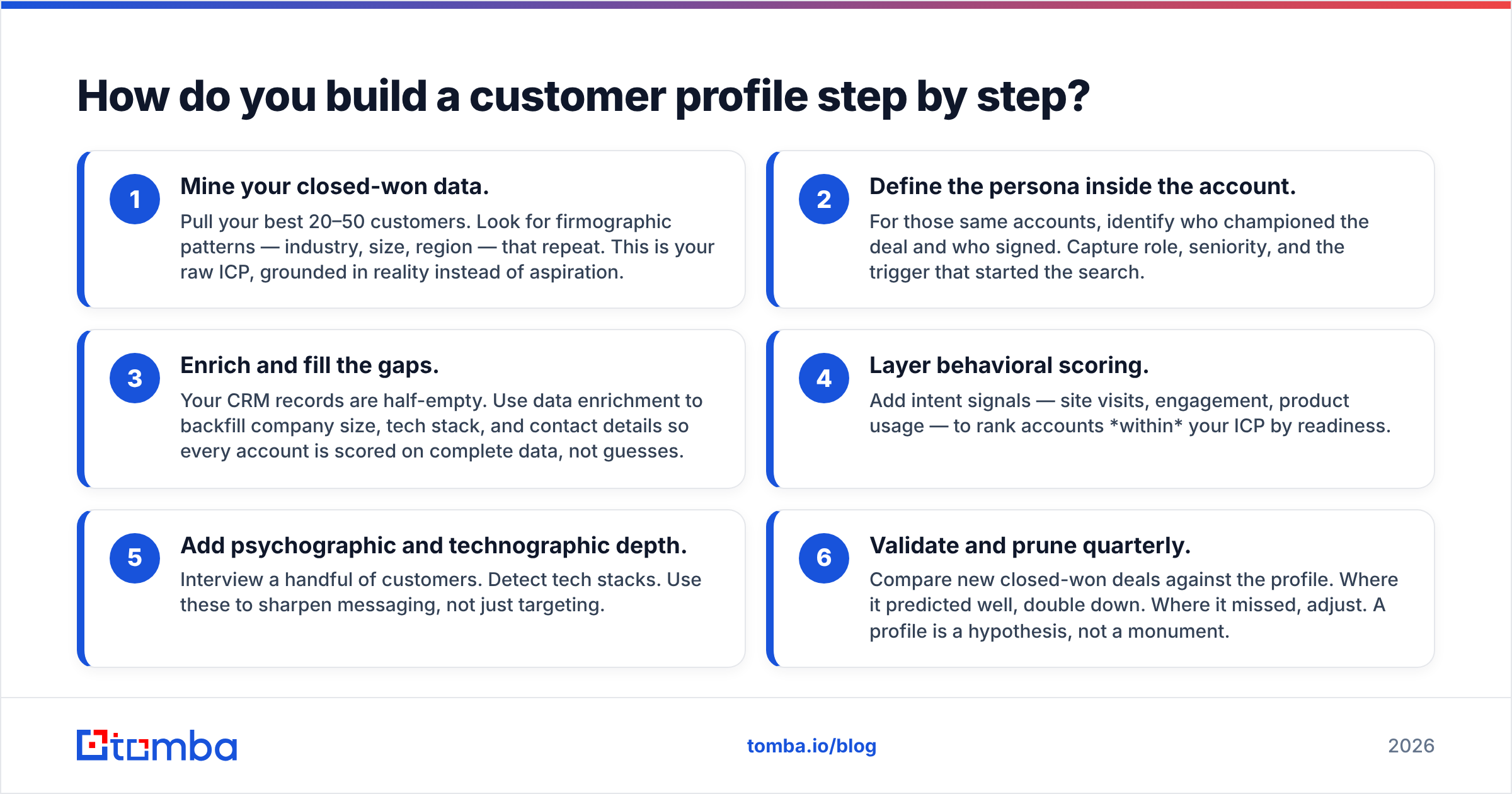
- Mine your closed-won data. Pull your best 20–50 customers. Look for firmographic patterns — industry, size, region — that repeat. This is your raw ICP, grounded in reality instead of aspiration.
- Define the persona inside the account. For those same accounts, identify who championed the deal and who signed. Capture role, seniority, and the trigger that started the search.
- Enrich and fill the gaps. Your CRM records are half-empty. Use data enrichment to backfill company size, tech stack, and contact details so every account is scored on complete data, not guesses.
- Layer behavioral scoring. Add intent signals — site visits, engagement, product usage — to rank accounts within your ICP by readiness.
- Add psychographic and technographic depth. Interview a handful of customers. Detect tech stacks. Use these to sharpen messaging, not just targeting.
- Validate and prune quarterly. Compare new closed-won deals against the profile. Where it predicted well, double down. Where it missed, adjust. A profile is a hypothesis, not a monument.
The step that quietly makes or breaks the whole thing is step three. Every downstream method — behavioral scoring, persona matching, technographic plays — assumes you can actually reach the people in your profile. That means verified contact data. A profile that identifies the perfect 500 accounts is worthless if you have bounced emails for 300 of them.
What data quality do these methods require?#
All seven methods share one dependency: the underlying data has to be accurate, complete, and current. This is the unglamorous foundation nobody wants to talk about, and it is exactly where most profiling efforts quietly rot.
Three data quality checks worth building into your process:
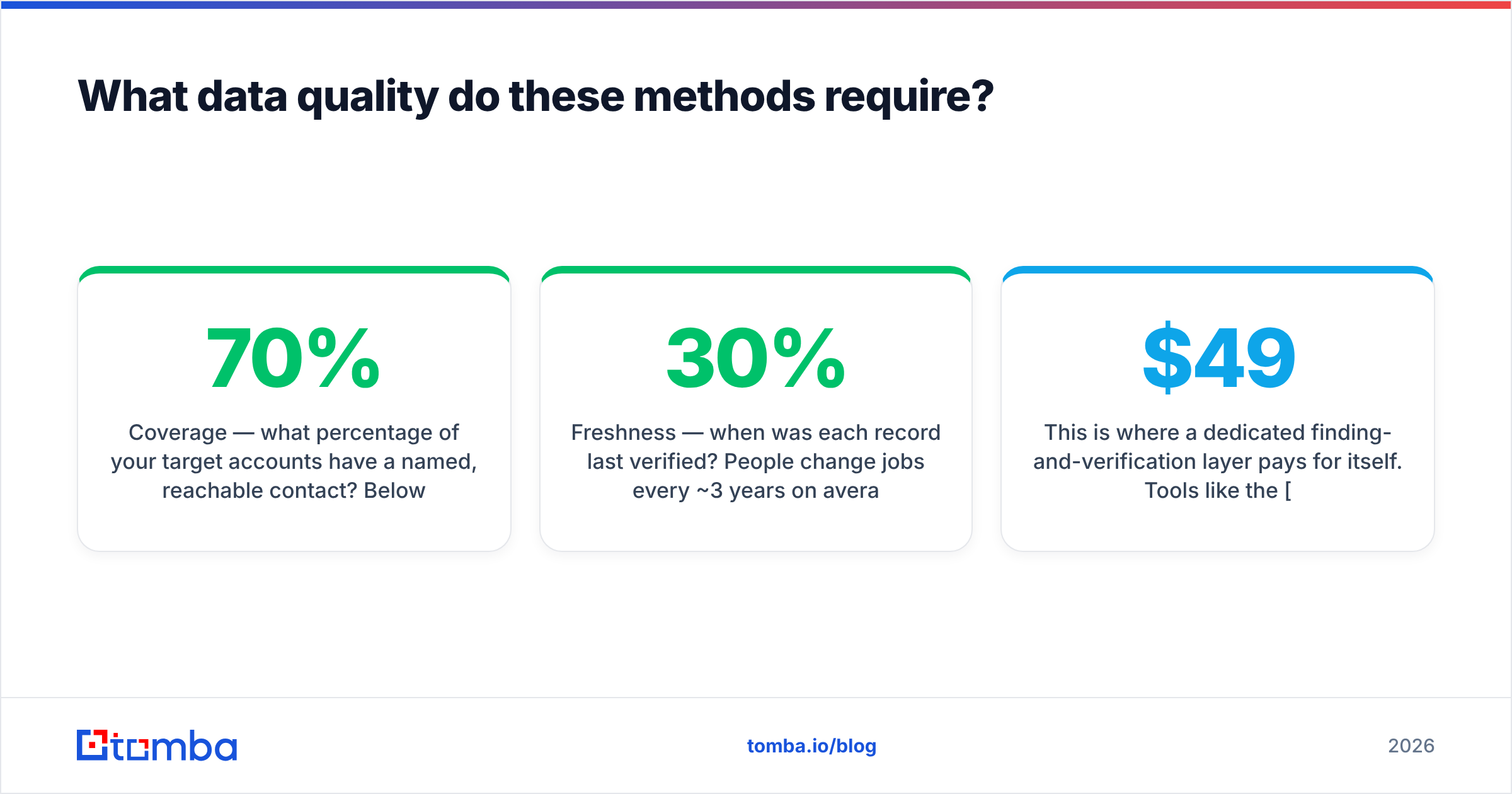
- Coverage — what percentage of your target accounts have a named, reachable contact? Below 70% and your profile is more fiction than fact.
- Freshness — when was each record last verified? People change jobs every ~3 years on average; contact data decays roughly 25–30% per year.
- Verification — are the emails you have actually deliverable? Sending a campaign to an unverified list burns your sender reputation before your profiling ever gets tested.
This is where a dedicated finding-and-verification layer pays for itself. Tools like the Tomba Email Finder locate professional emails by domain or name, and a domain search pulls every reachable contact at a target company — so the accounts your profile flags actually convert into conversations. On pricing, Tomba runs a free tier at 25 searches per month, with paid plans starting at $49/mo; you can see the full Tomba pricing before committing.
Common customer profiling mistakes to avoid#
Even good teams trip over the same roots. Watch for these:
- Confusing aspiration with evidence. Your profile should describe who does buy, not who you wish would. Enterprise logos on a slide feel great and close nothing.
- Profiling once and forgetting it. Markets move. A profile built in 2024 is aimed at a 2024 market. Refresh quarterly.
- Over-segmenting. Twelve micro-personas that each cover 4% of pipeline is a spreadsheet, not a strategy. Start with two or three that matter.
- Ignoring the losers. Your closed-lost and churned accounts are as informative as your wins. They tell you who to disqualify.
- Skipping data hygiene. The most sophisticated behavioral model in the world still fails if the contact records feeding it are wrong.
Which customer profiling method should you start with?#
Start with firmographic profiling built on your real closed-won data, then enrich toward behavioral and technographic depth as your volume and tooling grow. It is the fastest path to a profile you can act on this quarter, and it lays a foundation the other six methods bolt onto cleanly.
But remember the through-line of this entire guide: every method is only as good as the data underneath it. Before you obsess over which profiling framework is theoretically superior, make sure you can actually find and reach the people your profile describes. Spin up a free account and use the Tomba Email Finder to turn your target profile into a list of verified, reachable contacts — because a customer profile you can act on beats a perfect one you can only admire. That is the difference between a profiling exercise and a pipeline.
Related guides#
Ready to find emails that actually work?
Join 150,000+ professionals who stopped guessing and started sending. Free credits on signup — no credit card required.
Get the Tomba newsletter
Practical outbound tactics and product updates — once every two weeks.
About the author