Customer Qualification in 2026: Frameworks, Steps, and Data
Customer qualification decides which deals deserve your time. Here are the frameworks, a repeatable process, and the data that keeps your pipeline clean in 2026.
Most pipelines don't die from too few leads. They die from too many bad ones. Customer qualification is the discipline that decides which prospects earn your reps' hours and which get a polite "not right now." Get it right and win rates climb, sales cycles shrink, and forecasting stops feeling like astrology.
This guide breaks down what customer qualification actually means in 2026, the frameworks that still hold up, a step-by-step process you can run this week, and the data layer that makes the whole thing work instead of guessing.
TL;DR#
- Customer qualification is the process of scoring a prospect's fit, need, budget, authority, and timing before you invest selling effort.
- Frameworks like BANT, MEDDIC, CHAMP, and GPCTBA each fit different deal sizes and sales motions — pick one, don't stack all of them.
- The biggest leaks are upstream: bad contact data and vague ICP definitions push unqualified leads into the funnel before a rep ever talks to them.
- Enrichment beats interrogation — verified firmographic and contact data answers half your qualifying questions before the first call.
- Qualify continuously, not once. A deal that passed BANT in week one can fail it in week four when the champion leaves.
What is customer qualification?#
Customer qualification is deciding, on evidence, whether a prospect is worth pursuing — and how hard. Think of it like triage in an emergency room. You don't treat patients in the order they walked in; you treat them in the order of who needs help and who you can actually help. Qualification is triage for your pipeline.
Technically, qualification measures a prospect against two axes: fit (do they match your ideal customer profile?) and intent (do they have a real, funded, time-bound problem you solve?). A lead can be a perfect fit with zero intent — a great-fit company that's happy with its current vendor. Or high intent with terrible fit — a tiny startup desperate for an enterprise tool it can't afford. Neither is qualified. You want both.
The output isn't a yes/no flag. It's a priority. Qualified leads get sequenced, demoed, and forecasted. Marginal ones get nurtured. Poor-fit ones get disqualified fast, which is a feature, not a failure — a quick "no" frees the hours a slow "maybe" would have wasted.
Why does customer qualification matter so much in 2026?#
Because attention is the scarcest resource in sales, and buyers have less of it than ever. Buying committees now average 6–10 people, cycles are longer, and reps are stretched across more accounts. Chasing an unqualified deal doesn't just waste that deal's time — it steals capacity from three qualified ones.
Poor qualification shows up everywhere downstream:
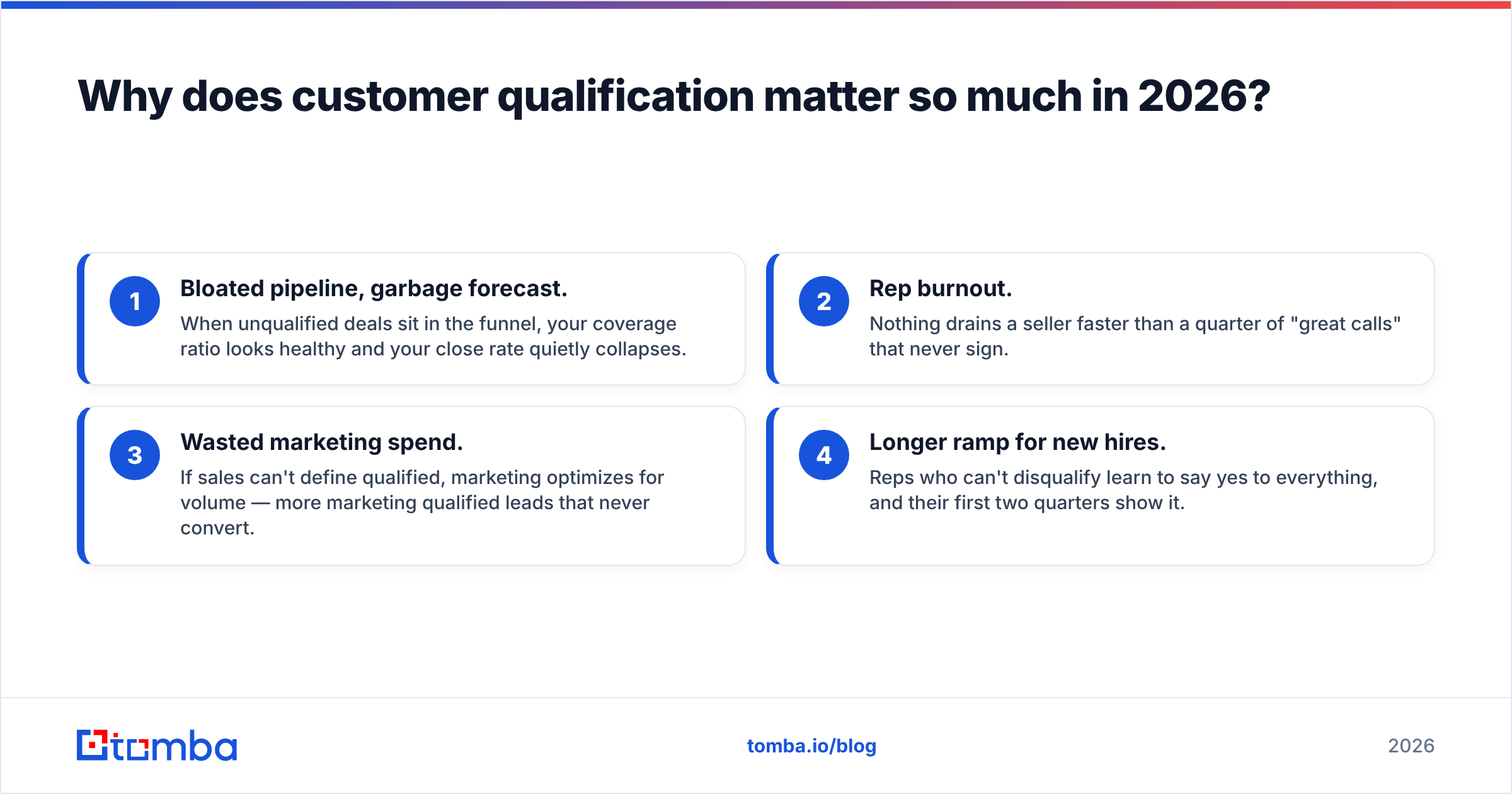
- Bloated pipeline, garbage forecast. When unqualified deals sit in the funnel, your coverage ratio looks healthy and your close rate quietly collapses.
- Rep burnout. Nothing drains a seller faster than a quarter of "great calls" that never sign.
- Wasted marketing spend. If sales can't define qualified, marketing optimizes for volume — more marketing qualified leads that never convert.
- Longer ramp for new hires. Reps who can't disqualify learn to say yes to everything, and their first two quarters show it.
Strong qualification is the cheapest lever you have. It costs no ad budget and no new headcount — just discipline and better data.
What are the main customer qualification frameworks?#
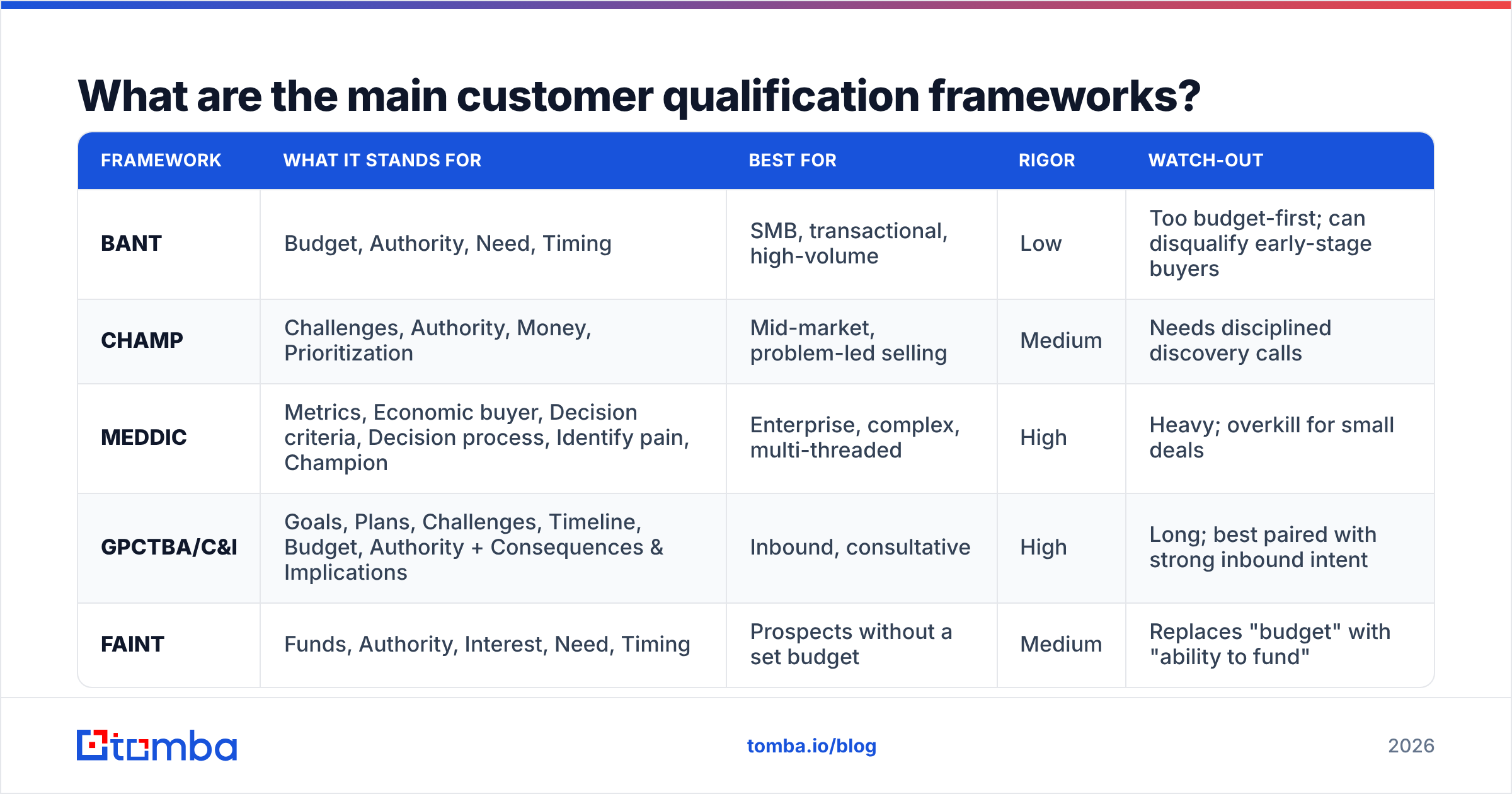
There's no single correct framework; there's a correct framework for your motion. A $200/month self-serve product and a $500K enterprise platform need very different rigor. Here's how the major ones compare.
| Framework | What it stands for | Best for | Rigor | Watch-out |
|---|---|---|---|---|
| BANT | Budget, Authority, Need, Timing | SMB, transactional, high-volume | Low | Too budget-first; can disqualify early-stage buyers |
| CHAMP | Challenges, Authority, Money, Prioritization | Mid-market, problem-led selling | Medium | Needs disciplined discovery calls |
| MEDDIC | Metrics, Economic buyer, Decision criteria, Decision process, Identify pain, Champion | Enterprise, complex, multi-threaded | High | Heavy; overkill for small deals |
| GPCTBA/C&I | Goals, Plans, Challenges, Timeline, Budget, Authority + Consequences & Implications | Inbound, consultative | High | Long; best paired with strong inbound intent |
| FAINT | Funds, Authority, Interest, Need, Timing | Prospects without a set budget | Medium | Replaces "budget" with "ability to fund" |
A few rules of thumb:
- Simple motion, use BANT or CHAMP. If a rep closes deals in one or two calls, MEDDIC's overhead will slow them down.
- Complex, multi-stakeholder deals need MEDDIC. The "Economic buyer" and "Champion" fields alone prevent most enterprise slippage. Salesforce and most enterprise sales orgs lean on MEDDIC or a variant for exactly this reason.
- Inbound-heavy? GPCTBA fits. When HubSpot popularized it, the point was to qualify consultatively rather than interrogate.
- No budget line yet? FAINT. Great for emerging categories where buyers know they have a problem but haven't budgeted for it.
Don't stack frameworks. Pick one, train the whole team on the same vocabulary, and make it a required field set in your CRM.
How do you actually run a customer qualification process?#
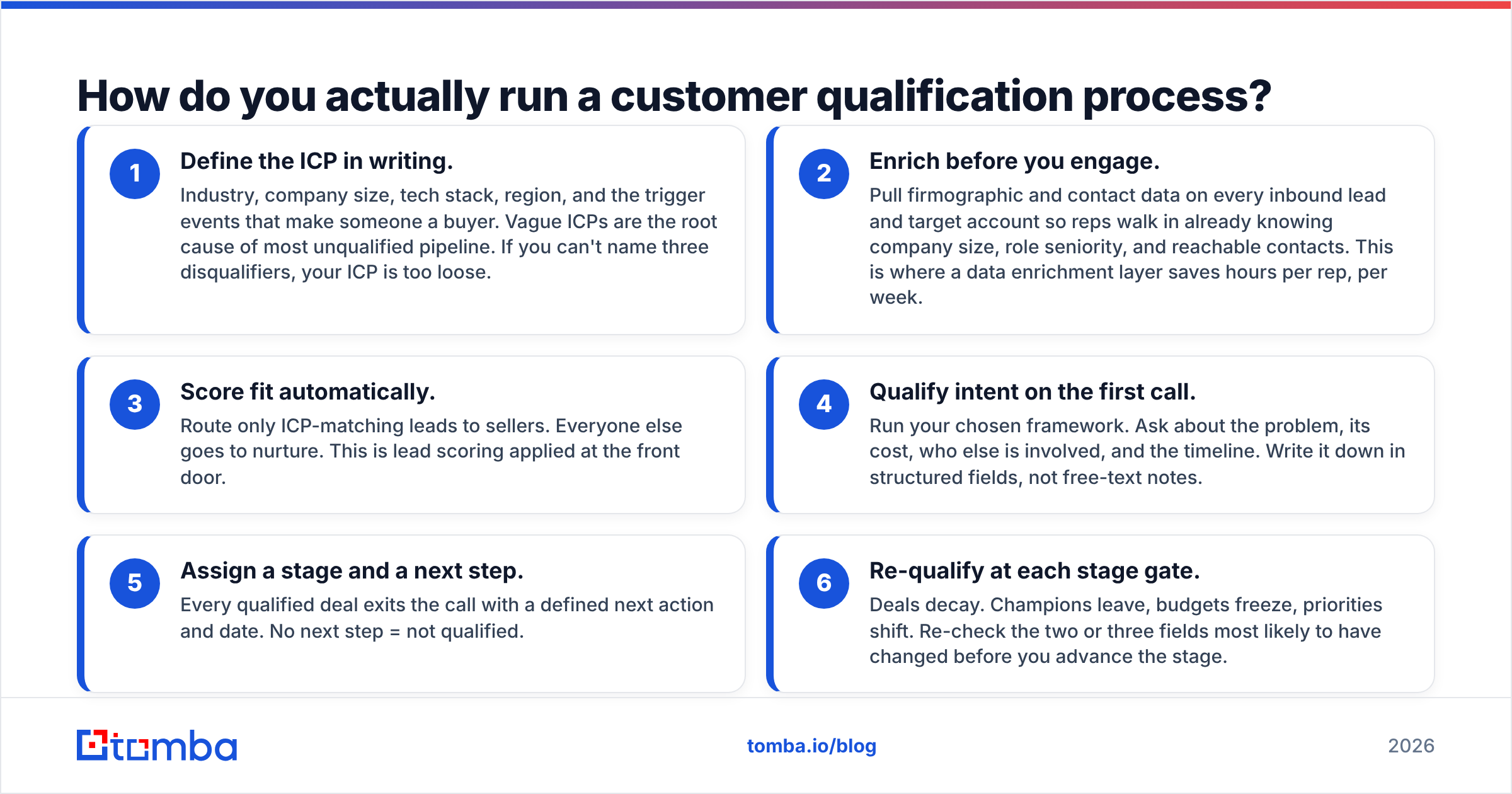
Here's a repeatable, six-step process you can operationalize this week. It works regardless of which framework you chose above — the framework just defines what you score at step 4.
- Define the ICP in writing. Industry, company size, tech stack, region, and the trigger events that make someone a buyer. Vague ICPs are the root cause of most unqualified pipeline. If you can't name three disqualifiers, your ICP is too loose.
- Enrich before you engage. Pull firmographic and contact data on every inbound lead and target account so reps walk in already knowing company size, role seniority, and reachable contacts. This is where a data enrichment layer saves hours per rep, per week.
- Score fit automatically. Route only ICP-matching leads to sellers. Everyone else goes to nurture. This is lead scoring applied at the front door.
- Qualify intent on the first call. Run your chosen framework. Ask about the problem, its cost, who else is involved, and the timeline. Write it down in structured fields, not free-text notes.
- Assign a stage and a next step. Every qualified deal exits the call with a defined next action and date. No next step = not qualified.
- Re-qualify at each stage gate. Deals decay. Champions leave, budgets freeze, priorities shift. Re-check the two or three fields most likely to have changed before you advance the stage.
The discipline that separates good teams isn't step 4 — everyone runs discovery. It's steps 2 and 6: enriching before the conversation and re-qualifying throughout it.

What data do you need to qualify a customer well?#
You need three data layers, and most teams only have one. Interrogating a prospect for information you could have looked up is the fastest way to burn goodwill on a first call.
- Firmographic data — company size, revenue, industry, location, growth signals. This answers fit before anyone picks up the phone.
- Contact data — the right person, verified email, direct role, and seniority. If you're pitching a manager who can't sign, you're not qualified regardless of how the call felt. A reliable email finder plus email verification ensures you're reaching a real decision-maker, not a bounced role account.
- Behavioral / intent data — site visits, content downloads, pricing-page views, hiring signals. This answers timing.
The practical failure mode is contact data. Reps waste enormous time chasing leads whose emails bounce or whose title changed six months ago. Feeding your qualification process from a clean B2B database with verified contacts means the "Authority" and "reachability" parts of qualification are solved before discovery even starts.
Here's the payoff in numbers: if a rep spends 20% less time on unqualified or unreachable leads, that's roughly one extra selling day per week. Across a team of ten, that's ten reps' worth of extra capacity per year — with zero new hires.
What's the difference between a lead, an MQL, an SQL, and a qualified customer?#
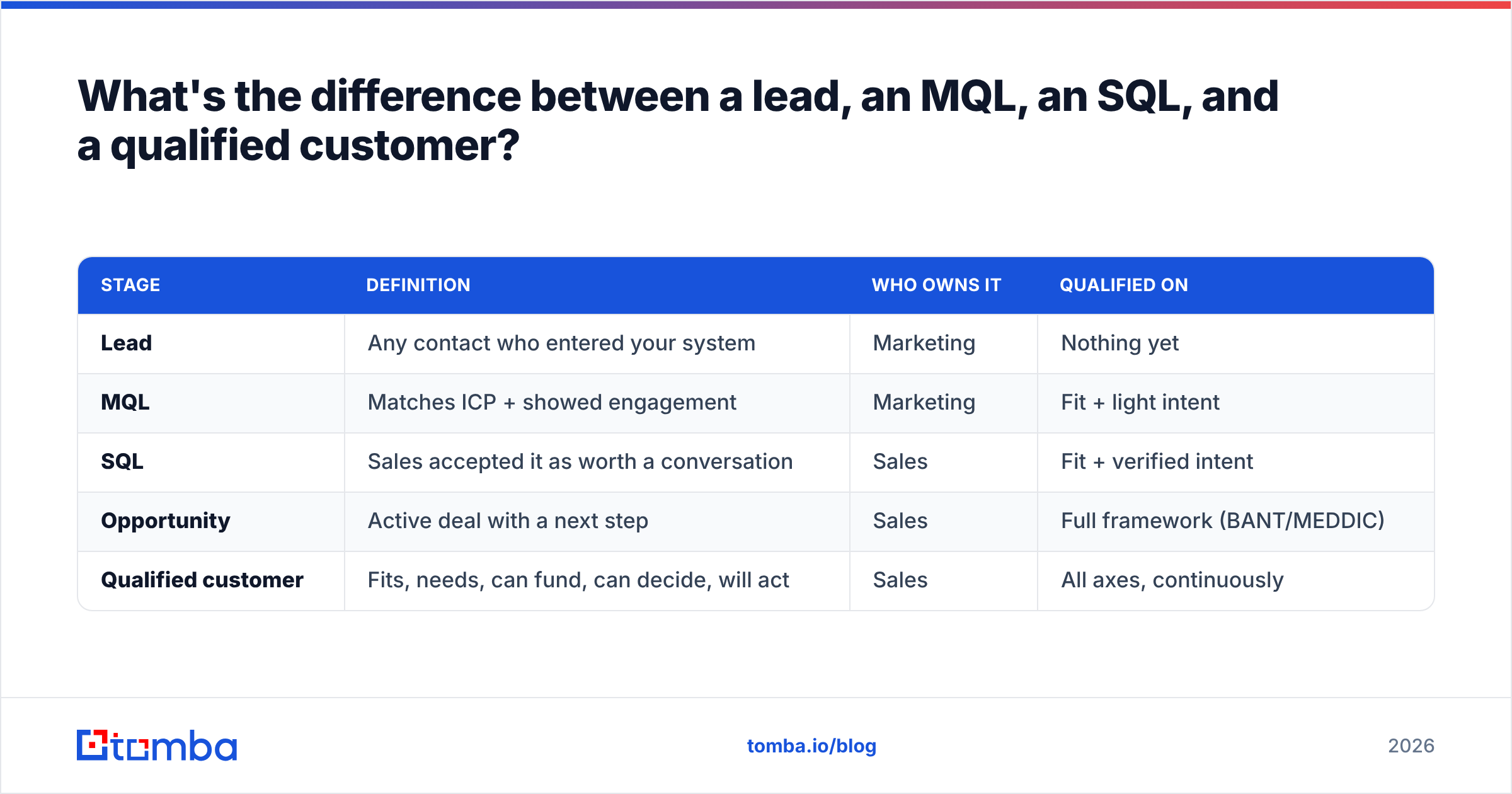
These terms get used interchangeably and it causes real friction between marketing and sales. Clear definitions are half the battle.
| Stage | Definition | Who owns it | Qualified on |
|---|---|---|---|
| Lead | Any contact who entered your system | Marketing | Nothing yet |
| MQL | Matches ICP + showed engagement | Marketing | Fit + light intent |
| SQL | Sales accepted it as worth a conversation | Sales | Fit + verified intent |
| Opportunity | Active deal with a next step | Sales | Full framework (BANT/MEDDIC) |
| Qualified customer | Fits, needs, can fund, can decide, will act | Sales | All axes, continuously |
The handoff from MQL to SQL is where most pipelines leak. Marketing thinks it delivered a qualified lead; sales thinks it got a list. The fix is a shared, written definition and enriched data so both teams see the same firmographic reality — not marketing's "engaged!" versus sales' "this company has 4 employees."
What are the most common customer qualification mistakes?#
- Qualifying once and never again. The single most expensive habit. Re-qualify at every stage.
- Confusing interest with intent. A prospect who loves your demo but has no budget and no timeline is a fan, not a buyer.
- Skipping the economic buyer. If you never confirm who signs, you're forecasting a deal you can't close.
- Leading with budget. BANT's biggest flaw. Ask about the problem and its cost first; budget follows from a quantified pain.
- Trusting stale contact data. Chasing the wrong person or a dead inbox wrecks otherwise-good qualification. Verify contacts before, not after.
- No disqualification criteria. If nothing ever gets disqualified, you don't have a qualification process — you have a to-do list.
The teams that consistently forecast within a few points aren't smarter closers. They're more ruthless disqualifiers, and they feed the process with data they trust. You can compare tooling and pricing options on the Tomba pricing page if you're building that data layer from scratch.
How does customer qualification connect to the rest of your pipeline?#
Qualification isn't a stage — it's a filter that runs across every stage. Upstream, it tells marketing what "good" looks like so they target it. Midstream, it tells reps where to spend their finite hours. Downstream, it makes your forecast trustworthy because every deal in commit has passed the same gates.
The connective tissue is data. When your ICP definition, enrichment layer, and CRM fields all speak the same language, qualification stops being a subjective gut call and becomes a system. That's the difference between a team that hopes its pipeline is real and one that knows.
According to independent reviews on G2, the tools that move the needle here aren't the ones with the flashiest AI — they're the ones that keep contact and company data accurate at scale, because everything else in qualification depends on that foundation being true.
The bottom line#
Customer qualification is the highest-leverage, lowest-cost improvement most sales teams can make in 2026. Pick one framework that fits your motion, define your ICP in writing, enrich before you engage, and re-qualify continuously. The frameworks are free; the discipline and the data are what separate the teams that hit number from the ones that explain why they didn't.
If your qualification keeps breaking on bad contact data — wrong people, bounced emails, missing decision-makers — start at the source. Use the Tomba Email Finder to find and verify the right decision-maker's professional email by name, company, or domain, so every lead you qualify is one you can actually reach. Cleaner data in means fewer wasted cycles out. Start on the free tier (25 searches/month) and scale up only when qualification is paying for itself.
Related guides#
Ready to find emails that actually work?
Join 150,000+ professionals who stopped guessing and started sending. Free credits on signup — no credit card required.
Get the Tomba newsletter
Practical outbound tactics and product updates — once every two weeks.
About the author