Customer Relationship Building Strategy: A 2026 Playbook
A customer relationship building strategy is what turns one-off deals into renewals and referrals. Here's the 2026 framework, the metrics that prove it works, and the tools to run it.
Customer Relationship Building Strategy: A 2026 Playbook
Most B2B teams treat the closed-won date as the finish line. It's the starting line. The revenue that compounds — renewals, expansions, referrals — comes from what you do after the signature, and that requires a deliberate customer relationship building strategy, not a folder of good intentions.
This guide gives you a framework you can run this quarter, the metrics that prove it's working, and the tooling that keeps the whole thing from collapsing into a pile of stale spreadsheet rows.
TL;DR#
- A customer relationship building strategy is a repeatable system for turning transactions into long-term accounts — not a personality trait of your best rep.
- The five stages are connect, qualify, deliver value, nurture, and expand. Skip nurture and you leak revenue you already paid to acquire.
- Clean contact data is the foundation. Wrong emails and dead phone numbers quietly kill relationships before they start.
- Track leading indicators (response rate, engagement frequency, health score) — not just churn, which tells you the relationship died months ago.
- Tools matter, but sequence matters more. A CRM plus reliable enrichment beats a fancier tool used inconsistently.
What is a customer relationship building strategy?#
A customer relationship building strategy is a documented, repeatable system for creating and deepening trust with the people who buy from you — so that a single sale becomes a stream of renewals, upsells, and referrals.
Think of it like tending an orchard instead of foraging. Foraging is chasing one new logo after another and eating what you find. Tending an orchard means you plant, water, and prune the same trees for years, and they produce every season. The forager is always hungry in winter. The orchardist has fruit on the shelf.
Technically, the strategy sits on top of your CRM and coordinates three things: who you're building with (the accounts and contacts worth the investment), what you do at each stage (the plays), and how you measure whether trust is actually growing (the signals). Miss any one and you get activity without outcomes — reps "staying in touch" with no idea whether it moves the account forward.

Why does relationship building beat one-off selling?#
Because acquiring a new customer costs far more than keeping one, and existing customers buy more over time. Research summarized by HubSpot and others consistently puts the cost of winning a new account at several times the cost of retaining an existing one, and Gartner has long noted that a large majority of future revenue in most B2B businesses comes from the current customer base.
The math is unforgiving. If you close 100 deals a year but lose 40 of last year's customers, you're running up a down escalator. A relationship strategy attacks the problem from both ends: it raises retention and it makes each retained account more valuable through expansion.
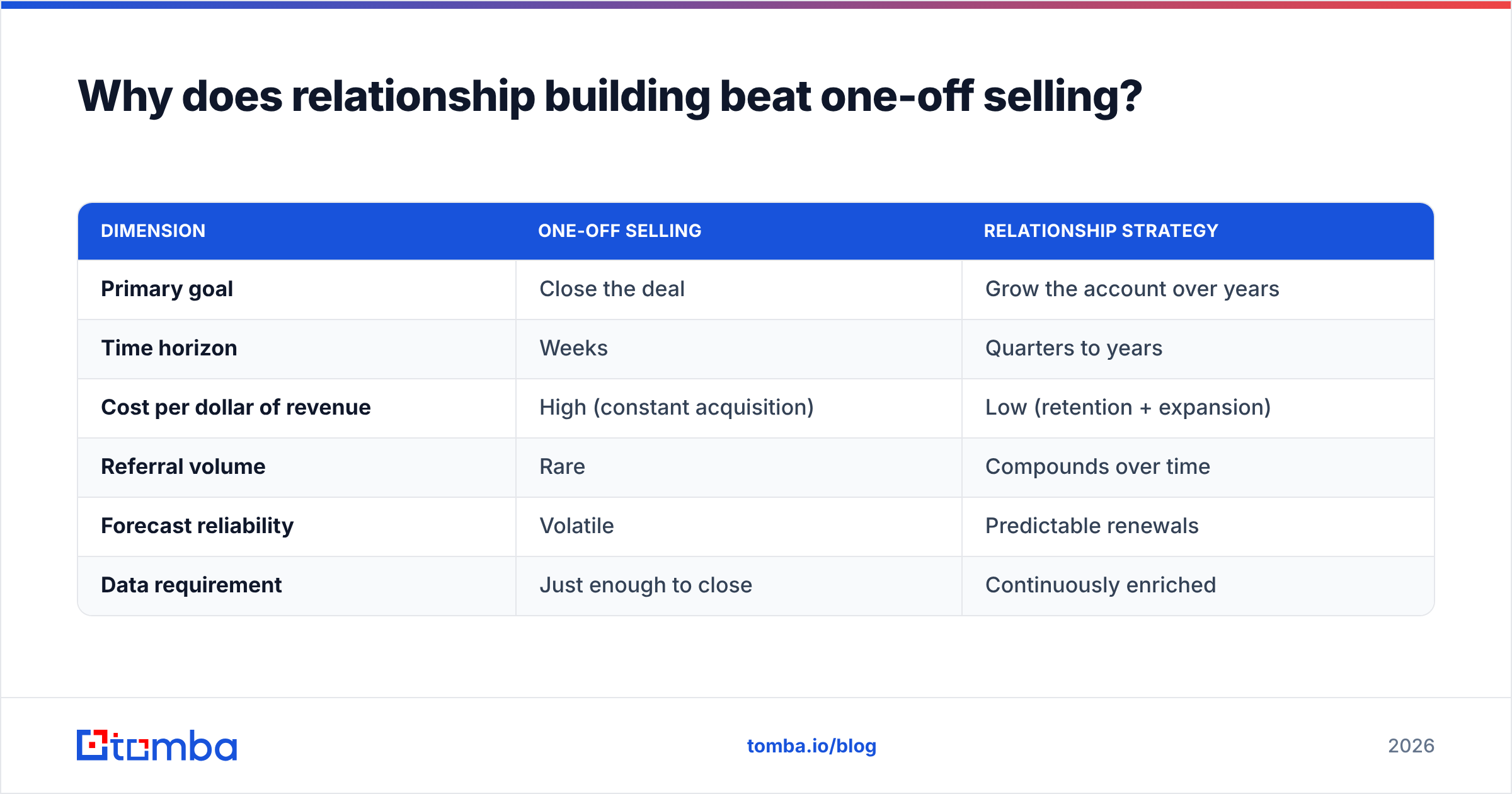
Here's the contrast in plain terms:
| Dimension | One-off selling | Relationship strategy |
|---|---|---|
| Primary goal | Close the deal | Grow the account over years |
| Time horizon | Weeks | Quarters to years |
| Cost per dollar of revenue | High (constant acquisition) | Low (retention + expansion) |
| Referral volume | Rare | Compounds over time |
| Forecast reliability | Volatile | Predictable renewals |
| Data requirement | Just enough to close | Continuously enriched |
The right column is where durable revenue lives. The left column is where teams burn out.
What are the five stages of the framework?#
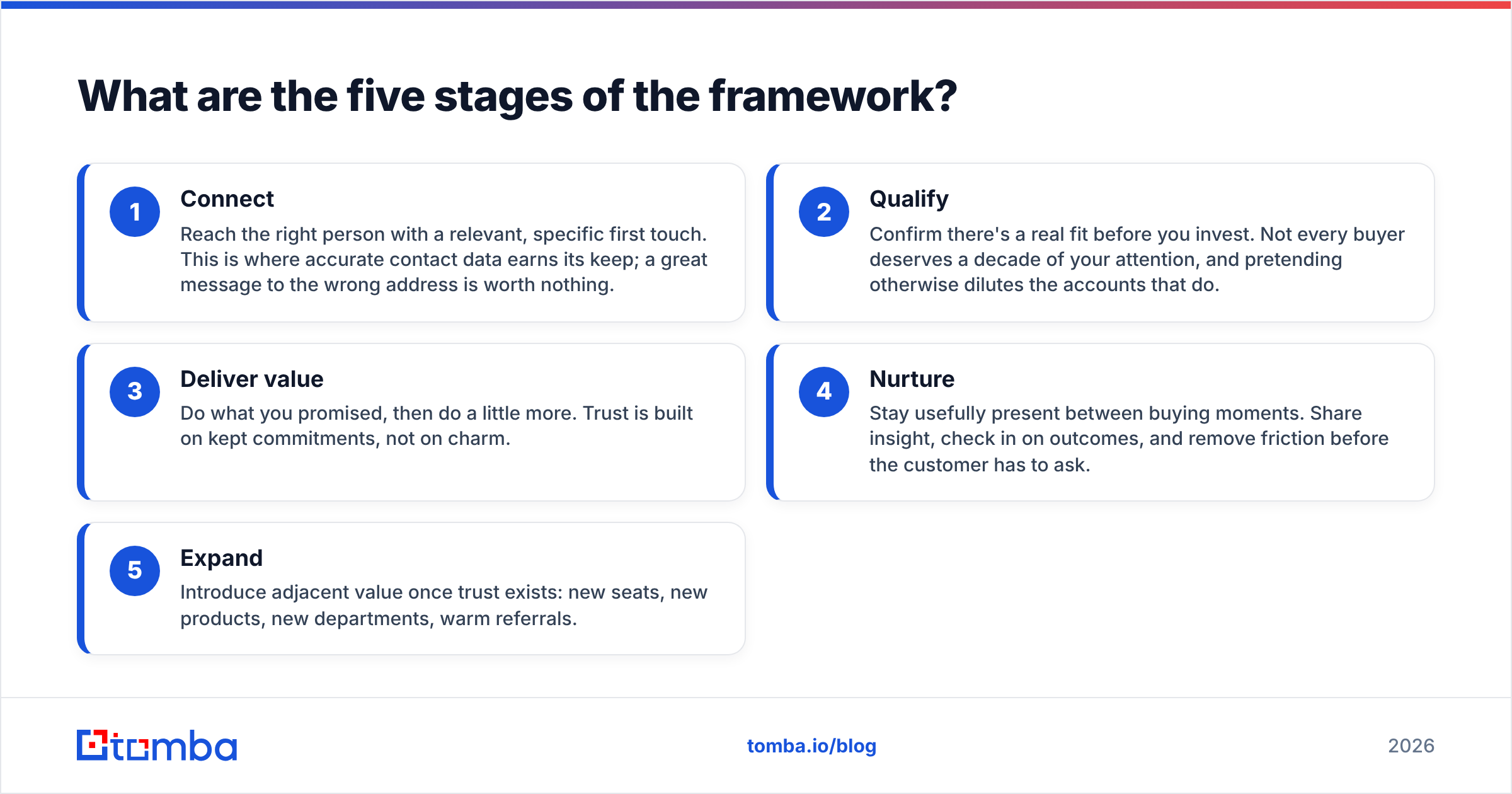
Every strong customer relationship building strategy moves a contact through five stages. Treat them as a loop, not a funnel — expansion feeds back into new connections through referrals.
- Connect — Reach the right person with a relevant, specific first touch. This is where accurate contact data earns its keep; a great message to the wrong address is worth nothing.
- Qualify — Confirm there's a real fit before you invest. Not every buyer deserves a decade of your attention, and pretending otherwise dilutes the accounts that do.
- Deliver value — Do what you promised, then do a little more. Trust is built on kept commitments, not on charm.
- Nurture — Stay usefully present between buying moments. Share insight, check in on outcomes, and remove friction before the customer has to ask.
- Expand — Introduce adjacent value once trust exists: new seats, new products, new departments, warm referrals.
Most teams are competent at stages one through three and quietly abandon four and five. That gap is exactly where your competitors' win-back campaigns find their targets.
How does data quality make or break the strategy?#
Bad data doesn't announce itself — it just silently ends relationships you thought were healthy. A renewal reminder sent to a champion who left the company six months ago. A "how's it going?" call to a disconnected number. A personalized note addressed to the wrong buyer. Each one signals we don't actually know you, which is the opposite of what the strategy is trying to build.
This is why enrichment isn't a nice-to-have bolted onto the side. It's plumbing. Contacts decay fast — people change jobs, companies rebrand, roles shift — so a relationship system needs a way to keep records current without manual data entry.
A few practical habits:
- Verify before you send. Run addresses through an email verifier so bounces don't damage your sender reputation or your credibility.
- Fill the gaps automatically. Use data enrichment to keep titles, companies, and contact details fresh as accounts evolve.
- Keep a reachable second channel. When email goes quiet, a validated number from a phone finder keeps the relationship alive.
- Find the new champion fast. When your contact leaves, a quick domain search surfaces their replacement before the account goes cold.
Clean data is boring. It's also the difference between a strategy that runs on rails and one that runs on hope.
Which metrics actually prove the relationship is growing?#
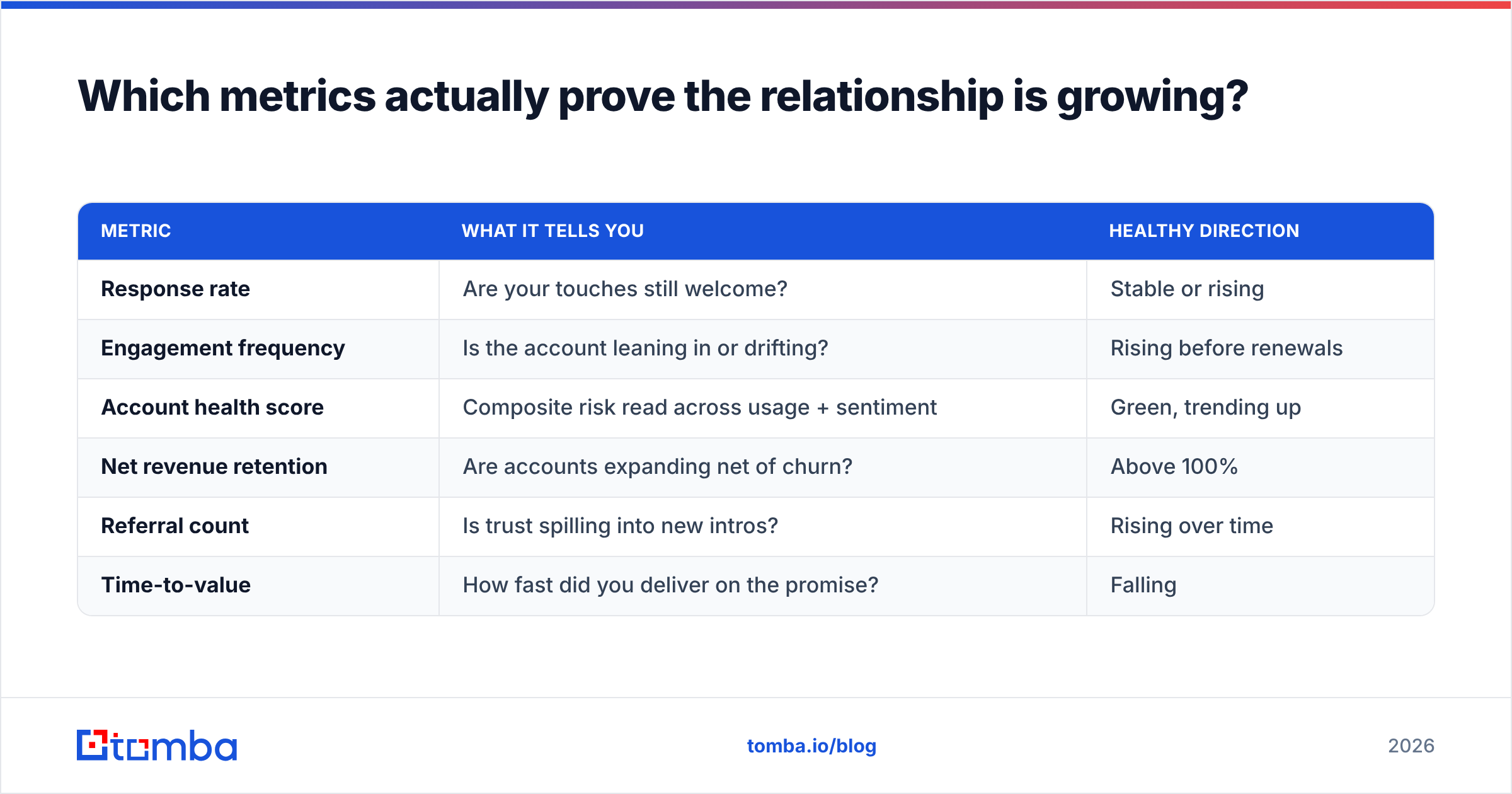
Track leading indicators, not just lagging ones. Churn is a lagging indicator — by the time it shows up in your dashboard, the relationship has been dying for months. The signals below tell you the trajectory while you can still change it.
| Metric | What it tells you | Healthy direction |
|---|---|---|
| Response rate | Are your touches still welcome? | Stable or rising |
| Engagement frequency | Is the account leaning in or drifting? | Rising before renewals |
| Account health score | Composite risk read across usage + sentiment | Green, trending up |
| Net revenue retention | Are accounts expanding net of churn? | Above 100% |
| Referral count | Is trust spilling into new intros? | Rising over time |
| Time-to-value | How fast did you deliver on the promise? | Falling |
Pick two or three to start. A strategy measured against six metrics that nobody updates is worse than one measured against two that the whole team watches.
What tools support a customer relationship building strategy?#
You need three layers: a system of record, a system of engagement, and a system of data. Most teams over-invest in the first two and starve the third — then wonder why their beautiful CRM is full of contacts they can't reach.
- System of record (CRM): Salesforce, HubSpot, or Pipedrive. This is where the relationship's history lives. Choose the one your team will actually update.
- System of engagement: Your sequencing, calling, and scheduling tools — how you execute the plays at each stage.
- System of data: The layer that keeps the other two accurate. This is where an email finder and enrichment engine like Tomba fit, feeding verified contacts into your CRM and connecting through native integrations like HubSpot and Salesforce.
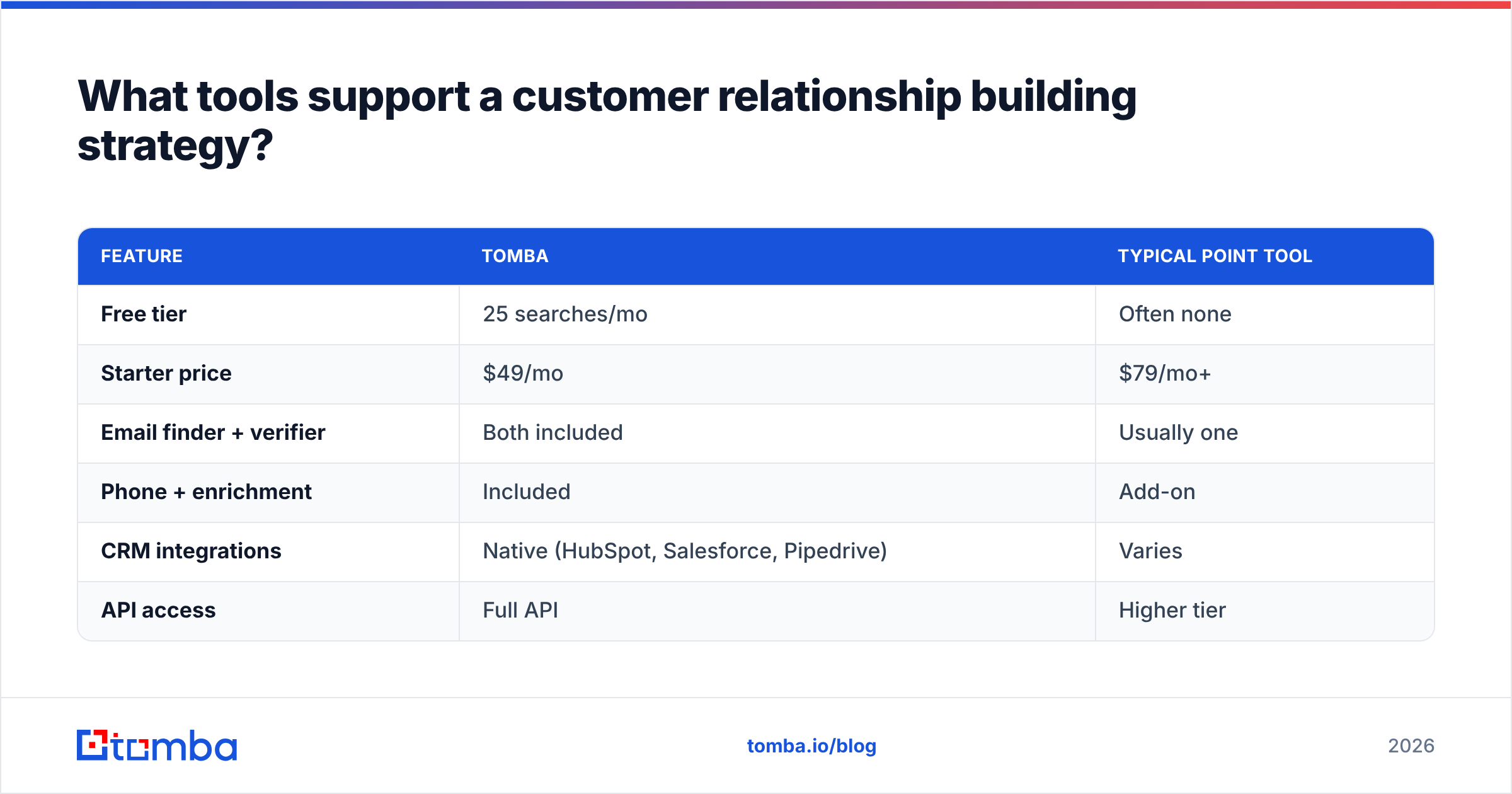
Here's how the data layer stacks up on the attributes that matter for relationship work:
| Feature | Tomba | Typical point tool |
|---|---|---|
| Free tier | 25 searches/mo | Often none |
| Starter price | $49/mo | $79/mo+ |
| Email finder + verifier | Both included | Usually one |
| Phone + enrichment | Included | Add-on |
| CRM integrations | Native (HubSpot, Salesforce, Pipedrive) | Varies |
| API access | Full API | Higher tier |
See full Tomba pricing for the Growth ($99/mo) and Pro ($249/mo) tiers if you're running the strategy across a larger team. The point isn't that one tool wins every category — it's that the data layer has to be reliable and affordable enough that you'll actually keep it current. A strategy is only as good as the records it runs on.
How do you roll this out in 90 days?#
Don't try to boil the ocean. Sequence it.
Days 1–30 — Fix the foundation. Audit your existing contacts, verify the ones that matter, and enrich the gaps. You'll likely find 20–40% of your "active" relationships are pointed at stale data. Fixing that alone recovers relationships you'd written off.
Days 31–60 — Install the stages. Write down the specific play for each of the five stages. What does "nurture" actually mean at your company — a monthly insight email, a quarterly business review, a Slack channel? Vague stages produce vague behavior.
Days 61–90 — Measure and tune. Stand up two or three leading metrics and review them weekly. Kill plays that don't move the numbers. Double down on the ones that do.
By day 90 you have a system, not a slogan — and the compounding starts.
Common mistakes to avoid#
- Treating every account the same. Relationship investment should follow account value. Spreading effort evenly starves your best accounts.
- Confusing frequency with value. Ten low-value check-ins annoy more than one genuinely useful insight. Be present, not noisy.
- Letting data rot. The single most common failure. Relationships die at the point where your records stopped matching reality.
- Owning the relationship in one person's head. If your best rep leaves and the account goes with them, you had a personal relationship, not a company strategy. Document it in the CRM.
The bottom line#
A customer relationship building strategy is the highest-leverage system most B2B teams don't formally run. The plays aren't exotic — connect, qualify, deliver, nurture, expand — but running them consistently, against accurate data, against real metrics, is what separates teams that compound revenue from teams that keep refilling a leaky bucket.
Start with the foundation: you can't build a relationship with a contact you can't reach. Spin up the Tomba Email Finder on the free tier, verify and enrich your existing book of business, and give your CRM the clean, current data that every stage of the strategy depends on. The framework is free. The compounding is not optional — it starts the moment your records match reality.
Related guides#
Ready to find emails that actually work?
Join 150,000+ professionals who stopped guessing and started sending. Free credits on signup — no credit card required.
Get the Tomba newsletter
Practical outbound tactics and product updates — once every two weeks.
About the author