Customer Retention vs New Customer Acquisition (2026 Guide)
Acquiring a new customer can cost 5x more than keeping one — but you can't grow on retention alone. Here's the honest math on when each wins in 2026.
The choice in customer retention vs new customer acquisition comes down to one fixed budget and two levers. You can spend it to win new logos. Or you can spend it to keep the customers you already closed. Pick wrong and you stall on a leaky bucket. Or you starve your pipeline. This is the oldest tension in growth. In 2026, ad costs are up, sales cycles are longer, and boards want efficient growth. So getting the balance right is what separates compounding from treading water.
TL;DR#
- Retention usually wins on ROI. Acquiring a new customer costs roughly 5x more than retaining an existing one, and a 5% lift in retention can raise profit 25%–95% (Bain & Company).
- Acquisition is non-negotiable for growth. You cannot retain your way from $1M to $10M. Retention compounds a base; acquisition builds it.
- It's not either/or — it's sequencing. Early-stage companies over-index on acquisition; mature ones shift weight to retention and expansion.
- The metric that settles most arguments is LTV:CAC. Below 3:1 you likely have an acquisition-efficiency or retention problem worth fixing before you scale spend.
- Good data underpins both. Accurate contact and enrichment data lowers acquisition cost and powers the segmentation that drives retention.
What is the difference between customer retention and new customer acquisition?#
Acquisition is everything you do to turn a stranger into a first-time paying customer. Retention is everything you do to keep that customer paying — and ideally spending more — after the first sale.
They feel like opposites. But they are two halves of the same revenue engine. Acquisition fills the top of the funnel: ads, outbound, content, cold email, events. Retention protects the bottom: onboarding, support, success, renewals, and expansion. One buys you a customer. The other decides whether that customer was worth buying.
The debate never dies because both levers compete for the same three resources — budget, headcount, and executive attention. Every dollar spent re-engaging an at-risk account is a dollar not spent on a new prospect, and the reverse is true too. So the real question in customer retention vs new customer acquisition isn't "which is better" in the abstract. It's "which returns more per dollar, given where my business is right now."
Why does customer retention cost less than acquisition?#
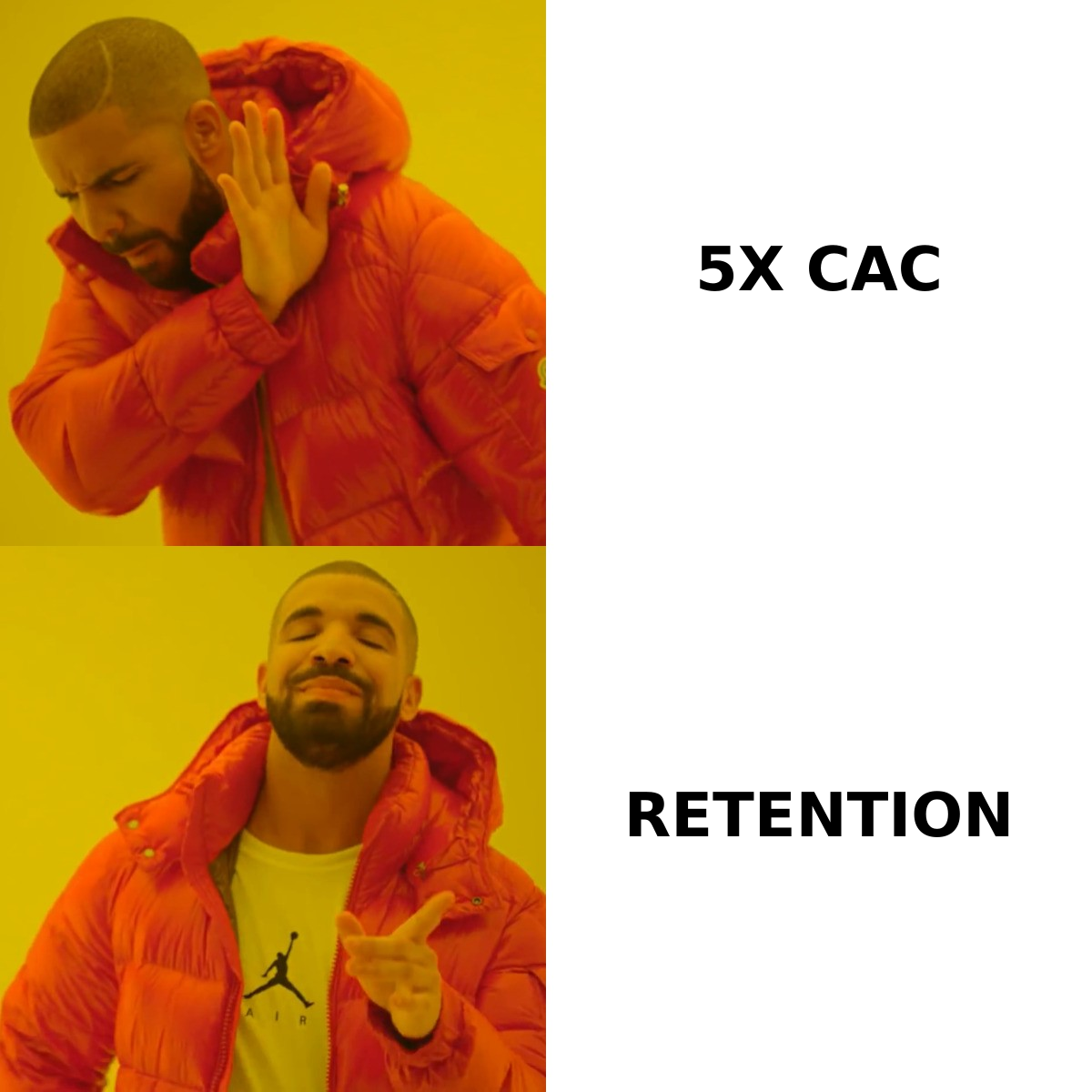
Because you've already paid the expensive part. With an existing customer, the trust, the data, the integration, and the buying relationship already exist. With a new prospect, you fund discovery, education, objection-handling, and risk from zero.
The widely cited benchmarks line up here:
- Acquiring a new customer costs 5x to 7x more than retaining an existing one, according to research popularized by HubSpot and Frederick Reichheld's work.
- A 5% increase in retention can increase profits by 25% to 95% — the classic Bain & Company / Harvard Business Review finding.
- The probability of selling to an existing customer is 60%–70%, versus 5%–20% for a new prospect.
- Existing customers spend more over time as they trust you and adopt more of your product.
That doesn't make acquisition wasteful. It makes it front-loaded. The cost of acquisition (CAC) is a one-time investment you recover over the customer's lifetime. The trouble starts only when that lifetime is too short to recover it — a retention failure disguised as an acquisition problem.
How do you measure whether retention or acquisition is winning?#
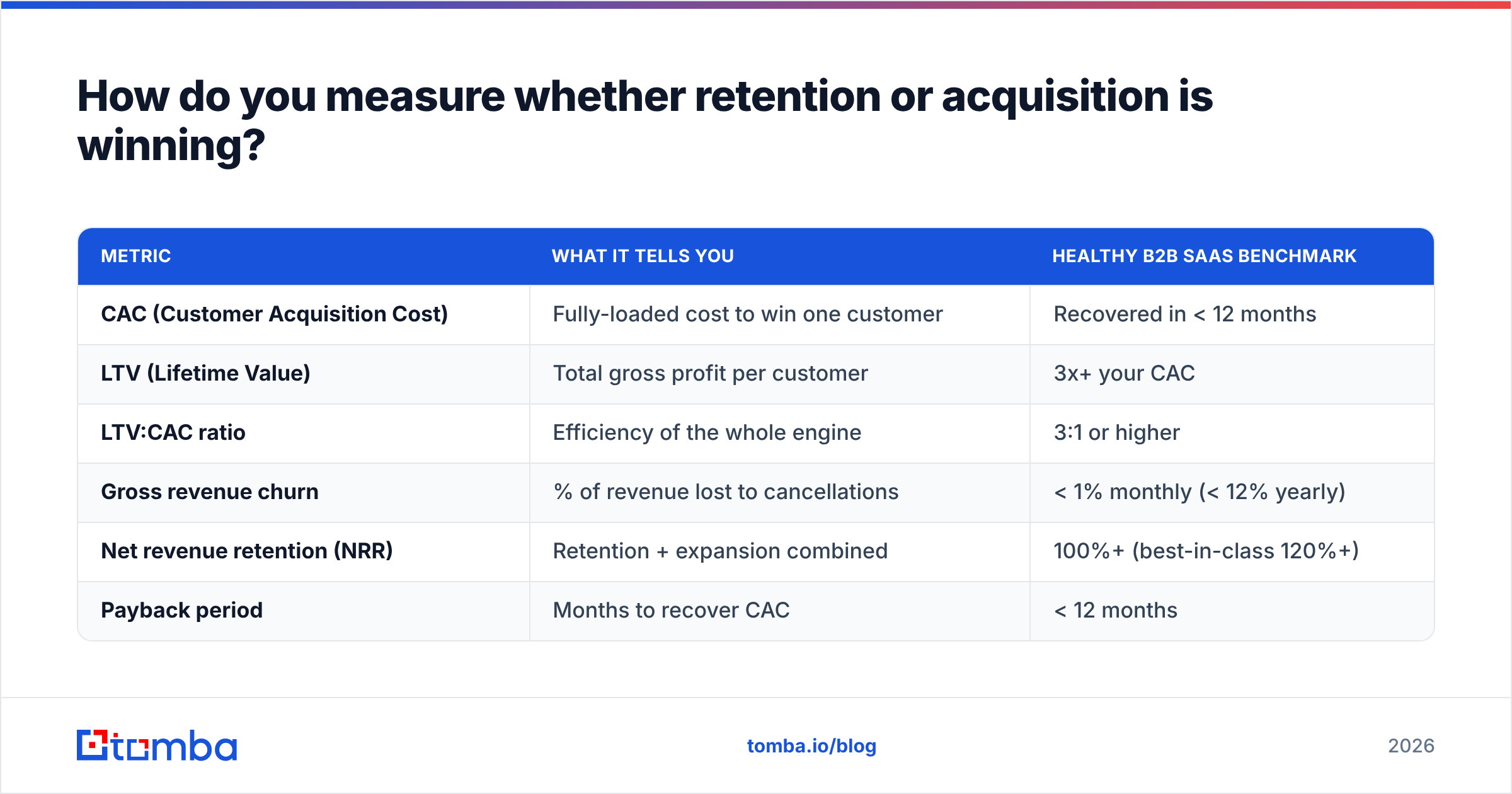
Use a small set of ratios, not gut feel. These are the metrics that turn a philosophical debate into a spreadsheet decision.
| Metric | What it tells you | Healthy B2B SaaS benchmark |
|---|---|---|
| CAC (Customer Acquisition Cost) | Fully-loaded cost to win one customer | Recovered in < 12 months |
| LTV (Lifetime Value) | Total gross profit per customer | 3x+ your CAC |
| LTV:CAC ratio | Efficiency of the whole engine | 3:1 or higher |
| Gross revenue churn | % of revenue lost to cancellations | < 1% monthly (< 12% yearly) |
| Net revenue retention (NRR) | Retention + expansion combined | 100%+ (best-in-class 120%+) |
| Payback period | Months to recover CAC | < 12 months |
The single most useful number is net revenue retention. If NRR is above 100%, your existing base grows even if you never sign another customer — expansion outweighs churn. That's the closest thing to a "retention is winning" green light. If NRR is below 90%, no amount of acquisition will fix a bucket that leaks faster than you can fill it.
The second most useful is LTV:CAC. Below 3:1, adding acquisition spend often just accelerates losses. Above 4:1, you may actually be under-investing in acquisition and leaving growth on the table.
Is customer retention always better than acquisition?#
No — and treating it as a universal truth is how early-stage companies stall. Retention is a multiplier on a base you already have. If your base is tiny, multiplying it barely moves revenue. A pre-product-market-fit startup with 40 customers should spend almost entirely on acquisition and learning, not on elaborate loyalty programs.
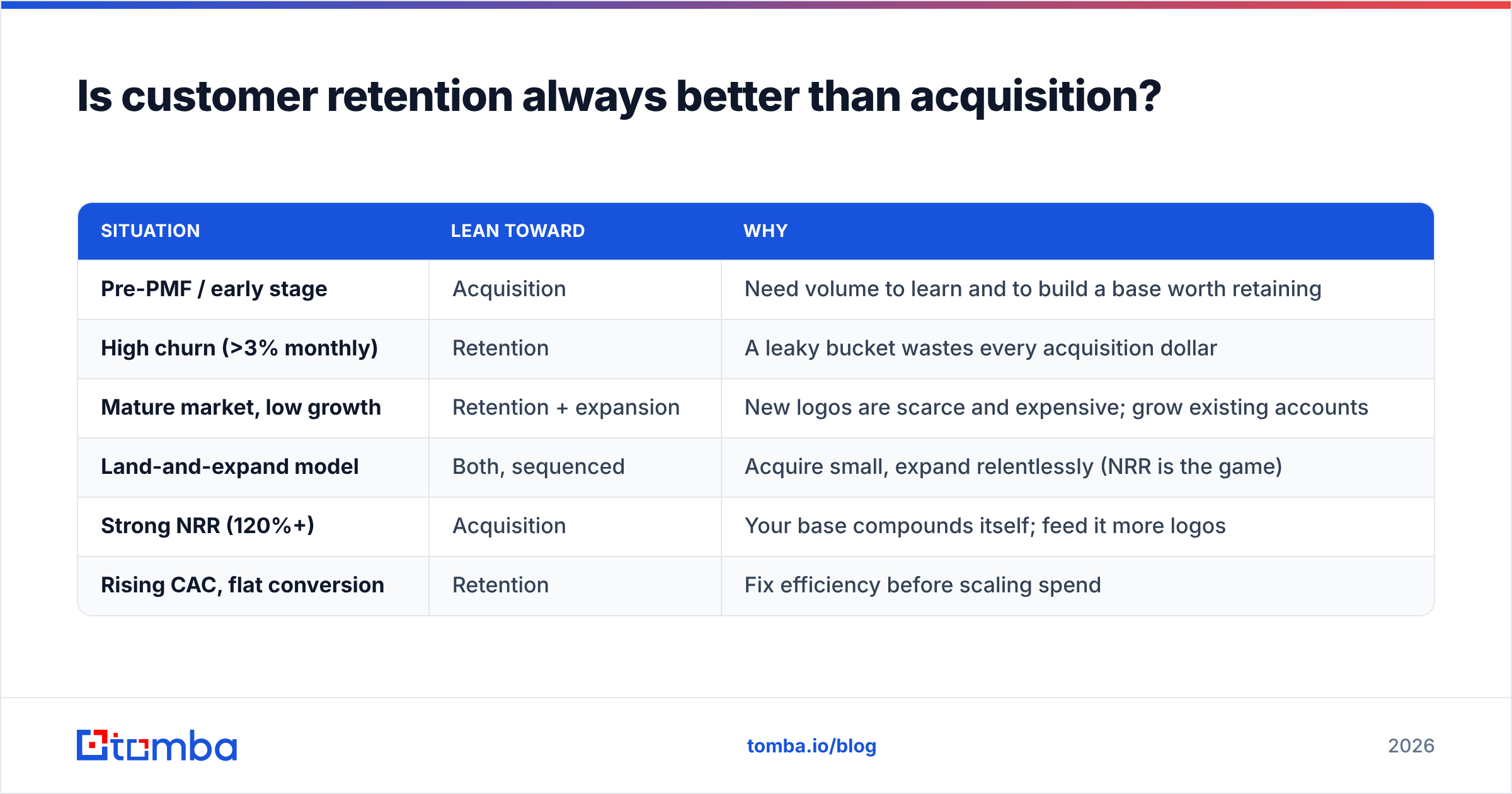
Here's the honest breakdown of when each lever wins:
| Situation | Lean toward | Why |
|---|---|---|
| Pre-PMF / early stage | Acquisition | Need volume to learn and to build a base worth retaining |
| High churn (>3% monthly) | Retention | A leaky bucket wastes every acquisition dollar |
| Mature market, low growth | Retention + expansion | New logos are scarce and expensive; grow existing accounts |
| Land-and-expand model | Both, sequenced | Acquire small, expand relentlessly (NRR is the game) |
| Strong NRR (120%+) | Acquisition | Your base compounds itself; feed it more logos |
| Rising CAC, flat conversion | Retention | Fix efficiency before scaling spend |
Most efficient operators follow one pattern. They acquire aggressively until they have a base and a repeatable motion. Then they shift marginal dollars toward retention and expansion as CAC rises and the market matures. According to Gartner research on growth strategy, the highest-performing companies don't pick a side — they rebalance the mix as they scale.

What happens when you ignore one side?#
You get one of two predictable failure modes.
Ignore retention and you build a leaky bucket. Every month you pour acquired customers in the top while an equal or greater number drains out the bottom. Growth looks flat despite rising ad spend. CAC keeps climbing because you're constantly replacing churned revenue instead of adding to it. Eventually payback periods stretch past the point of profitability. The surprised-Pikachu moment — waking up to 60% annual churn — is always foreseeable in the cohort data months before it hits the P&L.
Ignore acquisition and you slowly suffocate. Even with world-class retention, some churn is involuntary — companies get acquired, budgets get cut, champions leave. Without a steady inflow of new logos, your total addressable revenue only shrinks. Retention-only strategies feel safe and efficient right up until the market shifts and you have no new pipeline to absorb the shock.
The takeaway: these aren't competing philosophies. They're two failure modes you steer between. The job is balance, not victory.
How does better data improve both retention and acquisition?#
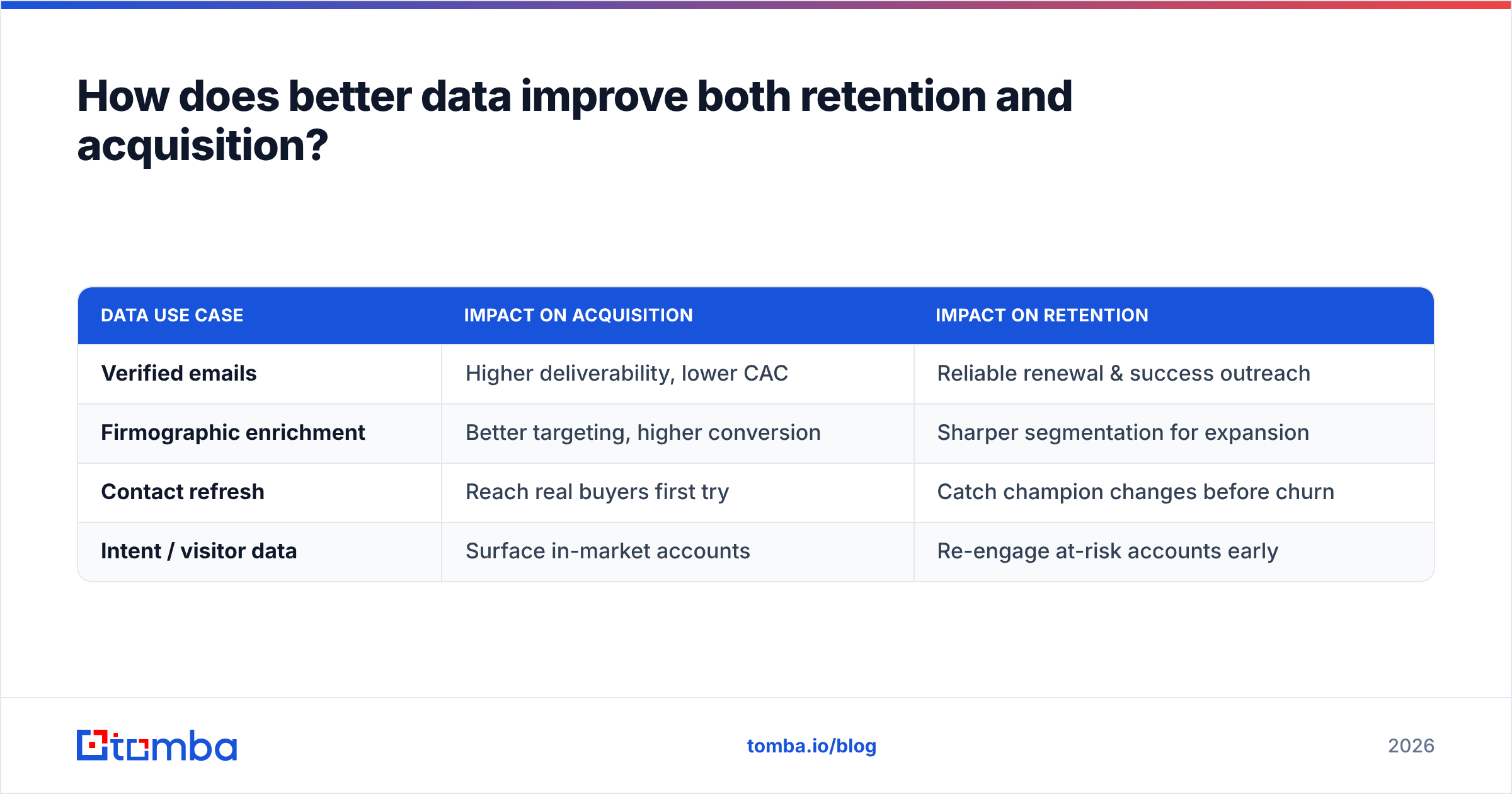
Data quality is the hidden variable that lowers CAC and raises retention at the same time. Most teams treat "acquisition tooling" and "retention tooling" as separate stacks. In practice, the same accurate contact and firmographic data powers both.
On the acquisition side, bad data is a silent tax. Bounced emails hurt deliverability, wrong titles waste rep time, and missing phone numbers kill connect rates. Verified, enriched contact data means your outbound reaches real decision-makers on the first try — which directly cuts cost-per-meeting. A reliable email finder and clean data enrichment turn a spray-and-pray list into a targeted one, and identifying anonymous website visitor reveal traffic surfaces in-market accounts you'd otherwise never know were interested.
On the retention side, enriched data drives the segmentation that makes success proactive instead of reactive. Knowing an account's size, tech stack, and org changes lets you spot expansion signals and churn risk early. When a champion's title changes or a company gets acquired, that's a retention trigger — but only if your CRM data is current.
| Data use case | Impact on acquisition | Impact on retention |
|---|---|---|
| Verified emails | Higher deliverability, lower CAC | Reliable renewal & success outreach |
| Firmographic enrichment | Better targeting, higher conversion | Sharper segmentation for expansion |
| Contact refresh | Reach real buyers first try | Catch champion changes before churn |
| Intent / visitor data | Surface in-market accounts | Re-engage at-risk accounts early |
This is why treating data as shared infrastructure — rather than an acquisition-only line item — quietly improves both sides of the equation. You can compare what that infrastructure costs on the Tomba pricing page against the CAC savings it unlocks.
What's the right customer retention vs new customer acquisition mix for 2026?#
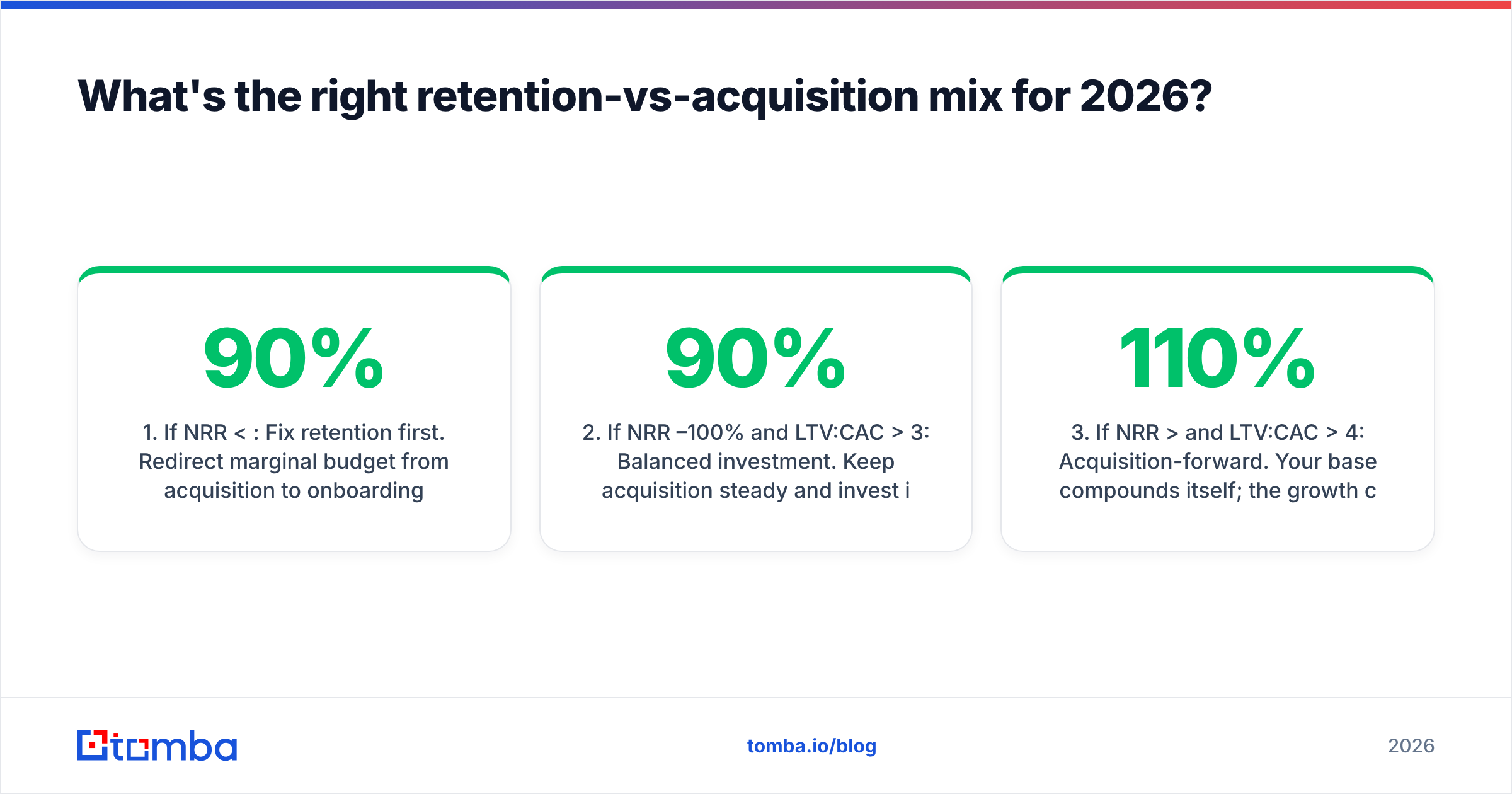
Anchor the mix to your LTV:CAC and NRR, then adjust for stage. There's no universal 70/30 split, but there is a decision framework:
- If NRR < 90%: Fix retention first. Redirect marginal budget from acquisition to onboarding and success until the bucket stops leaking. New logos on top of heavy churn is lighting money on fire.
- If NRR 90%–100% and LTV:CAC > 3: Balanced investment. Keep acquisition steady and invest in expansion motions to push NRR above 100%.
- If NRR > 110% and LTV:CAC > 4: Acquisition-forward. Your base compounds itself; the growth constraint is now top-of-funnel volume, so feed it.
- If CAC payback > 18 months: Pause net-new spend increases, tighten targeting with better data, and shore up early-lifecycle retention (the first 90 days predict the rest).
The 2026 context sharpens all of this. Paid channels are more expensive and more crowded, buying committees are larger, and efficient growth is the mandate from most boards. That environment rewards two things: precision in acquisition (reach the right accounts with clean data, not more accounts with noisy data) and compounding in retention (expand existing accounts where trust already exists). The winners won't be the teams that pick a side. They'll be the teams that measure honestly and rebalance quarterly.
Frequently asked questions#
Is it cheaper to retain or acquire a customer? Retaining is typically 5x–7x cheaper than acquiring, because the trust, data, and relationship already exist. But cheaper per dollar doesn't mean you can skip acquisition — you need new logos to have anyone to retain.
What is a good net revenue retention rate? 100% or above is healthy for B2B SaaS; 120%+ is best-in-class. Above 100% means your existing base grows through expansion even without new customers.
Should a startup focus on retention or acquisition? Early-stage startups should lean heavily toward acquisition to build a base and find product-market fit, then shift weight toward retention and expansion as they scale and CAC rises.
How does data quality affect CAC? Poor contact data inflates CAC through bounced emails, wasted rep time, and low connect rates. Verified, enriched data reaches real buyers on the first attempt, directly lowering cost-per-meeting and cost-per-customer.
The bottom line#
Customer retention vs new customer acquisition was never a fight to win — it's a balance to manage. Retention almost always returns more per dollar. But acquisition is the only thing that builds a base big enough for retention to matter. Measure LTV:CAC and NRR honestly, sequence your investment to your stage, and treat data as the shared infrastructure that makes both cheaper and more effective.
That last point is where you can act today. Both engines run on accurate contact data — reach the right new accounts and keep your existing ones current. Start with the Tomba Email Finder to build targeted, verified lists that lower your acquisition cost and keep your CRM clean enough to power real retention. The free tier gives you 25 searches a month to test it against your current numbers before you commit a dollar.
Related guides#
Ready to find emails that actually work?
Join 150,000+ professionals who stopped guessing and started sending. Free credits on signup — no credit card required.
Get the Tomba newsletter
Practical outbound tactics and product updates — once every two weeks.
About the author