Customer Scoring in 2026: The Complete No-Fluff Guide
Customer scoring ranks accounts by value, fit, and risk so your team stops guessing. Here's how the models actually work in 2026 — and how to build one without a data-science team.
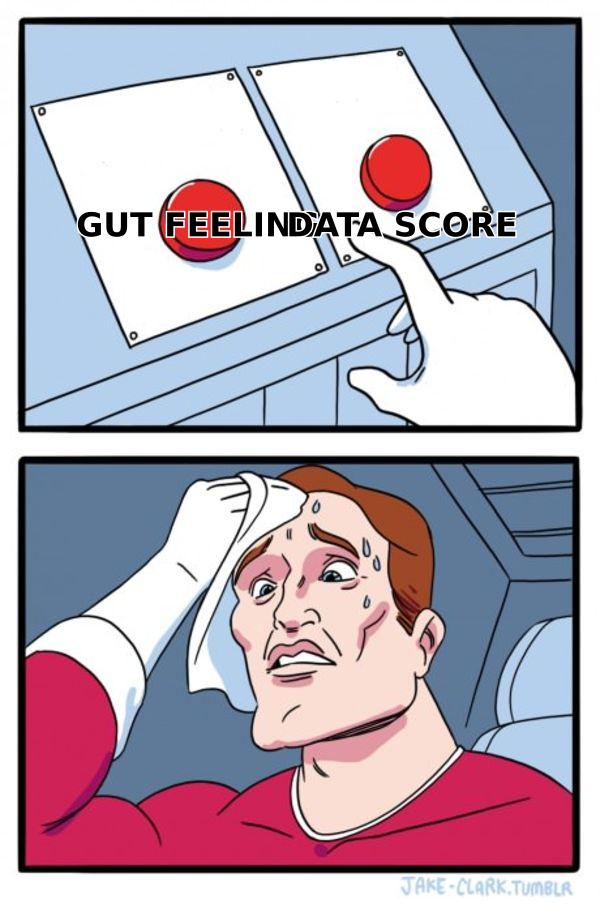
Most teams still rank customers the same way they did a decade ago: whoever shouts loudest gets attention, and quiet accounts churn in silence. Customer scoring replaces that reflex with a number — a repeatable way to say which accounts deserve your time, which are about to leave, and which are ready to spend more.
This guide breaks down what customer scoring is in 2026, the models that actually hold up, and how to stand one up without hiring a data-science team.
TL;DR#
- Customer scoring assigns a numeric value to each account based on fit, engagement, revenue potential, and churn risk — so prioritization is a data decision, not a personality contest.
- There are four core score types: lead score, fit/ICP score, health score, and expansion score. Most teams need at least two.
- You don't need machine learning to start. A weighted rules-based model gets you 80% of the value in an afternoon.
- Garbage in, garbage out. Scores are only as good as the contact and firmographic data behind them — enrichment is the unglamorous prerequisite.
- Review quarterly. A score that never changes is a score nobody trusts.
What is customer scoring?#
Customer scoring is the practice of assigning each account or contact a number that predicts how valuable — or how risky — they are to your business. Think of it like a credit score for your pipeline: instead of reading every account's full history, you get one figure that summarizes the signal.
That number rolls up several inputs. A fit dimension asks "does this account look like our best customers?" An engagement dimension asks "are they actually paying attention?" A risk dimension asks "are they about to leave?" Combine them and you get a rank you can sort a whole book of business by.
The payoff is focus. When every rep has 400 accounts and eight hours a day, the constraint isn't effort — it's attention allocation. Scoring tells the team where the next hour is best spent, and it does it the same way for everyone, so a hand-off between reps doesn't reset the account's history to zero.
What are the main types of customer scores?#
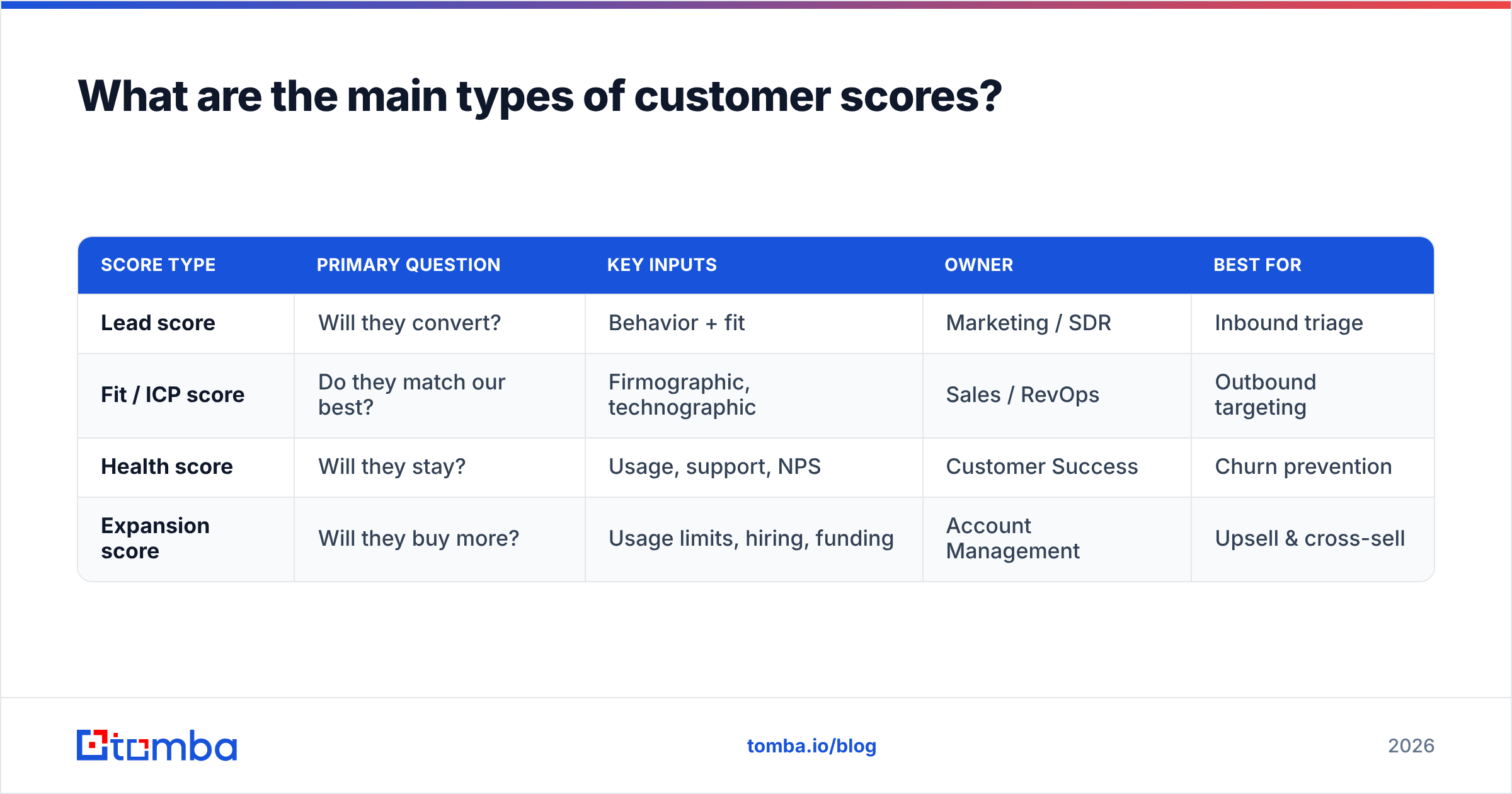
"Customer scoring" is an umbrella. In practice you're usually building one of four distinct scores, each answering a different question at a different stage of the lifecycle.
- Lead score — How likely is this new prospect to convert? Blends demographic fit with behavioral signals (demo requests, pricing-page visits, email replies). This is the classic marketing qualified lead threshold your marketing and sales teams argue about.
- Fit / ICP score — How closely does this account match your ideal customer profile? Purely firmographic and technographic: company size, industry, tech stack, geography. It ignores behavior entirely, which makes it great for outbound targeting.
- Health score — How happy and sticky is an existing customer? Built from product usage, support tickets, NPS, and payment history. Owned by customer success, it's your churn early-warning system.
- Expansion score — Which current customers are ready to buy more? Looks for usage hitting plan limits, new hires in buying roles, or funding events that unlock budget.
Here's how they stack up side by side.
| Score type | Primary question | Key inputs | Owner | Best for |
|---|---|---|---|---|
| Lead score | Will they convert? | Behavior + fit | Marketing / SDR | Inbound triage |
| Fit / ICP score | Do they match our best? | Firmographic, technographic | Sales / RevOps | Outbound targeting |
| Health score | Will they stay? | Usage, support, NPS | Customer Success | Churn prevention |
| Expansion score | Will they buy more? | Usage limits, hiring, funding | Account Management | Upsell & cross-sell |
Most B2B teams start with a fit score (cheap, no behavioral data needed) and a health score (highest revenue impact), then layer in the others.
How does customer scoring work?#
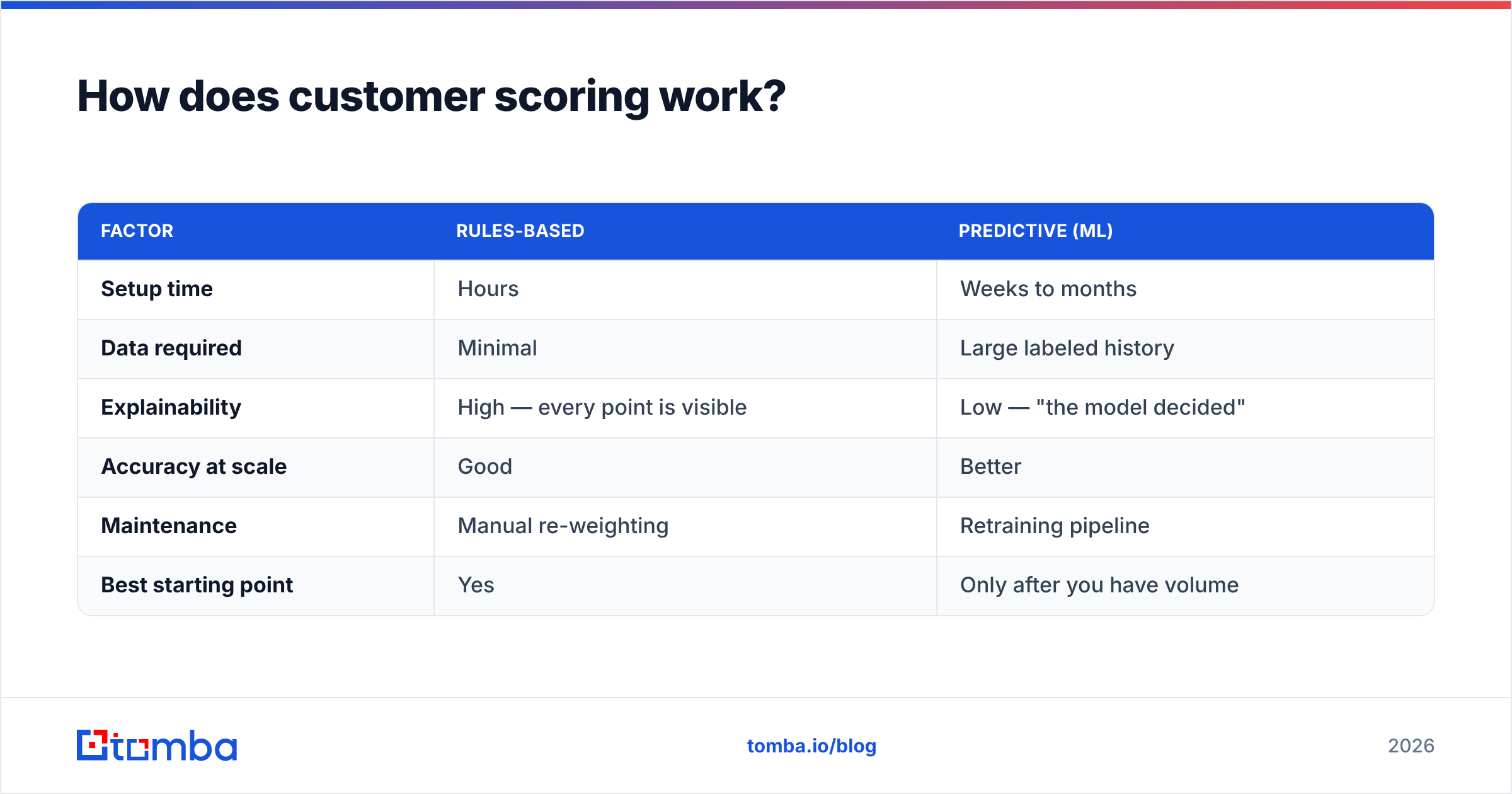
Two families of models dominate, and the honest answer is that you probably want the simpler one first.
Rules-based (weighted) scoring assigns points to attributes you choose. A company in your target industry gets +20; a free-tier user who hasn't logged in for 30 days gets −15. You sum the points, and the total is the score. It's transparent, easy to explain to a skeptical VP, and you can build it in a spreadsheet. The downside: the weights are your best guess, so they drift from reality over time.
Predictive (machine-learning) scoring flips the logic. Instead of you declaring the weights, you feed the model historical outcomes — who converted, who churned — and it learns which attributes actually predicted them. It's more accurate at scale and catches patterns humans miss, but it's a black box to your reps, needs clean historical data, and quietly rots if nobody retrains it.
| Factor | Rules-based | Predictive (ML) |
|---|---|---|
| Setup time | Hours | Weeks to months |
| Data required | Minimal | Large labeled history |
| Explainability | High — every point is visible | Low — "the model decided" |
| Accuracy at scale | Good | Better |
| Maintenance | Manual re-weighting | Retraining pipeline |
| Best starting point | Yes | Only after you have volume |
Vendors like HubSpot and Salesforce now ship both flavors natively, so you rarely have to build the plumbing yourself — the harder work is deciding what to feed them.
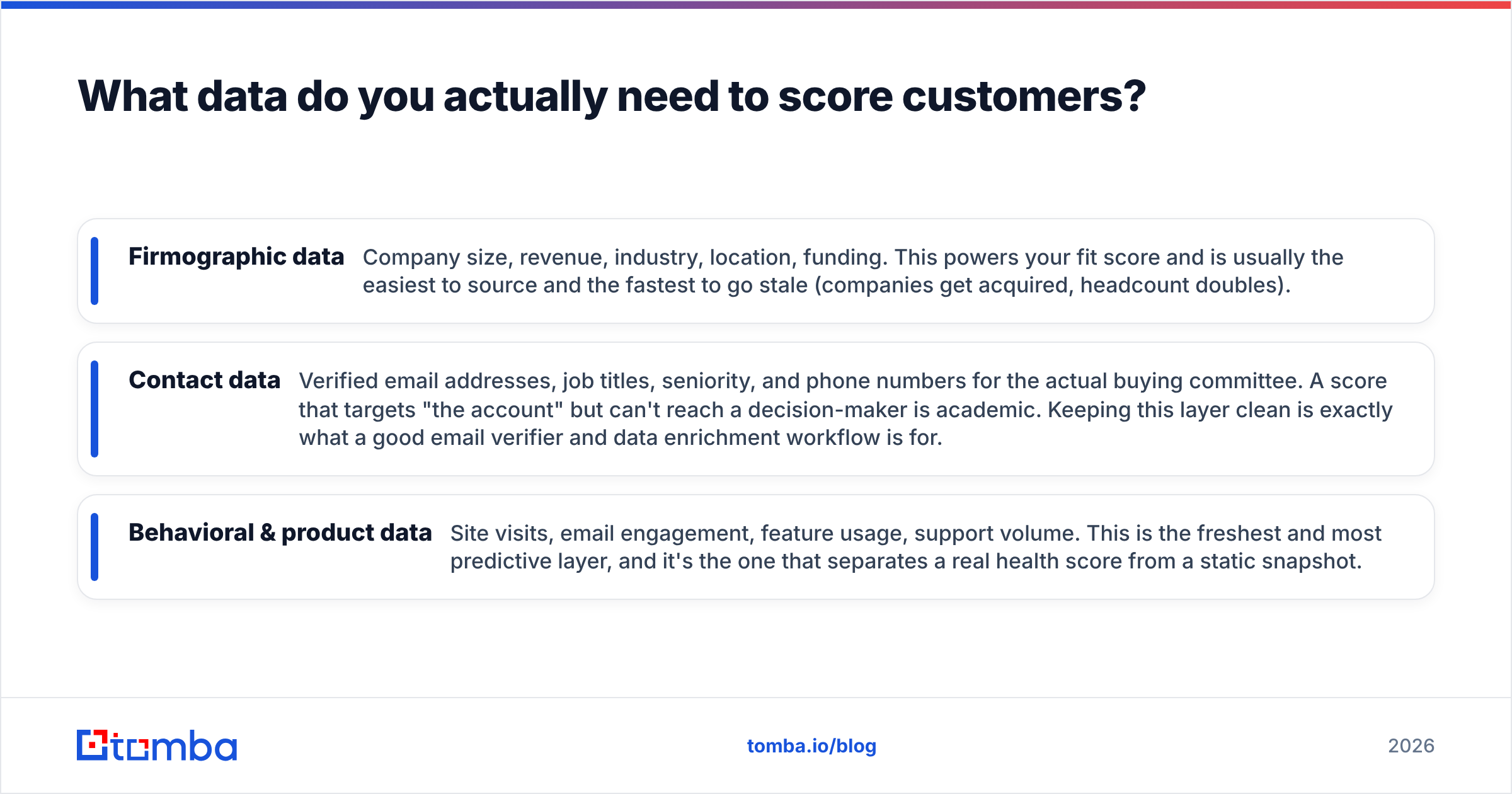
What data do you actually need to score customers?#
This is where most scoring projects quietly fail. A perfectly designed model on top of stale, half-empty records produces confident nonsense. Before you tune a single weight, get these three data layers in order.
- Firmographic data — Company size, revenue, industry, location, funding. This powers your fit score and is usually the easiest to source and the fastest to go stale (companies get acquired, headcount doubles).
- Contact data — Verified email addresses, job titles, seniority, and phone numbers for the actual buying committee. A score that targets "the account" but can't reach a decision-maker is academic. Keeping this layer clean is exactly what a good email verifier and data enrichment workflow is for.
- Behavioral & product data — Site visits, email engagement, feature usage, support volume. This is the freshest and most predictive layer, and it's the one that separates a real health score from a static snapshot.
The unglamorous truth: enrichment quality caps your scoring quality. If 30% of your accounts are missing industry or headcount, your fit score is effectively scoring a coin flip for a third of your pipeline. Auditing coverage in your B2B database before modeling saves you from "solving" a problem your data can't actually see.
How do you build a customer scoring model in 5 steps?#
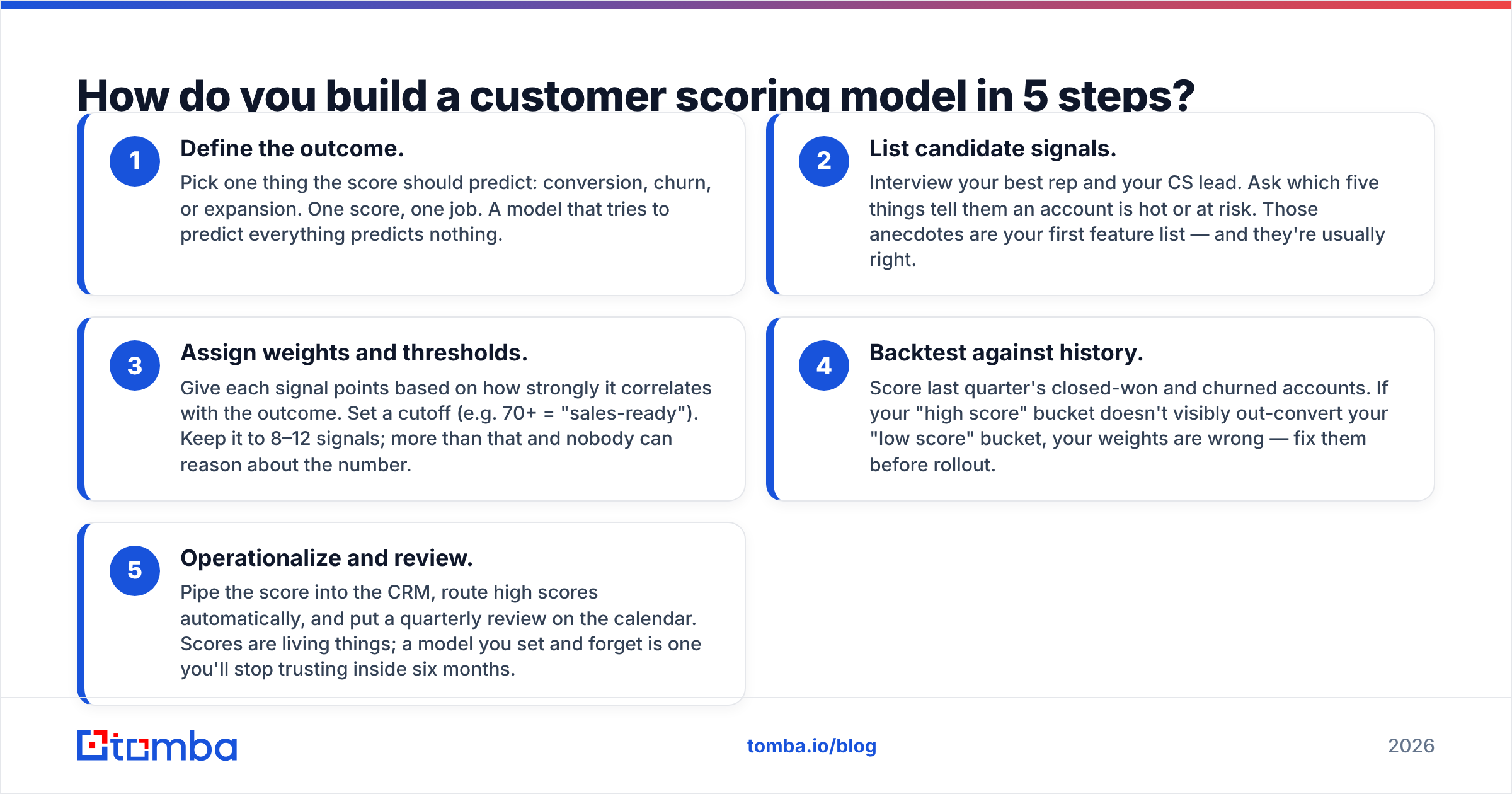
You can ship a first version this week. Resist the urge to make it perfect — make it live, then tune it.
- Define the outcome. Pick one thing the score should predict: conversion, churn, or expansion. One score, one job. A model that tries to predict everything predicts nothing.
- List candidate signals. Interview your best rep and your CS lead. Ask which five things tell them an account is hot or at risk. Those anecdotes are your first feature list — and they're usually right.
- Assign weights and thresholds. Give each signal points based on how strongly it correlates with the outcome. Set a cutoff (e.g. 70+ = "sales-ready"). Keep it to 8–12 signals; more than that and nobody can reason about the number.
- Backtest against history. Score last quarter's closed-won and churned accounts. If your "high score" bucket doesn't visibly out-convert your "low score" bucket, your weights are wrong — fix them before rollout.
- Operationalize and review. Pipe the score into the CRM, route high scores automatically, and put a quarterly review on the calendar. Scores are living things; a model you set and forget is one you'll stop trusting inside six months.
What are the most common customer scoring mistakes?#
- Recency blindness. A one-time score from onboarding day tells you nothing about an account trending toward churn today. Scores must recompute on fresh data.
- Vanity signals. Email opens feel like engagement but are noisy in a post-Apple-Mail-Privacy world. Weight replies and meetings, not opens.
- No negative scoring. Great models subtract points — for inactivity, downgrades, unsubscribes — not just add them. A pile-up of positives with no decay inflates everyone to "hot."
- Scoring without reach. Ranking accounts you can't contact is a planning exercise, not a revenue one. Pair every fit score with verified contact data so a "10/10 account" comes with an email you can actually send to.
- Ignoring the field. If reps consistently override the score, the score is wrong — or the reps don't understand it. Both are fixable, but only if you listen.
Analyst firms have tracked this for years — Gartner consistently finds that account-based prioritization outperforms volume-based outreach, but only when the underlying data is trustworthy. The model is the easy part; the data discipline is the moat.
Is customer scoring worth it for a small team?#
Yes — arguably more than for a large one. A 50-person sales org can absorb some wasted effort; a five-person team can't. When every hour is scarce, a lightweight fit-plus-health score is the single highest-leverage RevOps project you can run, and it doesn't require ML or a dedicated analyst.
Start with a spreadsheet, ten signals, and clean contact data. Once the manual version proves its worth — measured in higher win rates on the accounts you prioritized — graduate to your CRM's native scoring, then predictive models if volume justifies it. The sequence matters: teams that jump straight to ML usually discover their data wasn't ready and quietly abandon the project.
Get the data your scores depend on#
A customer scoring model is only as strong as the contact and company data feeding it. Before you tune weights or turn on predictive scoring, make sure the records underneath are complete and verified — that's the difference between a score your reps trust and one they override.
Tomba's Email Finder and enrichment tools give you verified emails, firmographics, and decision-maker details to build fit and health scores on solid ground — starting free with 25 searches a month, then $49/mo on the Starter plan once you scale. See full Tomba pricing to match a plan to your pipeline. Score smarter by starting with data you can actually reach.
Related guides#
Ready to find emails that actually work?
Join 150,000+ professionals who stopped guessing and started sending. Free credits on signup — no credit card required.
Get the Tomba newsletter
Practical outbound tactics and product updates — once every two weeks.
About the author