Customer Segmentation in 2026: A B2B Playbook That Works
Customer segmentation decides which accounts you win and which you waste budget chasing. Here's the 2026 B2B framework — models, data, and a step-by-step build you can copy this week.
Customer segmentation is the difference between a go-to-market motion that compounds and one that quietly burns cash. Get it right and every email, ad, and sales call lands on someone who is actually ready to buy. Get it wrong and your best reps spend their week chasing accounts that were never a fit.
This guide is the practical, no-fluff version: what customer segmentation is, the models that actually work in B2B, the data you need underneath them, and a step-by-step build you can ship this week.
TL;DR#
- Customer segmentation is the practice of grouping buyers by shared traits — firmographic, behavioral, needs-based, or value-based — so you can target each group with the right message and offer.
- The four models that matter in B2B are firmographic, behavioral, needs-based, and value (RFM-style) segmentation. Most teams should combine two or three, not pick one.
- Segmentation is only as good as the data underneath it. Stale titles, missing industries, and dead emails silently sabotage even a smart model.
- A workable build is five steps: define the goal, pick 2–3 segmentation axes, enrich and clean your data, score and rank segments, then route each segment to a tailored play.
- Start narrow. One high-value segment with a sharp message beats twelve segments you can't service.
What is customer segmentation?#
Customer segmentation is the process of dividing your total addressable market into smaller groups of buyers who share meaningful characteristics — so you can market, sell, and serve each group differently.
Think of it like a florist arranging bouquets. You don't hand every walk-in customer the same arrangement. A wedding planner, a funeral home, and a teenager buying an anniversary gift want completely different things at completely different price points. Segmentation is sorting your buyers into those groups before you decide what to offer them.
In B2B, the stakes are higher than in consumer marketing because deals are larger, buying committees are bigger, and a mistargeted campaign wastes weeks of a rep's time — not a $4 click. That's why serious revenue teams treat segmentation as an operating discipline, not a one-time spreadsheet exercise.
Why does customer segmentation matter for B2B revenue?#
Because undifferentiated outreach is expensive and it doesn't scale. When you treat a 12-person startup and a 4,000-person enterprise the same way, you underserve the account worth $200k and overspend on the one worth $2k.
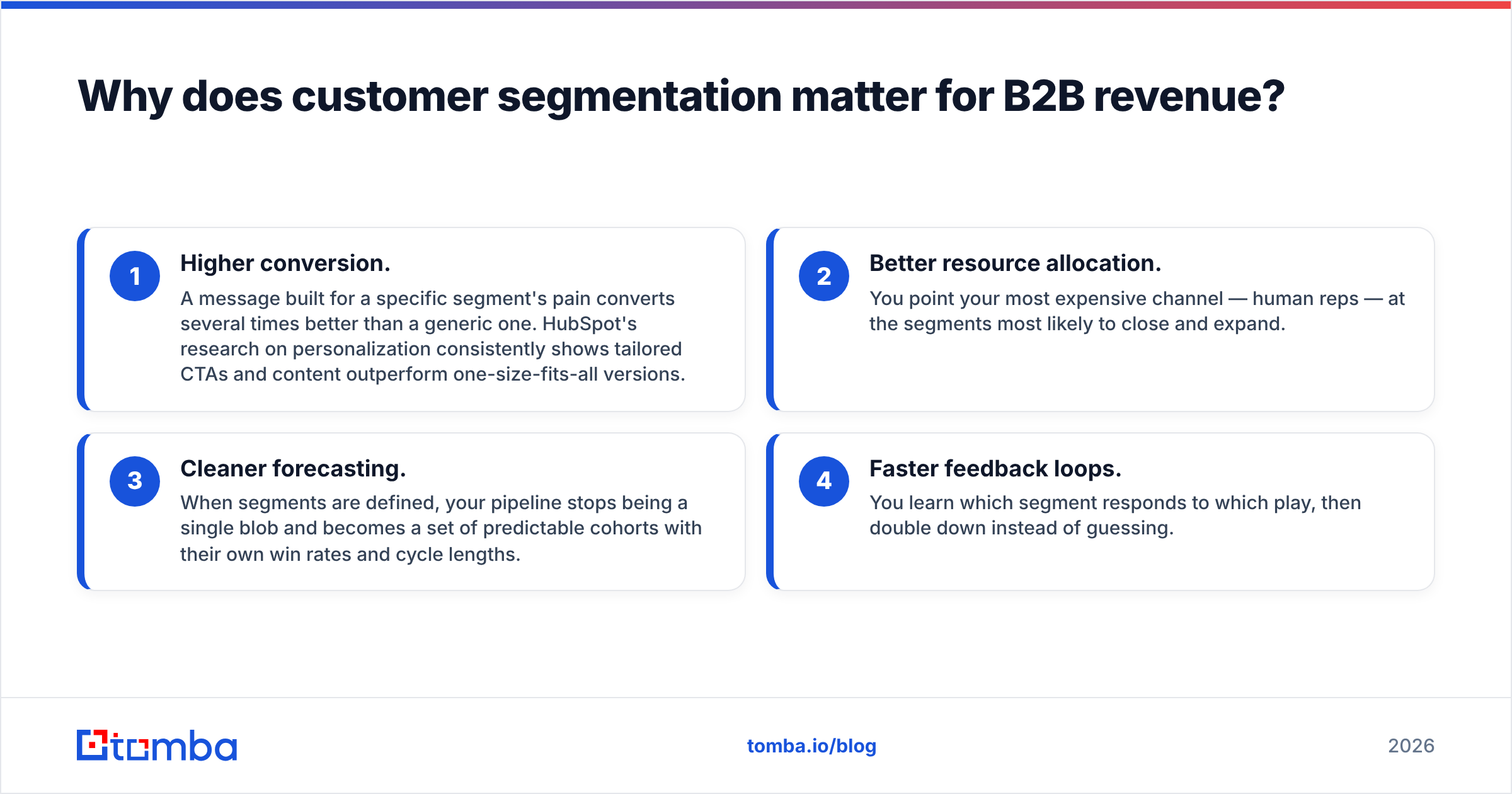
Concretely, good segmentation drives four things:
- Higher conversion. A message built for a specific segment's pain converts several times better than a generic one. HubSpot's research on personalization consistently shows tailored CTAs and content outperform one-size-fits-all versions.
- Better resource allocation. You point your most expensive channel — human reps — at the segments most likely to close and expand.
- Cleaner forecasting. When segments are defined, your pipeline stops being a single blob and becomes a set of predictable cohorts with their own win rates and cycle lengths.
- Faster feedback loops. You learn which segment responds to which play, then double down instead of guessing.
If you want the textbook framing, Gartner and Forrester both treat account segmentation as the foundation of any revenue operations motion — it's what your ICP, scoring, and territory design all sit on top of.
What are the main types of customer segmentation?#
There are four models that carry most of the weight in B2B. You rarely use just one.
Firmographic segmentation#
Grouping accounts by company attributes: industry, employee count, revenue, location, tech stack, and growth stage. This is the B2B equivalent of demographics and it's usually where you start because the data is objective and easy to source.
Behavioral segmentation#
Grouping by what buyers do: pages visited, demos booked, features used, email replies, content downloaded. Behavior is the strongest predictor of intent because it reflects real actions instead of assumed fit.
Needs-based segmentation#
Grouping by the problem the buyer is trying to solve or the use case they're hiring your product for. A CRM sold to a solo consultant for contact management is a different segment than the same CRM sold to a 50-rep team for pipeline forecasting — even if the firmographics overlap.
Value-based (RFM) segmentation#
Grouping existing customers by Recency, Frequency, and Monetary value — how recently they bought, how often, and how much. This is how you find expansion candidates, at-risk accounts, and your quiet whales.
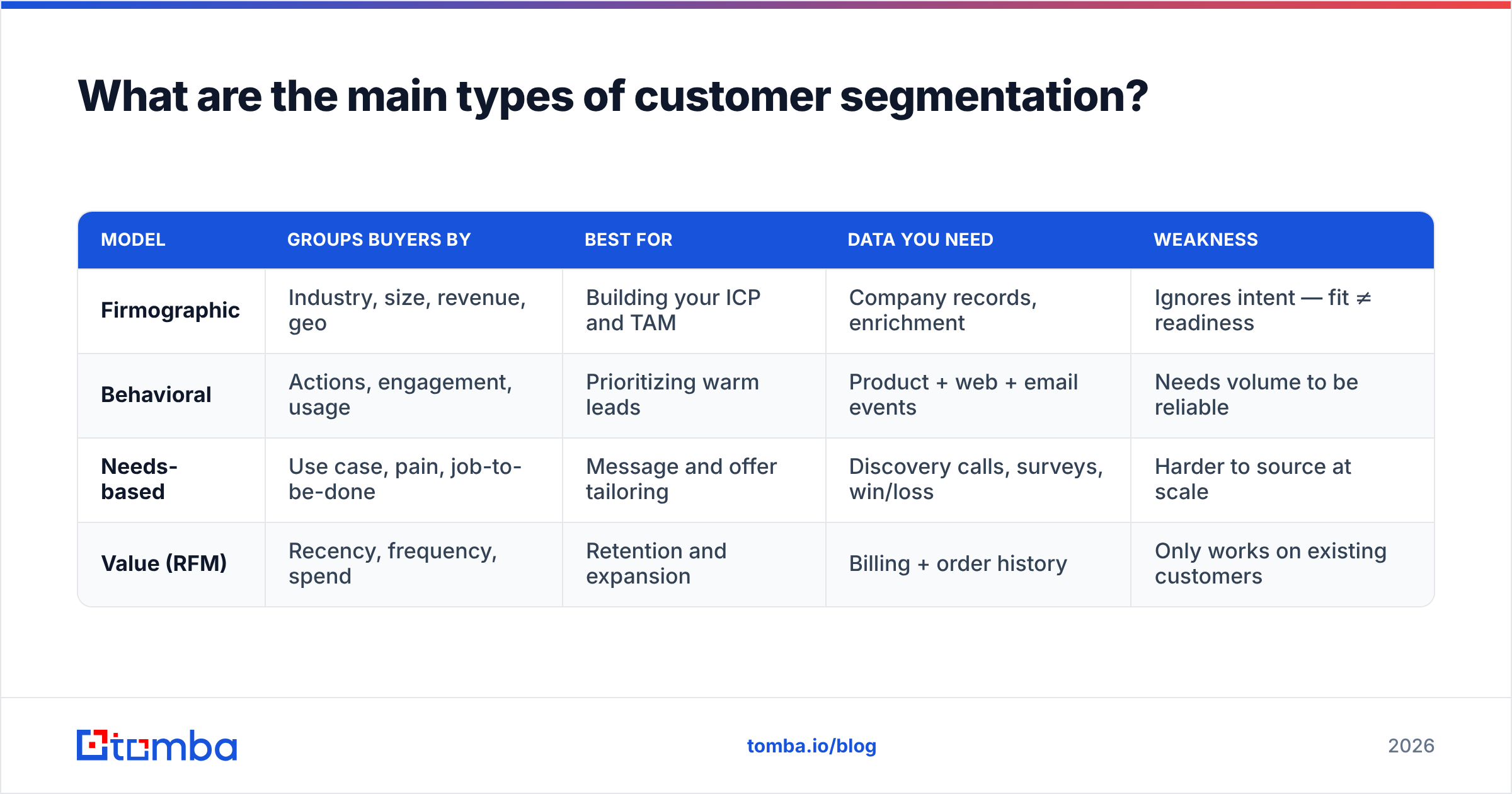
Here's how the four compare in practice:
| Model | Groups buyers by | Best for | Data you need | Weakness |
|---|---|---|---|---|
| Firmographic | Industry, size, revenue, geo | Building your ICP and TAM | Company records, enrichment | Ignores intent — fit ≠ readiness |
| Behavioral | Actions, engagement, usage | Prioritizing warm leads | Product + web + email events | Needs volume to be reliable |
| Needs-based | Use case, pain, job-to-be-done | Message and offer tailoring | Discovery calls, surveys, win/loss | Harder to source at scale |
| Value (RFM) | Recency, frequency, spend | Retention and expansion | Billing + order history | Only works on existing customers |
The teams that win combine axes. A common, powerful stack: firmographic to define who's a fit → behavioral to find who's ready → needs-based to decide what to say.
How do you build a customer segmentation model, step by step?#
You don't need a data science team. You need a clear goal and clean inputs. Here's a five-step build.
1. Define the outcome first. Are you trying to book more meetings, raise average deal size, cut churn, or expand existing accounts? Segmentation for acquisition looks nothing like segmentation for retention. Write the goal down before you touch a spreadsheet.
2. Choose 2–3 axes, not seven. Pick the smallest set of dimensions that separates your buyers into groups you can actually serve differently. If two "segments" get the same message and the same rep, they're one segment. Collapse them.
3. Enrich and clean the underlying data. This is the step most teams skip and most segmentation dies on. If 30% of your records are missing industry or employee count, your firmographic segments are fiction. Run every account through data enrichment to fill in company size, industry, and role, and use an email verifier so the contacts inside each segment are actually reachable.
4. Score and rank the segments. Not all segments deserve equal effort. Score each on fit (how well it matches your ICP) and potential value (deal size × win rate × volume). This is where lead scoring and segmentation meet — you're ranking groups, then ranking accounts inside them.
5. Route each segment to a tailored play. Assign a channel, a message, and an owner per segment. High-value enterprise segments get named reps and multi-touch sequences; long-tail SMB segments get automated, self-serve motions. The routing is the payoff — segmentation with no differentiated action is just a pretty chart.

What data do you need for accurate customer segmentation?#
Three layers, roughly in order of how often teams get them wrong.
- Firmographic data — industry, headcount, revenue, HQ location, tech stack. This defines fit. Source it from your CRM and top up the gaps with enrichment.
- Contact-level data — the right person's role, seniority, and a verified email or phone number. A perfect segment full of bounced emails converts to nothing.
- Behavioral and intent data — site visits, content engagement, product usage, and third-party intent signals. This is what turns a static list into a prioritized one.
The uncomfortable truth: segmentation is a data-quality problem wearing a strategy costume. According to widely cited G2 and industry benchmarks, B2B contact data decays roughly 25–30% per year as people change jobs and companies restructure. A segment you built in January is materially wrong by summer if you never refresh it.
That's why the enrichment and verification step isn't optional housekeeping — it's the load-bearing wall. Tools like Tomba's domain search let you pull the right contacts for every account in a segment, and its bulk email finder lets you refresh an entire segment in one pass instead of one record at a time.
What does customer segmentation look like in practice?#
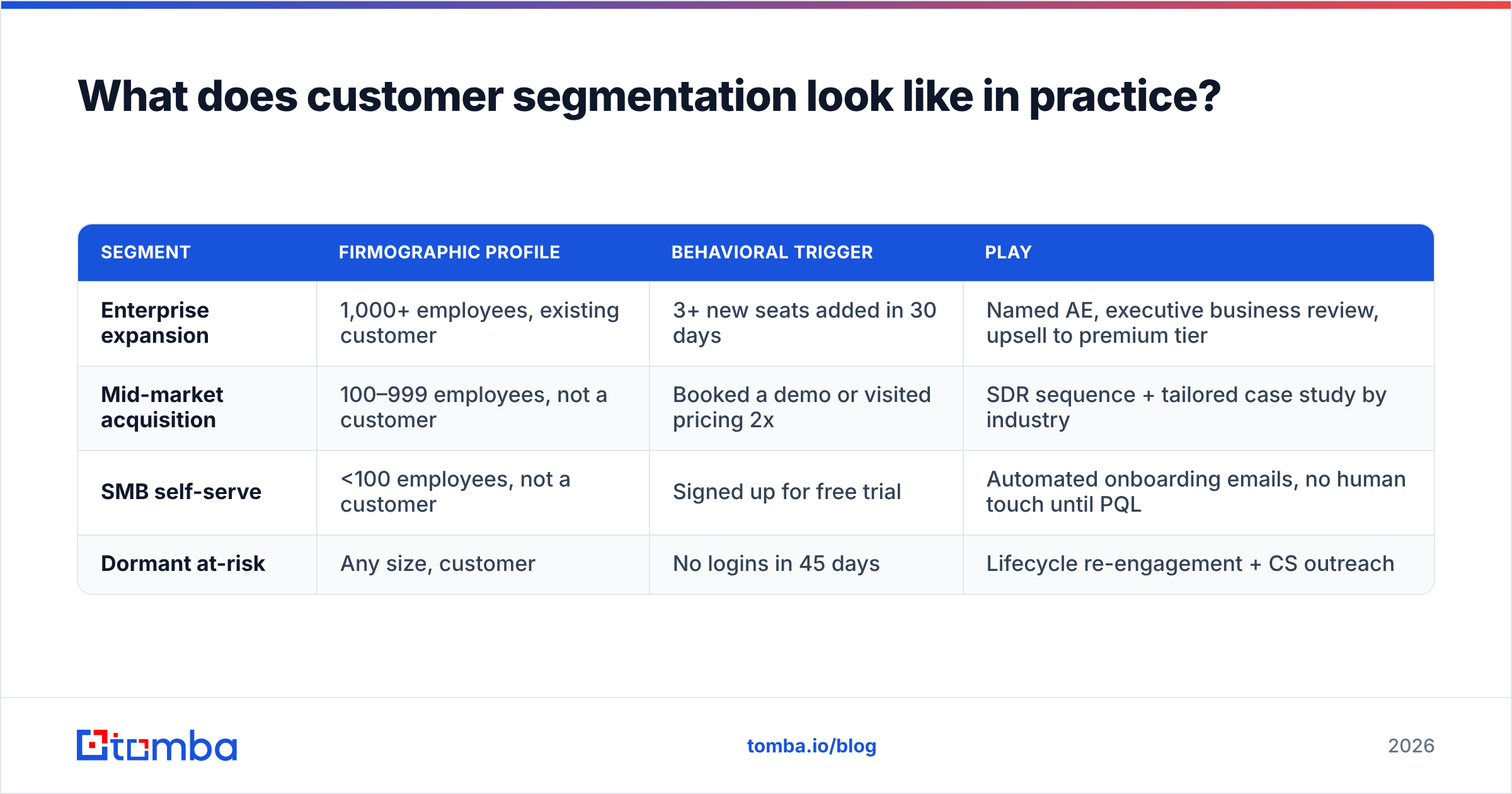
Here's a concrete example. Say you sell a project-management SaaS and your goal is more closed-won revenue, not just more meetings.
You start firmographic and land on three fit-based groups, then layer behavior on top:
| Segment | Firmographic profile | Behavioral trigger | Play |
|---|---|---|---|
| Enterprise expansion | 1,000+ employees, existing customer | 3+ new seats added in 30 days | Named AE, executive business review, upsell to premium tier |
| Mid-market acquisition | 100–999 employees, not a customer | Booked a demo or visited pricing 2x | SDR sequence + tailored case study by industry |
| SMB self-serve | <100 employees, not a customer | Signed up for free trial | Automated onboarding emails, no human touch until PQL |
| Dormant at-risk | Any size, customer | No logins in 45 days | Lifecycle re-engagement + CS outreach |
Notice what happened: the same product now has four completely different motions, four different owners, and four different messages — all driven by combining firmographic fit with behavioral signals. That's segmentation doing real work.
To build the acquisition segments, you'd pull target accounts, then use an email finder to get verified contacts for the specific roles you care about (a champion in Ops, an economic buyer in Finance), and route them into the right sequence.
What are the most common customer segmentation mistakes?#
- Too many segments. Twelve segments you can't staff is worse than three you can execute flawlessly. Complexity is not sophistication.
- Segmenting on fit but ignoring intent. A perfect-ICP account that has never heard of you is not the same as a perfect-ICP account that just visited your pricing page twice. Behavior breaks the tie.
- Set-and-forget. Segments decay. Rebuild or re-enrich quarterly, or you'll be marketing to job titles that left 8 months ago.
- No differentiated action. If every segment gets the same email, you didn't segment — you sorted.
- Dirty data underneath. Missing firmographics and dead emails quietly wreck otherwise-smart models. This is the single most common failure point, and it's the cheapest to fix.
Customer segmentation vs. market segmentation: what's the difference?#
They're related but not the same. Market segmentation is a broad, strategic exercise — dividing an entire market into addressable slices to decide which markets to enter and how to position. It happens early and shapes product and pricing.
Customer segmentation is narrower and more operational — dividing your actual buyers and prospects into groups so you can execute targeted go-to-market plays. Market segmentation tells you which pond to fish in; customer segmentation tells you which fish to cast to first, and with what bait.
Most B2B teams need both, but customer segmentation is the one you touch weekly.
How do you keep segments accurate over time?#
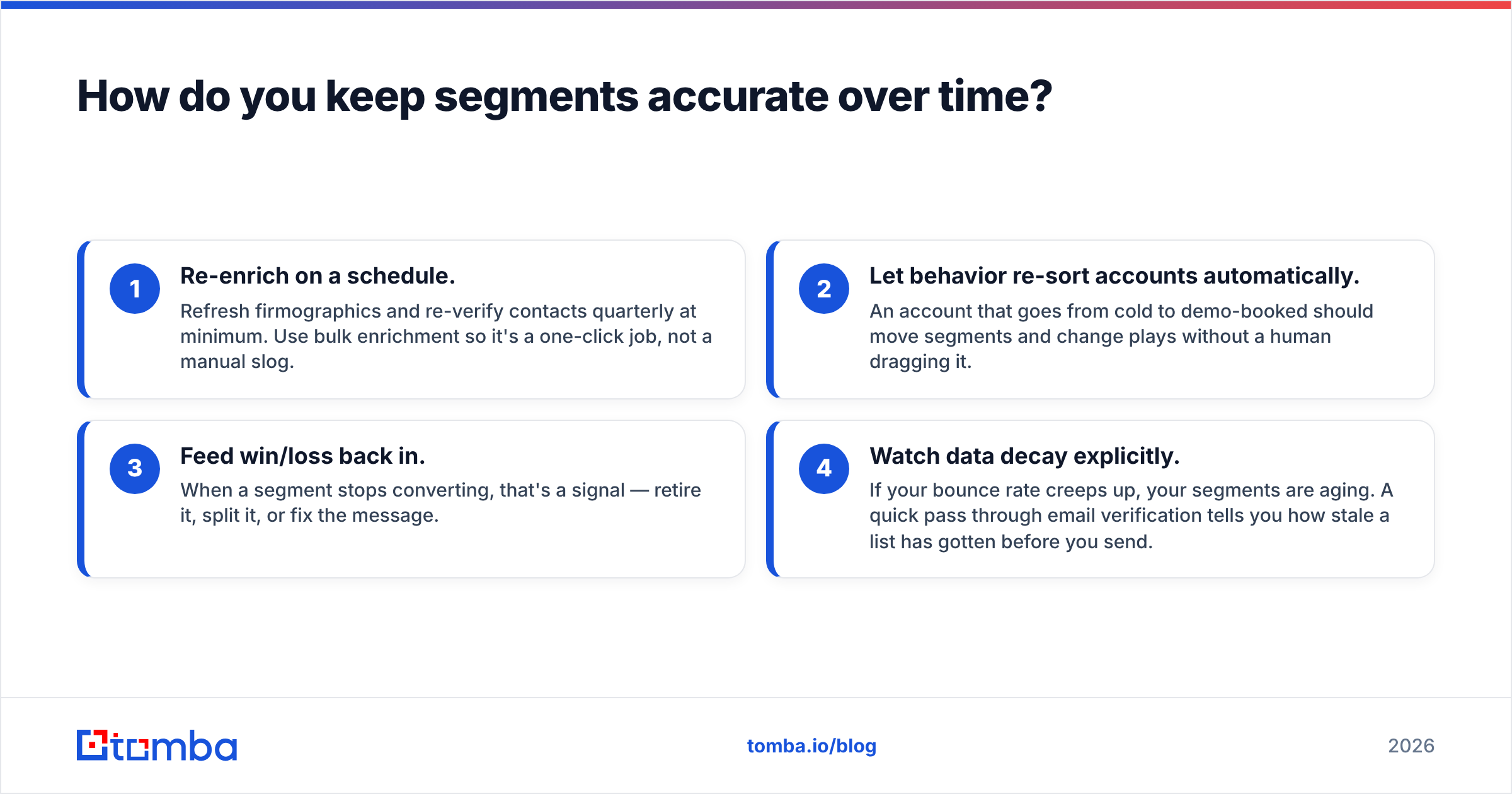
Treat segmentation as a living system, not a document.
- Re-enrich on a schedule. Refresh firmographics and re-verify contacts quarterly at minimum. Use bulk enrichment so it's a one-click job, not a manual slog.
- Let behavior re-sort accounts automatically. An account that goes from cold to demo-booked should move segments and change plays without a human dragging it.
- Feed win/loss back in. When a segment stops converting, that's a signal — retire it, split it, or fix the message.
- Watch data decay explicitly. If your bounce rate creeps up, your segments are aging. A quick pass through email verification tells you how stale a list has gotten before you send.
Put your segments to work#
Customer segmentation only pays off when each group is real, reachable, and routed to the right play. That means the boring layer — accurate firmographics and verified contacts — has to be right before the clever strategy on top can do anything.
That's exactly where Tomba's Email Finder earns its place in the stack. Point it at the accounts in any segment and it returns verified, role-specific email addresses so every group you build is actually contactable — not a list of guesses. Pair it with bulk enrichment and verification to refresh whole segments in a single pass, and your segmentation stops being a slide and starts being a pipeline.
Start free with 25 searches a month, and check the Tomba pricing plans — Starter is $49/mo — when you're ready to enrich and reach an entire segment at once. Build the segment, verify the contacts, and let each group get the message it was actually waiting for.
Related guides#
Ready to find emails that actually work?
Join 150,000+ professionals who stopped guessing and started sending. Free credits on signup — no credit card required.
Get the Tomba newsletter
Practical outbound tactics and product updates — once every two weeks.
About the author