Customer Segmentation vs Customer Profiling: The 2026 Guide
Segmentation groups your market; profiling describes who's inside each group. Here's the real difference, when to use each, and how to combine them for sharper B2B targeting.
Most B2B teams use "segmentation" and "profiling" as if they mean the same thing. They don't — and treating them as interchangeable is why so many outbound campaigns miss. One splits your market into groups. The other describes the people inside each group in enough detail to actually sell to them.
Get the distinction right and your targeting, messaging, and lead scoring all sharpen at once. Get it wrong and you end up with beautifully labeled segments you have no idea how to talk to.
TL;DR#
- Customer segmentation divides your total market into groups that share traits (industry, size, region, behavior) so you can prioritize and message at scale.
- Customer profiling builds a detailed portrait of a single ideal customer or persona — role, pains, buying triggers, tech stack, contact data.
- Segmentation answers "which groups matter?"; profiling answers "who exactly do I sell to, and what do I say?"
- They are not rivals. You segment first, then profile the segments worth pursuing.
- Both fall apart without accurate, enriched contact data — stale records make every segment and profile a guess.
What is customer segmentation?#
Customer segmentation is the practice of dividing your addressable market into distinct groups that share measurable characteristics. Think of it like sorting a warehouse: before you can ship anything efficiently, you group items by size, weight, and destination. You're not describing any single package yet — you're organizing the whole inventory so the right resources go to the right shelves.
In B2B, common segmentation variables include:
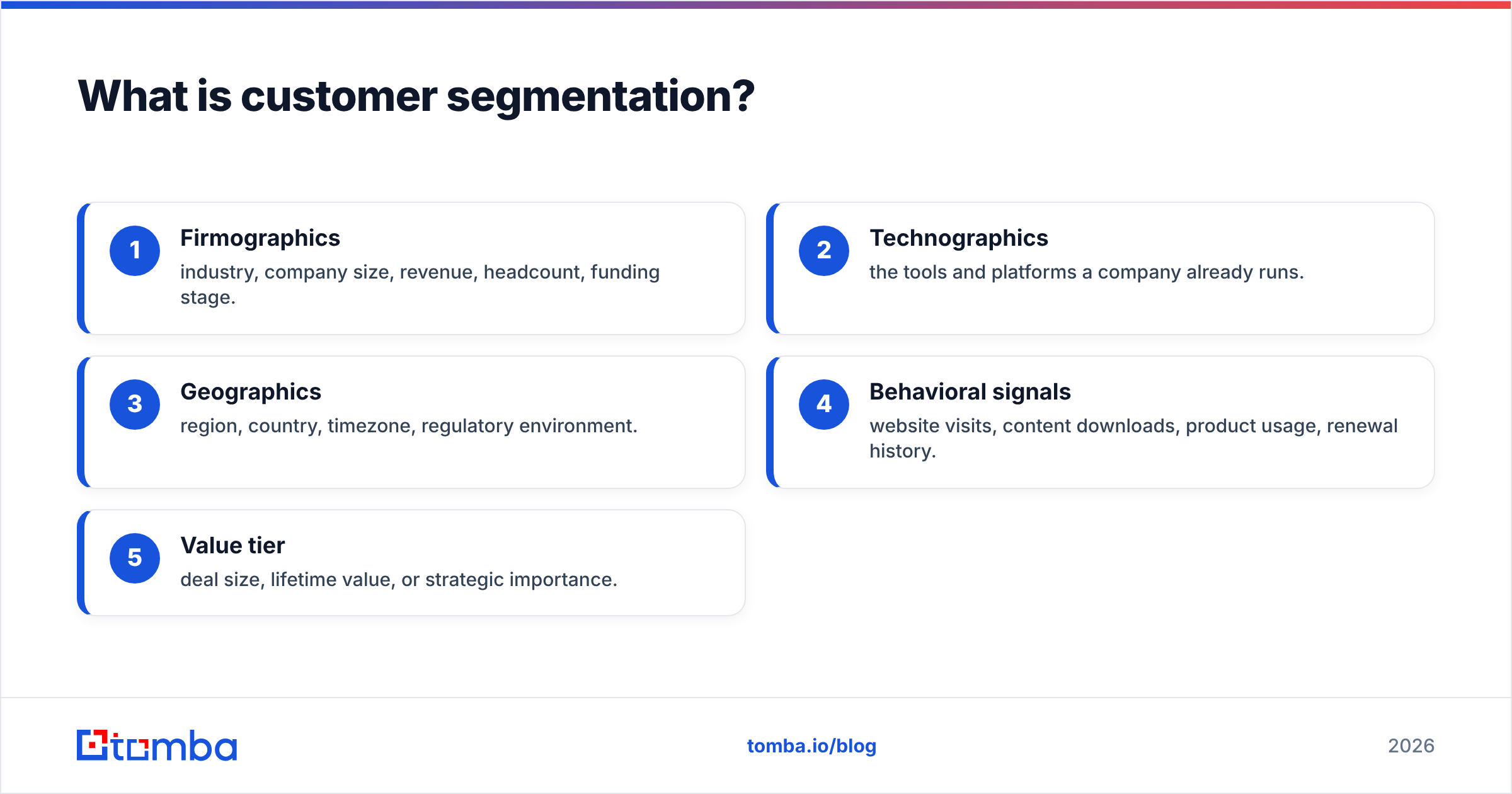
- Firmographics — industry, company size, revenue, headcount, funding stage.
- Technographics — the tools and platforms a company already runs.
- Geographics — region, country, timezone, regulatory environment.
- Behavioral signals — website visits, content downloads, product usage, renewal history.
- Value tier — deal size, lifetime value, or strategic importance.
The output of segmentation is a set of buckets — "mid-market SaaS in North America running HubSpot," "enterprise manufacturers in the EU," and so on. Each bucket gets its own priority, budget, and broad messaging angle. According to HubSpot, segmented campaigns consistently outperform batch-and-blast sends because relevance rises the moment you stop treating every account the same.
Segmentation is a top-down, market-wide exercise. You're looking at thousands of accounts and asking, "How do I carve this into groups my team can actually act on?"

What is customer profiling?#
Customer profiling is the practice of building a rich, detailed description of a specific customer type — often called an Ideal Customer Profile (ICP) or buyer persona. If segmentation sorts the warehouse, profiling is writing the full spec sheet for your single best-selling product: exactly who buys it, why, what almost stops them, and how to reach them.
A strong B2B customer profile typically captures:
- The account: industry, size, growth stage, tech stack, and pain points that your product solves.
- The buyer: job title, seniority, department, goals, and the metrics they're measured on.
- Buying triggers: hiring a new VP, adopting a competing tool, hitting a growth ceiling, a compliance deadline.
- Objections: what makes this person hesitate, and who else has to sign off.
- Contact reality: verified work email, direct phone, LinkedIn — the data that turns a profile into an actual conversation.
Profiling is bottom-up and person-centric. Instead of describing a group, you describe an archetype in enough detail that a rep reading it knows exactly what to say in the first line of a cold email. This is where data enrichment earns its keep — a profile with no verified contact point is a character sketch, not a sales asset.
Salesforce frames the ICP as the foundation of account-based selling for a reason: you cannot run targeted plays without first agreeing on who the target actually is. You can read more on how leading teams structure this in Salesforce's guidance on ideal customer profiles.
Customer segmentation vs customer profiling: what's the real difference?#
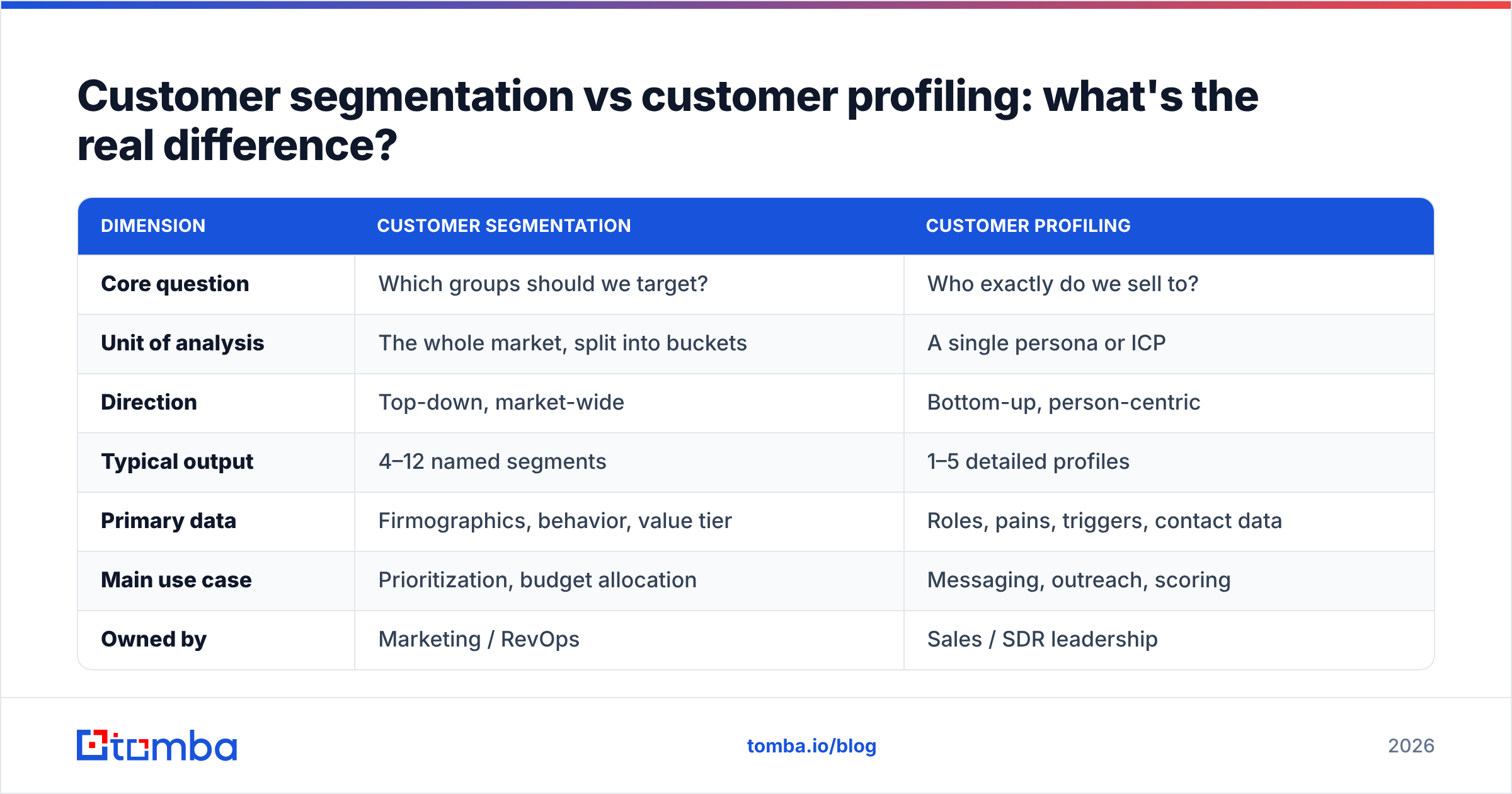
Here's the cleanest way to hold both in your head: segmentation is about groups, profiling is about people. Segmentation tells you which slices of the market to chase; profiling tells you how to win the individuals inside those slices.
| Dimension | Customer Segmentation | Customer Profiling |
|---|---|---|
| Core question | Which groups should we target? | Who exactly do we sell to? |
| Unit of analysis | The whole market, split into buckets | A single persona or ICP |
| Direction | Top-down, market-wide | Bottom-up, person-centric |
| Typical output | 4–12 named segments | 1–5 detailed profiles |
| Primary data | Firmographics, behavior, value tier | Roles, pains, triggers, contact data |
| Main use case | Prioritization, budget allocation | Messaging, outreach, scoring |
| Owned by | Marketing / RevOps | Sales / SDR leadership |
| Fails without | Clean grouping variables | Accurate, verified contacts |
Notice the last row. Both tactics collapse the moment your underlying data is wrong. A segment built on outdated firmographics groups the wrong accounts; a profile built on a bounced email reaches nobody. That's why the teams that win treat a clean B2B database as the prerequisite, not an afterthought.
Is one better than the other?#
No — and framing it as a contest is the mistake. Segmentation and profiling operate at different altitudes and do different jobs. Asking which is "better" is like asking whether a map or a street address is more useful. The map gets you to the right neighborhood; the address gets you to the door.
That said, they have different failure modes:
- Segmentation without profiling gives you tidy buckets and generic messaging. You know you should target "mid-market fintech," but your emails still read like a press release because you never defined the human inside that segment.
- Profiling without segmentation gives you a gorgeous persona and no idea how big the opportunity is or where to spend first. You know your dream buyer intimately — you just can't tell if there are 50 of them or 50,000.
The practical answer is sequence, not preference. Segment to prioritize, profile to convert.
How do segmentation and profiling work together?#
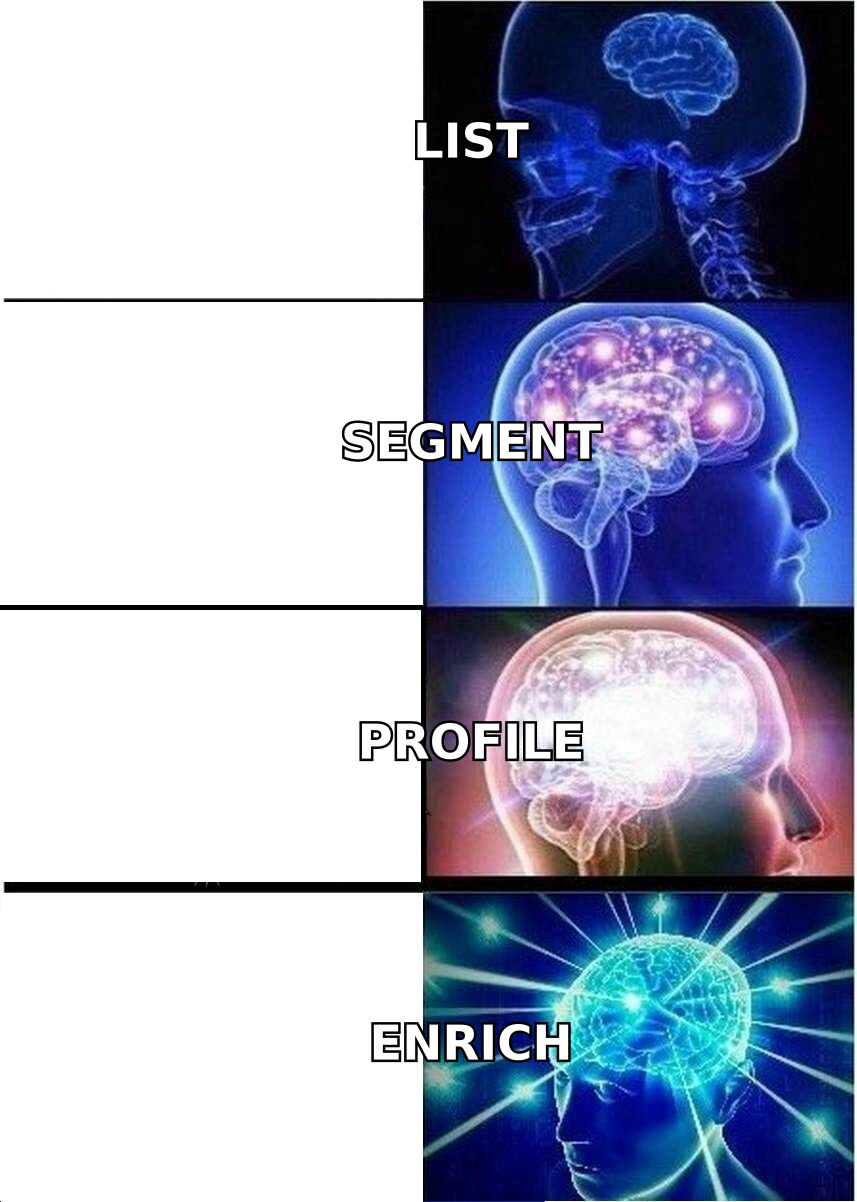
They form a funnel of increasing precision. Here's the workflow most high-performing B2B teams converge on:
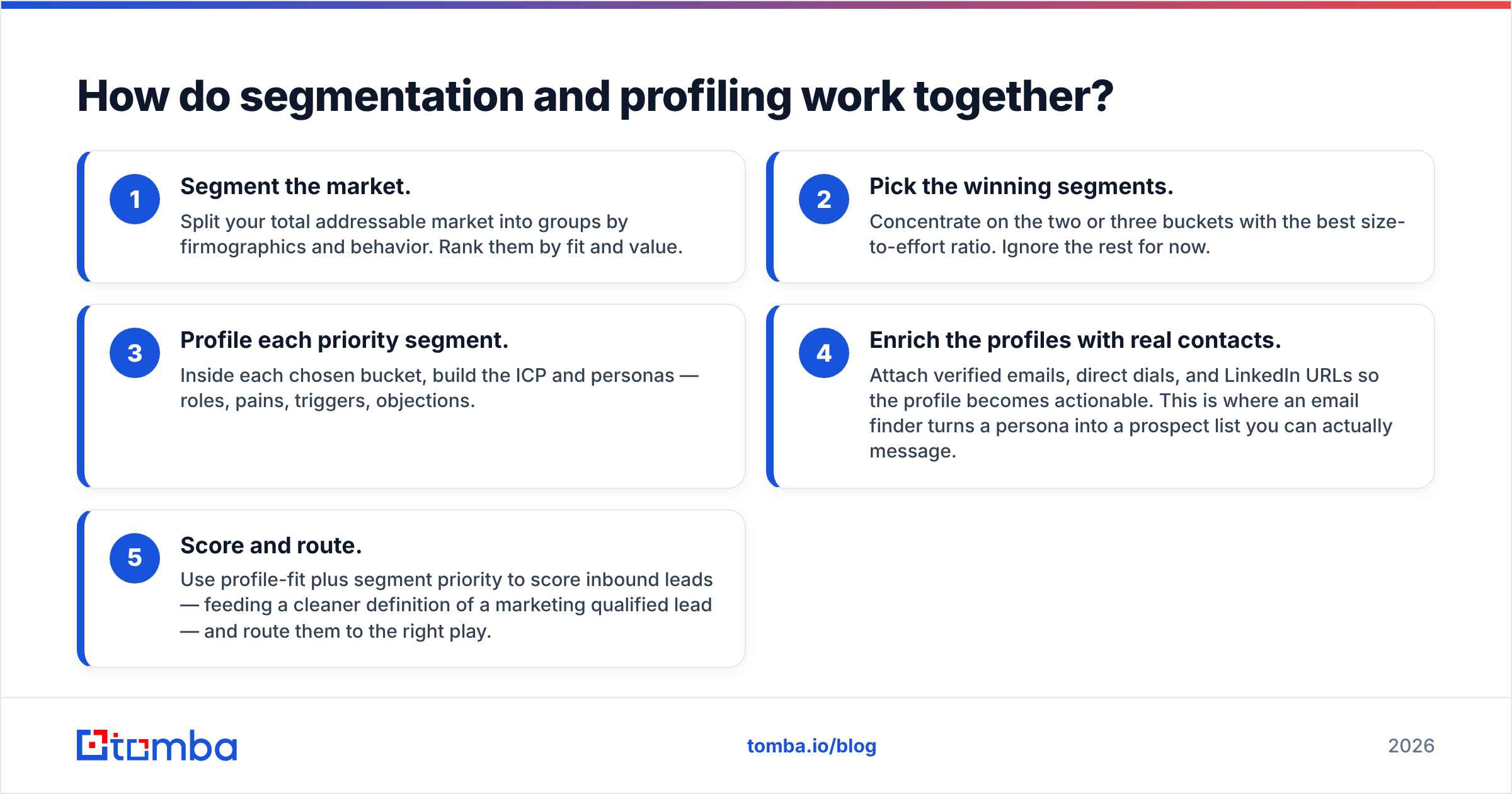
- Segment the market. Split your total addressable market into groups by firmographics and behavior. Rank them by fit and value.
- Pick the winning segments. Concentrate on the two or three buckets with the best size-to-effort ratio. Ignore the rest for now.
- Profile each priority segment. Inside each chosen bucket, build the ICP and personas — roles, pains, triggers, objections.
- Enrich the profiles with real contacts. Attach verified emails, direct dials, and LinkedIn URLs so the profile becomes actionable. This is where an email finder turns a persona into a prospect list you can actually message.
- Score and route. Use profile-fit plus segment priority to score inbound leads — feeding a cleaner definition of a marketing qualified lead — and route them to the right play.
The loop is continuous. As reps work the profiled contacts, real-world reply and win data flows back and refines both the segments and the profiles. Gartner's research on go-to-market strategy repeatedly points to this feedback loop — buy signals informing targeting — as the difference between static ICPs and ones that actually track the market. You can dig into that thinking on Gartner.
A worked example: segmentation and profiling in practice#
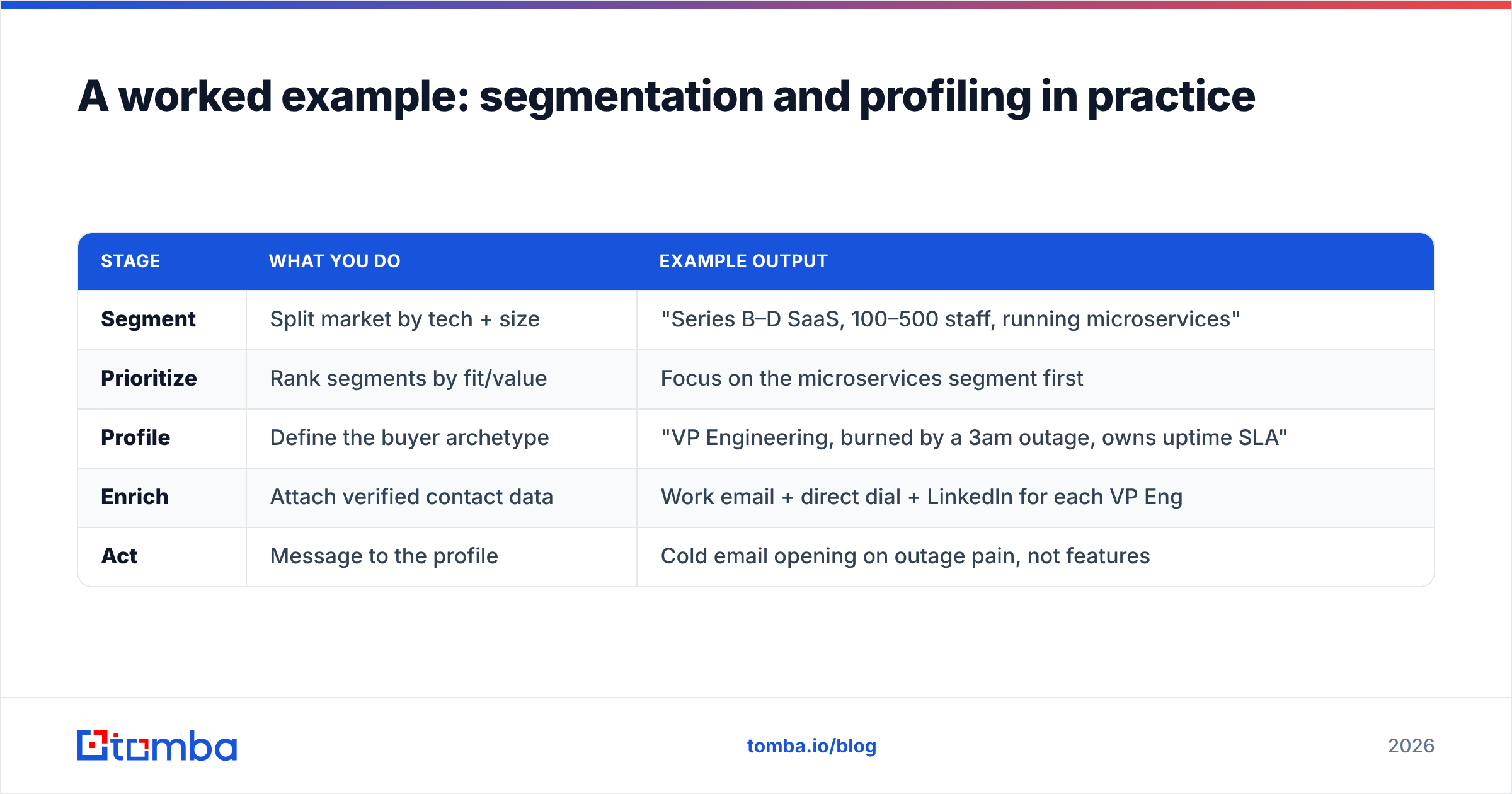
Say you sell an API monitoring tool. Here's how the two tactics stack:
| Stage | What you do | Example output |
|---|---|---|
| Segment | Split market by tech + size | "Series B–D SaaS, 100–500 staff, running microservices" |
| Prioritize | Rank segments by fit/value | Focus on the microservices segment first |
| Profile | Define the buyer archetype | "VP Engineering, burned by a 3am outage, owns uptime SLA" |
| Enrich | Attach verified contact data | Work email + direct dial + LinkedIn for each VP Eng |
| Act | Message to the profile | Cold email opening on outage pain, not features |
At the segment stage you know where to fish. At the profile stage you know what bait to use. At the enrichment stage you actually get a line in the water. Skip any step and the next one weakens.
Notice how the messaging only becomes possible after profiling. "Series B–D SaaS running microservices" doesn't tell a rep what to write. "VP Engineering who got paged at 3am and now owns the uptime SLA" writes the first sentence for you.
What data do you need for each?#
The data requirements diverge, and understanding that split tells you where to invest.
For segmentation you need breadth. You're classifying thousands of accounts, so you want structured, consistent variables across your whole market: industry codes, employee counts, tech stack, region, and behavioral events from your own systems. Coverage matters more than depth — a missing field on one account is fine; a missing field on 40% of accounts breaks the bucket.
For profiling you need depth and accuracy. You're describing a handful of archetypes and then reaching specific people, so you need verified, person-level detail: correct titles, current employer, deliverable email addresses, and direct phone numbers. Here a single wrong record is expensive — it's a bounced send or a call to a number that's been reassigned.
This is exactly why enrichment and verification sit at the center of profiling. A profile that says "target VP Engineering" is worthless until you can produce this VP Engineering, at this company, with an email that lands. Bounce rates above a few percent also drag down email deliverability for your whole domain, so verifying contacts before you send protects far more than a single campaign.
When should you focus on segmentation vs profiling?#
Lean toward segmentation when:
- You're entering a new market and don't yet know which groups convert.
- Marketing needs to allocate budget across campaigns.
- Your TAM is huge and undifferentiated, and you're drowning in accounts.
- Leadership is asking "where should we focus next quarter?"
Lean toward profiling when:
- You've already chosen your target segments and need to convert them.
- SDRs are writing outreach that feels generic and gets low replies.
- You're building account-based plays for named accounts.
- Your lead scoring keeps passing bad-fit leads to sales.
Most teams need both running in parallel, owned by different functions. RevOps and marketing tend to steward segmentation; sales and SDR leadership own profiling and the outreach that flows from it. When those two groups drift apart — marketing chasing one set of segments while sales personalizes for another — pipeline quality drops fast. Keeping them aligned on a shared data foundation is half the battle.
Common mistakes to avoid#
- Over-segmenting. Twenty micro-segments you can't staff is worse than four you can execute. If you can't build a distinct play for a segment, it shouldn't be its own segment.
- Profiles built on opinion, not data. An ICP invented in a conference room drifts from reality. Anchor it to your actual closed-won deals.
- Letting profiles go stale. People change jobs constantly in B2B. A profile enriched two years ago is mostly noise now — re-verify contact data regularly.
- Confusing a persona with a lead list. A persona describes a type; a lead list contains real, reachable people. You need enrichment to bridge them.
- Ignoring the data layer. The fanciest segmentation model and the most detailed profile both die on bad contact data. Start there.
The bottom line#
Segmentation and customer profiling aren't competitors — they're two zoom levels of the same picture. Segment to decide where to spend. Profile to decide what to say and to whom. Then enrich those profiles with verified, deliverable contact data so the whole thing turns into pipeline instead of a slide deck.
The teams that win don't argue about which tactic is better. They run both, keep the underlying data clean, and let real reply data refine their groups and personas over time.
If your profiles keep dead-ending at "we know who to target but not how to reach them," start at the data layer. Tomba's Email Finder turns a defined persona into verified, ready-to-contact leads — find professional emails by name, company, or domain, then push them straight into your sequences. Build the segment, sharpen the profile, and give your reps contacts that actually land. Compare options on the Tomba pricing page, starting free with 25 searches a month.
Related guides#
Ready to find emails that actually work?
Join 150,000+ professionals who stopped guessing and started sending. Free credits on signup — no credit card required.
Get the Tomba newsletter
Practical outbound tactics and product updates — once every two weeks.
About the author