Customer Targeting in 2026: A Practical B2B Playbook
Most B2B teams target too broadly and burn pipeline. Here's how to define your ideal customer, segment by fit, and reach real buyers in 2026 without wasting outreach.
Customer targeting is the difference between a pipeline full of deals you can actually close and an inbox full of "not interested" replies. In 2026, with buyers ignoring generic outreach and data privacy tightening the funnel, targeting the wrong accounts is not just inefficient — it's expensive. This guide breaks down how to define, segment, and reach the right customers without wasting a single credit.
TL;DR#
- Customer targeting is the process of identifying, prioritizing, and reaching the specific accounts and people most likely to buy — not everyone who technically could.
- The foundation is a sharp Ideal Customer Profile (ICP) plus buyer personas, backed by firmographic, technographic, and intent data.
- Fit-based targeting (score accounts by how well they match your ICP) consistently beats volume-based "spray and pray" outreach.
- Clean, verified contact data is the make-or-break input — bad data quietly kills even a perfect targeting strategy.
- Tools like Tomba's email finder and data enrichment turn your target list into reachable, verified contacts.
What is customer targeting?#
Customer targeting is choosing who you sell to before you decide how. Think of it like fishing: you can drop a net anywhere and haul in whatever swims by, or you can learn where a specific fish feeds, at what depth, at what time of day — and cast there. The second approach catches fewer things by accident and far more of what you actually want.
In B2B, targeting operates on two levels at once:
- Account-level — which companies fit your product (size, industry, tech stack, growth stage).
- Contact-level — which people inside those companies influence or make the buying decision.
A common mistake is treating targeting as a one-time list build. In reality it's a continuous loop: define your ideal customer, find matching accounts, reach the right people, measure who converts, then feed those learnings back into your definition. Teams that skip the feedback step keep targeting the customers they wish they had instead of the ones who actually pay.
Why does customer targeting matter more in 2026?#
Three shifts have raised the cost of poor targeting:
- Reply rates punish irrelevance. Buyers get more cold outreach than ever, so anything generic gets deleted in under a second. Precise, relevant messaging is now table stakes, and relevance starts with targeting.
- Deliverability is fragile. Blasting large, unverified lists trashes your sender reputation and lands future mail in spam — even to good prospects. Tight targeting keeps volumes sane and bounce rates low.
- Budgets reward efficiency. According to Gartner research on B2B buying, purchase decisions now involve larger buying groups and longer cycles. Chasing bad-fit accounts wastes weeks you can't get back.
The payoff for getting it right is compounding: better fit means higher win rates, shorter cycles, bigger deals, and lower churn — because you sold to companies your product was built for in the first place.
What are the building blocks of a targeting strategy?#
Every solid targeting strategy stacks four layers. Skip one and the whole thing wobbles.
- Ideal Customer Profile (ICP) — a description of the company that gets the most value from you: revenue band, headcount, industry, region, tech stack, and growth signals.
- Buyer personas — the people inside the ICP: their role, goals, pains, and what makes them say yes. A VP of Sales and a RevOps manager care about different things.
- Segmentation — grouping your total addressable market into tiers so you can spend more effort on higher-value fits.
- Data and enrichment — the firmographic, technographic, and intent signals that let you actually score and reach accounts. This is where a reliable B2B database earns its keep.
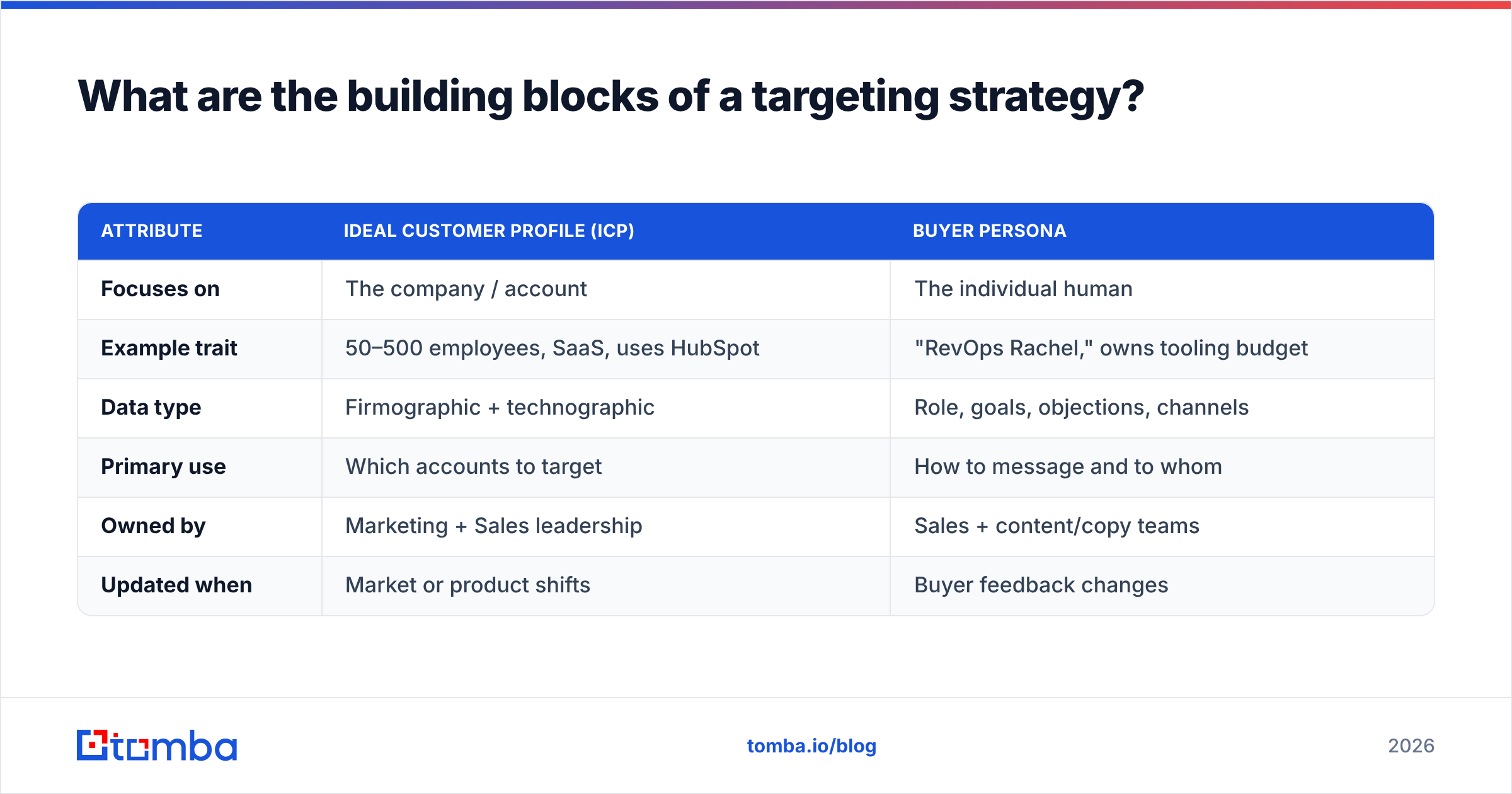
Here's how the two most-confused layers differ:
| Attribute | Ideal Customer Profile (ICP) | Buyer Persona |
|---|---|---|
| Focuses on | The company / account | The individual human |
| Example trait | 50–500 employees, SaaS, uses HubSpot | "RevOps Rachel," owns tooling budget |
| Data type | Firmographic + technographic | Role, goals, objections, channels |
| Primary use | Which accounts to target | How to message and to whom |
| Owned by | Marketing + Sales leadership | Sales + content/copy teams |
| Updated when | Market or product shifts | Buyer feedback changes |
Use the ICP to build the list. Use personas to write the message. Confusing the two is why so many "personalized" emails still feel like junk.
How do you build an Ideal Customer Profile that works?#
Start with evidence, not aspiration. Your best ICP is hiding in your existing customer data.
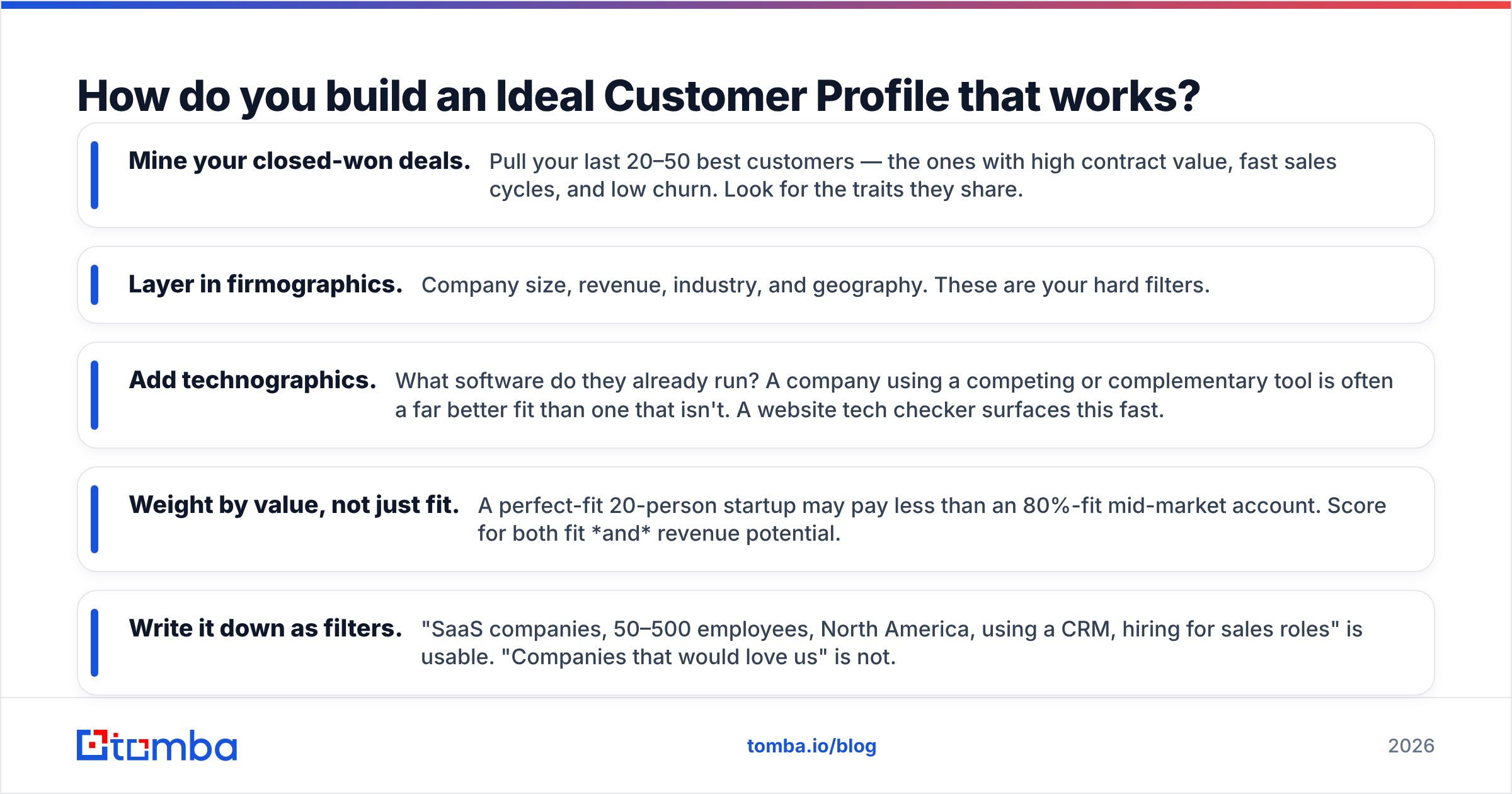
- Mine your closed-won deals. Pull your last 20–50 best customers — the ones with high contract value, fast sales cycles, and low churn. Look for the traits they share.
- Layer in firmographics. Company size, revenue, industry, and geography. These are your hard filters.
- Add technographics. What software do they already run? A company using a competing or complementary tool is often a far better fit than one that isn't. A website tech checker surfaces this fast.
- Weight by value, not just fit. A perfect-fit 20-person startup may pay less than an 80%-fit mid-market account. Score for both fit and revenue potential.
- Write it down as filters. "SaaS companies, 50–500 employees, North America, using a CRM, hiring for sales roles" is usable. "Companies that would love us" is not.
Validate the ICP against your pipeline before you scale. If your defined ICP doesn't overlap with the accounts already closing, your definition — not your reps — is the problem.
Fit-based vs. volume-based targeting: which wins?#
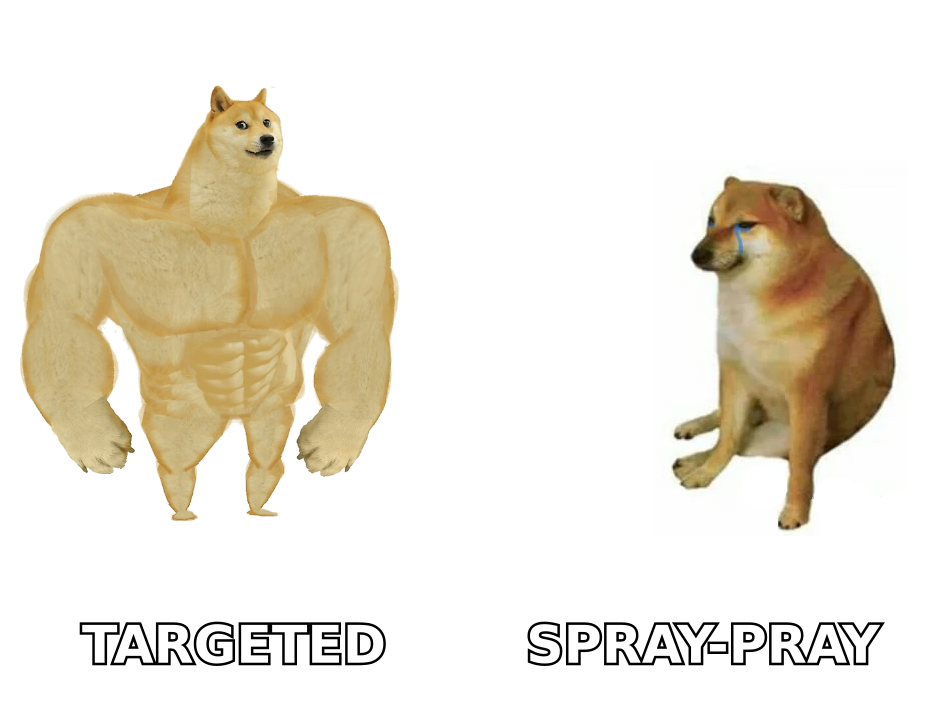
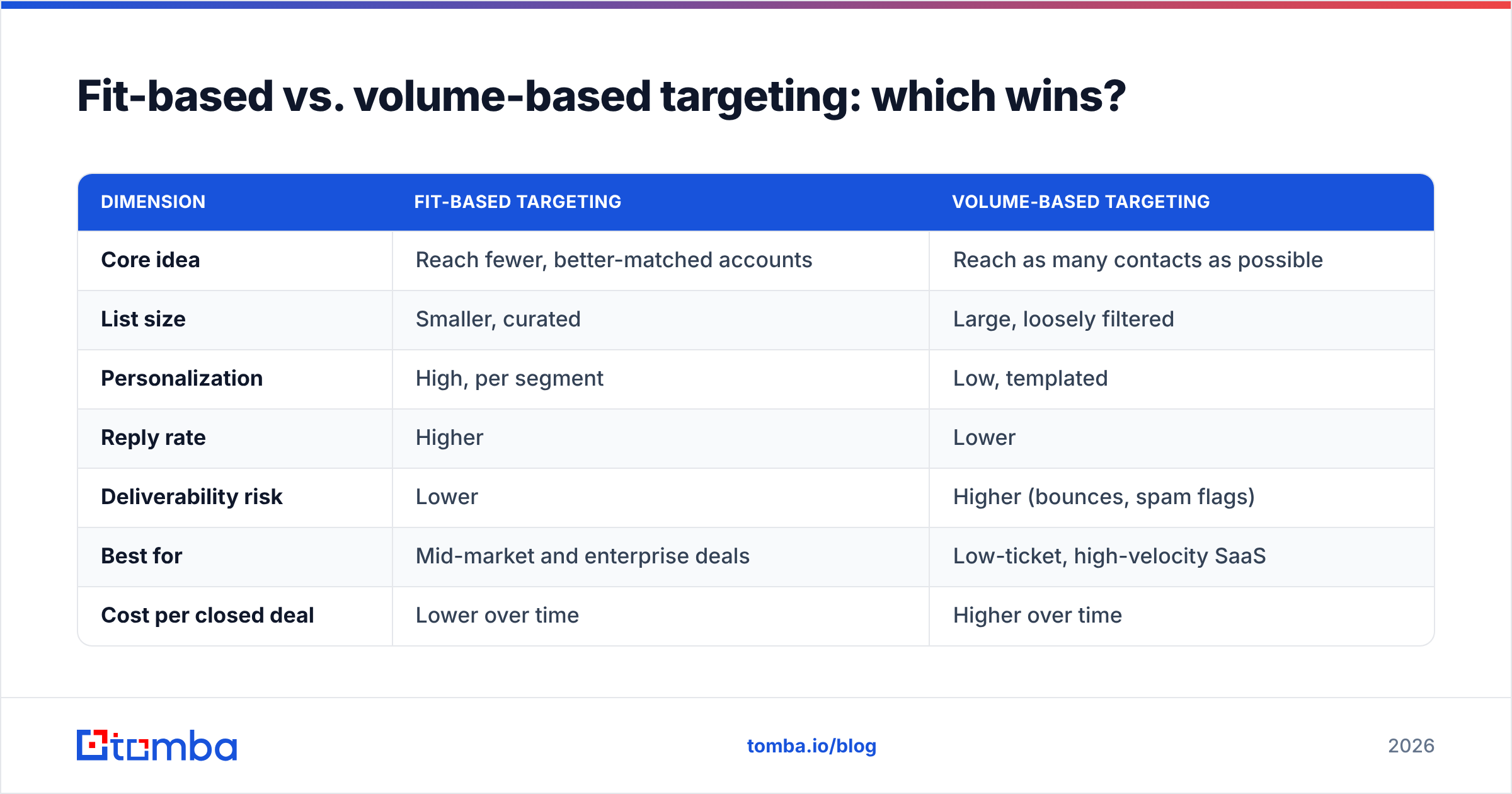
Fit-based targeting wins for almost every B2B team that sells a considered purchase. Volume-based targeting only makes sense when your product is cheap, self-serve, and closes with near-zero human touch.
| Dimension | Fit-based targeting | Volume-based targeting |
|---|---|---|
| Core idea | Reach fewer, better-matched accounts | Reach as many contacts as possible |
| List size | Smaller, curated | Large, loosely filtered |
| Personalization | High, per segment | Low, templated |
| Reply rate | Higher | Lower |
| Deliverability risk | Lower | Higher (bounces, spam flags) |
| Best for | Mid-market and enterprise deals | Low-ticket, high-velocity SaaS |
| Cost per closed deal | Lower over time | Higher over time |
The trap is that volume feels productive — more emails sent looks like more work done. But sending 5,000 emails to a bad list produces fewer meetings than 500 to a sharp one, and it damages the infrastructure you need for the next campaign. Target quality, then scale the winning segments.
How do you segment your target market?#
Segmentation turns one giant "everyone" into a handful of prioritized groups you can message distinctly. The four most useful B2B segmentation lenses:
- Firmographic — industry, company size, revenue, location. The baseline for almost every B2B list.
- Technographic — the tools a company uses. Strong buying signals live here: a company that just adopted a CRM may need everything that plugs into it.
- Behavioral / intent — actions that suggest active buying: site visits, content downloads, job postings, funding rounds.
- Value tier — Tier 1 (dream accounts, full personalization), Tier 2 (strong fit, semi-personalized), Tier 3 (acceptable fit, scaled outreach).
A practical model is the classic 1:1, 1:few, 1:many split borrowed from account-based marketing. Reserve deep research and custom messaging for Tier 1, use segment-level personalization for Tier 2, and run efficient templated sequences for Tier 3. You spend your scarce human effort exactly where it moves revenue.
How do you turn a target list into reachable contacts?#
A segmented account list is potential energy. It does nothing until you can actually reach a decision-maker — with a valid email or phone number that lands. This is the step most strategies underinvest in, and it's where good data separates results from theory.
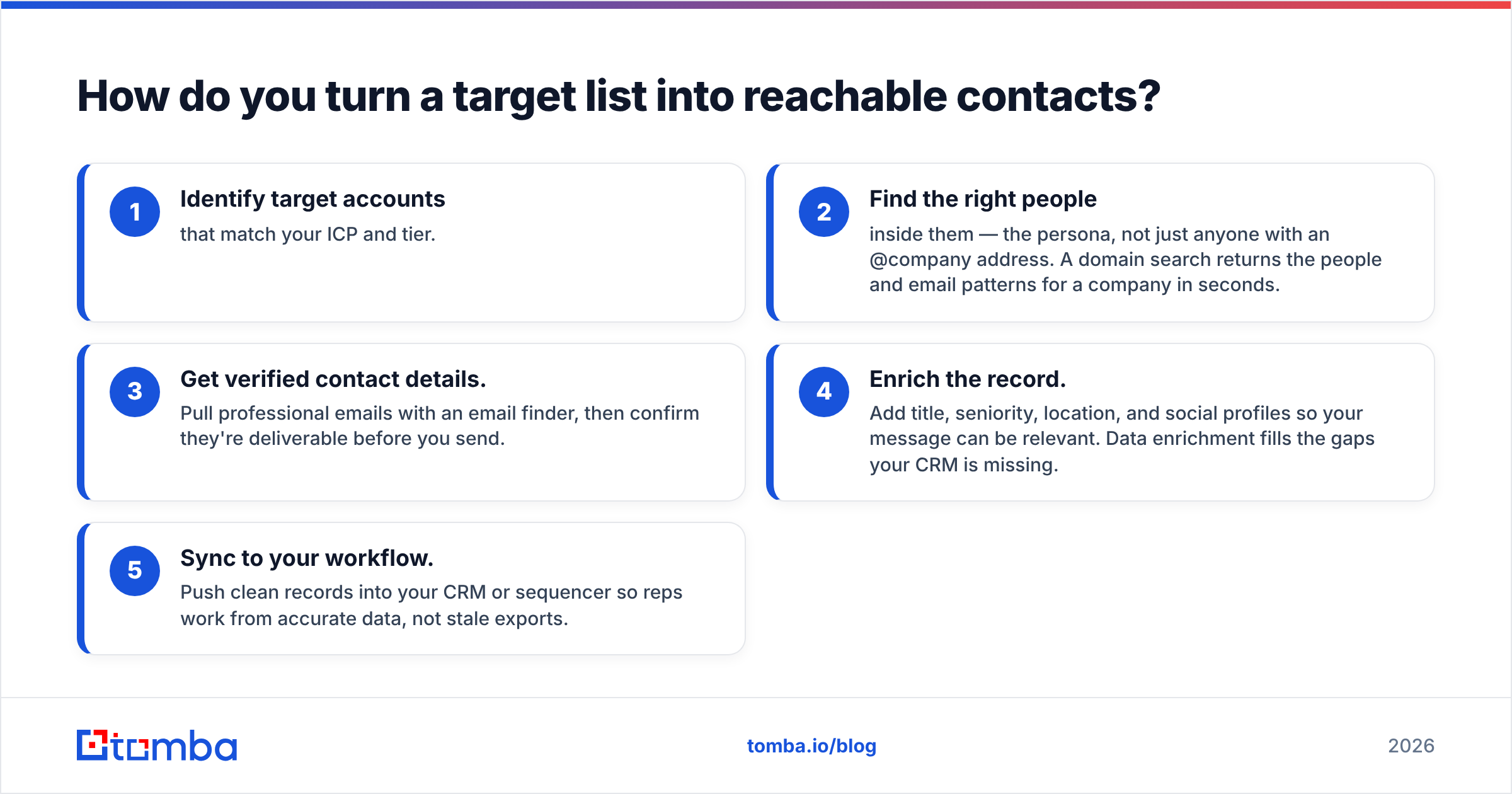
The workflow looks like this:
- Identify target accounts that match your ICP and tier.
- Find the right people inside them — the persona, not just anyone with an @company address. A domain search returns the people and email patterns for a company in seconds.
- Get verified contact details. Pull professional emails with an email finder, then confirm they're deliverable before you send.
- Enrich the record. Add title, seniority, location, and social profiles so your message can be relevant. Data enrichment fills the gaps your CRM is missing.
- Sync to your workflow. Push clean records into your CRM or sequencer so reps work from accurate data, not stale exports.
Verification matters more than most teams admit. Sending to unverified addresses inflates bounce rates, and high bounces tell mailbox providers you're a spammer — so your next campaign underperforms even to perfect-fit prospects. Verifying up front protects the whole system. Independent reviews on G2 consistently rank verification as the single highest-leverage data-quality step for outbound teams.
What data quality problems quietly wreck targeting?#
Even a flawless strategy fails on dirty data. Watch for these:
- Stale records. People change jobs constantly; roughly a third of B2B contact data decays each year. A "perfect" list from 12 months ago is now partly fiction.
- Catch-all domains. Some company servers accept every address, so a normal verifier can't confirm the mailbox exists. You need catch-all-specific handling to avoid guessing.
- Missing decision-makers. You have a company but only reach an intern. Enrichment and persona-based search fix the "right company, wrong person" gap.
- Duplicate and conflicting entries. The same account in three formats splits your data and skews reporting.
The fix is process, not heroics: verify on capture, enrich on entry, and re-check high-value segments before major campaigns. Treat your target data as a living asset, not a one-time purchase.
How do you measure whether your targeting works?#
Targeting is a hypothesis. These metrics tell you if it's true:
- Reply and positive-reply rate by segment — the fastest signal that a segment fits.
- Meeting-booked rate — filters out polite "no thanks" replies.
- Win rate by ICP tier — Tier 1 should meaningfully outperform Tier 3, or your tiers are wrong.
- Sales-cycle length — good-fit accounts close faster.
- Bounce rate — a proxy for data quality; rising bounces mean your list is decaying.
- Customer lifetime value and churn by segment — the ultimate proof, since a "won" bad-fit deal often churns fast.
Review these monthly and feed the results back into your ICP. If a segment you rated Tier 2 quietly outperforms Tier 1, promote it. Targeting is never finished — it's tuned.
Common customer-targeting mistakes to avoid#
- Targeting everyone. "Any company with an email" is not a strategy. Broad is the enemy of relevant.
- Confusing job titles with authority. Titles vary wildly across companies; map to role in the buying decision instead.
- Ignoring the buying group. Modern B2B decisions involve several stakeholders. Reaching one champion isn't enough — map the committee.
- Skipping verification to save time. You'll pay it back with interest in bounces and spam placement.
- Never revisiting the ICP. Markets move. A definition set two years ago may be targeting a shrinking segment.
Frequently asked questions#
What's the difference between customer targeting and segmentation? Targeting is the decision of which groups to pursue; segmentation is the act of dividing your market into those groups. You segment first, then target the segments worth your effort.
How many buyer personas should I have? Usually three to five per ICP. Enough to message distinctly, few enough to actually maintain. More than five and they blur together.
Can small teams do account-based targeting? Yes. Small teams often do it better because they can't afford waste. Start with a tight Tier 1 list of 25–50 dream accounts and go deep rather than wide.
How often should I refresh my target list? Re-verify high-value segments before every major campaign, and rebuild your ICP quarterly or whenever your product or market shifts.
Put your targeting into motion with verified contacts#
Great targeting dies without great data. Once you've defined your ICP, segmented your market, and mapped your personas, the last mile is reaching real, verified decision-makers — and that's exactly what Tomba's Email Finder is built for. Find professional emails by domain, name, or company, verify them before you send, and enrich each record so your outreach lands relevant and in the inbox. Start free with 25 searches a month, and when you're ready to scale, check Tomba pricing — plans begin at $49/mo. Target sharper, waste less, and turn your best-fit accounts into pipeline.
Related guides#
Ready to find emails that actually work?
Join 150,000+ professionals who stopped guessing and started sending. Free credits on signup — no credit card required.
Get the Tomba newsletter
Practical outbound tactics and product updates — once every two weeks.
About the author