Customer Targeting for B2B: A Practical 2026 Playbook
Most B2B pipelines leak because the targeting is wrong, not the messaging. Here's how to build a tight ICP, score accounts, and reach the right buyers in 2026 without burning your domain or your budget.
TL;DR
- Customer targeting for B2B is the discipline of deciding who you sell to before you decide what you say — get this wrong and no amount of copy fixes it.
- Start with a written Ideal Customer Profile (ICP) built on firmographics, technographics, and observed pain, then layer buying-committee personas on top.
- Score accounts with a simple fit-plus-intent model so reps spend time on the 20% of accounts that produce 80% of revenue.
- Data quality is the hidden multiplier: a tight target list with verified contact data beats a huge list of guesses every time.
- Reach buyers where they already are — email, phone, and LinkedIn — using accurate, permission-aware data instead of spray-and-pray blasts.
What is customer targeting for B2B?#
Customer targeting for B2B is the process of defining, prioritizing, and reaching the specific companies and people most likely to buy from you. Think of it like fishing: spray-and-pray outbound is casting a net across the whole ocean and hoping. Real targeting is knowing which lake holds the fish you want, what bait they bite, and when they feed.
In practice, targeting sits upstream of every other go-to-market activity. Your messaging, channel mix, lead scoring, and even your product roadmap all inherit their quality from how well you defined the target. When targeting is loose, symptoms show up everywhere downstream: low reply rates, long sales cycles, high churn, and reps who "work hard" but miss quota.
The shift over the last few years is that B2B buyers now self-educate. According to Gartner research, buyers spend only about 17% of the purchase journey talking to any supplier's sales team, and even less with any single vendor. That means you rarely get to convince the wrong account — you only get to reach the right one at the right moment. Targeting is how you earn those minutes.
Why does most B2B targeting fail?#
Most targeting fails for one of three reasons, and all three are fixable.
- No written ICP. The profile lives in a founder's head or a rep's gut. It can't be tested, taught, or scaled.
- Firmographics only. Teams target "SaaS companies, 50–200 employees" and stop there — ignoring whether those companies actually have the pain the product solves.
- Bad data underneath a good strategy. The ICP is right, but the contact list is stale, unverified, or scraped years ago, so outreach bounces and reputation tanks.
That third failure is the quiet killer. You can nail the strategy and still lose because your emails hit dead inboxes. High bounce rates hurt your sender reputation, which drags down deliverability for the good addresses too. Targeting and data hygiene are not separate projects — they are the same project.
How do you build an Ideal Customer Profile?#
Your ICP is the foundation, so build it from evidence, not aspiration. The fastest path is to mine your own best customers.
Pull your closed-won accounts from the last 12–24 months, filter for the ones with the highest retention and expansion, and look for what they share. Then document the profile across four layers:
- Firmographics — industry, company size, revenue, geography, funding stage. The "what kind of company" layer.
- Technographics — the tools they already run. If your product integrates with HubSpot or Salesforce, companies using those tools are warmer by default.
- Trigger events — hiring for a role, new funding, a leadership change, a product launch, or a compliance deadline. These signal when an account is in-market.
- Persona and pain — who inside the account feels the problem, and how they describe it in their own words.
A written ICP turns targeting from an art into a repeatable filter. Every account either matches the criteria or it doesn't, and reps stop debating gut feelings.
ICP vs. buyer persona vs. TAM — what's the difference?#
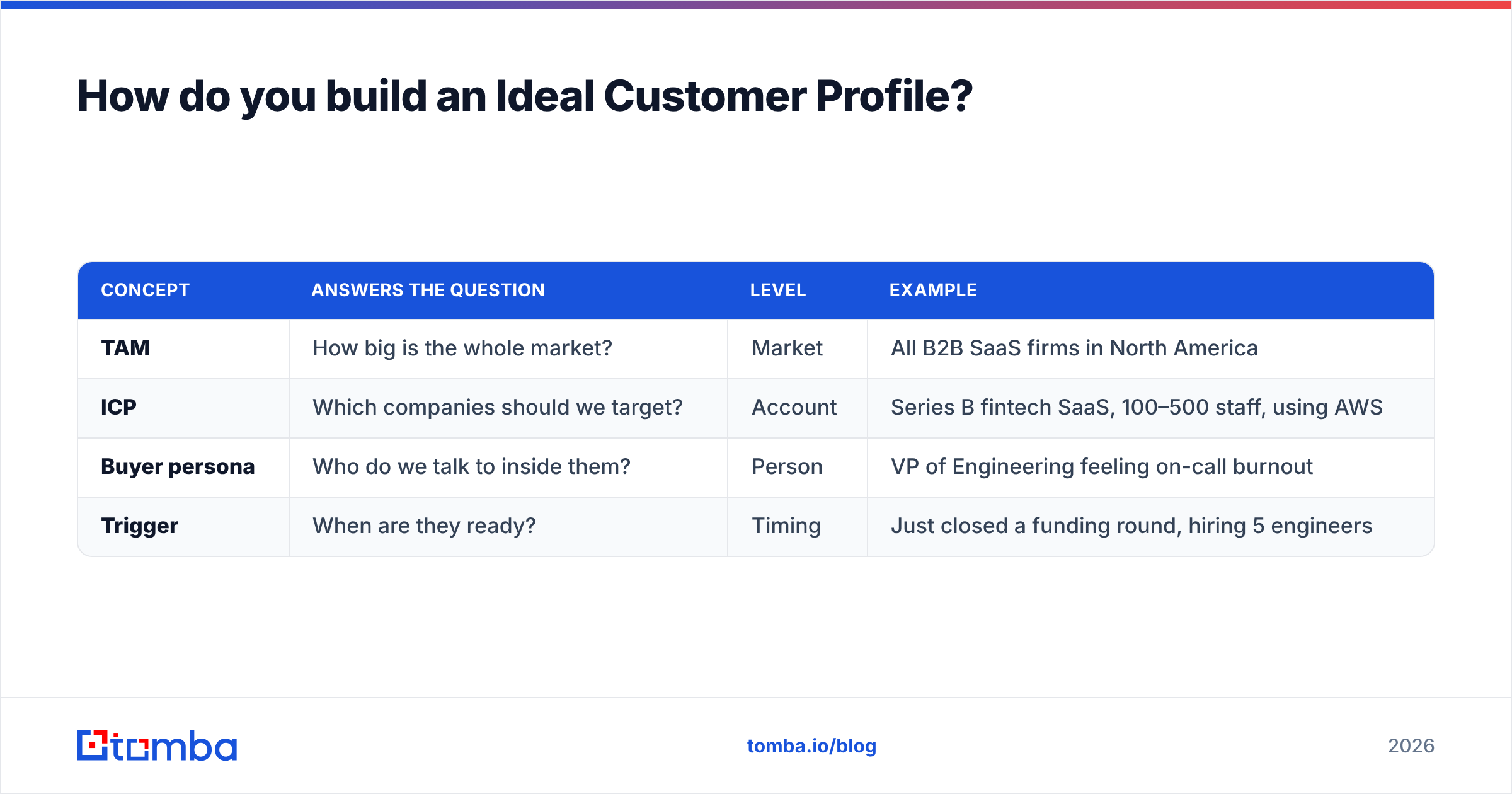
These three terms get used interchangeably and shouldn't be. Here's the distinction that matters:
| Concept | Answers the question | Level | Example |
|---|---|---|---|
| TAM | How big is the whole market? | Market | All B2B SaaS firms in North America |
| ICP | Which companies should we target? | Account | Series B fintech SaaS, 100–500 staff, using AWS |
| Buyer persona | Who do we talk to inside them? | Person | VP of Engineering feeling on-call burnout |
| Trigger | When are they ready? | Timing | Just closed a funding round, hiring 5 engineers |
Your TAM is the ocean. Your ICP narrows it to the right lakes. Your personas are the specific fish. Triggers tell you when they're feeding. You need all four working together — an ICP with no personas leaves reps guessing who to email, and personas with no triggers leave them guessing when.
How do you score and prioritize target accounts?#
Once you have a list that fits your ICP, you still can't call all of it at once. Prioritization is where good targeting turns into pipeline. The simplest durable model scores two axes and multiplies them.
- Fit — how closely the account matches your ICP (firmographic + technographic match), scored 1–5.
- Intent — observed signals that the account is in-market right now: website visits, content downloads, job postings, competitor research, or social selling engagement, scored 1–5.
Multiply the two and you get a 1–25 priority score. Accounts scoring 16+ are your A-tier — human-led, multi-threaded outreach. The 9–15 band is B-tier for lighter-touch sequences. Below 9, you nurture with marketing until a trigger fires. This keeps your best reps on the accounts most likely to close instead of treating a 10,000-row list as equally worthy.
The payoff is real: teams that concentrate effort on high-fit, high-intent accounts consistently report better win rates than teams that work lists top-to-bottom. Prioritization is leverage, and it costs nothing but discipline.
What data do you need for accurate B2B targeting?#
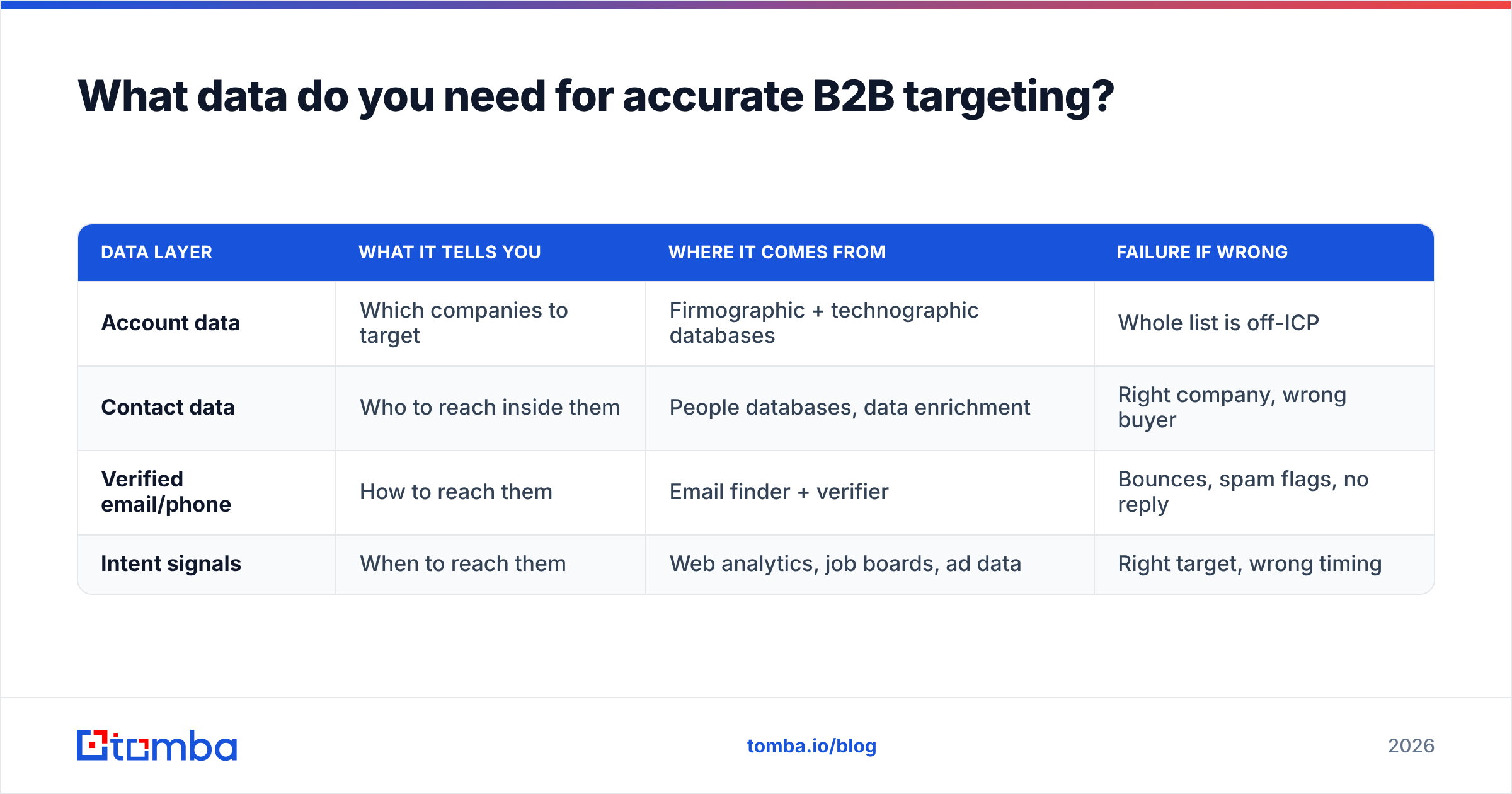
You need three data layers, and the accuracy of each compounds. Getting the company right but the person wrong wastes the whole effort; getting the person right but the email wrong wastes it at the finish line.
| Data layer | What it tells you | Where it comes from | Failure if wrong |
|---|---|---|---|
| Account data | Which companies to target | Firmographic + technographic databases | Whole list is off-ICP |
| Contact data | Who to reach inside them | People databases, data enrichment | Right company, wrong buyer |
| Verified email/phone | How to reach them | Email finder + verifier | Bounces, spam flags, no reply |
| Intent signals | When to reach them | Web analytics, job boards, ad data | Right target, wrong timing |
Contact data decays fast — a meaningful share of B2B professionals change roles every year, so any list older than a few months is partly fiction. This is why verification is not optional. Before you send, run addresses through an email verifier to strip out invalids and catch-alls, and use domain search to map every reachable contact at a target company in one pass.
When you're sourcing net-new accounts, you have options: build from your own research, enrich an existing CRM segment, or buy from a curated provider. Vendors like BookYourData offer pre-built B2B lists that can jump-start a segment, and pairing any purchased list with independent verification is the safe way to use one. The principle holds regardless of source — trust, but verify.
Which channels work best for B2B targeting in 2026?#
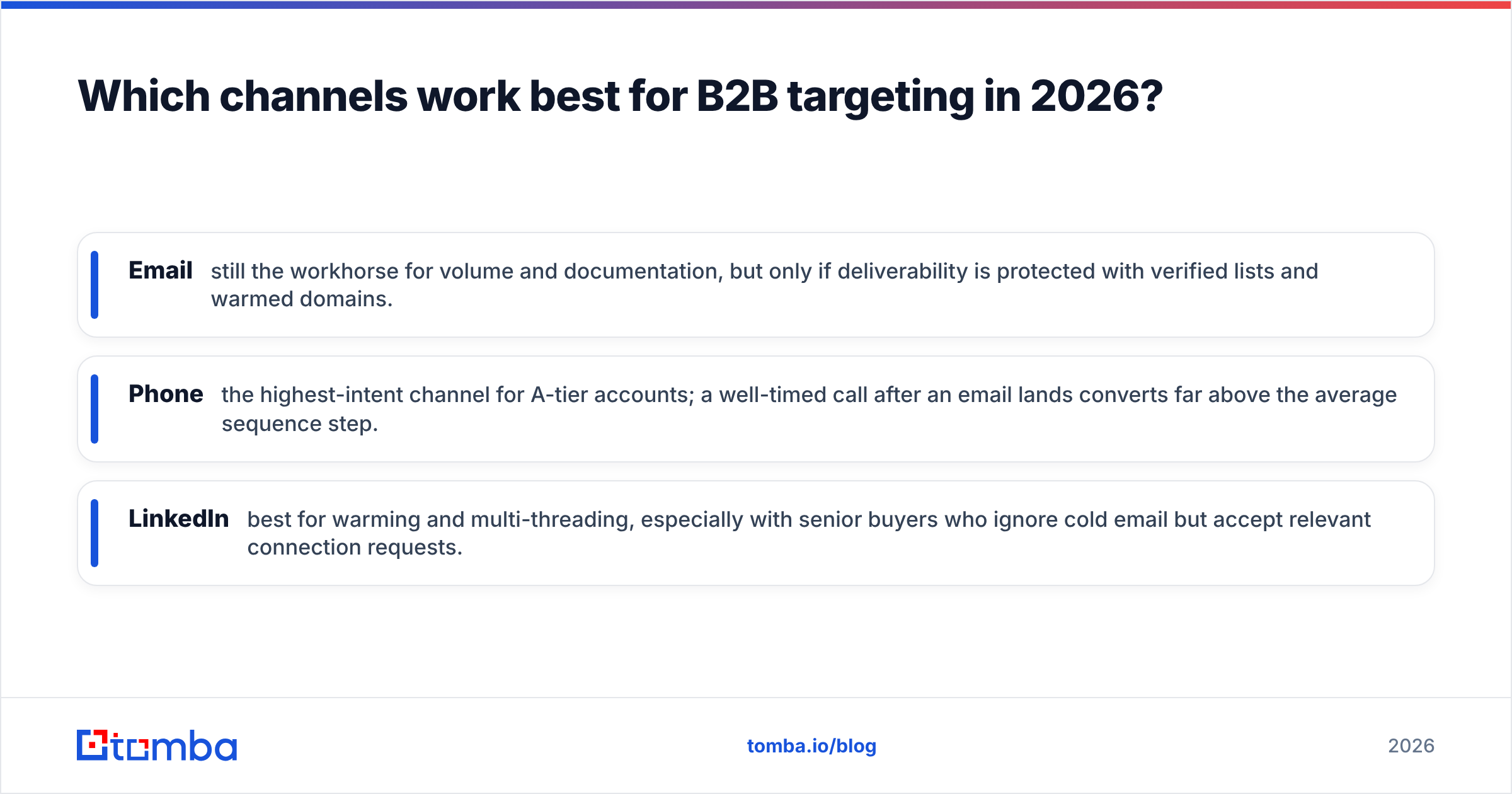
The best channel is wherever your specific buyer actually responds, which is why targeting and channel choice are linked. That said, three channels carry most B2B outbound, and the winning move is sequencing them rather than picking one.
- Email — still the workhorse for volume and documentation, but only if deliverability is protected with verified lists and warmed domains.
- Phone — the highest-intent channel for A-tier accounts; a well-timed call after an email lands converts far above the average sequence step.
- LinkedIn — best for warming and multi-threading, especially with senior buyers who ignore cold email but accept relevant connection requests.
A simple, effective cadence multi-threads across all three: a personalized email referencing a trigger event, a LinkedIn touch a day later, then a phone call to the primary persona. HubSpot's sales data consistently shows that multi-touch, multi-channel sequences outperform single-channel blasts — but only when each touch is relevant, which loops right back to targeting quality.
The failure mode to avoid: buying a giant list and blasting the same email to all of it. It burns your domain, trains buyers to ignore you, and produces the vanity metric of "emails sent" with none of the revenue. Fewer, better-targeted touches win.
How do you measure whether your targeting is working?#
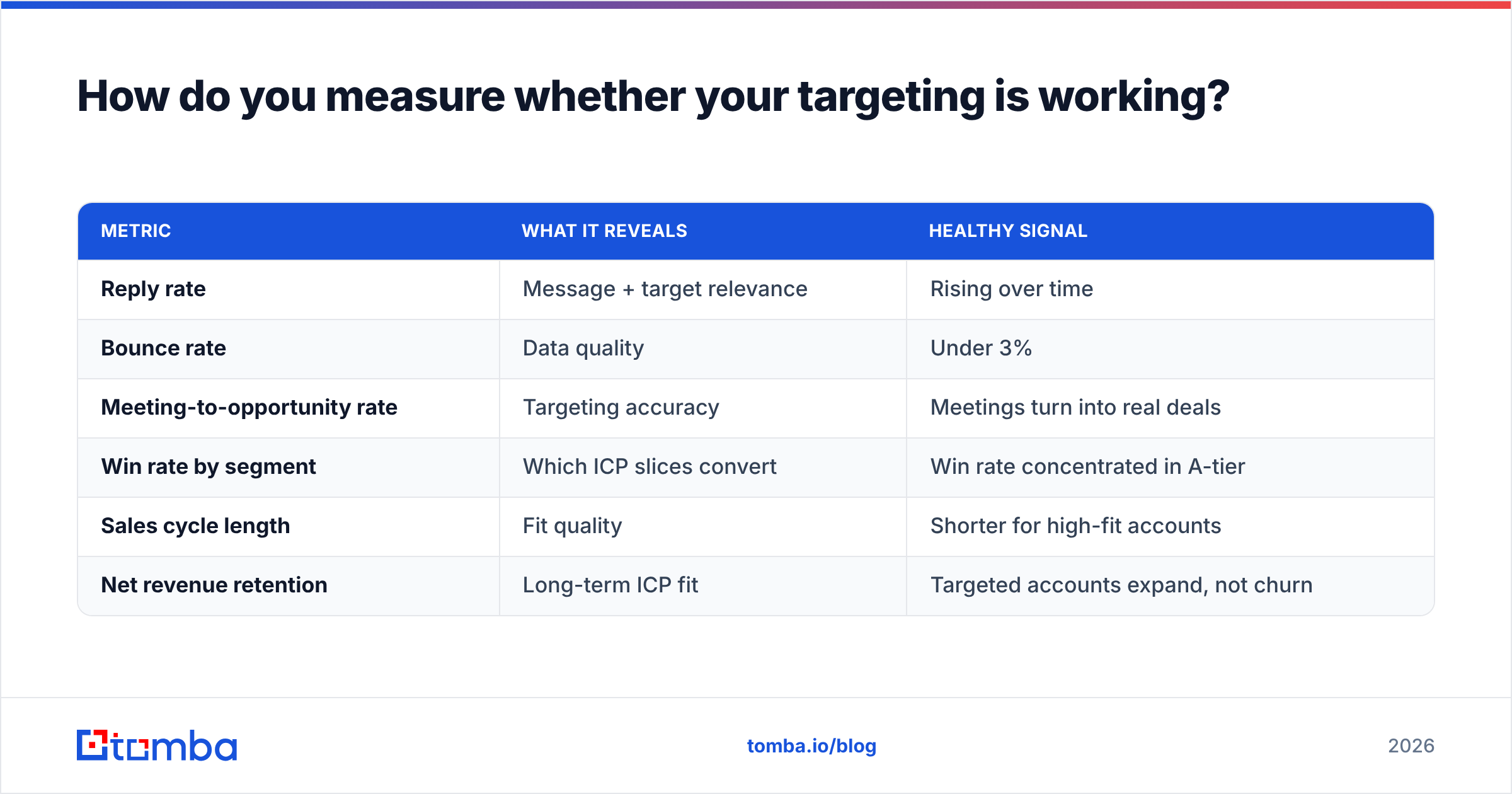
Track leading and lagging indicators together, because targeting problems show up in leading metrics weeks before they hit revenue.
| Metric | What it reveals | Healthy signal |
|---|---|---|
| Reply rate | Message + target relevance | Rising over time |
| Bounce rate | Data quality | Under 3% |
| Meeting-to-opportunity rate | Targeting accuracy | Meetings turn into real deals |
| Win rate by segment | Which ICP slices convert | Win rate concentrated in A-tier |
| Sales cycle length | Fit quality | Shorter for high-fit accounts |
| Net revenue retention | Long-term ICP fit | Targeted accounts expand, not churn |
If reply rates are healthy but win rates are low, your messaging is fine and your targeting is off — you're reaching people who can't or won't buy. If bounce rates are high, fix your data before touching anything else. Read the metrics as a diagnostic chain, not a scorecard, and let them feed back into a quarterly ICP review. Markets move; your target should move with them.
Common B2B targeting mistakes to avoid#
- Targeting titles instead of people. "VP of Sales" is a title, not a buyer. Some VPs own the budget; others are figureheads. Verify the actual decision-maker per account.
- Confusing a big list with a good list. A 500-account list you can multi-thread beats a 50,000-row list you blast once.
- Ignoring data decay. Re-verify and re-enrich on a schedule, not once at import.
- Skipping the buying committee. Enterprise B2B deals involve multiple stakeholders; single-threading into one contact is the fastest way to stall.
- Never revisiting the ICP. An ICP written two years ago is describing a market that no longer exists.
The bottom line#
Customer targeting for B2B is the highest-leverage decision in your go-to-market motion because everything downstream inherits its quality. Write a real ICP from your best customers, layer personas and triggers on top, score accounts on fit and intent, and — above all — put accurate, verified data underneath the whole system. Strategy without clean data is a blueprint with no foundation.
That's the part most teams underinvest in, and it's exactly where the right tooling pays for itself. Tomba's Email Finder turns a target account list into verified, ready-to-reach contacts — find decision-makers by domain, name, or company, confirm the addresses are real before you send, and enrich each contact with the context your reps need to personalize. You can start free with 25 searches a month and scale up as your target list grows; see Tomba pricing for the Starter ($49/mo), Growth, and Pro tiers. Build the target list right, reach it with confidence, and let your reps spend their hours on the accounts that actually close.
Related guides#
Ready to find emails that actually work?
Join 150,000+ professionals who stopped guessing and started sending. Free credits on signup — no credit card required.
Get the Tomba newsletter
Practical outbound tactics and product updates — once every two weeks.
About the author