Customer Targeting Strategies: The 2026 Playbook for B2B Teams
Most teams burn budget chasing the wrong buyers. Here are seven customer targeting strategies to define your best-fit accounts, prioritize them, and reach the right people first.
Targeting everyone is the fastest way to reach no one. If your pipeline feels busy but your win rate is flat, the problem usually is not your product or your reps — it is who you are aiming at. This guide breaks down the customer targeting strategies that actually move revenue in 2026, how they fit together, and how to operationalize them without a six-figure data stack.
TL;DR#
- Customer targeting strategies are the systematic methods you use to decide which accounts and people to pursue — and, just as importantly, which to ignore.
- The highest-ROI approach layers a sharp ICP, firmographic and technographic filters, intent signals, and account tiers instead of relying on any single one.
- Bad targeting is expensive: wasted rep hours, low reply rates, and inflated CAC. Good targeting compounds across every channel you run.
- Data quality is the hidden multiplier — a perfect ICP is useless if your contact records are stale or unverified.
- Start narrow, measure by segment, and expand only into look-alikes of your proven winners.
What are customer targeting strategies?#
Customer targeting strategies are the repeatable rules that decide where your sales and marketing effort goes. Think of them like a fishing guide's playbook: an amateur casts anywhere the water looks nice, while a pro reads the season, the temperature, and the bait to fish exactly where the catch is. Technically, targeting is the bridge between your total addressable market (a huge, abstract number) and your actual pipeline (a finite list of named accounts and people you will contact this quarter).
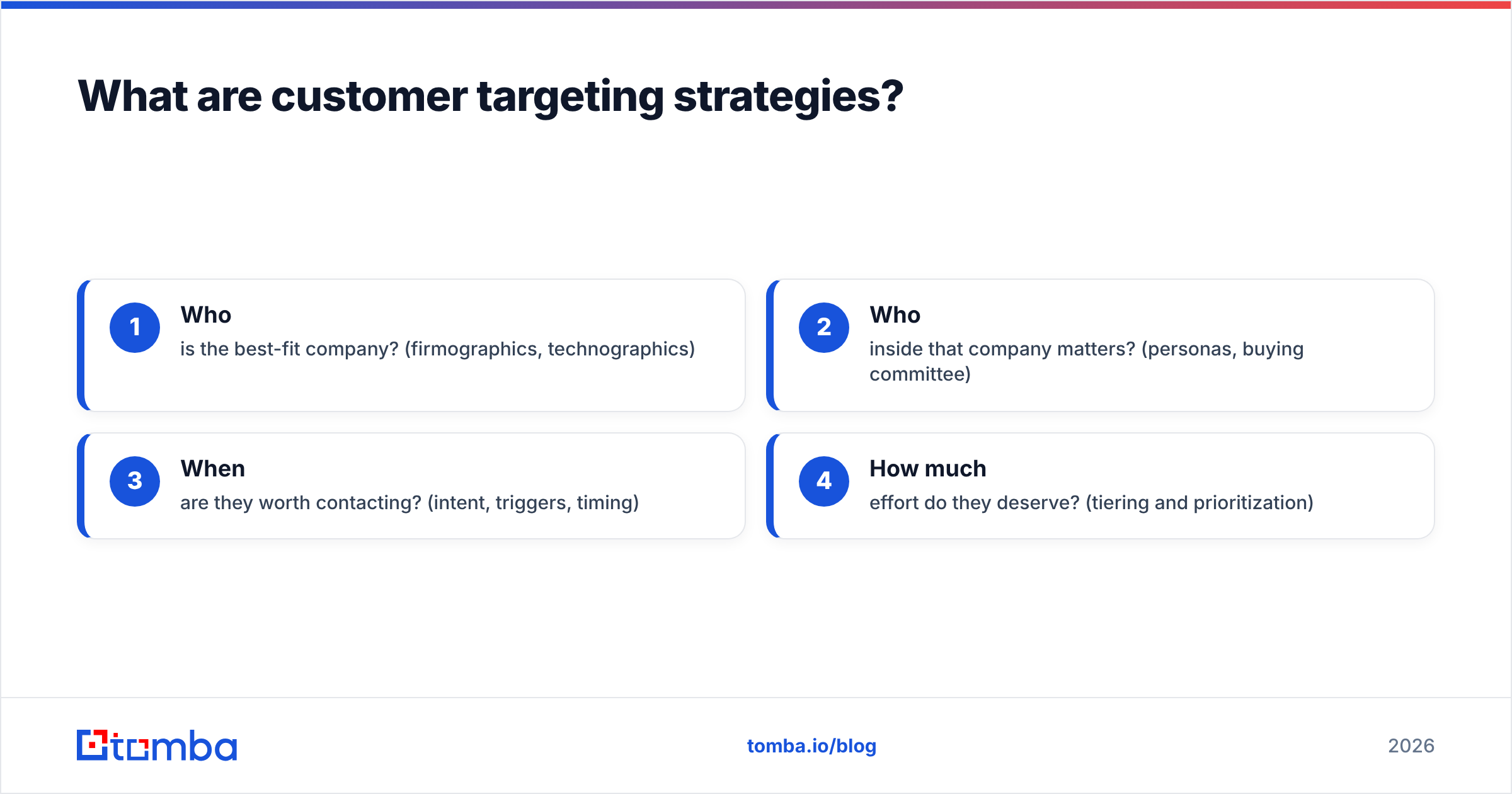
Most teams conflate targeting with a list pull. It is bigger than that. A complete targeting motion answers four questions:
- Who is the best-fit company? (firmographics, technographics)
- Who inside that company matters? (personas, buying committee)
- When are they worth contacting? (intent, triggers, timing)
- How much effort do they deserve? (tiering and prioritization)
Get those four right and every downstream metric — reply rate, meetings booked, win rate — improves at the same time.

Why does targeting decide your CAC?#
Targeting decides your customer acquisition cost because it sets the denominator on every conversion rate you have. Send 1,000 emails to a vague list and you might book three meetings. Send 300 emails to a tightly-defined segment and you might book twelve. Same effort, four times the pipeline, a quarter of the cost per meeting.
Poor targeting shows up as symptoms teams often misdiagnose:
- "Our copy is not converting." Often the copy is fine; the reader was never a buyer.
- "Deliverability is tanking." Blasting unverified addresses spikes bounces and hurts sender reputation.
- "Reps are not working hard enough." They are — just against accounts that were never going to buy.
According to Gartner, B2B buying groups now involve six to ten stakeholders, so aiming at a single "decision maker" and hoping is no longer viable. You have to target the account and the committee inside it.
The 7 core customer targeting strategies#
Here are the seven strategies most B2B teams should combine, roughly in the order you should build them.
- Ideal Customer Profile (ICP) targeting. Define the company attributes of your best existing customers — industry, size, growth stage, business model — and filter your market to matches. This is the foundation everything else sits on.
- Firmographic segmentation. Slice the ICP into segments by revenue, headcount, geography, and funding so messaging and offers can flex per segment.
- Technographic targeting. Target by the tools a company already runs (CRM, cloud provider, marketing stack). A complementary or competing tool in their stack is a strong buying signal.
- Intent-based targeting. Prioritize accounts showing active research behavior — content consumption, review-site visits, keyword surges — so you reach them while the problem is top of mind.
- Account-based (ABM) targeting. Pick a finite named-account list and coordinate marketing plus sales around it with personalized plays. Best for high-ACV, considered purchases.
- Persona and buying-committee targeting. Map the champion, the economic buyer, and the blockers, then tailor a message to each role instead of one generic pitch.
- Look-alike expansion. Once a segment proves out, find companies that statistically resemble your closed-won accounts and pour effort there before exploring cold territory.
Notice these are layers, not alternatives. ICP tells you the universe; intent and tiering tell you the sequence.
How do the main targeting approaches compare?#
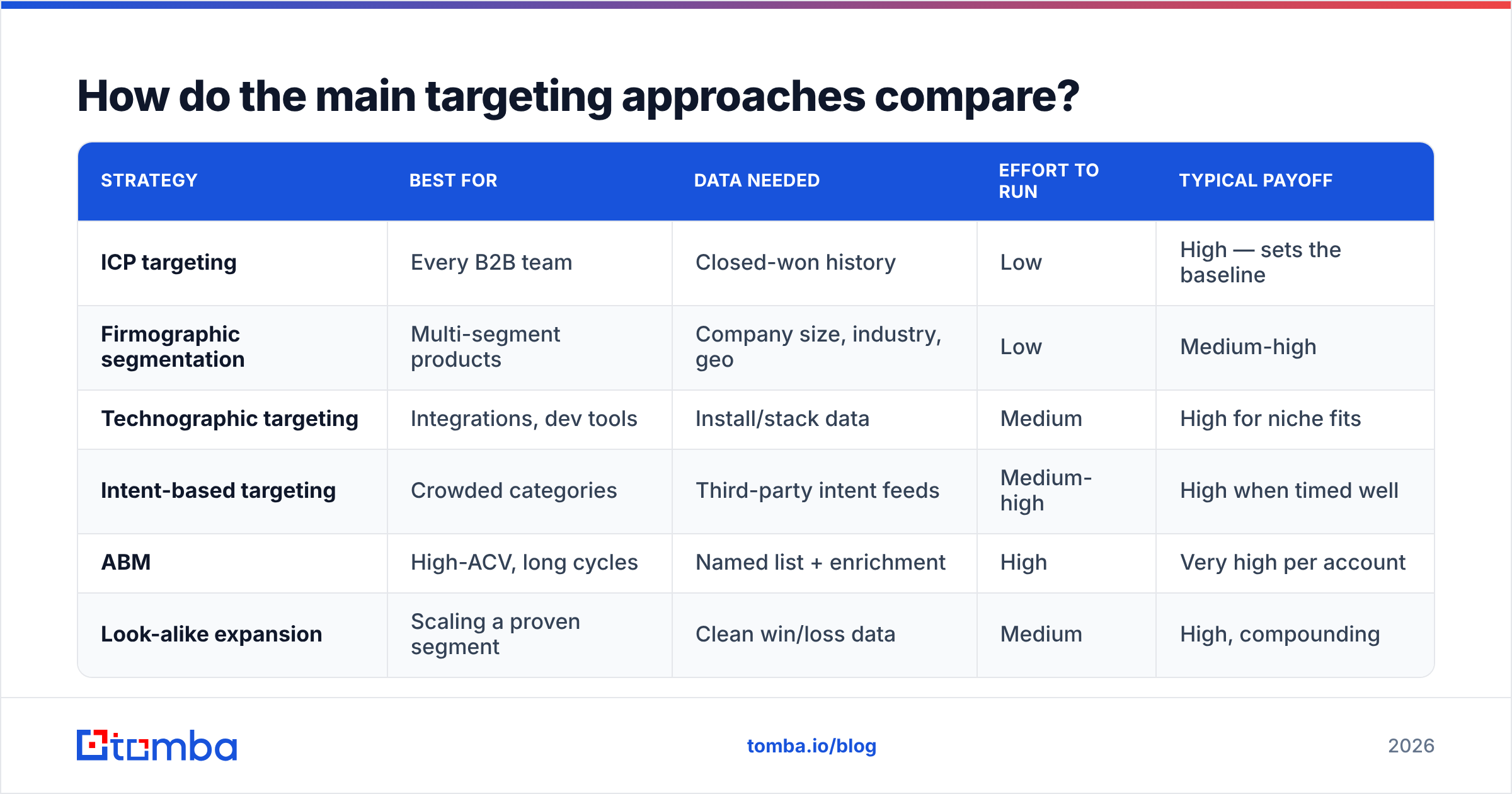
Different strategies fit different deal sizes, sales cycles, and data maturity. Use this table to pick where to start.
| Strategy | Best for | Data needed | Effort to run | Typical payoff |
|---|---|---|---|---|
| ICP targeting | Every B2B team | Closed-won history | Low | High — sets the baseline |
| Firmographic segmentation | Multi-segment products | Company size, industry, geo | Low | Medium-high |
| Technographic targeting | Integrations, dev tools | Install/stack data | Medium | High for niche fits |
| Intent-based targeting | Crowded categories | Third-party intent feeds | Medium-high | High when timed well |
| ABM | High-ACV, long cycles | Named list + enrichment | High | Very high per account |
| Look-alike expansion | Scaling a proven segment | Clean win/loss data | Medium | High, compounding |
If you are early, run ICP plus firmographic segmentation first — they are cheap and they de-risk everything after. Add intent and ABM once you have proof of what "good" looks like.
How do you build an ICP that actually works?#
Build your ICP from evidence, not aspiration. The most common mistake is writing an ICP that describes the customers you wish you had. Instead, mine the customers you already win and keep.
A practical, four-step method:
- Pull your closed-won cohort. Export your best 20–50 accounts by revenue retained, not just deal size. Retention filters out bad-fit customers who churned.
- Find the shared attributes. Look for patterns in industry, employee count, tech stack, and business model. Two or three tight commonalities beat a ten-field wish list.
- Add negative criteria. Explicitly list disqualifiers — company size, region, or stack that predicts churn. Knowing who to skip is half of targeting.
- Pressure-test with sales. Reps have gut-level fit signals your CRM does not capture. Reconcile the data view with their field view.
Once the profile is written, you need to turn it into a contactable list. That means moving from "SaaS companies, 50–200 employees, using HubSpot" to actual companies and the verified emails of the right personas inside them. A domain search turns a list of matching company websites into named contacts by role, so your ICP becomes an outreach list instead of a slide.
Where does data quality fit into targeting?#
Data quality is the multiplier that determines whether any of these strategies pay off. You can define a flawless ICP and still fail if the contact data behind it is wrong. Industry benchmarks consistently put B2B data decay around 2–3% per month as people change jobs — so a list built even six months ago is meaningfully rotten.
Two failure modes to guard against:
- Wrong person, right company. You reached a real inbox, but the contact left last quarter. The message dies silently.
- Right person, dead inbox. The persona is perfect, but the address bounces, dragging down email deliverability for your whole domain.
The fix is a verification step between "list built" and "sequence launched." Running addresses through an email verifier before you send keeps bounce rates low and protects the sender reputation you need for the next campaign. For accounts on catch-all domains — where the server accepts everything and tells you nothing — a dedicated catch-all verifier gives you a real confidence signal instead of a coin flip.

How do you prioritize accounts once you have the list?#
Prioritize with tiers, because not every good-fit account deserves the same effort. A flat list treats a $200k opportunity the same as a $5k one, which guarantees you under-invest where it counts.
A simple, durable tiering model:
- Tier 1 — Named/ABM accounts. Perfect ICP fit plus high revenue potential. Get custom research, multithreaded outreach, and marketing air cover. Usually 20–50 accounts per rep.
- Tier 2 — High-fit, scaled. Strong ICP match handled with lightly personalized sequences and role-based messaging. Hundreds of accounts.
- Tier 3 — Broad reach. Fits the ICP on paper; worked with efficient, mostly automated plays and monitored for intent spikes that promote them to Tier 2.
The point of tiers is not bureaucracy — it is allocating your most expensive resource (rep attention) to the accounts most likely to return it. Layer intent signals on top so a Tier 3 account that suddenly starts researching your category gets promoted automatically.
What tools support a targeting motion?#
You need three capabilities in your stack, and they can come from one or several vendors:
- Discovery — find companies and the right people inside them (domain search, data enrichment, intent feeds).
- Verification — confirm contacts are real and reachable before you spend a send on them.
- Orchestration — a CRM and sequencing layer to run the plays and measure results by segment.
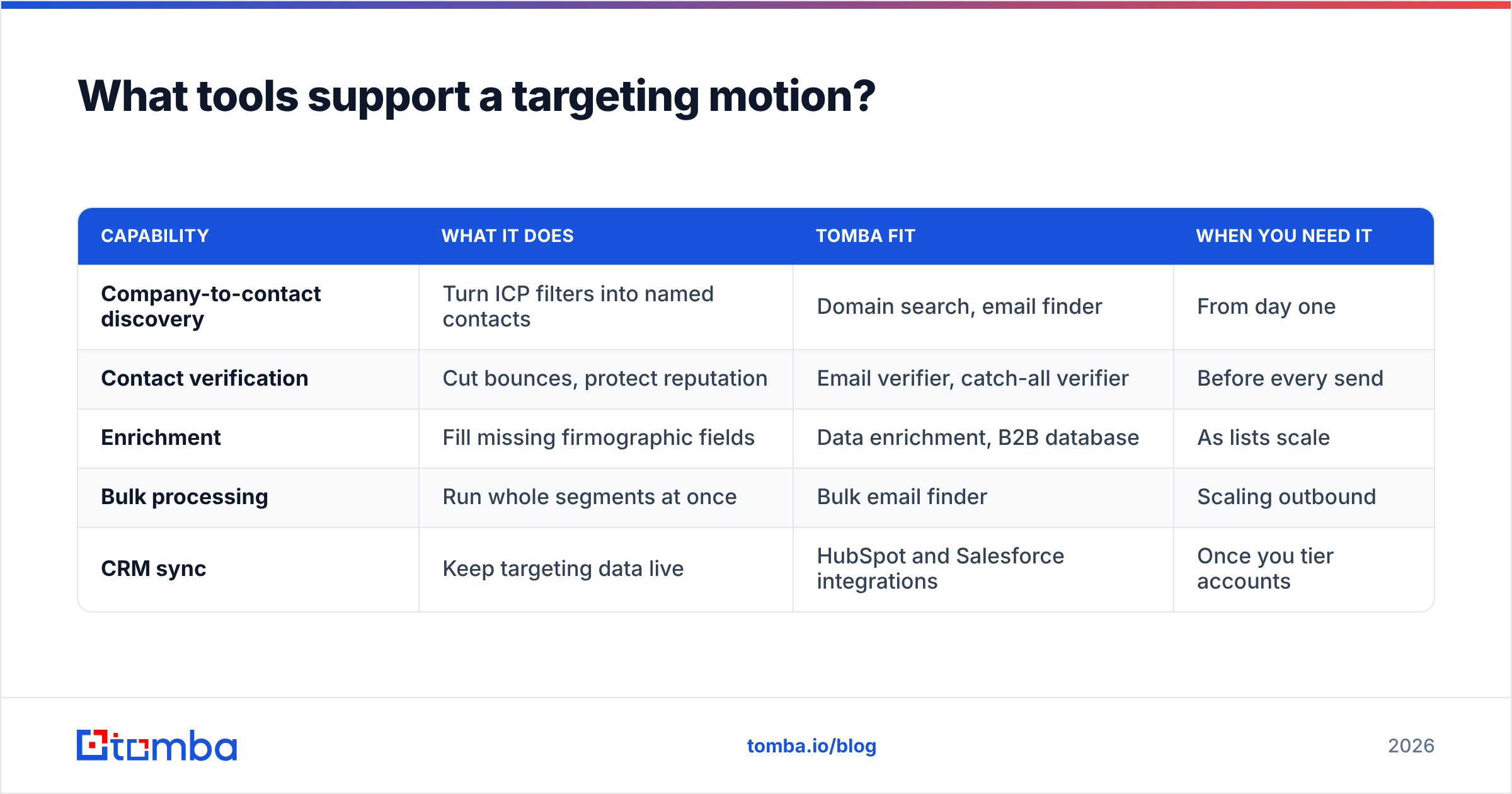
Here is how a lean, targeting-focused stack maps out.
| Capability | What it does | Tomba fit | When you need it |
|---|---|---|---|
| Company-to-contact discovery | Turn ICP filters into named contacts | Domain search, email finder | From day one |
| Contact verification | Cut bounces, protect reputation | Email verifier, catch-all verifier | Before every send |
| Enrichment | Fill missing firmographic fields | Data enrichment, B2B database | As lists scale |
| Bulk processing | Run whole segments at once | Bulk email finder | Scaling outbound |
| CRM sync | Keep targeting data live | HubSpot and Salesforce integrations | Once you tier accounts |
For teams comparing platforms, G2's sales-intelligence category is a useful neutral place to sanity-check vendors against your own segment before you commit budget. The tooling matters less than the discipline: define, verify, tier, measure.
How do you measure whether your targeting is working?#
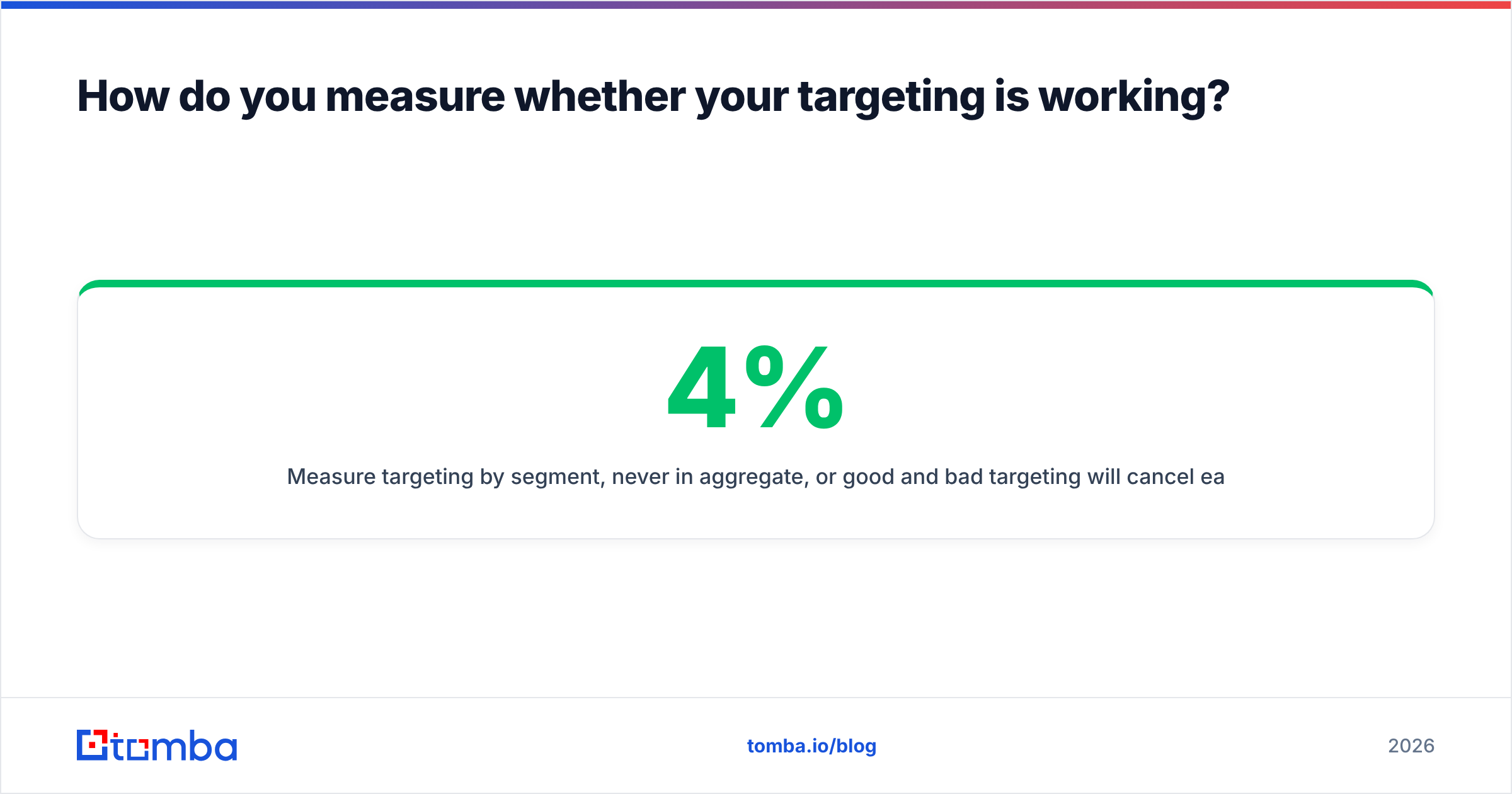
Measure targeting by segment, never in aggregate, or good and bad targeting will cancel each other out in the averages. A blended 4% reply rate can hide a 12% winner and a 1% money-pit sitting side by side.
Track these by ICP segment and tier:
- Reply and positive-reply rate — is the message landing with this audience?
- Meeting-to-opportunity conversion — are the conversations real or polite?
- Win rate and sales-cycle length — the truest fit signals; good targeting wins faster.
- Net revenue retention — the ultimate proof a segment was worth targeting at all.
When a segment underperforms across all four, cut it and reallocate to your proven look-alikes. When one overperforms, that is your signal to expand. Review the response-rate trend monthly, not quarterly — targeting drifts as your market and data age.
Common targeting mistakes to avoid#
- Chasing logos over fit. A famous brand that will churn is worse than an unglamorous account that renews for five years.
- One message for the whole committee. The CFO and the end user care about different things; targeting the account without targeting the personas leaves deals stuck.
- Skipping verification to "save time." Every bounce is a small tax on deliverability that compounds across future campaigns.
- Never revisiting the ICP. Your best-fit profile shifts as you move upmarket. Re-derive it from closed-won data at least twice a year.
- Confusing volume with progress. More contacts is not more pipeline. Fewer, better-targeted contacts almost always wins.
Putting it together: a 30-day rollout#
If you are starting from a messy list, here is a realistic sequence. Week one, derive your ICP from closed-won retention data and write your negative criteria. Week two, translate the ICP into named accounts with a domain search and map the buying committee for your Tier 1 list. Week three, verify every contact and enrich missing fields so your CRM reflects reality. Week four, launch role-specific sequences by tier and instrument reporting by segment. By day 30 you are no longer guessing — you are running a measurable targeting machine you can tune.
Turn your ICP into a contactable list#
Great targeting dies at the last mile if you cannot reach the right people. Once your ICP and tiers are set, the Tomba Email Finder turns your list of best-fit companies into verified, role-based contacts by domain, name, or company — so your reps spend their time selling, not scraping. It pairs with built-in verification to keep bounces low and your sender reputation intact, and it plugs into your CRM so targeting data stays live. Start free with 25 searches on the Tomba free tier, and check Tomba pricing — Starter is $49/mo — when you are ready to scale a proven segment. Define who matters, verify you can reach them, and let precision do the heavy lifting.
Related guides#
Ready to find emails that actually work?
Join 150,000+ professionals who stopped guessing and started sending. Free credits on signup — no credit card required.
Get the Tomba newsletter
Practical outbound tactics and product updates — once every two weeks.
About the author