Cybersecurity Lead Generation Strategies That Actually Convert in 2026
Selling security software is harder than ever: skeptical CISOs, long buying committees, and zero tolerance for spam. Here are nine cybersecurity lead generation strategies that fill pipeline without burning your domain.
Cybersecurity Lead Generation Strategies That Actually Convert in 2026
Selling cybersecurity is a trust business before it is a software business. Your buyers are paid to be paranoid, the buying committee has eight people, and one clumsy cold email can get your domain flagged by the very spam filters your prospects obsess over. Generic lead-gen advice breaks down fast in this market.
This guide covers nine cybersecurity lead generation strategies built for how security actually buys in 2026 — long committees, technical scrutiny, and a low tolerance for hype.
TL;DR#
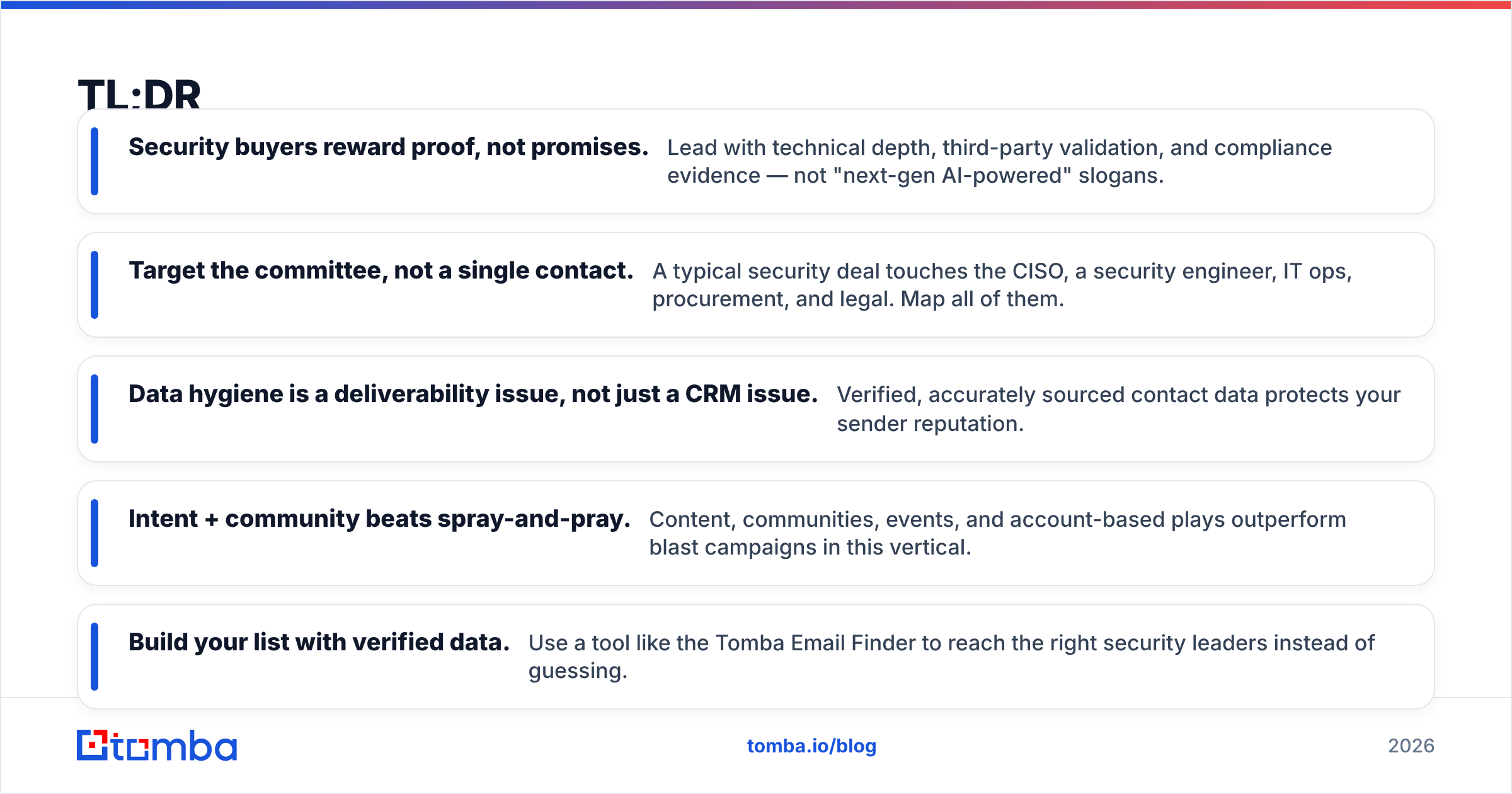
- Security buyers reward proof, not promises. Lead with technical depth, third-party validation, and compliance evidence — not "next-gen AI-powered" slogans.
- Target the committee, not a single contact. A typical security deal touches the CISO, a security engineer, IT ops, procurement, and legal. Map all of them.
- Data hygiene is a deliverability issue, not just a CRM issue. Verified, accurately sourced contact data protects your sender reputation.
- Intent + community beats spray-and-pray. Content, communities, events, and account-based plays outperform blast campaigns in this vertical.
- Build your list with verified data. Use a tool like the Tomba Email Finder to reach the right security leaders instead of guessing.
Why is cybersecurity lead generation so hard?#
Because you are selling to people whose job is to distrust unsolicited messages. A marketing email that lands in a normal inbox as "a bit pushy" lands in a security leader's inbox as "a potential phishing attempt." The bar is higher and the margin for error is thinner.
Three structural realities make security different from typical B2B SaaS:
- The buying committee is large and technical. Gartner's research on B2B buying groups puts the average at 6–10 stakeholders; in security it skews to the top of that range because risk, IT, legal, and finance all weigh in.
- The sales cycle is long. Six to eighteen months is normal for enterprise security deals. Your lead-gen has to feed a pipeline you will not close this quarter.
- Reputation is currency. A vendor caught buying scraped lists or spamming looks careless with data — the one thing a security buyer cannot forgive.
That last point is why your list-building method is a strategic decision, not an afterthought.
What are the best cybersecurity lead generation strategies?#
Here are the nine that consistently produce qualified pipeline for security vendors, ordered roughly from foundation to advanced.
1. Map the security buying committee before you prospect#
You are not selling to a person; you are selling to a group with competing incentives. The CISO cares about risk and board reporting. The security engineer cares about integration and false-positive rates. Procurement cares about price and contract terms. Legal cares about data residency and liability.
Build a target account map that names all of these roles. Then use domain search to find the actual people behind each function at your target companies, rather than defaulting to whoever answered a form.
2. Lead with proof, not adjectives#
Security buyers have heard "AI-powered next-generation zero-trust" a thousand times. What moves them is evidence:
- Independent test results (e.g., MITRE ATT&CK evaluations, third-party pen-test summaries).
- Compliance attestations — SOC 2 Type II, ISO 27001, FedRAMP status.
- Peer validation on a site your buyer already trusts, like G2 or Gartner Peer Insights.
Put this proof in your first touch. A cold email that references a specific benchmark converts far better than one that lists features.
3. Build a verified contact list (and protect your domain)#
Here is where most security-vendor outreach quietly fails. Teams buy a bulk list, blast it, watch bounce rates spike, and torch their sender reputation. Ironically, poor email deliverability is a self-inflicted security-adjacent wound.
The fix is disciplined data sourcing:
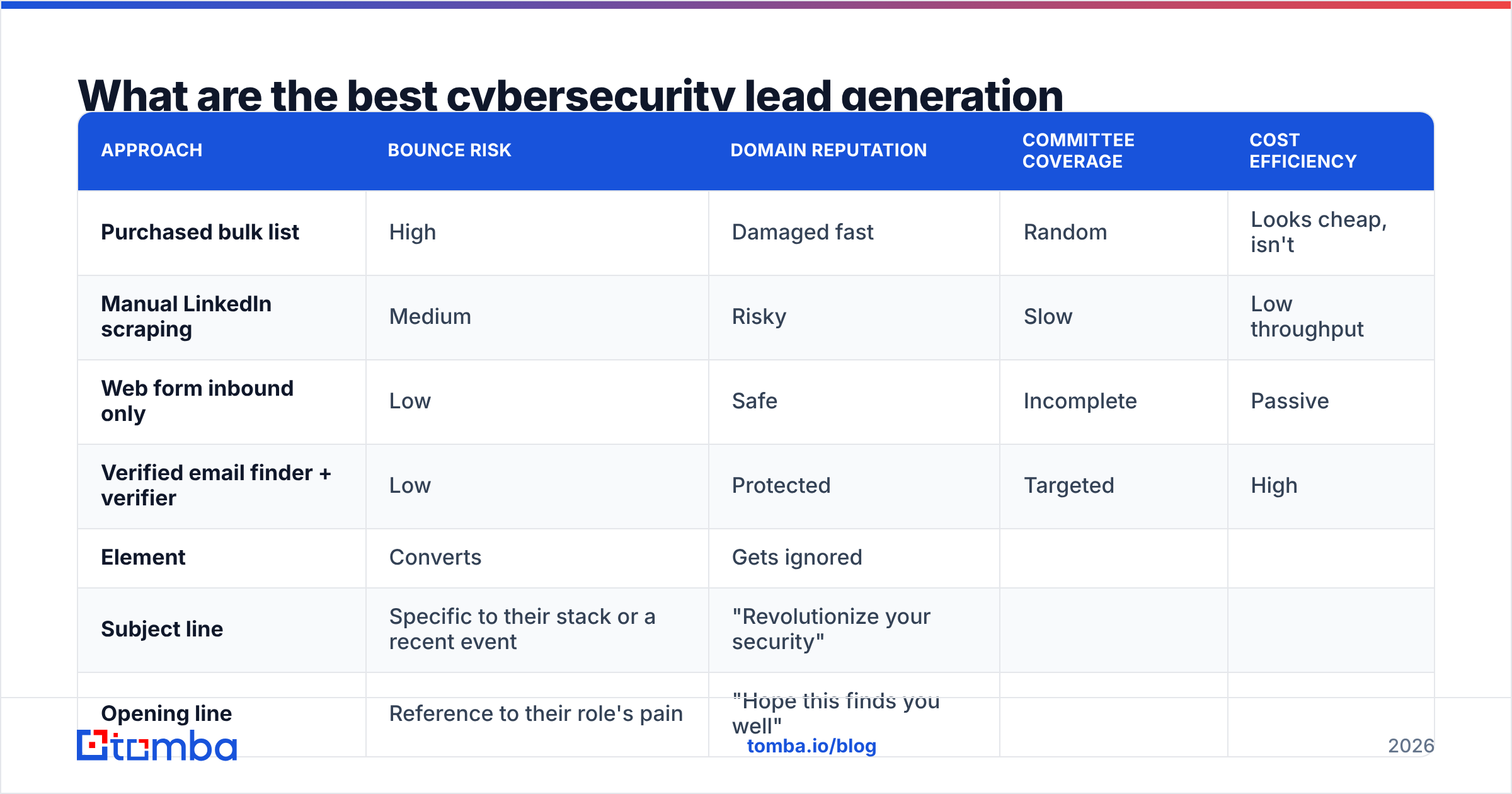
| Approach | Bounce risk | Domain reputation | Committee coverage | Cost efficiency |
|---|---|---|---|---|
| Purchased bulk list | High | Damaged fast | Random | Looks cheap, isn't |
| Manual LinkedIn scraping | Medium | Risky | Slow | Low throughput |
| Web form inbound only | Low | Safe | Incomplete | Passive |
| Verified email finder + verifier | Low | Protected | Targeted | High |
Find contacts with an email finder, then run every address through an email verifier before it enters a sequence. For domains that accept everything, a dedicated catch-all verifier tells you whether an address is actually safe to send to.
4. Publish technical content your buyer would actually read#
Security practitioners consume deep content: threat breakdowns, incident post-mortems, architecture guides, and detection engineering write-ups. Thin "5 tips for staying safe online" blog posts do nothing for pipeline.
Produce content that demonstrates you understand their world:
- Threat research your SOC team can publish under a byline.
- Compliance playbooks mapped to real frameworks.
- Detection rules or open-source tooling you give away.
Gate the heavier assets behind a short form to capture inbound leads, and syndicate the ungated pieces to build authority.
5. Run account-based plays for enterprise targets#
For your top 100 accounts, one-to-one beats one-to-many. Combine firmographic and technographic signals (what stack they run, what breaches hit their sector) with role-level contact data, then coordinate marketing and sales on a single named-account list.
This is where contact enrichment earns its keep: append job titles, seniority, and company details so your reps personalize at the account level instead of sending the same template to a whole industry.
6. Show up where security people gather#
Security has strong communities: conferences (RSA, Black Hat, BSides), Slack and Discord groups, and subreddits. You cannot spam these — you will get ejected — but you can participate, sponsor thoughtfully, and build relationships.
Event-driven lead gen works well here. Speak on a panel, publish the talk, then follow up with attendees using verified contact data rather than a scraped badge-scan list.

7. Use intent data to time your outreach#
A security team that just suffered an incident, failed an audit, or posted a job for a "SOC analyst" is signaling budget and urgency. Intent and trigger signals let you reach out when the pain is fresh.
Pair the signal with the right person. When you spot a hiring or breach trigger, use domain search to pull the security leadership at that company and reach out with a message tied to the specific event.
8. Personalize outreach with role-specific messaging#
One message for the whole committee is a wasted send. The CISO wants risk reduction and board-ready reporting; the engineer wants fewer false positives and clean integrations. Write variants per role, and keep them short.
A quick comparison of what lands versus what gets deleted:
| Element | Converts | Gets ignored |
|---|---|---|
| Subject line | Specific to their stack or a recent event | "Revolutionize your security" |
| Opening line | Reference to their role's pain | "Hope this finds you well" |
| Proof point | Named benchmark or compliance cert | Vague "industry-leading" |
| Ask | 15-minute technical walkthrough | "Jump on a quick call?" |
| Length | Under 120 words | Three scrolling paragraphs |
9. Follow up like a professional, not a stalker#
Security buyers are busy and slow by design. A disciplined, value-added follow-up sequence — each touch adding a new proof point rather than "just bumping this" — outperforms both single sends and aggressive daily pings. Space touches out, cap the sequence, and always give them an easy out.
How do you measure cybersecurity lead generation success?#
Track the metrics that reflect a long, committee-driven cycle — not just raw lead volume. Vanity metrics will make a slow-but-healthy security pipeline look broken.
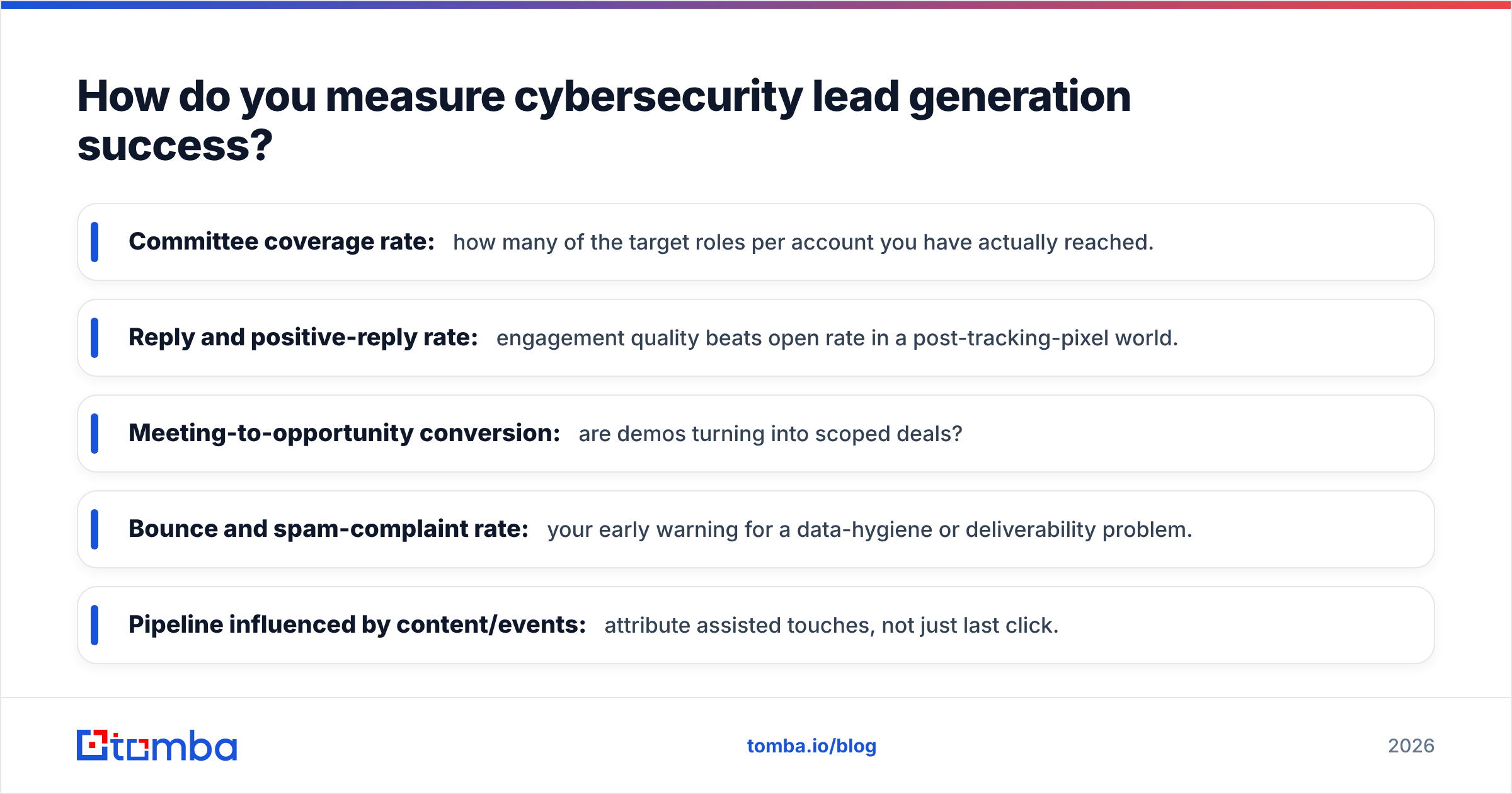
- Committee coverage rate: how many of the target roles per account you have actually reached.
- Reply and positive-reply rate: engagement quality beats open rate in a post-tracking-pixel world.
- Meeting-to-opportunity conversion: are demos turning into scoped deals?
- Bounce and spam-complaint rate: your early warning for a data-hygiene or deliverability problem.
- Pipeline influenced by content/events: attribute assisted touches, not just last click.
If your bounce rate creeps up, stop and fix your data before it damages your sender reputation. In this market, a burned domain is far more expensive than a slow month.
Which strategy should you start with?#
Start with the two that compound: clean data (Strategy 3) and committee mapping (Strategy 1). Every other tactic — content, ABM, intent, follow-up — depends on reaching the right, real people. Get those two right and the rest of your cybersecurity lead generation strategies have something solid to stand on.
If you are a smaller vendor, layer in technical content and community next; those build authority without a big ad budget. If you are enterprise, prioritize account-based plays and intent timing.
Common mistakes to avoid#
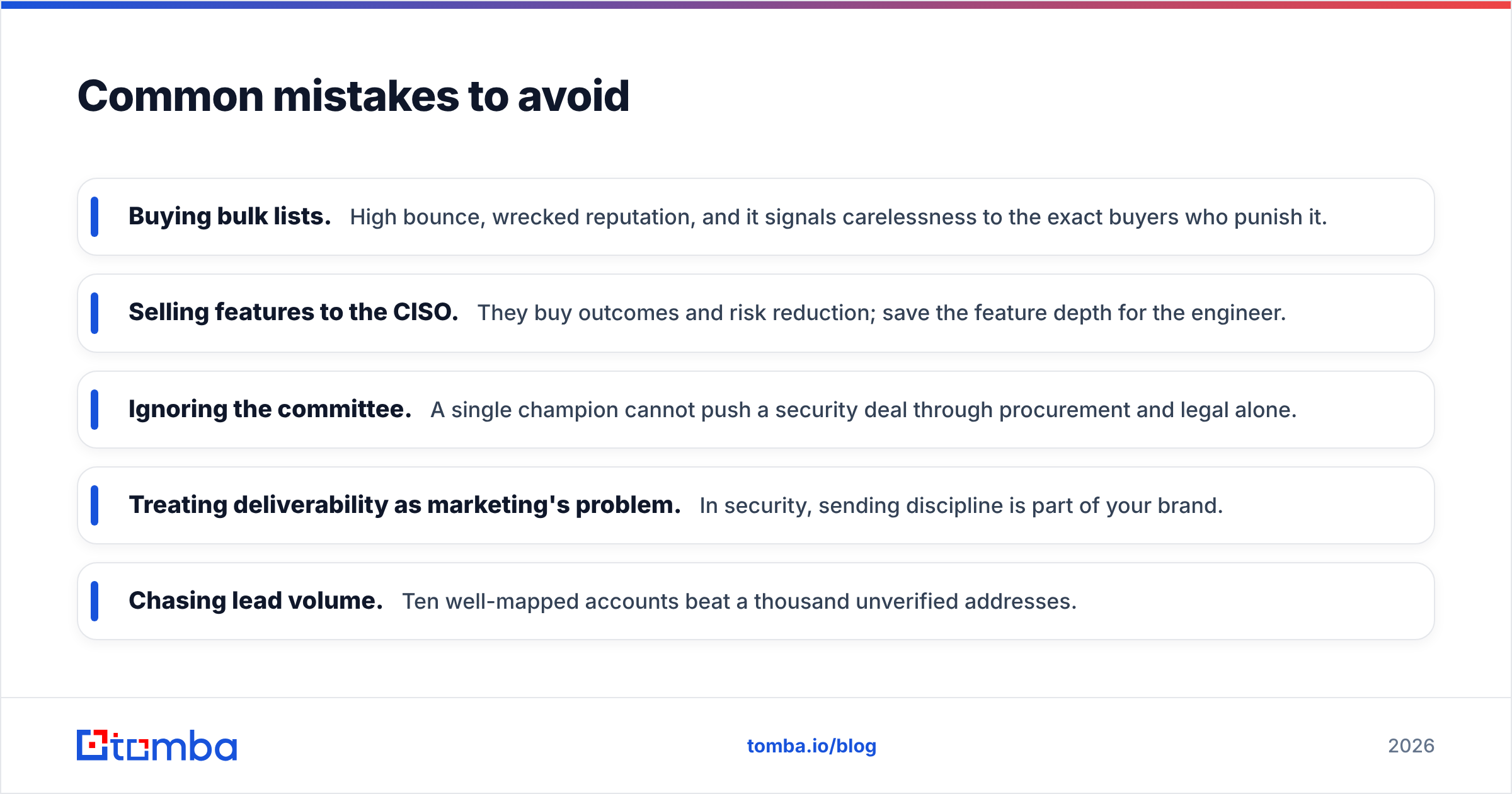
- Buying bulk lists. High bounce, wrecked reputation, and it signals carelessness to the exact buyers who punish it.
- Selling features to the CISO. They buy outcomes and risk reduction; save the feature depth for the engineer.
- Ignoring the committee. A single champion cannot push a security deal through procurement and legal alone.
- Treating deliverability as marketing's problem. In security, sending discipline is part of your brand.
- Chasing lead volume. Ten well-mapped accounts beat a thousand unverified addresses.
Put verified data at the center of your pipeline#
Every strategy above works better when you are reaching real security decision-makers at the right accounts. That starts with accurate, verified contact data — the difference between a message a CISO reads and one that gets reported as phishing.
Use the Tomba Email Finder to find security leaders by name, company, or domain, verify every address before you send, and enrich your target accounts so each touch is personal and on-time. Explore Tomba pricing — including a free tier of 25 searches a month — and build a cybersecurity pipeline on data you can trust instead of lists you have to hope about.
Related guides#
Ready to find emails that actually work?
Join 150,000+ professionals who stopped guessing and started sending. Free credits on signup — no credit card required.
Get the Tomba newsletter
Practical outbound tactics and product updates — once every two weeks.
About the author