D7 Lead Finder vs DiscoverOrg: Which B2B Data Tool Wins?
D7 Lead Finder sells cheap bulk lists; DiscoverOrg (now ZoomInfo) sells premium verified intelligence. Here's which one actually fits your budget, your data-quality needs, and your outbound goals in 2026.
D7 Lead Finder vs DiscoverOrg: Which B2B Data Tool Wins?
Two tools, two completely different philosophies. D7 Lead Finder scrapes the open web and hands you enormous lists for pocket change. DiscoverOrg — now folded into ZoomInfo — sells human-verified, org-chart-deep intelligence at enterprise prices. Picking between them isn't about which is "better." It's about which failure mode you can live with: too much unverified volume, or too big an invoice.
This is a neutral breakdown of where each one earns its keep, where each one hurts you, and the cheaper hybrid most teams actually end up running.
TL;DR#
- D7 Lead Finder is a low-cost bulk scraper: huge volume, flat pricing, but raw, often-stale data you must clean before you send anything.
- DiscoverOrg / ZoomInfo is premium verified intelligence: accurate contacts, org charts, and intent signals — at a multi-thousand-dollar annual commitment.
- Accuracy is the real gap. D7's scraped emails bounce far more often; DiscoverOrg's are human-checked but you pay for that rigor.
- Neither verifies at send time. Whichever list you buy, run it through a dedicated email verifier before your first campaign or you'll torch your domain.
- The pragmatic move for most SMBs: skip both extremes — pull targeted, verified contacts on demand and only pay for what you use.
What is D7 Lead Finder?#
D7 Lead Finder is a bulk lead-generation tool built for volume. You type in a niche and a location — "dentists in Chicago," "plumbers in Manchester" — and it returns a downloadable list of businesses with emails, phone numbers, websites, and social profiles scraped from public sources. It leans heavily toward local and SMB prospecting: agencies, local-service marketers, and anyone who needs a lot of names fast without a per-record price tag.
The appeal is simple. It's cheap, it's flat-rate, and it doesn't gate you behind annual contracts or credit meters. If your outbound model is "email 10,000 businesses and see what sticks," D7 gives you the raw fuel.
The catch is equally simple: it's scraped data. Nobody at D7 is calling to confirm that "info@" address still reaches a human, that the owner didn't sell the business, or that the phone line still rings. You're buying quantity and inheriting the cleanup job.

What is DiscoverOrg (now ZoomInfo)?#
DiscoverOrg was a premium B2B intelligence platform known for one thing above all: accuracy through human verification. Its researchers maintained detailed org charts, direct-dial phone numbers, and decision-maker profiles for mid-market and enterprise accounts. In 2019 it merged with ZoomInfo, and the DiscoverOrg dataset now lives inside the broader ZoomInfo platform, layered with intent data, technographics, and workflow integrations.
Where D7 sells a spreadsheet, DiscoverOrg sells a system: sales teams use it to map buying committees, trigger outreach on hiring or funding signals, and push enriched records straight into Salesforce or HubSpot. It's built for teams selling five-figure deals where knowing the exact VP of Engineering — and their direct line — is worth real money.
The tradeoff is cost and commitment. Pricing is quote-based, typically starts in the four-to-five-figures-per-year range, and usually comes with seat minimums and an annual contract. You're not buying a list; you're buying a subscription to an intelligence layer.

D7 Lead Finder vs DiscoverOrg: the core differences#
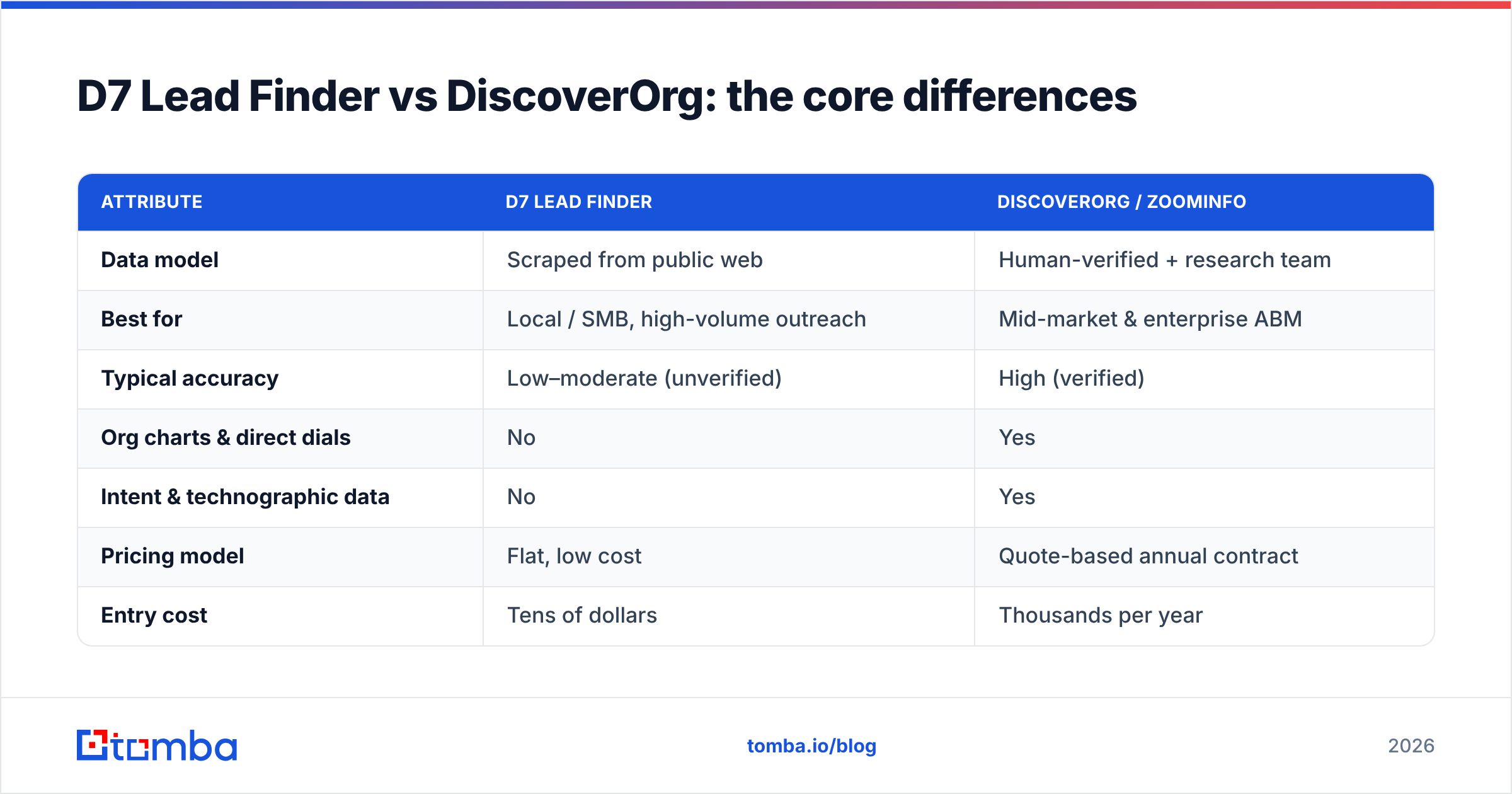
Here's the head-to-head on the attributes that actually change your outcomes.
| Attribute | D7 Lead Finder | DiscoverOrg / ZoomInfo |
|---|---|---|
| Data model | Scraped from public web | Human-verified + research team |
| Best for | Local / SMB, high-volume outreach | Mid-market & enterprise ABM |
| Typical accuracy | Low–moderate (unverified) | High (verified) |
| Org charts & direct dials | No | Yes |
| Intent & technographic data | No | Yes |
| Pricing model | Flat, low cost | Quote-based annual contract |
| Entry cost | Tens of dollars | Thousands per year |
| CRM integrations | Limited / manual export | Deep (Salesforce, HubSpot, etc.) |
| Send-time email verification | No | No (enrichment only) |
| Contract commitment | None / month-to-month | Annual, seat minimums |
The pattern is clear: D7 optimizes for cost-per-name, DiscoverOrg optimizes for confidence-per-name. Your business model decides which number matters more.
Is DiscoverOrg worth the price over D7?#
Short answer: only if your deals are big enough that a wrong contact costs you more than the subscription.
DiscoverOrg's value is concentrated in high-consideration, multi-stakeholder sales. If you're selling a $60,000 platform into a 500-person company, you need to know the exact buying committee, who reports to whom, and which direct dial reaches the economic buyer. Guessing wastes weeks of a rep's time — far more expensive than the license. In that world, verified org charts and intent triggers pay for themselves.
D7 wins the opposite scenario. If you're an agency blasting a local-services offer to 8,000 small businesses at a $200 price point, you don't need an org chart — you need reach and a low floor. Paying enterprise rates to reach a one-person plumbing company makes no sense. The scraped list, cleaned up, is the rational choice.
Where teams get burned is buying the wrong tier for their motion: SMBs signing DiscoverOrg contracts they can't utilize, or enterprise sellers trying to run complex ABM off a raw D7 scrape and wondering why reply rates crater. Match the tool to the deal size, not to the brand name. For context on how buyers rate each category, browse the verified reviews on G2.
How accurate is the data, really?#
This is where the comparison gets uncomfortable for both sides. Scraped data decays fast — B2B contact data goes stale at roughly 25–30% per year as people change jobs — and D7 does little to fight that drift. DiscoverOrg's human verification pushes accuracy much higher, but "verified last quarter" still isn't "valid at the moment you press send."
The critical insight: neither tool verifies your list at send time. DiscoverOrg enriches and researches; D7 scrapes. Neither runs a live SMTP check the instant before your campaign goes out. That gap is exactly what nukes deliverability — a bounce rate above ~3% signals mailbox providers that you're not maintaining your list, and your sender reputation takes the hit for every good contact that follows.
So regardless of which data source you choose, the workflow is the same:
- Pull the raw list from D7, DiscoverOrg, or wherever it lives.
- Deduplicate and normalize the columns before anything else.
- Verify every address through a real-time checker — this is non-negotiable.
- Segment the valid contacts by role and intent.
- Only then load them into your sequencer.
Skipping step 3 is the single most common reason "the data was bad" — when really the process was bad. A cheap bulk verify pass turns a mediocre D7 list into a safe-to-send one, and it catches the 5–10% of even premium records that quietly went stale.
Which one fits your team?#
Use this quick decision guide instead of the brand hype:
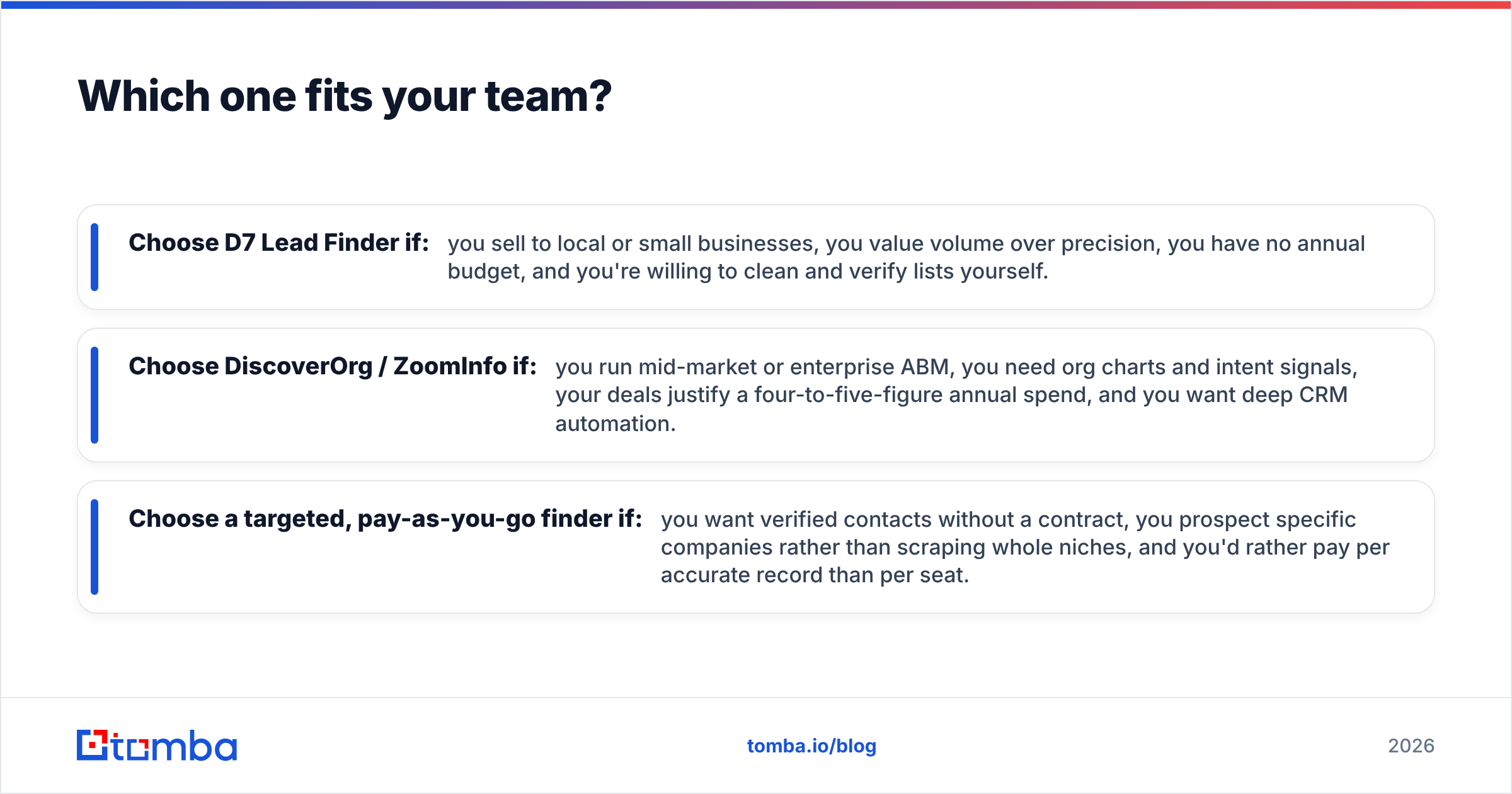
- Choose D7 Lead Finder if: you sell to local or small businesses, you value volume over precision, you have no annual budget, and you're willing to clean and verify lists yourself.
- Choose DiscoverOrg / ZoomInfo if: you run mid-market or enterprise ABM, you need org charts and intent signals, your deals justify a four-to-five-figure annual spend, and you want deep CRM automation.
- Choose a targeted, pay-as-you-go finder if: you want verified contacts without a contract, you prospect specific companies rather than scraping whole niches, and you'd rather pay per accurate record than per seat.
That third option is where a lot of teams quietly land — and it's the gap Tomba fills between D7's cheap-but-raw and DiscoverOrg's accurate-but-expensive.
Where does Tomba fit in this comparison?#
Tomba isn't a bulk scraper or a five-figure enterprise suite — it's the verified middle. Instead of buying a giant list and hoping, you find the exact people you want by company and verify them in the same flow.
The domain search returns every professional email at a target company, complete with role and confidence score, so you can build an account list the way DiscoverOrg users do — without the annual contract. The email finder pinpoints an individual's address from a name and domain, and every result runs through the same verification engine that powers Tomba's standalone verifier. That solves the send-time gap both D7 and DiscoverOrg leave open.
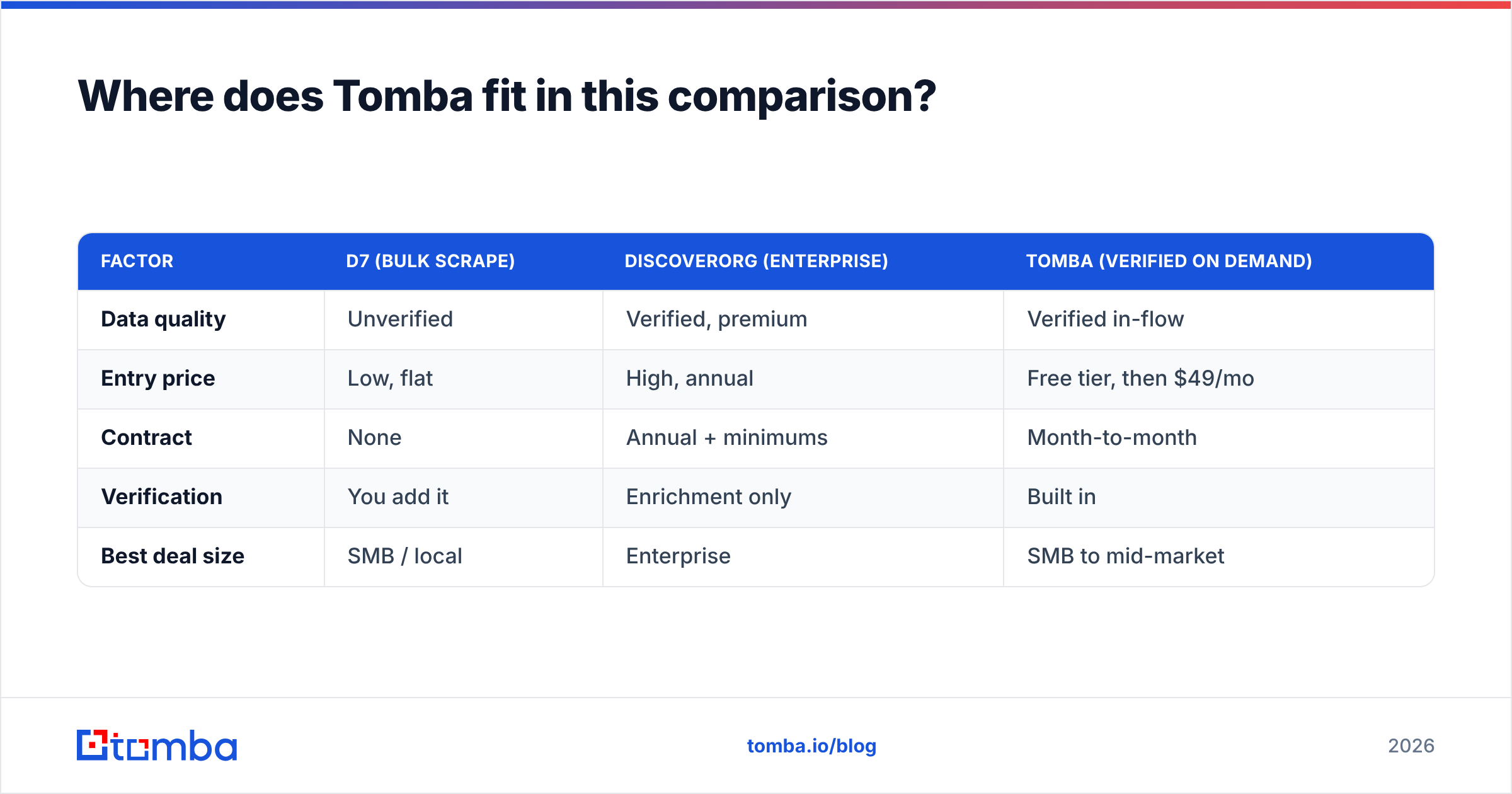
Here's how the three approaches stack up on the decision that matters most — accuracy versus cost:
| Factor | D7 (bulk scrape) | DiscoverOrg (enterprise) | Tomba (verified on demand) |
|---|---|---|---|
| Data quality | Unverified | Verified, premium | Verified in-flow |
| Entry price | Low, flat | High, annual | Free tier, then $49/mo |
| Contract | None | Annual + minimums | Month-to-month |
| Verification | You add it | Enrichment only | Built in |
| Best deal size | SMB / local | Enterprise | SMB to mid-market |
On pricing specifically, Tomba starts with a free tier of 25 searches per month, then Starter at $49/mo, Growth at $99/mo, and Pro at $249/mo — you can see the full Tomba pricing breakdown before committing to anything. That's a fraction of a DiscoverOrg contract and, unlike D7, the accuracy is baked in rather than bolted on afterward. If data provenance matters to you, Tomba is transparent about where its data comes from.
The bottom line#
D7 Lead Finder and DiscoverOrg sit at opposite ends of the same spectrum. D7 gives you maximum volume at minimum cost and leaves quality control entirely to you. DiscoverOrg gives you enterprise-grade verified intelligence and charges accordingly. Choosing between them is really about matching the tool to your deal size and your tolerance for cleanup.
But the honest verdict for most sales and marketing teams is that you don't need either extreme. You need accurate contacts, on the accounts you actually care about, without a contract that outlives your quarter — and you need them verified before they ever hit your sequencer.
That's the job Tomba was built for. Start free with the Tomba Email Finder, pull verified professional emails by name or domain, and skip both the bounce-heavy scrape and the five-figure invoice. Find the right people, confirm they're real, and send with a clean sender reputation intact.
Related guides#
Ready to find emails that actually work?
Join 150,000+ professionals who stopped guessing and started sending. Free credits on signup — no credit card required.
Get the Tomba newsletter
Practical outbound tactics and product updates — once every two weeks.
About the author