D7 Lead Finder vs GrowMeOrganic: 2026 Lead Gen Comparison
D7 Lead Finder scrapes local business leads by keyword; GrowMeOrganic mines B2B contacts and automates outreach. Here's which one fits your pipeline in 2026 — and where a verified data layer beats both.
D7 Lead Finder vs GrowMeOrganic: 2026 Lead Gen Comparison
Both tools promise to fill your pipeline, but they solve different problems. Picking the wrong one means paying for data you can't use — or an outreach engine feeding on leads that bounce. This is the honest breakdown.
TL;DR#
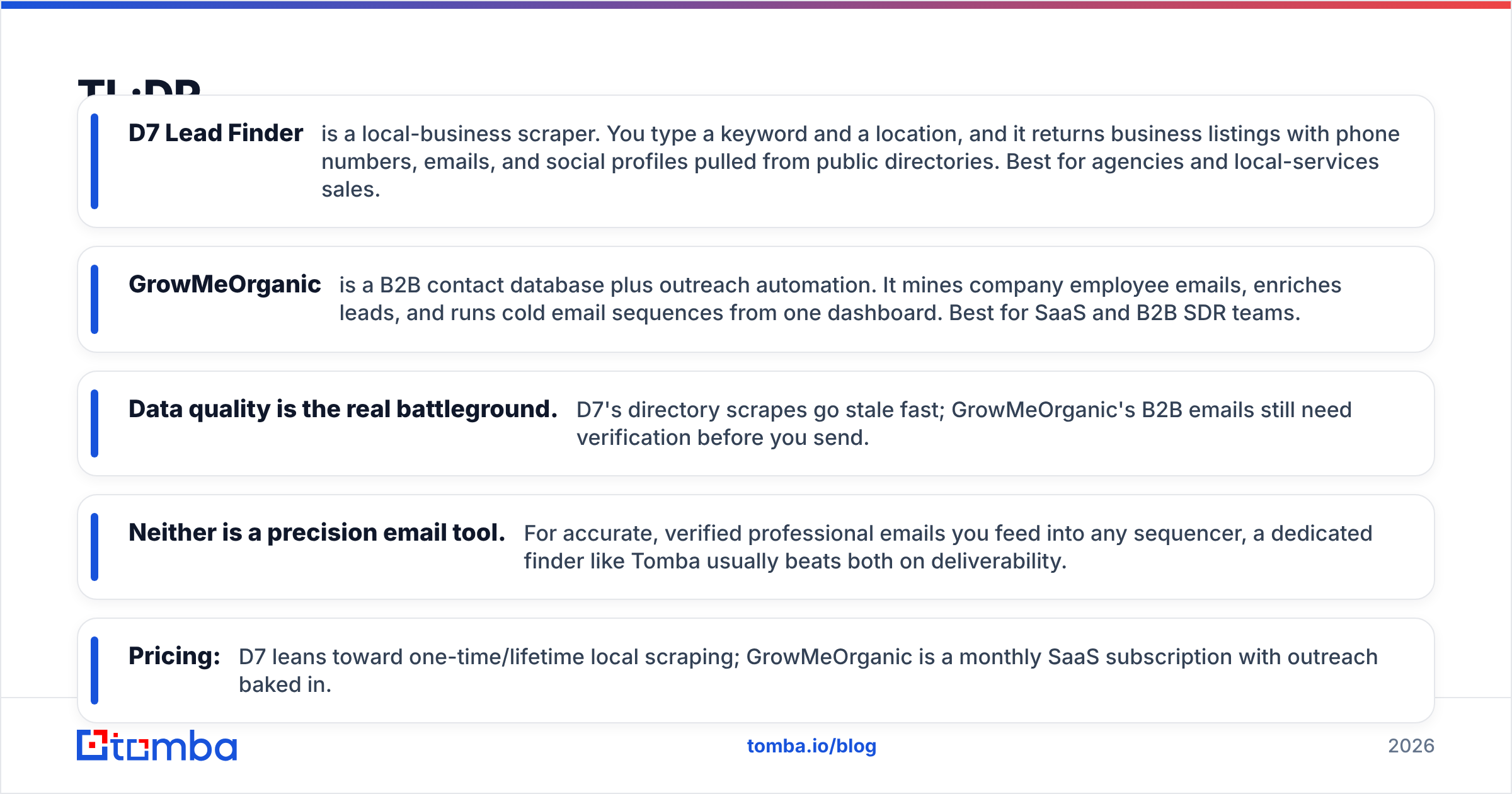
- D7 Lead Finder is a local-business scraper. You type a keyword and a location, and it returns business listings with phone numbers, emails, and social profiles pulled from public directories. Best for agencies and local-services sales.
- GrowMeOrganic is a B2B contact database plus outreach automation. It mines company employee emails, enriches leads, and runs cold email sequences from one dashboard. Best for SaaS and B2B SDR teams.
- Data quality is the real battleground. D7's directory scrapes go stale fast; GrowMeOrganic's B2B emails still need verification before you send.
- Neither is a precision email tool. For accurate, verified professional emails you feed into any sequencer, a dedicated finder like Tomba usually beats both on deliverability.
- Pricing: D7 leans toward one-time/lifetime local scraping; GrowMeOrganic is a monthly SaaS subscription with outreach baked in.
What does D7 Lead Finder actually do?#
D7 Lead Finder is a search-and-scrape tool aimed at local lead generation. You give it a niche ("dentists," "roofers," "gyms") and a geography ("Austin, TX"), and it crawls public sources — business directories, maps listings, social pages — to return a list of businesses with whatever contact data it can attach: phone, website, email, and social links.
The appeal is speed for a specific job. If you run a marketing agency selling websites to plumbers, D7 can hand you a spreadsheet of 500 plumbers in a metro area in minutes. It is a volume-first, breadth-first tool.
The trade-off is precision and freshness. Directory data is generic — you often get a info@ or contact@ inbox, not a decision-maker. Listings go stale as businesses close, move, or change numbers. And because it scrapes public listings rather than a maintained B2B graph, you rarely get named contacts with role and seniority.
What does GrowMeOrganic actually do?#
GrowMeOrganic is a broader B2B prospecting and outreach platform. It combines three things that D7 doesn't bundle together:
- A B2B contact database — search by industry, headcount, title, and geography to pull named employees at target companies.
- A LinkedIn and email extractor — Chrome extension that pulls contact data while you browse.
- Cold email automation — build sequences, send from connected mailboxes, and track opens and replies without a separate tool like Instantly or Lemlist.
That bundling is the pitch: find, enrich, and email from one login. For a small B2B team that doesn't want a five-tool stack, it's genuinely convenient.
The catch is that "all-in-one" tools tend to be good-not-great at each layer. The database has real coverage gaps outside major markets, the extracted emails still include guesses, and the sending infrastructure is simpler than a dedicated cold email platform. You trade best-in-class for one bill.
D7 Lead Finder vs GrowMeOrganic: head-to-head comparison#
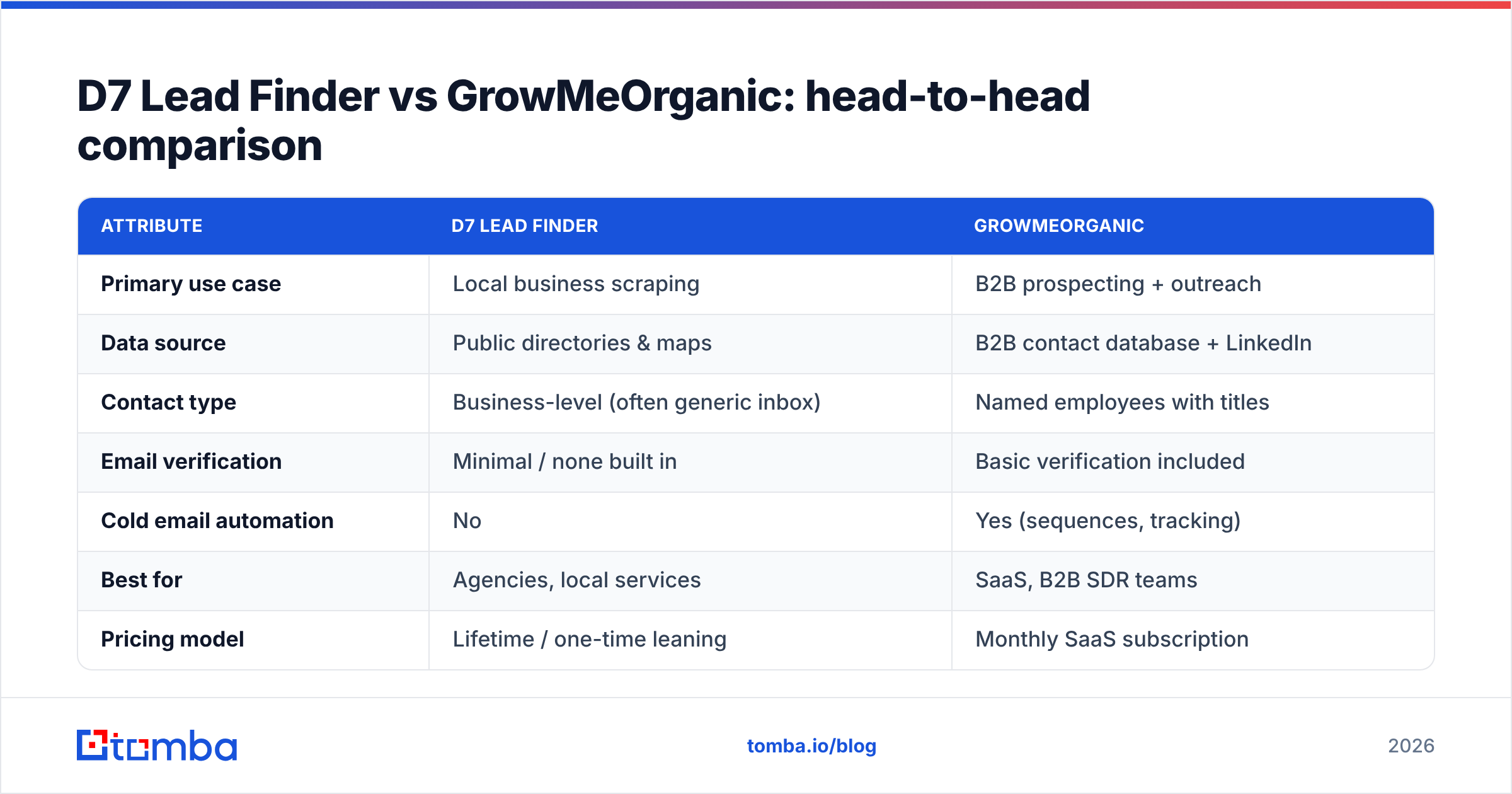
Here's the core matchup across the attributes that decide most purchases.
| Attribute | D7 Lead Finder | GrowMeOrganic |
|---|---|---|
| Primary use case | Local business scraping | B2B prospecting + outreach |
| Data source | Public directories & maps | B2B contact database + LinkedIn |
| Contact type | Business-level (often generic inbox) | Named employees with titles |
| Email verification | Minimal / none built in | Basic verification included |
| Cold email automation | No | Yes (sequences, tracking) |
| Best for | Agencies, local services | SaaS, B2B SDR teams |
| Pricing model | Lifetime / one-time leaning | Monthly SaaS subscription |
| Learning curve | Very low | Moderate |
| Data freshness risk | High (stale listings) | Medium (needs verification) |
The pattern is clear: D7 wins on simplicity and local coverage; GrowMeOrganic wins on B2B depth and workflow consolidation. Neither wins on the thing that actually protects your sender reputation — verified, deliverable emails.
Which one has better data quality?#
Neither gives you send-ready data out of the box, and that matters more than any feature list.
D7's weakness is staleness and generic contacts. A scraped list of local businesses is only as current as the directory behind it, and a contact@ address routed to a shared inbox rarely reaches an owner. You'll spend real time cleaning and re-finding decision-maker emails.
GrowMeOrganic's weakness is guessed emails. Like most B2B databases, it produces pattern-based addresses (first.last@company.com) that look plausible but haven't been confirmed against the mail server. Send to enough of those and your bounce rate climbs, which drags down email deliverability and can land your domain on a blocklist.
This is why serious teams treat lead sourcing and email validation as two separate steps. Whatever tool sources the lead, you run the address through an email verifier before it ever enters a sequence. A clean list of 300 confirmed contacts outperforms a raw dump of 3,000 every time.

How do the pricing models compare?#
The two tools price around different assumptions about how you work.
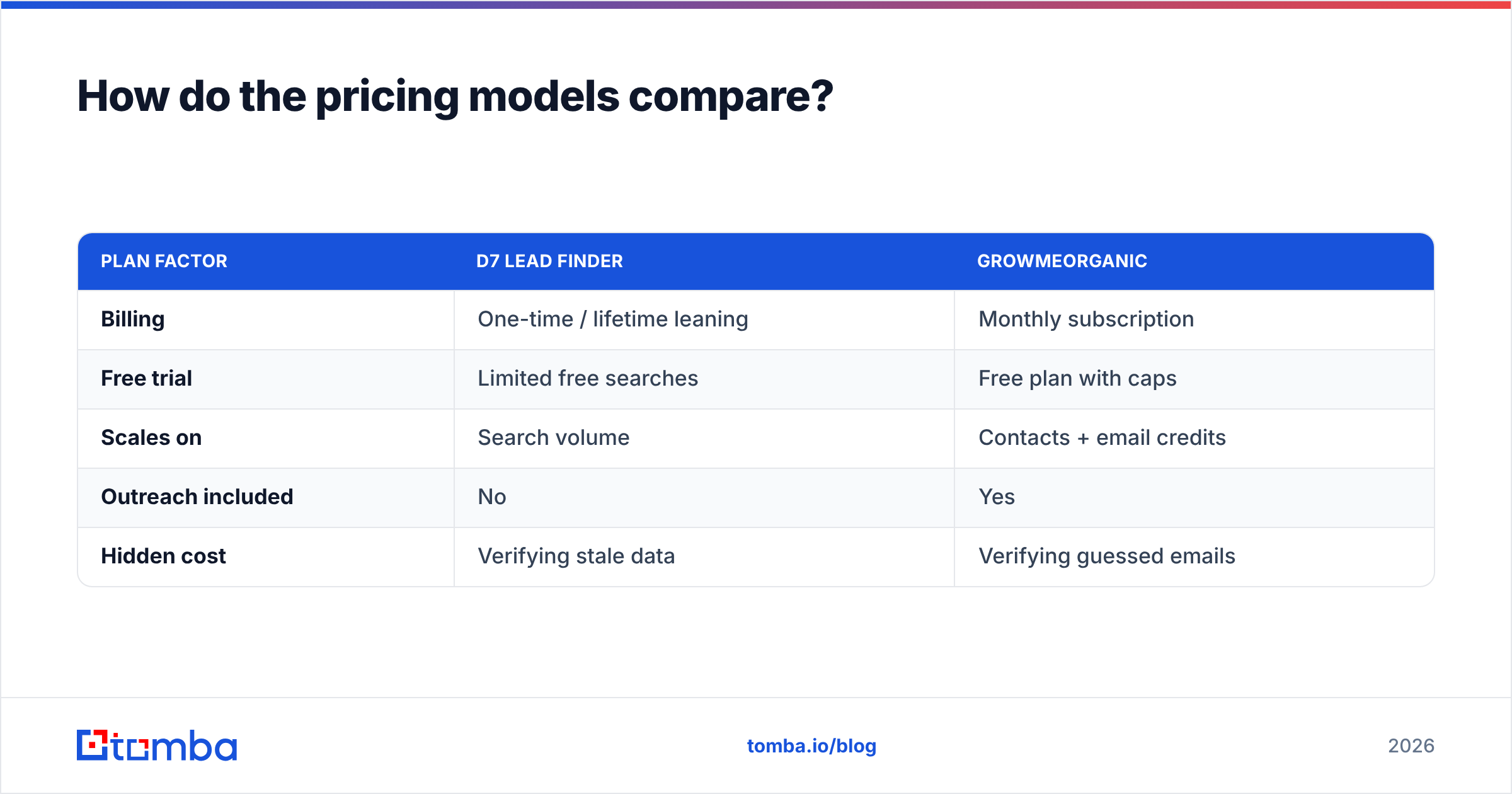
D7 Lead Finder leans toward one-time or lifetime-style access for local scraping — attractive if you do occasional bursts of local list-building and don't want a recurring bill. GrowMeOrganic is a monthly SaaS with tiers scaling on credits, contacts, and sending volume, which fits teams running continuous outbound.
| Plan factor | D7 Lead Finder | GrowMeOrganic |
|---|---|---|
| Billing | One-time / lifetime leaning | Monthly subscription |
| Free trial | Limited free searches | Free plan with caps |
| Scales on | Search volume | Contacts + email credits |
| Outreach included | No | Yes |
| Hidden cost | Verifying stale data | Verifying guessed emails |
Notice the shared line at the bottom: both carry a hidden verification cost. Budget for a verification layer with either tool, or you'll pay for it later in bounces and burned domains. For reference on how a dedicated data vendor structures this, the transparent Tomba pricing tiers (Free at 25 searches/mo, Starter $49/mo, Growth $99/mo, Pro $249/mo) show what standalone finding and verification costs when it isn't bundled into an outreach suite.
When should you pick D7 Lead Finder?#
Choose D7 if your motion is local and volume-driven:
- You sell to local businesses — web design, SEO, insurance, home services — where a business phone and website matter more than a named contact.
- You want lists fast and cheap without committing to a monthly platform.
- You already have your own outreach stack (a dialer or a cold email tool) and just need raw prospect lists to feed it.
- You cold call more than you cold email, so the generic-inbox problem hurts you less.
D7 is a lead sourcing tool, not a lead engagement tool. Pair it with a separate outreach system and a verification step and it does its one job well.
When should you pick GrowMeOrganic?#
Choose GrowMeOrganic if your motion is B2B and consolidation-driven:
- You sell software or services to companies and need named decision-makers with titles, not front-desk inboxes.
- You want one tool to find, enrich, and email instead of stitching together three subscriptions.
- Your team is small and would rather manage a single dashboard than a full RevOps stack.
- You run continuous outbound, where a monthly platform with built-in sequencing pays for itself.
If you're comparing it to heavier platforms, GrowMeOrganic is closer to an accessible Apollo alternative than to a pure database — the outreach layer is the differentiator.
Where does a dedicated email finder beat both?#
Both tools compromise on the one thing that decides whether your outreach lands: verified, deliverable emails.
D7 hands you generic inboxes. GrowMeOrganic hands you educated guesses. Either way, the addresses need confirming, and neither tool's built-in checking matches a specialist. That's the gap a dedicated finder fills.
A tool like the Tomba Email Finder approaches it from the accuracy side. Instead of scraping a directory or guessing a pattern, it finds professional emails by name and company, cross-checks them against multiple sources, and runs SMTP-level verification so you know an address is live before you send. You can also work at company scale with domain search to pull every discoverable email at a target company, then push clean data into your CRM via the Tomba API or the HubSpot integration.
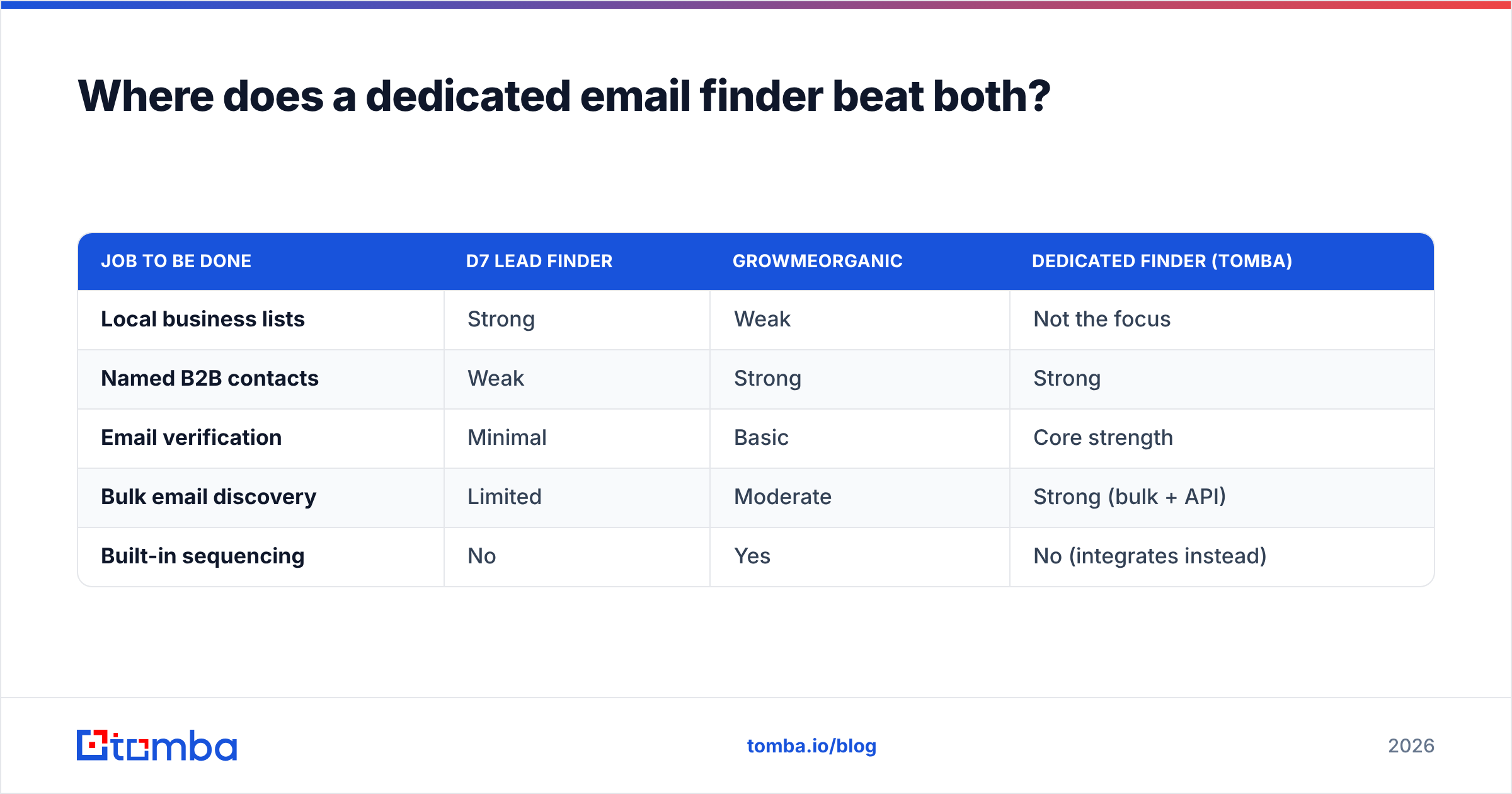
Here's how the roles actually stack up:
| Job to be done | D7 Lead Finder | GrowMeOrganic | Dedicated finder (Tomba) |
|---|---|---|---|
| Local business lists | Strong | Weak | Not the focus |
| Named B2B contacts | Weak | Strong | Strong |
| Email verification | Minimal | Basic | Core strength |
| Bulk email discovery | Limited | Moderate | Strong (bulk + API) |
| Built-in sequencing | No | Yes | No (integrates instead) |
The realistic 2026 stack for most B2B teams isn't "one tool wins." It's source with your finder, verify with a specialist, then send with your outreach layer. GrowMeOrganic can be that outreach layer; D7 can be a local-list feeder. But the verified-data core — the part that keeps your domain healthy — is worth handling with a purpose-built tool. You can even automate the whole flow through the Tomba Chrome extension or a bulk email finder run.
For a wider view of how these categories overlap, G2's lead intelligence grid is a useful neutral reference, and HubSpot's guide to lead generation frames where sourcing tools sit in the funnel.
The verdict: which should you buy in 2026?#
Buy D7 Lead Finder if you're an agency or local-services seller who needs cheap, fast business lists and already owns your outreach. Buy GrowMeOrganic if you're a small B2B team that wants named contacts and cold email in one subscription.
But don't mistake either for a data-accuracy solution. Both leave you with a verification job, and skipping it is the fastest way to torch your sender reputation. Whichever sourcing tool you pick, add a real finding-and-verification layer before your emails go out.
If deliverability is where your outbound actually breaks, start there. The Tomba Email Finder gives you verified professional emails by name, company, or domain — with a free tier of 25 searches to test accuracy against your own list before you commit. Source however you like, but send on clean data. That's the difference between a pipeline and a spam folder.
Related guides#
Ready to find emails that actually work?
Join 150,000+ professionals who stopped guessing and started sending. Free credits on signup — no credit card required.
Get the Tomba newsletter
Practical outbound tactics and product updates — once every two weeks.
About the author