Data for Lead Generation: How to Build Lists That Convert
Great lead gen starts with great data, not more tools. Here's how to source, verify, and enrich data for lead generation that actually books meetings in 2026.
Most lead generation problems are data problems wearing a marketing costume. You can A/B test subject lines forever, but if 30% of your list bounces and half the "decision-makers" left the company last year, no clever copy will save the campaign.
This guide is about the unglamorous foundation: the data for lead generation itself. Where it comes from, how to tell good data from garbage, how to enrich it, and how to keep it clean so your pipeline stops leaking money.
TL;DR#
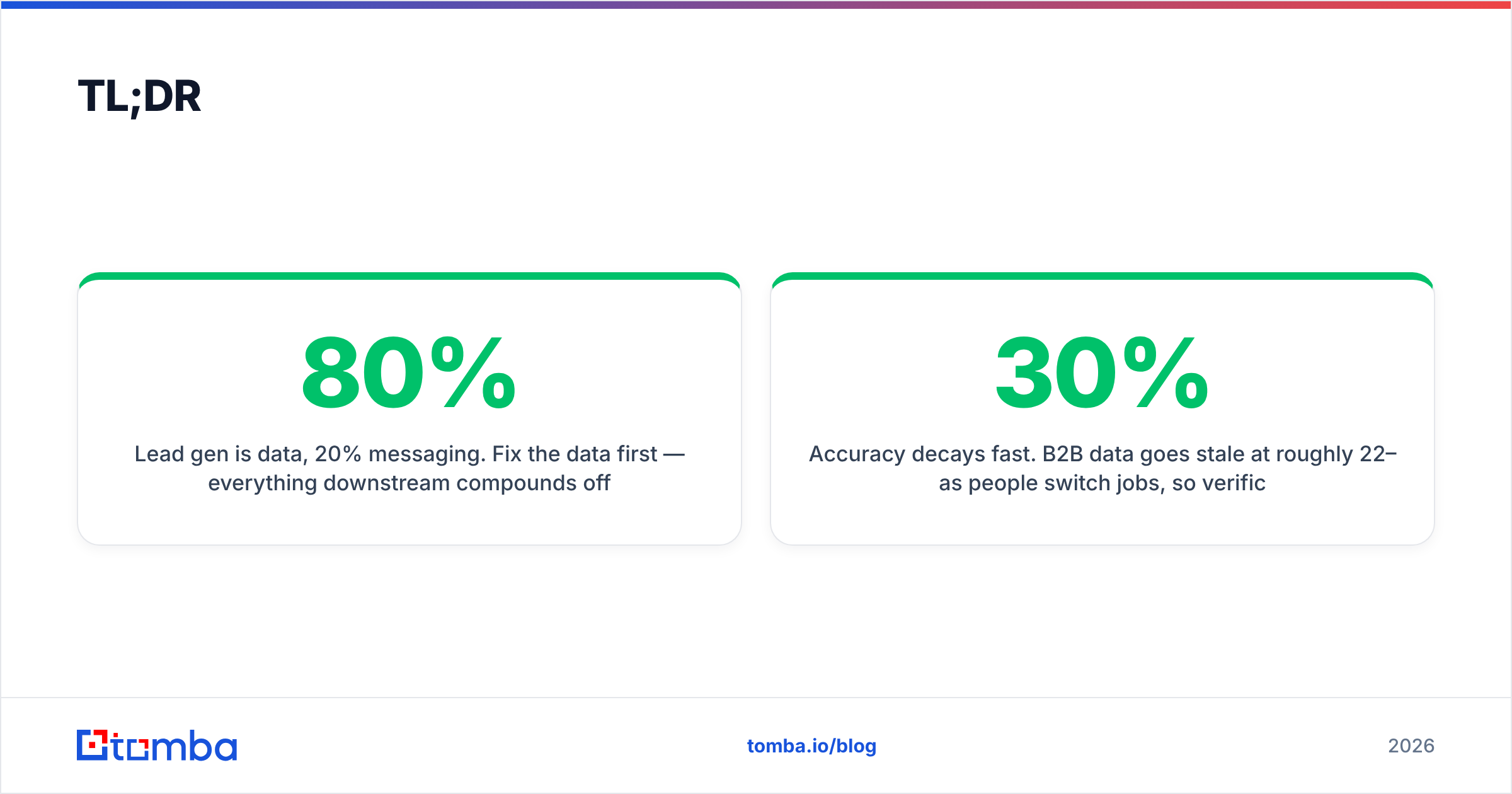
- Lead gen is 80% data, 20% messaging. Fix the data first — everything downstream compounds off it.
- Three data types matter: firmographic (the company), demographic (the person), and intent (buying signals). You want all three, layered.
- Accuracy decays fast. B2B data goes stale at roughly 22–30% per year as people switch jobs, so verification is a recurring task, not a one-time purchase.
- Buy, build, or find — each sourcing model has a cost/quality trade-off. Most teams end up blending them.
- Verify before you send. A quick pass through an email verifier protects your sender reputation and your reply rate.
What Counts as "Data for Lead Generation"?#
Think of your lead data like the ingredients in a kitchen. A name and an email are flour and water — necessary, but they don't make a meal. The teams that consistently book meetings work with a fuller pantry.
There are three layers you actually need:
- Firmographic data — the company facts: industry, headcount, revenue, location, tech stack, funding stage. This is how you decide whether a company fits your ICP at all.
- Demographic (contact) data — the human: full name, job title, seniority, department, verified work email, and often a direct phone number. This is how you reach the right person, not the info@ inbox.
- Intent and behavioral data — the signals: a company hiring for a role you serve, visiting your pricing page, downloading a competitor's whitepaper, or announcing a funding round. This is timing, and timing is most of the win.
The mistake beginners make is treating a scraped list of emails as "lead data." It isn't. It's contact data with no context — you have no idea if the person fits, no idea if they're in-market, and often no idea if the email even works.

Firmographic vs demographic vs intent, at a glance#
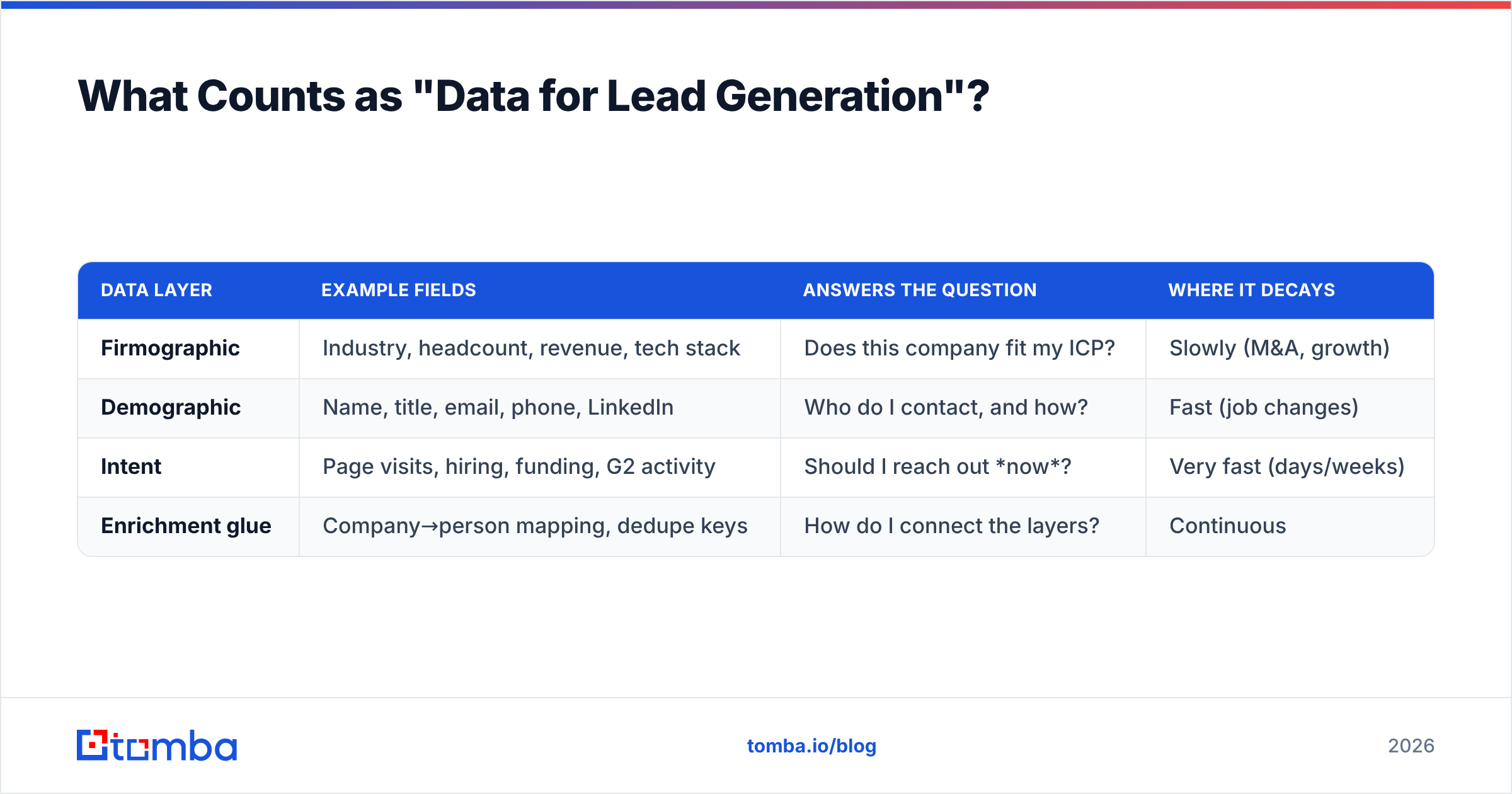
| Data layer | Example fields | Answers the question | Where it decays |
|---|---|---|---|
| Firmographic | Industry, headcount, revenue, tech stack | Does this company fit my ICP? | Slowly (M&A, growth) |
| Demographic | Name, title, email, phone, LinkedIn | Who do I contact, and how? | Fast (job changes) |
| Intent | Page visits, hiring, funding, G2 activity | Should I reach out now? | Very fast (days/weeks) |
| Enrichment glue | Company→person mapping, dedupe keys | How do I connect the layers? | Continuous |
You need a way to join these layers together. That "glue" — matching a person to a company to a signal — is where data enrichment earns its keep.
Where Does Good Lead Data Actually Come From?#
There are three honest ways to get B2B data, and every serious team uses some blend of them.
1. Buy it (data providers and marketplaces). You purchase pre-built lists or subscribe to a database. Fast, scalable, and great for breadth. The catch is freshness and fit — a generic bought list can be months out of date, and you're often paying for contacts you'll never touch. Vendors like BookYourData have built a reputation around pay-as-you-go, verified B2B lists, which sidesteps the "pay for millions of stale rows" problem that plagues cheaper marketplaces.
2. Build it (first-party capture). Forms, gated content, webinar signups, newsletter subscribers, product signups. This is the highest-quality data you'll ever own because the person raised their hand. The downside is volume — first-party data is a trickle, not a firehose, and it takes time to compound.
3. Find it (targeted discovery). You identify a specific account or person and go get their verified contact details on demand. This is where an email finder or domain search fits: you know you want the VP of Engineering at a target company, and you retrieve a verified email in seconds instead of buying a 50,000-row list to get 12 useful contacts.
Buy vs build vs find#
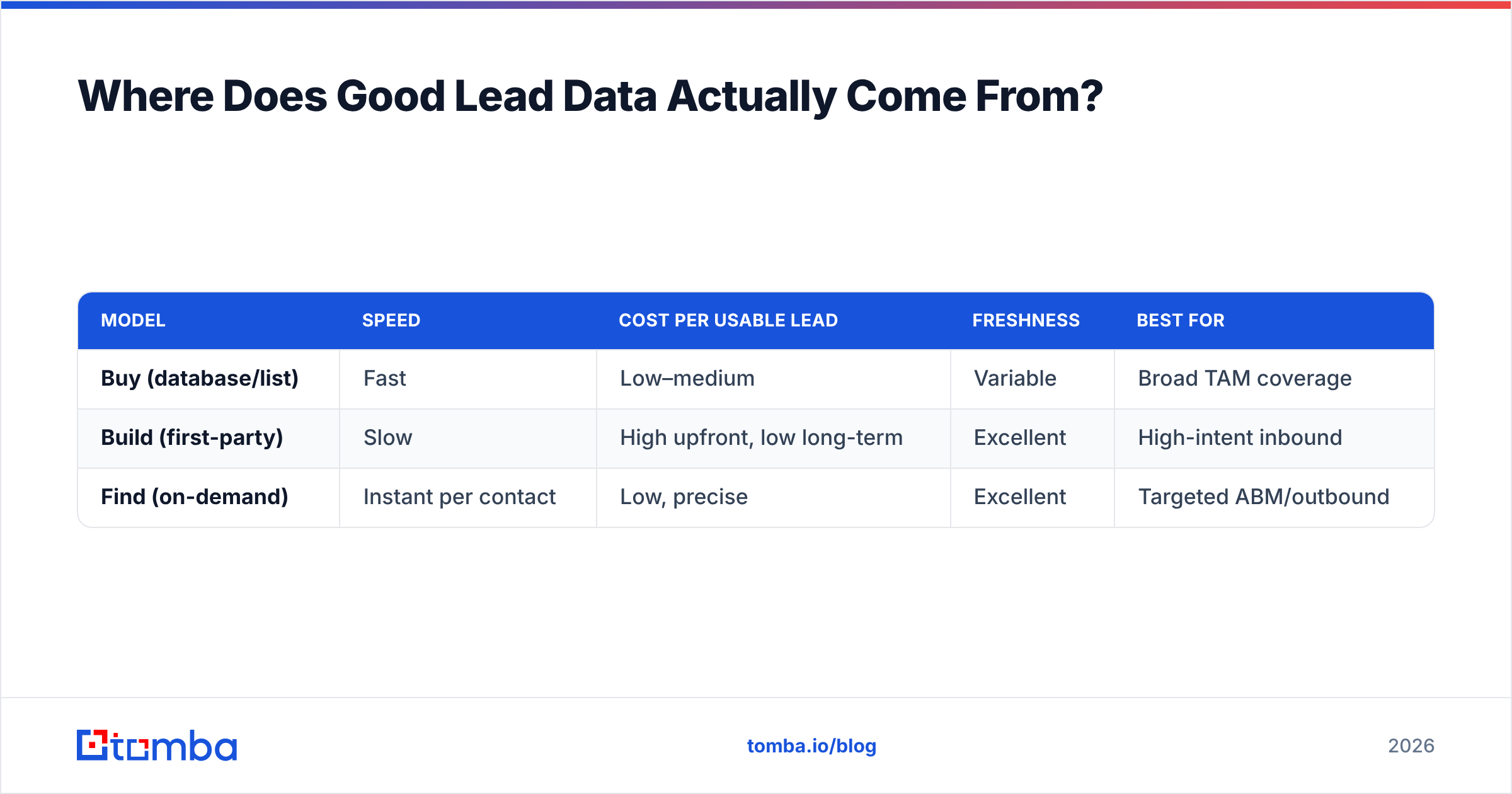
| Model | Speed | Cost per usable lead | Freshness | Best for |
|---|---|---|---|---|
| Buy (database/list) | Fast | Low–medium | Variable | Broad TAM coverage |
| Build (first-party) | Slow | High upfront, low long-term | Excellent | High-intent inbound |
| Find (on-demand) | Instant per contact | Low, precise | Excellent | Targeted ABM/outbound |
The right answer is rarely just one. A common high-performing setup: build an ICP and target account list from firmographic data, find the exact right contacts inside those accounts on demand, and buy intent signals to prioritize who to hit first.
How Do You Know If Your Data Is Any Good?#
Here's the uncomfortable truth nobody selling you a list wants to say out loud: B2B contact data decays by roughly 22% to 30% every single year. People change jobs, companies rebrand, domains migrate, and email formats change after an acquisition. HubSpot and other CRM vendors have documented this decay for years — it's why a list you bought in January is measurably worse by June (HubSpot on data decay).
So "good data" isn't a property you buy once. It's a state you maintain. Judge any dataset on four axes:
- Accuracy — Is the email deliverable? Is the title current? Run it through verification, don't trust it on faith.
- Completeness — Do you have enough fields to segment and personalize, or just a name and a guess at the email?
- Consistency — Are formats standardized (job titles, country codes, company names) so you can actually filter and dedupe?
- Freshness — When was each record last verified? A "verified 2 years ago" email is functionally unverified.
The single highest-ROI habit here is verifying emails before every send. A verifier checks whether the mailbox exists, whether the domain accepts mail, and flags risky patterns like catch-all domains and spam traps. Skipping this is how good sender reputations die — and once your email deliverability tanks, even your perfect leads never see the message.
For domains that accept every address (catch-alls), a standard verifier will shrug. That's where a dedicated catch-all verifier helps you decide which risky-but-plausible contacts are worth the send.
What Does an Enriched Lead Record Look Like?#
Enrichment is the step where a thin lead becomes a workable one. You start with a fragment — say, a work email captured from a form — and you append the rest.
Take a raw inbound signup: dana@northwind.io. On its own, that's nearly useless for a sales rep. Enriched, it becomes actionable:
- Person: Dana Okafor, Director of RevOps
- Company: Northwind Analytics, 180 employees, Series B, martech
- Tech stack: Salesforce, Outreach, Snowflake
- Signal: Company posted 3 RevOps job openings this month
- Contact: verified email, direct dial, LinkedIn profile
Now a rep can write one sentence that proves they did their homework, instead of a generic blast. That's the entire game. Enrichment turns "spray and pray" into "relevant and rare."
You can do this at scale with a bulk email finder for outbound list-building, or in real time via the Tomba API so records get enriched the moment they enter your CRM — no manual copy-paste, no stale snapshots.
A minimum viable enriched record#
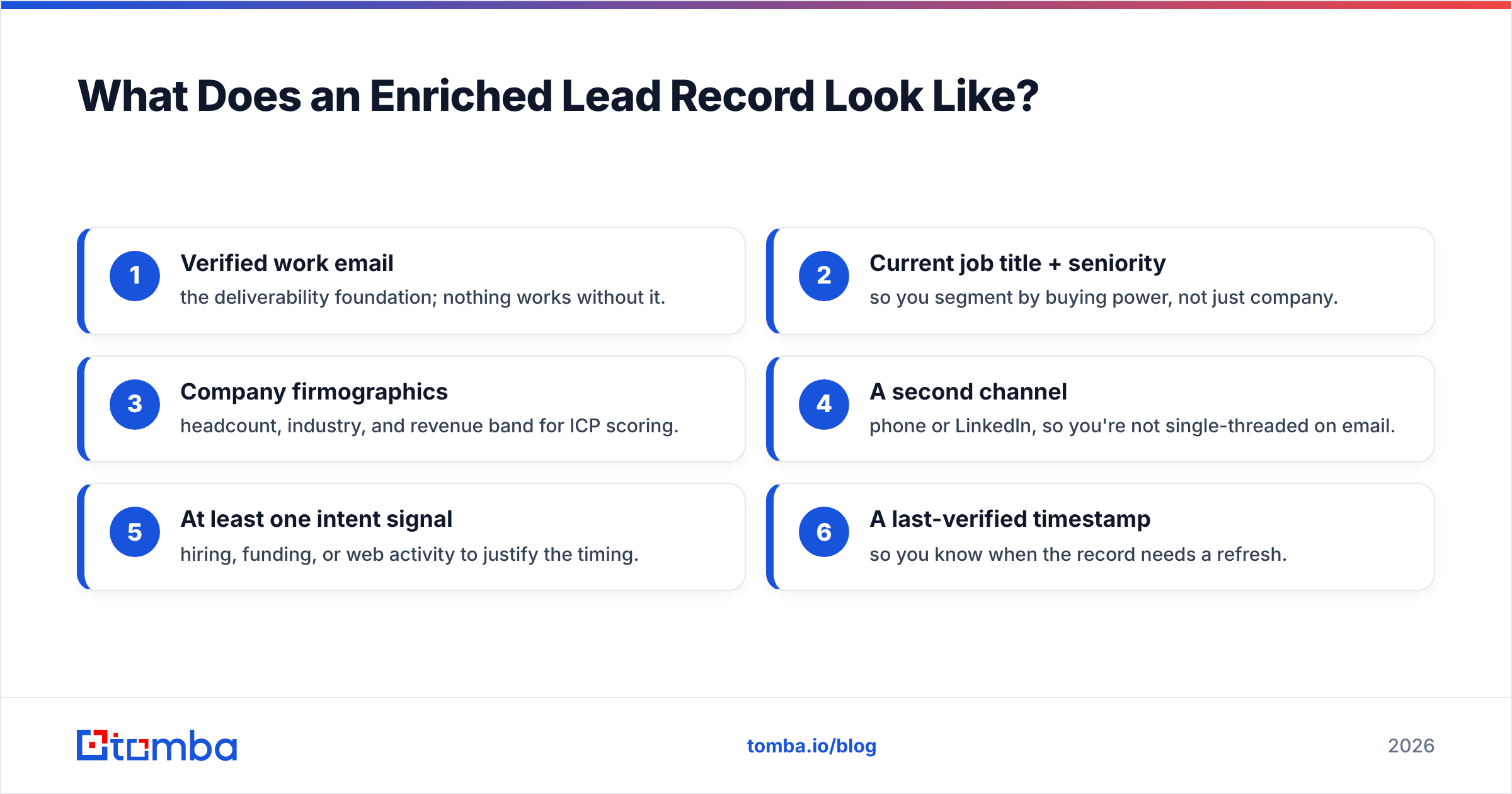
- Verified work email — the deliverability foundation; nothing works without it.
- Current job title + seniority — so you segment by buying power, not just company.
- Company firmographics — headcount, industry, and revenue band for ICP scoring.
- A second channel — phone or LinkedIn, so you're not single-threaded on email.
- At least one intent signal — hiring, funding, or web activity to justify the timing.
- A last-verified timestamp — so you know when the record needs a refresh.
If a lead record has all six, your reps can personalize in under a minute. If it's missing three of them, they'll either skip it or send something generic — and you paid for that lead either way.
How Do You Keep Lead Data Clean Over Time?#
Data hygiene is like brushing your teeth. Doing it hard once a year doesn't help; doing it a little, consistently, prevents the expensive problems. Build these into your workflow:
- Verify on entry. Every new lead — inbound or outbound — gets its email verified before it's marked "contactable."
- Re-verify on a cadence. Re-check active pipeline contacts quarterly. Because of that 22–30% annual decay, a quarterly pass catches most job-changers before they cost you a bounce.
- Dedupe relentlessly. The same human shows up as three records from three sources. Merge them on a stable key (verified email is a good one).
- Standardize fields. "VP Sales," "V.P. of Sales," and "Vice President, Sales" should all filter together. Normalize on import.
- Enrich, don't just collect. A pile of emails isn't an asset. A segmented, scored, enriched database is.
Tools help, but the discipline is organizational. Assign an owner. Data with no owner rots by default — entropy always wins when nobody's watching.
Which Data Sources Should You Prioritize?#
If you're building your data for lead generation stack from scratch, prioritize in this order:
- Your ICP definition first. You can't judge data quality without knowing what "good" looks like. Write down firmographics and titles before you buy or find anything.
- First-party capture. Set up form enrichment and web-visitor identification so your best-fit, highest-intent leads are captured automatically.
- On-demand finding for target accounts. For named accounts, retrieve verified contacts precisely instead of buying broad lists.
- Intent signals. Layer in buying signals once the first three are solid — intent without contactability is just interesting trivia.
- Bought data for breadth. Fill TAM gaps with reputable, verified providers last, once you know exactly which segments you're missing.
The ordering matters because each layer makes the next one cheaper. A tight ICP means you buy less junk. Verified contacts mean intent data actually converts. Skip the foundation and you'll overspend at every layer above it.
The Bottom Line#
Lead generation feels like a creativity problem, so teams pour energy into copy, cadences, and channels. But the leverage is upstream. Clean, complete, verified, well-timed data for lead generation makes mediocre copy work and makes great copy unstoppable. Bad data makes even brilliant campaigns fail quietly.
Start by fixing what you already have: verify your list, enrich the thin records, and put a re-verification cadence on the calendar. Then build the sourcing engine — ICP first, first-party capture, on-demand finding, intent, and bought breadth, in that order.
When you're ready to source and verify the contacts behind your target accounts, the Tomba Email Finder retrieves professional, verified emails by name, domain, or company — with a free tier (25 searches/month) to test it, then paid plans from $49/month. Check the Tomba pricing page to match a plan to your volume, and pair it with the built-in verifier so every lead you add is contactable before your first send. Fix the data, and the pipeline follows.
Related guides#
Ready to find emails that actually work?
Join 150,000+ professionals who stopped guessing and started sending. Free credits on signup — no credit card required.
Get the Tomba newsletter
Practical outbound tactics and product updates — once every two weeks.
About the author