Data Science in Sales: How Data Teams Drive Revenue in 2026
Data science in sales turns messy CRM records into forecasts, lead scores, and next-best actions. Here is how it actually works in 2026 — and where to start.
Data science in sales is the practice of using statistical models, machine learning, and clean data to make selling decisions that used to run on gut feel — who to call, what to say, and how likely the deal is to close. Done right, it does not replace reps; it points them at the accounts and moments where their time actually converts.
TL;DR#
- Data science in sales applies models to CRM, product, and firmographic data to predict outcomes (lead scores, churn risk, forecast accuracy) and recommend actions.
- The four highest-ROI use cases in 2026 are lead scoring, forecasting, next-best-action, and territory/quota planning — in that order for most teams.
- Models are only as good as the inputs. Garbage contact data and stale firmographics sink more sales-AI projects than bad algorithms do.
- You do not need a PhD team to start. A clean data foundation plus one focused model beats a "sales AI platform" bolted onto a dirty CRM.
- Start where the payoff is obvious and measurable: fix data quality, then score leads, then automate the boring routing.
What is data science in sales?#
Think of a sales org as a restaurant kitchen at rush hour. Every rep is a cook with limited hands, and tickets (leads, deals, renewals) pile up faster than anyone can work them. Data science is the expediter who reads the whole board and tells each cook which ticket to grab next so nothing burns. Technically, it is the discipline of extracting predictions and recommendations from historical and real-time sales data using statistics and machine learning.
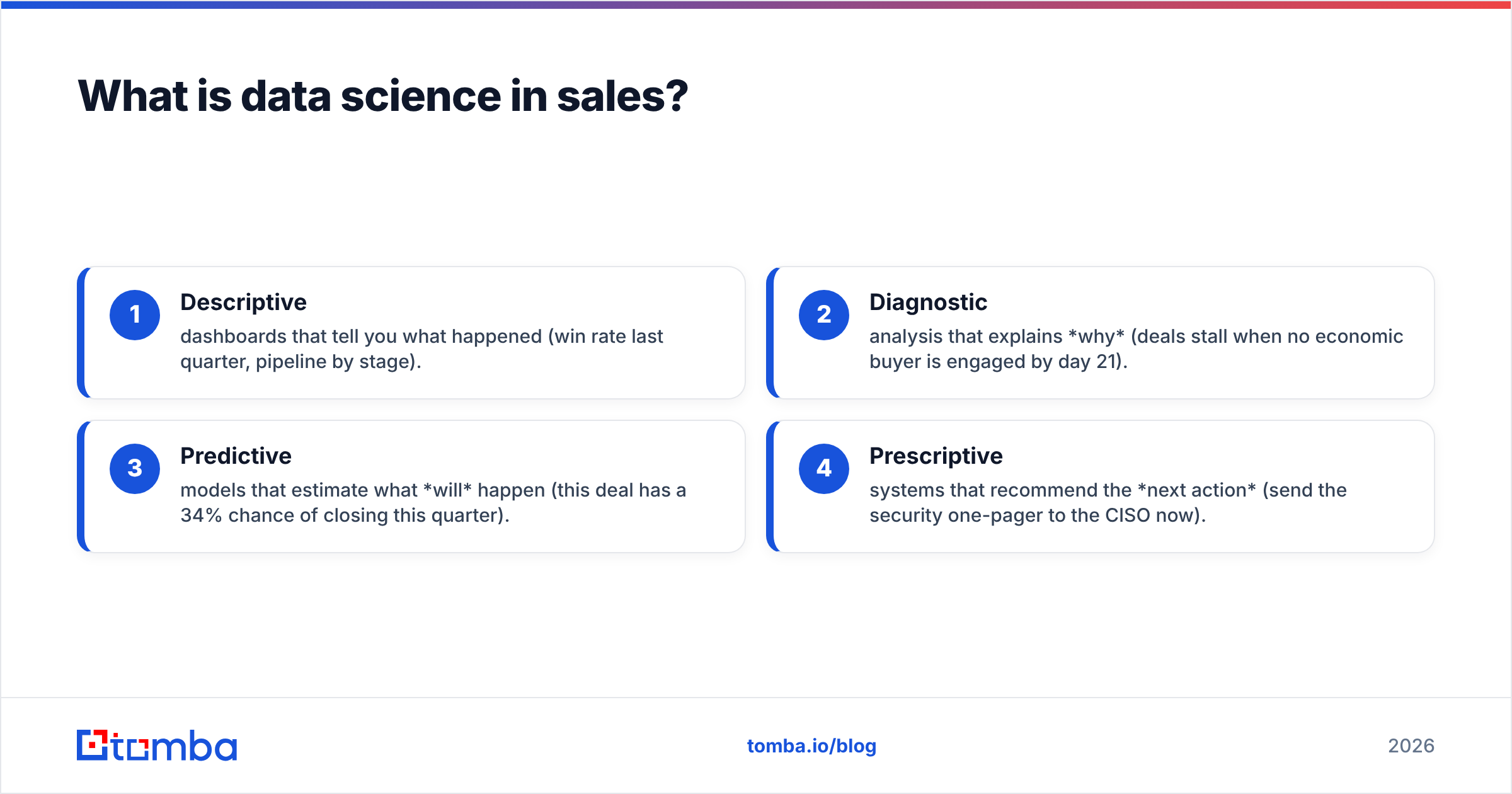
In practice, "data science in sales" spans a spectrum:
- Descriptive — dashboards that tell you what happened (win rate last quarter, pipeline by stage).
- Diagnostic — analysis that explains why (deals stall when no economic buyer is engaged by day 21).
- Predictive — models that estimate what will happen (this deal has a 34% chance of closing this quarter).
- Prescriptive — systems that recommend the next action (send the security one-pager to the CISO now).
Most teams live in the first two and think they are "doing data science." The revenue lift shows up when you cross into predictive and prescriptive — and that jump depends far more on data quality than on model sophistication.

Why does data science matter for sales in 2026?#
Because attention is the scarcest resource on a sales team, and data science is how you allocate it. A rep working 40 accounts by intuition will spread effort evenly. A rep working the same 40 accounts ranked by a fit-and-intent model will spend 80% of their time on the 8 accounts most likely to buy. Same headcount, very different pipeline.
Three shifts make this urgent now:
- Buyers self-serve until late. According to Gartner research on B2B buying, buyers spend only a small fraction of the journey with any single sales rep. You have to be right when you do engage, which means predicting intent instead of reacting to it.
- Data volume outgrew manual triage. Product usage logs, website visits, and enrichment feeds produce more signals than any human can weigh. Models weigh them consistently.
- AI tooling got cheap. What required a data-engineering team in 2019 now ships as a feature. The moat moved from "can you build a model" to "is your underlying data clean enough to trust one."
What data powers sales models?#
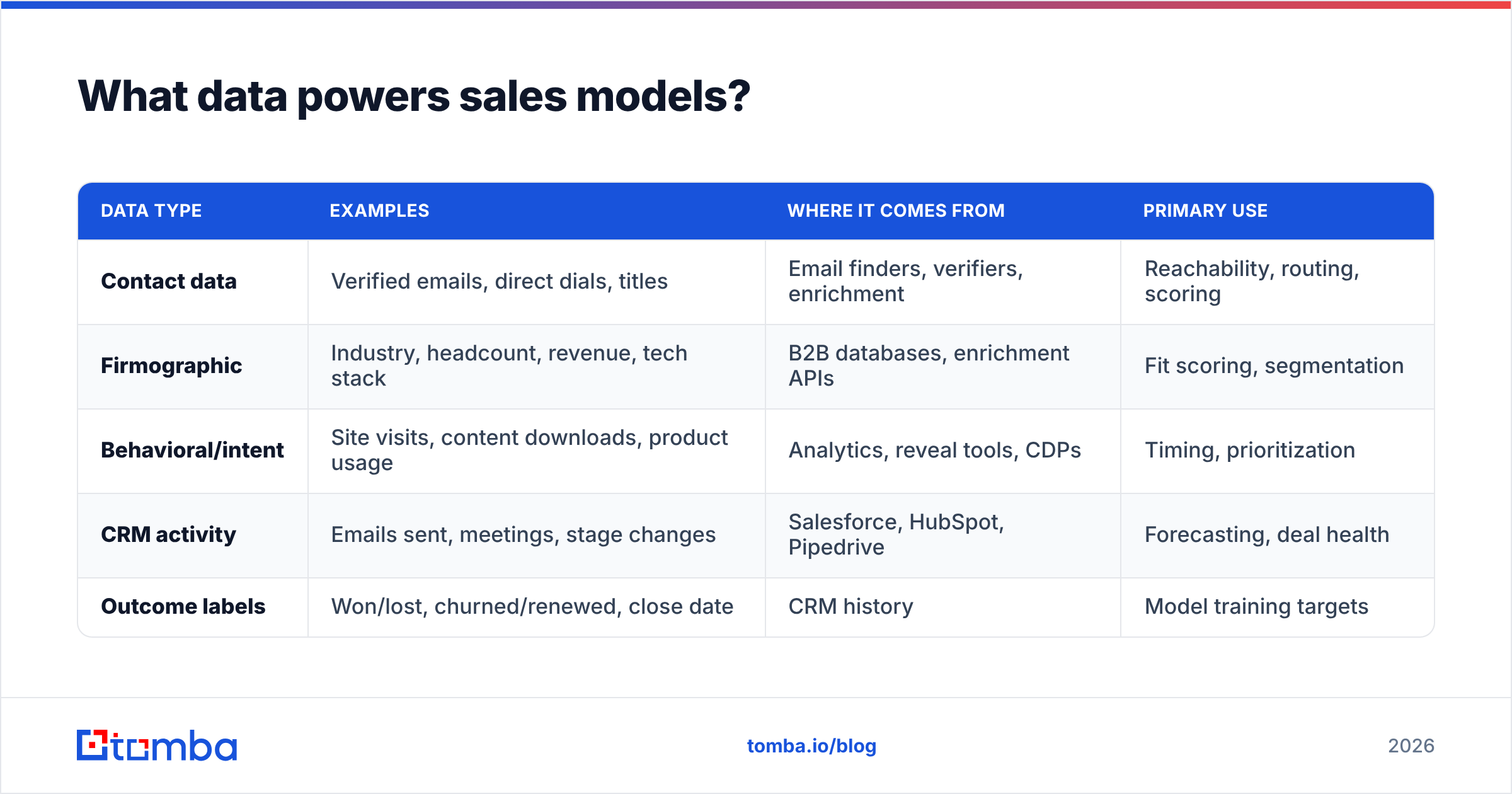
A sales model is a blender: the smoothie is only as good as what you drop in. Here is the core input set, roughly in order of impact.
| Data type | Examples | Where it comes from | Primary use |
|---|---|---|---|
| Contact data | Verified emails, direct dials, titles | Email finders, verifiers, enrichment | Reachability, routing, scoring |
| Firmographic | Industry, headcount, revenue, tech stack | B2B databases, enrichment APIs | Fit scoring, segmentation |
| Behavioral/intent | Site visits, content downloads, product usage | Analytics, reveal tools, CDPs | Timing, prioritization |
| CRM activity | Emails sent, meetings, stage changes | Salesforce, HubSpot, Pipedrive | Forecasting, deal health |
| Outcome labels | Won/lost, churned/renewed, close date | CRM history | Model training targets |
Notice that contact and firmographic data sit at the top. A brilliant propensity model that fires on a bounced email or a contact who left the company two years ago produces confident nonsense. This is why serious teams treat data enrichment and verification as part of the model pipeline, not an afterthought — and why a fast, accurate email finder is upstream infrastructure for the whole analytics stack, not just a rep tool.
The rule that never changes: clean the inputs first. You cannot model your way out of a dirty CRM.
What are the highest-ROI use cases?#
You do not have to do everything. These four use cases deliver most of the value, and you can ship them roughly in this order.
- Predictive lead scoring — Rank inbound and outbound leads by likelihood to convert, using fit (firmographics) and intent (behavior). This is usually the first model teams ship because the label (converted or not) is clean and the payoff is immediate: reps stop chasing tire-kickers.
- Sales forecasting — Move from "commit / best case / worst case" spreadsheets to a model that scores every open deal on close probability and rolls it into a number leadership can defend. Improves both accuracy and the forecast review meeting.
- Next-best-action — Recommend the specific move most likely to advance each deal (loop in a champion, send a case study, schedule a technical call). This is prescriptive and depends on rich activity history.
- Territory and quota planning — Use account-level potential (fit × market size) to balance territories so no rep gets a desert and no rep gets a goldmine. Removes the annual political knife-fight.
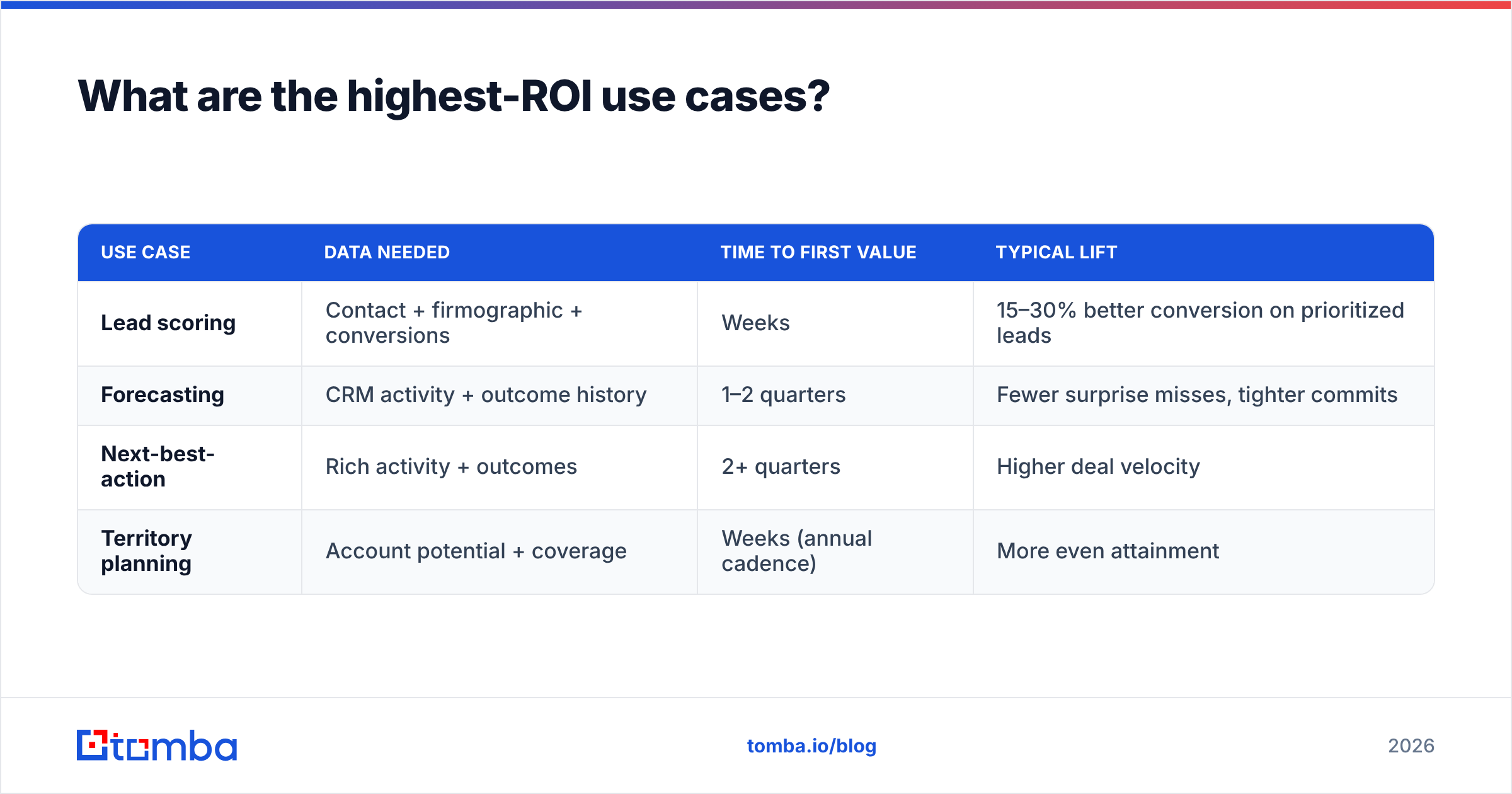
A quick reality check on where each lands:
| Use case | Data needed | Time to first value | Typical lift |
|---|---|---|---|
| Lead scoring | Contact + firmographic + conversions | Weeks | 15–30% better conversion on prioritized leads |
| Forecasting | CRM activity + outcome history | 1–2 quarters | Fewer surprise misses, tighter commits |
| Next-best-action | Rich activity + outcomes | 2+ quarters | Higher deal velocity |
| Territory planning | Account potential + coverage | Weeks (annual cadence) | More even attainment |
Start at the top of the list. Lead scoring gives you a fast, measurable win that funds the harder projects.
How do you build a sales data science stack?#
You assemble it in layers, and — critically — you do it bottom-up. Skipping the foundation is the single most common way these projects fail.
- Layer 1 — Data foundation. Verified contacts, deduplicated accounts, consistent field definitions. This is unglamorous plumbing and it is 70% of the work. Tools like an email verifier and bulk enrichment live here, keeping the records feeding your models trustworthy.
- Layer 2 — Warehouse + pipelines. A place to unify CRM, product, and enrichment data (Snowflake, BigQuery, or even a well-structured Postgres for smaller teams) with scheduled syncs.
- Layer 3 — Modeling. Where the actual data science happens: feature engineering, training, evaluation. This can be a notebook stack, an AutoML tool, or a vendor's built-in scoring.
- Layer 4 — Activation. Scores and recommendations pushed back into the tools reps already use — the CRM, the sequencer, Slack. A model nobody sees in their workflow is a model nobody uses.
If you take one thing from this section: the foundation layer is where projects live or die. A modest model on clean data beats a sophisticated one on garbage every time. See where quality data actually comes from in Tomba's data sources if you want to pressure-test your own inputs.
Should you build models or buy a platform?#
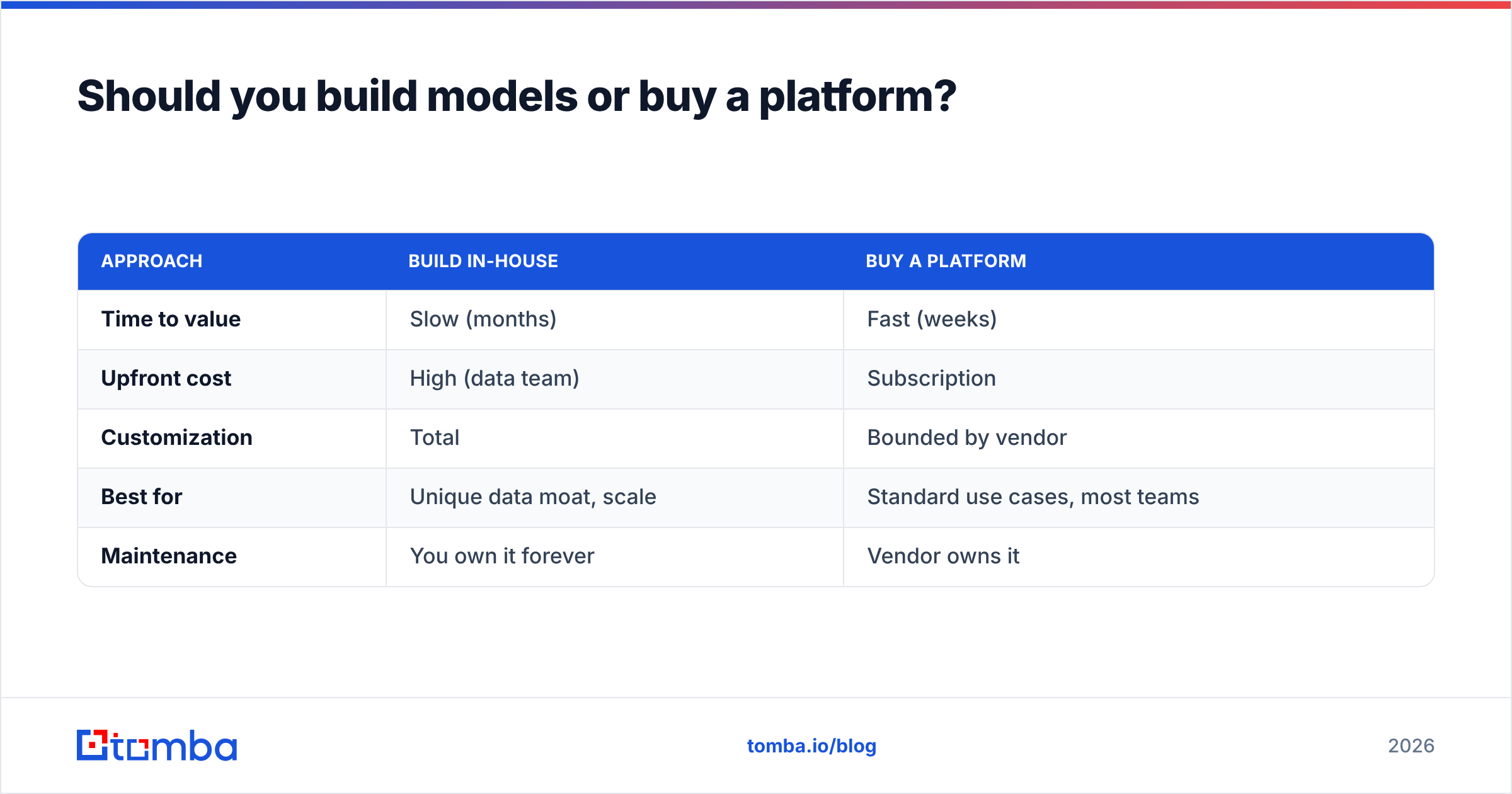
The honest answer: buy for the common use cases, build only where you have a genuine data advantage. Most teams have no business writing a custom lead-scoring model when a mature tool does it well out of the box — and every team should own its data foundation regardless of what it buys on top.
| Approach | Build in-house | Buy a platform |
|---|---|---|
| Time to value | Slow (months) | Fast (weeks) |
| Upfront cost | High (data team) | Subscription |
| Customization | Total | Bounded by vendor |
| Best for | Unique data moat, scale | Standard use cases, most teams |
| Maintenance | You own it forever | Vendor owns it |
The trap is buying an expensive "AI sales platform" and pointing it at a CRM full of bounced emails and duplicate accounts. The platform will happily generate confident scores from bad data. That is worse than no model, because it launders bad inputs into decisions people trust. Whatever you buy, own the data layer underneath it — that is the part no vendor can fix for you.
How do you measure whether it is working?#
Tie every model to a metric a VP of Sales already cares about, and A/B test it against the status quo. Vanity metrics like "model accuracy" mean nothing if attainment does not move.
- Lead scoring: conversion rate of top-ranked leads vs. a control group. If reps working "A" leads do not convert meaningfully better than "C" leads, the model is not earning its keep.
- Forecasting: forecast accuracy (commit vs. actual) over several quarters. Watch the trend, not one lucky quarter.
- Next-best-action: deal velocity and stage-conversion for reps who follow recommendations vs. those who do not.
- Data quality (the leading indicator): bounce rate, duplicate rate, enrichment coverage. When these degrade, every downstream model degrades with them — usually before anyone notices in the outcome metrics.
Set a baseline before you deploy anything. "We think it's helping" is not evidence; a control group is.
What are the common failure modes?#
Most sales data science projects do not fail on math. They fail on the boring stuff:
- Dirty inputs. Stale titles, bounced emails, contacts who changed jobs. Fixable with routine verification and enrichment — but only if you treat it as ongoing hygiene, not a one-time cleanup.
- No activation. The score sits in a dashboard nobody opens instead of surfacing in the CRM at the moment of decision.
- Modeling the wrong thing. Optimizing for meetings booked when the business needs revenue. Pick the target metric carefully.
- No trust. If reps do not understand why a lead scored high, they ignore it. Explainability beats a marginal accuracy gain.
- Set-and-forget. Buyer behavior drifts; a model trained on 2024 patterns quietly rots. Retrain on a schedule.
For a broader map of the terminology behind these systems, the B2B glossary is a useful reference when aligning a sales and data team on definitions. It also helps to compare notes against peer reviews on a neutral marketplace like G2's sales analytics category before committing to any vendor.
How do small teams start without a data team?#
Start narrow, and start with data quality — because it is the one investment that pays off no matter which model you build later.
- Audit your CRM. Measure bounce rate, duplicate rate, and how many contacts are missing a verified email or current title. This is your baseline.
- Fix the foundation. Run existing records through verification and enrichment; wire a Chrome extension or Google Sheets add-on so new contacts enter clean.
- Ship one model. Predictive lead scoring, using a tool's built-in feature or a simple logistic-regression baseline. Do not over-engineer the first one.
- Measure against a control. Split leads, route half by the model and half the old way, and compare conversion after a few weeks.
- Expand only after proof. Once scoring earns trust, move to forecasting.
A three-person sales team can run this playbook without hiring a single data scientist. The leverage is in the data foundation and one focused model — not in a sprawling platform.
The bottom line#
Data science in sales is not about replacing reps with algorithms. It is about pointing scarce human attention at the accounts and moments that convert, using models fed by clean, verified data. The teams that win in 2026 are not the ones with the fanciest models — they are the ones whose inputs are trustworthy enough that the models can be believed.
Every layer of that stack — scoring, forecasting, next-best-action — sits on top of one thing: accurate contact and company data. If your reps are still working from bounced emails and stale titles, no model will save the forecast. Start at the foundation. Use Tomba's Email Finder to feed your CRM and your models verified, deliverable contacts, back it with the email verifier to keep bounce rates low, and check the current Tomba pricing — the free tier gives you 25 searches a month to test the quality before you commit a cent. Clean inputs first; smart models follow.
Related guides#
Ready to find emails that actually work?
Join 150,000+ professionals who stopped guessing and started sending. Free credits on signup — no credit card required.
Get the Tomba newsletter
Practical outbound tactics and product updates — once every two weeks.
About the author