B2B Data Vendors in 2026: How to Choose Without Overpaying
Not all B2B data vendors are worth the invoice. Here's how to compare accuracy, coverage, pricing, and compliance in 2026 — and avoid paying enterprise rates for stale contacts.
B2B Data Vendors in 2026: How to Choose Without Overpaying
Buying B2B data feels a lot like buying a used car with the hood welded shut. Every vendor swears their records are "95%+ accurate," every dashboard looks polished, and you don't find out what you actually bought until the bounce reports roll in three weeks later. The invoice, meanwhile, is very real.
This guide cuts through that. You'll learn what separates a genuinely good data vendor from an expensive contact dump, how pricing models quietly punish you, and which evaluation steps catch a bad dataset before you sign.
TL;DR#
- Accuracy claims are marketing until you verify them yourself. Run a free sample of 100–200 records through independent verification before you commit to any data vendor.
- Coverage and freshness matter more than raw database size. A vendor with 200M "contacts" that are 18 months stale is worse than one with 50M records refreshed weekly.
- Pricing models are where you overpay. Per-seat enterprise contracts, credit expiry, and forced annual commits inflate cost far more than the sticker price suggests.
- Compliance is non-negotiable in 2026. GDPR, CCPA, and consent provenance can turn a cheap list into a legal liability.
- The best setup is often hybrid: a broad database for firmographics plus a real-time finder-and-verifier like Tomba for fresh, on-demand contact data.

What are B2B data vendors, exactly?#
A B2B data vendor sells you information about companies and the people who work at them — company names, industries, headcount, revenue, technologies used, plus contact details like email addresses, phone numbers, and job titles. You use that data to build target lists, enrich your CRM, score leads, and route accounts.
Think of it like a phone book for the modern go-to-market team, except the phone book is supposed to update itself, tell you who just changed jobs, and flag which numbers are disconnected. In practice, most fall short of that ideal — which is exactly why evaluation matters.
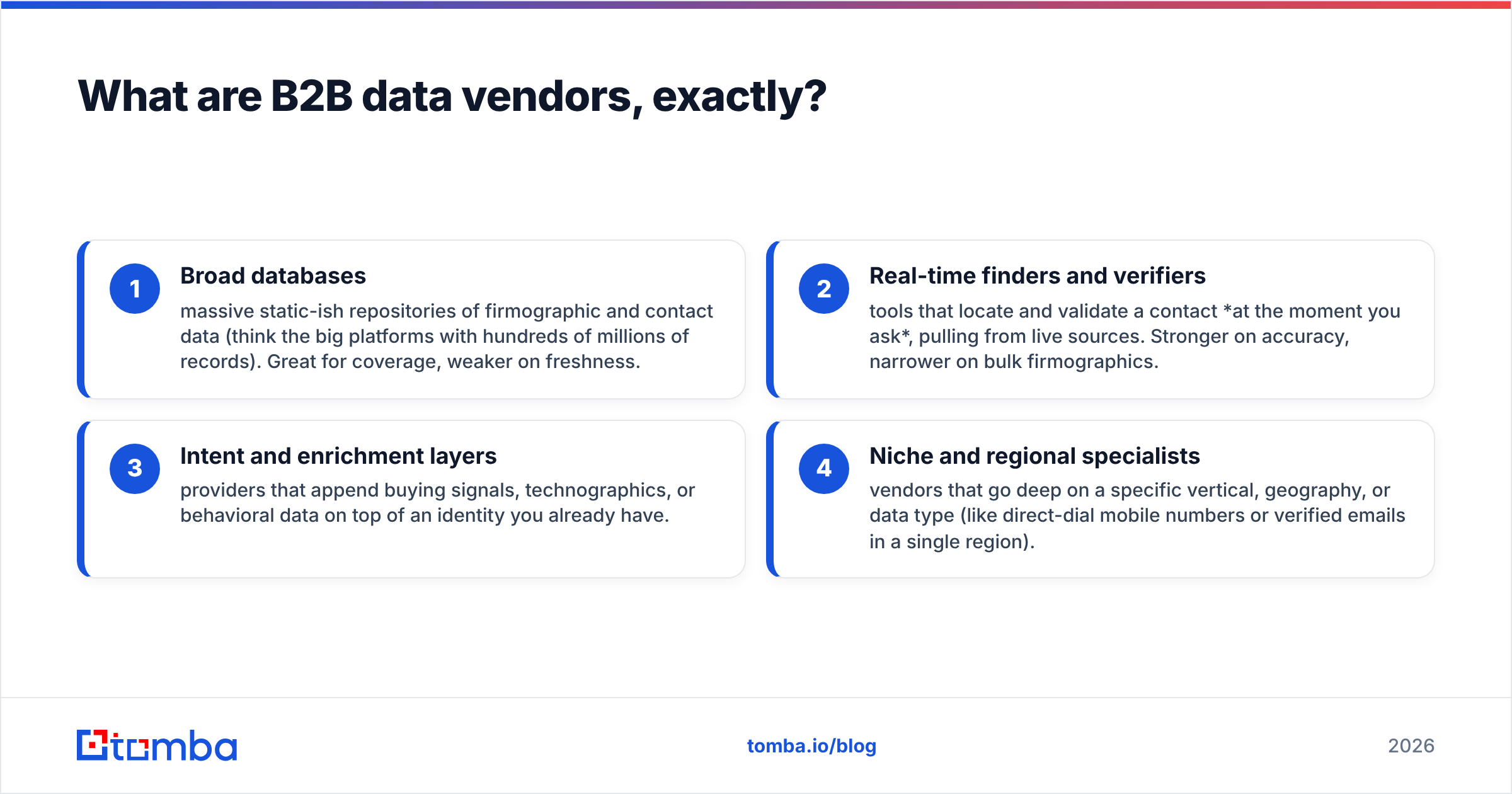
Vendors generally fall into a few buckets:
- Broad databases — massive static-ish repositories of firmographic and contact data (think the big platforms with hundreds of millions of records). Great for coverage, weaker on freshness.
- Real-time finders and verifiers — tools that locate and validate a contact at the moment you ask, pulling from live sources. Stronger on accuracy, narrower on bulk firmographics.
- Intent and enrichment layers — providers that append buying signals, technographics, or behavioral data on top of an identity you already have.
- Niche and regional specialists — vendors that go deep on a specific vertical, geography, or data type (like direct-dial mobile numbers or verified emails in a single region).
Most teams need two of these categories working together, not one vendor pretending to do everything.
How do you evaluate B2B data vendors?#
Judge every data vendor on five dimensions. Score each one honestly and the winner usually picks itself.
- Accuracy — What percentage of records are correct right now? Not "at time of collection." Verify with your own test, not their case study.
- Coverage — Does the vendor actually have the personas, regions, and company sizes you sell to? A US-heavy database is useless for a team selling into DACH.
- Freshness — How often is data re-verified? Job changes hit B2B contact data at roughly 25–30% churn per year, so a stale record decays fast.
- Compliance — Where does the data come from, and can the vendor document consent and lawful basis? This is a board-level risk in 2026.
- Total cost — Not the headline price. The real number after credit expiry, seat minimums, overage fees, and annual lock-in.
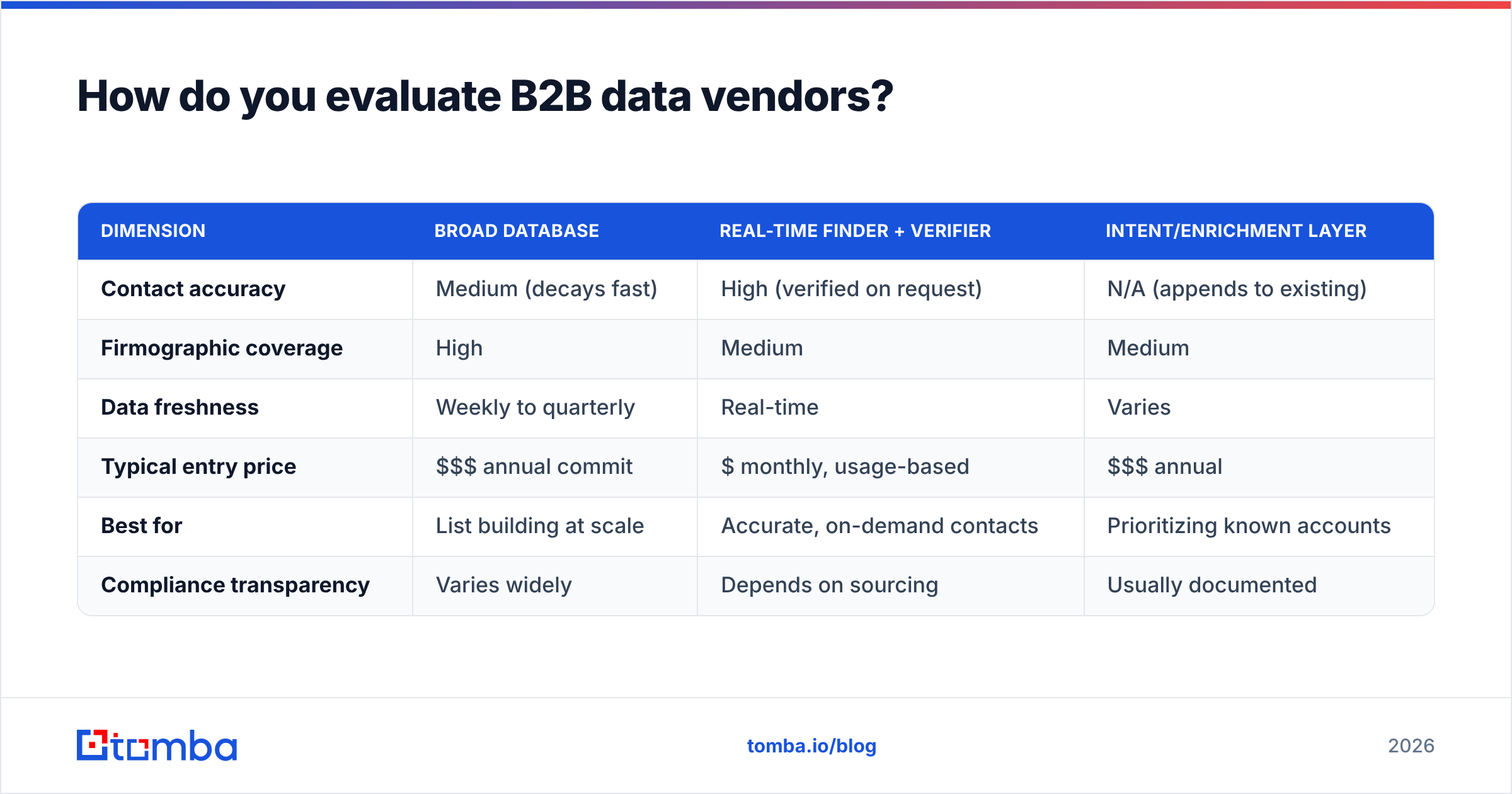
Here's how the main vendor categories tend to stack up against those dimensions:
| Dimension | Broad database | Real-time finder + verifier | Intent/enrichment layer |
|---|---|---|---|
| Contact accuracy | Medium (decays fast) | High (verified on request) | N/A (appends to existing) |
| Firmographic coverage | High | Medium | Medium |
| Data freshness | Weekly to quarterly | Real-time | Varies |
| Typical entry price | $$$ annual commit | $ monthly, usage-based | $$$ annual |
| Best for | List building at scale | Accurate, on-demand contacts | Prioritizing known accounts |
| Compliance transparency | Varies widely | Depends on sourcing | Usually documented |
The takeaway: no single category dominates. Broad databases win coverage, real-time tools win accuracy and flexibility, and intent layers only help once you already know who you're targeting.
Which pricing model actually costs you the most?#
The pricing model matters more than the per-record price, and this is where most teams overpay without noticing.
Watch for these four cost traps:
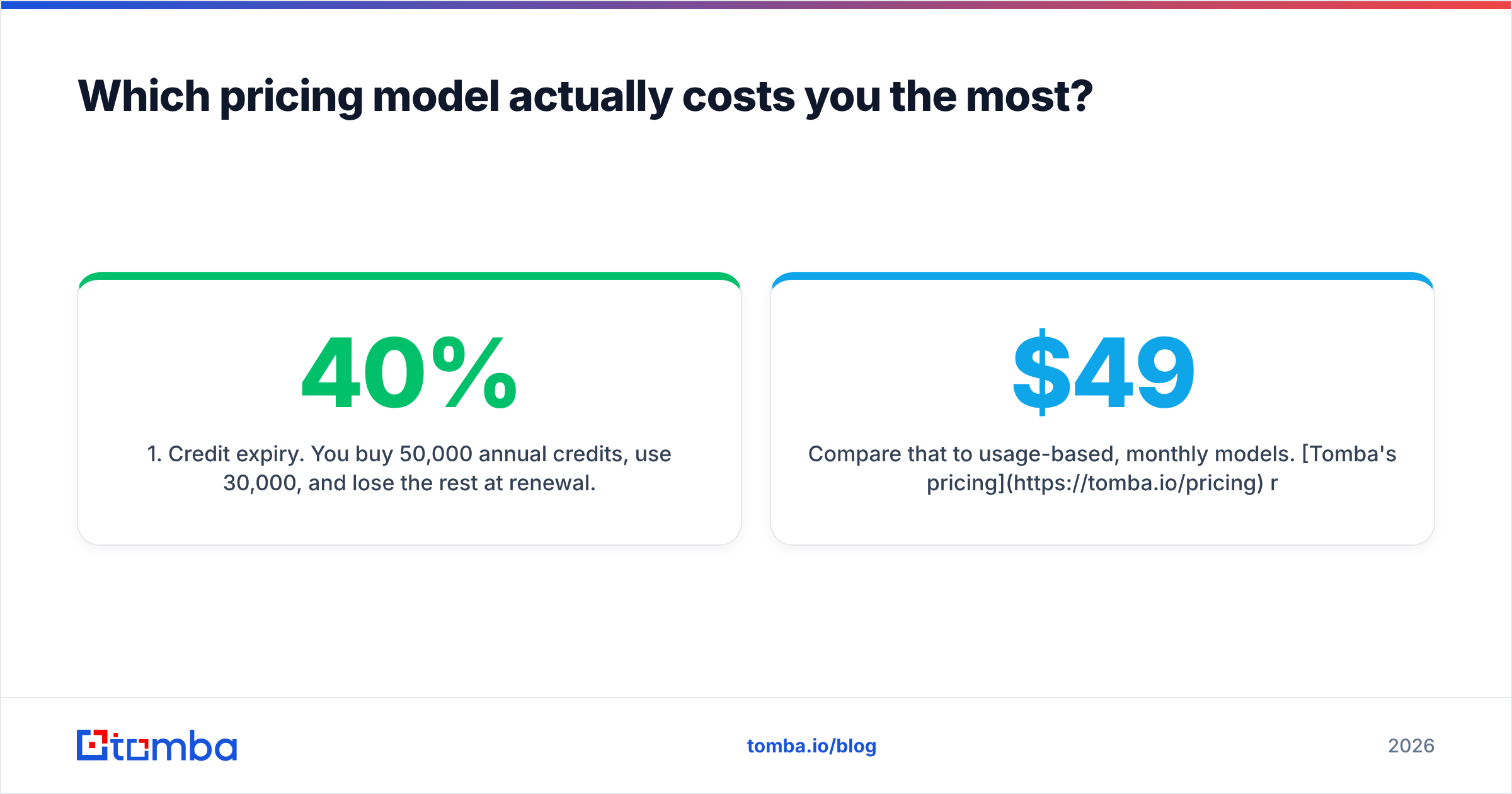
- Credit expiry. You buy 50,000 annual credits, use 30,000, and lose the rest at renewal. That's a 40% effective price hike hiding in the fine print.
- Per-seat minimums. Enterprise data platforms often force 5–10 seats even when three reps do the prospecting. You pay for empty chairs.
- Annual lock-in with no accuracy SLA. You commit for a year; they commit to nothing measurable about data quality. If the data is bad in month two, you're still paying in month eleven.
- Overage penalties. Blow past your quota mid-quarter and per-record costs can triple compared to the base rate.
Compare that to usage-based, monthly models. Tomba's pricing runs on transparent monthly tiers — a free plan with 25 searches, Starter at $49/mo, Growth at $99/mo, and Pro at $249/mo — with no forced annual commit to get started. When you're evaluating vendors, model your actual expected usage against each pricing structure. A cheaper per-record rate frequently loses to a "pricier" tool once expiry and minimums are factored in.
A quick gut-check: if you can't cancel a data contract the same month you discover the data is bad, you're not buying data — you're financing someone else's database.
How do you test a data vendor before you buy?#
Never trust a vendor's accuracy claim. Test it. Here's a repeatable process that takes an afternoon and saves you a year of regret.
- Pull a representative sample. Ask for (or generate) 100–200 records that match your real ICP — right industries, regions, and seniority. A cherry-picked demo list proves nothing.
- Verify emails independently. Run every email through a neutral email verifier you control. Note the deliverable, risky, and invalid split. If more than 5–8% are invalid, the "95% accurate" claim just failed.
- Spot-check freshness. Take 20 contacts and confirm on LinkedIn whether they still hold the listed role. Job-change decay is the silent killer of B2B data quality.
- Test coverage gaps. List 25 target accounts you know should be in a good database. See how many the vendor actually returns with usable contacts.
- Check the catch-all trap. Many "valid" emails sit on catch-all domains that accept everything and deliver nothing useful. A catch-all verifier tells you which "verified" records are actually a coin flip.
If a vendor refuses to give you a real sample, that refusal is your answer. Confident vendors let you test.
What about data compliance and sourcing?#
Where the data comes from is now as important as whether it's accurate. In 2026, regulators and buyers both care about provenance, and a non-compliant list can cost far more than it ever earned.
Ask every data vendor three direct questions:
- What is the lawful basis for this data? Under GDPR, legitimate interest for B2B outreach has limits, and consent provenance should be documentable. See the European Commission's data protection guidance for what "lawful basis" actually requires.
- Do you honor opt-outs and suppression lists across the platform? A single deletion request should propagate, not resurface next refresh.
- Can you show me your sourcing methodology? Scraped-and-resold data with no transparency is a red flag. Vendors that publish how they source and validate data are signaling accountability.
Reputable review platforms like G2 also surface real customer complaints about compliance and data decay that vendor sites conveniently omit. Read the 2- and 3-star reviews, not just the glowing ones.
Is one big vendor better than a hybrid stack?#
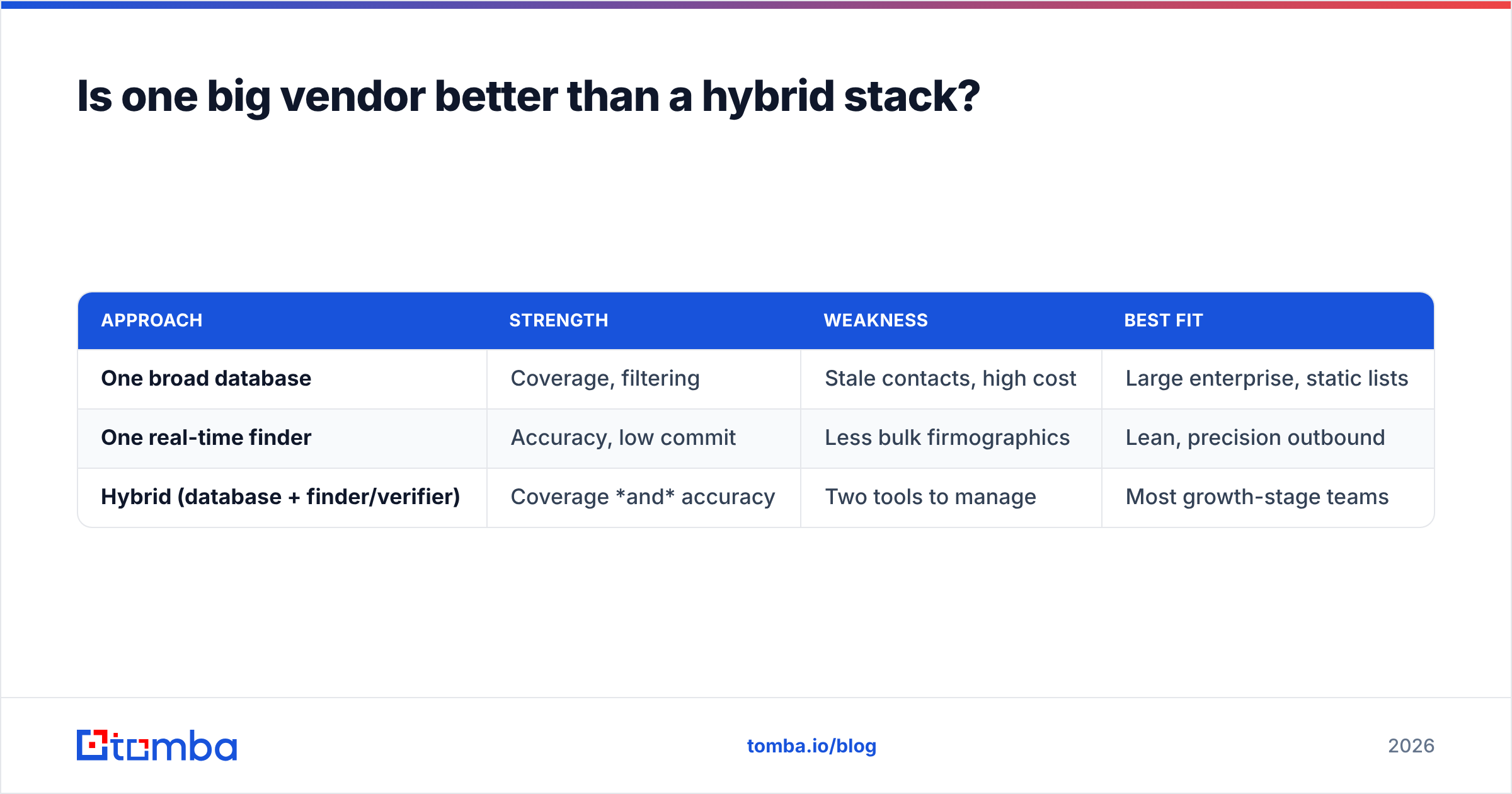
For most teams, a hybrid stack beats a single mega-vendor. Here's the logic.
A single broad database gives you scale but locks you into whatever freshness cycle they run. A single real-time tool gives you accuracy but may lack deep firmographic filters for building large lists. Combine them and each covers the other's weakness.
| Approach | Strength | Weakness | Best fit |
|---|---|---|---|
| One broad database | Coverage, filtering | Stale contacts, high cost | Large enterprise, static lists |
| One real-time finder | Accuracy, low commit | Less bulk firmographics | Lean, precision outbound |
| Hybrid (database + finder/verifier) | Coverage and accuracy | Two tools to manage | Most growth-stage teams |
A practical hybrid looks like this: use a broad database or your CRM to define target accounts and firmographics, then use a real-time domain search and finder to pull fresh, verified contacts for those accounts at the moment you're ready to reach out. You get the filtering power of a database without inheriting its decay.
This is also cheaper than it sounds, because you only pay to find contacts you'll actually use — instead of renting a 200-million-row database where you touch 2% of it.
What questions should you ask before signing?#
Bring this checklist to every vendor call. The answers separate real data vendors from list resellers.
- What's your re-verification cycle, in days? "We refresh regularly" is not an answer.
- What happens to unused credits at renewal? If they expire, negotiate rollover or walk.
- Can I start monthly and scale up? Forced annual commits protect the vendor, not you.
- What's your measured bounce rate on a fresh export? Ask for a number they'll stand behind.
- How do you handle catch-all and role-based addresses? Vague answers mean inflated "valid" counts.
- Can you document data sourcing and consent? Non-negotiable in regulated markets.
- Is there a real free sample — not a scheduled demo? Test data beats a slide deck every time.
If a vendor answers all seven cleanly, they're worth a trial. If they dodge three or more, keep looking.
The bottom line on choosing data vendors#
The best data vendor isn't the one with the biggest database or the loudest accuracy claim — it's the one whose data survives your verification test, fits your actual usage, and doesn't lock you into paying for decay. Test before you trust, model total cost instead of sticker price, and demand compliance transparency.
For teams that want fresh, verified contact data without an enterprise contract, start with a real-time finder you can test in minutes. Tomba's Email Finder lets you find professional emails by name, company, or domain, verify them on the spot, and scale from a free 25-search plan up to Pro — no annual lock-in required. Run a sample against your ICP today, check the results with your own eyes, and let the bounce report — not the sales deck — decide which data vendor earns your budget.
Related guides#
Ready to find emails that actually work?
Join 150,000+ professionals who stopped guessing and started sending. Free credits on signup — no credit card required.
Get the Tomba newsletter
Practical outbound tactics and product updates — once every two weeks.
About the author