Datanyze Pricing in 2026: Plans, Real Costs, and Alternatives
A neutral breakdown of Datanyze pricing in 2026 — every plan, what a credit actually buys, the costs that don't show on the page, and a cheaper way to get B2B emails.
Datanyze is a lightweight sales-intelligence and technographics tool now owned by ZoomInfo. It sells B2B contact data — business emails and direct-dial phone numbers — through a Chrome extension and a credit-based subscription. The pricing looks cheap at the entry level, but the credit model, the annual-billing lock-in, and the gaps in coverage change the math once you actually start prospecting.
This is a neutral breakdown of Datanyze pricing in 2026: what each plan costs, what a credit really buys you, the costs that don't appear on the pricing page, and when a purpose-built email finder gets you the same data for less.
TL;DR: Is Datanyze worth the money?#
- Datanyze uses a credit model. One credit ≈ one contact reveal (email + direct dial). Plans differ mainly by how many credits you get per month, not by features.
- Entry pricing is low (~$29/mo range), but credits are capped tightly, so heavy prospecting weeks drain your allotment fast.
- The best discounts require annual billing, which locks you in for 12 months before you know if the data quality fits your territory.
- Coverage skews toward US tech companies. For non-US, non-tech, or SMB lists, hit rates drop and you burn credits on misses.
- If you mainly need verified emails, a dedicated email finder like Tomba is usually cheaper per accurate contact and doesn't lock you into a seat-and-credit bundle.

What is Datanyze and who is it for?#
Datanyze started as a technographics company — it told you what software a website runs (CRM, analytics, hosting, e-commerce platform) so reps could time outreach around a prospect's tech stack. After ZoomInfo acquired it, Datanyze was repositioned as an affordable, self-serve contact-data tool aimed at individual reps, founders, and small teams who can't justify a full ZoomInfo contract.
In practice, you install the Chrome extension, browse a company website or a LinkedIn profile, and Datanyze surfaces a contact's business email and direct-dial number. Each reveal spends a credit. That's the core loop.
It's a reasonable fit if you:
- Prospect one contact at a time while browsing LinkedIn or company sites.
- Sell into US-based tech companies, where Datanyze coverage is strongest.
- Want technographic signals (what tools a company uses) alongside contact data.
- Have a small, predictable outreach volume that fits inside a monthly credit cap.
It's a weaker fit for bulk list-building, non-US territories, or anyone who needs high email-verification accuracy at scale.
How does Datanyze pricing work in 2026?#
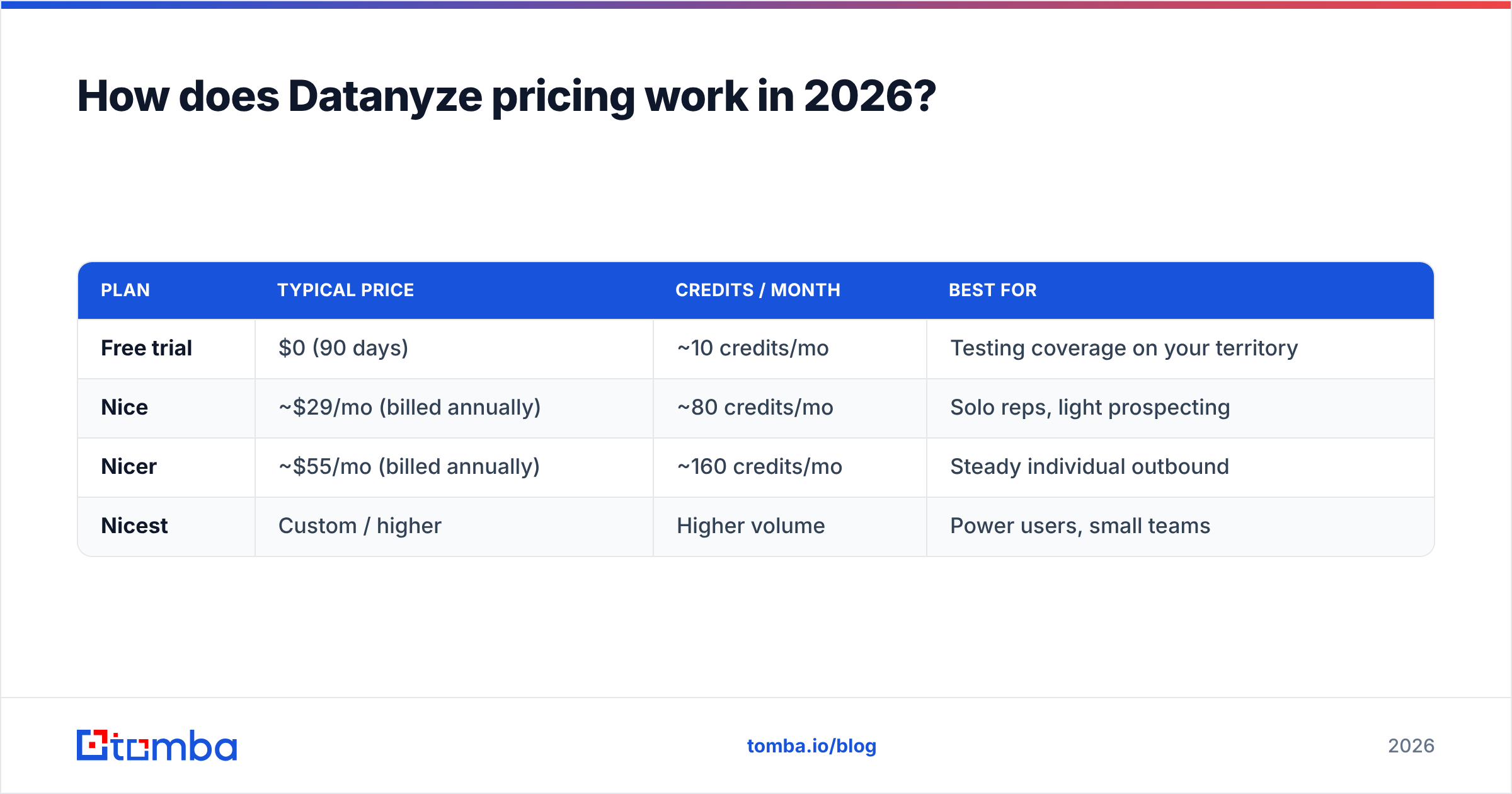
Datanyze pricing is built around three paid tiers plus a free trial. The plans are named "Nice," "Nicer," and "Nicest," and the practical difference between them is credit volume. Feature sets are broadly similar across tiers.
Note: Datanyze has restructured pricing more than once since the ZoomInfo acquisition, and higher volumes are increasingly quote-based. Always confirm current numbers on the official Datanyze pricing page before you buy — the figures below reflect commonly published rates and are for comparison, not a quote.
| Plan | Typical price | Credits / month | Best for |
|---|---|---|---|
| Free trial | $0 (90 days) | ~10 credits/mo | Testing coverage on your territory |
| Nice | ~$29/mo (billed annually) | ~80 credits/mo | Solo reps, light prospecting |
| Nicer | ~$55/mo (billed annually) | ~160 credits/mo | Steady individual outbound |
| Nicest | Custom / higher | Higher volume | Power users, small teams |
A few things the table doesn't make obvious:
- A "credit" is a reveal, not a guaranteed good contact. If Datanyze returns an email that later bounces, you've generally still spent the credit. Misses cost money.
- The advertised low price is the annual rate. Month-to-month billing is higher, so the cheapest headline number assumes a 12-month commitment.
- Credits usually don't roll over. A quiet month is wasted budget; a busy month runs you dry before it ends.
- Direct dials and emails draw from the same credit pool in most configurations, so phone-heavy and email-heavy workflows compete for the same allotment.
If you want to sanity-check any provider's plan against your real monthly volume, model it as cost per accurate contact, not cost per credit — that's where credit-based tools and flat email-finder plans diverge sharply.
What do you actually get at each tier?#
Because features are similar across paid plans, your decision is really about volume and billing terms. Here's the honest read on each:
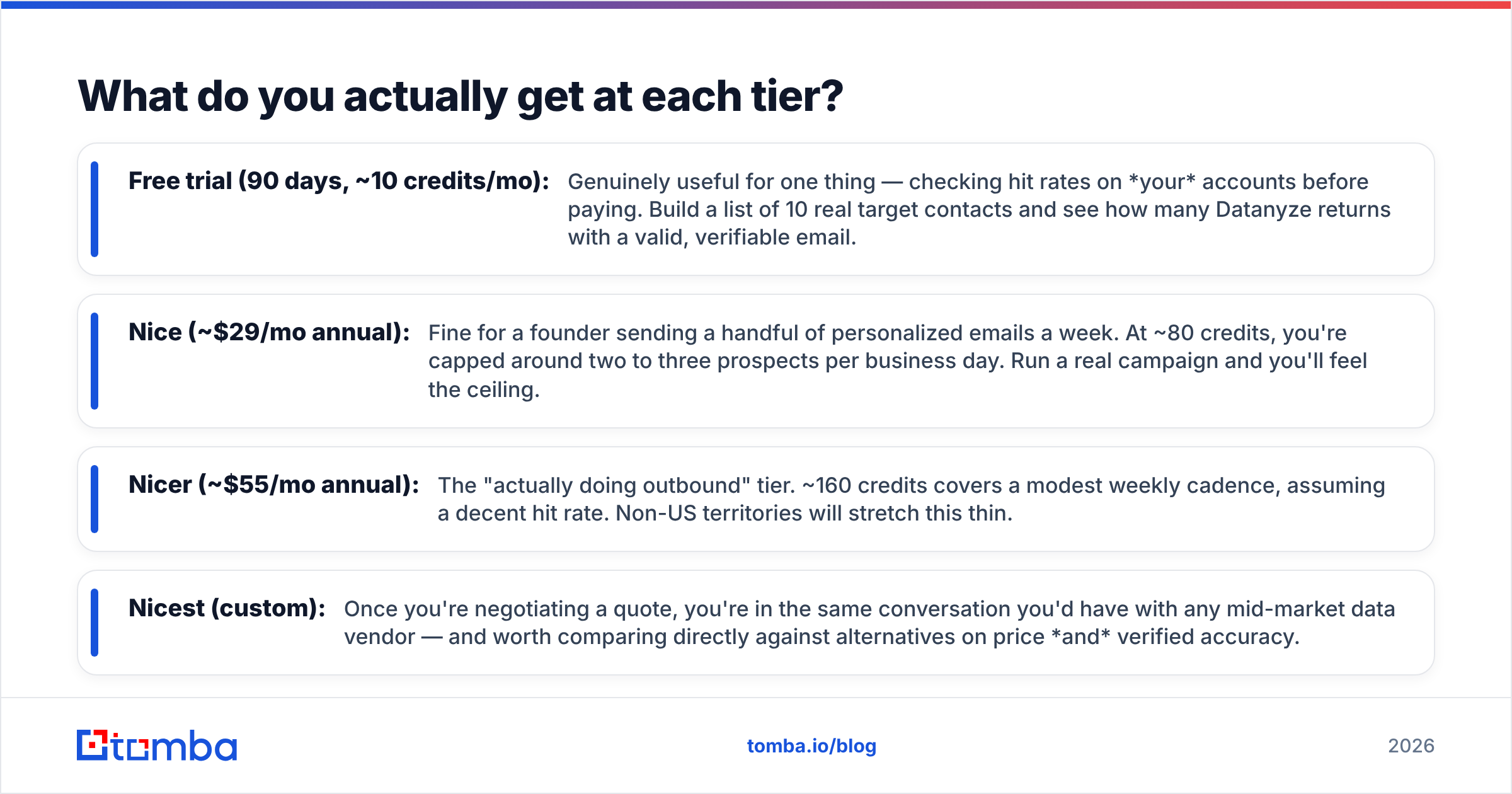
- Free trial (90 days, ~10 credits/mo): Genuinely useful for one thing — checking hit rates on your accounts before paying. Build a list of 10 real target contacts and see how many Datanyze returns with a valid, verifiable email.
- Nice (~$29/mo annual): Fine for a founder sending a handful of personalized emails a week. At ~80 credits, you're capped around two to three prospects per business day. Run a real campaign and you'll feel the ceiling.
- Nicer (~$55/mo annual): The "actually doing outbound" tier. ~160 credits covers a modest weekly cadence, assuming a decent hit rate. Non-US territories will stretch this thin.
- Nicest (custom): Once you're negotiating a quote, you're in the same conversation you'd have with any mid-market data vendor — and worth comparing directly against alternatives on price and verified accuracy.
The pattern: Datanyze is priced to feel cheap for very light use and to push you toward annual commitment and higher tiers as soon as your volume is real.
Datanyze pricing vs Tomba: which is cheaper for emails?#
If your primary need is finding and verifying professional email addresses, a dedicated email finder is usually the better economics. Datanyze bundles emails, direct dials, and technographics into a credit pool; Tomba focuses on getting the email right and verifying it before you send.
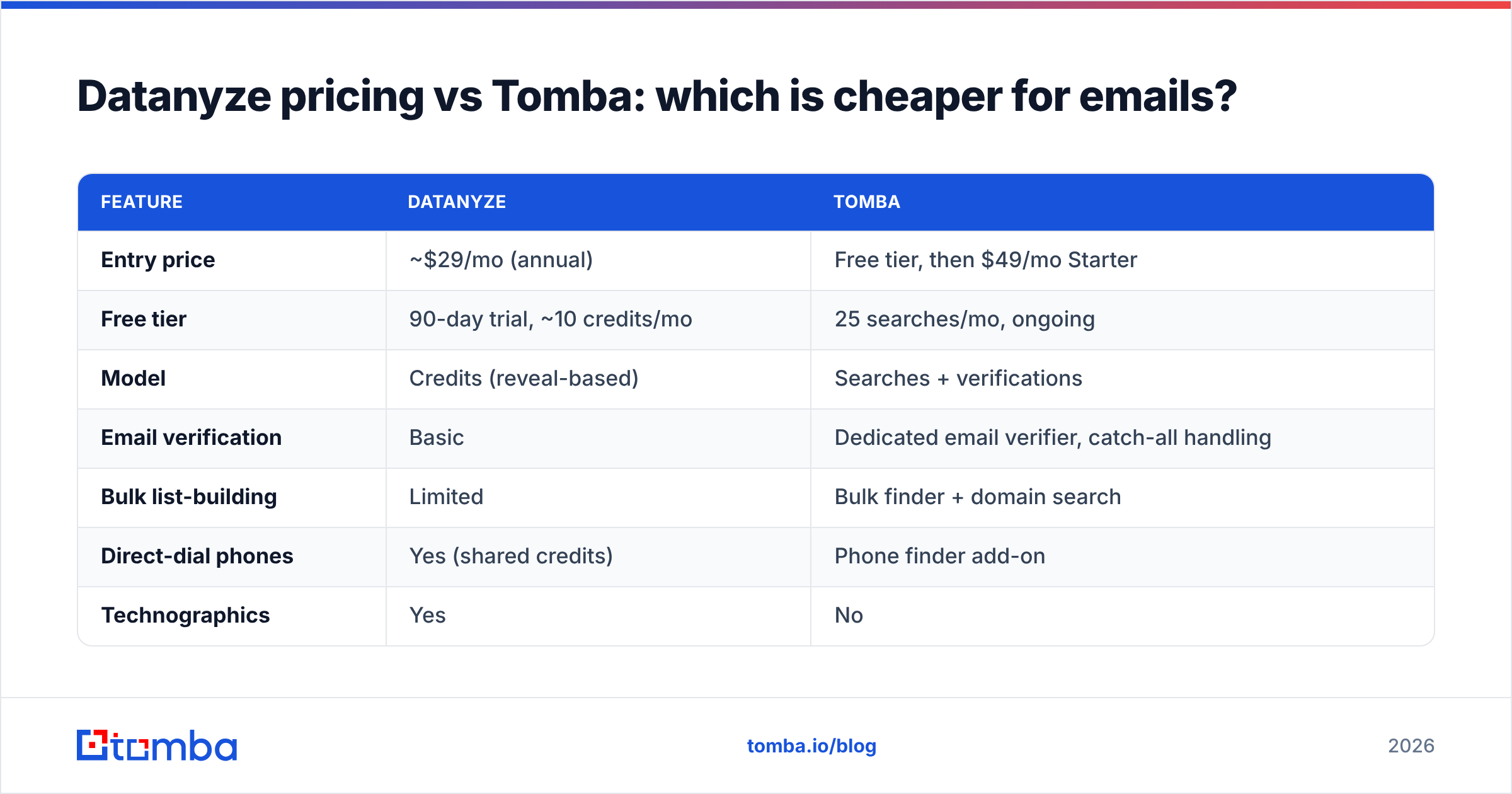
Here's a like-for-like comparison focused on the job most reps actually hire these tools for — accurate B2B emails at a predictable cost.
| Feature | Datanyze | Tomba |
|---|---|---|
| Entry price | ~$29/mo (annual) | Free tier, then $49/mo Starter |
| Free tier | 90-day trial, ~10 credits/mo | 25 searches/mo, ongoing |
| Model | Credits (reveal-based) | Searches + verifications |
| Email verification | Basic | Dedicated email verifier, catch-all handling |
| Bulk list-building | Limited | Bulk finder + domain search |
| Direct-dial phones | Yes (shared credits) | Phone finder add-on |
| Technographics | Yes | No |
| Best territory | US / tech | Global |
| API access | Limited | Full email finder API |
The trade-off is clear. Datanyze wins if you specifically want technographic signals and one-off direct dials while browsing. Tomba wins on verified-email economics, bulk work, global coverage, and a permanent free tier instead of a 90-day clock. You can see the full Tomba pricing breakdown to compare tiers side by side.
For teams that live in LinkedIn, note that both approaches can pull contact data from profiles — Tomba does it through its LinkedIn finder, which returns a verified email rather than a raw guess.

What are the hidden costs of Datanyze pricing?#
The sticker price is only part of the total. Budget for these:
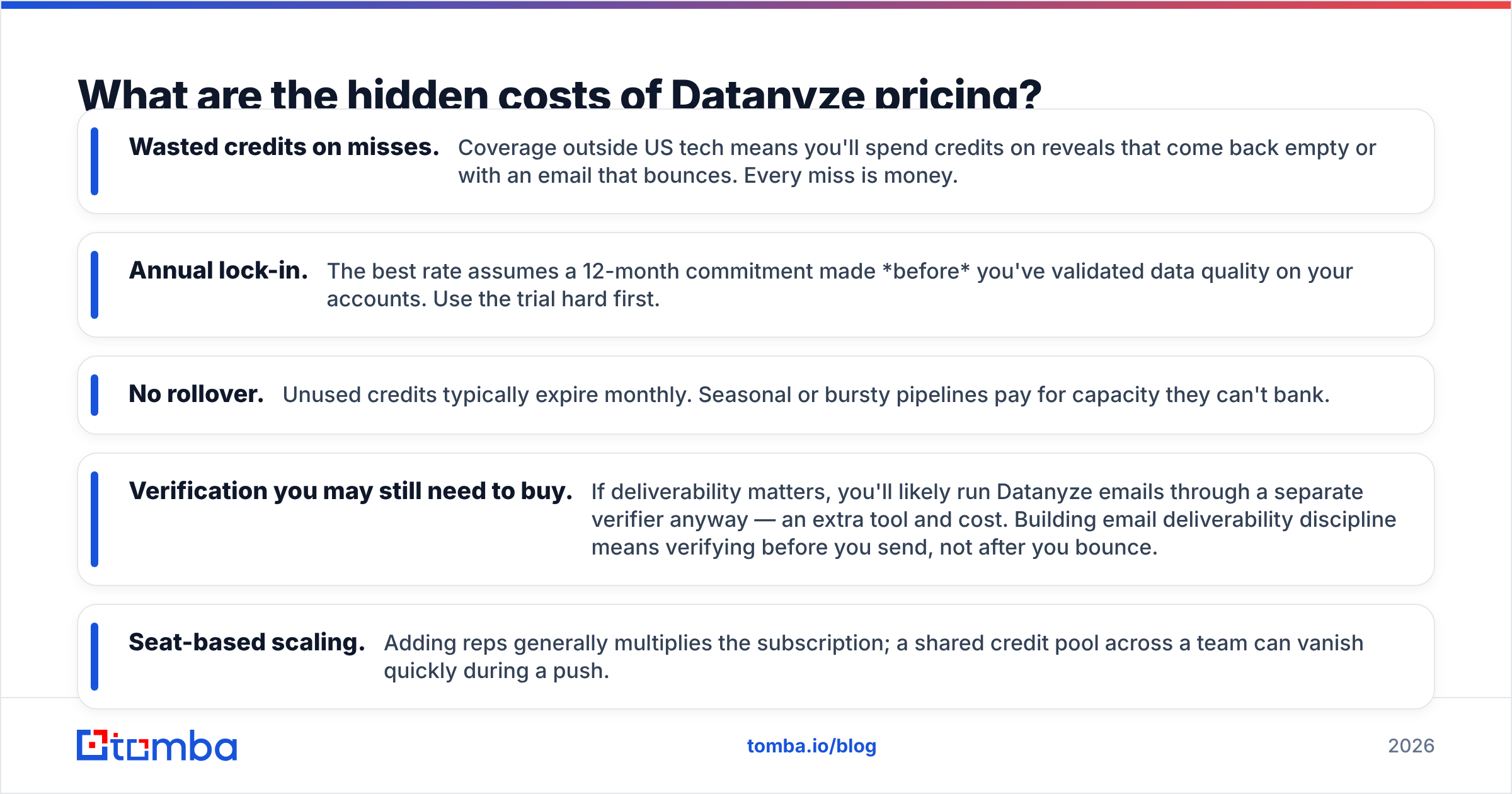
- Wasted credits on misses. Coverage outside US tech means you'll spend credits on reveals that come back empty or with an email that bounces. Every miss is money.
- Annual lock-in. The best rate assumes a 12-month commitment made before you've validated data quality on your accounts. Use the trial hard first.
- No rollover. Unused credits typically expire monthly. Seasonal or bursty pipelines pay for capacity they can't bank.
- Verification you may still need to buy. If deliverability matters, you'll likely run Datanyze emails through a separate verifier anyway — an extra tool and cost. Building email deliverability discipline means verifying before you send, not after you bounce.
- Seat-based scaling. Adding reps generally multiplies the subscription; a shared credit pool across a team can vanish quickly during a push.
None of these are unique to Datanyze — most credit-based data tools share them — but they're the difference between the price you see and the price you pay.
Is Datanyze accurate enough to justify the cost?#
Accuracy is territory-dependent, and that's the fairest way to say it. On US-based technology companies, Datanyze's contact data is competitive and the technographic layer is a genuine differentiator. On international accounts, non-tech verticals, and smaller businesses, published reviews on G2 consistently flag thinner coverage and more stale records.
Two practical implications:
- Test before you commit. Use the 90-day trial to run your real target list, not a demo list. Count verified hits, not reveals.
- Separate "found" from "verified." A returned email isn't a deliverable email. If a tool doesn't verify aggressively, you inherit the bounce risk — and bounces damage your sender reputation, which costs far more than any subscription.
If verified accuracy across global territories is your priority, it's worth comparing how each vendor sources and validates records — Tomba documents its approach on its data sources page, and verification is a first-class product rather than an afterthought.
Who should buy Datanyze, and who shouldn't?#
Buy Datanyze if:
- You sell into US tech companies and want technographic timing signals.
- Your volume is genuinely low and predictable, fitting inside a credit cap.
- You prospect one contact at a time from the browser and value direct dials.
Look elsewhere if:
- You need to build and verify bulk email lists — a bulk email finder is a different, cheaper tool for that job.
- You sell internationally or into non-tech verticals where coverage thins out.
- You want a permanent free tier and flat, predictable pricing instead of credits and annual lock-in.
- Email deliverability is the whole game and you need verification baked in.
The bottom line on Datanyze pricing#
Datanyze is priced to look inexpensive and to convert light users into annual, higher-tier commitments. For its sweet spot — solo reps working US tech accounts who value technographics and direct dials — it's a reasonable, low-friction option. Outside that sweet spot, the credit model and coverage gaps quietly inflate your real cost per accurate contact.
If the job you're actually hiring for is "get me correct, verified business emails without burning credits on misses," a dedicated email finder is the more honest deal. Tomba's Email Finder gives you a real free tier (25 searches every month, not a 90-day countdown), verification built in, global coverage, and flat plans starting at $49/mo — so the price you see is close to the price you pay. Test it against your own target list, count the verified hits, and let the numbers decide.
Related guides#
Ready to find emails that actually work?
Join 150,000+ professionals who stopped guessing and started sending. Free credits on signup — no credit card required.
Get the Tomba newsletter
Practical outbound tactics and product updates — once every two weeks.
About the author