Datanyze vs Apolloio (2026): Which B2B Data Tool Wins?
Datanyze and Apollo.io both promise clean B2B contact data, but they solve very different problems. Here's an honest breakdown of pricing, accuracy, and fit—plus a cheaper pick.
Datanyze vs Apolloio (2026): Which B2B Data Tool Wins?
Choosing between Datanyze vs Apolloio feels like a head-to-head. But the two tools barely play the same sport. One is a light technographics and contact-lookup extension. The other is a full prospecting, enrichment, and sales-engagement platform. The right pick depends on the job you hire the tool to do.
This is a neutral, hands-on comparison. We break down pricing, data accuracy, coverage, and workflow fit. We also cover the hidden costs neither vendor lists on its pricing page. Then we name the cases where a leaner, cheaper option beats both.
TL;DR: Datanyze vs Apolloio at a glance#
- Apollo.io wins on breadth. It bundles a 275M+ contact database, sequences, a dialer, and CRM sync into one seat. If you want one platform to run outbound, it is the stronger all-rounder.
- Datanyze wins on simplicity and low entry price. It is a focused Chrome extension. You grab emails and tech signals while you browse. No sequencing, no bloat.
- Data accuracy is the real battleground. Both inflate their "verified" claims. In the wild, bounce rates often land 8–15% higher than the dashboards suggest.
- Neither is the cheapest way to get verified emails. For pure email-finding at scale, a specialist like Tomba Email Finder delivers a lower cost-per-valid-email. SMTP-level checks are baked in.
- Best pick = your workflow. Solo prospector on LinkedIn → Datanyze. Full outbound team → Apollo. Ops teams enriching lists in bulk → a dedicated finder plus verifier via API.
What is Datanyze and who is it for?#
Datanyze is a browser-first prospecting tool. It is built around a Chrome extension. When you visit a company website or a LinkedIn profile, it surfaces contact details. You see the email, direct dial, and mobile. It also shows technographic data—the software that company runs, like their CRM, ad platform, or ecommerce stack.
That technographic angle is Datanyze's claim to fame. Say your product only sells to companies on Shopify. Or you want to target accounts running a rival's tool. Then Datanyze's tech detection is a genuinely useful filter.
The trade-off is that Datanyze is narrow. There is no email sequencing, no dialer, and no deal pipeline. It is a data-grabbing companion, not a system of record. Pricing starts low with a small run of free credits. It then moves to a modest monthly seat. That suits individual reps but caps you on volume.

Datanyze fits best for:
- Solo SDRs and founders who prospect account-by-account in the browser.
- Technographic targeting—selling to specific tech stacks.
- Light-touch outbound where you export a handful of contacts, not thousands.
What is Apollo.io and who is it for?#
Apollo.io is an all-in-one sales intelligence and engagement platform. It pairs a large B2B contact database (Apollo markets 275M+ contacts and 60M+ companies) with prospecting filters, email sequences, a built-in dialer, meeting scheduling, and native CRM sync to HubSpot and Salesforce.
Datanyze hands you data and steps back. Apollo tries to own the whole outbound motion instead. Find the contact. Enrich it. Sequence the email. Dial the number. Log the activity. You do it all without leaving the app. That is powerful for a growing team that would otherwise stitch together four tools.
The catch is complexity and credit math. Apollo's free tier and low headline prices look generous. But they come with export limits, email-credit caps, and gated data fields. Most serious users get pushed to the Professional or Organization tiers. The platform is deep, and new users often underestimate the ramp time.
Apollo fits best for:
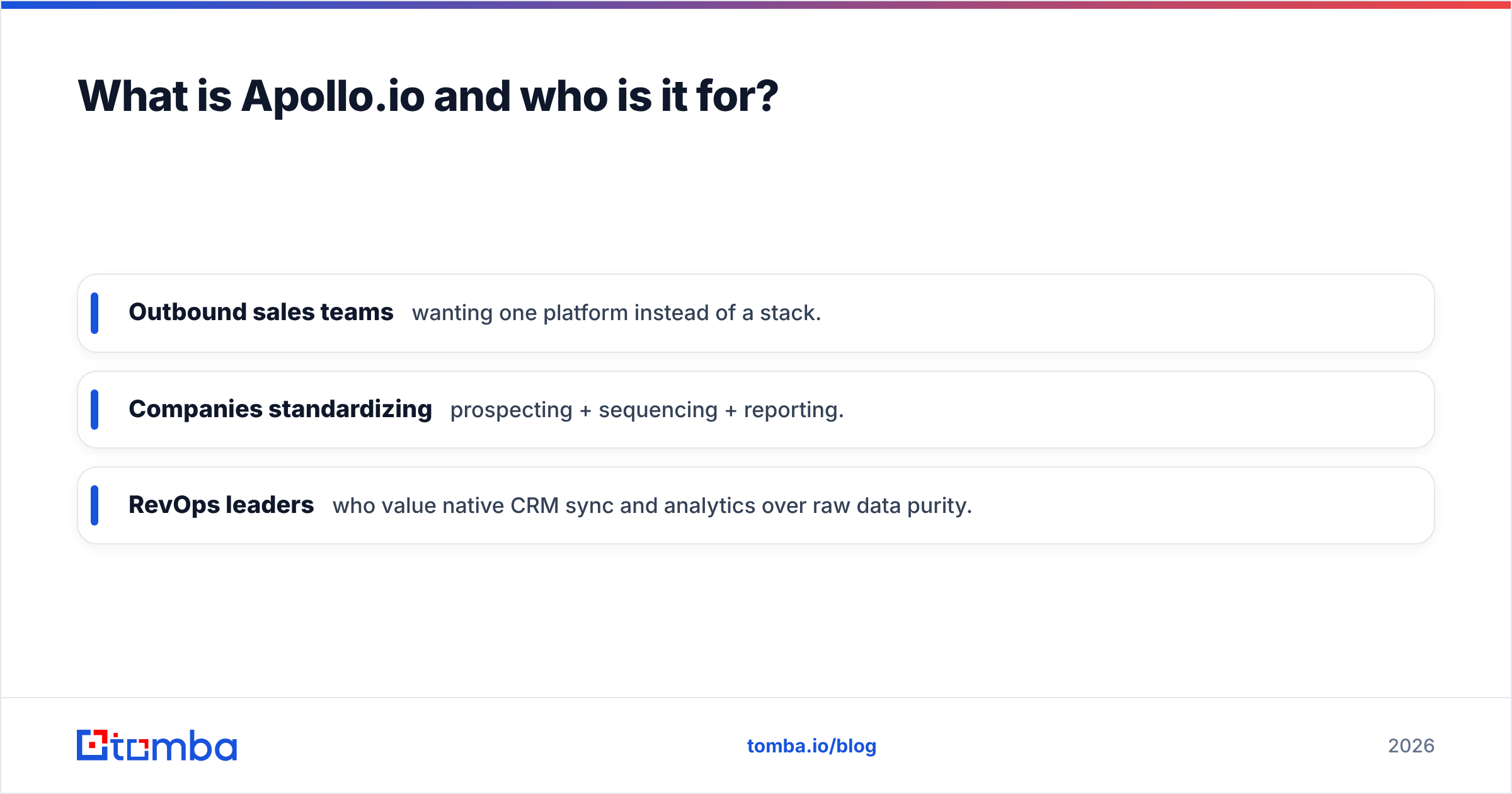
- Outbound sales teams who want one platform instead of a stack.
- Companies standardizing prospecting, sequencing, and reporting.
- RevOps leaders who value native CRM sync and analytics over raw data purity.
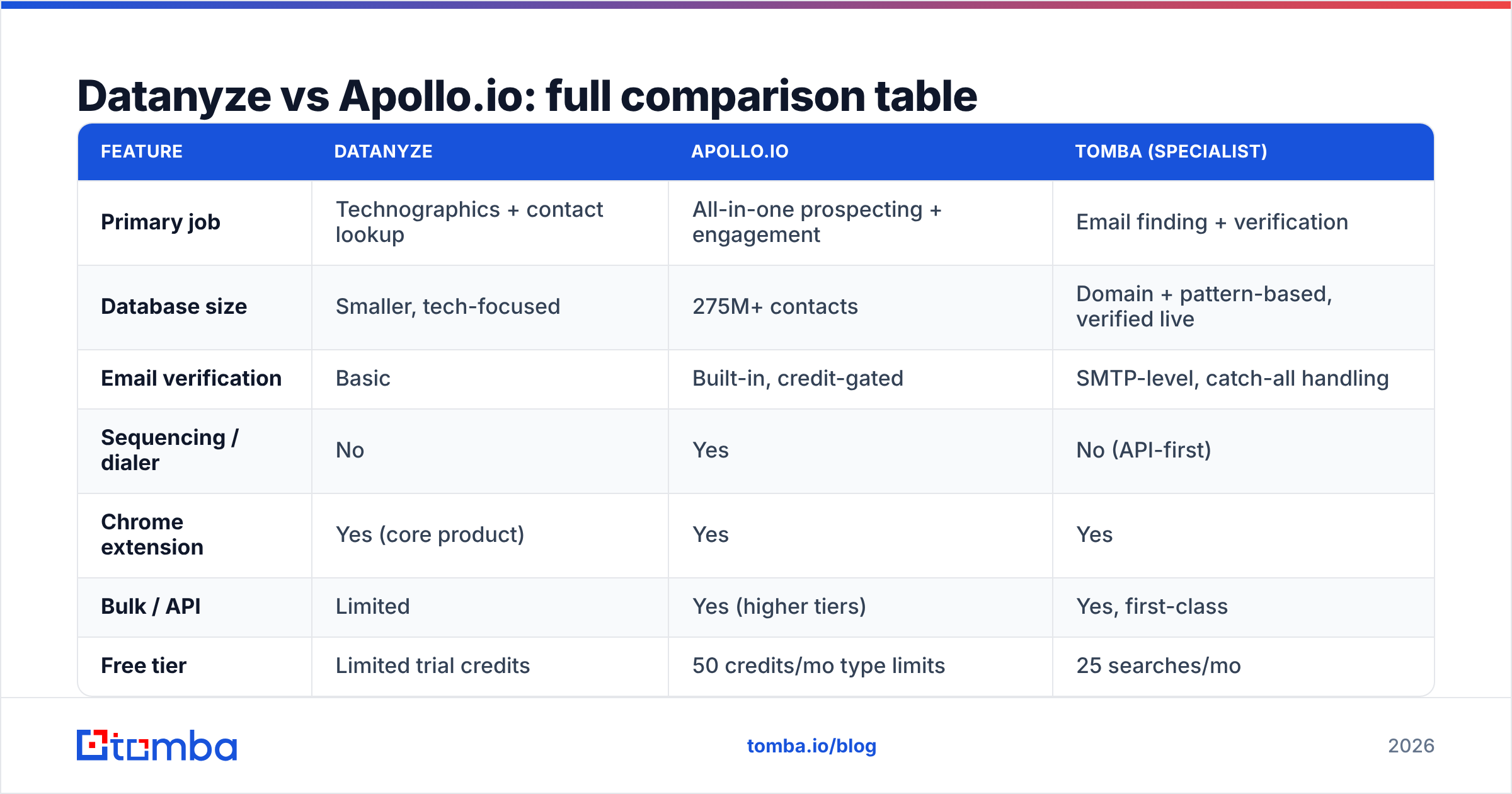
Datanyze vs Apolloio: full comparison table#
| Feature | Datanyze | Apollo.io | Tomba (specialist) |
|---|---|---|---|
| Primary job | Technographics + contact lookup | All-in-one prospecting + engagement | Email finding + verification |
| Database size | Smaller, tech-focused | 275M+ contacts | Domain + pattern-based, verified live |
| Email verification | Basic | Built-in, credit-gated | SMTP-level, catch-all handling |
| Sequencing / dialer | No | Yes | No (API-first) |
| Chrome extension | Yes (core product) | Yes | Yes |
| Bulk / API | Limited | Yes (higher tiers) | Yes, first-class |
| Free tier | Limited trial credits | 50 credits/mo type limits | 25 searches/mo |
| Entry paid price | ~$29–39/mo range | ~$49/user/mo (Basic) | $49/mo Starter |
| Best for | Solo reps, tech targeting | Outbound teams | Cost-per-verified-email at scale |
Prices shift often. Always confirm current Tomba pricing and the vendors' own pages before you buy. The point of the table is not the exact dollar figure. It is the shape of what you get for it.
Is Apollo.io better than Datanyze?#
Yes—if you need more than data. Apollo is the better platform when your bottleneck is running outbound end to end. You get contacts, sequences, dialing, and reporting under one login. That removes the tax of exporting a CSV from one tool and importing it into another.
No—if you only need data and a tech-stack filter. Apollo's breadth is dead weight for a solo rep. They just want to grab an email and a tech signal while browsing. In that case Datanyze is faster, cheaper, and far less to learn.
Here is the honest summary. Apollo is a bigger, more capable machine. Bigger machines cost more to run and take longer to master. "Better" comes down to whether you will actually use the extra surface area.

How accurate is the data, really?#
This is where both marketing pages get optimistic. "Verified" is not a standard term. Vendors define it loosely.
Two failure modes dominate in real campaigns:
- Stale contacts. People change jobs all the time. A database of 275M contacts is only as good as its refresh rate. A record that was right six months ago can bounce today.
- Catch-all domains. Many company mail servers accept every address at the domain. So a naive verifier marks them "valid" when they may not exist. Handling catch-alls right is a real technical problem. A dedicated catch-all verifier is built to solve it.
In practice, teams report live bounce rates several points higher than the dashboard's "verified" number. That gap matters. A 12% bounce rate torches your sender reputation. It then drags down every future campaign, not just the current one.
The takeaway is not that Datanyze or Apollo are dishonest. It is that no single database stays fresh. Whatever you choose, run a separate verification pass before you send. If your main need is clean addresses, a purpose-built email verifier will catch what a bundled check misses. On peer-review sites like G2, data accuracy is the most common complaint across every provider here. That tells you it is a workflow problem, not a vendor problem.

What do Datanyze and Apollo.io actually cost?#
Headline prices mislead in both directions.
Datanyze looks cheap because it is—for low volume. But credits run out fast. And there is no path to bulk enrichment. If your needs grow past account-by-account browsing, you will outgrow it. Then you pay for a second tool anyway.
Apollo looks cheap at the entry tier. Then the real costs appear: email-export caps, gated phone numbers, and per-credit enrichment. Teams that model Apollo at $49/user often land at 2–3x that. They hit export limits or need the data-enrichment add-ons. Apollo's own pricing page (see apollo.io) is the source of truth. Read the credit fine print, not just the tier name.
The metric that actually matters is cost per verified, deliverable email. It is not cost per seat or per raw credit. Divide total spend by usable contacts. The "cheap" tool is often the expensive one.
| Cost factor | Datanyze | Apollo.io |
|---|---|---|
| Entry seat | Low | Low, misleading |
| Bulk export | Not really an option | Credit-capped |
| Phone/mobile data | Add-on | Gated to higher tiers |
| Hidden ramp cost | Minimal (simple tool) | Significant (deep platform) |
| Scales cheaply? | No | Only at Organization tier |
When should you use a dedicated email finder instead?#
Neither Datanyze nor Apollo is built mainly to be the cheapest, most accurate email-finding engine. That is a side feature for both. When email finding is the core job, a specialist wins on price and precision.
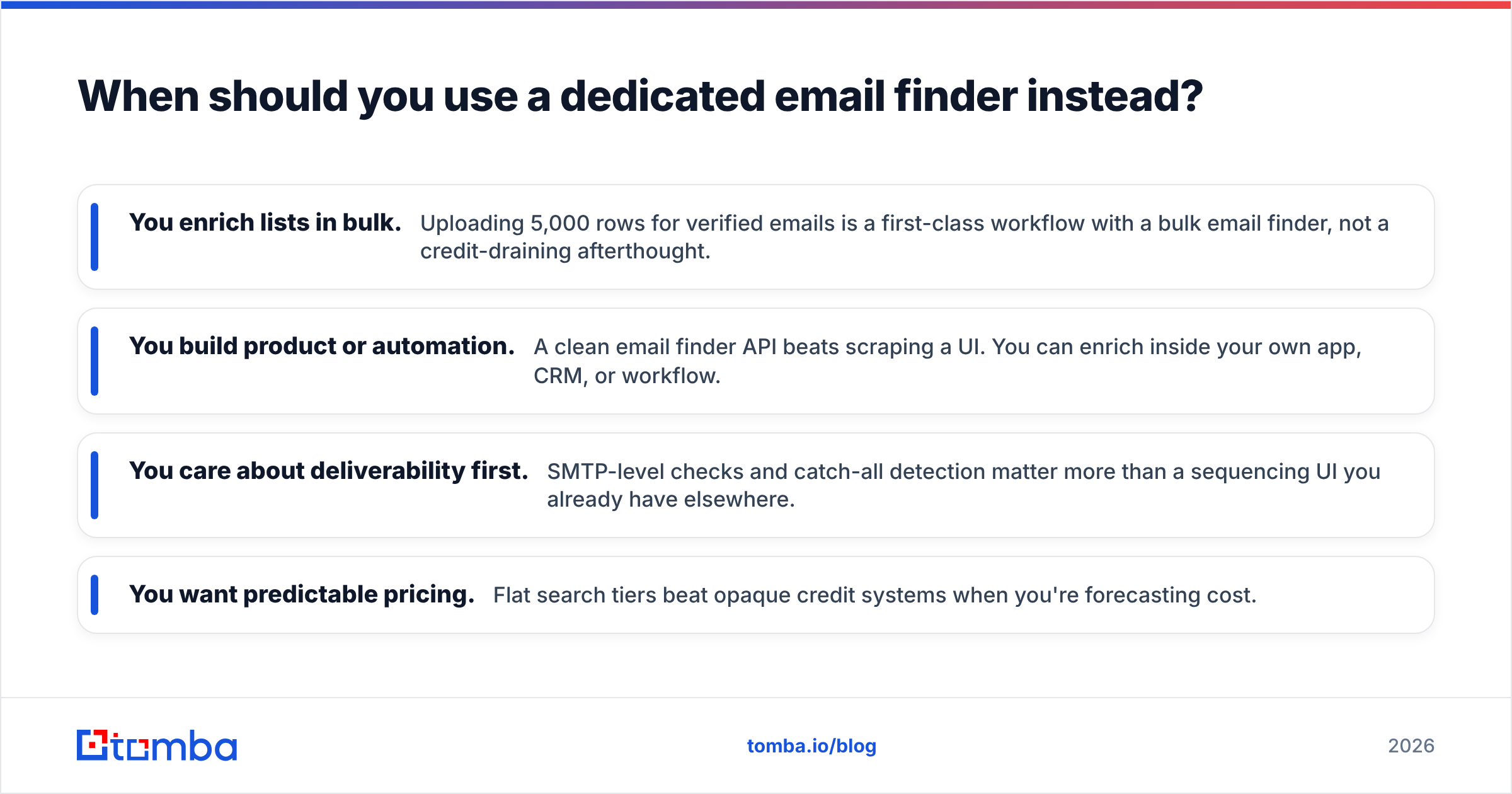
Use a dedicated finder when:
- You enrich lists in bulk. Uploading 5,000 rows for verified emails is a first-class workflow with a bulk email finder. It is not a credit-draining afterthought.
- You build product or automation. A clean email finder API beats scraping a UI. You can enrich inside your own app, CRM, or workflow.
- You care about deliverability first. SMTP-level checks and catch-all detection matter more than a sequencing UI you already have.
- You want predictable pricing. Flat search tiers beat opaque credit systems when you forecast cost.
This is where Tomba fits. It does not try to replace Apollo's sequencer or Datanyze's tech detection. It does one thing: finding and verifying professional emails at a lower cost-per-valid-address. You can pair it with either tool. Prospect in Apollo or Datanyze. Then verify and top up missing emails through Tomba's domain search.

Datanyze vs Apolloio: which should you choose?#
Match the tool to the job, not the hype:
- Choose Datanyze if you are a solo rep or small team. You prospect in the browser and need technographic targeting. It is simple, affordable at low volume, and does its narrow job well.
- Choose Apollo.io if you run a real outbound team. You want a database, sequencing, dialing, and CRM sync in one platform. Just be ready for the credit math and the ramp time.
- Choose a specialist finder if verified email volume is your real bottleneck. Layer it under whichever platform you use. Or run it standalone via API and integrations like HubSpot and Salesforce.
There is no shame in using two tools. The best stacks we see pair a broad prospecting platform with a cheap, accurate verification layer. No single database stays fresh. Verification is where deliverability is won or lost.
The bottom line#
Apollo.io is the more powerful platform. Datanyze is the leaner, cheaper starting point. But "which is better" is the wrong question if your real problem is getting clean, deliverable emails without overpaying per credit.
If email finding and verification is the job that moves your pipeline, start with the tool built for it. Tomba Email Finder gives you SMTP-verified addresses, catch-all handling, bulk enrichment, and an API. It starts free with 25 searches a month and scales from $49/mo. Find the emails. Verify them before you send. Let Apollo or Datanyze handle the rest of the motion. Try it on your next list and compare the bounce rate for yourself.
Related guides#
Ready to find emails that actually work?
Join 150,000+ professionals who stopped guessing and started sending. Free credits on signup — no credit card required.
Get the Tomba newsletter
Practical outbound tactics and product updates — once every two weeks.
About the author