Datanyze vs DealSignal (2026): Which B2B Data Tool Wins?
Datanyze leans on technographics and a cheap self-serve tier; DealSignal sells human-verified, on-demand records. Here's which B2B data tool fits your team in 2026—and a leaner alternative worth testing.
Choosing between Datanyze and DealSignal comes down to one question: do you want cheap technographic signals to spot the right accounts, or human-verified contact records you can dial and email today? They solve overlapping problems from opposite ends, and the wrong pick wastes budget on data your team won't touch.
This is a neutral, hands-on comparison—accuracy, coverage, pricing model, compliance, and real use cases—so you can match the tool to how your team actually prospects.
TL;DR: Datanyze vs DealSignal at a glance#
- Datanyze is a lightweight, self-serve tool built around technographics (what tech a company runs) plus a Chrome extension for grabbing contact info. Cheap entry price, shallower contact depth.
- DealSignal is an on-demand data platform that assembles and human-verifies records to spec. Higher accuracy claims, custom pricing, better for large or compliance-sensitive lists.
- Pricing model is the real divide: Datanyze publishes low self-serve tiers; DealSignal is mostly quote-based and priced for teams buying data at volume.
- Neither is a pure email finder. If your core need is finding and verifying business emails fast, a focused tool like Tomba usually wins on price-per-verified-contact.
- Best fit: Datanyze for solo reps and tech-stack targeting; DealSignal for RevOps teams enriching CRMs at scale.

What is Datanyze and who is it for?#
Datanyze started life as a technographics company—its whole pitch was telling you which websites run Shopify, Salesforce, HubSpot, or any of thousands of other tools. That DNA still shapes the product. You use Datanyze primarily to build target lists based on the technology a company uses, then grab contact details through its browser extension while you're on a LinkedIn profile or company site.
It's a self-serve, individual-contributor tool. A rep can sign up, run a trial, and start pulling emails and direct dials without a procurement cycle. The trade-off is depth: contact coverage and verification are thinner than dedicated data platforms, and technographic freshness varies by how popular the site is.
Datanyze fits you if:
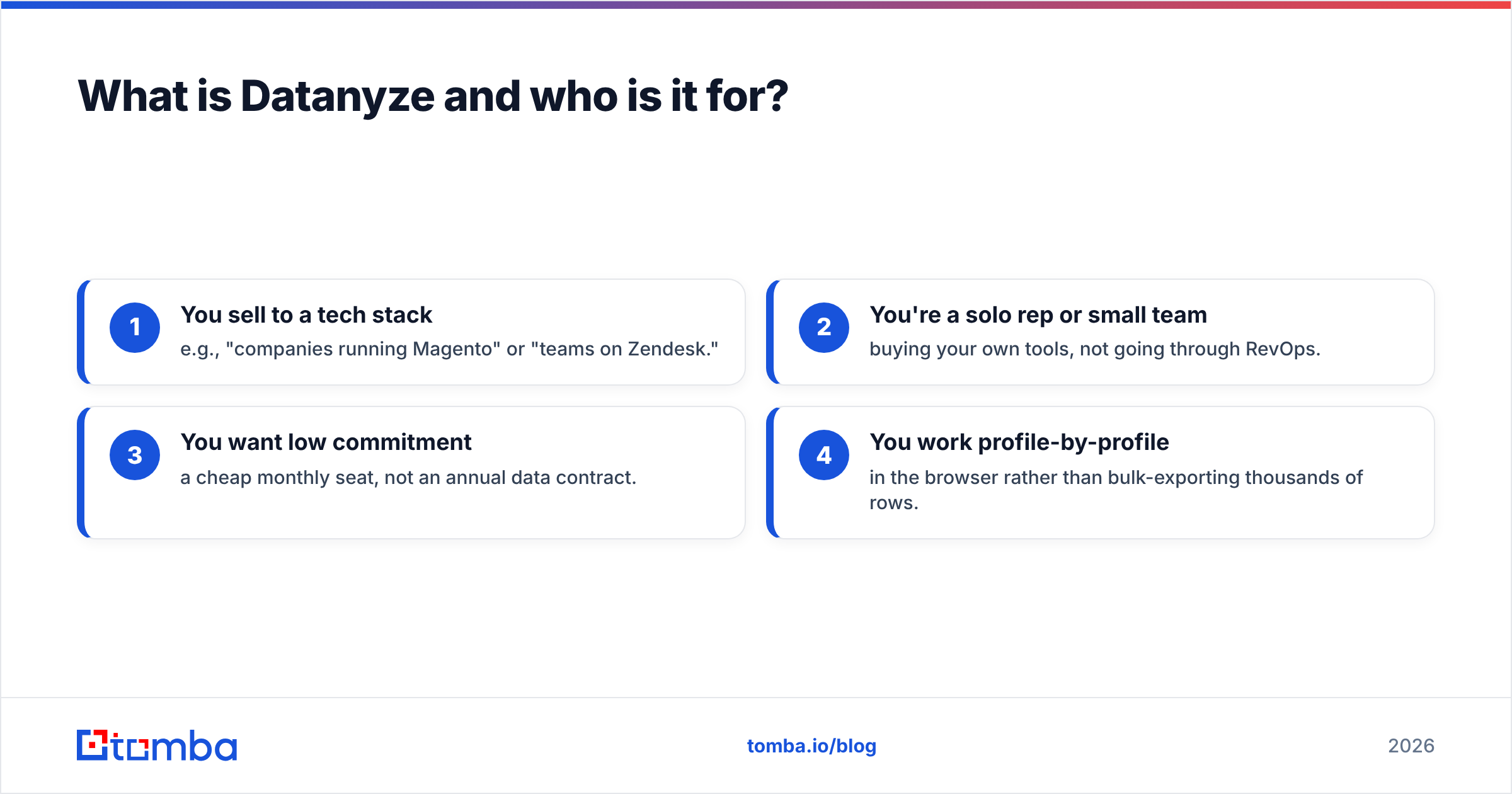
- You sell to a tech stack — e.g., "companies running Magento" or "teams on Zendesk."
- You're a solo rep or small team buying your own tools, not going through RevOps.
- You want low commitment — a cheap monthly seat, not an annual data contract.
- You work profile-by-profile in the browser rather than bulk-exporting thousands of rows.
What is DealSignal and who is it for?#
DealSignal is a B2B data platform built around on-demand, human-verified records. Instead of only pulling from a fixed database, DealSignal can research and verify contacts to match your ideal customer profile, then re-verify on a schedule so the data doesn't rot. It leans hard on accuracy guarantees, GDPR/CCPA compliance, and CRM enrichment workflows.
This is a team tool. Pricing is largely custom, and the sweet spot is RevOps or demand-gen groups that need clean, compliant records flowing into Salesforce or HubSpot at volume—often paired with intent and firmographic filters.
DealSignal fits you if:
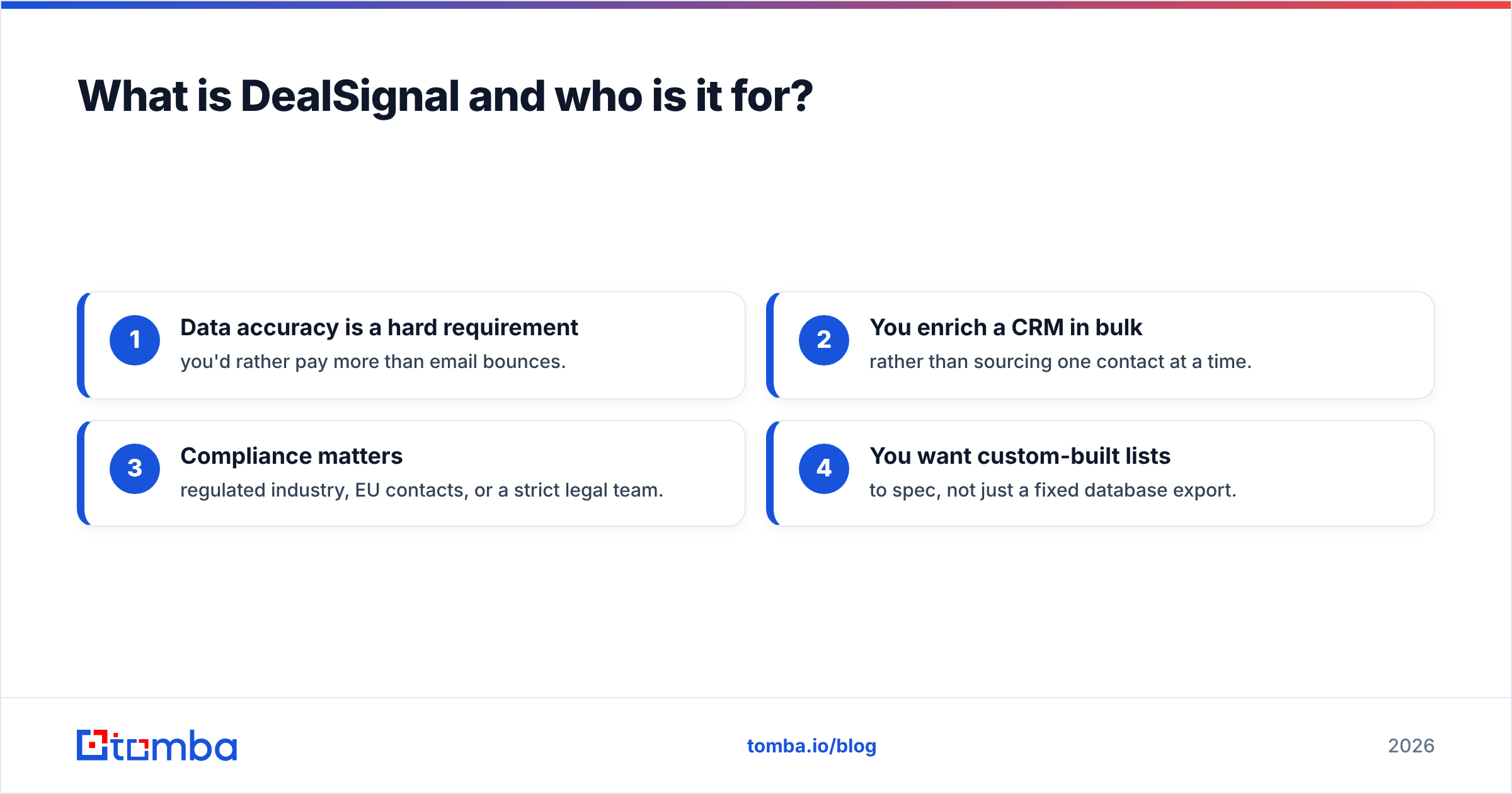
- Data accuracy is a hard requirement — you'd rather pay more than email bounces.
- You enrich a CRM in bulk rather than sourcing one contact at a time.
- Compliance matters — regulated industry, EU contacts, or a strict legal team.
- You want custom-built lists to spec, not just a fixed database export.
Datanyze vs DealSignal: side-by-side comparison#
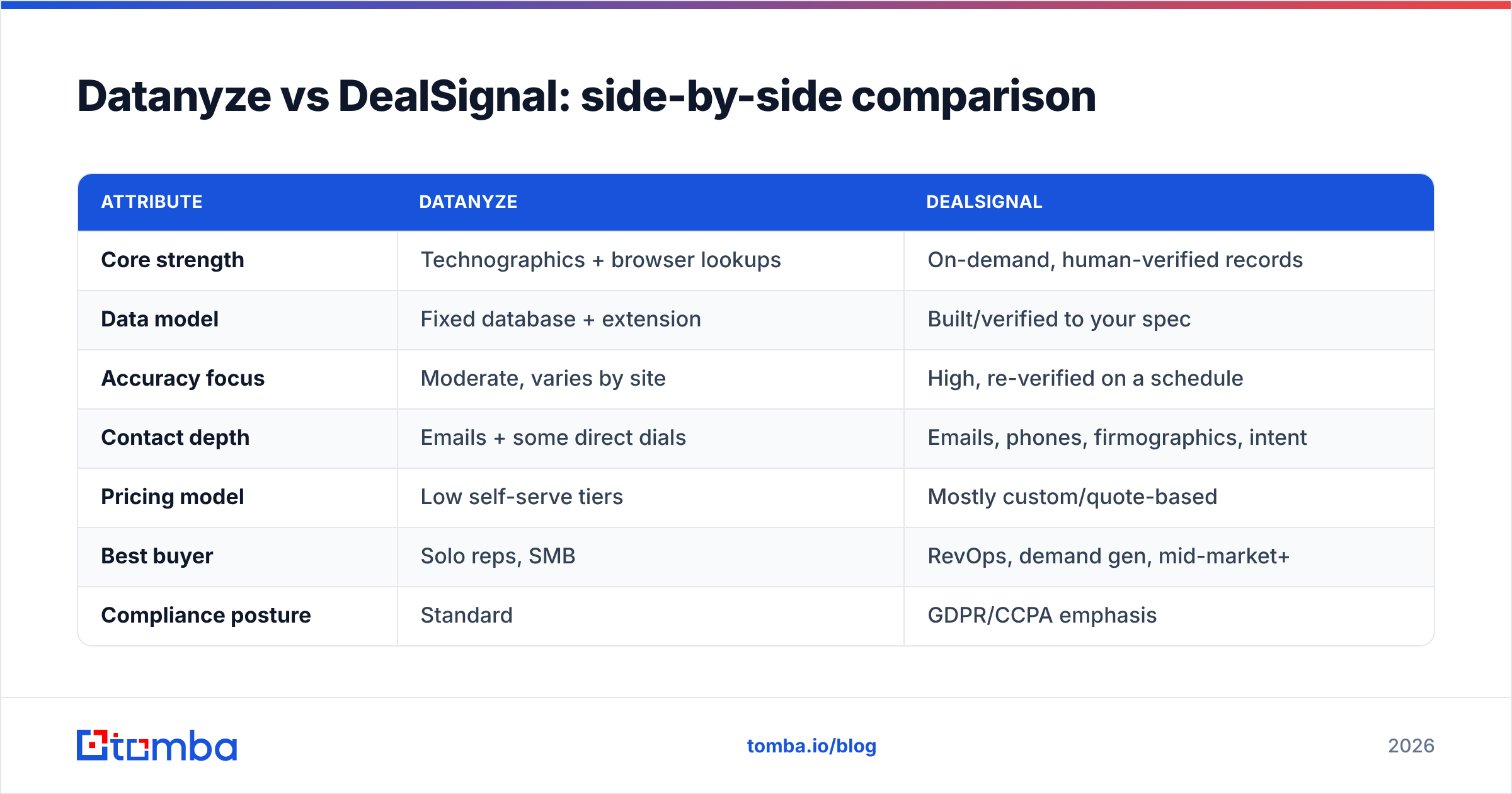
Here's the head-to-head on the attributes that actually change your buying decision. Treat pricing as directional and confirm current numbers on each vendor's site—both change tiers often.
| Attribute | Datanyze | DealSignal |
|---|---|---|
| Core strength | Technographics + browser lookups | On-demand, human-verified records |
| Data model | Fixed database + extension | Built/verified to your spec |
| Accuracy focus | Moderate, varies by site | High, re-verified on a schedule |
| Contact depth | Emails + some direct dials | Emails, phones, firmographics, intent |
| Pricing model | Low self-serve tiers | Mostly custom/quote-based |
| Best buyer | Solo reps, SMB | RevOps, demand gen, mid-market+ |
| Compliance posture | Standard | GDPR/CCPA emphasis |
| Bulk enrichment | Limited | Core use case |
| Learning curve | Low | Moderate |
The pattern is clear: Datanyze optimizes for a cheap, fast, individual workflow; DealSignal optimizes for accuracy and scale at a higher price point. Very few teams genuinely need both.
Which has better data accuracy?#
DealSignal wins on accuracy, at a cost. Its human-in-the-loop verification and scheduled re-verification are designed to keep bounce rates low, which is exactly what you want when you're loading tens of thousands of records into a CRM and sending campaigns against them. If a bad list can get your domain flagged, paying for verified data is cheaper than repairing your sender reputation.
Datanyze's accuracy is fine for what it is—opportunistic, one-at-a-time lookups where you can eyeball the result before you send. But it's a database-plus-extension model, so a stale record can slip through, and technographic signals age fastest on smaller or fast-changing sites.
Here's the honest caveat that applies to both tools: no provider's emails are 100% deliverable at the moment you export them. Contacts change jobs, mailboxes get retired, and catch-all domains hide the truth. Whatever platform you pick, run exports through a dedicated email verifier before you send. It's the single cheapest insurance against a bounce spike—and it's why a lot of teams pair a data platform with a standalone verification layer rather than trusting one vendor end to end.
How do Datanyze and DealSignal price it?#
This is where the two products stop looking like competitors at all.
- Datanyze publishes low, self-serve monthly tiers and typically offers a limited free trial. You can be up and running for the price of a couple of lunches per month, which is why individual reps love it.
- DealSignal is priced like a data service. Expect custom quotes tied to record volume, verification depth, and enrichment frequency—more like a RevOps line item than a personal seat.
So "which is cheaper" is the wrong question. Datanyze is cheaper per seat; DealSignal can be cheaper per usable record at scale if accuracy saves you from re-buying bad data. Map the cost to the job:
| Scenario | Lower total cost |
|---|---|
| One rep, occasional lookups | Datanyze |
| Small team, tech-stack targeting | Datanyze |
| CRM enrichment, 10k+ records | DealSignal |
| Compliance-critical EU data | DealSignal |
| High-volume cold email that must not bounce | Verify separately, either way |
Where do both tools fall short?#
Every comparison should name the gap, so here it is: neither Datanyze nor DealSignal is a purpose-built email finder, and that shows up in two ways.
First, price-per-verified-email. When your actual job is "get me the correct, deliverable address for these 5,000 people," a platform priced around technographics or custom data research is heavier and pricier than a focused finder. You end up paying for capabilities you're not using.
Second, developer and workflow flexibility. If you want to enrich inside a spreadsheet, trigger lookups from your app, or push results straight into an outreach sequence, you'll want first-class API access and native integrations. That's a different product category from "buy a list and export it."
This is the lane where a specialist tool competes directly on the one metric that matters. If you mostly need accurate emails by domain or name—plus a proper B2B database and data enrichment to fill the gaps—you can often cover the core job for far less than either platform's list-buying motion, then layer intent or technographics only if you truly need them.
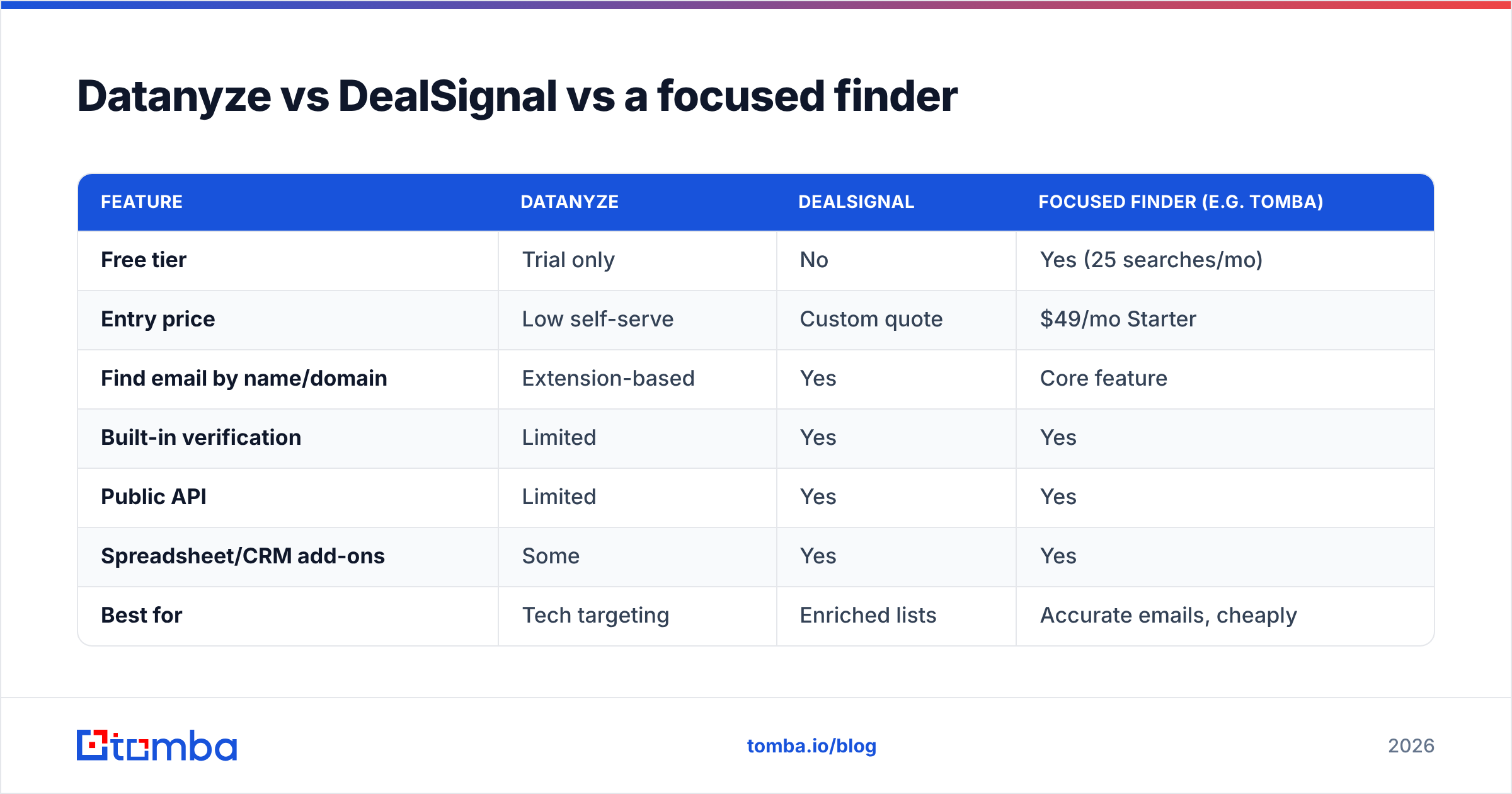
Datanyze vs DealSignal vs a focused finder#
To make the trade-off concrete, here's how the two stack up against a specialist email-finder approach for the specific task of sourcing and verifying contacts.
| Feature | Datanyze | DealSignal | Focused finder (e.g. Tomba) |
|---|---|---|---|
| Free tier | Trial only | No | Yes (25 searches/mo) |
| Entry price | Low self-serve | Custom quote | $49/mo Starter |
| Find email by name/domain | Extension-based | Yes | Core feature |
| Built-in verification | Limited | Yes | Yes |
| Public API | Limited | Yes | Yes |
| Spreadsheet/CRM add-ons | Some | Yes | Yes |
| Best for | Tech targeting | Enriched lists | Accurate emails, cheaply |
The point isn't that a finder replaces everything Datanyze or DealSignal do—technographics and human-verified custom research are real, distinct value. It's that if the finding-and-verifying step is 80% of your need, buying a full data platform to get it is overkill.
How to choose in 2026#
Pick based on the job in front of you, not the longest feature list:
- Choose Datanyze if you're a rep or small team, you target by technology stack, and you want a cheap, browser-first tool with no procurement drama.
- Choose DealSignal if you're in RevOps or demand gen, you enrich a CRM at scale, and accuracy plus compliance justify a custom contract.
- Choose a focused email finder if your real bottleneck is getting correct, deliverable addresses fast and affordably—especially with API and spreadsheet workflows—rather than technographics or bespoke list-building.
A common, cost-smart stack in 2026 looks like this: a lightweight finder for day-to-day sourcing and verification, plus one heavier platform (like DealSignal) only when a specific campaign needs deep enrichment or compliance-grade records. You stop paying enterprise prices for everyday lookups. For a full breakdown of where finders fit against enrichment platforms, browse independent reviews on G2 before you commit to an annual deal.
The bottom line#
Datanyze and DealSignal aren't really the same product wearing different logos—Datanyze is a cheap, self-serve technographics-and-lookup tool for individuals, and DealSignal is a premium, on-demand verified-data service for teams. If you sell to a tech stack on a budget, Datanyze. If you enrich a CRM at scale and accuracy is non-negotiable, DealSignal.
But if you read this whole comparison because your actual pain is "I just need the right email, verified, without a five-figure contract," neither is the tightest fit. Start with a focused Tomba Email Finder—find professional emails by domain, name, or company, verify them in the same workflow, and scale through the API when you're ready. The free tier gives you 25 searches a month, Starter is $49/mo, and you can check current Tomba pricing before spending a cent. Try it on your next list and compare the deliverable-contact cost yourself.
Related guides#
Ready to find emails that actually work?
Join 150,000+ professionals who stopped guessing and started sending. Free credits on signup — no credit card required.
Get the Tomba newsletter
Practical outbound tactics and product updates — once every two weeks.
About the author