Datanyze vs Exact Data (2026): Full B2B Data Comparison
Datanyze pushes technographics and Chrome-based prospecting; Exact Data sells purchased list files. Here's an honest, side-by-side breakdown of accuracy, pricing, and which one fits your outbound in 2026.
Choosing a B2B data vendor usually comes down to one question: do you want a tool that finds contacts live, or a file of contacts someone already compiled? Datanyze and Exact Data sit on opposite ends of that spectrum, which makes "Datanyze vs Exact Data" a more interesting comparison than a typical head-to-head between two clones.
This post breaks down what each one actually does, where the data comes from, how pricing works, and which type of team each fits — without pretending either is perfect.
TL;DR: Datanyze vs Exact Data at a glance#
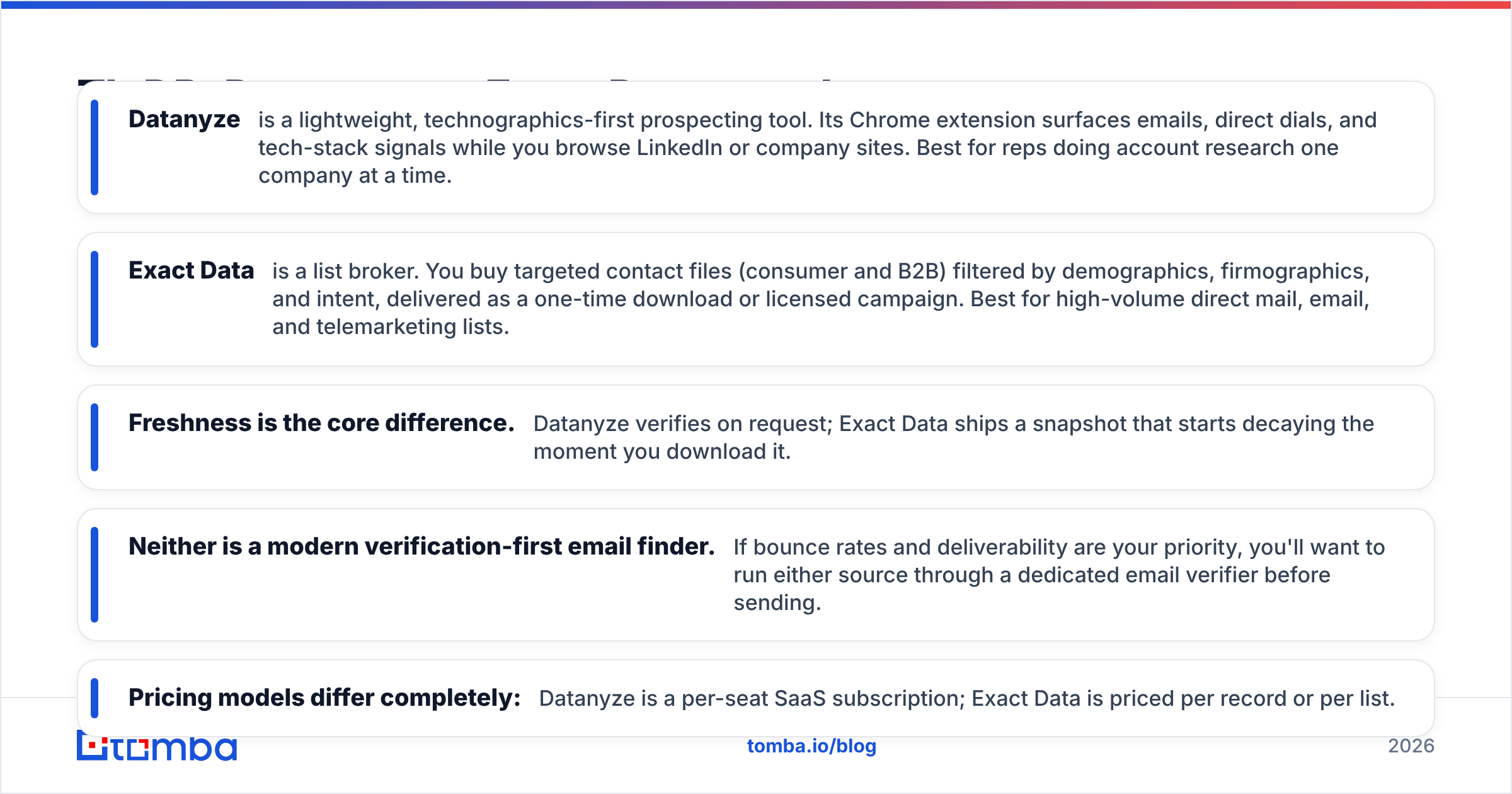
- Datanyze is a lightweight, technographics-first prospecting tool. Its Chrome extension surfaces emails, direct dials, and tech-stack signals while you browse LinkedIn or company sites. Best for reps doing account research one company at a time.
- Exact Data is a list broker. You buy targeted contact files (consumer and B2B) filtered by demographics, firmographics, and intent, delivered as a one-time download or licensed campaign. Best for high-volume direct mail, email, and telemarketing lists.
- Freshness is the core difference. Datanyze verifies on request; Exact Data ships a snapshot that starts decaying the moment you download it.
- Neither is a modern verification-first email finder. If bounce rates and deliverability are your priority, you'll want to run either source through a dedicated email verifier before sending.
- Pricing models differ completely: Datanyze is a per-seat SaaS subscription; Exact Data is priced per record or per list.
What is Datanyze?#
Datanyze started as a technographics company — it made its name tracking which websites run which software (Shopify vs Magento, HubSpot vs Marketo, and so on). ZoomInfo acquired it, and today Datanyze is positioned as an affordable, self-serve prospecting layer aimed at individual reps and small teams.
The workflow is browser-centric. You install the Chrome extension, land on a prospect's LinkedIn profile or company website, and Datanyze returns a business email, a mobile/direct dial where available, and firmographic context. Credits are consumed as you reveal contacts.
Its strengths are convenience and cost. For a rep who lives in LinkedIn and wants contact details without leaving the tab, it's fast. The technographic angle is still useful if your ICP is defined by a tech signal ("companies using Salesforce," "sites on Webflow").
The weaknesses are depth and scale. Datanyze's database is smaller than the enterprise giants, direct-dial coverage is inconsistent outside North America, and bulk list-building isn't its strong suit. You can read verified user sentiment on Datanyze's G2 profile — the recurring themes are ease of use on the plus side and data gaps on the minus side.

What is Exact Data?#
Exact Data is a list broker and data compiler, not a live prospecting tool. You describe an audience — job title, industry, revenue band, geography, and for consumer campaigns, demographics like age or homeownership — and Exact Data returns a targeted list you can license or buy outright.
This is the classic direct-marketing model. It shines when you need volume for channels that consume large files: postal direct mail, broadcast email campaigns run through a service bureau, and outbound telemarketing. Exact Data covers both B2B and B2C, which most SaaS-era prospecting tools don't touch.
The trade-off is the nature of a purchased list. A file is a snapshot. The moment it's compiled, people change jobs, emails get deactivated, and phone numbers get reassigned. B2B data decays fast — industry estimates put contact-data decay at roughly 25–30% per year, and job-change churn concentrates that decay in exactly the senior titles you most want to reach. A list bought in January is measurably weaker by summer. You can review Exact Data's offering and compliance claims on their official site.
There's also the deliverability risk. Bought lists that haven't been re-verified are a common source of spam-trap hits and hard bounces, which damage your sender reputation. If you go this route, verification isn't optional.

Datanyze vs Exact Data: side-by-side comparison#
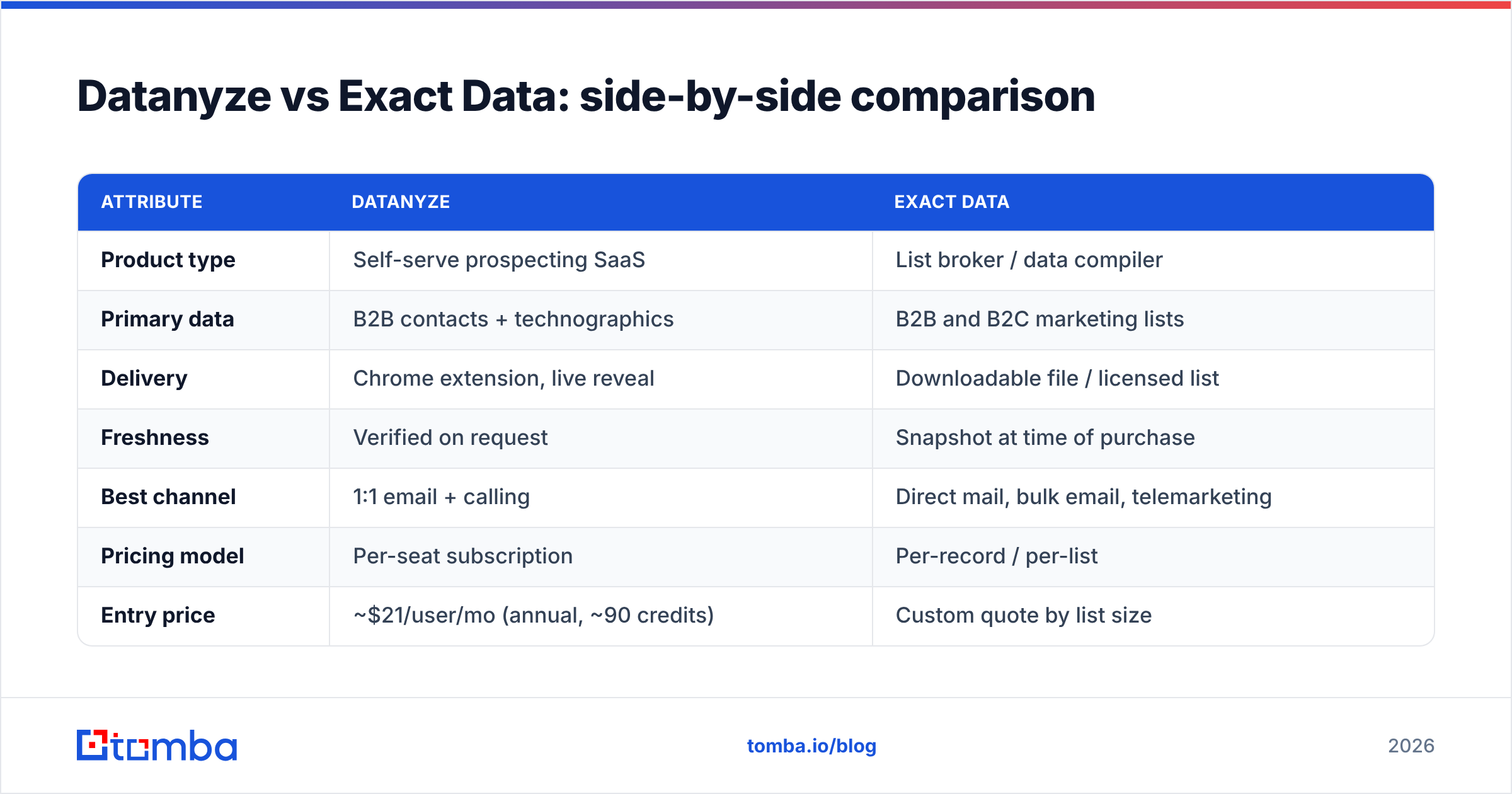
Here's the core matchup. Read this table by your workflow, not just by feature count — a per-seat tool and a per-record list serve very different buyers.
| Attribute | Datanyze | Exact Data |
|---|---|---|
| Product type | Self-serve prospecting SaaS | List broker / data compiler |
| Primary data | B2B contacts + technographics | B2B and B2C marketing lists |
| Delivery | Chrome extension, live reveal | Downloadable file / licensed list |
| Freshness | Verified on request | Snapshot at time of purchase |
| Best channel | 1:1 email + calling | Direct mail, bulk email, telemarketing |
| Pricing model | Per-seat subscription | Per-record / per-list |
| Entry price | ~$21/user/mo (annual, ~90 credits) | Custom quote by list size |
| Free option | Limited free trial | No |
| Ideal user | SDRs, small sales teams | Direct marketers, agencies |
| Weak spot | Database depth, non-US dials | Data decay, no live enrichment |
Is Datanyze more accurate than Exact Data?#
Neither wins outright — accuracy depends on how you use each one, but the mechanics favor a live tool.
Datanyze verifies contacts closer to the moment you request them, so a fresh reveal is generally more reliable than a months-old row in a purchased file. That said, Datanyze's coverage is narrower, so "accurate but not found" is a common outcome — you'll get clean data on the accounts it covers and blanks on the ones it doesn't.
Exact Data can deliver enormous reach, but reach and accuracy aren't the same thing. A 50,000-record list is only as good as its last verification pass, and list files rarely come re-verified at the moment of download. The volume is real; the freshness is the gamble.
The honest takeaway: treat every source as raw material, not gospel. Whether you pull from Datanyze, Exact Data, or anywhere else, run the addresses through verification before you send. A modern data enrichment and verification step catches the dead addresses that quietly wreck your bounce rate. This is where a lot of teams under-invest, and it's the cheapest insurance in outbound.

How does pricing compare?#
The two use pricing models that barely resemble each other, so "cheaper" depends entirely on what you're buying.
Datanyze is a straightforward per-seat SaaS subscription. It publishes a low entry point (around $21 per user per month billed annually for a modest credit allotment), with higher tiers unlocking more credits. Predictable, easy to expense, and scales by headcount.
Exact Data is quoted per record or per list. You tell them the audience and volume; they return a price. Costs scale with list size and whether you're doing a one-time purchase or a multi-use license. Great for a single big campaign, harder to budget as a continuous data feed.
A quick way to think about it:
- Continuous, rep-driven prospecting → subscription tools like Datanyze amortize better.
- One large campaign push → a per-list buy from a broker like Exact Data can be cheaper per contact.
- Ongoing, verification-first pipeline → a credit-based finder-plus-verifier stack (more on that below) usually beats both on cost-per-usable-contact, because you're not paying for dead rows.
Don't compare sticker prices. Compare cost per contact you can actually reach after verification — that's the number that hits your pipeline.
Where does the data come from?#
Data provenance matters for both accuracy and compliance, and the two vendors source very differently.
Datanyze blends public web crawling (its technographic heritage), contributed data, and third-party licensing, refreshed against live signals when you request a reveal. Because it leans on public and observable signals, coverage is strongest for companies with a visible web and tech footprint.
Exact Data compiles from a wide mix of opt-in registrations, public records, surveys, and partner sources — the standard list-compiler pipeline. That breadth is why it can serve consumer segments, but it also means you should scrutinize consent and suppression practices, especially for email and phone outreach under GDPR, CAN-SPAM, and TCPA. Transparency about data sources is something you should demand from any vendor before you send a single message.

Which one should you choose?#
Match the tool to the motion, not the brand.
Choose Datanyze if you're an SDR or small team doing account-by-account research, you value the Chrome-extension workflow, technographic filtering fits your ICP, and your volume is measured in dozens of reveals per day rather than tens of thousands of records per month.
Choose Exact Data if you're running high-volume direct marketing — postal mail, telemarketing, or large broadcast email through a compliant service bureau — you need consumer as well as business coverage, and you have a verification step already in place to scrub the file before use.
Choose neither if your priority is a clean, verification-first B2B email pipeline with an API and predictable credit pricing. That's a different category, and it's worth knowing your options.
What's a leaner alternative to both?#
If your real job is "find reliable B2B emails and don't get burned by bounces," a dedicated finder-and-verifier is usually a better fit than either a technographics tool or a bought list.
Tomba sits in that lane. Instead of buying a static file or paying per seat for a browser widget, you use a verification-first email finder that returns a confidence score with every result, plus a built-in verifier so you can scrub any list — including one you exported from Datanyze or purchased from a broker — before it touches your sending domain.
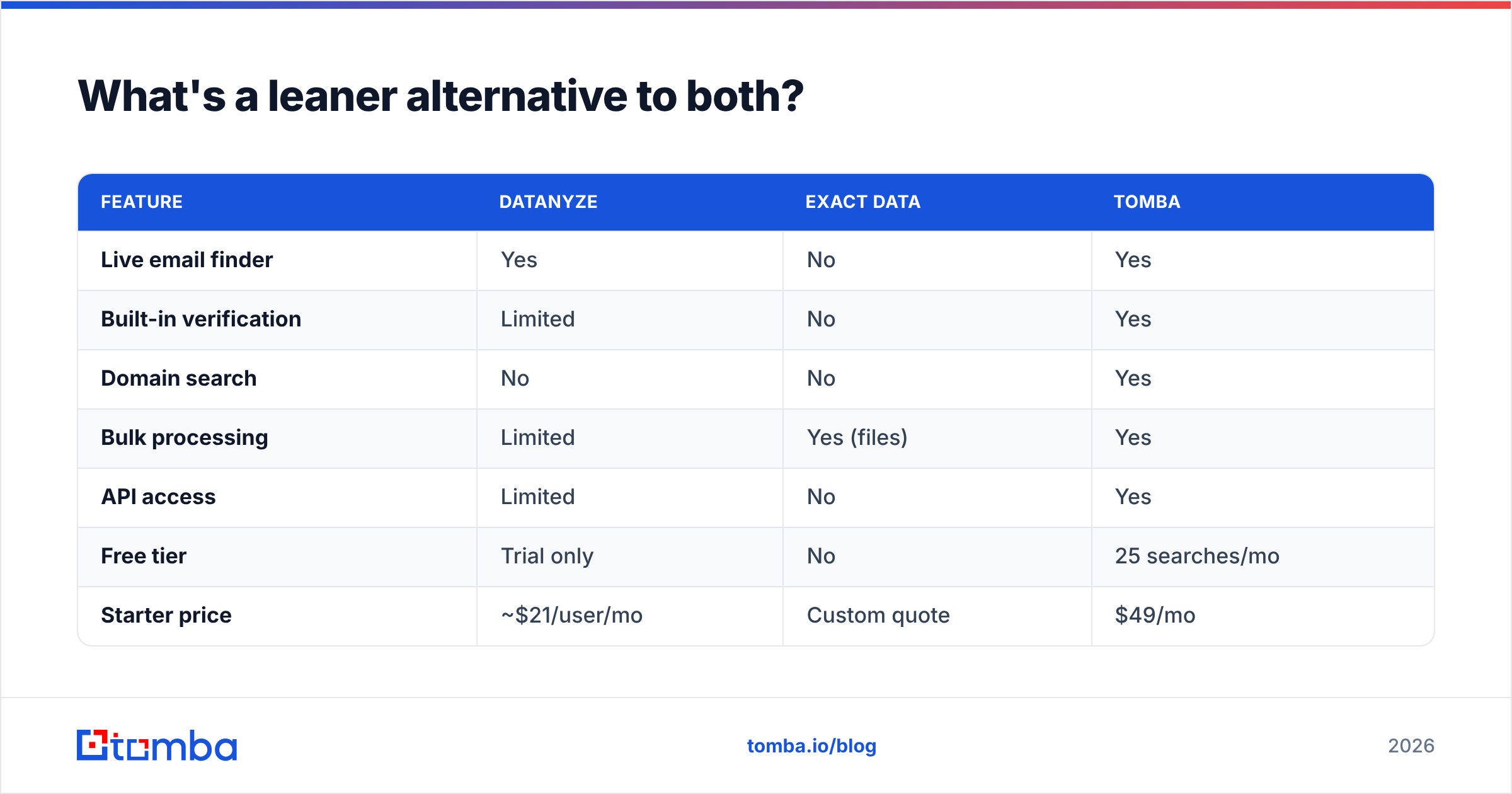
Here's how the models line up:
| Feature | Datanyze | Exact Data | Tomba |
|---|---|---|---|
| Live email finder | Yes | No | Yes |
| Built-in verification | Limited | No | Yes |
| Domain search | No | No | Yes |
| Bulk processing | Limited | Yes (files) | Yes |
| API access | Limited | No | Yes |
| Free tier | Trial only | No | 25 searches/mo |
| Starter price | ~$21/user/mo | Custom quote | $49/mo |
Tomba's pricing is public and credit-based — a free tier with 25 searches per month, then Starter at $49/mo, Growth at $99/mo, and Pro at $249/mo (full Tomba pricing online). The domain search tool also fills a gap neither Datanyze nor Exact Data addresses well: give it a company domain and get back the known email pattern plus the people behind it, verified.
None of this means Datanyze or Exact Data is a bad tool. They're built for specific jobs — technographic prospecting and list buying, respectively. It means you should be clear about which job you're hiring for before you pay.
Frequently asked questions#
Is Datanyze the same as ZoomInfo? No. ZoomInfo owns Datanyze, but Datanyze is positioned as a lighter, cheaper, self-serve product for individuals and small teams, while ZoomInfo targets enterprise. Different price point, different depth.
Can I buy a one-time list from Datanyze? Not really — Datanyze is a subscription tool built around live, credit-based reveals. For one-time bulk list purchases, a broker like Exact Data is the closer fit.
Do I still need to verify data from Exact Data? Yes. Any purchased list is a snapshot that decays quickly. Run it through email verification before sending to protect your sender reputation and keep bounce rates low.
Which is cheaper, Datanyze or Exact Data? It depends on volume and use case. Datanyze's per-seat model is cheaper for continuous rep prospecting; Exact Data can be cheaper per contact for a single large campaign. Compare cost per usable contact after verification.
The bottom line#
Datanyze vs Exact Data isn't really tool-vs-tool — it's live prospecting vs bought lists. Datanyze fits reps who research accounts one at a time and value a fast browser workflow. Exact Data fits direct marketers who need volume across mail, phone, and email. Both demand a verification step you shouldn't skip.
If your core need is accurate, verified B2B emails with a real free tier and an API, start with the Tomba Email Finder. Test 25 searches free, check the confidence scores against your own accounts, and decide with data instead of a sales quote — then layer in verification so nothing you send bounces.
Related guides#
Ready to find emails that actually work?
Join 150,000+ professionals who stopped guessing and started sending. Free credits on signup — no credit card required.
Get the Tomba newsletter
Practical outbound tactics and product updates — once every two weeks.
About the author