Datanyze vs Forager (2026): Which Email Finder Wins?
Datanyze and Forager both promise clean B2B contact data, but they solve very different problems. Here's an honest breakdown of accuracy, pricing, and where each one actually earns its seat in your stack.
Datanyze vs Forager: Which Contact Data Tool Actually Fits Your Stack?
Picking between Datanyze and Forager feels harder than it should, because the two tools barely overlap once you look past the "find B2B emails" headline. One is a lightweight Chrome-extension play built around technographics and quick lookups. The other is a firehose of continuously refreshed contact records aimed at data teams and API-first workflows. Choose wrong and you either overpay for volume you never touch, or you cap out on lookups mid-campaign.
This is a neutral, hands-on comparison — no vendor spin. We'll break down accuracy, pricing, data freshness, and the workflows each tool is genuinely good at, then show where a focused email finder like Tomba beats both on cost per verified contact.
TL;DR — Datanyze vs Forager in 5 bullets#
- Datanyze is best for reps who live in the browser: a Chrome extension that surfaces emails, direct dials, and technographic signals on the fly. Great for light, opportunistic prospecting.
- Forager is best for data and RevOps teams: a large, frequently-refreshed contact database with strong API access, built for enrichment at scale rather than one-off lookups.
- Accuracy is close on common corporate domains; both slip on catch-all domains, SMBs, and non-US contacts where a dedicated verifier matters more than the source.
- Pricing favors Forager for high-volume enrichment and Datanyze for individual reps — but neither is cheap per verified email compared with a specialist finder.
- The pragmatic pick: many teams pair a database for coverage with a precise finder-plus-verifier for the accounts that matter. That's where Tomba's $49/mo starter tier changes the math.
What is Datanyze and who is it for?#
Datanyze is a sales intelligence tool, now part of the ZoomInfo family, best known for its browser extension and technographic data. Instead of asking you to run bulk jobs, it meets you where you already work — on a company website or a LinkedIn profile — and pops contact details plus the technologies that company runs (their CMS, analytics, ad tech, and so on).
That technographic angle is the real differentiator. If your pitch depends on knowing a prospect uses Shopify, HubSpot, or a specific cloud provider, Datanyze surfaces that signal at the moment of research. For a rep building a short, high-context list by hand, it's fast and low-friction.
Where it gets awkward: Datanyze is not built for pulling ten thousand contacts into a spreadsheet overnight. Credits are geared toward individual lookups, coverage outside North America thins out, and you'll still want to run results through an independent email verifier before you send. It's a scalpel, not a bulldozer.
What is Forager and who is it for?#
Forager positions itself around a large, continuously refreshed B2B contact database delivered through a fast API and bulk enrichment tooling. The pitch is coverage and freshness: rather than scraping on demand, Forager maintains records and re-checks them on a rolling basis, so the emails and job titles you pull are less likely to be six months stale.
That makes Forager a natural fit for teams that treat data as infrastructure — RevOps building enrichment pipelines, growth teams hydrating a CRM, or engineers wiring contact lookups into a product. If your bottleneck is "we need a million rows enriched and kept current," Forager's model is built for exactly that.
The trade-off is that a database-first tool is only as good as its match rate on your target segments. Broad coverage numbers look great in aggregate, but they hide the gaps that hurt: niche verticals, small companies, and catch-all domains where even a fresh record can't be confidently verified. Volume is not the same as precision.
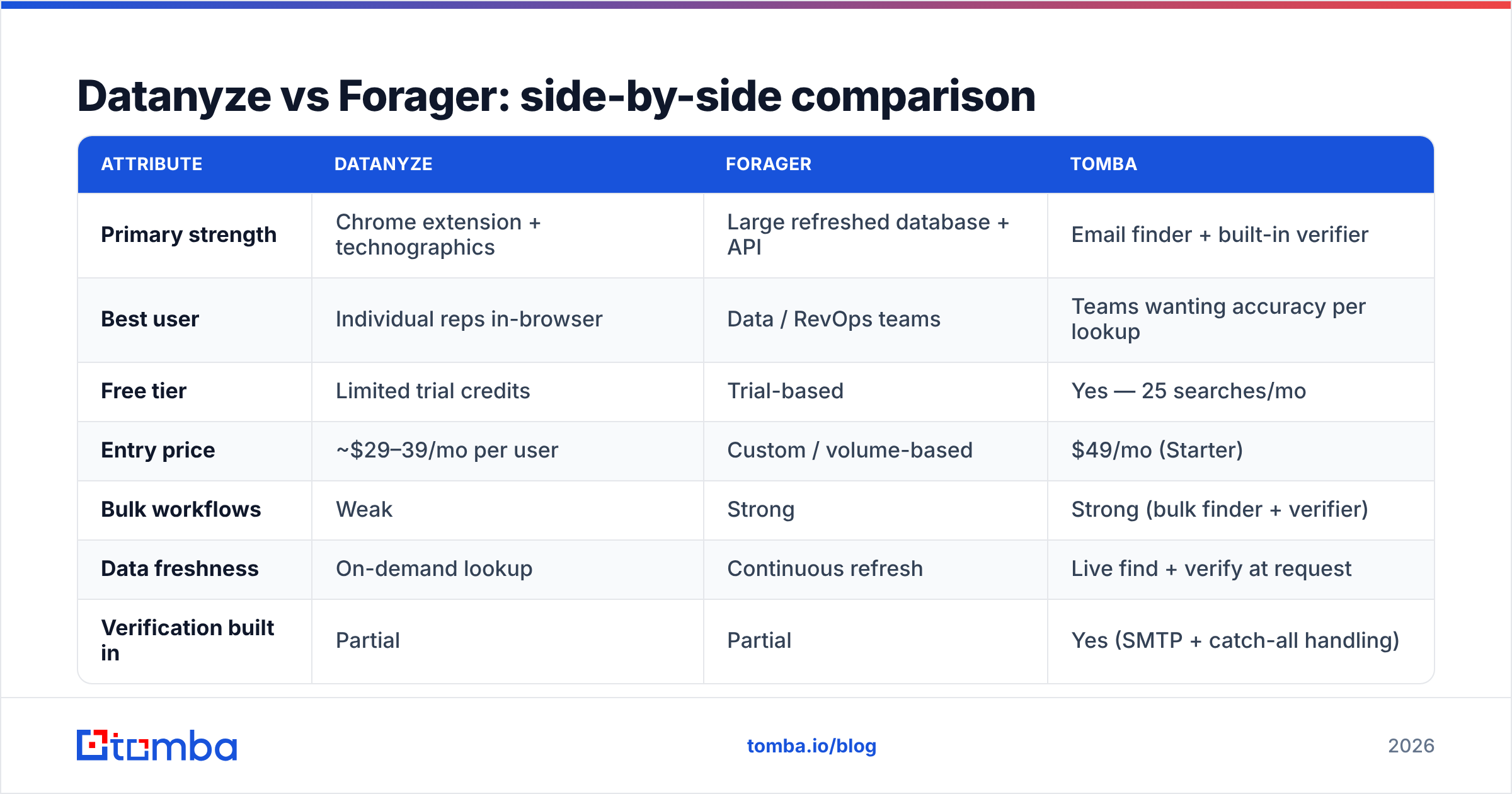
Datanyze vs Forager: side-by-side comparison#
Here's the core matchup on the attributes that actually change your results. Prices reflect publicly listed tiers and shift over time — confirm current numbers on each vendor's site before you buy.
| Attribute | Datanyze | Forager | Tomba |
|---|---|---|---|
| Primary strength | Chrome extension + technographics | Large refreshed database + API | Email finder + built-in verifier |
| Best user | Individual reps in-browser | Data / RevOps teams | Teams wanting accuracy per lookup |
| Free tier | Limited trial credits | Trial-based | Yes — 25 searches/mo |
| Entry price | ~$29–39/mo per user | Custom / volume-based | $49/mo (Starter) |
| Bulk workflows | Weak | Strong | Strong (bulk finder + verifier) |
| Data freshness | On-demand lookup | Continuous refresh | Live find + verify at request |
| Verification built in | Partial | Partial | Yes (SMTP + catch-all handling) |
| API access | Limited | Full, first-class | Full REST API |
| Non-US coverage | Thin | Broad but uneven | Domain-based, global |
Two honest takeaways from this table. First, Datanyze and Forager are answering different questions — "help me research this one account" versus "keep my whole database warm." Second, neither leads on verified accuracy per contact, because both treat verification as a secondary step rather than the core product.
How accurate is each tool, really?#
Accuracy is where every contact-data comparison lives or dies, and it's also where marketing numbers mislead the most. A vendor claiming "95% accuracy" is usually measuring against clean, high-traffic corporate domains — the easy cases everyone gets right.
The hard cases separate the tools:
- Catch-all domains. When a mail server accepts every address, a naive checker marks everything "valid." Both Datanyze and Forager can hand you catch-all addresses that bounce. A dedicated catch-all verifier is what actually protects your sender reputation here.
- SMB and long-tail companies. Big databases skew toward enterprise. If you sell to sub-200-employee companies, match rates drop and you feel it as blank rows.
- Recency. People change jobs constantly. Forager's continuous refresh helps; Datanyze's on-demand model can serve a stale cached record.
- Region. Non-US and non-English-market coverage is thinner across the board — verify before you trust a headline coverage stat.

The practical lesson: the source of an email matters less than whether it was verified at the moment you use it. That's why the strongest workflows separate "find" from "verify," and lean on a tool that does both in one pass rather than trusting a database's internal confidence score.
How does pricing compare?#
Pricing is where the two tools diverge sharply — and where cost per verified contact tells the real story.
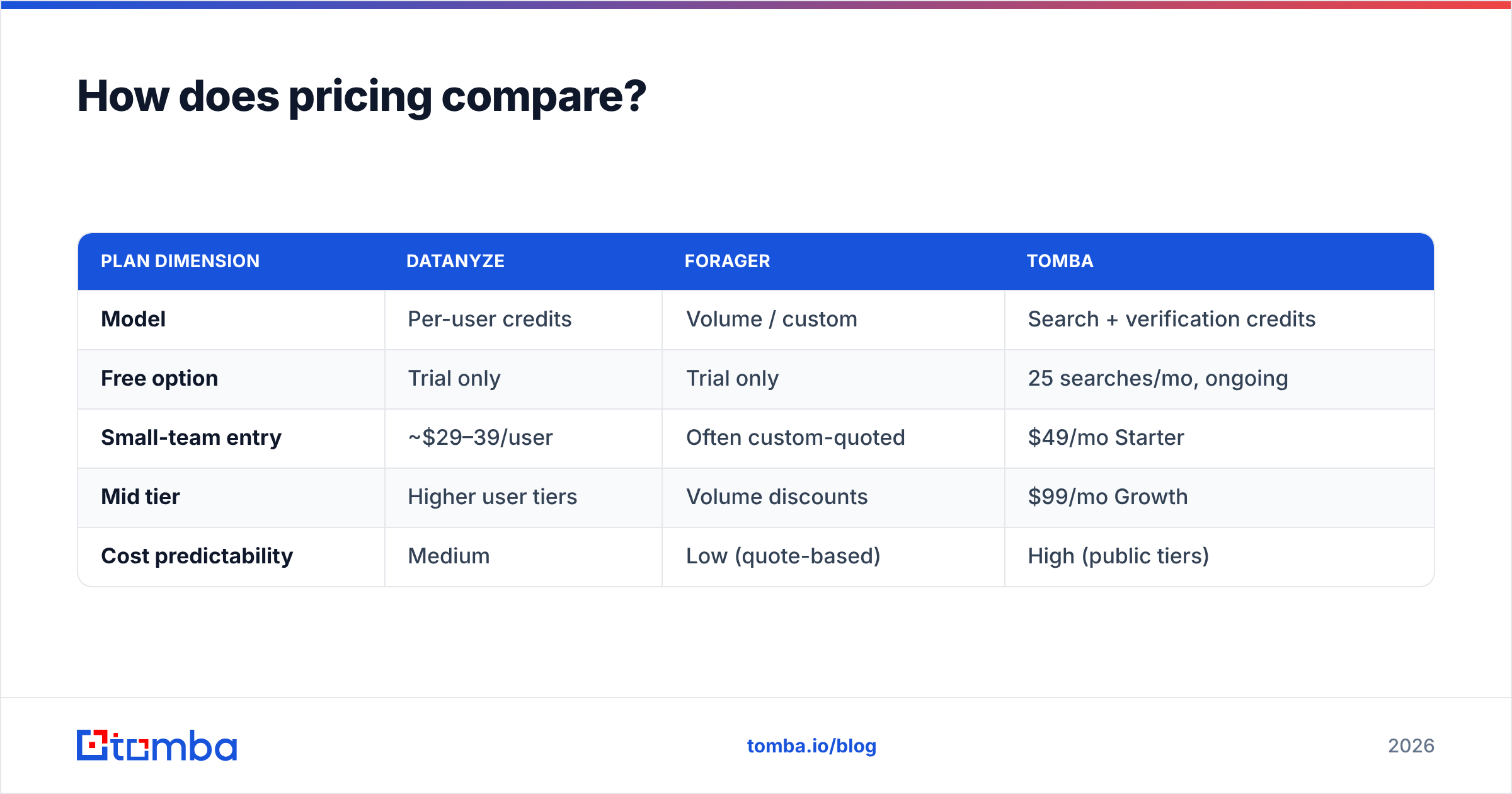
Datanyze uses a per-user, credit-metered model in the roughly $29–39/mo range for individuals, which is friendly for a single rep but scales awkwardly across a team. Forager typically prices on volume with custom quotes, so it gets cheaper per record as you buy more — attractive if you're enriching hundreds of thousands of rows, expensive as an entry point for a small team.
| Plan dimension | Datanyze | Forager | Tomba |
|---|---|---|---|
| Model | Per-user credits | Volume / custom | Search + verification credits |
| Free option | Trial only | Trial only | 25 searches/mo, ongoing |
| Small-team entry | ~$29–39/user | Often custom-quoted | $49/mo Starter |
| Mid tier | Higher user tiers | Volume discounts | $99/mo Growth |
| Cost predictability | Medium | Low (quote-based) | High (public tiers) |
For a full, public breakdown of Tomba's tiers — Free, Starter $49/mo, Growth $99/mo, Pro $249/mo, and Enterprise — see the Tomba pricing page. The point isn't that cheaper always wins; it's that a transparent, verification-included price beats a quote-based database when you're trying to forecast cost per booked meeting.
When should you choose Datanyze?#
Pick Datanyze if your prospecting is browser-native and research-heavy. Concretely, it earns its spot when:
- You sell on technographics. Your hook depends on what tech a company runs, and you want that intel at the moment you view their site or profile.
- You're an individual rep, not a data team, and you value speed of a single lookup over bulk throughput.
- Your list-building is opportunistic — you find accounts as you browse rather than exporting a target list up front.
Datanyze is a respected tool for that motion. Just pair it with an independent verification step and don't expect it to be your bulk-enrichment engine. You can read real user experiences on G2 before committing.
When should you choose Forager?#
Pick Forager if data volume and freshness are the constraint. It fits when:
- You run enrichment pipelines and need an API-first source that keeps records current.
- Your addressable market is large and enterprise-leaning, where broad coverage pays off.
- You have a data or RevOps function that can integrate, monitor, and de-dupe at scale.
Check Forager's own documentation and coverage claims against your specific segments in a trial. Broad coverage is a real asset — but only if it lands on the companies you actually sell to. Validate match rate on a sample of your accounts, not a generic list.
Where does Tomba fit against both?#
Tomba takes a deliberately different position: instead of being a browse-time gadget or a bulk database, it's a precision find email addresses engine with verification baked into the same workflow. You give it a name and domain (or run a whole domain), and it returns addresses that are checked at request time — including proper handling of catch-all servers that trip up naive checkers.
That design closes the gap both other tools leave open:
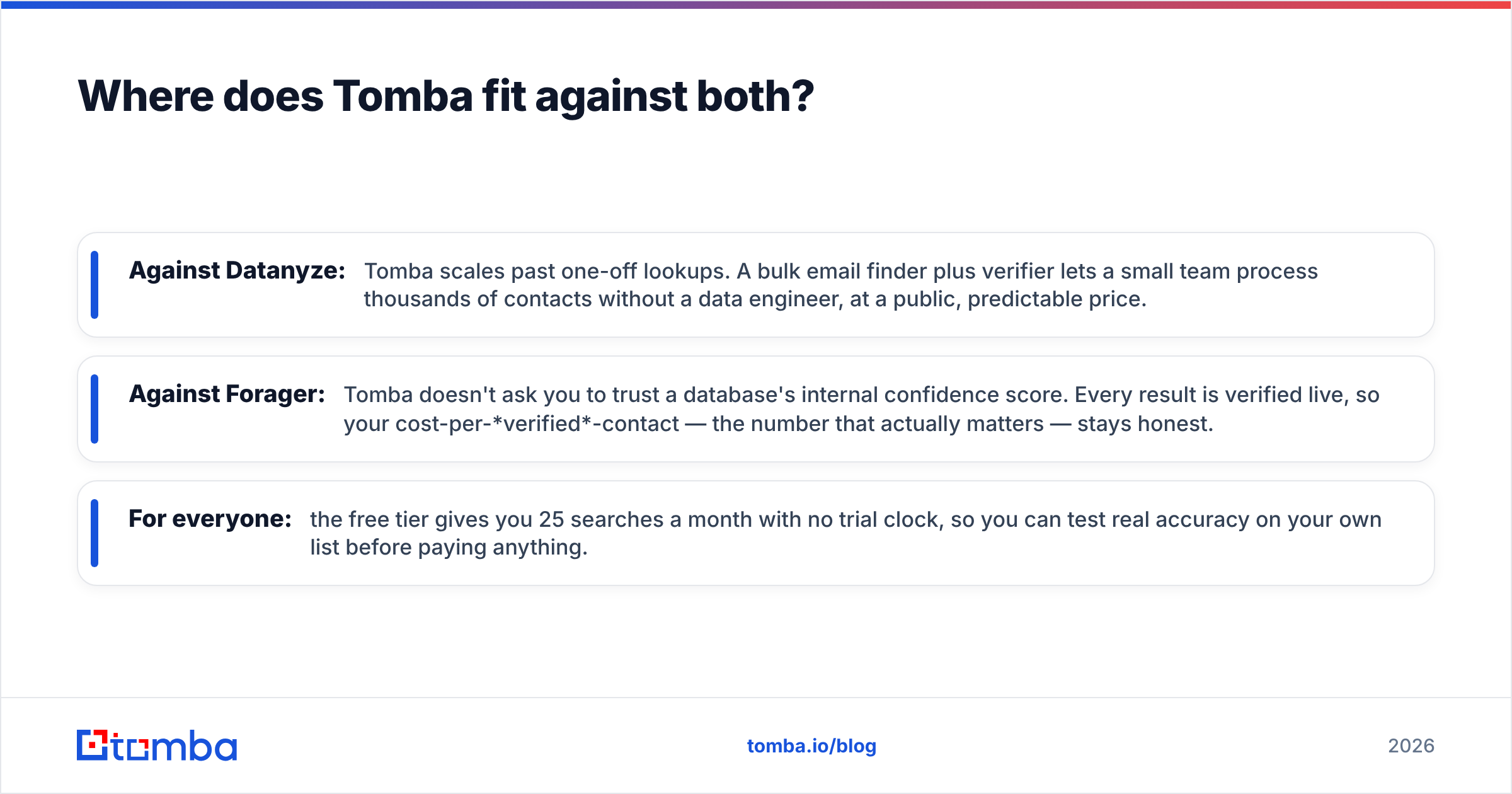
- Against Datanyze: Tomba scales past one-off lookups. A bulk email finder plus verifier lets a small team process thousands of contacts without a data engineer, at a public, predictable price.
- Against Forager: Tomba doesn't ask you to trust a database's internal confidence score. Every result is verified live, so your cost-per-verified-contact — the number that actually matters — stays honest.
- For everyone: the free tier gives you 25 searches a month with no trial clock, so you can test real accuracy on your own list before paying anything.

None of this makes Datanyze or Forager bad choices — they're strong at what they're built for. It means the "versus" framing is often the wrong question. The right question is which layer of your data stack you're actually trying to fill.
Datanyze vs Forager: the honest verdict#
Choose Datanyze if you're a rep who prospects in the browser and sells on technographic signals. Choose Forager if you're a data team that needs large-scale, continuously refreshed contact data through an API. Choose Tomba if your priority is verified accuracy per contact at a transparent price — whether as your primary finder or as the verification layer that keeps the other two honest.
Most mature teams end up with a hybrid: a database for coverage, and a precise find-and-verify tool for the accounts that pay the bills. If bounce rates and wasted sends are your real pain, start with verification-first.
Want to test that claim on your own list? Spin up the free tier of the Tomba Email Finder — 25 searches a month, no trial countdown — run your toughest 25 target contacts through it, and compare the verified results against whatever Datanyze or Forager hands you. Let the bounce rate decide.
Related guides#
Ready to find emails that actually work?
Join 150,000+ professionals who stopped guessing and started sending. Free credits on signup — no credit card required.
Get the Tomba newsletter
Practical outbound tactics and product updates — once every two weeks.
About the author