Datanyze vs Generect: B2B Data Tools Compared for 2026
Datanyze leans on technographics and free browser lookups; Generect bets on real-time LinkedIn-sourced leads. Here's which B2B data tool actually fits your outbound in 2026 — and where a cheaper stack beats both.
You need contact data that converts, and two names keep surfacing: Datanyze and Generect. One is a veteran technographics platform with a free Chrome lookup; the other is a newer engine that pulls fresh leads straight from LinkedIn signals. They sound similar on a landing page, but they solve different problems — and picking wrong means paying for records your reps can't email.
This is an honest, side-by-side look at where each tool wins, where each falls short, and how to avoid overpaying for data you'll have to re-verify anyway.
TL;DR#
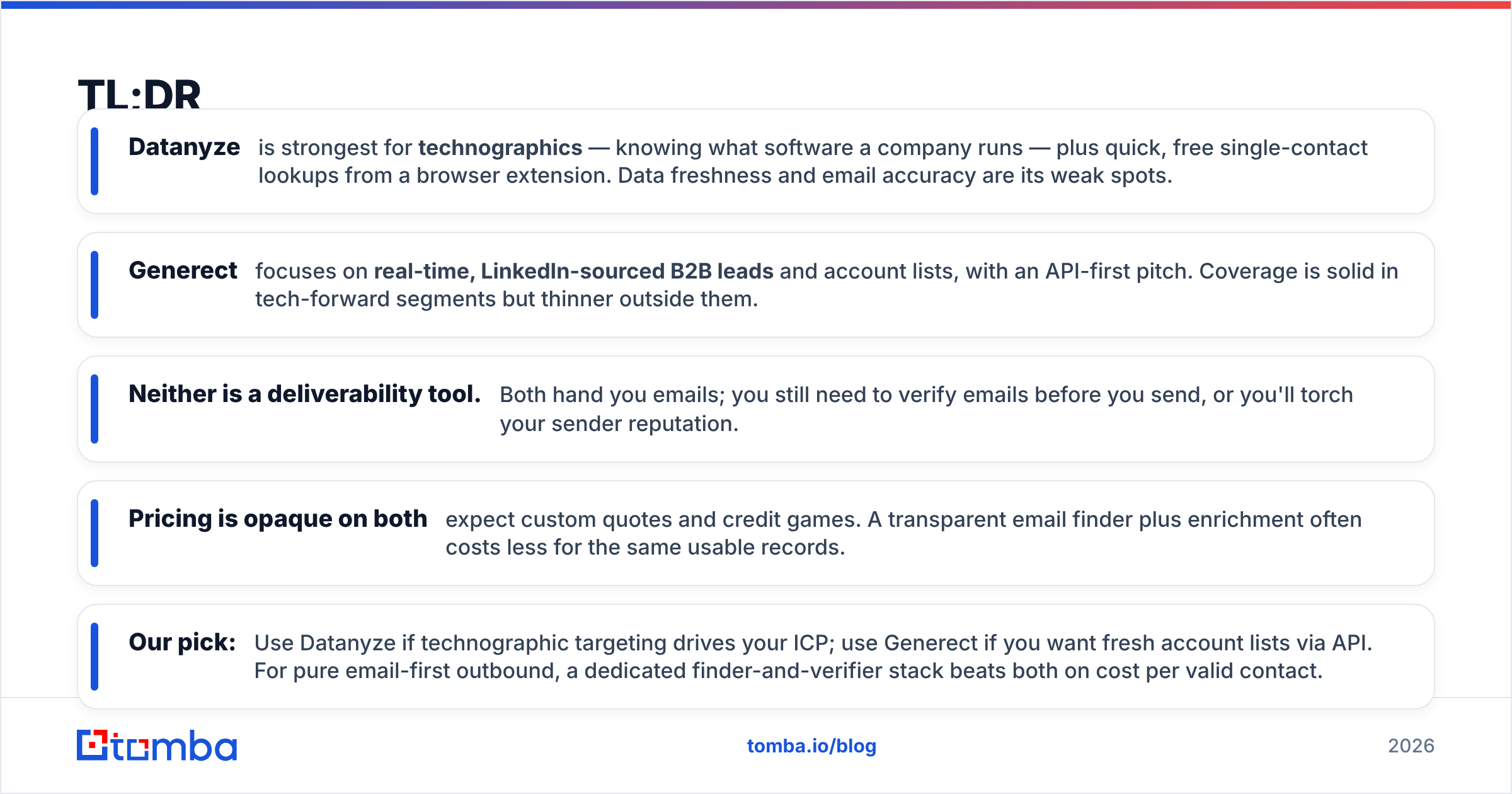
- Datanyze is strongest for technographics — knowing what software a company runs — plus quick, free single-contact lookups from a browser extension. Data freshness and email accuracy are its weak spots.
- Generect focuses on real-time, LinkedIn-sourced B2B leads and account lists, with an API-first pitch. Coverage is solid in tech-forward segments but thinner outside them.
- Neither is a deliverability tool. Both hand you emails; you still need to verify emails before you send, or you'll torch your sender reputation.
- Pricing is opaque on both — expect custom quotes and credit games. A transparent email finder plus enrichment often costs less for the same usable records.
- Our pick: Use Datanyze if technographic targeting drives your ICP; use Generect if you want fresh account lists via API. For pure email-first outbound, a dedicated finder-and-verifier stack beats both on cost per valid contact.
What is Datanyze and who is it for?#
Datanyze built its name on technographics — the practice of segmenting companies by the technology they use. If your product only makes sense for teams already running Shopify, HubSpot, or Salesforce, that signal is gold, and Datanyze indexes it at scale.
The product most people actually touch is the Chrome extension. You land on a LinkedIn profile or a company website, click the icon, and Datanyze surfaces an email guess, a phone number, and firmographic context. It's frictionless for one-off prospecting, and there's a free tier that hooks individual reps.
Where Datanyze struggles is data recency and email accuracy. Because much of its contact layer is modeled and pattern-based rather than continuously re-verified, you'll hit stale addresses and role changes — especially for contacts who switched jobs in the last year. Reviews on G2 consistently praise the technographic angle while flagging bounce rates and coverage gaps outside North America.
Best fit: SDRs and marketers whose targeting hinges on the tech stack a company runs, and who want a cheap or free per-seat lookup tool.
What is Generect and who is it for?#
Generect is the newer entrant, and it leans into freshness. Instead of serving records from a static warehouse, it emphasizes leads assembled from real-time LinkedIn signals — new hires, role changes, company growth — and delivers them through account and contact lists or an API you can wire into your own workflow.
That API-first posture is the real differentiator. If you're a RevOps or growth team building a pipeline that pulls targeted lists on a schedule and pushes them into your CRM or sequencer, Generect is designed to be a data source, not a dashboard you log into daily.
The trade-offs are coverage breadth and predictability. Real-time sourcing shines for tech-forward, LinkedIn-active industries and thins out in traditional verticals, smaller local businesses, and regions with lower LinkedIn penetration. And like Datanyze, the emails it returns are best treated as candidates to be verified, not gospel.
Best fit: API-comfortable teams that want continuously refreshed account and contact lists over a big-but-stale database.
Datanyze vs Generect: the head-to-head comparison#
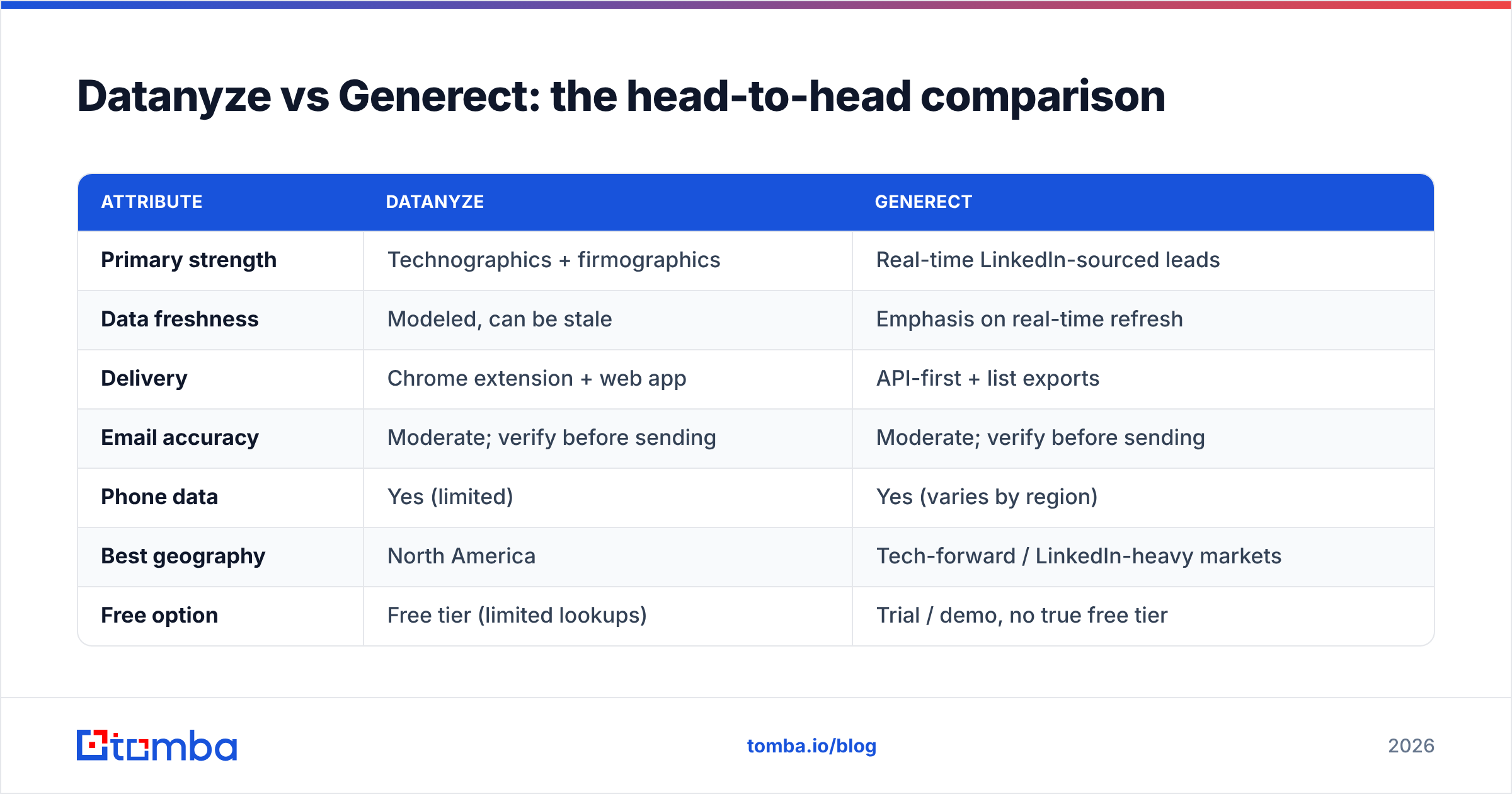
Here's the core matchup on the attributes that decide real outbound outcomes.
| Attribute | Datanyze | Generect |
|---|---|---|
| Primary strength | Technographics + firmographics | Real-time LinkedIn-sourced leads |
| Data freshness | Modeled, can be stale | Emphasis on real-time refresh |
| Delivery | Chrome extension + web app | API-first + list exports |
| Email accuracy | Moderate; verify before sending | Moderate; verify before sending |
| Phone data | Yes (limited) | Yes (varies by region) |
| Best geography | North America | Tech-forward / LinkedIn-heavy markets |
| Free option | Free tier (limited lookups) | Trial / demo, no true free tier |
| Ideal user | SDRs, marketers | RevOps, growth, developers |
| Pricing transparency | Low | Low |
The pattern is clear: Datanyze optimizes for tech-stack targeting and easy manual lookups, while Generect optimizes for programmatic, fresh list-building. Neither one is a full outbound platform, and neither replaces a verification step.
How they compare on data accuracy#
Accuracy is where both tools force the same conversation. A B2B contact record is only as good as its email deliverability at the moment you press send — and job-change churn alone invalidates roughly a quarter to a third of B2B contact data every year (a figure vendors like Gartner have long cited for CRM decay).
Datanyze's modeled emails and Generect's real-time pulls both improve your starting list, but neither guarantees a mailbox exists today. That's why the mature play is: source with either tool, then run every address through an independent verifier and a catch-all verifier before it touches a sequence. Skipping that step is the single fastest way to spike bounce rates and land in spam.
How much do Datanyze and Generect cost in 2026?#
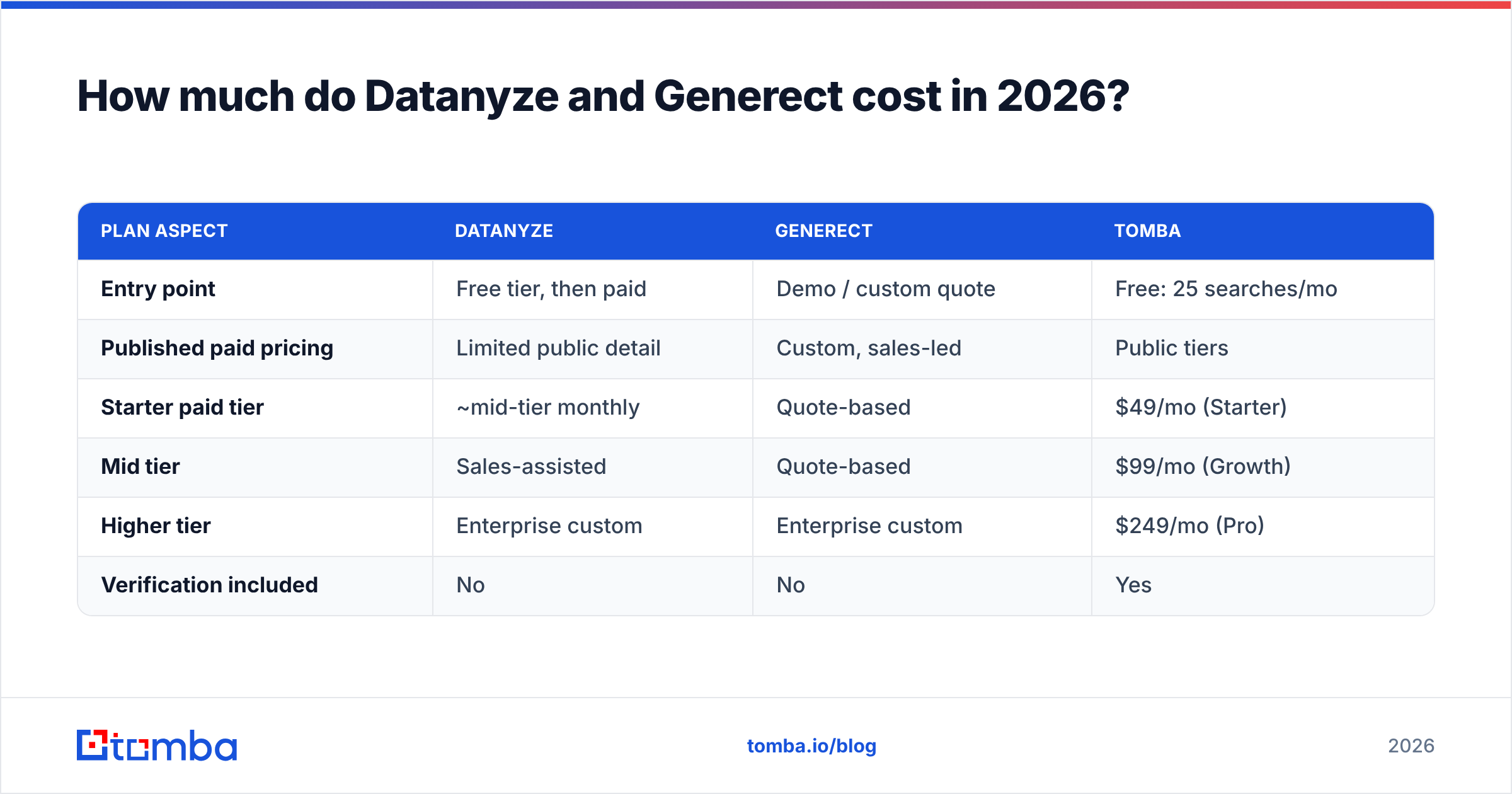
Neither vendor publishes clean, self-serve pricing across all tiers, which makes true cost-per-valid-record hard to calculate up front. Here's the realistic shape of what you'll encounter, alongside a transparent alternative for reference.
| Plan aspect | Datanyze | Generect | Tomba |
|---|---|---|---|
| Entry point | Free tier, then paid | Demo / custom quote | Free: 25 searches/mo |
| Published paid pricing | Limited public detail | Custom, sales-led | Public tiers |
| Starter paid tier | ~mid-tier monthly | Quote-based | $49/mo (Starter) |
| Mid tier | Sales-assisted | Quote-based | $99/mo (Growth) |
| Higher tier | Enterprise custom | Enterprise custom | $249/mo (Pro) |
| Verification included | No | No | Yes |
Two things to watch on both platforms:
- Credit accounting. A "credit" can be consumed on a reveal that returns a partial or unusable record. Ask exactly when a credit is burned.
- The hidden verification cost. If emails aren't verified, budget for a separate verifier — that's real money the sticker price hides.
When you fold verification back in, a stack with a built-in email verifier and predictable per-seat pricing frequently lands cheaper per usable contact than either sales-led quote.

Which tool is more accurate for cold outreach?#
Short answer: it's a tie on raw accuracy, and both lose to a source-plus-verify workflow. Datanyze and Generect each give you a better-than-random starting list, but the deciding factor for cold outreach isn't the vendor — it's whether you verify before you send.
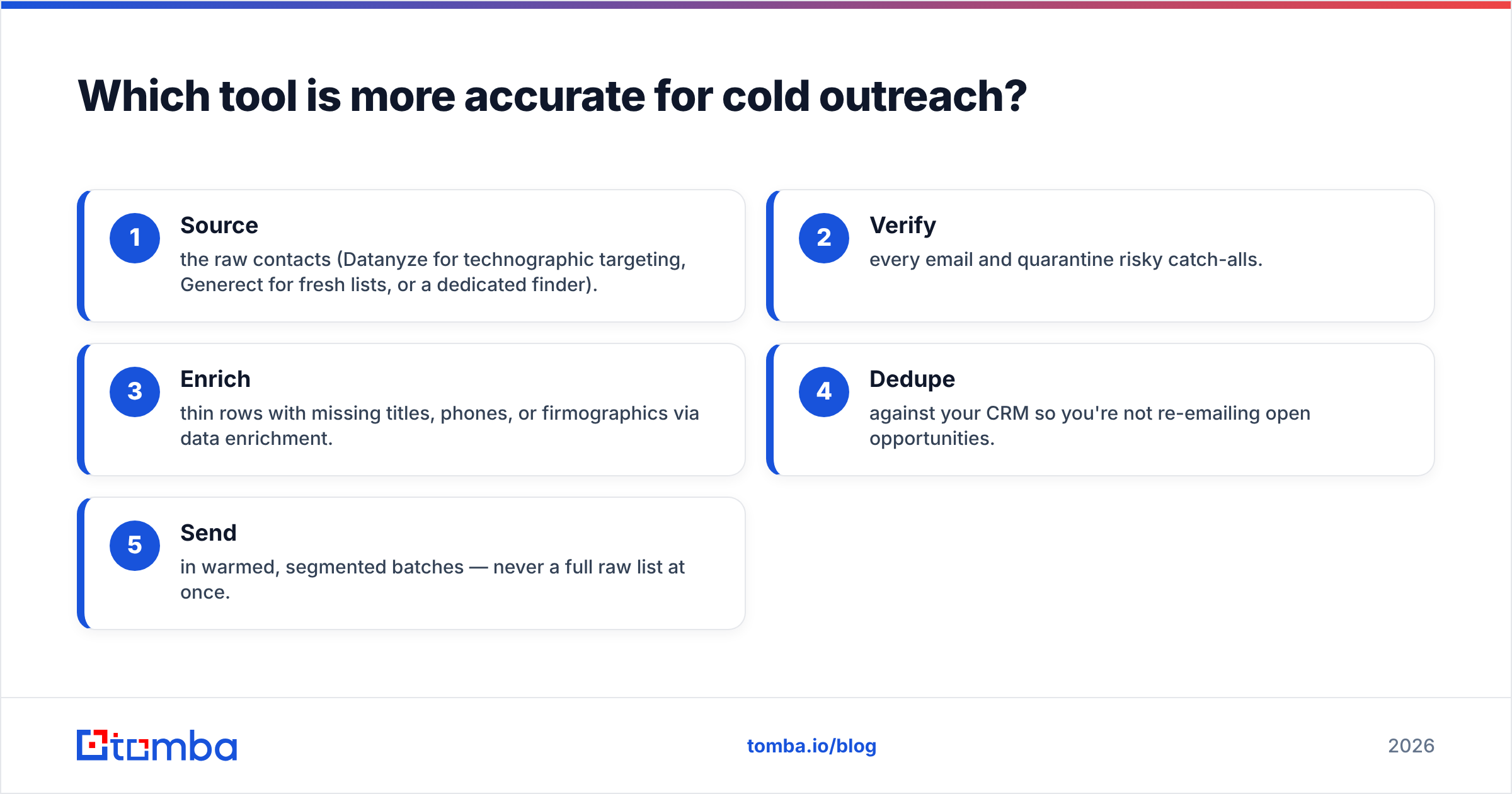
Here's the workflow that actually protects your sender reputation regardless of which data tool you choose:
- Source the raw contacts (Datanyze for technographic targeting, Generect for fresh lists, or a dedicated finder).
- Verify every email and quarantine risky catch-alls.
- Enrich thin rows with missing titles, phones, or firmographics via data enrichment.
- Dedupe against your CRM so you're not re-emailing open opportunities.
- Send in warmed, segmented batches — never a full raw list at once.
Do this and a "70% accurate" source becomes a clean, sendable list. Skip it and even a great source will bounce enough to hurt you.
Datanyze vs Generect: pros and cons#
Datanyze pros
- Best-in-class technographic data for tech-stack targeting
- Free tier and a genuinely handy Chrome extension
- Strong North American firmographic coverage
Datanyze cons
- Email accuracy and freshness lag; verify before sending
- Coverage thins outside North America
- Pricing detail is limited until you talk to sales
Generect pros
- Real-time, LinkedIn-signal-driven freshness
- API-first design that fits automated pipelines
- Good fit for tech-forward, LinkedIn-active markets
Generect cons
- Coverage narrows in traditional verticals and low-LinkedIn regions
- No true free tier; sales-led onboarding
- Emails still need independent verification
When should you skip both and use an email-first stack?#
Skip both when your bottleneck is valid emails at a predictable price, not exotic data signals. If your ICP isn't defined by a specific tech stack (Datanyze's edge) and you don't need programmatic real-time lists (Generect's edge), you're paying for capabilities you won't use.
For most outbound teams, the job is simpler than either platform assumes:
- Find the right contact at a target company — a domain search returns every reachable email pattern at an account in one query.
- Confirm it's deliverable with an integrated verifier.
- Scale it through the Tomba API or a bulk email finder without per-record surprises.
That's a tighter, cheaper loop than licensing a broad intelligence suite you'll only half-use — and every email arrives pre-verified, so your bounce rate stays low from day one.
Frequently asked questions#
Is Datanyze or Generect better for technographics? Datanyze. Technographic targeting is its founding strength. Generect focuses on fresh lead sourcing, not deep tech-stack intelligence.
Does Generect give real-time data? That's its core pitch — leads assembled from live LinkedIn signals rather than a static database. Freshness is strongest in tech-forward, LinkedIn-active segments.
Do I still need to verify emails from these tools? Yes. Both return candidate emails that decay with job changes. Run them through a verifier and a catch-all check before sending to protect deliverability.
Which is cheaper, Datanyze or Generect? Both are largely quote-based, so true cost depends on your volume and how credits are counted. Factor in a separate verification cost, since neither includes it.
Can I replace both with a single tool? If your need is finding and verifying business emails at scale, a combined finder-plus-verifier covers most outbound use cases at a lower cost per usable contact.
The verdict#
Choose Datanyze if technographics define your ICP. Choose Generect if you want fresh, API-delivered account lists. But understand what you're buying: both are sourcing tools, and both leave verification — the step that actually determines whether your emails land — as your problem.
If your real goal is a clean, deliverable list without the sales-led pricing dance, start with a tool built for exactly that. Tomba's Email Finder finds professional emails by domain, name, or company, verifies them in the same workflow, and scales through a documented API — with public pricing that starts free and tops out predictably. Source smarter, verify by default, and put your budget toward contacts your reps can actually reach.
Related guides#
Ready to find emails that actually work?
Join 150,000+ professionals who stopped guessing and started sending. Free credits on signup — no credit card required.
Get the Tomba newsletter
Practical outbound tactics and product updates — once every two weeks.
About the author