Datanyze vs Go4database: B2B Data Provider Comparison (2026)
Datanyze sells technographics and self-serve contact data; Go4database sells pre-built email lists. We compare accuracy, pricing, and workflow fit so you pick the right B2B data source in 2026.
Choosing between Datanyze and Go4database usually comes down to one question: do you want a self-serve intelligence tool that hands you technographics and contact data on demand, or a vendor that sells you a pre-built list and gets out of the way? They sound similar on a feature grid, but they solve different problems — and buying the wrong one wastes a quarter of pipeline.
This comparison breaks down accuracy, pricing, data freshness, and real workflow fit so you can decide which one belongs in your stack in 2026 — and where a verification-first approach beats both.
TL;DR: Datanyze vs Go4database at a glance#
- Datanyze is a sales-intelligence and technographics tool (owned by ZoomInfo). It's strongest when you want to target accounts by the software they use and pull contact data one prospect at a time.
- Go4database is a bulk B2B list vendor. It's built for buyers who want large, pre-segmented contact files delivered as a download, often by industry or job title.
- Accuracy is the real divider. Technographic and static-list data both decay fast, so whichever you choose, you need a verification layer before you send.
- Pricing models differ sharply: Datanyze leans toward per-seat/credit subscriptions, Go4database toward one-time list purchases priced per record.
- The smart 2026 play is a live email-finder + verifier workflow so you pay for contacts you can actually reach, not a stale CSV.

What is Datanyze and who is it for?#
Datanyze started as a technographics company — it tracks which technologies a website runs (CRMs, ad pixels, payment processors, hosting) so sales teams can build target lists based on tech stack signals. After the ZoomInfo acquisition, it became a lightweight, self-serve contact-and-company data tool aimed at individual reps and small teams rather than enterprise RevOps.
You use Datanyze when you want to answer a question like "show me companies using Shopify Plus and give me the marketing director's email." It's a research tool: you look up a company or a person, and it returns firmographics, technographics, and contact details, often through a Chrome extension while you browse LinkedIn or a company site.
Its sweet spot is account targeting by intent-adjacent signals. If your product only makes sense for companies on a specific platform, technographic filtering is genuinely useful and hard to replicate with a plain list. The tradeoff: coverage and contact accuracy vary by region and seniority, and like all sales-intelligence tools, the underlying data ages between refresh cycles.
What is Go4database and who is it for?#
Go4database is a list-selling data vendor. Instead of a self-serve app you query prospect by prospect, you tell them the segment you want — an industry, a set of job titles, a geography, a technology audience — and they deliver a pre-compiled file of contacts, typically as a one-time purchase priced by volume.
This model appeals to buyers who need scale fast: an agency spinning up a campaign, a team entering a new vertical, or anyone who wants 20,000 records in a spreadsheet by Friday. There's no per-seat subscription to manage and no learning curve — you get a CSV.
The catch is the one every list buyer eventually hits: static lists decay the moment they're compiled. People change jobs at 15–30% per year, company domains change, and role titles shift. A list that was 90% accurate at compile time can be materially worse by the time it lands in your sequencer. That's not a knock specific to Go4database — it's the structural weakness of any "buy a file" model, and it's why deliverability discipline matters more than list size.

Datanyze vs Go4database: side-by-side comparison#
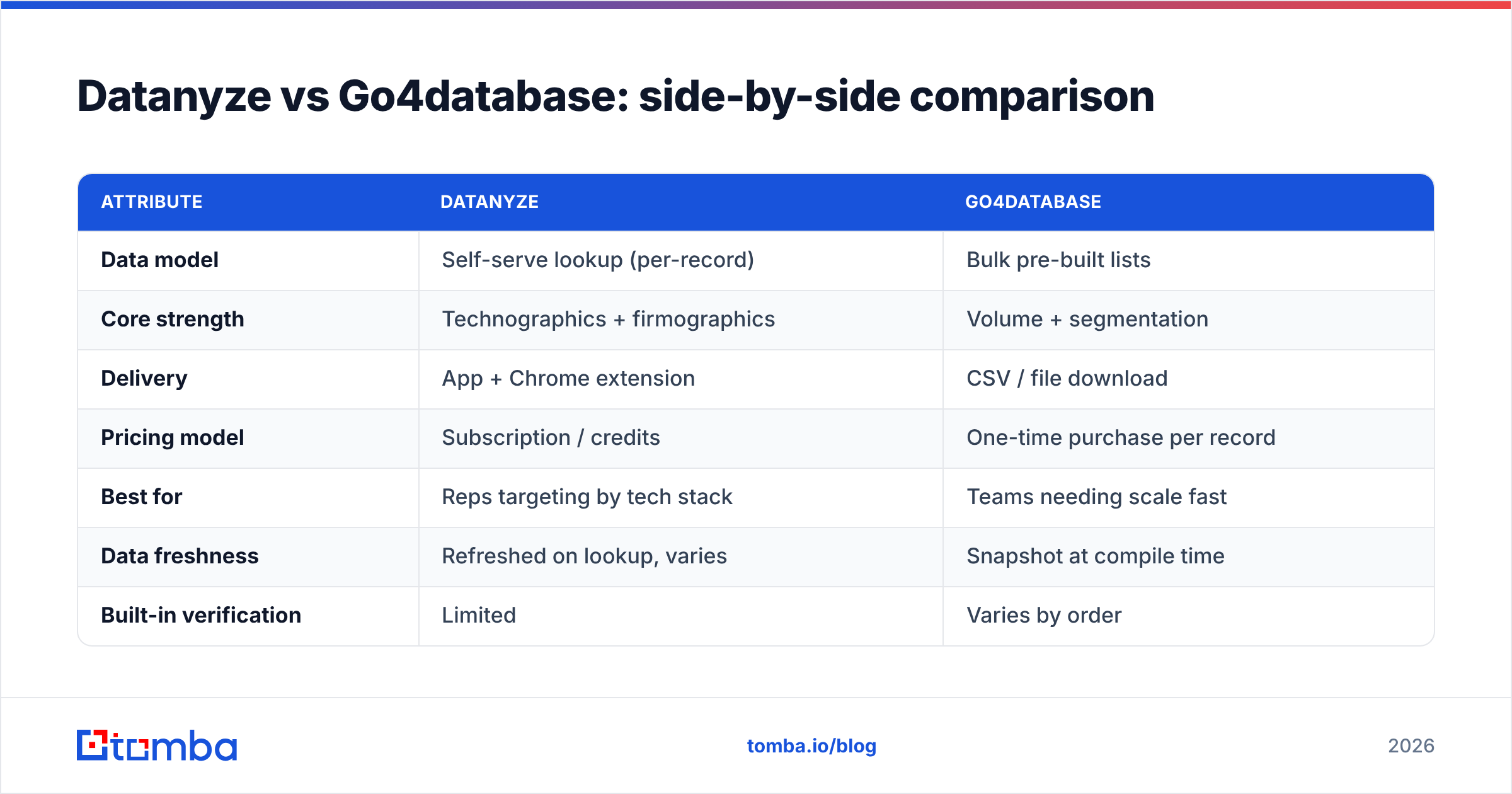
Here's how the two stack up on the attributes that actually change your results.
| Attribute | Datanyze | Go4database |
|---|---|---|
| Data model | Self-serve lookup (per-record) | Bulk pre-built lists |
| Core strength | Technographics + firmographics | Volume + segmentation |
| Delivery | App + Chrome extension | CSV / file download |
| Pricing model | Subscription / credits | One-time purchase per record |
| Best for | Reps targeting by tech stack | Teams needing scale fast |
| Data freshness | Refreshed on lookup, varies | Snapshot at compile time |
| Built-in verification | Limited | Varies by order |
| Ideal team size | Individual reps / SMB | Agencies / bulk campaigns |
The pattern is clear: Datanyze optimizes for precision on a small number of accounts, while Go4database optimizes for breadth in a single transaction. Neither is "better" in the abstract — it depends on whether your motion is targeted ABM or wide-net outbound.
Which has more accurate data?#
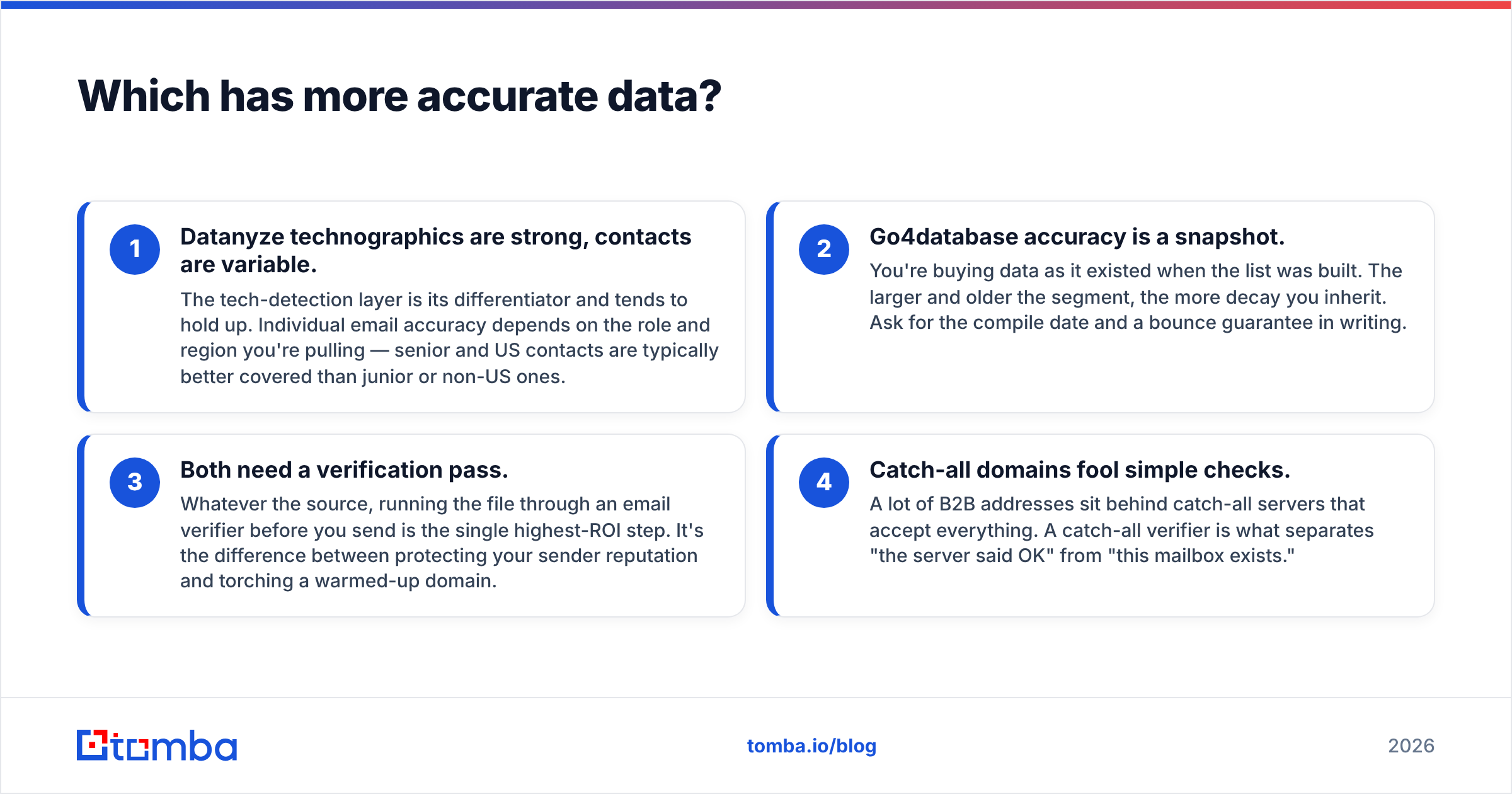
Neither wins outright, and if a vendor promises you 95%+ accuracy on a static file, treat it as a marketing number, not a guarantee. Here's the honest breakdown:
- Datanyze technographics are strong, contacts are variable. The tech-detection layer is its differentiator and tends to hold up. Individual email accuracy depends on the role and region you're pulling — senior and US contacts are typically better covered than junior or non-US ones.
- Go4database accuracy is a snapshot. You're buying data as it existed when the list was built. The larger and older the segment, the more decay you inherit. Ask for the compile date and a bounce guarantee in writing.
- Both need a verification pass. Whatever the source, running the file through an email verifier before you send is the single highest-ROI step. It's the difference between protecting your sender reputation and torching a warmed-up domain.
- Catch-all domains fool simple checks. A lot of B2B addresses sit behind catch-all servers that accept everything. A catch-all verifier is what separates "the server said OK" from "this mailbox exists."
The reps who win with either tool treat purchased or pulled data as a starting point to validate, not a finished asset to blast. Independent reviews on G2 echo this: the data is useful, but freshness and coverage are the recurring caveats across the sales-intelligence category.
How do Datanyze and Go4database pricing compare?#
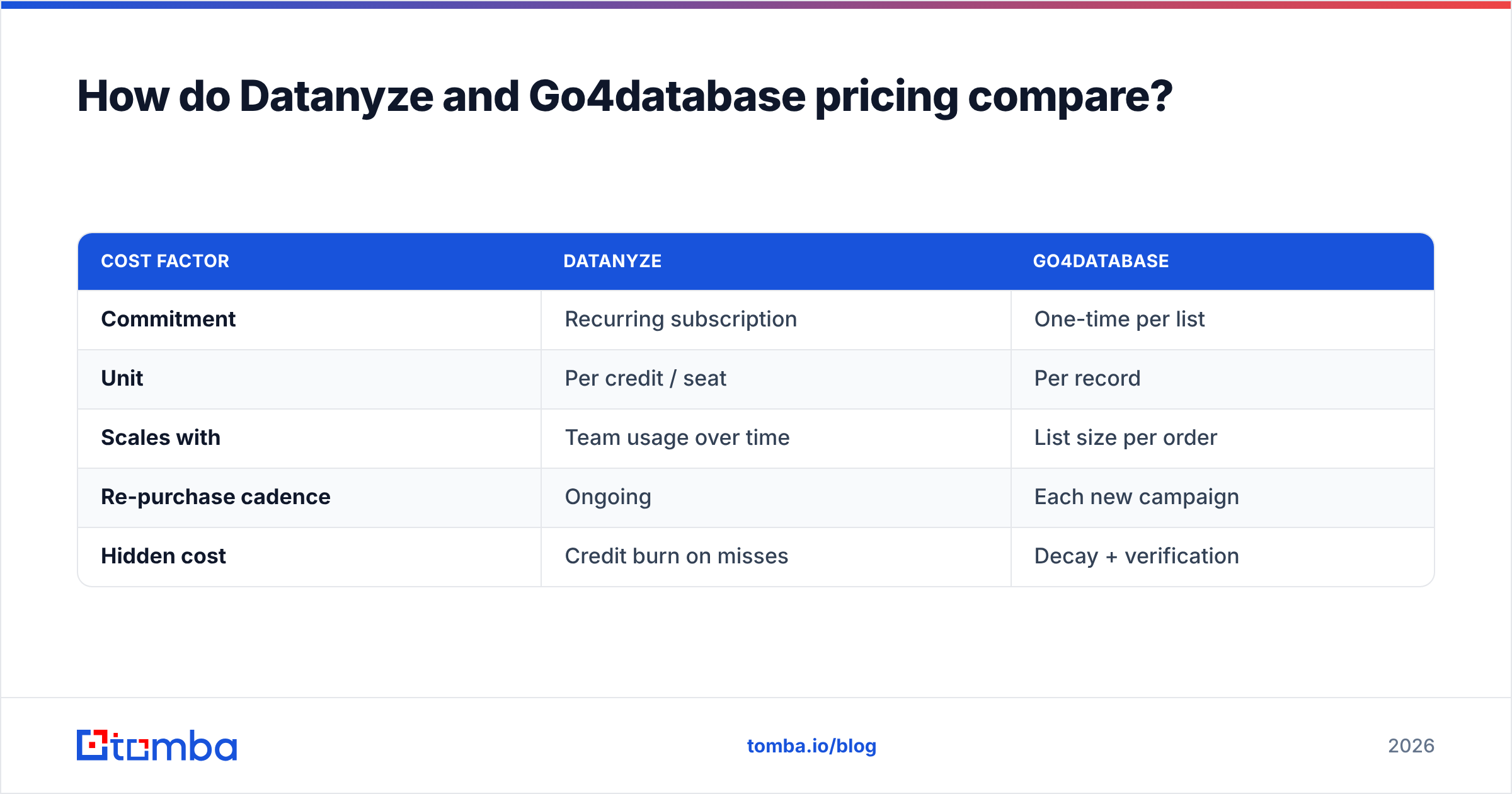
The pricing philosophies are almost opposites, which makes a like-for-like number hard.
- Datanyze is subscription-oriented, with credit-based lookups. You pay a recurring fee and consume credits as you reveal contacts. Costs scale with usage and seats, which suits steady, ongoing prospecting but can get expensive if a whole team is pulling records daily.
- Go4database is transactional. You pay once for a defined list at a per-record rate that drops as volume rises. There's no ongoing commitment, but there's also no ongoing freshness — you're buying a snapshot, and next quarter you buy another.
| Cost factor | Datanyze | Go4database |
|---|---|---|
| Commitment | Recurring subscription | One-time per list |
| Unit | Per credit / seat | Per record |
| Scales with | Team usage over time | List size per order |
| Re-purchase cadence | Ongoing | Each new campaign |
| Hidden cost | Credit burn on misses | Decay + verification |
The "hidden cost" row is where budgets actually leak. With Datanyze you can burn credits on lookups that return thin or unusable contacts. With Go4database you pay for records that may have decayed, then pay again — in time or tools — to verify them. Either way, budget for a verification and enrichment step; it's not optional if you care about deliverability.
When should you choose a live email-finder instead?#
Choose a live, verification-first workflow when your priority is reaching real people, not owning a big file. This is the gap both a static list vendor and a per-seat intelligence tool leave open.
A modern email finder works differently from both: instead of selling you a snapshot or charging per seat, it resolves a contact from a name and domain at the moment you need it, then verifies deliverability in the same step. That means:
- You pay for reachable contacts, not warehoused rows. No decay tax on data you bought months ago.
- Domain-level discovery replaces guesswork. With domain search you pull every known address pattern at a target company in one query.
- Bulk still works when you need scale. A bulk email finder handles list-sized jobs without committing you to a stale CSV.
- Enrichment fills the gaps. Data enrichment adds the firmographic and role context that raw lists usually lack.
If your motion is targeted and you value freshness over file size, this is the model that ages best — because nothing is stored waiting to go stale.
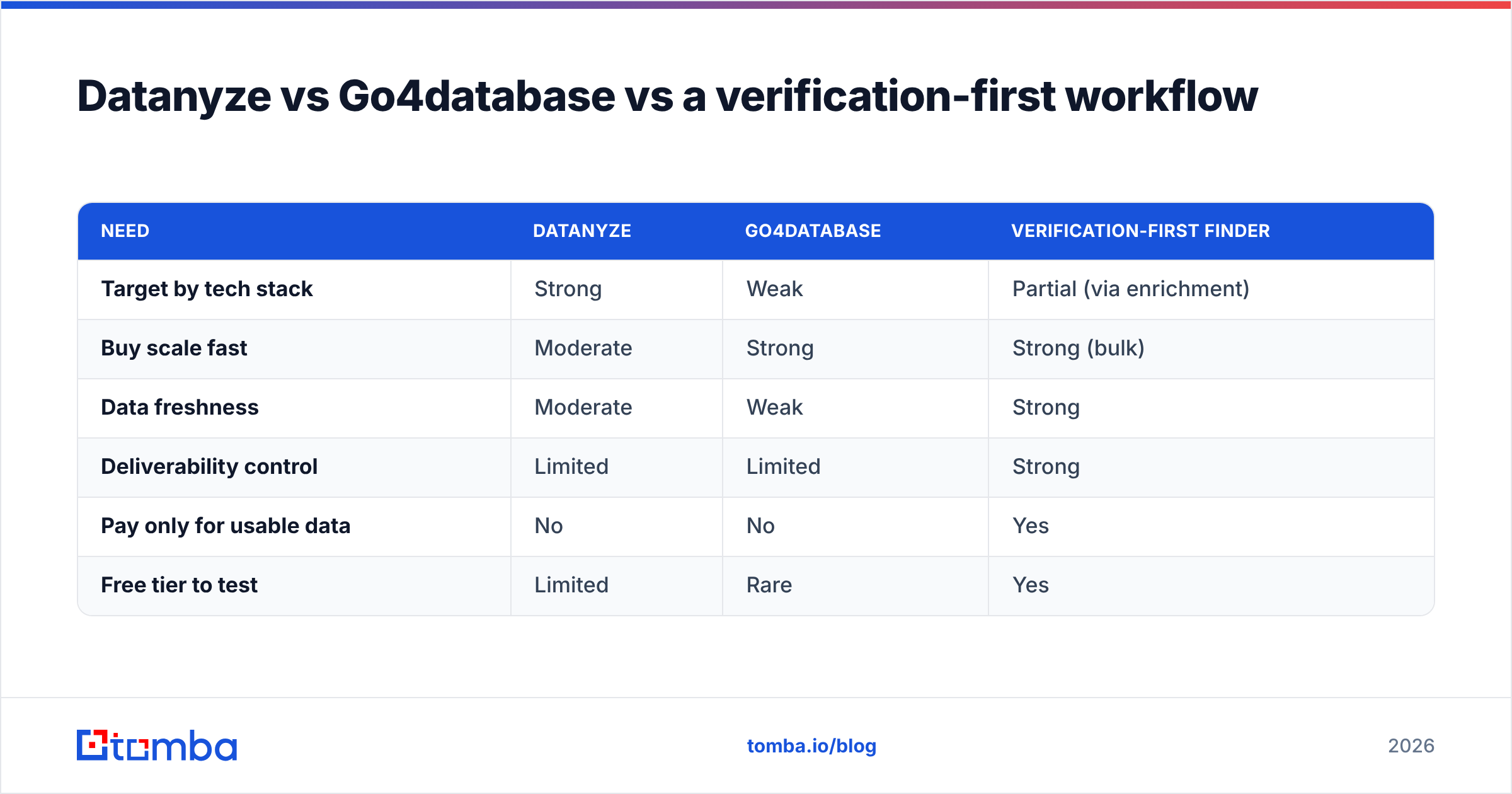
Datanyze vs Go4database vs a verification-first workflow#
Here's the three-way view most comparison posts skip, because it reframes the choice.
| Need | Datanyze | Go4database | Verification-first finder |
|---|---|---|---|
| Target by tech stack | Strong | Weak | Partial (via enrichment) |
| Buy scale fast | Moderate | Strong | Strong (bulk) |
| Data freshness | Moderate | Weak | Strong |
| Deliverability control | Limited | Limited | Strong |
| Pay only for usable data | No | No | Yes |
| Free tier to test | Limited | Rare | Yes |
For teams that live and die by inbox placement, the third column is where the leverage is. You can read more about how source quality drives email deliverability — the short version is that clean, verified, fresh data protects the domain reputation that every campaign depends on.
How to decide: a quick framework#
Work through these in order:
- Is technographic targeting core to your ICP? If you genuinely must filter by software used, Datanyze earns its spot — few list vendors replicate that signal well.
- Do you need scale in one transaction with no subscription? If yes and freshness is secondary, Go4database's model fits — just negotiate a bounce guarantee and the compile date.
- Is deliverability your bottleneck? If bounces and spam complaints are hurting you, neither a static list nor a per-seat intelligence tool fixes the root cause. A live finder plus email verification does.
- Do you want to test before you commit? Start with a free tier, validate accuracy on your own ICP, then scale what works. See Tomba pricing for where a free tier and paid plans line up.
Most teams discover the honest answer is "a bit of both plus verification" — use a targeting signal to build the account list, then resolve and verify contacts live rather than trusting a snapshot.
The bottom line#
Datanyze is the better pick when technographic targeting is central to your ICP and you're prospecting steadily enough to justify a subscription. Go4database is the better pick when you need raw volume in a single, no-commitment purchase and you're prepared to verify what you get. Both, though, share the same structural weakness: the data starts aging the moment it's compiled or pulled, and neither guarantees the address will land.
If your real goal is reaching prospects — not owning the biggest file on the team — start with a verification-first workflow. Use the Tomba Email Finder to resolve contacts from a name and domain on demand, verify deliverability in the same step, and enrich the record before it ever hits your sequencer. You pay for people you can actually reach, protect your sender reputation, and skip the decay tax that both list-buying and per-seat lookups quietly charge. Try it on your own ICP with the free tier, measure the bounce rate against whatever you're using now, and let the numbers pick the winner.
Related guides#
Ready to find emails that actually work?
Join 150,000+ professionals who stopped guessing and started sending. Free credits on signup — no credit card required.
Get the Tomba newsletter
Practical outbound tactics and product updates — once every two weeks.
About the author