Datanyze vs Grata: Sales Intelligence Compared for 2026
Datanyze and Grata solve different prospecting problems. This head-to-head breaks down data coverage, pricing, and fit so you can pick the right sales intelligence tool in 2026 — and see where a leaner stack beats both.
Choosing between Datanyze and Grata feels like a straight comparison until you actually use them. It isn't. These two tools sit in the same "sales intelligence" bucket on review sites, but they were built to answer different questions. Pick the wrong one and you'll pay for coverage you never touch.
This guide breaks both down on data, pricing, workflow, and honest fit — then shows where you may not need either.
TL;DR: Datanyze vs Grata in one screen#
- Datanyze is a lightweight contact and technographic finder aimed at SDRs who want quick email and phone lookups while browsing LinkedIn or company sites.
- Grata is a deal-sourcing search engine built for private equity, M&A, and corporate development teams hunting hard-to-find private companies.
- They rarely compete for the same buyer. Datanyze is a rep tool; Grata is a dealmaker tool.
- Pricing gap is huge. Datanyze starts near entry-level SaaS pricing; Grata is enterprise-tier and quote-only.
- Neither is a great pure email-finding engine. If your core need is accurate contact data at scale, a dedicated email finder will out-perform both on cost per verified contact.
What is Datanyze and who is it for?#
Datanyze is a contact-data and technographics tool that lives mostly in your browser. You install the extension, land on a prospect's LinkedIn profile or company website, and it surfaces email addresses, direct-dial numbers, and the technologies that company runs.
Its original claim to fame was technographic data — telling you that a target uses Shopify, HubSpot, or AWS so you could tailor outreach. Datanyze was acquired by ZoomInfo, and today it works as an affordable, self-serve entry point rather than a full data platform.
The typical Datanyze user is an individual SDR or a small outbound team that wants:
- Fast one-off contact lookups during manual prospecting
- Technographic signals to personalize cold emails
- A low monthly commitment with a credit-based model
It is not built for bulk list-building, deep firmographic filtering, or sourcing companies that don't already have a strong web footprint.

What is Grata and who is it for?#
Grata is a company-search engine for finding private businesses that are hard to find anywhere else. Instead of starting from a person, you start from a thesis: "vertical SaaS companies in logistics, 20–200 employees, US-based, bootstrapped." Grata's machine-learning search reads company websites and returns a ranked list of matches, including the small and mid-market firms that traditional databases miss.
That focus makes Grata the tool of choice for:
- Private equity and M&A teams building acquisition pipelines
- Corporate development groups mapping a market
- Investment banks sourcing sell-side and buy-side targets
Grata layers on relationship intelligence, conglomerate mapping, and workflow features to manage a deal funnel. It is a sourcing platform first and a contact tool second — you use it to decide which companies to pursue, not to blast a thousand SDR emails.
If your job is quota-carrying outbound, Grata is overkill. If your job is finding the needle-in-a-haystack private company, few tools do it better.
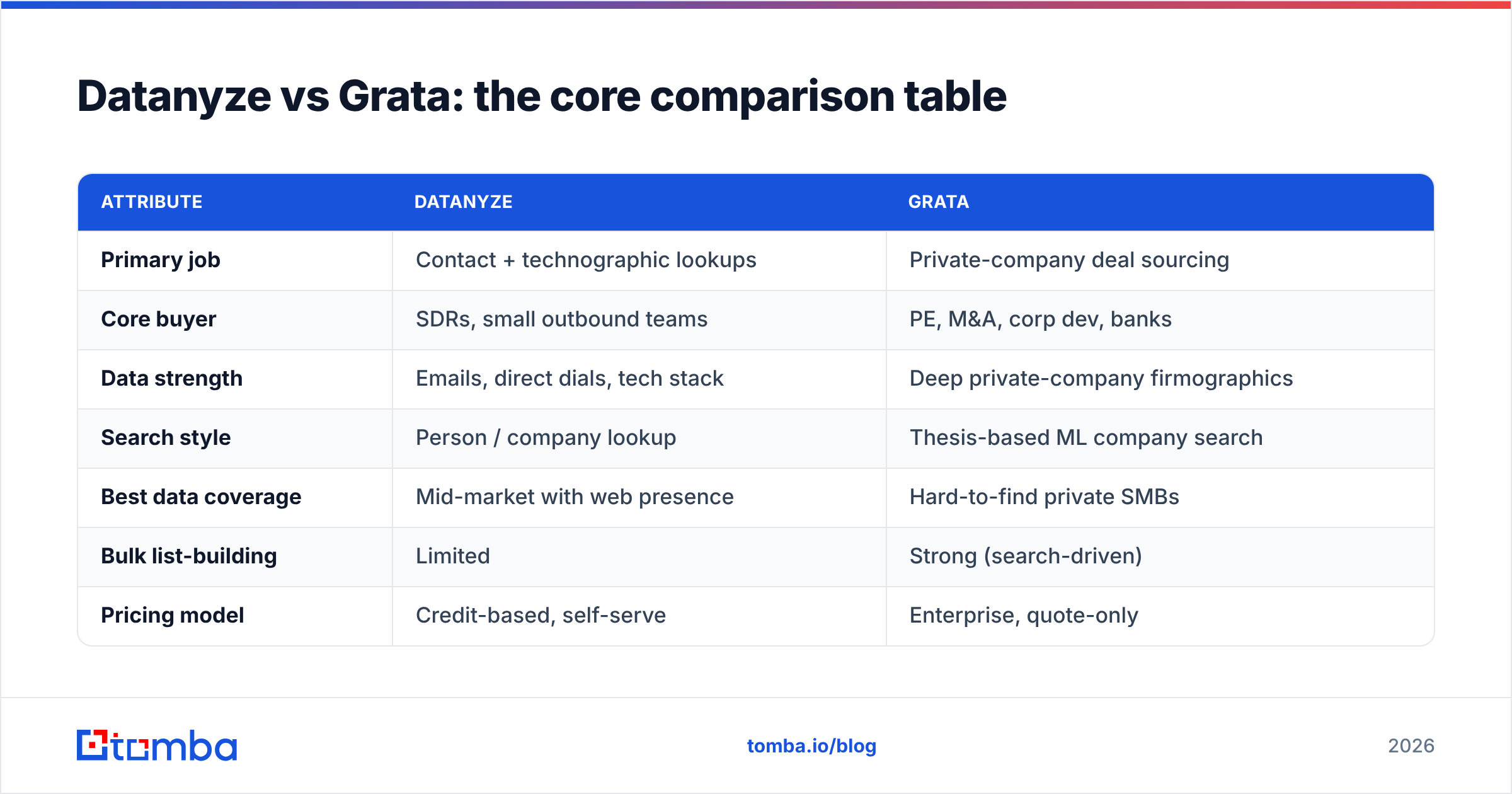
Datanyze vs Grata: the core comparison table#
Here's the head-to-head on the attributes that actually change your decision.
| Attribute | Datanyze | Grata |
|---|---|---|
| Primary job | Contact + technographic lookups | Private-company deal sourcing |
| Core buyer | SDRs, small outbound teams | PE, M&A, corp dev, banks |
| Data strength | Emails, direct dials, tech stack | Deep private-company firmographics |
| Search style | Person / company lookup | Thesis-based ML company search |
| Best data coverage | Mid-market with web presence | Hard-to-find private SMBs |
| Bulk list-building | Limited | Strong (search-driven) |
| Pricing model | Credit-based, self-serve | Enterprise, quote-only |
| Entry price | Low (SaaS entry tier) | High (enterprise contract) |
| Free option | Limited free trial | Demo only |
| Learning curve | Minutes | Hours to days |
The pattern is clear: Datanyze optimizes for speed and price on individual contacts; Grata optimizes for discovery and depth on companies. They overlap on the word "data" and almost nowhere else.
Is Datanyze better than Grata for cold outreach?#
For cold outreach, Datanyze is the closer fit — with a caveat.
Datanyze gives a rep what they need in the moment: an email, a phone number, and a technographic hook. That maps directly to a cold-email or cold-call workflow. Grata, by contrast, hands you a company list but expects you to source and verify contacts elsewhere, which adds a step for pure outbound motions.
The caveat is accuracy. Contact data from browser-extension tools degrades fast — people change jobs, emails bounce, and technographic tags go stale. If you push unverified Datanyze emails straight into a sequence, your bounce rate climbs and your sender reputation suffers. Always run new contacts through an email verifier before the first send.

So the honest answer: Datanyze beats Grata for outreach mechanics, but neither replaces a disciplined verify-before-send step.
Is Grata worth it over Datanyze for market mapping?#
Yes — if market mapping is genuinely your job and you have the budget.
Grata's thesis-based search is the feature Datanyze simply doesn't have. When you need to find every independent HVAC-software company in North America, Datanyze can't build that list; Grata can. Grata also surfaces the private, under-the-radar businesses that never show up in tools optimized for enterprise contact data.
The trade-off is cost and complexity. Grata is an enterprise purchase with a real onboarding curve, and a single SDR would never justify the spend. According to third-party reviews on G2, buyers consistently frame Grata as a dealmaking platform, not a rep productivity tool — which lines up with how the two products are actually used.
If you're weighing the two purely on price, it's not close: Datanyze is a fraction of Grata's cost. But you're not buying the same thing.
Where both tools fall short: contact accuracy and cost per lead#
Here's what neither vendor puts on its homepage: finding a company or a name is the easy part. Reaching a real, verified inbox is where campaigns are won or lost.
Datanyze's contact data is convenient but variable in accuracy, and its credit model gets expensive if you prospect heavily. Grata isn't built to deliver clean, verified emails at volume at all — that's outside its lane. In both cases, teams end up bolting on a second tool to actually get deliverable contact data.
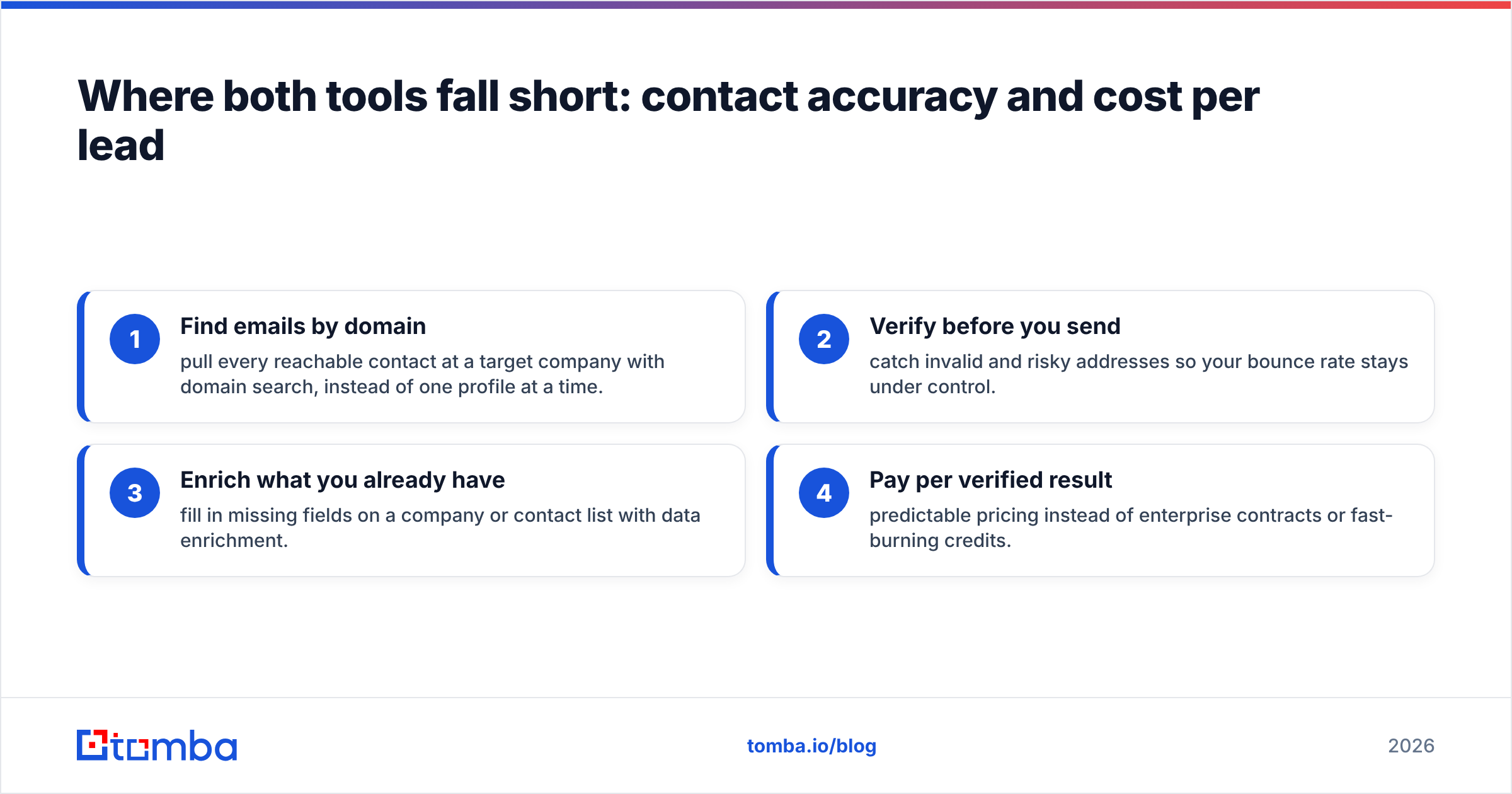
That's the gap a focused contact-data platform fills. A dedicated stack lets you:
- Find emails by domain — pull every reachable contact at a target company with domain search, instead of one profile at a time.
- Verify before you send — catch invalid and risky addresses so your bounce rate stays under control.
- Enrich what you already have — fill in missing fields on a company or contact list with data enrichment.
- Pay per verified result — predictable pricing instead of enterprise contracts or fast-burning credits.
You still use Grata (or a similar sourcing tool) to decide which companies matter. You just don't overpay a sales-intelligence suite for the contact layer.
How does Tomba compare on the contact-data layer?#
Tomba isn't a deal-sourcing engine like Grata, and it isn't a technographic browser toy — it's the contact-data layer that both Datanyze users and Grata users tend to need next. Once you know the target company, Tomba finds and verifies the people you actually email.
| Capability | Datanyze | Grata | Tomba |
|---|---|---|---|
| Email finder | Basic | No | Core product |
| Email verification | Limited | No | Yes |
| Domain-wide search | No | No | Yes |
| Bulk processing | Limited | Company lists | Yes |
| Data enrichment | Partial | Firmographic | Yes |
| Free tier | Trial | No | 25 searches/mo |
| Entry price | Low | Enterprise | $49/mo |
| API access | Limited | Enterprise | Yes |
Tomba's pricing is transparent and self-serve: a free tier with 25 searches per month, then Starter at $49/mo, Growth at $99/mo, and Pro at $249/mo, with custom Enterprise plans above that. You can see the full breakdown on the Tomba pricing page. That structure is designed for teams that want accurate contact data without an enterprise commitment — the exact spot where Datanyze gets pricey and Grata was never meant to compete.
If you want to understand where the numbers come from, Tomba is transparent about its data sources, which matters more than any single accuracy stat on a landing page.
Which one should you actually choose?#
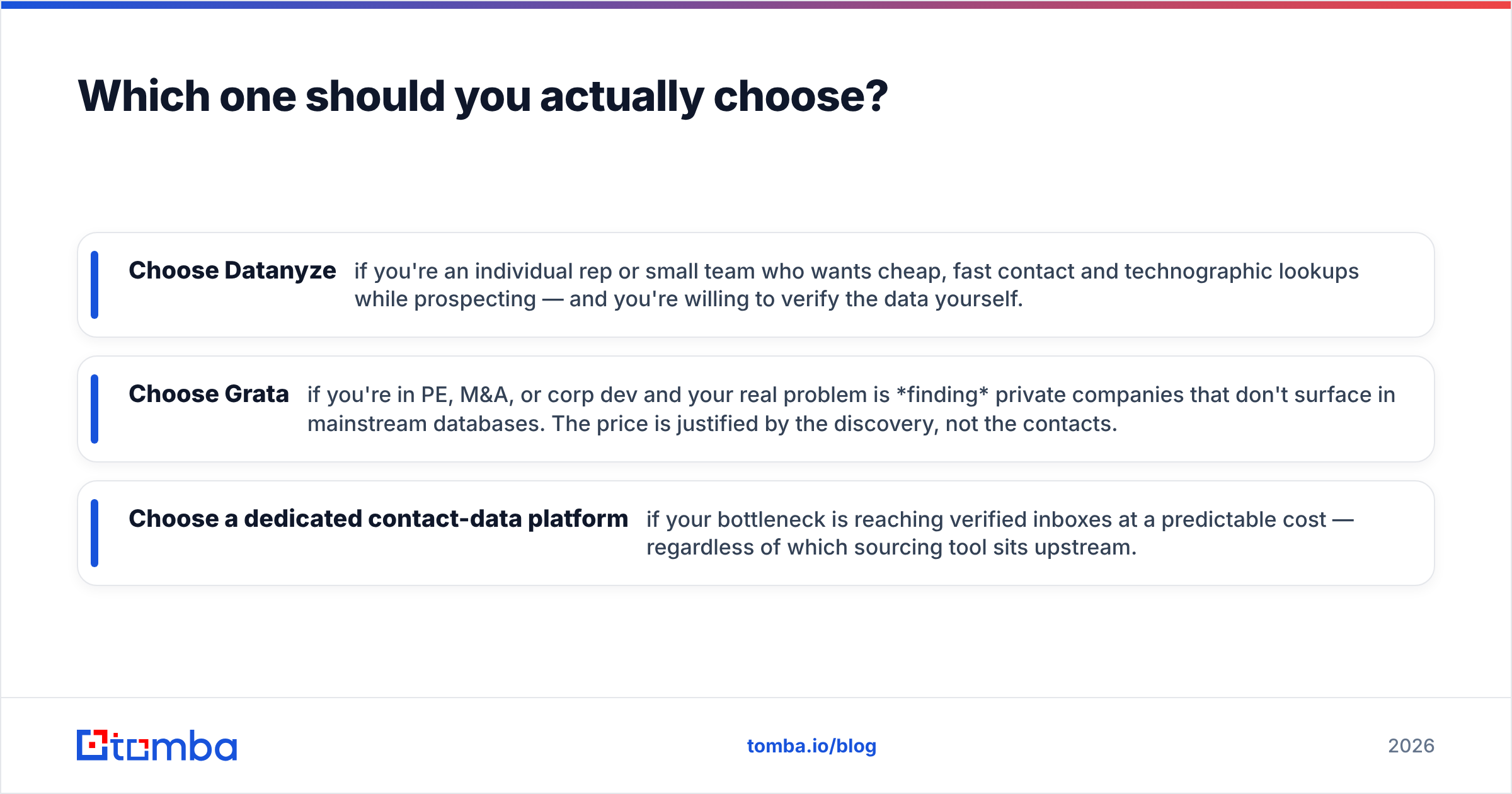
Match the tool to the job, not the marketing category:
- Choose Datanyze if you're an individual rep or small team who wants cheap, fast contact and technographic lookups while prospecting — and you're willing to verify the data yourself.
- Choose Grata if you're in PE, M&A, or corp dev and your real problem is finding private companies that don't surface in mainstream databases. The price is justified by the discovery, not the contacts.
- Choose a dedicated contact-data platform if your bottleneck is reaching verified inboxes at a predictable cost — regardless of which sourcing tool sits upstream.
Most teams that think they're stuck choosing between Datanyze and Grata are actually running two different plays. Sourcing and contact accuracy are separate problems, and trying to solve both with one all-in-one suite is how budgets balloon and data quality slips.
You can compare these categories yourself: check Datanyze for the rep-tool angle and Grata for the dealmaking angle, then decide whether either one truly covers your contact-data needs — or whether you're better off pairing your sourcing tool with a purpose-built finder.
The bottom line#
Datanyze and Grata aren't rivals so much as tools for different rooms in the building. Datanyze helps a rep move fast on individual contacts at a low price. Grata helps a dealmaker discover private companies no one else can find. Neither one is the accuracy-first contact engine that most outbound and RevOps teams actually need to fill the pipeline.
If that contact layer is your real gap, start with the tool built for it. Tomba's email finder turns a domain or a name into a verified, deliverable email — with a free tier to test it, transparent pricing, and an API when you're ready to scale. Sort your sourcing however you like; just make sure the emails you send actually land.
Related guides#
Ready to find emails that actually work?
Join 150,000+ professionals who stopped guessing and started sending. Free credits on signup — no credit card required.
Get the Tomba newsletter
Practical outbound tactics and product updates — once every two weeks.
About the author