Datanyze vs Lakeb2b (2026): B2B Data Comparison & Verdict
Datanyze and Lakeb2b solve two different B2B data problems—technographics vs. bulk lists. Here's an honest breakdown of accuracy, coverage, pricing, and the leaner option most teams actually need.
Datanyze vs Lakeb2b (2026): B2B Data Comparison & Verdict
Choosing between Datanyze and Lakeb2b feels like a head-to-head, but you're really comparing two different tools that happen to sell "B2B data." One is a technographics and contact lookup layer built for reps working live accounts. The other is a bulk list vendor that ships pre-packaged contact databases. Pick wrong and you either overpay for records you never touch, or you starve your reps of the account context they need to open a conversation.
This is a neutral breakdown—accuracy, coverage, pricing, and fit—plus where a leaner, pay-for-what-you-verify tool beats both.
TL;DR#
- Datanyze is best when reps need technographics and quick, in-workflow contact lookups on accounts they're already researching. Think Chrome-extension prospecting, not bulk exports.
- Lakeb2b is a list/data provider: large pre-built B2B databases and custom list builds sold by volume, often for wide top-of-funnel campaigns and ABM seeding.
- Accuracy is the real battleground. Purchased lists decay ~2–2.5% per month, so any static Lakeb2b export needs verification before you send.
- Neither verifies at send time by default. If deliverability is the goal, pair whatever data source you pick with a real-time email verifier.
- Best value for most teams: find-and-verify on demand instead of buying volume. A find emails workflow that only charges for valid results usually beats both on cost-per-usable-contact.
What is Datanyze?#
Datanyze is a sales intelligence tool focused on technographics—the technologies a company runs (CRM, ecommerce platform, analytics, hosting, and so on)—paired with contact lookups. Historically it grew as a "what tech does this site use" engine and later added a Chrome extension that surfaces contact details and company data while a rep browses LinkedIn or a company website.
The core promise is context in the moment. A rep on a prospect's site can see the company's tech stack, firmographics, and a contact email without leaving the tab. That makes Datanyze a good fit for reps who research accounts one at a time and want a reason to reach out ("I see you're on Shopify Plus...").
It is not designed as a bulk-export machine. You can pull contacts, but the workflow, credit model, and UX all point toward on-account, rep-driven prospecting rather than dumping 50,000 records into a sequencer. For background on the category, Datanyze's own site (datanyze.com) frames it as a freemium prospecting tool.
What is Lakeb2b?#
Lakeb2b is a B2B data provider and list vendor. Instead of a lightweight lookup layer, it sells access to large contact and company databases and builds custom lists to spec—by industry, title, geography, company size, and sometimes intent or technographic filters. Delivery is typically a file or a CRM/ESP push rather than an interactive extension.
This model suits teams that want volume: broad awareness campaigns, event invite lists, ABM account seeding, or channel/reseller outreach where you need thousands of contacts matching a firmographic profile. Lakeb2b (lakeb2b.com) positions around healthcare, technology, and other vertical databases plus data appending and enrichment services.
The tradeoff with any list provider is freshness and provenance. A purchased list is a snapshot. B2B contact data decays fast as people change jobs, so the value of a static export drops the moment it's delivered.

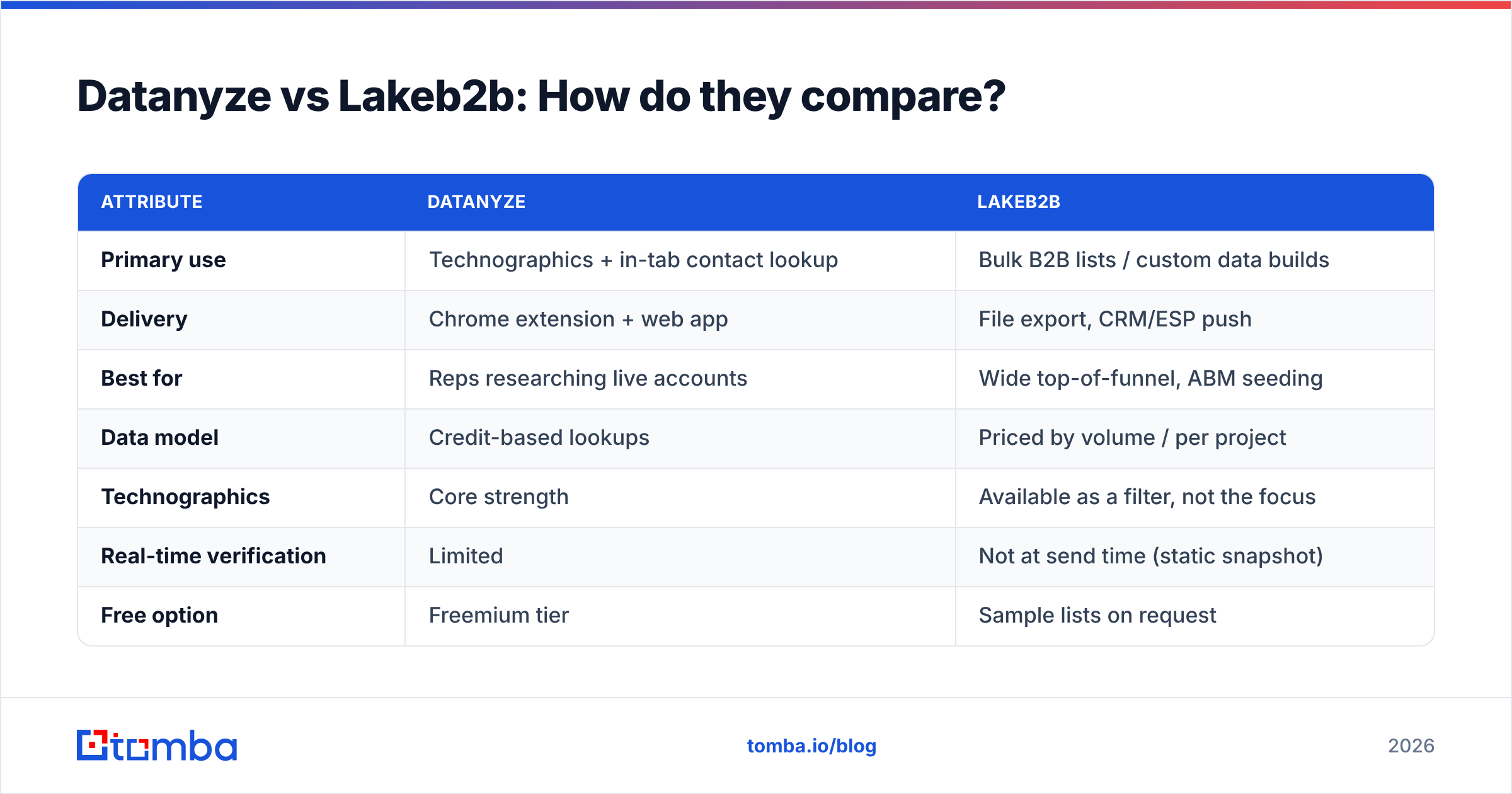
Datanyze vs Lakeb2b: How do they compare?#
Here's the honest side-by-side. Treat pricing as directional—Lakeb2b in particular quotes per project, and Datanyze's plans shift over time.
| Attribute | Datanyze | Lakeb2b |
|---|---|---|
| Primary use | Technographics + in-tab contact lookup | Bulk B2B lists / custom data builds |
| Delivery | Chrome extension + web app | File export, CRM/ESP push |
| Best for | Reps researching live accounts | Wide top-of-funnel, ABM seeding |
| Data model | Credit-based lookups | Priced by volume / per project |
| Technographics | Core strength | Available as a filter, not the focus |
| Real-time verification | Limited | Not at send time (static snapshot) |
| Free option | Freemium tier | Sample lists on request |
| Typical buyer | AEs, SDRs, founders | Demand gen, list-buying teams |
The pattern is clear: Datanyze optimizes for depth on few accounts; Lakeb2b optimizes for breadth across many. They're not really competitors so much as answers to different questions.
When Datanyze wins#
- You sell into accounts where the tech stack is the wedge (martech, devtools, ecommerce apps).
- Reps prospect manually and one account at a time.
- You value speed inside the browser over CSV exports.
When Lakeb2b wins#
- You need thousands of matching contacts for a broad campaign, fast.
- You have a clear firmographic ICP and want a done-for-you list build.
- You're seeding an ABM program or an events push where scale matters more than per-record depth.
Which is more accurate?#
Accuracy is where most "vs" comparisons get hand-wavy, so let's be concrete: the number that matters is cost per usable contact, not cost per record.
A record is only usable if the email is deliverable at the moment you send. Two forces work against you:
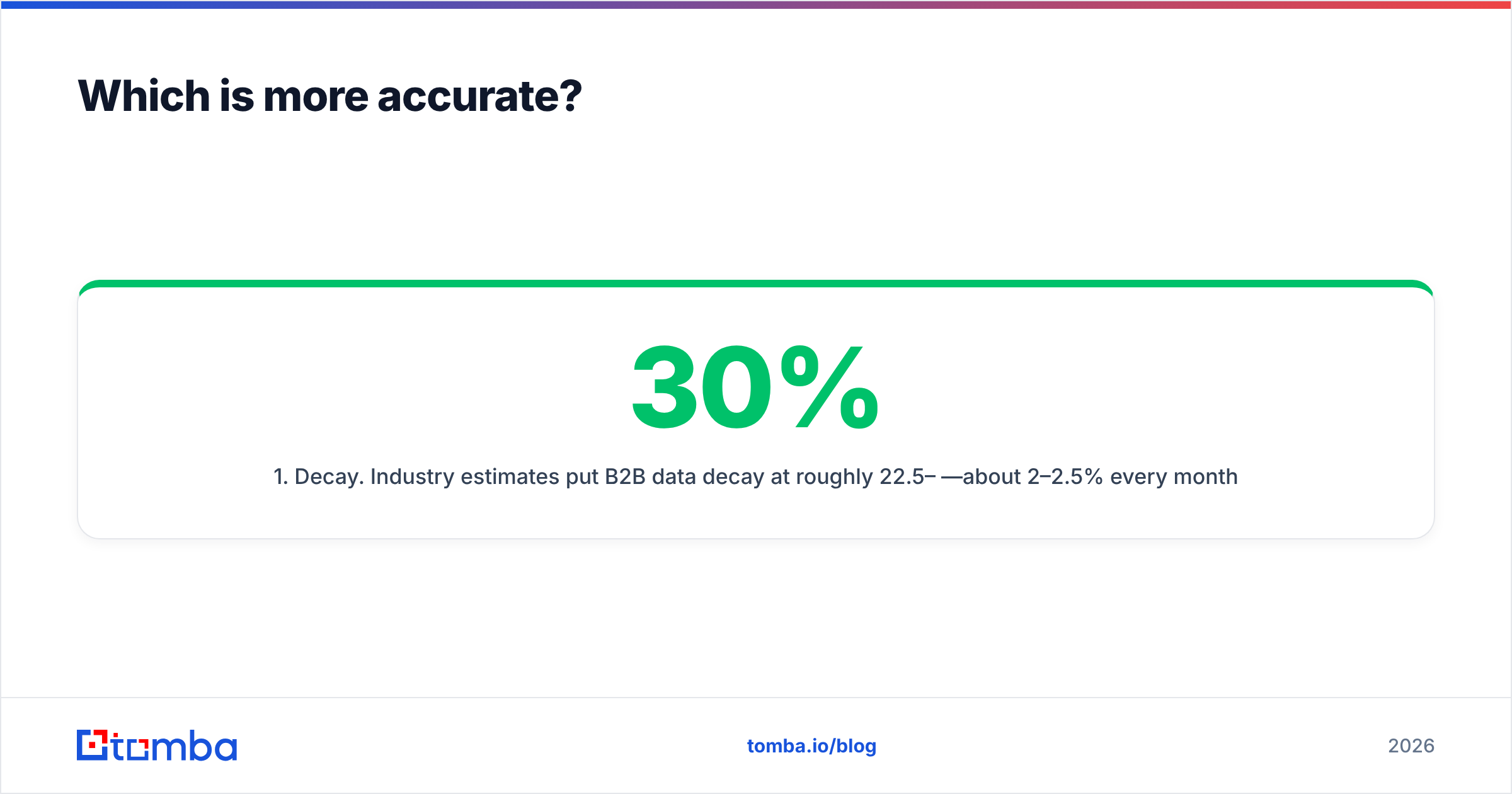
- Decay. Industry estimates put B2B data decay at roughly 22.5–30% per year—about 2–2.5% every month—as people switch jobs and companies rebrand. A list that's 95% valid on delivery can be 80% valid a quarter later.
- Catch-all domains. Many corporate domains accept every address at the SMTP layer, so a raw list can look "valid" while hiding dead mailboxes. You need a catch-all verifier to separate real inboxes from accept-all noise.
Neither Datanyze nor Lakeb2b is built to guarantee send-time validity. Datanyze surfaces a contact when you look it up, but it isn't running a fresh SMTP check as you export. Lakeb2b ships a snapshot that starts decaying immediately. That's not a knock on either vendor—it's how the model works. It just means verification is your job, and skipping it is what tanks deliverability.
The practical takeaway: whatever source you choose, run every address through real-time verification before it hits your sequencer. If you'd rather not stitch two vendors together, a single find-and-verify pipeline removes the gap.
What about pricing and value?#
Datanyze uses a credit model (freemium entry, then paid tiers that meter lookups). Lakeb2b prices by volume or per project—you scope a list, they quote it. Both can be reasonable for their intended job, but both share a hidden cost: you pay for records regardless of whether they're deliverable.
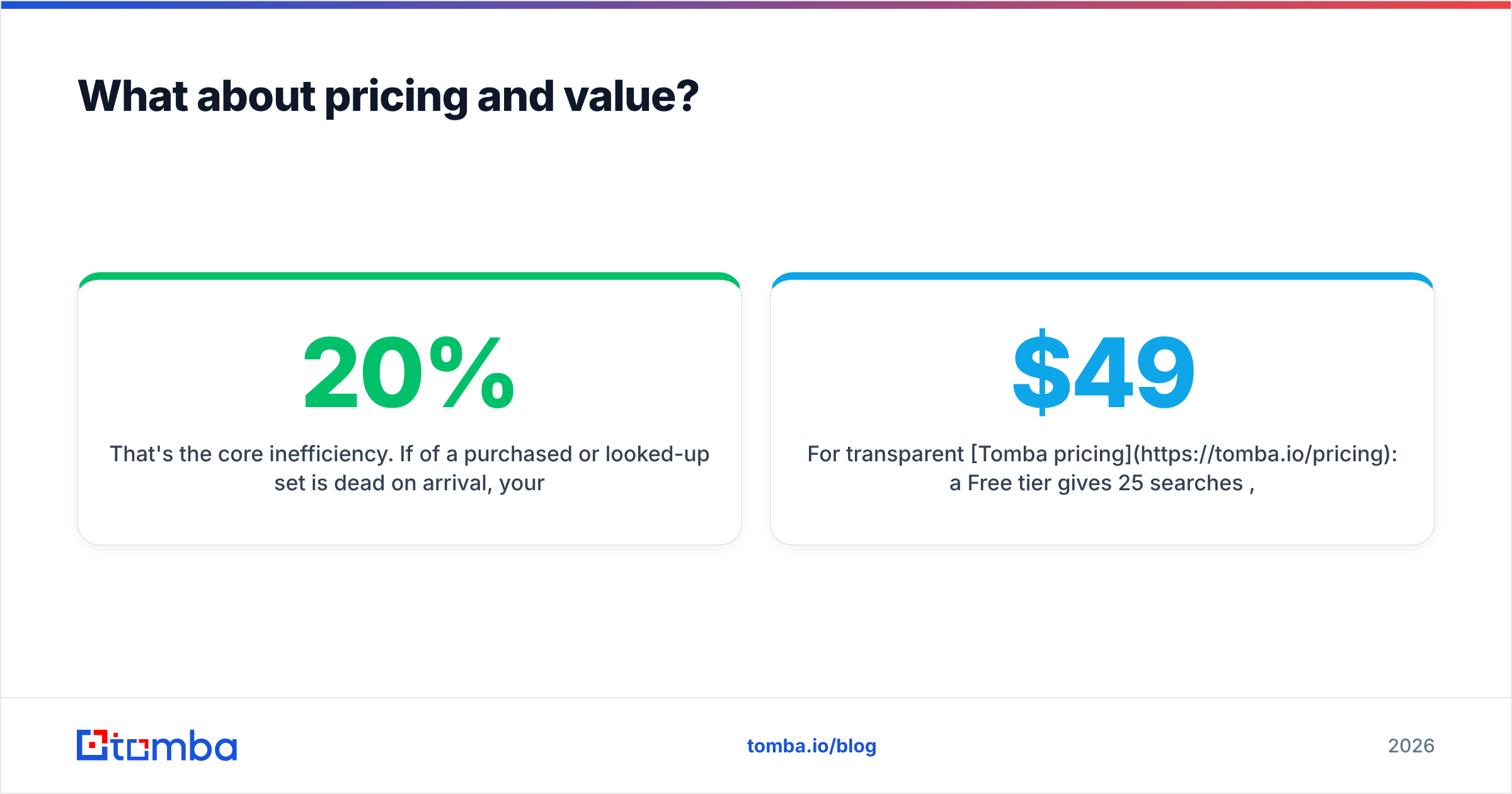
That's the core inefficiency. If 20% of a purchased or looked-up set is dead on arrival, your real cost per usable contact is 25% higher than the sticker price—before you count the deliverability damage from bouncing on stale addresses.
A different model fixes this: find on demand, verify in the same step, and only spend on valid results. For teams doing outbound, that usually beats paying for volume up front. Here's how the three approaches stack up on the metric that actually matters:
- Buy a bulk list (Lakeb2b style): low friction, high volume, but you eat the decay and pay for dead records. Mandatory re-verification adds a second tool and cost.
- Look up per account (Datanyze style): high context and great for a rep's live workflow, but credits burn whether or not the email lands, and there's no send-time guarantee.
- Find + verify on demand (Tomba style): search by name, company, or domain, get a confidence score, and pull data enrichment fields alongside—so you spend on contacts you'll actually use. See Tomba pricing for the exact tiers.
For transparent Tomba pricing: a Free tier gives 25 searches/mo, Starter is $49/mo, Growth $99/mo, Pro $249/mo, and Enterprise is custom. You get finder, verifier, company email search, and enrichment in one place instead of buying a list and a verifier separately.
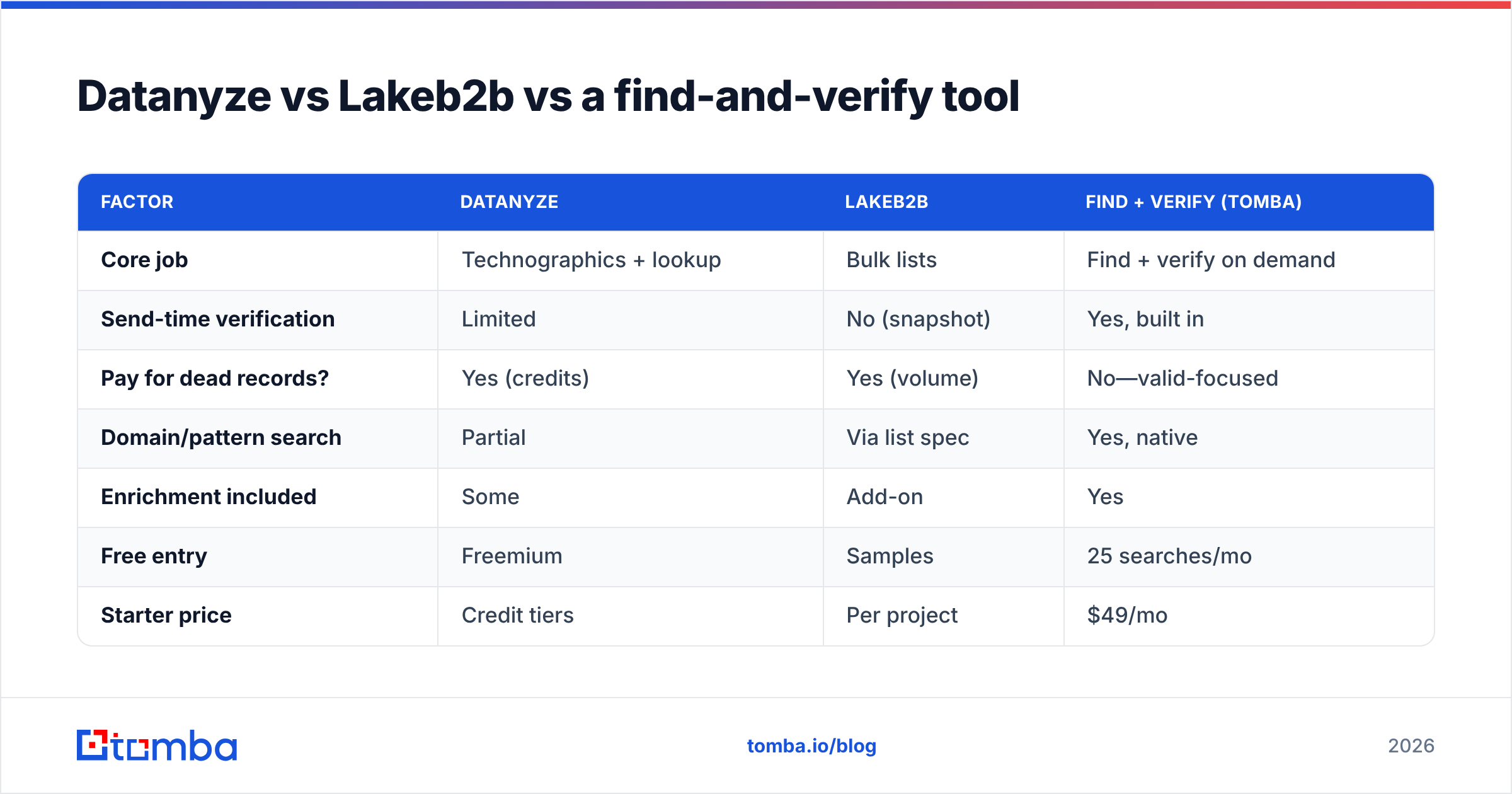
Datanyze vs Lakeb2b vs a find-and-verify tool#
Because most teams are actually asking "which of these gets me deliverable contacts cheapest," here's the three-way view.
| Factor | Datanyze | Lakeb2b | Find + verify (Tomba) |
|---|---|---|---|
| Core job | Technographics + lookup | Bulk lists | Find + verify on demand |
| Send-time verification | Limited | No (snapshot) | Yes, built in |
| Pay for dead records? | Yes (credits) | Yes (volume) | No—valid-focused |
| Domain/pattern search | Partial | Via list spec | Yes, native |
| Enrichment included | Some | Add-on | Yes |
| Free entry | Freemium | Samples | 25 searches/mo |
| Starter price | Credit tiers | Per project | $49/mo |
None of this means Datanyze or Lakeb2b are bad tools. If your entire motion is stack-based, rep-driven prospecting, Datanyze's in-tab context is genuinely useful. If you run high-volume demand gen and have a verification step downstream, a Lakeb2b list can fill a funnel quickly. The point is to match the tool to the job—and to never send to unverified data.
How do you choose the right one?#
Answer three questions:
- Volume or depth? Need thousands of contacts on a firmographic profile → lean list vendor (Lakeb2b). Need rich context on specific accounts → lean intelligence tool (Datanyze).
- Is the tech stack your wedge? If "you use X, we integrate with X" is your pitch, technographics matter, and Datanyze's core strength earns its keep.
- Who owns deliverability? If nobody currently verifies addresses before send, that's your real problem—not which vendor you pick. Add a real-time email verification step first.
For most outbound teams, the honest answer is that you don't need a big pre-bought list or a stack-centric lookup tool as your foundation. You need reliable, verified contacts you can pull as you build target lists—by find emails by domain or by name—without paying for records that bounce. Datanyze and Lakeb2b become optional add-ons for specific plays, not the core of your data spend.
If you want to sanity-check any vendor before committing, third-party reviews on G2 are a useful reality check on data quality and support, since buyers report decay and bounce rates you won't see on a sales page.
Frequently asked questions#
Is Datanyze the same as Lakeb2b? No. Datanyze is a sales intelligence and technographics tool with in-browser contact lookups. Lakeb2b is a B2B data and list provider that sells pre-built or custom contact databases by volume. Different models, different jobs.
Which has more accurate emails? Neither guarantees send-time accuracy. Datanyze returns contacts on lookup; Lakeb2b ships a snapshot that decays about 2–2.5% per month. Whichever you use, verify addresses in real time before sending.
Can I skip verification if the data is "fresh"? No. Even freshly delivered lists contain catch-all domains and recent job changes. A quick verification pass protects sender reputation and reply rates.
What's the cheapest path to deliverable contacts? Usually a find-and-verify workflow that only charges for valid results, because you stop paying for dead records and don't need a second verification tool.
The verdict#
Datanyze vs Lakeb2b comes down to depth vs. breadth—technographic context on live accounts versus bulk lists at scale. Both are legitimate for their intended job, and both leave verification to you. If your goal is deliverable outbound at a sane cost per usable contact, the smarter foundation is a tool that finds and verifies in one step.
That's where Tomba fits. Use the Tomba Email Finder to search by domain, name, or company, get a confidence score on every result, and enrich contacts in the same flow—so you spend on people who actually reply, not on a list that started decaying the day it arrived. Start free with 25 searches a month, then scale to a plan that matches your volume. Skip the buy-a-list-then-clean-it tax and build verified pipeline from the first search.
Related guides#
Ready to find emails that actually work?
Join 150,000+ professionals who stopped guessing and started sending. Free credits on signup — no credit card required.
Get the Tomba newsletter
Practical outbound tactics and product updates — once every two weeks.
About the author