Datanyze vs Minelead (2026): Which Email Finder Wins?
Datanyze and Minelead promise fast B2B emails, but they win at very different jobs. Here's an honest breakdown of accuracy, pricing, and data — plus where a third option quietly beats both.
Choosing between Datanyze and Minelead usually comes down to one question you don't see on either homepage: do you need technographic targeting or do you need clean, verified emails at volume? These two tools look similar in a feature grid, but they were built for different jobs. Pick the wrong one and you either overpay for data you never use, or you burn your domain reputation on unverified guesses.
This is a neutral, hands-on comparison. We'll break down accuracy, pricing, data coverage, and real workflows — and we'll be honest about where a third option, Tomba, fits when neither Datanyze nor Minelead is the right call.
TL;DR: Datanyze vs Minelead in 30 seconds#
- Datanyze is really a technographics and sales-intelligence tool that happens to surface contact data. Strong for account research and firmographic filtering; weaker as a pure, high-volume email finder.
- Minelead is a lightweight, budget-friendly email finder with a domain search and a free tier. Fine for quick lookups, thinner on verification depth and enrichment.
- Accuracy is the deciding factor for cold outreach — unverified emails bounce, and bounces wreck your sender reputation.
- Pricing favors Minelead for small teams; Datanyze skews toward larger sales orgs that want intent and technographic signals.
- If your #1 goal is verified emails with real bounce protection, evaluate a dedicated email finder like Tomba alongside both before you commit.
What is Datanyze and who is it for?#
Datanyze started life as a technographics company — its original claim to fame was telling you what software a website runs (CRM, analytics, e-commerce platform, chat widget, and so on). It was acquired by ZoomInfo and now positions itself as a lightweight sales-intelligence and prospecting tool, with a Chrome extension that pulls contact details while you browse LinkedIn or company sites.
That heritage matters. Datanyze is strongest when your targeting is account-first: "show me mid-market SaaS companies using Shopify Plus and HubSpot." The contact data is a means to an end. If you're a rep who researches accounts before reaching out, the technographic layer is genuinely useful.
Where it gets weaker is volume email finding. Datanyze isn't built to hand you 5,000 verified addresses from a domain list on a Tuesday morning. Its credit model and single-contact workflow suit reps picking targets one at a time, not growth teams running bulk campaigns.
What is Minelead and who is it for?#
Minelead is the opposite personality: a focused, no-frills email finder. You give it a domain and it returns the email addresses it has associated with that company, plus a pattern guess (like {first}.{last}@company.com). It offers a free tier, a browser extension, an API, and bulk domain search.
Minelead's appeal is simplicity and price. For freelancers, small agencies, or anyone doing occasional lookups, it's an easy on-ramp. You don't need to learn a sales-intelligence platform — you just search a domain and copy the result.
The trade-off is depth. Pattern-based guessing without rigorous verification means some of what you get is a plausible format, not a confirmed inbox. For low-volume use that's tolerable. For cold email at scale, every unconfirmed address is a coin flip against your deliverability.

Datanyze vs Minelead: the core comparison#
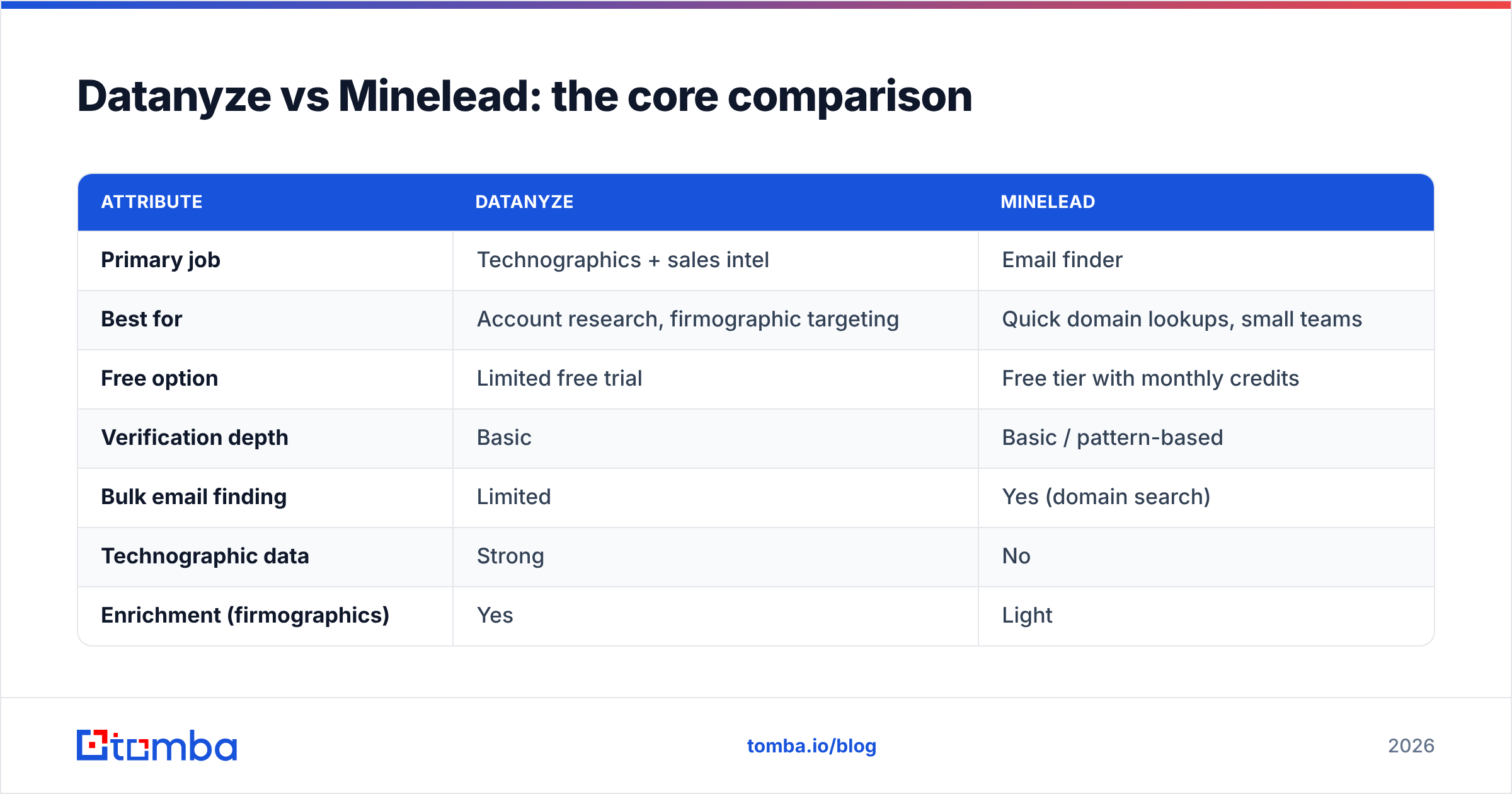
Here's the head-to-head on the attributes that actually change your results. Prices and tiers move over time, so confirm on each vendor's site before buying — this reflects general positioning in 2026.
| Attribute | Datanyze | Minelead |
|---|---|---|
| Primary job | Technographics + sales intel | Email finder |
| Best for | Account research, firmographic targeting | Quick domain lookups, small teams |
| Free option | Limited free trial | Free tier with monthly credits |
| Verification depth | Basic | Basic / pattern-based |
| Bulk email finding | Limited | Yes (domain search) |
| Technographic data | Strong | No |
| Enrichment (firmographics) | Yes | Light |
| API access | Yes | Yes |
| Ideal user | Mid-market/enterprise reps | Freelancers, SMBs |
The pattern is clear: Datanyze sells intelligence, Minelead sells convenience. Neither is primarily engineered around verified-email accuracy — which is exactly the metric that decides whether a cold campaign lands or bounces.
Is accuracy better with Datanyze or Minelead?#
Accuracy is where this comparison gets uncomfortable for both tools, and it's the one number that should drive your decision.
An email finder's job isn't to hand you an address that looks right. It's to hand you an address that is right — one that passes SMTP checks, isn't a spam trap, and won't bounce. A 10% bounce rate on a cold list can get your domain throttled or blocklisted, and no amount of clever technographic filtering fixes a poisoned sending reputation.

Datanyze leans on ZoomInfo-adjacent data, which is broad but not always fresh at the individual-contact level — people change jobs, and stale records surface as bounces. Minelead leans on pattern inference, which is fast and cheap but structurally prone to false positives on catch-all domains, where any address appears valid.
That catch-all problem is worth calling out. If you can't tell a real inbox from a domain that accepts everything, your "found" emails are guesses in disguise. A dedicated catch-all verifier and a real email verifier step are what separate a usable list from a deliverability liability. Neither Datanyze nor Minelead makes verification its headline feature — and that's the gap most buyers only discover after the bounces roll in.
Datanyze vs Minelead pricing: which is cheaper?#
Budget usually breaks the tie, so let's be concrete about the shape of each model.
- Minelead is the cheaper entry point. It offers a genuine free tier and low-cost paid plans, which is why solo operators and small agencies gravitate to it. You pay for lookups, not a platform.
- Datanyze is priced as sales software. You're buying intent-adjacent intelligence and technographics, not just emails, so the per-seat cost is higher and aimed at teams that will use the research layer.
- Watch the credit math. Both tools charge for results, but a "result" that bounces is money you paid twice — once for the credit, again in lost reputation and rep time chasing dead addresses.
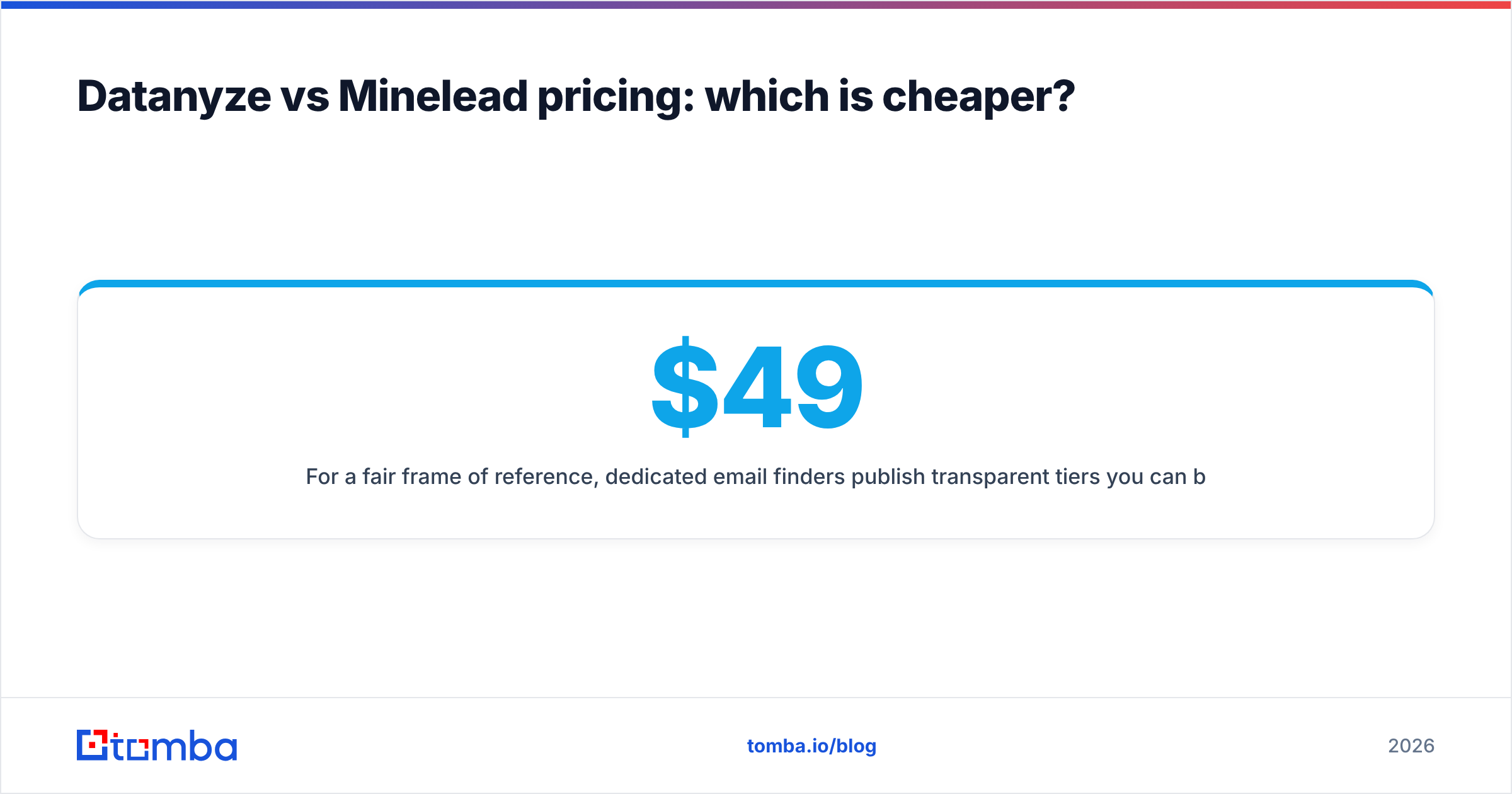
For a fair frame of reference, dedicated email finders publish transparent tiers you can benchmark against. For example, Tomba pricing runs a free tier (25 searches/month), Starter at $49/mo, Growth at $99/mo, and Pro at $249/mo — with verification built into the same workflow rather than sold as an afterthought. When you compare, don't compare sticker prices; compare cost per verified, deliverable email. That's the number that shows up in your campaign results.
Where does a dedicated email finder beat both?#
Here's the honest part: if your goal is technographic account targeting, Datanyze has a real edge and this article isn't trying to talk you out of it. If your goal is a rare, casual lookup, Minelead's free tier is hard to argue with.
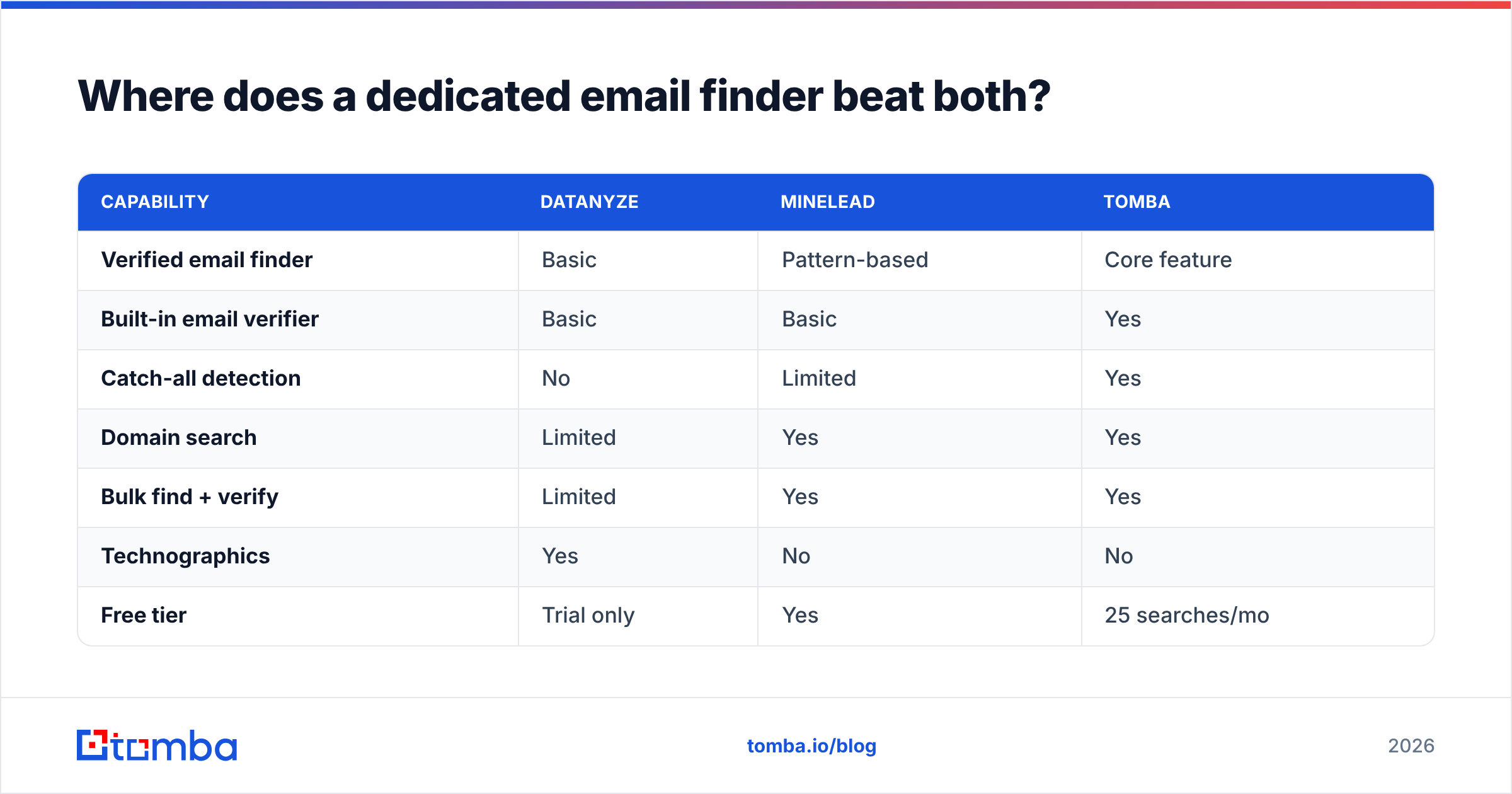
But if your goal is outbound at scale — find, verify, enrich, export, repeat — a purpose-built email finder tends to beat a sales-intel suite and a lightweight lookup tool at the same time. That's the lane Tomba is built for, and it's worth putting side by side.
| Capability | Datanyze | Minelead | Tomba |
|---|---|---|---|
| Verified email finder | Basic | Pattern-based | Core feature |
| Built-in email verifier | Basic | Basic | Yes |
| Catch-all detection | No | Limited | Yes |
| Domain search | Limited | Yes | Yes |
| Bulk find + verify | Limited | Yes | Yes |
| Technographics | Yes | No | No |
| Free tier | Trial only | Yes | 25 searches/mo |
| Starter price | Sales-software tier | Low-cost | $49/mo |
A few specifics that matter for real campaigns:
- Verification is in the loop, not bolted on. Tomba's email verifier runs on the same addresses you find, so you export deliverable contacts instead of a mix of hits and guesses.
- Domain search that returns patterns and confirmations. Use domain search to pull every contact at a company, then confirm before you send.
- Bulk without babysitting. The bulk email finder handles list-based workflows that Datanyze's one-at-a-time model isn't designed for.
- Data you can trace. Understanding where the data comes from matters when you're staking a campaign on it.
To be clear, Tomba doesn't do technographics — if that's your must-have, Datanyze wins on that axis. This is about matching the tool to the job, not declaring a universal champion.
Which should you actually choose?#
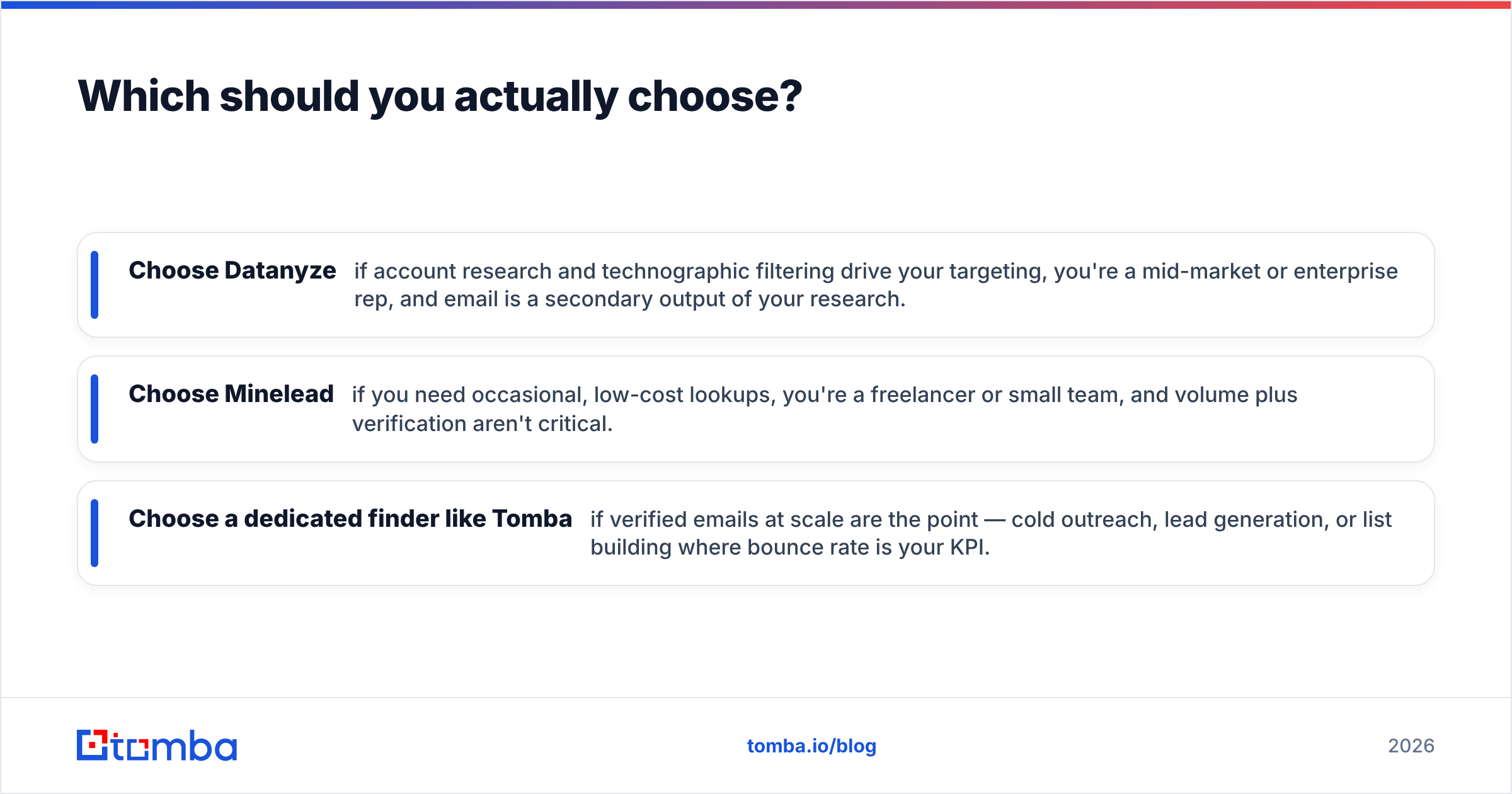
Match the tool to your primary job, not to the longest feature list:
- Choose Datanyze if account research and technographic filtering drive your targeting, you're a mid-market or enterprise rep, and email is a secondary output of your research.
- Choose Minelead if you need occasional, low-cost lookups, you're a freelancer or small team, and volume plus verification aren't critical.
- Choose a dedicated finder like Tomba if verified emails at scale are the point — cold outreach, lead generation, or list building where bounce rate is your KPI.
The mistake to avoid is buying on brand recognition or free-tier convenience and only later discovering your bounce rate is tanking deliverability. Run a small test batch through any tool you're serious about, verify the results independently, and measure cost per deliverable email — not per lookup. You can cross-check independent reviews on G2 and the vendors' own docs at datanyze.com and minelead.io before you commit.
The bottom line#
Datanyze and Minelead solve different problems, and neither is built primarily around verified-email accuracy — the metric that decides whether your outreach lands. Datanyze wins on technographics and account intelligence; Minelead wins on price and simplicity. If your real need is finding and verifying professional emails at volume without wrecking your sender reputation, that's a different tool category entirely.
That's exactly what the Tomba Email Finder is built for: find professional emails by name, domain, or company, verify them in the same workflow, and export lists you can actually send to. Start free with 25 searches a month, test it against your current tool on a real list, and compare the one number that matters — how many emails actually reach the inbox.
Related guides#
Ready to find emails that actually work?
Join 150,000+ professionals who stopped guessing and started sending. Free credits on signup — no credit card required.
Get the Tomba newsletter
Practical outbound tactics and product updates — once every two weeks.
About the author