Datanyze vs Saleshandy (2026): Which B2B Sales Tool Wins?
Datanyze finds contact data; Saleshandy sends cold email at scale. So which one actually moves your pipeline in 2026? Here's the honest, side-by-side breakdown — plus a cheaper way to get accurate emails.
The Datanyze vs Saleshandy debate looks like a head-to-head. It isn't. The two tools solve different halves of the same problem. Datanyze helps you find a prospect's contact details. Saleshandy helps you email those prospects at scale. Pick between them without knowing that split, and you can pay for two tools that barely overlap.
This Datanyze vs Saleshandy breakdown is honest and side by side. We cover what each tool does well, where the data holds up, how pricing compares, and which one fits your motion. No vendor spin.
TL;DR: Datanyze vs Saleshandy at a glance#
- Datanyze is a technographics and contact-data tool. Its Chrome extension surfaces emails and direct-dial numbers as you browse LinkedIn and company sites. Best for reps who prospect one lead at a time.
- Saleshandy is a cold email outreach platform. It handles sequences, multi-inbox sending, warmup, and a built-in Lead Finder database. Best for teams running high-volume cold email.
- They barely compete. Datanyze feeds your list; Saleshandy sends to it. Many teams use a finder plus a sender rather than choosing.
- Neither is the cheapest way to get accurate emails. A dedicated email finder like Tomba Email Finder often delivers better hit rates per dollar than Datanyze's contact credits.
- Verdict: Choose Datanyze for on-the-fly prospecting, Saleshandy for outreach automation — and verify every address before you send.
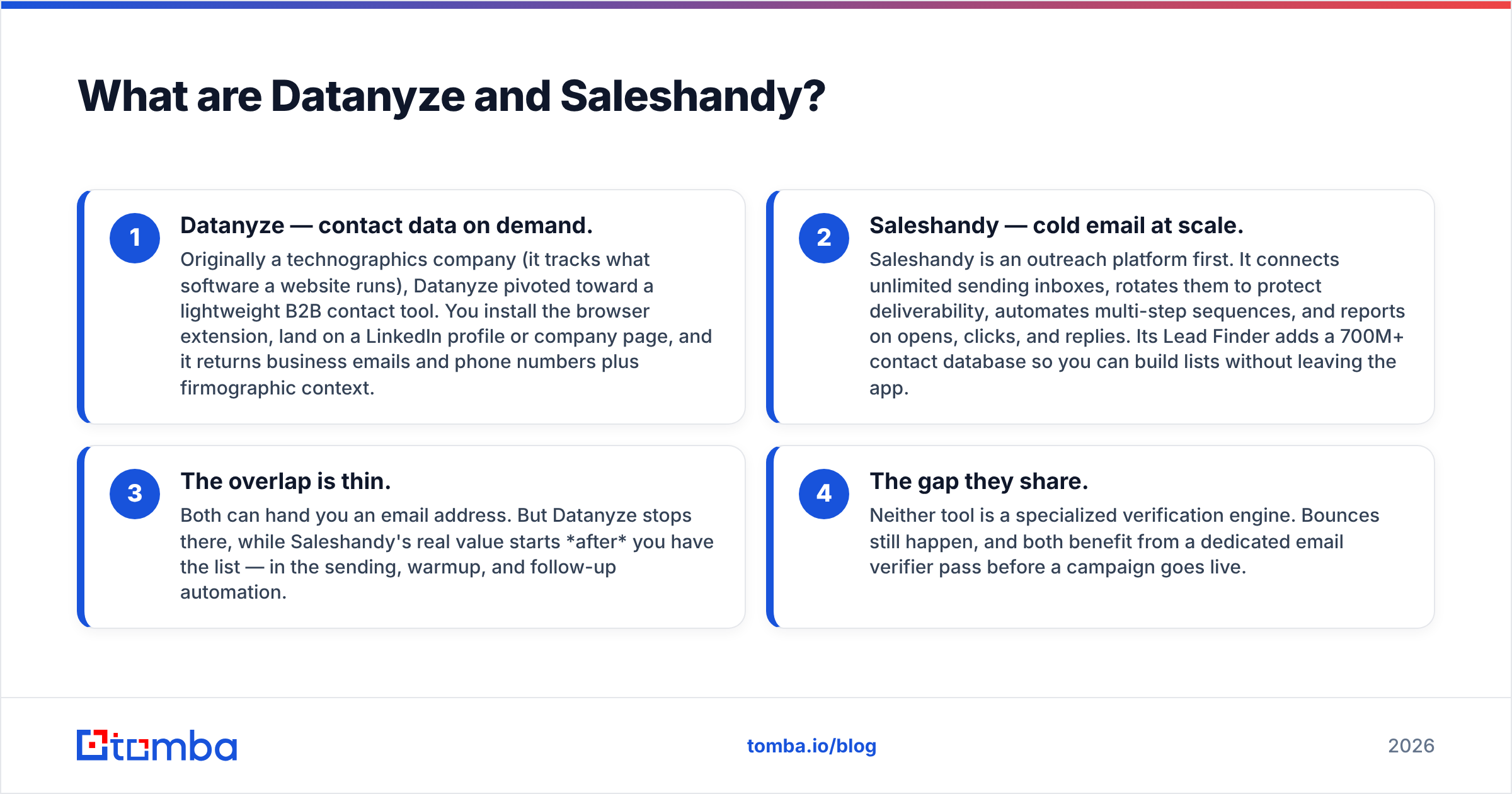
What are Datanyze and Saleshandy?#
The fastest way to understand this matchup is to see what problem each tool was built for.
- Datanyze — contact data on demand. Originally a technographics company (it tracks what software a website runs), Datanyze pivoted toward a lightweight B2B contact tool. You install the browser extension, land on a LinkedIn profile or company page, and it returns business emails and phone numbers plus firmographic context.
- Saleshandy — cold email at scale. Saleshandy is an outreach platform first. It connects unlimited sending inboxes, rotates them to protect deliverability, automates multi-step sequences, and reports on opens, clicks, and replies. Its Lead Finder adds a 700M+ contact database so you can build lists without leaving the app.
- The overlap is thin. Both can hand you an email address. But Datanyze stops there, while Saleshandy's real value starts after you have the list — in the sending, warmup, and follow-up automation.
- The gap they share. Neither tool is a specialized verification engine. Bounces still happen, and both benefit from a dedicated email verifier pass before a campaign goes live.
How do Datanyze and Saleshandy compare feature by feature?#
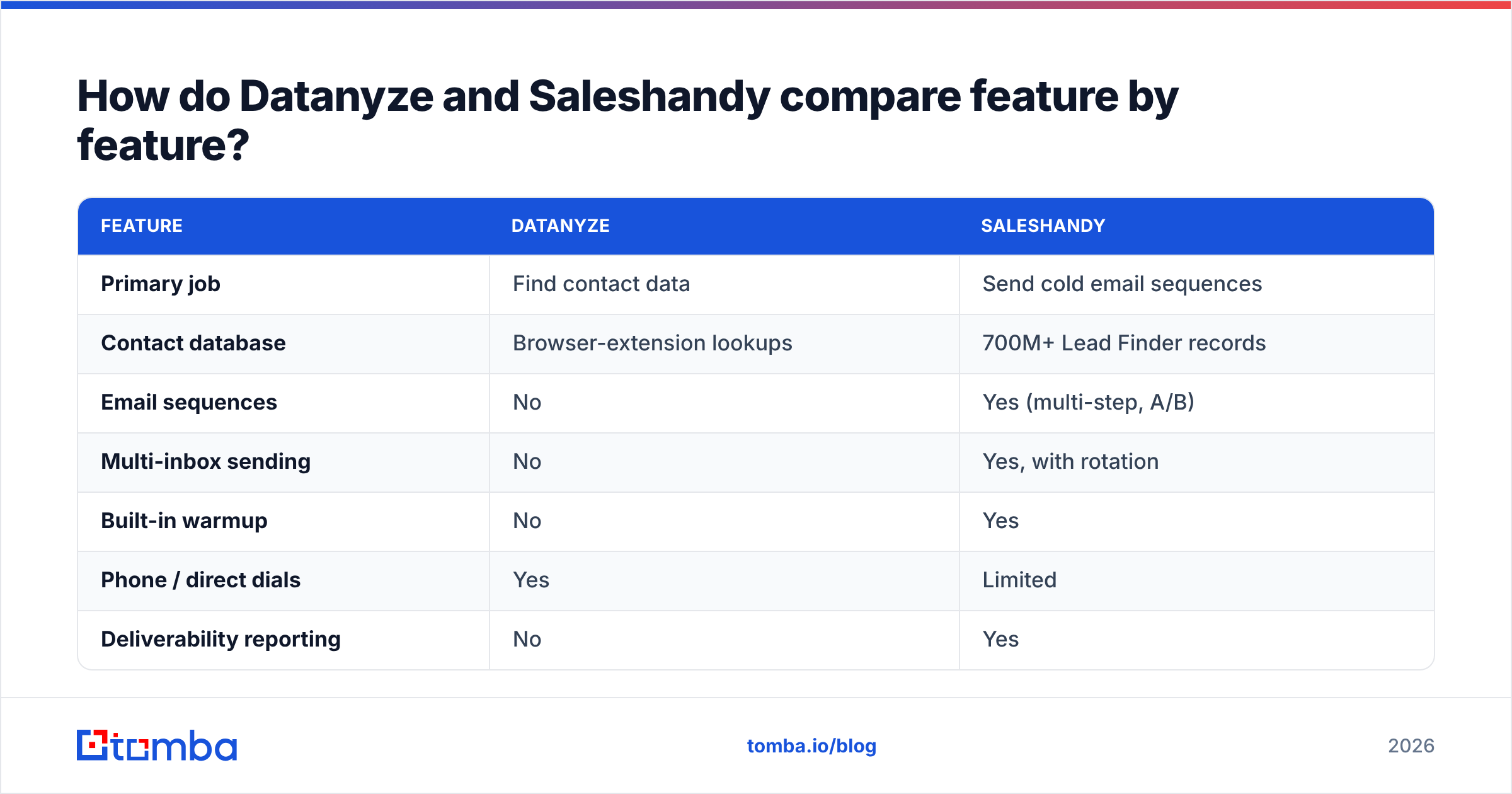
Here's the Datanyze vs Saleshandy head-to-head on the attributes that change your workflow.
| Feature | Datanyze | Saleshandy |
|---|---|---|
| Primary job | Find contact data | Send cold email sequences |
| Contact database | Browser-extension lookups | 700M+ Lead Finder records |
| Email sequences | No | Yes (multi-step, A/B) |
| Multi-inbox sending | No | Yes, with rotation |
| Built-in warmup | No | Yes |
| Phone / direct dials | Yes | Limited |
| Deliverability reporting | No | Yes |
| Free option | Limited trial | Free trial, no free tier |
| Best for | SDRs prospecting live | Teams scaling outreach |
The table makes the split obvious. If your bottleneck is finding people, Datanyze leans in. If your bottleneck is reaching them consistently, Saleshandy is the stronger platform. Very few teams get everything they need from just one of them.
Which has better data accuracy?#
Data quality is where prospecting tools live or die. It's also the most common complaint against extension-based finders. Datanyze pulls contact details as you browse, so coverage is uneven. It's great for some domains and thin for others. Reviews on G2 often cite old numbers and missing emails. That's the trade-off for a one-click extension.
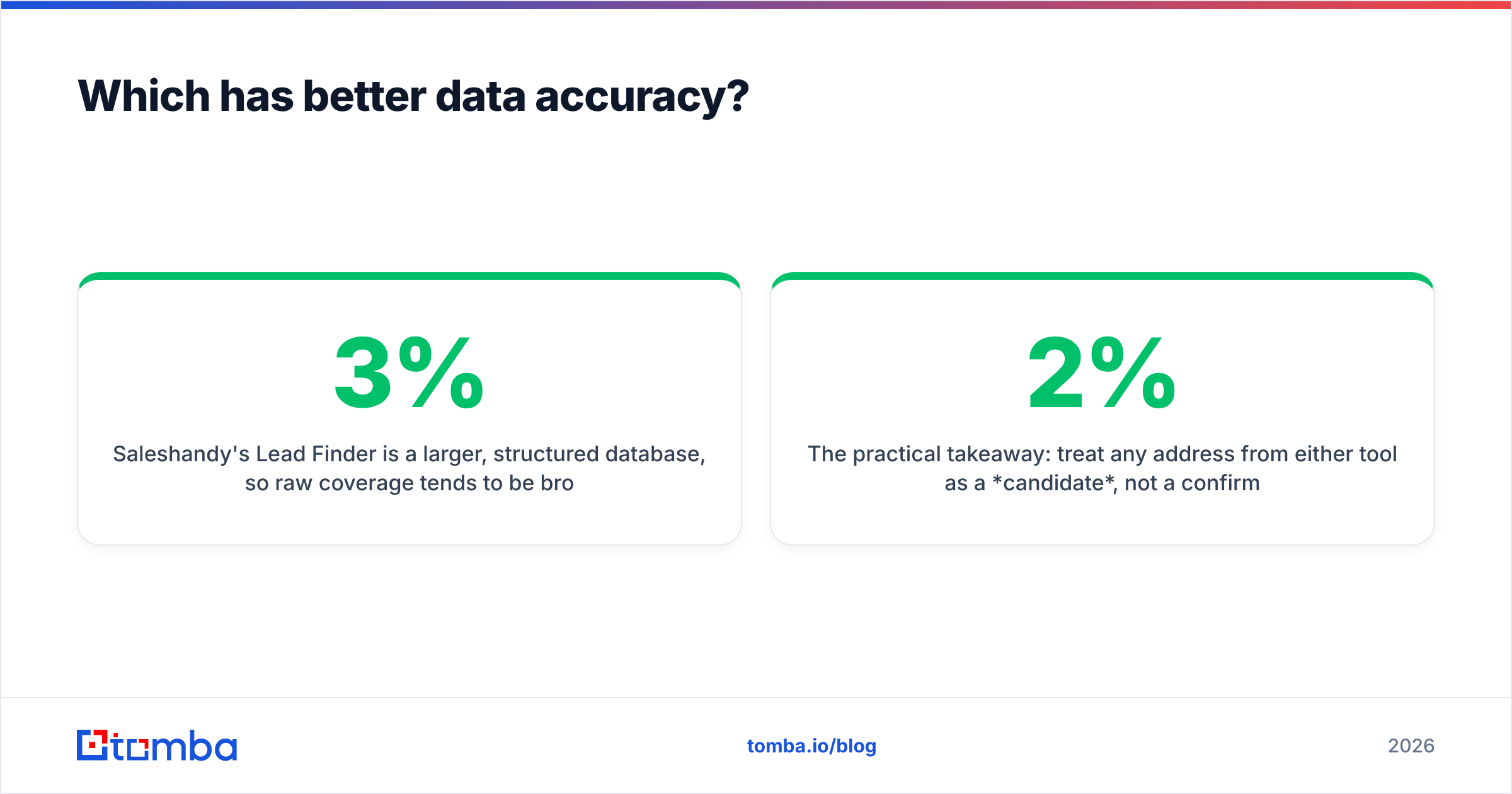
Saleshandy's Lead Finder is a larger, structured database, so raw coverage tends to be broader. But size is not the same as freshness. A record that was right 18 months ago can bounce today. No static database escapes decay of roughly 2–3% each month, because people change jobs.
The practical takeaway is simple. Treat any address from either tool as a candidate, not a confirmed contact. Then run your list through a verification step. Checking MX records, SMTP response, and catch-all status is what separates a 2% bounce rate from a 15% one. That's the exact job of a purpose-built tool like Tomba's email verifier. It plugs in ahead of whichever finder or sender you pick.
Which has better cold email features?#
This one isn't close: Saleshandy wins outright, because cold email is its entire reason to exist.
- Sequences. Saleshandy builds multi-step campaigns with conditional follow-ups, A/B testing, and auto-pause on reply. Datanyze has none of this.
- Inbox rotation. Spreading volume across multiple sending accounts protects your domain reputation. Saleshandy automates it; Datanyze doesn't send at all.
- Warmup. Saleshandy includes built-in warmup to keep new inboxes out of spam. This is table stakes for cold email in 2026, and Datanyze simply isn't in this category.
- Analytics. Open, click, reply, and bounce tracking feed your iteration loop. Datanyze offers no sending analytics because it never sends.
If you were comparing Datanyze to a finder-plus-sender stack, this is the column where a standalone data tool can't compete. Datanyze isn't losing here so much as playing a different sport.
How do Datanyze and Saleshandy pricing plans compare?#
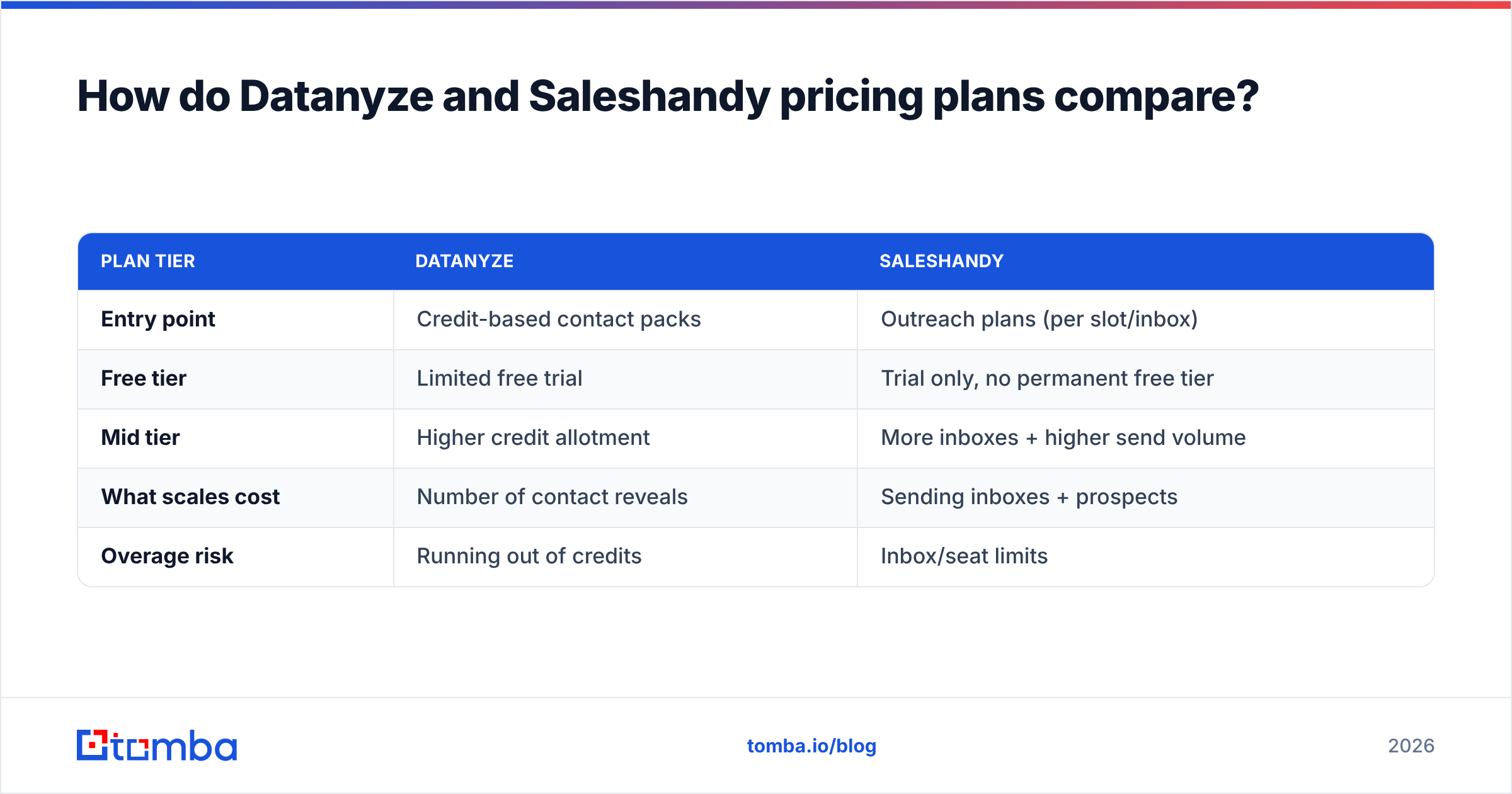
In the Datanyze vs Saleshandy pricing comparison, both tools price around their core value. So this is more about what you're buying than a straight dollar-for-dollar match.
| Plan tier | Datanyze | Saleshandy |
|---|---|---|
| Entry point | Credit-based contact packs | Outreach plans (per slot/inbox) |
| Free tier | Limited free trial | Trial only, no permanent free tier |
| Mid tier | Higher credit allotment | More inboxes + higher send volume |
| What scales cost | Number of contact reveals | Sending inboxes + prospects |
| Overage risk | Running out of credits | Inbox/seat limits |
Datanyze's model rewards light, targeted prospecting — you pay for the reveals you use. Saleshandy's model rewards volume senders who need many inboxes and a big prospect list. Neither is "cheaper" universally; it depends entirely on whether your spend is going toward finding or sending.
For teams whose main cost is email discovery, it's worth benchmarking both against a dedicated finder. Transparent Tomba pricing starts free (25 searches/month) and moves to a $49/month Starter plan, which frequently undercuts the effective per-email cost of extension credits when you're finding at any real scale. Run the numbers on your own volume before committing.
Is Datanyze or Saleshandy better for your team?#
The Datanyze vs Saleshandy choice comes down to your bottleneck. Match the tool to it.
Choose Datanyze if:
- You prospect live on LinkedIn and company sites and want data inline.
- Direct-dial phone numbers matter as much as email.
- Your reps work a small number of high-value accounts, not big lists.
- You already have a separate sending platform you like.
Choose Saleshandy if:
- Cold email is your primary outbound channel.
- You need to warm and rotate multiple inboxes to stay out of spam.
- You want list-building and sending under one roof.
- You're scaling volume and need deliverability reporting to protect your domain.
Use a dedicated finder + verifier alongside either if:
- Data accuracy is costing you bounces and burned reputation.
- You want predictable per-email pricing instead of variable credit burn.
- You're running bulk email finder jobs and need consistent hit rates across thousands of rows.
The honest answer for most teams is that this isn't strictly an either/or. Datanyze and Saleshandy occupy different stages of the pipeline, and the highest-performing outbound stacks pair a strong data source with a strong sender — then gate both behind verification.
Where does Tomba fit in the Datanyze vs Saleshandy debate?#
Tomba isn't a cold email sender, so it doesn't replace Saleshandy's sequencing. What it does is the one job both tools do imperfectly: finding accurate, verified professional emails at a transparent price.
- Domain-level discovery. Use domain search to pull every reachable email pattern for a target company, not just whatever an extension happens to surface.
- Verification built in. Every result runs through validation, so your bounce rate stays low before a single Saleshandy sequence fires.
- Scales without credit anxiety. Predictable pricing means finding 5,000 emails doesn't blow up your budget the way variable reveal credits can.
In practice, the strongest 2026 stack often looks like: Tomba for accurate data → Saleshandy for sending and follow-up → verification throughout. Datanyze can slot into the discovery step too, but if per-email accuracy and cost are your priority, a specialized finder is the more efficient choice.
FAQ#
Is Datanyze the same as Saleshandy? No. Datanyze is a contact-data tool for finding emails and phone numbers; Saleshandy is a cold email outreach platform for sending sequences at scale. They solve different stages of outbound.
Does Saleshandy find emails like Datanyze? Yes — Saleshandy's Lead Finder includes a 700M+ contact database, so it can build lists in-app. But its core strength is sending and automation, not the browsing-based, one-lead-at-a-time discovery that Datanyze specializes in.
Which is more accurate, Datanyze or Saleshandy? Both suffer from normal database decay and can return stale records. Neither is a substitute for a dedicated verification pass. Run any list through an email verifier before sending, regardless of which tool sourced it.
Can I use Datanyze and Saleshandy together? Absolutely, and many teams do — Datanyze (or a finder like Tomba) supplies the contacts, Saleshandy sends and follows up. They complement rather than compete.
The bottom line#
In the end, Datanyze vs Saleshandy isn't a real rivalry. They're two stages of the same pipeline. Datanyze helps reps find contacts inline; Saleshandy turns a list into a running outreach engine. Pick based on which bottleneck hurts more, and don't assume one tool covers both jobs well.
Whatever you choose for sending, the emails you feed it decide your results. If accuracy and cost-per-lead are what keep you up at night, start with a finder built for exactly that: try Tomba Email Finder free, verify as you go, and hand Saleshandy a list that actually lands in the inbox.
Related guides#
Ready to find emails that actually work?
Join 150,000+ professionals who stopped guessing and started sending. Free credits on signup — no credit card required.
Get the Tomba newsletter
Practical outbound tactics and product updates — once every two weeks.
About the author